


The main problem investigated by this study was the poor access of farmers with physical disabilities to agricultural extension and training agencies. The study’s main objective was to identify and analyse the training and extension needs of farmers with disabilities. As a first step in achieving such a goal, agencies that specialize, or that have the potential to specialize, in supporting, treating, educating and training PPD were reviewed. Primary results showed that many government and non-governmental organizations, institutions, committees and other agencies were directly and indirectly involved in the training of PPD, but that none of these agencies and institutions was exclusively specialized in and assigned to educating and training rural PPD engaged in agricultural activities.
The data collected indicated that PPD have high potential to engage actively in the area’s agricultural development process. Although no specific agricultural extension and training programmes had been established for PPD as a special group, many rural PPD were already engaged in some kind of crop and/or animal production. The extension field workers rated the yields, evaluated the efficiency of farmers with disabilities and compared the results with those of able-bodied farmers in the same area, finding little difference. The collected information revealed that fewer than 10 percent of the farmers with physical disabilities had been able to attend professional training, clinical and technical centres, and none of these centres was specialized in agricultural training for farmers with disabilities.
Considering the potential of the Ministries of Agriculture and Jihad Sazandegi’s existing rural extension networks to specialize, it is proposed that the extension departments of these two ministries assume responsibility for the agricultural extension and training of farmers with disabilities in rural areas as a special client group.
The following are some of the conclusions and implied recommendations that can be drawn from the study:
The Ministries of Agriculture and Jihad Sazandegi both have relatively strong expert staff within their extended organizational networks for rural areas. These specialized human resources would be quite capable of planning and performing agricultural extension and training programmes for farmers with physical disabilities.
Although the existing extension agencies have no special programmes for PPD, farmers with disabilities have acquired some improved farming practices indirectly, and have gained necessary skills and experience from relatives, friends and neighbours.
The farming activities, types and duration of operations, sources of information and motivation of farmers with physical disabilities were similar to those of their able-bodied colleagues.
Able-bodied farmers and farmers with physical disabilities also face similar problems in farming, and have comparable training needs. Farmers with disabilities said specifically that greater respect and attention would help them to improve their agricultural operations.
Sources of financial support and technical guidance, as well as the nature of the farming operations themselves, were nearly the same for farmers with physical disabilities as for able-bodied farmers.
Because of their physical disabilities, relevant farmers requested that farming inputs be provided to them at their homes or farms.
Farmers with disabilities also requested that agricultural training be carried out at their farms or homes, either individually or in special groups.
About two-thirds of the relatives who assisted farmers with disabilities did so because of emotional relationships, and one-third did it for the sake of improving the family’s economic conditions. It could be claimed that economic incentives may also have motivated those who assisted their relatives with disabilities for emotional reasons.
Training programmes for farmers with disabilities need to focus on ways and means of facilitating the application of improved inputs and new farm machinery and tools. In this respect, farmers with disabilities expressed a need for training, along with provision of the necessary inputs, tools, equipment and machinery. This implies that training on its own may not supply sufficient service to farmers with disabilities.
The expectations of the relatives of farmers with disabilities were centred on the provision of credit and/or loans so that farmers can buy inputs, machinery and tools easily. On many occasions, relatives implicitly expressed the belief that if farmers with disabilities were offered sufficient financial support, it would be easier to train their relatives with disabilities. This corresponds with findings that indicated relatives as the main source of indirect training for farmers with disabilities.
If relatives were the main target group for extension training, PPD would remain dependent on them. If farmers with disabilities are to attain independence, they must be the main target for training from extensionists.
Farmers with physical disabilities did not expect to be considered as a special case; instead they wanted extension field workers to treat them as if they were able-bodied.
Active farmers with disabilities were good examples of the effectiveness of indirect extension teaching methods in rural areas.
Active farmers with disabilities have a strong tendency to emphasize their motivation, abilities and capabilities, rather than their disabilities, when talking to extensionists.
Difficulties in moving, loading and transporting inputs and products were the most important effects of the farmers’ disabilities. At the same time, farmers with disabilities were generally engaged in field activities that involved and necessitated moving, loading and transporting. Extension field workers should carry out surveys to select the farm activities that best fit the physical capabilities of farmers with disabilities, and should then assist those farmers to engage in such appropriate farm practices.
Fish farming, hatching, apiculture, sericulture, floriculture and poultry production are among the “light” farming activities that are extensively practised by able-bodied producers in Mazandaran, but farmers with disabilities are less frequently engaged in them. Since the natural environment of the province is suitable for these activities, it is recommended that extensionists plan effective policies to encourage, support and train farmers with disabilities to engage in them.
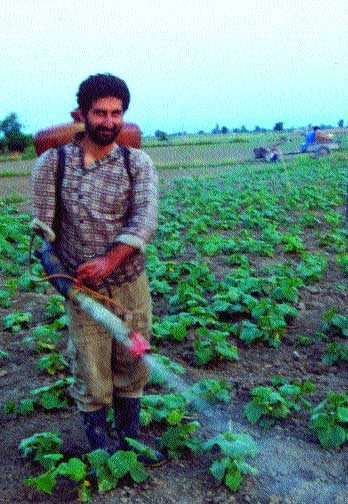
A physically disabled farmer spraying his cucumber farm without following the normally recommended safety procedure
