


IPGRI’s organizational structure is reviewed in this chapter, bearing in mind IPGRI’s orientation to networking and the considerable geographic dispersal of its activities and offices. It is the only CGIAR Centre with a direct interest in Western and Eastern Europe.
The budget and staff complement have increased substantially since the 4th EPMR. The organization of IPGRI has not changed markedly which is unsurprising as the DG has remained in post. The most significant change is that the Regional Directors of the PGRP and the coordinator of the SGRP report directly to the DG, while being co-supervised by the DDGP. The Directors of DIT and GRST continue to report directly to the DDGP.
IPGRI is organized into three programme groups, which are supported by the Finance, Human Resources and Administration Department as shown in the Organogram in Figure 8.1.
The DG is both head of the Institute and leads the SGRP. At the same time he has two other key responsibilities. He leads the GCT initiative and is Secretary of the CGIAR Genetic Resources Policy Committee. The Deputy Director General Programmes, the Assistant Director General, the Director of INIBAP and the Director of Finance and Administration all have the similar seniority and make up the most senior internal committee, the Management Executive Committee (MEC). MEC is formally the executive branch of the Management Committee (MC) and is charged with the responsibility of overseeing the management of the Institute.
The DDGP has line responsibility for the quality of science in the Institute and for programme oversight, has specific responsibility for managing the PGRP and chairs the Programme Planning and Review Committee (PPRC). She is also an important resource person in the external communications activities of IPGRI, for example, by playing an important and visible part in the World Summit on Sustainable Development in 2002.
The ADG has line responsibility for Board relations, impact assessment studies and donor relations. The latter involves monitoring project reports by staff to donors, identifying new donors and assistance with preparation of new project proposals. This has become a considerable task as the number of individual projects is now over 250 and the number of donors over 150.
The Director of INIBAP operates from Montpellier where he is responsible for both the day-to-day operations of the global Musa Programme and the project preparation and fund raising activities specifically relating to INIBAP. As a member of MEC he is also accountable for the overall management of IPGRI.
The DFA operates from Rome and has line responsibility for finance, human resources, information technology and office administration. The regional administrators and the financial manager of INIBAP in Montpellier report to him on functional issues and through their principle reporting line to their respective Regional Director and the Director of INIBAP.
Figure 8.1 - IPGRI Organogram
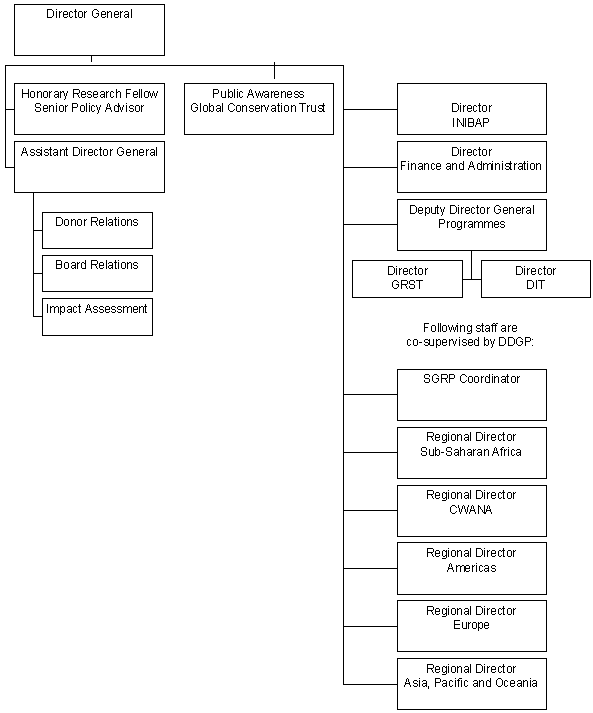
The Regional Directors of PGRP are responsible for the operations of the regional offices of PGRP. They are not responsible for the INIBAP offices in their regions, which report directly to the Director of INIBAP. There are two Thematic Group Directors, for GRST and DIT. They exercise responsibility for overseeing the quality of the programme in their areas of expertise that, in the case of the Director of GRST, includes line responsibility for policy research and related research at the Institute.
There are three internal standing committees. The MEC meets on average once a month on an irregular schedule. Last year MEC met twelve times and the Director of INIBAP attended only four times, once by phone. The MC and the PPRC meet regularly respectively twice and once a year. The MC, which is chaired by the DG, is responsible for developing and overseeing the implementation of institutional strategies, mechanisms, frameworks and processes required for the effective functioning of IPGRI as a publicly funded science based organization. The members of MC are the Regional and Thematic Directors, the SGRP coordinator and members of MEC. The PPRC is the driving force in the detailed planning and monitoring of projects. The PPRC meets once a year, in November, to review Project proposals, annual budgets and work plans of Projects and Project reports. It also discusses key programme related policies and strategies and makes recommendations to the MC on resource allocation for programme activities and other management issues relevant to the conducting of an effective scientific programme. Members of the PPRC are the DDGP, the Thematic Directors, the Project Coordinators, the Director of INIBAP and the coordinator of SGRP - some 24 in all.
The programme of the Institute is organized into 20 multidisciplinary projects. Their objectives reflect the mandate of the Institute. Each project is composed of a number of separate activities, which together, under the project coordinator, produce the output from that project which goes towards fulfilling the Institute’s mandate. It is expected that most new initiatives would be a component part of an existing project and thus in IPGRI terminology, constitute a new Activity. New activities can be proposed by any staff member and with the approval of the relevant Project Coordinator and the relevant Thematic and/or Regional Director, may be submitted to the DDGP or Director of INIBAP for approval, if funding has been identified. The modified Project workplan will be submitted to the following PPRC for endorsement. The DDGP operates a discretionary fund from which such activities can be funded. If restricted funds are required the ADG is involved. Ideas for a new institutional Project, on the other hand, would be brought as a first step to the PPRC and if approved will be formulated by a task force appointed by DDGP. The formulated proposal has to be approved by PPRC, in which case a detailed work plan and budget and suggested project staffing submitted to the DG for approval, in consultation with MEC.
An Innovation Fund was set up in 2001 to stimulate new ideas. The staff is invited to submit ideas to a panel headed by the DDGP, which includes a Board member. Those selected are awarded US$25 000, if necessary, to hire outside consultants to work up a proposal for further work. These are considered by the PPRC and MC. The staff is encouraged to think "outside the box" and a range of ideas have been put forward ranging from prospects for ecotourism in in situ conservation, to IPGRI’s relationship with the UN’s International Year of Mountain. In the first year four awards were made, but due to restricted funding only two awards were made in 2002. The Panel was impressed with this innovative effort to stimulate debate and ideas at all levels in IPGRI.
In sum, at the present time no committee is formally charged with the mandatory approval of new projects and activities. Activities can, in themselves, be of a significant size. The present formal approval process does not require the largest single Activity being undertaken by the Institute, namely the ‘Rehabilitation and modernization of the Alto Beni organic banana production for export market’ project in Bolivia, with a budget of nearly one million dollars in 2002, to be approved by MEC. In practice it was. But the Panel believes that the present system is too discretionary and not sufficiently transparent. It is not structured in a manner that is designed to ensure a necessarily cost effective use of resources or lead to a consistent and coordinated focus of IPGRI’s scientific programme. In addition, because of the lack of a transparent "paper trail" the present system can engender confusion with scientific staff and this effectively reduces the clarity of the Institute’s programme.
8.2.1.1 Internal communications
With the growth of staff and improvements in communication systems a number of improvements have been effected to internal communications since the last EPMR. These include the recent installation of a comprehensive and institutional archive for managing documents. In addition IPGRI coordinates, with other CGIAR Centres, standards for information technology, in particular regarding email infrastructure and desktop software. IPGRI uses Microsoft for email, databases and document management, as well as Web Publishing. The Integrated Voice Data Network (IVDN) is being moved to "voice over ip" and multi-site videoconferencing capacity has been installed at Maccarese. APO and INIBAP are already connected and the AMS, SSA and CWANA will be linked by mid-2003.
The ‘360 Degree’ Evaluation, referred to below, suggests that the amount of communication, in particular the amount of general internal email traffic, has got out of hand. The MEC has now asked staff to evaluate the situation and make recommendations for change. The Panel agrees with this analysis and supports these initiatives.
A wide range of institutional databases have been developed in the Finance and Administration area and, with the exception of the accounting management system Platinum, these have been developed in-house. These databases remain unconnected but there are clearly opportunities to link these tools.
It is generally felt at senior staff level that IPGRI has now grown too large to maintain the easy going atmosphere and informal communication system that sufficed at the time of the last EPMR. It is no longer possible to involve all staff in general decision making or keep them up to speed on all issues. For this reason a ‘360 Degree’ Evaluation of Senior Management was commissioned by MEC and undertaken by an outside consultant in October 2002. The Panel commends MEC for this initiative and for the open manner in which it has communicated with staff following the evaluation. The overall sense of the evaluation is that staff has difficulty coming to terms with the increasing complexity of the Institute. This refers both to the size of the organization and the multiplicity of its tasks. The main recommendation emanating from this important exercise was the need to tighten the functioning of the MEC to improve its efficiency and effectiveness, principally by meeting more often and allocating more time to face-to-face meetings. Furthermore it is important that MEC spend more time on strategic issues and less on routine housekeeping issues. It has also been decided to invite other relevant staff to join MEC on an ad hoc basis to help in some its deliberations. In order to improve efficiency the agenda will be circulated beforehand and the minutes posted on Sharepoint for all staff. In responding to the Evaluation MEC also pointed out the need to review and revise IPGRI’s overall strategy document. The new DG has told the Panel he will lead this task. The Panel believes that it is important that the PPRC plays its designated role in this process.
It appears that staff has difficulty understanding the interaction of the regional and thematic groups and in particular the roles and responsibilities of the Directors of these groups as they relate to Project Coordinators and Activity Managers. The Panel believes that this reflects the fact that too many staff have dual reporting lines and that the line responsibilities of the DDGP should be clarified. The Panel also believes that there should be fewer staff reporting directly to the DG.
8.2.2.1 Resource mobilization
As IPGRI’s international profile has grown and the issues with which it is engaged have become of greater concern globally, the universe of potential donors has increased considerably and the international financial situation has become more difficult. There are now more than 250 individually funded components of the 20 Projects and over 150 donors (compared to some 70 components and some 80 donors in 1997). In addition the budget has grown from about US$19 million at the time of the last EPMR to about US$30 million in 2003 and the proportion of unrestricted funding has fallen from 64% to 35%. As a result the function of ensuring the successful financing of IPGRI and the husbanding of existing donors has become onerous. For example nearly 200 visits to donors and potential donors were made by management and staff in 2002 and over 80 reports were submitted to donors. The ADG has three major responsibilities and as a result there is no single senior staff member in the Institute fully committed to the function of fund raising, donor relations and coordinating and supporting senior scientists in their interactions with donors.
8.2.2.2 Public relations
IPGRI is concerned with issues that are not only of interest to the scientific community, but to the development community as a whole and those of the general public interested in issues relating to sustainable management of the planet, small farmers rights and ecology. As a result it is important that IPGRI continue to position itself appropriately in the international debate, for example regarding genetic modification of organisms. This is both important for its intellectual standing, for the well being of its staff and also for its reputation with donors and potential donors.
The public profile of IPGRI is also an important component part of the function of successful fund raising, especially where an effort is being made to tap new sources of funding, principally from non-government and non-traditional sources. The Institute has a fund raising strategy, first approved by the Board in 2001. This is regularly revised, in particular to take account of the changing external donor environment and possible new sources of finance. Part of that strategy incorporates a supportive public relations exercise. In this context it is necessary to formulate a detailed action plan to raise the public profile of IPGRI appropriately. The work of the consultants fund raising for the GCT (see Section 8.4) should provide useful lessons and pointers. At the present time IPGRI’s public awareness scientist has been seconded to the GCT.
A Task Force, of which the DG was Chair and which included a representative of Future Harvest, was set up in 2000 which, working with FAO, contracted with consultants to ascertain the feasibility of funding the GCT. A business plan was produced in June 2001 and funds were made available to start work on the first phase of fund raising. Costs, including IPGRI senior staff time and management costs from June 2001 to June 2002 were some US$1.2 million and these were fully covered by contributions from a number of donors including the World Bank, CGIAR Centres, Brazil, Colombia, Switzerland and USAID. An Interim Panel of Eminent Experts is being recruited; legal structures investigated; presentations made at such venues as WSSD: and a budget has been produced to fund the initiative as from October 2002 through 2005, running at approximately US$1.5 million a year. Bids by countries to host the GCT will be called by the end of this year and a search for the Executive Director put in place. The Executive Board should hold its first meeting in June 2004.
Preliminary work on the GCT, discussed in section 5.2.5, was undertaken under the SGRP at IPGRI. The DG has been intimately involved and has been named Interim Secretary, a position he will take up when he retires from IPGRI. He will operate out of FAO Headquarters but in close collaboration with IPGRI. IPGRI, together with FAO, will jointly administer the funding until GCT is legally constituted. Costs for the second phase, from mid 2003 to end 2004, are estimated at US$1.8 million and pledges of US$1.6 million have already been received from, amongst others, Colombia, Egypt, the UN Foundation and USAID. IPGRI charges the direct costs of contributions, including staff time and overall is achieving a fully satisfactory overhead on donors’ contributions, in accordance with its new rules. One member of IPGRI’s staff has already been seconded to this initiative on public awareness.
11. The Panel recommends that a more formal and transparent planning and decision making process is required with respect to the Institute’s scientific programme, whereby:
(a) an appropriate ToR for MEC should be agreed with the Board, which would include the requirement that all new projects and activities are approved by the full MEC before they are submitted to donors;
(b) MEC meet regularly once a month and the agenda and minutes are available on the intranet to all staff in a timely manner;
(c) Regional Directors report directly to the DDGP; and
(d) all activities with an annual budget of over US$500 000 and activities where IPGRI is assuming non-traditional risks, are brought to the attention of the Executive Committee of the Board.
12. The Panel recommends that, to serve the requirements of an organization of IPGRI’s complexity, a key senior individual be exclusively dedicated to fund raising, working to the Board approved fund raising strategy incorporating an appropriate PR function.
