


The road from Manila to Nairobi
The journey from Manila to Nairobi was a long one. It took us a whole year to navigate what was sometimes a smooth road, sometimes a rough one, sometimes a rewarding journey and sometimes frustrating. But here we are at our destination in one piece, ready to give you feedback on what we accomplished or could not accomplish, and the lessons learnt along the way, so that we may do better next time.
We started the journey armed with two essentials - a route map and a compass. The map showed the point of departure and the destination, with all the stops in between and the nature of the tasks to be performed at each stop. This was the Secretariat’s Programme of Work, presented to you and endorsed by you in Manila. The other element indispensable to our journey was the mandate you gave us, which spells out clearly the limits of our responsibilities. This mandate, our compass, kept us on track.
The route map consisted of concrete actions the Secretariat was expected to carry out. These were all linked directly to the four components of the GFAR Business Plan: development of a global information and communication system for agricultural research for development (ARD); strategic thinking on ARD issues; promotion of research partnerships; and institutional support to GFAR stakeholders.
The mandate you provided limited us to playing the following roles:
Guardian of institutional memory and coordinator
Facilitator, enabling GFAR stakeholders to implement the Business Plan
Pro-active promoter or catalyst for information and communication management (ICM), to ensure that GFAR stakeholders and others working in ARD are linked and communicate with each other.
In reviewing our stewardship during 2003, and guided by both route map and compass, we were able to group our accomplishments under four headings:
Facilitating systems governance operations
Engaging and interacting with stakeholders
Facilitating research partnerships
Providing a medium for communication and knowledge sharing among GFAR stakeholders and their collaborators.
Facilitating systems governance operations
The Secretariat is responsible for organizing statutory meetings of GFAR’s various governing bodies. During 2003 we held a management team meeting during which important decisions were taken on three issues: minimum critical staffing of the Secretariat, our relationship with the facilitation units of the Global Partnership Programmes (GPPs), and the fine-tuning of preparations for the GFAR 2003 triennial General Conference. The minutes of that meeting have been posted on the GFAR website. While there are normally two management team meetings each year, we held only one in 2003 because the second one, usually held in May, would have coincided with the General Conference. In addition, we felt members of the management team would have ample opportunity to interact during the Conference.
The General Conference was an important statutory meeting for GFAR. It brought together all our stakeholders for the purpose of renewing their alliances and provided guidelines and input on the issues that the group as a whole should focus on during the current triennium. It was a major undertaking for the Secretariat. In collaboration with the Conference Organizing Committee, we designed the meeting agenda and tackled all the logistical aspects of organizing this international meeting, including fund raising. By all accounts, including formal and informal evaluations by participants and a post-mortem by the Secretariat, GFAR 2003 was a success. The consensus was that the meeting addressed its objectives and achieved its expected outputs.
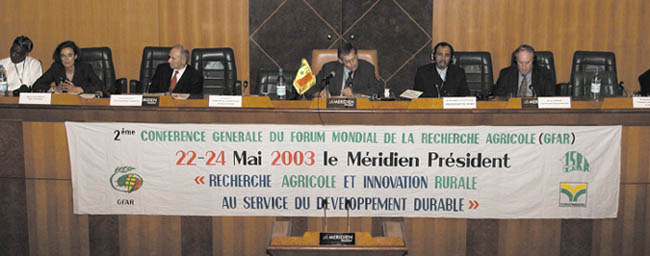
Rodney Cooke, Chair of the GFAR Donor Support Group, during the opening session of the 2003 GFAR Conference in Dakar, Senegal. Photo: GFAR
Here are a few highlights of the General Conference:
A two-day pre-Conference consultation was organized for representatives of civil society organizations (CSOs), which constitute an important stakeholder group. The consultation allowed representatives of these organizations to define their vision of ARD and to identify issues they believe GFAR as a whole should tackle. It was attended by 48 participants representing 33 non-government organizations (NGOs) and 15 farmer organizations from 37 countries. More on this below.
At the General Conference itself, two keynote speakers identified new and emerging global issues, threats and opportunities of relevance to agriculture and to which GFAR should pay attention as it pursues its goal. Ian Johnson, Chair of the Consultative Group on International Agricultural Research (CGIAR), identified six key issues that GFAR needed to reflect upon. These were poverty alleviation, the need to develop new institutional frameworks, a long-term agenda or time frame for global issues and themes (water, energy, health, agriculture and biodiversity), the output of the World Summit on Sustainable Development, the pertinence of a focus on Africa, and the transformational role that science and technology play in society. On this last issue, he concluded that GFAR, in its advocacy role, urgently needs to encourage ministerial bodies and the public to see science not as a threat but as an opportunity for change. He stressed that research is central to the future of agriculture and that making the case through GFAR would help improve the sector’s position on the global agenda.
The second keynote speaker was Wiseman Nkuhlu, Chair of the Steering Committee of the New Partnership for Africa’s Development (NEPAD). He highlighted the importance of partnerships with civil society, including farmer organizations, smallholder producers and women’s groups, for improving agricultural productivity in Africa. He identified a number of initiatives on which NEPAD was working and which offered opportunities for collaboration with GFAR stakeholders. Among those activities were: small-scale water harvesting, engendering and democratizing agriculture, seed multiplication and facilitating microfinancing.
GFAR stakeholders also emphasized the notion of an increased advocacy role for GFAR, and the need to step up our activities in the area of inter-regional collaboration. While stakeholders applauded current efforts in ICM, it recommended that GFAR shift into second gear, providing more space for CSOs in global ARD decision-making processes.
Soon after the Conference, the Secretariat began translating these and other recommendations into elements and components of the next GFAR Business Plan for 2004 - 2006, which was one of the expected outputs of the meeting. The Secretariat also prepared a short report on the Conference and shared it widely through the Electronic Global Forum for Agricultural Research (EGFAR) website. In addition, we published proceedings of the meeting, both as a printed book and as an electronic document on our website.
Meetings of the national agricultural research systems (NARSs) subcommittee, the GFAR Steering Committee and the Donor Support Group were the last to be organized by the Secretariat in 2003. These have allowed for continued smooth turning of the wheels of GFAR’s governance and operations.
Working with civil society organizations: interaction and support
An improved CSO database
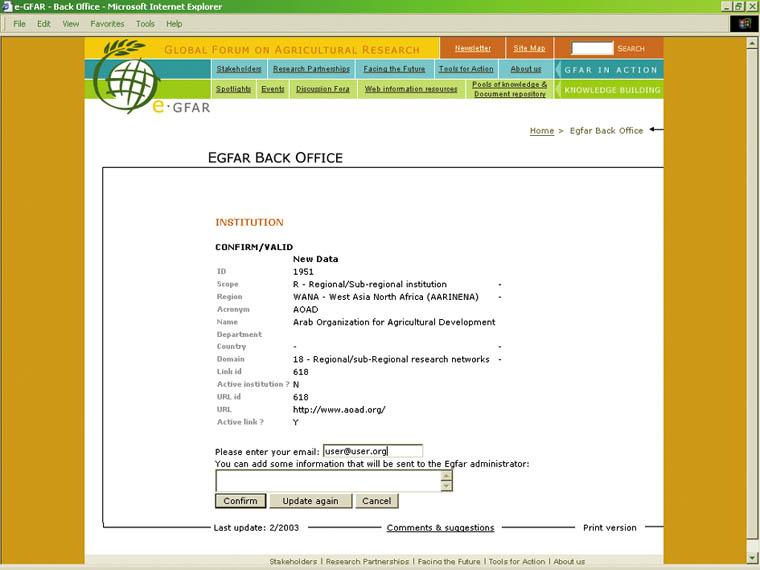
The update of our database on CSOs through a formal survey and web search resulted in 50 new entries. The database will soon be linked to EGFAR so that it can be searched by users. Eventually, it will be managed by the CSOs themselves through the EGFAR Back Office (EBO) system. (See the accompanying computer screen illustrations in the section on the EGFAR website below.) This arrangement will encourage regular updating, build a strong sense of ownership and make available valuable information on CSOs involved in ARD around the world. The Secretariat itself has used the data on several occasions to identify prospective participants in GFAR-related events. We hope to make it directly available to other stakeholders in the near future.
Pre-Conference workshop
During the CSO meeting just before the Dakar Conference, participating organizations endorsed the concept of partnership, a central GFAR guiding theme. They insisted that such partnerships be grounded in reciprocity, mutual trust, joint learning, a shared vision and complementary strategies. The CSOs see such partnerships as indispensable to realizing their vision, as a way to stimulate farmer innovation, facilitate research - extension linkages and promote capacity building so that farmers and their representatives become true partners, with the leadership and analytical skills required to convincingly articulate their needs.
The CSOs also argued in favour of reviewing the types of research being carried out as well as the structure and nature of research partnerships. They said that since agriculture serves multiple functions (resource utilization, ecological and social functions), ARD activities must likewise be multifaceted and should involve various stakeholders. And this in turn implies the need to strongly support participatory research approaches and agro-ecosystem and farming systems research. Finally, they strongly advocated the promotion of an enabling political, social and economic environment for the less vocal stakeholders in ARD, and their representation and active participation in research governance structures.
Subregional focal points were identified and charged with working with GFAR to follow up on these agreements, recommendations and future ARD activities.
Building a CSO network in the Southern Caucasus
The Secretariat participated in an initiative of NGOs and farmers’ organizations in the Southern Caucasus, who sought to organize themselves into a network for more effective contribution to common objectives. During a two-day meeting in late March 2003, in Tbilisi, Georgia, NGOs and farmers’ organizations from Georgia, Azerbaijan and Armenia met to prepare for this new arrangement. The network will take up the challenges of raising awareness of current constraints to agriculture and of mapping out strategies to ensure the voices of NGOs and farmers’ organizations are heard and that they contribute to ARD-related decision making.
Participants discussed issues and challenges facing the three countries. Recognising the important role they could play in developing the agriculture sector, they resolved to form an informal network, the Forum of NGOs and Farmer Organizations in the South Caucasus. The group’s initial objective is to facilitate cooperation, partnership and coordination of their efforts. The following are some of the key activities included in the agenda drafted by the participants:
Establishment of a scientific/technical committee and thematic working groups that will lead efforts to address priority issues, including participating in priority-setting exercises in the region
Development of an information exchange and communication capability
Creation of linkages with CSOs in Central Asia and international organizations involved in ARD
Fundraising to support implementation of the Forum’s agenda.
The GFAR Secretariat will continue to monitor and facilitate this initiative, and will make use of the outputs of this workshop to help define future efforts to strengthen CSOs in the region.
Collaborating with the CGIAR
Collaborative priority setting
During the year, the GFAR Secretariat and that of the Interim Science Council (iSC) of the CGIAR, taking advantage their proximity within FAO in Rome, collaborated on many occasions to advance the CGIAR agenda. For example, the GFAR Secretariat participated in brainstorming sessions convened by the iSC Chair to map out research priority-setting procedures and strategies for informing CGIAR decision making by individual centres, system-wide programmes and Challenge Programmes (CPs).
The outcome was a two-step approach, now complete, to which GFAR contributed as follows:
Identification and recommendation of participants from the GFAR stakeholder database to take part in both the stakeholder and scientific panel consultations
Facilitation of consultation with, and feedback from, stakeholders during the GFAR 2003 meeting in Dakar
Participation in an examination of step 1 outputs and fine-tuning of step 2 by iSC and stakeholders at an iSC-convened meeting in June 2003
Contribution to the output of the exercise.
Challenge Programmes
GFAR was invited to serve on the Programme Steering Committee of the Challenge Programme on Unlocking Genetic Diversity in Crops for the Resource-Poor. In that capacity, it has actively contributed to the development of the CP. In particular, four GFAR representatives participated in the Technical Planning Workshop and the Programme Steering Committee meeting in August 2003 in Wageningen, the Netherlands. This ensured that the views of various GFAR stakeholders were made known and accommodated. It was recently suggested that a GFAR Stakeholder Committee be established to advise the CP’s Programme Steering Committee and provide a mechanism for consultation with, and feedback from ARD stakeholders. Ways to operationalize such a mechanism are currently being examined.
We note that other CPs have not yet taken full advantage of the convening power of GFAR and the expertise it can mobilize. Table 1 below outlines the role that GFAR could play at various stages of the CP development and implementation. We urge current and future CPs to collaborate with the GFAR Secretariat on strategies for ensuring a stronger GFAR role in the CPs.
Table 1. The role of GFAR in various stages of CPs
|
Stage of CP |
Potential roles for GFAR |
|
Development |
· Participate in stakeholder
consultation meetings |
|
Implementation |
· Participate in the work of the
Programme Steering Committee |
|
Review |
· Assist in mobilizing stakeholder participation |
Nominations for the Genetic Resources Policy Committee
At the request of the CGIAR, the GFAR Secretariat consulted its stakeholders in order to identify suitable candidates to sit on the reorganized CGIAR Genetic Resources Policy Committee. Responses received from various stakeholder groups, including national research institutions, farmer organizations and NGOs were synthesized and forwarded to the CGIAR systems office.
Facilitating research partnerships
One of the four legs on which GFAR stands, so to speak, is the promotion of research partnerships in four thematic areas. Global Partnership Programmes (GPPs) are the main instrument used by GFAR for this purpose. During the year under review, a discussion forum organized by the Secretariat demonstrated the willingness of our stakeholders to work together on a common problem, using the GPP approach. In keeping with GFAR tradition, the Secretariat in some instances advocated the inclusion of certain stakeholders who had initially been left out of these nascent partnerships. Below we present a few examples of such activities, facilitated and nurtured by the Secretariat during 2003.
Rural knowledge systems and innovation processes
One reason often cited for the failure of technology transfer efforts to benefit their intended target groups is the behaviour of researchers and development workers. Not infrequently they are accused of neglecting to take local rural knowledge into account and to build on this to develop new technologies that can alleviate poverty and improve the livelihoods of the poor. Many research and development institutions are therefore grappling today with tough issues: how to translate formal science into useful options, introduced using participatory approaches, at the local level; how to encourage and stimulate the innovative capacity of local groups; and how to strengthen that capacity through training.
The Secretariat has facilitated discussion and dialogue among a number of such institutions and groups. The emerging consensus is that there is a need to better understand the relationship between various knowledge systems and to use those systems in a complementary fashion. It is also agreed that such an approach demands not only an understanding of knowledge systems, but also the use of participatory methods. Such methods allow for the design and execution of activities which, because they are based on a lasting marriage between new and traditional know-how, eventually lead to the greater resilience of poor and vulnerable groups, their enhanced capacity for innovation, and greater skill in tackling complex problems.
The stakeholder groups for which the Secretariat provided a forum for discussion have a common understanding of the issues surrounding rural knowledge systems and innovation processes. Nevertheless, these groups have identified very different entry points for harnessing and improving these local systems and processes. Table 2 summarizes the various initiatives that the Secretariat has nurtured to date through electronic discussion, face-to-face brainstorming and workshops. Although these initiatives are complementary and have a common goal, they are at different levels of development and tackle different aspects of rural development. It was therefore decided that no further effort should be made to integrate them into one “super” GPP. Rather, it was suggested that they be developed as distinct GPPs in their own right and networked to promote information exchange and knowledge sharing. The Secretariat will continue to provide a neutral platform to move these initiatives forward.
Rural innovation for small and medium-sized agricultural enterprises (SMEs)
This initiative, whose development has been facilitated by the Secretariat, builds on the outputs of a series of regional workshops organized in 2002 by GFAR and FAO’s Agricultural Support Systems (AGS) Division.
The priority for this research partnership is postharvest issues. At about the same time, the Post-harvest Action Group, a consortium of groups based at international research centres, decided to develop and implement an initiative aimed at linking farmers to markets. It was therefore only natural that the three groups - FAO - AGS, Post-harvest Action Group and GFAR (through its Secretariat) - decided to work together to design and implement a joint venture. The resulting initiative is called Integrated Post-harvest Systems: Linking Farmers to the Market. The GFAR Secretariat has made several contributions to its development:
Construction of a database of institutions and organizations working in this area of ARD. Among other things, the database has facilitated the identification of CSOs, private-sector groups and Southern NARSs who can be invited to participate in subsequent activities of the three collaborating groups. The database will soon be available on EGFAR.
The organization of a session on SMEs and agricultural markets in developing countries, during the GFAR 2003 General Conference. The objective of this satellite meeting was to inform GFAR stakeholders of the Post-harvest Systems initiative and pave the way for their participation. Meeting participants identified five researchable issues that could be addressed: How can partnerships foster the development of agricultural SMEs? How are markets changing the nature of demand for agricultural products? What is the role of science and technology in fostering SME development? Which types of training can best contribute to the development of SMEs? What are the elements of a sustainable finance strategy to support agro-industrial development?
The organization of an international workshop titled Global Post-harvest Systems Initiative for the 21st Century: Linking Farmers to the Market, in collaboration with FAO - AGS and the Post-harvest Action Group. Held at FAO headquarters in Rome 7 - 9 October 2003, the workshop was attended by almost 100 participants from various stakeholder constituencies and regions. Its purpose was to seek stakeholder endorsement of a strategic framework for advancing the development of the Post-harvest Systems initiative. The Secretariat contributed in several ways. First, with funding from the International Fund for Agricultural Development (IFAD) and the Rockefeller Foundation, it ensured the participation of Southern partners, at the same time linking these two potential donor organizations to the initiative. (IFAD is in the process of linking some of its ongoing field projects to the initiative). Second, the Secretariat presented the initiative to a wider audience of potential partners and donors during a side event organized by the International Development Research Centre (IDRC) and the RockeFeller Foundation during the CGIAR’s 2003 Annual General Meeting. Third, it succeeded in having the GPP concept endorsed as a potential format for implementing the initiative. Finally, it secured a seat for GFAR on the Interim Coordinating Committee charged with moving the initiative forward.
Table 2. Summary table of initiatives related to rural knowledge and innovation processes
|
Title |
PROLINNOVA |
Making Knowledge Work |
Inter-SARD |
Inter-DEV |
ARD Methods |
|
Proponent |
NGOS through ETC-Ecoculture |
CABI and CIAT |
ETC (Dutch NGO) |
Gret (French NGO) |
ICRA, IAC (The Netherlands) |
|
Stakeholders involved/Partners |
NGOs, FOs and NARI (Ethiopia, Uganda, Ghana), Northern NGO (The Netherlands) |
ARIs (UK), IARCs (CIAT) |
Northern (The Netherlands and UK) and Southern (Philippines and India) NGOs; NARI (SEAMEO-SEARCA) |
Northern NGOs (The Netherlands, France, UK); Southern NGOs (Cameroon, Cambodia, Madagascar and Senegal); ARIs (France, Germany, Switzerland); and NARIs (Vietnam) |
|
|
Geographic focus |
East Africa (Ethiopia, Uganda, Ghana) |
To be defined |
South and Southeast Asia |
The Sahel, the Indian Ocean, Southeast Asia |
|
|
Donor (target and current) |
IDRC (RoKS Initiative) |
IFAD |
European Commission |
European Commission, Agence de la Francophonie, MAE-France, BMZ |
|
|
Thematic focus |
Farmer-led innovation in AE/NRM (focusing on small-holders, livestock-keepers and fisherfolk) |
To be further defined, but will likely to include IPM, high value crop development, NRM (e.g. soil management, agroforestry), seeds and seed systems and farmer - market linkages |
Agro-ecology, processes and methodologies, and institutional and legal issues (e.g. land rights, intellectual property rights) |
Urban agriculture; agro-ecology, food processing and decentralised electricity supplies |
ARD research methodologies |
|
Description |
PROLINNOVA is an NGO-led initiative to build a global learning network on promoting local innovation in ecologically oriented agriculture and natural resource management (EA/NRM). The focus is on learning from and encouraging field activities that strengthen the capacities of smallholders, livestock-keepers and fisher-folk to adjust to changing conditions by developing and adapting their own site-appropriate systems and institutions of resource management |
This proposed GPP will address the ways in which agricultural knowledge from local and scientific sources can be more effectively accessed and made use of through community-driven action research systems. The programme is envisaged as addressing specific poverty alleviation and food security themes in which development is currently inhibited by a lack of access to relevant knowledge, the complexity of the issues faced and the associated understanding required By drawing together widely different studies from different parts of the world and researching the human and institutional issues around the core technical processes, the principles and practice of knowledge acquisition and use will be optimized so that others can gain directly from the learning processes involved |
An initiative that builds a network of Southern and Northern partners for sharing information on social and technological innovations for community development and sustainable NRM in rural and peri-urban areas. It uses a web-based information system and a capacity building programme. Partners combine forces to develop capacities and tools to document and make available information on NRM |
Mutualist information service based on new information technologies. It offers development practitioners validated references on experiences, techniques and methods; makes use of a network of practitioners from developed and developing countries in the four thematic foci which produces and makes available operational information based on their practices. This information is organised in databases, accessible through a website that is a platform for exchange between these development stakeholders |
ARD methods are still no more than a concept note. The original intent was to create a space in the new 6th EU Framework Programme for a European partnership with ARD organisations in the South to enhance the development and dissemination of methods that increase the contribution of ARD to meeting the major challenges of sustainable development. The idea is to create a highly interactive and participatory initiative among clients, beneficiaries and other stakeholders in ARD in an interdisciplinary way using systems approaches that integrate activities at different levels ranging from policy making to technology development and application |
|
Activities/ Components/ Outputs |
1. Inventorying current activities and databases on promoting
local innovation in EA/NRM |
1. Key agricultural resource management needs and
knowledge-intensive development opportunities identified by community
stakeholders and those who serve them. |
1. Workshops to widen the partner network, identify existing
resources and systems, and support the process of making information
available |
The database structuring management of the network’s shared information combines different, cross-referenced, sub-sets of information The “Experiences and Practices” records make up the heart of the InterDev information system and aim not only to provide the results of experiences but above all to analyze how they were conducted, their implementation constraints, and the difficulties encountered. These records are supplemented by auxiliary records: the “Organizations” and “Resource Persons” records identify the various stakeholders (donors, experts, producers, trainers, etc); the “Equipment and Technologies” records focus on tools and how to implement them, and techniques and equipment available locally; the “Multimedia” records consist of images, photographs, equipment blueprints, video clips, etc; and the annotated “Bibliography” records reference selected documents as a function of their target uses and publics |
1. Inventory of ARD methods |
Livestock research
The Secretariat continued discussion on how to move ahead with a GPP on the control of trypanosomes. At the invitation of a consortium of donors, the Secretariat also identified potential roles and contributions by GFAR stakeholders in a number of livestock-related initiatives. It will continue to closely monitor the development and outcomes of the following:
Global Initiative on Livestock Services and the Poor, which is promoted by IFAD, the World Bank and Danish International Development Assistance (DANIDA) and whose objective is to create a platform for stakeholder cooperation on strengthening delivery of pro-poor livestock services
Inter-Agency Donor Meeting for Research on Livestock for the Poor, promoted by the UK’s Department for International Development (DFID)
EU Expert Livestock Meeting for Developing Countries, an initiative of the European Union for discussing member States’ respective livestock R&D programmes for poor countries.
Communication and knowledge sharing
The Secretariat has the mandate to develop, manage and maintain an Electronic Global Forum on Agricultural Research (EGFAR) and to help Regional Fora develop, manage and maintain their own Regional Agricultural Information Systems (RAISs). In addition, the Secretariat produces as number of publications each year in electronic and hard-copy formats. The following section looks at activities in 2003 in those three areas of ICM.
EGFAR website
Following a re-engineering process to which GFAR stakeholders contributed, a dynamic new EGFAR was launched in mid-2002. The electronic forum’s architecture and design have been improved, with information now stored in a relational database for better management of the site’s contents. A local search engine has also been added. Certain sections of the website, such as those devoted to stakeholders and research partnerships, are still under construction, in collaboration with our stakeholders. Completion of these will be given priority in 2004.
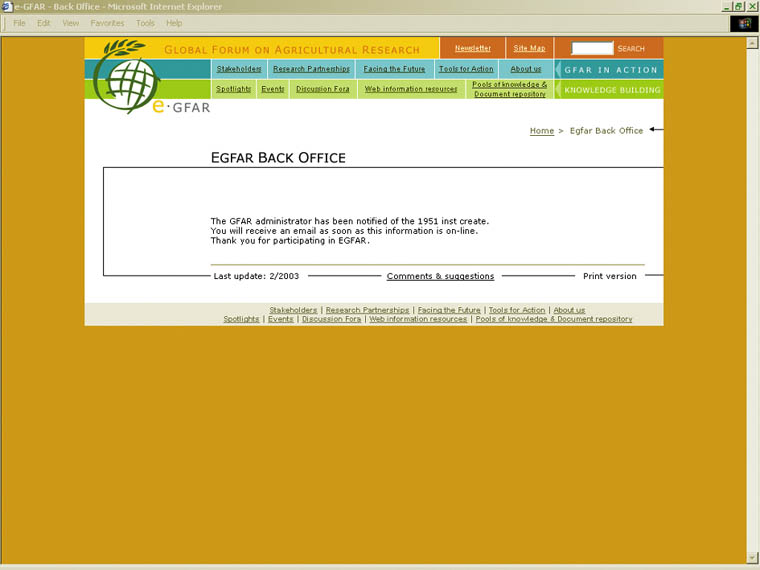
The EGFAR Back Office (EBO), a tool for uploading information, is perhaps the most important website innovation in 2003. This interactive tool allows stakeholders to manage the content of certain pages and/or information in the EGFAR database through a decentralized input process. Its web interface makes it possible for users and administrators with no knowledge of database or HTML codes to update information. The EBO has moved us that much closer to our goal of developing a truly decentralized ICM system, reflecting GFAR’s commitment to full and active stakeholder participation in all the Forum’s activities.
Several components and features of the EBO allowed us to take such rapid strides: four access levels, three of which are password-restricted; management of database records (events, institutions and related fora) and web-page contents’ capabilities; strong control of data integrity; e-mail alerts between users and administrator; administrator validation before any online publication; automatic index updates; and extended use of XML and XSL. The computer screens shown below illustrate the input process through the EGFAR Back Office.
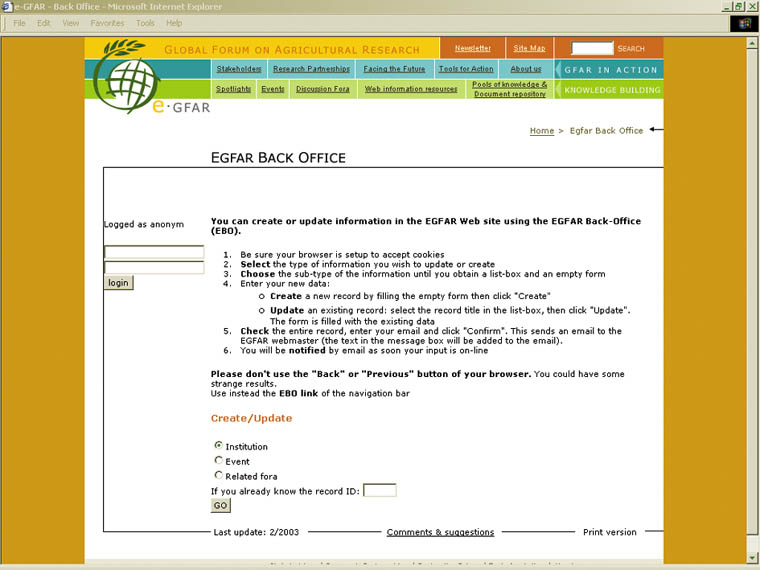
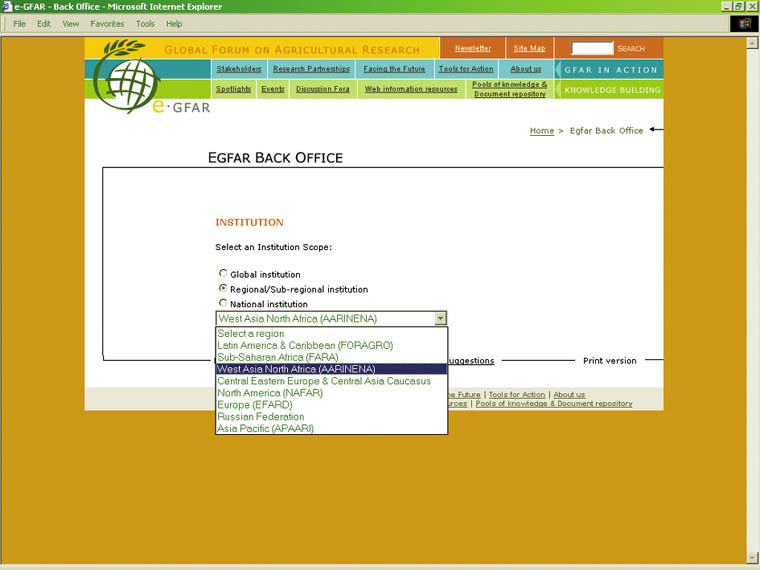
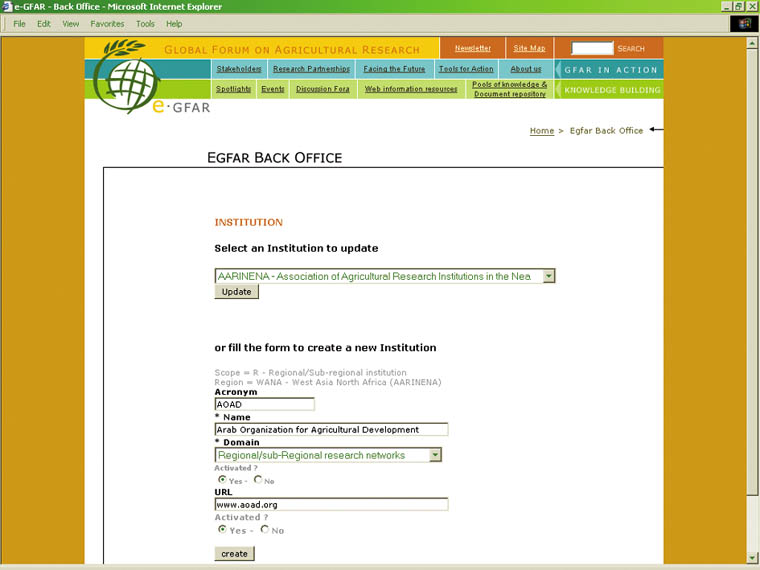
To further improve EGFAR, keep it up to date, and ensure that it is a fully responsive tool, a number of measures will be taken during the coming year. These include the establishment of an EGFAR technical advisory committee, which will draw on external ICM expertise and website input.
Support to RAISs and global initiatives
Global RAIS Project
One of the milestones identified in the current GFAR Business Plan is the approval of all RAIS strategies and their entry into operation by the end of the triennium. Although we began addressing this issue early in 2003 through the Global RAIS Project funded through the Accompanying Measures of the European INCODEV Programme, we have not yet fully met the target.
The project has two objectives: first, to enable each regional or subregional forum to develop and implement an information and communication strategy that will benefit from synergies and economies of scale at both the national and regional levels; and second, to develop a global strategic agenda that will link regions and facilitate the bottom-up implementation of a global information system project. The project calls for workshops in all five regions: West Asia and North Africa; Central Asia and the Caucasus; Latin America and the Caribbean; Sub-Saharan Africa; and Asia - Pacific. In addition, an inter-regional workshop started early this year.
The first regional event, held in Cairo, Egypt, 25 - 27 February, was the information and communication technology (ICT) Expert Consultation on strengthening RAISs, organized by the Association of Agricultural Research Institutions in the Near East and North Africa (AARINENA), the regional forum. Two concrete outcomes were the definition and endorsement of a work plan and budget by the participants (which included subregional representatives), and the establishment of an AARINENA - RAIS Steering Committee. The Steering Committee met for the first time in late July 2003 in Aleppo, Syria, at the headquarters of the International Center for Agricultural Research in the Dry Areas (ICARDA).
A similar workshop dealing with APARIS, the regional information system of the Asia-Pacific Association of Agricultural Research Institutions (APAARI), was held in Bangkok, 1 - 4 December 2003. The proceedings are available from the APAARI Secretariat, and also on http://www.APAARI.org.
Preparations are under way for other regional workshops as follows: Forum for Agricultural Research in Africa (FARA), Accra, Ghana, 27 - 28 April 2004; Forum of the Americas for Agricultural Research and Technological Development (FORAGRO), Costa Rica, 25 - 27 May 2004, and Central Asia and the Caucasus (CAC) Regional Forum, Tashkent, Uzbekistan, 25 - 27 November 2004. An inter-regional workshop will be held in Rome; the date has not yet been set.
In addition to facilitating the implementation of the GLOBAL RAIS project, the Secretariat also collaborated with the EARD-Infosys+ group to develop a system that allows cross-database searches. The objective is to facilitate information exchange both at the GFAR - RAIS and RAIS - RAIS levels so that GFAR has a truly decentralized information system: hosted at the regional level (or at national level in the most advanced cases) and completely managed by each RAIS.
One objective of the GFAR 2003 Conference was to harvest new ideas for improving multidirectional communication among GFAR stakeholders. To this end we organized a special side-event aimed at moving forward on a global agenda for ICM practitioners and presenting innovative aspects of ongoing activities in this area.
Three broad topics were covered by the eight presentations: RAISs, covered by EARD-Infosys+, AARINENA - RAIS, AGROWEB Caucasus and INFORTEC; global issues, covered by FAO/WAICENT (World Agricultural Information Centre) and GFAR (Global RAIS project); and success stories in ICM, covered by RUN Network and ISNAR (International Service for National Agricultural Research) (the iNARS Initiative). The Secretariat will ensure that some of the innovative ideas presented are captured for future use.
Publications and communication
This year we continued the tradition of publishing an EGFAR newsletter in two formats: PDF, for distribution to 1500 stakeholders on the GFAR-stakeholder mailing list; and HTML, made available online. Only one edition of the newsletter, which focused on the GFAR 2003 Conference, was published in 2003.
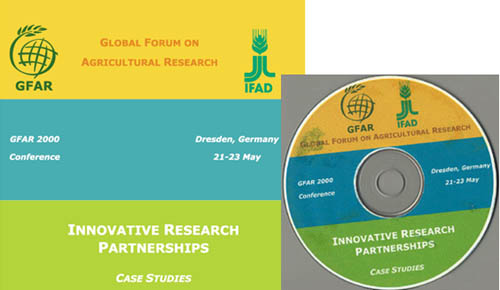
A CD-ROM titled “Innovative Research Partnerships” was published in April 2003. It is a collection of the case studies presented during the 2000 GFAR conference in Dresden, Germany. The CD-ROM allows users to browse documents, following the structure of the document repository section of EGFAR. The publication was distributed widely, especially during the GFAR 2003 Conference. In May, in collaboration with the International Plant Genetic Resources Institute (IPGRI), the GFAR Secretariat published other papers presented in Dresden, namely those related to the Initiative on Genetic Resources for Food and Agriculture.
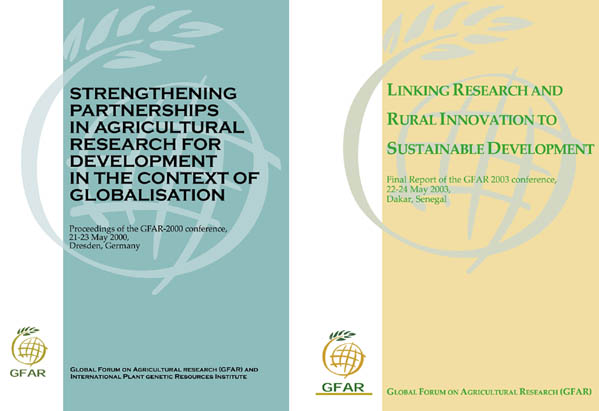
In October, the Secretariat published an English edition of the GFAR 2003 Conference proceedings, in book form. This was distributed during the Nairobi meetings. French and Spanish editions are being prepared and will be distributed in early 2004, together with a trilingual CD-ROM version. A GFAR poster and two leaflets - one on the Secretariat’s functions, the other on the Post-harvest Systems initiative - were also produced.
Let us hear from you
The past year has been a long learning experience for the Secretariat. But we are eager for your comments, constructive criticism, and certainly your encouragement. We do not know yet exactly what the next destination will be and what you have in store for us to tackle. But we are ready to continue this journey of discovery which, we hope, will help mobilize scientists and all ARD stakeholders in a global effort to alleviate poverty, increase food security and promote the sustainable use of natural resources.
