


Promoting the sustainable use of neglected but valuable plants
This brief report highlights several achievements of the Global Facilitation Unit for Underutilized Species (GFU) during 2003.
Raising awareness
The year’s activities kicked off with the GFU’s participation in the International Green Week agricultural fair in Berlin, Germany, 17 - 26 January. It was a major opportunity for us to create awareness of the importance of underutilized species. The GFU stand provided information - via posters, books, leaflets, video and discussion - on the contributions of underutilized plant species to food security, nutrition and health, income generation, cultural identity and biodiversity conservation.
The GFU invited the Fundación Promoción y Investigación de Productos Andinos (PROINPA) to use the stand to showcase foods made from quinoa, kañawa, amaranthus and tarwi. A Bolivian NGO, PROINPA promotes the production, consumption and commercialization of these grains and other Andean crops. Many visitors, from the general public, academia (researchers, teachers and students of all levels), the business world and the media, showed great interest in the exhibit. A number of classes visited the stand and collected study material for use in school projects. The GFU was able to lay the groundwork for collaboration with an international school garden initiative in Berlin. With our support, material related to underutilized species will be included in information packages to be produced and disseminated in support of school garden projects in several partner countries.
The fair provided an opportunity for the GFU to make contacts in the food industry and with fair trade and environmental organizations potentially interested in underutilized species. Personal contacts were also developed with scientists and other individuals with interests in conservation, development and sustainable use of underutilized species.
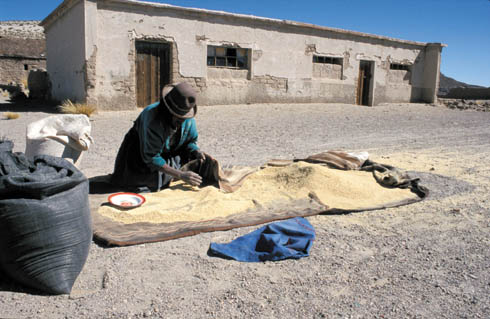
Bolivian quinoa after the harvest. The traditional Andean crop was one of the underutilized grains showcased by PROINPA and GFU at an agricultural fair in Berlin. Photo: Jean-Leo Dugast, Panos Pictures
Planning for successful promotion and utilization
In May 2003, the GFU held an international workshop in Leipzig, Germany, with the objective of identifying strategic elements for the promotion and sustainable use of underutilized plant species. Discussions underscored the important role these species can play in enhancing food security and alleviating poverty. Participants listed key characteristics of successful approaches to promotion that target and benefit poor people. The group identified priority areas for development, strategic elements for each, and the various actors who can be mobilized to help with implementation.
The proceedings of the workshop and other details are available on the GFU website.
Policy dialogue on the European Union’s Novel Food regulation
In a joint effort with personnel involved in projects of the German Agency for Technical Cooperation (GTZ) and with the International Potato Center (CIP), we analyzed the implications of the European Union’s Novel Food Regulation (NFR) for the import into the EU of food products derived from underutilized species. The NFR represents a threat to trade in all products that have not been marketed as a food to a significant degree within the EU before 15 May 1997. It especially affects small producers and entrepreneurs in developing countries for whom the export of such products provides an opportunity for higher incomes. Trade in products derived from underutilized species also stimulates sustainable use of these genetic resources.
Discussions on this issue with the German Federal Ministry for Economic Cooperation and Development (BMZ) and the German Ministry of Consumer Protection, Food and Agriculture (BMVEL) highlighted the inconsistency between development policies and consumer protection within the EU. A proposal, with recommendations on ways to better take into account the interests of developing countries without undermining consumer protection, was developed. This proposal has been submitted through BMZ to BMVEL, the authority charged with the implementation of NFR in Germany, with a request to bring the recommendations to the attention of the EU-working group on novel food currently reviewing the regulation.
Website launched
We launched our website in October 2003. Its purpose is not to duplicate existing efforts; rather, the site will serve as an Internet gateway or portal to many sources of information on underutilized species. It will serve a large and diverse clientele including researchers, development workers, policymakers, donor organizations, farmers and consumers.
Information accessible through this portal includes details of specific crops, events of interest, important topics related to underutilized species, links to other stakeholders and relevant publications. Besides making knowledge available for download, we intend the site to offer a platform for communication among interested parties. The portal is currently hosted by the International Plant Genetic Resources Institute (IPGRI), but maintained by the GFU. The address is www.underutilized-species.org.
Survey of the international community working on underutilized species
To facilitate networking and create synergy among all those involved in the development of underutilized species, it is important to know who the stakeholders are, what they are doing, and what strategies they are using. We therefore conducted a global survey to identify individuals and groups working with underutilized species. The information obtained has been compiled in a database which will soon be made available on the GFU’s website.
An essential component of the database is an expert list which will allow interested actors to contact each other and discuss topics of common interest. We are confident this kind of information will contribute to active and fruitful interactions within the community of individuals and organizations promoting underutilized species. The database will also provide an opportunity for members of this diverse community to make their work and expertise known to a larger audience. The value of such a database depends, of course, on continuous updates. Stakeholders are invited to submit their information using the electronic forms available.
The survey revealed that certain types of organizations are more heavily involved than others in the development of underutilized species. National and international research organizations and universities are currently much more active than groups in business and industry, development organizations, donors, extension services and farmers’ organizations. Not surprisingly, then, the fields that receive the most attention by stakeholders are characterization and conservation of plant genetic resources, applied research and training. Policy and legal issues were of least concern.
Strengthening the dynamics of indigenous knowledge and links with formal science
PROLINNOVA stands for Promoting Local Innovation. It is a global partnership led by NGOs to promote research and development approaches that enhance local innovation in ecologically oriented agriculture and natural resource management. The programme is being built from the bottom up: NGOs in Africa and Asia are facilitating multistakeholder design of country-level programmes and are designing an international programme to reinforce their activities.
Recognizing the dynamics of indigenous knowledge and learning how to strengthen farmers’ capacities to adjust to changing conditions are the focus of PROLINNOVA’s work. By developing and adapting their own site-appropriate systems and resource management institutions, rural people are trying to improve food security, sustain their livelihoods and safeguard the environment. PROLINNOVA builds on and seeks to scale up farmer-based R&D approaches that start with discovering how farmers carry out informal experimentation to develop and test new ideas for improved use of natural resources. Understanding and documenting the rationale behind local innovation transforms the way conventional researchers and extensionists view local people. The experience stimulates interest, on both sides, in entering into joint R&D. Local ideas can then be further developed in a participatory innovation process that integrates the dynamics of indigenous and formal scientific knowledge.
Mainstreaming participatory approaches
Scaling up is in two directions: horizontally, by involving more people and organizations, including farmer groups; and vertically, by targeting higher levels within institutions concerned with R&D in agriculture and natural resource management. PROLINNOVA seeks to integrate participatory approaches that build on local innovation into formal research, extension and education.
To achieve these objectives, the PROLINNOVA partners are developing country-specific ways to:
Identify and document local innovations and innovation processes
Establish partnerships among farmers, extensionists and scientists to further develop local innovations and to encourage others to experiment with them
Build capacities of all stakeholders in participatory R&D approaches and methods
Develop and expand mechanisms that give farmers influence over formal research, extension and education
Encourage multistakeholder learning through joint analysis of: PROLINNOVA approaches and methods; curricula and learning methods; and case studies of policies and institutional conditions.
Decentralized programme development
The concept for PROLINNOVA emerged four years ago. With support from GFAR, the NGO Committee of the CGIAR and the French Ministry of Foreign Affairs, a group made up mainly of NGOs from North and South met in Rambouillet, France, in December 1999 to discuss ways to forge global partnerships in agro-ecological R&D. The group asked ETC Ecoculture (Netherlands) to coordinate further development of the PROLINNOVA proposal and to seek funding support.
PROLINNOVA has been growing in a decentralized way since that meeting. NGOs in Ethiopia, Ghana and Uganda (Agri-Service Ethiopia, the Ecumenical Association for Sustainable Agriculture and Rural Development, and Environmental Alert, respectively) have facilitated the building of R&D partnerships within each of these countries. Support for their work was provided by the International Fund for Agricultural Development (IFAD), which is supporting a similar process in Niger. In each country, multistakeholder steering groups have collected local experiences in recognizing farmer innovation and informal experimentation and in promoting participatory innovation development. The groups convened workshops to analyze the in-country experiences and developed national action plans to improve and scale up participatory approaches to farmer-led R&D. NGOs in several other countries - Cambodia, Nepal, South Africa, Sudan and Tanzania - have also developed proposals for facilitating participatory design of PROLINNOVA programmes at national or subnational levels. Together, they succeeded in gaining support from the Netherlands Directorate-General for International Cooperation (DGIS) to execute their plans.
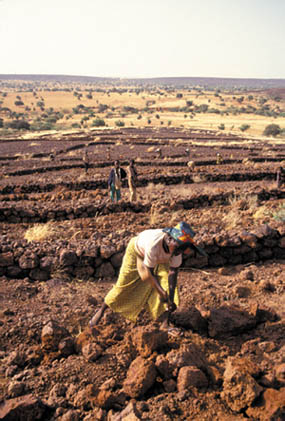
Protective embankments for crops in West Africa. PROLINNOVA builds on farmers’ own approaches to technical innovation. Photo: Giacomo Pirozzi, Panos Pictures
The national action plans differ, depending on the experience and self-identified strengths and weaknesses in engaging the dynamics of indigenous knowledge in participatory innovation development, and in institutionalizing the approach. However, they have some common elements, in particular:
Making an inventory of initiatives to promote local innovation and of the organizations involved
Creating national, multistakeholder learning platforms
Building in-country capacity to identify and document local innovation and to develop participatory innovation
Implementing participatory innovation development on the ground
Participatory monitoring and evaluation of joint activities, outcomes and impacts
Awareness raising and engagement in policy dialogue to create favourable environments for this approach.
For some international activities over the past four years, a mosaic of funds was pieced together from several sources. A study culminating in a workshop on “Advancing Participatory Technology Development” was an outstanding example of this cooperation. The meeting was hosted by the International Institute of Rural Reconstruction (IIRR) in the Philippines, which also published the proceedings and a selection of edited papers in 2003. PROLINNOVA received support for the workshop and publications from the Technical Centre for Agricultural and Rural Cooperation (CTA), DGIS, Misereor (Germany), the NGO Committee of the CGIAR, the Rockefeller Foundation and the Swiss Agency for Development and Cooperation (SDC) through the Swiss Centre for Agricultural Extension (LBL).
The workshop focused on experiences in scaling up participatory innovation development and in integrating it into mainstream agricultural research, extension and education. Workshop participants presented and analyzed case studies from Brazil, Cameroon, China, Costa Rica, Egypt, Ethiopia, Honduras, India, Kyrgyzstan, the Philippines, South Africa, Sri Lanka, Sudan, Thailand, Uganda, Vietnam and Zimbabwe. The proceedings (Participatory Technology Development for Agricultural Improvement: Challenges for Institutional Integration) and a book containing edited versions of selected case studies (Advancing Participatory Technology Development: Case Studies on Integration into Agricultural Research, Extension and Education) can be obtained from IIRR ([email protected]). The proceedings and all case studies can also be downloaded from the PROLINNOVA website and are available on CD-ROM from IIRR.
Other organizations involved in developing the PROLINNOVA concept also raised funds to undertake activities at the regional or national level. For example, the Participatory Ecological Land-Use Management (PELUM) association organized case studies and a workshop on farmer innovation in Eastern and Southern Africa. Also, Agromisa (Netherlands) is supporting PELUM-Zambia in strengthening the way farmers obtain, share and manage knowledge and experience, including documentation of local innovation.
The next major event will be an international workshop in March 2004 to share experiences in developing national PROLINNOVA partnerships, to discuss and compare national action plans and to decide on international learning mechanisms and programme governance. The workshop will be hosted by the PROLINNOVA multistakeholder platform in Ethiopia, known as PROFIEET (Promoting Farmer Innovation and Experimentation in Ethiopia). This process of participatory planning of the international programme mirrors the approach advocated by PROLINNOVA at the national level. The partners in the different countries are the developers and owners of the programme.
Country-level activities are supported by an international team composed of four organizations: ETC Ecoculture, IIRR, the Centre for International Cooperation at the Free University of Amsterdam, and LBL in Switzerland. Their contributions - for coordination, administration, capacity building, methodological support, advocacy, web-based knowledge management, documentation, editing and publishing - have been, and remain, invaluable.
In collaboration with existing electronic networks and databases serving groups with similar interests, PROLINNOVA will be building platforms for discussion of concepts and experiences in promoting local innovation. To overcome the digital divide, printed brochures, posters, books and circulars will also be disseminated, and links with other media, such as radio and video, will be sought. The use of participatory video to give local innovators an opportunity to share experience with other communities and to influence policymakers is an exciting new prospect being explored. Research on partnership building to move participatory approaches into formal R&D is also being planned with universities in PROLINNOVA partner countries.
More information on the bottom-up process in the PROLINNOVA initiative to build a global learning platform on the promotion of local innovation can be found on its website: www.prolinnova.net.
An emerging DMC programme
The Direct Sowing, Mulch-based Systems and Conservation Agriculture (DMC) initiative is a global partnership that aims to strengthen the capacity of key stakeholders to develop suitable DMC systems and accelerate their wide adoption. Still in its preparatory phase, the programme will feature a process of learning and synthesis. It will analyze and compare experiences from decentralized initiatives, draw lessons from them, and identify and fill technological and process-related gaps.
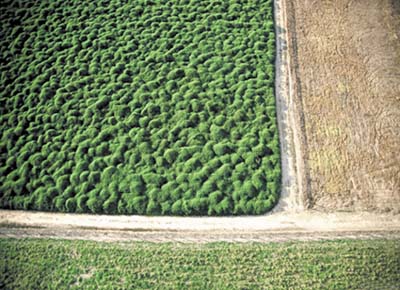
DMC technology at work: Upper left, the cover crop Styloxanthes gracilis improves the soil and is able to grow over residual Brachiaria, a pasture grass widely grown in the Brazilian cerrados (savannas). The lower portion of the photo shows conventional tillage. Photo: A. Chorier, CIRAD
DMC was formally launched in January 2000 by a large group of stakeholders, including national and international agricultural research institutes, NGOs and regional networks. The group agreed on the potential advantages of global cooperation for fostering adoption of DMC systems worldwide. At that time, a broad framework for the DMC initiative was forged. However, due to delays in bringing a full-time facilitator on board, the programme is not yet operational.
From May 2002 to August 2003, Fatima Ribeiro, a Brazilian researcher from the Instituto Agronômico do Paraná (IAPAR), served as DMC facilitator. She was hosted by France’s Centre de coopération internationale en recherche agronomique pour le développement (CIRAD). The following activities comprised her work plan, which was approved by the interim Steering Committee in May 2002:
Learning from local initiatives: establish an inventory and implement case studies on DMC research and development projects
Synthesis: prepare a synthesis of these activities in order to answer questions on adoption, the state-of-the-art and what has been learned about technologies, processes and policies
Feedback/advocacy: encourage links between research, extension and development agents; identify relevant research questions; promote the development of DMC research methods; and encourage farmer-to-farmer knowledge sharing and exchanges across projects
Information sharing: develop a DMC website.
Based on the work plan established by the Steering Committee, DMC concentrated its efforts on learning activities. However, as opportunities arose during the work plan period, additional activities were also carried out. The main outputs are summarized below.
Project inventory and DMC website
CIRAD provided resources for establishing the DMC website which it hosts at http://agroecologie.cirad.fr/dmc/index.php. The site contains an inventory of projects. Any DMC initiative with research and development components can be included. Managers of such projects are invited to fill in a form on the website and submit it. The DMC website also provides links to other websites on related topics.
Four case studies
The first case study was carried out in Bolivia, in collaboration with ANAPO, the National Association of Oilseed Producers. No-till (NT) is a DMC practice now used on nearly 400,000 hectares in the Department of Santa Cruz de la Sierra, mainly by medium-scale farmers. Adoption by small-scale farmers, however, has remained very low. The case study indicated that a key constraint on adoption of NT by small farmers is lack of specialized equipment. Rental markets for NT equipment have not developed and outright purchase can be very costly. Furthermore, these farmers also have limited access to pertinent information on NT.
Case study results also suggest that small farmers would use NT if suitable equipment were available. Medium-size power planters developed in Brazil are less expensive and perform well. These might usefully be evaluated for use under Bolivian conditions. Farmer groups could be formed to test these planters, and rental markets might be fostered. Such measures could make NT technology more accessible to small-scale farmers.
The second case study was carried out in Tanzania, under a collaborative project by IFAD, FAO, the Selian Agricultural Research Institute (SARI) and DMC. Funds were provided mainly by the Government of Japan, the Norwegian Agency for Development Cooperation (NORAD) and FAO.
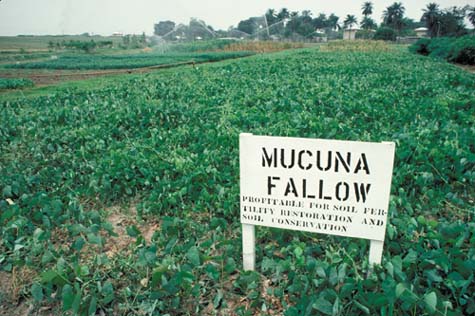
Legumes such as mucuna restore soil fertility in grain-cropping systems. Photo: Bruce Patton, Panos Pictures
This study was proposed by FAO as an assessment of labour-saving technology and practices with a focus on women farmers and vulnerable groups. Specifically, the research had the following objectives: 1) to verify that reduced tillage practices and conservation agriculture (CA) do save significant amounts of labour; 2) to verify that vulnerable groups - women, young people and orphans - are capable of adopting and practising CA without jeopardizing their own food security and livelihood stability; and 3) identify and overcome sociocultural barriers to the adoption of labour-saving practices such as CA.
The third case study, in Ghana, was conducted collaboratively by the Sedentary Farming Systems Project, ICRA and DMC. Farmers in the Brong Ahafo Region have traditionally practised zero tillage using hand tools, but mainly in combination with burning. Some are now adopting no-burn slash and mulch, the use of glyphosate and direct planting. Some have also started to use the legume mucuna as an improved fallow. However, there is an urgent need to increase labour productivity. This could be done by introducing mechanization options for conservation farming.
Tractor services for land preparation are prominent in the savannah areas, but only use disc ploughs. This practice is now spreading to the transitional zone of Ghana. It is important to stop the trend and to develop and offer mechanized services for conservation farming. In this context, the case study aimed to find out whether such service options could be introduced under existing social, ecological, technical and economic conditions and, if so, how this could be organized to ensure access by small-scale farmers.
Another case study is scheduled to start in March 2004 in Zambia, with support from the Swedish International Development Cooperation Agency’s Regional Land Management Unit (RELMA) for East Africa.
The KASSA platform
DMC participates in the CIRAD-led study titled Knowledge Assessment and Sharing on Sustainable Agriculture (KASSA). This initiative, to be financed by the European Union under its Integrating and Strengthening the European Research Area programme, involves 31 institutions organized into regional platforms. Contacts made by the DMC facilitator allowed the participation of important partners such as the Rice-Wheat Consortium for the Indo-Gangetic Plains (South Asia), ANAPO/Bolivia, and Brazil’s Fundação de Apoio Ensino, Pesquisa e Extensão (FAEPE) in association with IAPAR and EMBRAPA, for the scientific aspects. It is important to highlight that, despite the relatively high levels of adoption of DMC by small farmers in Brazil, this is restricted to the subtropical areas. FAEPE is the first Brazilian institution to address the issue with small farmers in tropical areas. The DMC initiative thus expects that participation of FAEPE in the KASSA project will ultimately help foster adoption of DMC systems in tropical areas of Brazil and other countries.
Mainstreaming DMC in Cambodia
With financial support from the Norwegian Trust Fund, a group of agronomists from Cambodia’s Ministry of Agriculture was trained in the concepts of DMC. As a result, a network of trials was established in the country. Preliminary technical and economic assessments of DMC systems have shown the feasibility of these technologies for rice-based farming systems.
Building an African platform for the Second World Congress on Conservation Agriculture
DMC collaborated with the African Conservation Tillage Network to help its members prepare an African contribution on the main issues surrounding the dissemination of DMC systems in Africa. This was presented at the Second World Congress on Conservation Agriculture, in Brazil in August 2003.
DMC and the DURAS project
Despite the delayed opening of tenders for the Promoting Sustainable Development in Southern Agricultural Research Systems project (DURAS), teams from the Southern Africa region are now preparing a farmer-oriented project on the consequences of the tragedy of AIDS in the area. The project will assist women in developing high-production DMC systems through biological management and direct sowing. This initiative takes place under the umbrella of the Action by Churches Together (ACT) network, with support from CIRAD, WWF and NARSs.
Filling research gaps
Fostering research to fill knowledge gaps is another role of DMC. By identifying key research needs, DMC can contribute to orienting research resources toward priority issues. One initiative already taken is the representation of DMC in the European Forum on Agricultural Research for Development.
Cooperation to boost the benefits of an undervalued crop
The Global Coconut Research for Development Programme (PROCORD) aims to generate and deliver benefits to coconut stakeholders, especially poor coconut producers and consumers. It was formed on the initiative of the Bureau for the Development of Research on Tropical Perennial Oil Crops (BUROTROP), IPGRI and GFAR.
The programme has three members: the Asian and Pacific Coconut Community (APCC), the International Coconut Genetic Resources Network (COGENT) and BUROTROP, each of which has specific but complementary strengths. PROCORD was launched during the COCOTECH meeting on 5 July 2002, in Pattaya, Thailand, when representatives of the three organizations and of IPGRI signed a memorandum of agreement.
The overriding goal of PROCORD is to improve the returns on coconut to farmers, communities and countries growing the crop. The programme’s objectives are to improve productivity, strengthen partnerships, enhance information access and dissemination, and promote capacity building.
Under the programme, the three member groups coordinate separate but complementary activities. COGENT focuses on genetic resources improvement, as well as socio-economics and policy support. BUROTROP has lead responsibility in the areas of pest and disease (especially lethal disease) control and productivity and sustainability of coconut-based agroforestry systems. APCC leads PROCORD’s efforts to improve the efficiency and value-added benefits of postharvest processing, utilization and marketing.
Although each institution concentrates on two research areas for PROCORD, it is by no means limited to these themes. All three organizations are free to conduct research on any of the identified themes, consistent with their institutional mandates and the decisions of their respective governing bodies.
Coordination of PROCORD is to be rotated among the three member institutions by mutual consent, and the Chair of the coordinating agency will also chair the PROCORD Coordinating Committee. For the first three years, COGENT will coordinate PROCORD and provide the Secretariat, as well as the necessary administrative support. The Coordinating Committee has held three meetings: on 5 July 2002 in Pattaya, Thailand; on 26 October 2002 in Manila, Philippines; and on 1 June 2003 in Montpellier, France. Meetings have been and will be scheduled back-to-back with other meetings of one of the three organizations.
Here is a summary, by member institution, of PROCORD achievements and plans.
COGENT
Genetic resources: conservation, safe exchange, evaluation and breeding
COGENT is committed to collecting and conserving coconut genetic resources, in national genebanks and in the International Coconut Genebank (ICG). To date, 1,416 accessions are conserved at 25 sites in 23 countries and 224 within the ICG system. Of the 224 accessions, 29 are at ICG-Southeast and East Asia, 50 at ICG-South Pacific, and 99 at ICG-Africa. The ICGs will be strengthened, field conservation of germplasm will continue, and more characterization data will be generated.
Current efforts to conserve genetic material in 23 national genebanks and four ICG sites will continue. To support this work, a training course on cryopreservation was conducted in India in 2002 with eight countries represented and again at the Institut de recherche pour le développement (IRD), France, with staff from five countries. A handbook, titled “Manual on Germplasm Health Management for the International Coconut Genebank”, will be published. Cryopreservation technology is being further developed and an embryo culture technique has been improved.

Coconut palm, southern India. Photo: Neil Cooper, Panos Pictures
COGENT is promoting international exchange and evaluation of germplasm. Multilocation trials involving Benin, Côte d’Ivoire, Tanzania, Mozambique, Brazil, Jamaica and Mexico will continue, as will the provision of germplasm to ICG member countries. Ongoing germplasm exchanges involve the Philippines and Vietnam; India, Sri Lanka and Bangladesh; and Papua New Guinea, Cook Islands, Marshall Islands, Kiribati and Tuvalu. In the area of crop improvement, biotechnology methods are now being applied to coconut. Microsatellite analysis kits, for example, were developed and will be used in nine countries to characterize farmer varieties. Plans for the future include analysis of quantitative trait loci (QTLs), genome mapping and somatic embryogenesis. These tools and methods of molecular genetics shorten the breeding cycle and allow scientists to introduce useful new characteristics into coconut.
A consultative meeting on globally coordinated coconut breeding, held in India in November 2002, is the foundation for a project proposal to be submitted to a donor in 2004. The goal of these efforts is to make available, to both national agricultural researchers and farmers, a range of improved planting materials with a wide genetic base and high consumer acceptability.
Socioeconomics and health
Understanding the social and economic constraints to smallholders’ adoption of new technology and to their participation in planting and rehabilitation programmes is vital to effective coconut R&D. Several activities have been carried out or are planned:
A survey of hybrid and varietal performance and farmer preferences was conducted, in collaboration with APCC and BUROTROP.
Surveys of 54 communities in eight countries were carried out to identify sites for a major poverty-reduction project, with similar surveys planned for 10 African countries. The project, funded by the ADB, covers 24 rural communities in eight countries. A proposal to fund projects for 10 more countries has been submitted to IFAD and others proposals to fund similar work in 10 African countries are being prepared.
Surveys of 24 communities in eight countries examined adoption of new technology and identified market constraints and opportunities. This research will be extended to another 16 countries.
In the area of nutrition and health, COGENT completed a study of the relationship between coconut diversity and human nutrition. A CD ROM, “Coconut is Good for Your Health”, will be prepared in collaboration with APCC and the Philippine Coconut Authority (PCA) for distribution worldwide. A study on the effects of coconut on HIV is also planned.
Linkages are to be developed with partner institutions to study the use of coconut oil derivatives for biofuel.
Training and policy support
In line with the results of a 1998 training needs survey, 10 MSc scholars were supported and have now graduated. Two PhD candidates are currently being supported in their work. Another training needs survey was begun in 2003.
A regional training course on technical writing, seminar presentation, proposal preparation and public awareness was held in Mexico in November 2003.
A seven-year work plan and budget for the ICG has been finalized and submitted to a suitable donor.
COGENT is reviewing plant genetic resources policies in the Asia - Pacific and Oceania region.
BUROTROP
Coconut diseases
Coconut lethal yellowing disease (LYD) is the clear research priority. Scientists at the University of Florida, USA, under a newly approved grant, and at the Institute of Arable Crops Research (IACR), Rothamsted, UK, under a grant from the UK’s Department for International Development (DFID), are sequencing the phytoplasmas that cause LYD. Their aim is to develop molecular markers and monoclonal antibodies to improve diagnostics.
The causal agents of a number of lethal diseases of coconut are still unknown. Identifying them will provide vital scientific information for disease control. In particular, a project is in progress to investigate the causal agent of Porroca (little leaf disease) in Latin America.
Research continues on the epidemiology of lethal diseases of coconut such as LYD, Phytophthora budrot, coconut foliar decay, heartrot and cadang-cadang. New studies will attempt to identify insect vectors and understand transmission mechanisms, including the possibility of seed transmission of LYD phytoplasmas. Future epidemiological studies will exploit powerful tools such as molecular markers and geographic information systems. A proposal for research on the management and control of LYD in Latin America has been submitted and is being funded by the Common Fund for Commodities (CFC).
Germplasm exchange protocols
Indexing protocols for virus and viroid diseases would help ensure safe international sharing of coconut germplasm. These have been developed for the Vanuatu viral disease, coconut foliar decay, as well as the viroid diseases, cadang-cadang from the Philippines and tinangaja disease from Guam. Workshops will be held to train people from ICG and quarantine facilities in the use of these protocols. Techniques to index phytoplasma, phytomonas and xylem proteo-bacteria will be developed.
Resistant varieties
For some diseases, varieties and ecotypes with varying levels of tolerance or resistance have been identified. For LYD, Malayan Yellow and Malayan Red Dwarf, Sri Lanka Green Dwarf, Panama Tall and Vanuatu Tall have potential. For coconut foliar decay, Vanuatu Tall is of interest. Other varieties are being tested in Ghana, Mozambique, Tanzania, Mexico, Jamaica and elsewhere. Development of improved resistant varieties is included in the LYD control project for Latin America and the Caribbean.
Integrated pest management (IPM)
The goal is to develop cultural practices favouring IPM. Cultural practices are available for several important pests, but more are needed. Funding will be sought from CFC and DFID for an IPM project on Oryctes spp. and coconut mite, with APCC as the executing agency.
Training sessions on cultural practices that help control Oryctes spp. and other Dynastidae are planned. In East Africa, sessions will highlight cultural practices for control of Pseudotheraptus wayi.
Projects on IPM of several important coconut pests have been conducted in many countries. An FAO-Vietnam project addresses IPM of Brontispa spp. Surveys and inter-country exchanges regarding natural enemies of major pests, including improved strains of viral and fungal pathogens for biological control, could provide valuable agents for IPM.
Agroforestry systems
Drought resistance is the main priority for R&D on the productivity and sustainability of coconut-based agroforestry systems. The following are highlights of current work and future plans in several areas of research:
Functioning and physiology: Modelling studies of coconut agrosystems were conducted under European Union-funded projects.
Nutrition: Techniques for managing coconut nutrition, based on leaf analysis and fertilizer reference trials, have been developed and made available. Training for farmers, extensionists and researchers is planned.
Water and carbon balances: Ongoing research in Vanuatu aims to establish a global balance of water and carbon exchanges at the level of the organs, the tree and the plantation. The results will be used to design diagnostic and decision tools for coconut plantation management. In India, long-term studies on the mechanisms and criteria of drought tolerance are being conducted. Breeding for drought tolerance is also under way, tolerant cultivars have been identified, and irrigation techniques have been developed and made available. Information on coconut irrigation will be disseminated and related training offered.
Multistorey cultivation: Locally adapted multistorey cropping systems have been tested under various conditions. A future research project will investigate the principles of successful multistorey cultivation with a view to designing models and refining recommendations. Training will also be provided.
Web page
A special page on the coconut commodity chain and PROCORD is available at www.egfar.org/action/partnership/cc/cocnut.shtml. Comments and contributions should be sent to BUROTROP, which created and maintains the site.
APCC
Processing and utilization
The goal of this research is to improve the efficiency and quality of copra and coconut oil production, and to enhance the value-adding impact of processing. This will be achieved in four main areas:
Improving small-scale processing methods for copra and coconut oil producers
Improving fruit processing for large-scale users
Improving the quality of value-added products such as desiccated coconut, coconut cream, coconut water, shells and stems
Increasing the uses, quality and value of byproducts derived from the kernel, husk, shell, sap, leaves and stem.
Marketing
APCC aims to expand and diversify markets and promote coconut consumption and use. The programme comprises five major areas of work:
Market studies to identify regional and global markets for major traditional and non-traditional coconut products. Demand, prospects, consumer preference and utilization patterns will be investigated.
Developing market channels and strategic marketing techniques for coconut products
Promoting the use of coconut in food and nonfood commercial and industrial sectors
Organizing world exhibitions and trade fairs for coconut products
Promoting public awareness on coconut, including its role as a health food, through brochures and other promotional materials.
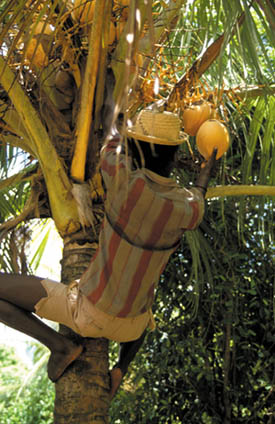
Harvesting coconuts, Tanzania. Photo: Penny Tweedie, Panos Pictures
