


As stated in the Partnership Programme 2003-2005, IPTRID’s development goals are “to reduce poverty, enhance food security and improve livelihoods, while conserving the environment”. Accordingly, the Secretariat staff has devoted all their efforts to fulfilling the work plan of the Programme for the period of eighteen months and the impacts and results achieved are reflected in these pages.
The activities are presented in three categories: the recently completed, ongoing and forthcoming so that the reader can have a rapid and clear idea of IPTRID’s main efforts. More in-detail information as well as some publications can be seen in the IPTRID web page http://www.fao.org/iptrid/. The web site also provides information about the IPTRID Secretariat and the Partnership Programme; it describes the services offered to developing countries and to development institutions and informs about the IPTRID projects worldwide.
Donors
International Fund for Agricultural Development
In 2001 the International Fund for Agricultural Development (IFAD) and IPTRID discussed the idea of the need to document the type and extent of water lifting technologies of smallholders in West Africa. IFAD and IPTRID decided to jointly collaborate on an effort which would aim to develop a programme directed towards the technology transfer and the identification of research uptake. IFAD then made a generous grant of US$100 000 to IPTRID in order to design and implement the first step of the programme. Work proceeded on schedule in 2001 and into 2002; towards the end of that year the study was well advanced but unfortunately, at that time, IPTRID went into a period of redefining its strategy and mandate and this particular activity suffered serious delays. IPTRID reached an agreement with IFAD to proceed with the publication of the Final Report, convinced as both institutions are that the material is still very valid and relevant, and has not lost its importance. A follow up will be made and the report is to be presented in Nigeria under a specific report findings seminar. These activities are being undertaken with the remaining funds US$23 000 that IFAD has permitted the Programme to utilize.
Inter American Development Bank
In mid-December 2004, IPTRID’s Assistant Programme Manager visited the organization and met officials of the Environment Division which deals with Water Management Issues. Also, a meeting was held with staff of FONTAGRO, the Agricultural Fund that supports research activities in the Latin America and Caribbean region. A general presentation of IPTRID was made to explain the Programme’s mission and achievements. Several possibilities of IDB support for our Programme were explored and further discussions will follow in early 2005.
World Bank
IPTRID has received support from the World Bank for one more year (2004) through the funding of a study in Egypt titled “Towards Integrated Planning of Irrigation and Drainage”. Details are given elsewhere in this report.
Canada
In mid-December IPTRID’s Assistant Programme Manager visited the Canadian International Development Agency (CIDA) and met with Mr Aly Shady, Senior Water Specialist and other high officials to discuss possibilities of Canadian support for our Programme. A general presentation on IPTRID was made to explain our nature and achievements, followed by discussions on the nature and level of involvement that could develop. Further discussions are to take place in early 2005 and IPTRID has agreed to provide further information on activities. Identification of other potential Canadian partners is already underway.
Federal Republic of Germany
Contacts were made with the German National ICID Committee in Bonn to explore ways in which the Government may be willing to support the IPTRID Partnership Programme and to identify local partners. Germany contributes some 35 million Euros to the core of FAO. Funds other than these are restricted to a 6.5 million Euro annual trust fund. The fund is largely utilised to support projects which meet specific regional and food policy criteria. Regionally, the currently targeted countries include Afghanistan (Asia), Sierra Leone (West Africa), Tanzania (Eastern Africa) and Brazil (Latin America). Projects must focus on food-insecure fractions of a country’s population and their fundamental Right for Nutrition (food policy criterion). Project approval procedures involve the submission of a two to three-page concept note and upon invitation through the Federal Ministry of Consumer Protection, Nutrition and Agriculture, the elaboration of a fully-fledged project proposal. Under the trust fund, no general support is provided to umbrella and networking organisations.
France
The French Ministry of Agriculture (MAAPAR) agreed to continue its support to the Programme through the extension of the secondment of a Senior Officer until 30 June 2005. The French Ministry of Foreign Affairs (MAE) expressed its will to appoint a new APO to IPTRID in 2005, after the termination of the contract of the present French APO, Sara Fernandez.
Organization of American States (OAS)
Contacts were made in December 2004 with officials of the Office for Sustainable Development and the Environment of OAS under whose responsibility fall issues pertaining to basin management, soil degradation, irrigation matters and, in general, sustainable agricultural management. An IPTRID presentation on goals and outputs was made followed by a discussion on opportunities for OAS to support the Programme. In was agreed that further discussions are to be held in early 2005 to pursue the matter.
Spain
In August 2004, the extension of the Spanish Associate Professional Officer, Sonia Tato, was signed for 12 month period. This agreement has been reached on cost sharing basis and illustrates the active role of the country partners in giving their in-kind contributions. The Spanish Government is very pleased with this development and they are looking forward to future collaboration.
In September 2004, IPTRID-FAO received a letter from the Ministry of Agriculture of Spain, MAPA, committing one million euros to implement projects related to irrigation and drainage. The Sub-Secretary of MAPA is planning a mission to Rome very soon to have a follow up on how the activities are to proceed. In that context, IPTRID has prepared and sent five different proposals to MAPA indicating how IPTRID would plan to use these resources.
Syrian Arab Republic
In November 2003, the Syrian Government approached IPTRID for support towards the country’s policy of irrigation modernization. IPTRID has identified the application of low cost/low pressure drip irrigation techniques as a key subject to be further investigated. A project proposal has been made to the Syrian Government for funding with the objective of assessing the economic and technical feasibility of implementing low cost/low pressure drip irrigation techniques in Syria, on a pilot basis in selected water-deficit areas, and to introduce the concept of “Kit” to the irrigated agriculture sector in Syria. In December 2003, a mission was conducted to further discuss the project with the Government represented by its Ministry of Agriculture and with the Japan International Cooperation Agency (JICA) as an identified donor. Funding was initially agreed to be jointly by the Ministry of Agriculture and JICA-Damascus Office awaiting a final decision for implementation. In the last meeting with the Minister of Agriculture in Damascus in October 2004, His Excellency has confirmed the importance of the project to the country’s policy of modernization and agreed to endorse it to the State Planning Commission and JICA to process the agreement and start the implementation.
United Kingdom
External Review: as agreed in the MOU between IPTRID and the Department for International Development (DFID) of the United Kingdom signed in November 2003, an external review that included two visits of two consultants of the British Organization took place in October and November 2004. This review consisted in evaluating IPTRID’s main activities that have been carried out during the year 2003 and 2004. Impacts were also assessed as well as the current financial situation. This evaluation is part of the mentioned MOU and will lead to further support by DFID to the Programme.
Partners
Brace Center for Water Management & Mc Gill University
An IPTRID presentation was made in mid-December 2004 to both Brace Center and McGill University staff dealing with irrigation and drainage issues. A verbal agreement has been reached so that both Canadian institutions will continue collaborating with our Programme. The nature and extent of the support is to be decided in the coming months and will be a function of the results of CIDA support for IPTRID.
Instituto Inter-Americano para la Cooperación Agrícola (IICA)
Officials of the Office for Technical Cooperation Agenda were visited in early December 2004. An IPTRID presentation was made since IICA was not yet aware of IPTRID’s activities. Ways to develop joint collaboration were explored and it was agreed that there is plenty of room to establish an IPTRID-IICA collaboration in the Latin America Region. Further contacts are forthcoming.
International Water Management Institute (IWMI)
A Letter of Agreement (LOA) in the amount of US$704 057 was signed in July 2004 with IWMI. The LOA is in agreement with the arrangement between the Minister for Development Cooperation of the Government of the Netherlands and FAO/IPTRID, and covers the activities to be achieved by IWMI during a two-year period. These activities are explained further below.
United States Bureau of Reclamation (USBR)
The USBR office in Washington was visited in December 2004 in order to revise and strengthen the existing partnership. request was made to the Bureau to assign some of their staff time to IPTRID activities. The level and nature of this contribution will depend on further discussions, to be continued in early 2005. The USBR has nominated Mr Delbert Smith as the new IPTRID Coordinator, in replacement of Mr Rodney Tekrony who hasjust retired.
HORTICA, Identification of a capacity building project for drip irrigation in the Niayes region, Senegal

The Hortica identification project “Renforcement des Capacités de micro-irrigation pour l’intensification de l’Horticulture has been terminated and approved by the Government of Senegal in June 2004. In September 2004 it was submitted by the Minister of Economics and Finance of Senegal to the Ambassador of Belgium for financing and implementation.
IPTRID International Conference: Towards a strategy for sustainable irrigated agriculture with feasible investment in drainage, Aral Sea Basin, Central Asia
The conference was held in Tashkent in March 2004 at ICWC and aimed at providing answers about options at the main and secondary level of drains, as well as indicating what should be done about the threat to the sustainability of irrigated agriculture due to inadequacy of the drainage network. Studies have shown that about 2.5 million hectares of irrigated lands suffer from extensive salinization and waterlogging and the drainage systems on these lands must be replaced or repaired. The investment cost of this drainage rehabilitation effort is estimated to be in excess of US $10 billion over the next 10-15 years.
The conference was organised in collaboration with SIC-ICWC and was addressed by international experts from the World Bank and IPTRID partners (HR Wallingford and McGill University). Funding was provided by the INCO Programme of the EC. It was opened by Mr A. Jalalov, Deputy Minister of Agriculture and Water Resources of Uzbekistan. The work presented was built on two preparatory foundations: firstly, the June 2003 preparatory workshop; and secondly, a series of detailed studies funded by the World Bank and carried out by IPTRID to investigate specific issues such as groundwater, water use efficiency, drainage design options and potential of GIS/RS data analysis. The conference report can be obtained from ICWC (in English or Russian); it is also available as a CD-ROM.
Database on Capacity Building Programmes for Irrigation Modernization Publication

A worldwide survey on the available capacity building programmes/courses run by various institutes/organizations has been carried out. The project went into two phases. The first was a preparation phase that included the analysis of the needs for capacity building of irrigation modernization, designing and preparing the survey, conducting the survey by collecting information on programmes/courses, and design outputs in a phase report and a basic database. The second phase was the follow up and finalization of the project which included continuing and leading to the term of the survey, compiling and analyzing the content of the database, continuing to put more advanced features on it and preparing a short report to present the analysis of the findings. Publishing the Database is in its final stage.
Special One-day Session on ICT Application in Water Sector; International Conference on Information and Communication Technologies: From Theory to Application. Damascus, Syria.
In the water sector, like in many others, there is an urgent need for professional information systems to facilitate information finding and to provide a platform for sharing professional knowledge and build the base for dialogue to adjacent sectors such as that of the environment. In this context, a special session on the Application of Information and Communication Technology (ICT) in the Water Sector was organized as part of the International Conference on ICT: From Theory to Application which was held in Damascus, Syria in April 2004. The session was co-financed by IPTRID and UNESCO-Cairo Office with participants representing international, regional and local organizations. The session aimed at presenting the efforts made by these various organizations to make information on water and the environment available to the public through their different collaborative information systems already established using different platforms or those who have started initiatives and will implement appropriate platforms.
Towards Integrated Planning of Irrigation and Drainage, Egypt
The study was carried out by IPTRID/FAO and supported by DFID (UK), FAO-RNE, HR Wallingford Ltd, (UK), Ministry of Water Resources and Irrigation (Egypt) and the World Bank. The purpose of the study was to complement the ongoing preparation of the Integrated Irrigation Improvement and Management Project (IIIMP). It was conducted in two phases: a Rapid Assessment Study of irrigation and drainage development in Egypt and a Stakeholder Workshop in which the main findings were presented to and discussed with some fifty participants.
Rapid Assessment Study: from 26 May until 19 June 2004, a team composed of six international and five national consultants visited the Mahmoudia Command Area, Baheira Governorate. The study approach was based on a participatory and multi-disciplinary conceptual framework, which is increasingly known as DrainFrame. The following principal steps were taken: (a) initial analysis of the current problematic situation; (b) function-oriented identification of landscapes and land and water control systems; (c) value-oriented stakeholder assessment; (d) Participatory assessment of problems and opportunities; (e) Participatory analysis of anticipated changes; (f) participatory impact assessment; and (g) Institutional appraisal. The team found that the proposed IIIMP is likely to have a positive impact on the performance of some 1.2 million beneficiaries that are engaged in the production of irrigated food and cash crops. At the lowest hydraulic level the mesqa, the project would reduce the principal constraint, which is the inequity of water distribution and thereby facilitate a more efficient use of available water resources. The study identified a number of important opportunities associated with stakeholders who use downstream parts of the landscape such as fishermen and aquaculturalists. However, the study also identified important environmental and health risks that need to be considered carefully in order to make the project a success. The project may jeopardize the ongoing water reuse programme, which is a major component of the Government’s strategy to increase the overall water use efficiency. Based on available knowledge it cannot be assumed that existing drainage facilities will be sufficient to function effectively under improved conditions.
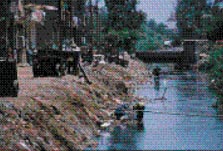
Stakeholder Workshop: From 6 to 9 October 2004 IPTRID, in collaboration with the Drainage Research Institute (DRI) and the Ministry of Water Resources and Irrigation, organised a stakeholder workshop at Borg Elarab, which is located in the vicinity of the project area. This high level workshop brought together nearly fifty participants including high ranking government and non-government officials. Particular attention was given to the participation of l cal stakeholders from Ministry districts, and water user organisations and water boards. Representatives from the Ministries of Health, Environment and Water Supply and Sanitation were among the participants. Officials from MWRI recognised the work presented by the IPTRID team as more important than that of the feasibility study team and all other eleven studies that are expected to make contribution to the formulation of the Project. It was announced by the Head of the Minister’s Office that a task force team would be established in order to propose how the study findings can be incorporated into the project preparation process. Dr Safwat Abdel Dayem, Senior Drainage Advisor to the World Bank, appreciated the successful effort of the study to apply a DrainFrame perspective to this complex Project and thereby reach beyond its boundaries.
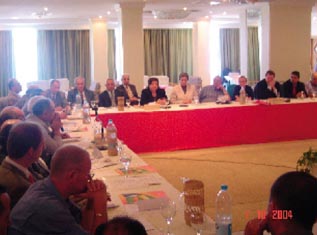
Workshop in Moscow: On the occasion of the 55th IEC and Inter-regional Conference which were held from 5-11 September 2004 in Moscow, Russia, a workshop was successfully conducted jointly between IPTRID/FAO and the ICID working group on “Capacity Building, Training and Education” (DFID funded). It marked the first step of a series of activities that are expected to result in an ICID-FAO-IPTRID guideline manual on capacity needs assessment to be published in 2006.
The half-day workshop was a follow-up to the activity of a 2003 workshop on “Capacity Development” held in Montpellier, France. It was organised in three sessions during which a total of five papers were presented to some thirty participants. The papers included two conceptual and three case studies focussing on specific country experiences. Broadly, capacity needs assessment evolves in stages starting with the assessing the existing and future capacities, mapping the capacity gaps, identifying opportunities for capacity development and defining objectives and targets as the basis for the formulation of a strategic plan of action. The workshop recognized the need for countries to be in the driving seat of that process and to engage international expertise to facilitate its successful implementation. The Chairperson of the working group, Mr Tom Franks, acknowledged IPTRID’s commitment to make the workshop a great success. He suggested that a similar and more far reaching workshop be organised in the year 2005, and thereby keep the positive momentum alive.
The proceeding of the workshop will be made available on the IPTRID web site and subsequently published according to the established IPTRID formats. The proceedings will form the basis for the development of a first draft of the Guidelines for Capacity Needs Assessment (see chapter on Developing the Programme for Southern and Eastern Africa)
Formulation of strategy for appropriate water-lifting technologies in West Africa
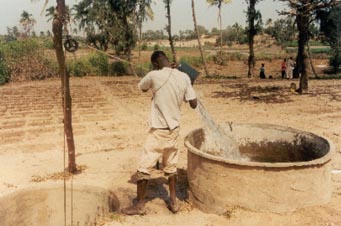
An agreement with IFAD on final report has been reached. This report reviews the status, problems and issues concerning water-lifting technologies in West Africa and proposes research and up-take programme
Design and prototyping of “Centre Virtuel de l’Eau Agricole”
The purpose of the project is to improve agricultural water management through a better access to information via Internet. The project is one of the components of the “Enforcement of Food Security in Developing countries” French strategy and the implementation of this component has been delegated to the IPTRID Secretariat.
Thanks to opportunities given by the Internet as well as more traditional information dissemination tools, the specific objective of the project is to contribute to the success of projects in the area of agricultural water management in Francophone Developing countries through information access and debates on issues linking water, food and environment.
The project, with duration of two years and a total amount of Euros 420 000, has two main components: (i) identification of requirements and concept definition of a virtual centre for the use of water in agriculture and (ii) the development of a prototype platform. A new Information Officer has been recently recruited for managing the project as well as supporting IPTRID in information technologies related activities.
Production of the English and French versions of the GRID magazine in 2004 (9 400 and 400 copies respectively)
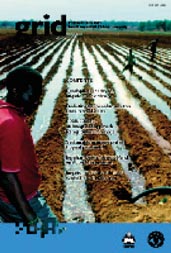
A new design of the GRID magazine has been issued. The purpose of this magazine is to inform readers about IPTRID’s activities, in particular about research and development in irrigation and drainage with a view to stimulating international debate on these issues. The original version of the GRID Magazine is in English in partnership with HR-Wallingford. It contains easily readable articles addressing engineering and social science issues that confront agricultural water management disciplines. The magazine presents an interdisciplinary approach to issues such as irrigation, drainage and capacity building in developing countries as well as a forum for partners to expose their view in the technical sphere.
Formulation of the AGRIMA capacity development programme for West Africa and the Mediterranean Region
Purpose: formulate the IPTRID multi-donor programme for total amount of five million euros in West and North Africa aimed at developing institutional capacities for developing and implementing national and/or regional agricultural water management strategies.
The overall objective of the programme is to improve the sustainability and the economic viability of water resources management in countries where water demand exceed water supply. In that perspective, the project will favour a better integration of the agricultural needs in national or regional water policies.
The programme formulation has involved at this stage the production of a project document submitted to the French Ministry of Foreign Affairs and the contact of other potential donors (Canada, Japan, Switzerland and Spain for the North African component). Missions to Burkina Faso, Senegal, Tunisia and Morocco have been carried out to identify specific activities dealing with water management in those countries.
REGIONAL PROGRAMME FOR EASTERN AND SOUTHERN AFRICA
In March 2004 IPTRID recruited a Senior Consultant for the Regional Programme in Southern and Eastern Africa. According to the terms of reference, the position involved the development of a strategic project portfolio for the IPTRID Sub-Programme for Africa based on the 2003-2005 IPTRID Partnership Programme document. Main activities included (i) to arrange for the conduct of Capacity Development Assessment studies in Africa and (ii) to manage the production of a first version of methodological guidelines for capacity needs assessment studies. In particular, the following activities have been carried out:
Zambia: Capacity needs identification and assessment mission to Zambia (in collaboration with HR-Wallingford)
With the support of FAO, the Government of Zambia has made substantial progress in the formulation of an Irrigation Policy and Strategy. This important milestone in the development of the irrigated agricultural sector in Zambia envisages the emergence of smallholding irrigators and entrepreneur farmers. Promising progress is being made in partnership with NGO smallholder irrigation schemes, outgrower systems and cooperatives.
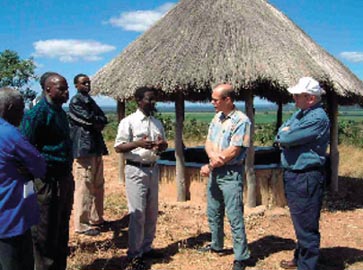
The team found that growth and reinvigoration of irrigation requires proper and sustained attention to capacity development across a wide range of stakeholders. The project-based approach has provided important experience and capacity development for individuals but without long-lasting benefits to the institutions involved. Consequently, few benefits are generated for the development of agricultural water management. Appropriate applied irrigation research is still needed but its possible contribution to the overall strategy implementation has to be demonstrated and fully integrated into extension systems that are demand-driven, client-oriented and based on identified needs and comparative advantages. The mission identified several capacity development options that could support irrigated agriculture in Zambia while recognising the importance of an integrated water resource management approach. An in-depth assessment of the technical, managerial and organizational capacity of the stakeholders involved will be a first step in developing a programme of capacity development.
ARCOD Conference: The Chairman of the Egyptian National Committee of ICID has invited IPTRID to participate in the First African Regional Conference on Drainage (ARCOD) being held in Cairo. In response to this invitation, IPTRID has agreed to present a paper within the framework of the proposed WASTSAVE workshop on the “Most Effective Water Conservation Techniques at National and Regional Scales”, which will be organised within the ARCOD conference. The title of the paper will be: “How the integration of water management systems can lead to real water savings in Egypt.”
Proposal writing: In November 2003, the International Water Management Institute (IWMI) in collaboration with the New Partnership for Africa’s Development (NEPAD), the Southern African Development Community (SADC) and the Global Water Partnership (GWP) prepared a concept note on a knowledge and capacity initiative for improved water control for sustainable agriculture in Southern Africa. The purpose of the initiative was to assist SADC and its interested member countries to develop a systematic data base on the current extent and status of irrigation and other controlled agricultural management systems in the region. The project would broadly strengthen the capacity of the NEPAD Secretariat for supporting African countries in the area of irrigation investment policies.
In October 2004, IPTRID was encouraged by IWMI and NEPAD to join the initiative and to contribute its experience in the field of Capacity Needs Assessment. Accordingly, the scope and the focus of the proposed project will be extended. Its purpose will be to assist SADAC and its interested member countries with the development of strategies for strengthening the capacity in agricultural water management based on assessed priority needs of the stakeholders. In addition to proposed project activities, countries will be encouraged to engage in a self-driven needs assessment for both (i) improved water control technologies and (2) adequate water service and support provision capacity of governmental, nongovernmental, farmer organisations and the private sector.
Irrigation modernization Web Site
Purpose: Development of a web section for presenting the outcome of the irrigation modernization survey, on the FAO/AGLW web site. The outputs of the modernization survey undertaken by IPTRID in collaboration with AGLW (case studies and analysis) will be presented in a section of the FAO/AGLW web site. The modernization activity is now being undertaken by FAO/AGLW as a tool for updated knowledge of the processes actually taking place and local organizations will have the opportunity to provide new cases.
IPTRID-IWMI COLLABORATIVE RESEARCH AND KNOWLEDGE NETWORKING
This IPTRID-IWMI collaboration has the following overriding objectives:
i) Fill strategic and practical research gaps identified through IPTRID’s programme by establishing useful data banks and developing better research and analytical tools.
ii) Increase national and regional capacity to improve management and institutional systems. This means supporting professional practices responsive to the issues of water for food, cities and the environment.
iii) Engage the creative thought and practice of the world water, agriculture and environmental communities and of key opinion and decision-makers. This calls for concerted investigation, problem solving, dialogue and the free and open exchange of ideas to understand and address the distinctive conditions, opportunities and values in the diverse societies more effectively.
The LOA includes four major activities, as follows:
Programme Development: The work will include providing strategic research input to national programmes on investment, performance evaluation and capacity and institution building in the area of smallholder water management. This includes work in water harvesting, low-cost drip irrigation, treadle pumps and other innovative approaches that show promise for alleviating poverty among smallholder farmers. Two publications in IPTRID’s series on Agricultural Water Management Strategies will be produced. These publications will focus on smallholder irrigation in Asia and Africa (priority will be given to Kenya, Republic of South Africa, Tanzania, Senegal and the Mekong Basin).
Support to Programme: IWMI will contribute substantially to the IPTRID programme on benchmarking irrigation performance. IWMI will assist in programme design, helping national partners with the benchmarking programme and the maintenance of an electronic database on performance of irrigation systems; the corresponding FAO-WB-ICID-IWMI-IPTRID web site will be provided and extended. In addition, IWMI will provide content in the area of “Water institutions and policies” to IPTRID operated WCA-infoNET.
Research and Analytical Tools: IWMI will provide support to IPTRID to promote policy-related research and development through the use of the PODIUM model in at least 6 countries in Asia and Africa. The activities will contribute to the knowledge to facilitate policy formulation on water for food and environmental security. Specifically, IWMI will assist host countries in identification of key water policy issues, conducting strategic research and in facilitating discussions around policy. IWMI will train developing country scientists to adapt and use analytical tools appropriate for their area, state or national conditions.
Networking: These activities are intended to facilitate the IPTRID-IWMI partnership. They will include IWMI staff participation in projects, meetings and seminars of the IPTRID network. More generally, they may include support to all kinds of communication between IPTRID partners.
TOWARDS A STRATEGY FOR SUSTAINABLE IRRIGATED AGRICULTURE WITH FEASIBLE INVESTMENT IN DRAINAGE, ARAL SEA BASIN, CENTRAL ASIA
Purpose: To assess the drainage needs for sustainable irrigated agriculture in the Aral Sea Basin. The Project is to prepare the needs assessment for the formulation of a strategy on the investment needed in the Aral Sea Basin. In addition, the Project contemplates holding a high level conference in Tashkent, Uzbekistan to discuss the hazards of the on-going salinization process and other threats to the sustainability of irrigated agriculture. Various partners have been involved, each one contributing a report on specific issues. The reports are in an advanced stage of review and will be published shortly.
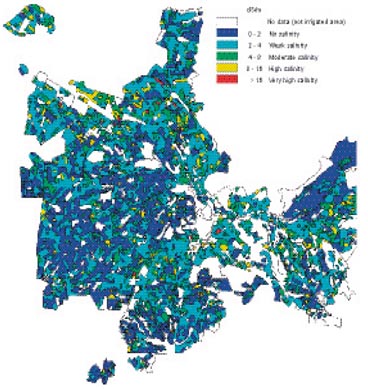
Water Watch, the Netherlands, “Detecting soil salinity changes in specific parts of the Aral Sea Basin from Landsat images”. In this report a remote sensing approach is described that gives the spatial distribution in soil salinity for a large part of the Karakalpakstan and Kashkadarya Oblasts.
At present it is estimated that 60 percent of the irrigated lands in Uzbekistan are affected by salinization (see Figure). With the current levels of investments in drainage the situation is deteriorating by varying degrees at different locations. If funds to rehabilitate the drainage system become available, it will probably be insufficient for a full-scale rehabilitation. This means that areas have to be selected on the basis of criteria that ensure maximum results.
HR Wallingford, UK, “Overall irrigation water use efficiency in the Aral Sea Basin”. This paper reports an exercise to evaluate overall irrigation efficiencies in selected planning zones of the Aral Sea Basin. The objective was to utilize locally available information in order to understand the scale of water use inefficiencies in the irrigation regimes of the planning zones. The paper provides evidence in support of the urgent needs for more efficient irrigation procedures to be introduced and for effective drainage networks to remove excess supplies of irrigation water.
The significance of this particular study is that it is based entirely on locally derived data. The work reinforces earlier conclusions that irrigation efficiency is low and has considerable scope for improvement. In particular, there remains a need for effective drainage and for more efficient irrigation practice.
Alterra-ILRI, the Netherlands, “Main characteristics of groundwater hydrology related to salinization and drainage”. In drainage projects the regional hydrogeological system is not always considered and the focus is often on shallow water table management only. Artificial drainage may, however, change the regional hydrogeological situation, for example, the spatial distribution of groundwater recharge and discharge zones and the recharge and discharge rates. Changes in the groundwater recharge and discharge situation will impact on groundwater quality and flow patterns.
The current groundwater assessment was made with very limited information. A better quantification of the hydrogeological setting, particularly groundwater flow and quality patterns, historical and future trends, will help to identify and assess feasible options for drainage and irrigation investments, which minimize the adverse impacts of salt mobilization from ambient groundwater and fit within an integrated approach of water management on the scale of river basins.
Scientific Information Center-Interstate Committee for Water Coordination, Uzbekistan, “Drainage in Aral Sea basin: Towards a strategy of sustainable development”. The Aral Sea Basin is located in a dry climatic zone where evaporation highly exceeds natural precipitation. The combination of climatic conditions, their location within the Aral Sea depression and being irrigated has resulted in a long process of salt accumulation leading to salinization of these arable lands. However, with irrigation being the main source of food, employment and income and thus driving the social-economic development of the region, it is unlikely that irrigation can be abandoned to curtail the salinization process. Nevertheless, intensive drainage provoked ecological impacts: river water quality degradation due to return water releases; violation of the salt balance and intensive salt mobilization in unsaturated zones from groundwater; and introduction of a complexity of drainage operation and maintenance.
It is surprising that with only a 30 to 50 percent functional drainage network, salinization has not extended to the entire area. Hence, under the current conditions it is necessary to organize reclamation infrastructure maintenance by means of: i) drawing decision makers’ attention to drainage issues; ii) combining public and private participation in drainage O&M under transition to market conditions; iii) training people (operators and users) on how to combine irrigation and drainage water management for effective crop growing; iv) reducing salt exchange between groundwater and unsaturated zones, on one side, and irrigation massifs and river, on the other; and v) organizing collector-drainage water management: its amount, release to river, limitation within a basin and basin organizations, etc.
Mc Gill University & Brace Centre for Water Management, Canada, “Drainage”. The primary aim of this study is to provide an assessment of the status of drainage conditions in irrigated agriculture on selected Oblasts in the irrigated areas in the five Central Asian countries and projections for future status considering selected drainage improvement scenarios based on assumptions and best estimates. Primary considerations in the strategy development include identifying the scale, priorities, selection criteria, specific rehabilitation schemes, institutional strengthening and the participation and contribution of all stakeholders.
The workshop titled “Towards a strategy for sustainable irrigated agriculture with feasible investment in drainage, Aral Sea Basin, Central Asia” was held in the ICWC Training Center in Tashkent from 10 to 13 March 2004. The objectives of the conference was to encourage and support debate at the highest level of government and private sector about the problems in land drainage throughout the Aral Sea Basin and to identify a coordinated strategy that can start being implemented by the Central Asian States. The conference provided a synthesized knowledge about the areas’ problems. A report on the proceedings has been produced and will be published together with the above reports.
Operation and maintenance of the WCA-Infonet information system

The purpose is to operate and maintain the developed Internet-based integrated information system, WCA-Infonet, that provides users of different professional backgrounds with direct access to information and expertise on water conservation and use in agriculture. In February 2004, the final technical report of the WCA infoNET, Information system on water conservation and use in agriculture, was produced.
IPTRID still has to identify possible synergies and hosting opportunities to secure the continuation of the WCA Infonet information system.
Low cost/low pressure drip irrigation techniques in irrigated agricultural sector in Syria

The objective of the project is to assess the economic and technical feasibility of implementing low cost/low pressure micro irrigation techniques in Syria on a pilot basis in selected water-deficit areas and to introduce the concept of “Kit” to the irrigated agriculture sector in Syria. It will also demonstrate and promote appropriate low cost/low pressure micro irrigation techniques, provide training to technicians and farmers on the new techniques. The proposal has been made and a decision on its funding by the Syrian Government is awaited.
Regional R&D Senior Management Workshop for East Africa
(To be held in March 2005) The aim of the workshop is to provide Institute Directors with insight on how to best utilise their resources and maximize return on investment in research. It will provide appropriate training in:
- Modern procedures for the management of research projects
- Leadership, motivation and team building
- Project cycle management
- Research planning, tools and methodologies
- Implementation of research programmes
- Research-extension linkages, information services and documentation
Forthcoming collaborating activities with the Ministry of Agriculture of Spain (MAPA)
Purpose: to formulate and implement capacity development irrigation and drainage projects in Latin America and North Africa Relations with the Spanish Ministry of Agriculture are ongoing in order to strengthen the already existing partnership. Five proposals have been submitted to the Spanish Government for their forthcoming visit in order to enable them to choose the IPTRID-AGLW activities for collaboration that would be implemented and financed together with the MAPA. The proposed projects would be located in Ecuador, El Salvador, Cuba and Morocco. The final selection of one or two projects will be decided between MAPA and the IPTRID/FAO. The proposals are as follows:
Drip irrigation water management in Eastern El Salvador
Environmental friendly irrigation development in Morocco
Small scale irrigation modernization in El Carchi, Ecuador
Support to the Special Programme for Food Security (SPFS) in Cuba: Drip irrigation Project in Velasco or similar areas
Support to the Special Programme for Food Security (SPFS) in Cuba: Project for the reclamation of saline soils for agricultural production through irrigation and drainage
Regional R&D Senior Management Workshop for South East Asia, Malaysia
The aim of the workshop is to provide Institute Directors with insight on how to best utilize their resources and maximize returns on investment in research. It will provide appropriate training in:
- Modern procedures for the management of research projects
- Leadership, motivation and team building
- Project cycle management
- Research planning, tools and methodologies
- Implementation of research programmes
- Research-extension linkages, information services and documentation
|
Date |
Country |
Staff |
Purpose |
|
August 2003 |
Sweden |
Olivier Cogels |
· To participate in the
8th Annual Meeting of the Consulting Partners of the Global Water
Partnership on 14 and 15 August 2003 and attend Plenary Sessions |
|
August 2003 |
Uzbekistan |
Harry Denecke |
· To hold discussions with SIC
ICWC and verify the progress of work on the project “Towards a strategy for
sustainable irrigated agriculture with feasible investment in
drainage” |
|
September 2003 |
France |
Olivier Cogels |
· To represent IPTRID at the CG,
MC and AC meetings |
|
September 2003 |
Netherlands |
Harry Denecke |
· To participate in the
“9th International Drainage Workshop” held in Utrecht, The
Netherlands, organized by Alterra-ILRI, Wageningen |
|
November 2003 |
India |
Olivier Cogels |
· To participate in the National
Consultation (INC) for ICID’s CountryPolicy Support Programme (CPSP), New
Delhi, India |
|
December 2003 |
France |
Sara Fernandez |
· To establish first contact
with the World Water Council for possible further collaboration |
|
December 2003 |
Senegal |
Olivier Cogels |
· To manage the production of
the project identification report «Renforcement des capacités de
micro-irrigation pour l’intensification de l’horticulture -Zone de
Niayes», validate the first draft with the Ministry of Agriculture and
facilitate its funding by the Belgian Development Aid |
|
December 2003 |
Egypt |
Maher Salman |
· To participate in the 2nd Regional Conference on Water Demand Management; hold discussions with NWRC and other institutions on collaboration with IPTRID |
|
December 2003 |
Syria |
Maher Salman |
· To attend a multilateral meeting on IPTRID/AGL project and visit institutions |
|
January 2004 |
Uzbekistan |
Harry Denecke |
· To prepare for the
International Conference titled “Towards a strategy for sustainable
irrigated agriculture with feasible investment in drainage” |
|
January 2004 |
France |
Jean Verdier |
· To discuss the AGRIMA project with the MAE and solve important divergences between the MAE and IPTRID about the formulation and implementation of this 5-7 million project |
|
February 2004 |
USA Washington |
Olivier Cogels |
· To represent FAO and IPTRID at
the World Bank Water Week. |
|
February 2004 |
Uzbekistan |
Harry Denecke |
· To prepare for the
International Conference titled “Towards a strategy for sustainable
irrigated agriculture with feasible investment in drainage”. |
|
March 2004 |
Uzbekistan |
Olivier Cogels |
· To evaluate the achievements
of the project titled “Towards a strategy for sustainable irrigated
agriculture with feasible investment in drainage” |
|
March 2004 |
Uzbekistan |
Harry Denecke |
· To participate in and co-chair
the International Conference titled “Towards a strategy for sustainable
irrigated agriculture with feasible investment in drainage” |
|
April 2004 |
Belgium |
Olivier Cogels |
· To identify fundraising
opportunities with the Walloon Region of Belgium |
|
May 2004 |
France |
Jean Verdier |
· To attend the IME international Workshop on Rural Water in the Mediterranean and the General Assembly of AFEID (French National Committee of ICID) |
|
May 2004 |
Republic of Zambia |
Wilfried Hundertmark |
· To assess the current
situation of CD activities in Zambia |
|
June 2004 |
Senegal |
Olivier Cogels |
· To validate the final draft of
the identification report of the HORTICA project with the Ministry of
Agriculture and further facilitate the funding through the Belgian Development
Aid |
|
June 2004 |
France |
Olivier Cogels |
· To secure the extension of Jean Verdier’s secondment to IPTRID and to consolidate the partnership with the MAE through a high level meeting with the Director General of International Cooperation and Development |
|
June 2004 |
Egypt |
Wilfried Hundertmark |
· To conduct a Rapid Assessment Study in Egypt titled “Towards Integrated Planning of Irrigation and Drainage in Egypt” co-funded by the World Bank, DFID and HR Wallingford |
|
September 2004 |
Russian Federation |
Kenji Yoshinaga |
To take part in the following events/activities in
Moscow: |
|
September 2004 |
United Kingdom |
Sara Fernandez |
To attend the UNDP Training on Human development (Oxford
University) |
|
October 2004 |
Syria |
Maher Salman |
· To follow-up project proposal with the Syrian Authorities and attend a workshop |
|
October 2004 |
Egypt |
Wilfried Hundertmark |
· Workshop Phase II of IPTRID/WB Rapid Assessment Study |
|
November 2004 |
France |
Franck Besseat |
· Virtual centre project: visit the MAE for Virtual Centre Project initiation |
|
December 2004 |
Burkina Faso |
Franck BesseatSara Fernandez |
Virtual centre project: |
|
December 2004 |
Canada, USA, Netherlands |
Carlos Garcés |
Visit to donors potential donors: CIDA, BID, OAS and partners McGill University, USBR, IICA, ILRI-Alterra and Wageningen |
|
December 2004 |
Senegal |
Franck Besseat |
Virtual centre project: |
|
December 2004 |
France |
Franck Besseat |
· Visit of potential partners
from North Africa for Virtual Center project |
|
December 2004 |
Egypt |
Maher Salman |
· To participate in the first
African Regional Conference on Drainage |
IPTRID continues to provide technical and financial support for International workshops. These are important mechanisms for awareness building and dissemination and constitute an integral component of IPTRID’s implementation strategy. During the reporting period IPTRID has supported four International workshops which are described briefly below.
Republic of Uzbekistan, March 2004. “Towards Strateg Sustainable Irrigated Agriculture with Feasible Investment in Drainage in the Aral Sea Basin”
The goals of the conference were the analysis of the present situation in Central Asia and the development of a strategy for sustainable development of irrigated farming and increased agricultural productivity based on a feasible approach to investment in drainage.
Syrian Arab Republic, April 2004. Special One-day Session on the ICT Application in Water and Environment Sectors
The special session was part of the ICTA 2004 that was held in Damascus with the aim to present the efforts made by various organizations to make information on water and the environment available to the public through their different collaborative information systems already established, using different platforms or those who have started initiatives and will implement appropriate platforms. The session was co-organized by IPTRID and the UNESCO-Cairo Office.
Russian Federation, September 2004. “Capacity needs assessment in Agricultural Water Management”
A workshop was successfully conducted in Moscow where IPTRID/FAO, with its support and working jointly with the ICID Working Group on Capacity Building, Training and Education, prepared a half day session on Capacity needs assessment on agricultural water management. Five papers were presented including different case studies in developing countries.
Arab Republic of Egypt, October 2004
IPTRID organized a stakeholder Workshop for the IPTRID-Rapid Assessment Study in support of the IIIMP in Alexandria, Egypt. Details are explained in the chapter above.
Two issues of the GRID Magazine in English and French.
Rapport final du “Projet d’identification et diffusion de bonnes pratiques sur les périmètres irrigués en Afrique de l’Ouest», 2004.
Hortica, Renforcement des capacités de micro-irrigation pour l’intensification de l’horticulture -Zone de Niayes, Sénégal».juillet, 2004
R&D Programme for sustainable Agricultural Water Management in Southeastern Anatolia, Turkey, 2003
Brabben, Thomas E. & Cornish, Gerald (HR Wallingford Ltd, UK). September 2004. Capacity needs in agricultural water management - experiences from Zambia. International workshop of the ICID on Capacity needs assessment in agricultural water management, Moscow, Russian Federation
Fernandez, Sara; Verdier, Jean & Garcés-Restrepo, Carlos. October 2004. Irrigation and water resources: which challenges, which solutions? World Water and environmental engineering magazine, November-December 2004 issue.
Fernandez, Sara & Verdier, Jean May 2004. Problématique de l’eau agricole en Méditerranée. Atelier international de l’Institut Méditerranéen de l’Eau. IPTRID Secretariat.
Hundertmark, Wilfried, September 2004. Strategic options for capacity assessment in agricultural water management: design and management of the process. International workshop of the ICID on Capacity needs assessment in agricultural water management, Moscow, Russian Federation.
Kay, Melvyn; Franks, Tom & Tato, Sonia. September 2004. Capacity Needs Assessment - Methodology and Process. International workshop of the ICID on Capacity needs assessment in agricultural water management, Moscow, Russian Federation.
Mahmoud, Ibrahim Mohamed, Ministry of Water Resource and Irrigation, Egypt. September 2004. Institutional Mapping to Assess Capacity Needs for the Development of Water Boards at District Level in Egypt. International workshop of the ICID on Capacity needs assessment in agricultural water management, Moscow, Russian Federation.
Salman, Maher. August 2003. The Utilization of Water Resources for Agriculture in Syria: Current Situation and Future Challenges. International Seminar on Water Issues of the World Federation of Scientists, Erice, Sicily, Italy.
Salman, Maher. March 2004. The Euphrates and Tigris: South Boundary Utilization and Views. International Workshop on Water, Development and Cooperation-Cooperative Perspective: Euphrates-Tigris and Southern Africa, Bonn, Germany.
Salman, Maher. December 2003. Water Demand Management in Syria: Centralized and decentralized Views. Regional Conference on Water Demand Management, Sharm El-Sheikh, Egypt.
Salman, Maher. April 2004. IPTRID Experience in Information Systems: From WCA infoNET to the Virtual Center for Water in Agriculture -Lessons Learned. Special Session on the Application of ICT in Water and Environment Sectors, International Conference on Information and Communication Technologies: From Theory to Application, Damascus, Syria.
Salman, Maher. October 2004. Institutional Reform for Irrigation and Drainage in Syria: Diagnosis of Key Elements. Syrian Expatriates Conference, Damascus, Syria.
Tardieu, Henri & Préfol, Bernard. 2004. Contribution to Draft. Public-Private Partnership in Irrigation and Drainage: Need for a Professional “Third Party” between Farmers and Governments. A contribution to the Water for Food initiative. Agriculture and Rural Development Department. The World Bank
Terwisscha van Scheltinga, Catharien & Zovtonog, Olga. September 2004. Changes in Irrigation Water Management: the Need for Capacity Development in Ukraine (Institute for Hydraulic Engineering and Land Reclamation of the Ukrainian Academy of Agrarian Science, Kyiv, Ukraine). International workshop of the ICID on Capacity needs assessment in agricultural water management, Moscow, Russian Federation.
Verdier, Jean. December 2003. L’eau et la sécurité alimentaire. Colloquium on «Les enjeux mondiaux de la sécurité alimentaire». Toulouse (France). Associations d’Agronomes et de Vétérinaires de Midi-Pyrénées
Verdier, Jean. May 2003. Vers une hydraulique agricole mieux adaptée aux zones arides et semi-arides. Rôle essentiel de la coopération internationale. Colloque sur la gestion du risque eau en pays semi-aride, Tunis, Tunisie.
