


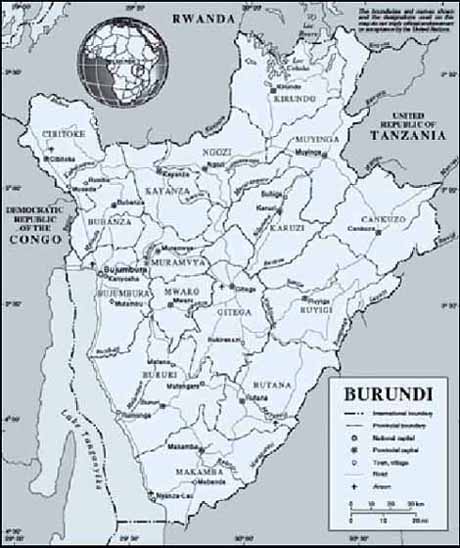
More than 11 years of civil war and political conflict have devastated Burundi, giving the population limited options for feeding themselves in the immediate future. At present, 1.2 million people live on food aid. Incidence of diseases is high, such as malaria, diarrhoea, cholera, respiratory infections and HIV/AIDS. Overall, household food security continues to be affected by a combination of chronic vulnerabilities, consequences of years of almost constant crises combined with short-time shock periods, such as drought, hailstorms and cassava pests.
However, some positive developments in the welfare and nutritious status of the population have taken place due to improved security conditions in rural areas and a continuous provision of food aid and emergency agricultural assistance. Furthermore, an ongoing peace process ushers new-found hopes for the stabilization of the country. The trend of refugees and internally displaced persons (IDPs) returning to their communities of origin has continued throughout the year. By May 2004, approximately 137 000 IDPs had returned home or were on the move. Nevertheless, problems caused by the long and violent conflict are still lingering. While basic material needs may be relatively well covered, violations of human rights and humanitarian law still occur. Sexual and gender-based violence, looting, destruction and occupation of civilian property and land by all parties to the conflict continue to be widespread and the province of Bujumbara Rural suffers from a prolonged armed conflict.
Needs Assessment
Following the years of war, vulnerable rural populations, comprised largely of unemployed youths, have a highly reduced access to land. The country has experienced a dramatic decrease in agricultural output, linked to a drop in agricultural productivity and disruptions in provision networks. Similarly, infrastructure for the storage and treatment of produce can no longer support the resumption of rural agricultural activity, which constitutes more than 80 percent of socio-economic activity.
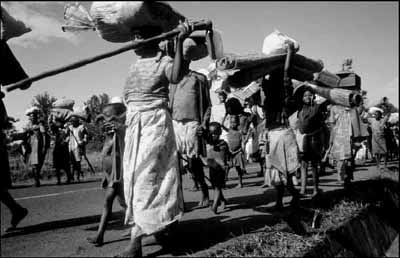
Frequent displacements of populations have forced households to over exploit community-owned forests by selling timber and related products in order to survive. Rural agro-forest nurseries have been weakened, and the distribution of fruit seedlings has been interrupted. Fruit constitutes one of the rare sources of vitamins, especially for children.
Loss of social capital is evident. Grassroots agricultural training systems are in disarray, with a reduction in the number of agricultural extension agents and assistant veterinary technicians. In search of a better life some trainers have either left the country or enrolled in armed groups. Those who remain in their home regions have not been unable to update their knowledge due to lack of training seminars and materials. The weakening of the training sector has at all levels limited agricultural innovation transfer capacities.
In areas bordering the lakes, Lake Tanganyika in particular, most fish processing installations have been pillaged and destroyed, reducing the fishing sector to a subsistence activity. National production levels have plummeted considerably, thereby accentuating the animal protein deficit in people’s diets. Lakeside populations, left with little means, have resorted to the use of materials such as mosquito nets that threaten ecological sustainability of the fishing sector.
Since 1996, the FAO Emergency Coordination Unit (ECU) has initiated a series of activities, such as evaluation of agricultural needs and rehabilitation, seasonal evaluations of harvests, distribution of seeds and tools and rehabilitation of seed multiplication, as well as support to targeted groups through market gardening activities. Logistical services are currently operated from two logistics bases, one in Bujumbura and one in Gitega. To maintain a suitable storage and rapid intervention capacity required by the needs of returning refugees, as well as adapting to increases in programmes and supplies, an additional logistics base is now needed in Makamba Province.
PROJECTS
FAO agricultural relief component: US$12 052 216
Assistance for the rehabilitation of rural community infrastructure
Objective
The provinces of Ruyigi, Rutana and Makamba have suffered years of insecurity and are now receiving a large number of returning refugees and IDPs. The project intends to take preliminary action and make agricultural support infrastructures operational, while a more integral rehabilitation is planned for a later date. Access to arable land will be improved through a rehabilitation of marshlands that were cultivated prior to the conflict. Roads and community warehouses will be reconstructed to facilitate technical support, provide agricultural supplies and reduce post-harvest losses. Vulnerable households will be assisted in improving their agricultural production capacity, thus facilitating their return to their communities of origin.
Project code: BDI-05/A06
Beneficiaries: Rural
communities
Implementing partners: WFP, Ministry of Agriculture and
Livestock
Project duration: January - December 2005
Funds
requested: US$2 000 000
Emergency agricultural assistance for market gardens and small livestock production
Objective
In the context of displacement to peri-urban zones with highly reduced access to land, this project aims to support market garden promotion and production to rapidly improve access to greater quantities and quality of food, as well as to generate income and improved nutrition for people affected by armed conflict and climatic variations.
To maximize market garden output through modest levels of investment, the project will provide small livestock to diversify revenue sources and produce organic fertilizer to improve the fertility of gardens located on small plots of land. Market garden by-products will be used to feed small animals such as rabbits and ducks. The project will, with support from local associations, assist 20 000 households who will benefit from a wide variety of market garden seeds, including tomatoes, cabbage, onions, eggplant and lenga-lenga (amaranth); small livestock and related equipment such as fertilizers and tools. Adequate training will also be provided.
Project code: BDI-05/A04
Beneficiaries: 20
000 extremely vulnerable households and/or displaced persons (widows, orphans)
living in peri-urban zones of Bujumbura, Kayanza and Gitega
Implementing
partners: Ministry of Agriculture and Livestock, WFP, NGOs,
UNICEF
Project duration: January - December 2005
Funds
requested: US$810 000
Emergency Agriculture Operations Coordination, Logistical Services and Food Security Early Warning and Control System (SAP-SSA)
Objective
In addition to the ones already operating in Bujumbura and Gitega, a new logistics base will be established in the Makamba Province. This base will maintain a suitable storage and rapid intervention capacity, while adapting to an increase in programmes and supplies required by the needs of returning refugees.
Specific objectives are to: (a) maintain and support the coordination of emergency agricultural assistance activities for vulnerable populations; (b) ensure necessary logistical capabilities; and (c) reinforce surveillance and early warning capacities related to food security. These objectives are aimed at contributing to the general goal of ensuring access to food, meeting nutritional needs of populations rendered vulnerable by conflict and climatic variations, and supporting the capacities of these populations to restart agricultural activities.
For 2005, the focus will be on consolidating the database, and on reinforcing analytical and forecast capacities through the enlargement of the early warning network throughout the provinces. The project aims towards a closer collaboration with other regional food security surveillance systems, disseminating information through the SAP-SSA monthly bulletin.
Project code: BDI-05/A07
Beneficiaries:
Ministry of Agriculture and Livestock, NGOs and
agriculturalists
Implementing partners: Ministry of Agriculture and
Livestock, WFP, UNICEF, NGOs
Project duration: January - December
2005
Funds requested: US$600 000
Emergency assistance to train grassroots trainers, particularly youths
Objective
Support will be offered to associations of young returnees, displaced and demobilized persons who have returned to their family land. Grassroots training structures that already have been put in place by the Ministry of Agriculture and Livestock will also be supported. Collaboration will be encouraged among NGOs and associations to reinforce rural communities’ capacities through young returnees, as well as displaced and demobilized persons who have expressed their interest in developing careers within the agricultural sector. Training topics will include market gardening, quality seed production, nutrition education, organization and management of associations.
Support to an agricultural training and information system will be accomplished through: (a) an analysis of the current knowledge base of agricultural practices in rural areas; (b) the support of technical training capacities already put in place by the Ministry of Agriculture and Livestock, with the participation in particular of young returnees, as well as displaced and demobilized persons who have returned to their family land; (c) the creation of a mobile technical training team capable of rapid intervention in the field; (d) the provision of a kit that includes training materials for leaders of youth associations; and (e) guided visits for the exchange of experiences between members of associations of young returnees residing in different provinces.
Project code: BDI-05/A09
Beneficiaries:
Ministry of Agriculture and Livestock, former agricultural extension agents,
local associations comprising young returnees and national
NGOs
Implementing partners: Ministry of Agriculture, local
associations, NGOs
Project duration: January - December
2005
Funds requested: US$300 000
Emergency assistance to vulnerable rural populations
Objective
The project seeks to guarantee equitable access to agricultural inputs to highly vulnerable households, enabling them to regain independence from food aid through the rehabilitation of agricultural activity. Beneficiary families will receive a variety of seeds for the 2005B, 2005C and 2006A seasons.
Primary activities will include: (a) identification of beneficiaries according to criteria developed by the Agricultural Coordination Committee, using a participatory approach; (b) purchase of agricultural inputs; (c) distribution of inputs in close collaboration with partners NGOs, local authorities, WFP and beneficiary representatives; and (d) evaluation of project impact.
Project code: BDI-05/A10
Beneficiaries: 190
000 households for the 2005B and 2006A agricultural seasons and 40 000
households for the 2005C season
Implementing partners: NGOs, Ministry
of Agriculture and Livestock
Project duration: January - December
2005
Funds requested: US$5 499 146
Rehabilitation of community and households agricultural production
Objective
Returnee families will be assisted through provision of seeds and agricultural tools and forest seedlings. Initially, provinces with high rates of returnees will be targeted, namely Ruyigi, Muyinga, Makamba, Bujumbura Rural, Karuzi, Kirundo, Kayanza. The project will include training involving local demobilized/unschooled youths in order to facilitate and support their social reintegration. A participatory approach will be based on the partnership with various NGOs. Impact indicators include the number of beneficiaries (returnee families), seedlings distributed in communities, training sessions held, and of unschooled/demobilized youth associations trained.
Project code: BDI-05/A05
Beneficiaries: 50
000 vulnerable households, including returnees in the phase of
reinstallation
Implementing partners: Ministry of Agriculture and
Livestock, Provincial Departments of Agriculture and Livestock (DPAE),
NGOs
Project duration: January - December 2005
Funds
requested: US$500 000
Support to community agricultural production and seed conservation
Objective
Greater attention has to be given to associations as a means of production and exchange of quality seeds for vulnerable households. Accordingly, community-based systems for the production and exchange of quality seeds will be rehabilitated and the project will distribute quality seeds and associated agricultural inputs. Communal storage facilities will be restored, at the same time as trainers are capacitated to support different aspects of seed production and management. An efficient information system regarding production networks and marketing of seeds will also be created.
The project aims to put in place 1 400 hectares of seed fields through support of national (30 hectares), provincial (200 hectares) and associative (1 170 hectares) structures. The beneficiary population is estimated at 150 000 vulnerable households, including returning refugees and IDPs in the process of reintegrating into their communities of origin.
Project code: BDI-05/A08
Beneficiaries: 150
000 vulnerable households, including returnees
Implementing partners:
Ministry of Agriculture and Livestock, DPAEs, NGOs
Project duration:
January - December 2005
Funds requested: US$1 200 000
Support to small-scale fishing
Objective
This project will aim at providing equitable access to fishing equipment to the most vulnerable, in particular (refugee) returnees and internally displaced persons returning to their home communities, and to improve the food security of fishing families with many young children. Beneficiary families who depend primarily on fishing will receive a variety of light equipment. Some 600 families who have been particularly affected by armed conflict will receive fishing material that includes 8-metre wooden boats, fishing nets, lamps, ropes and pullies. Twenty drying racks and 20 Chorkor-type fishsmoking ovens will be made available for communal use.
Primary activities will consist of (a) identification of beneficiaries, with particular attention given to families who have been hardest-hit by the crisis, using a participatory approach; (b) purchase of materials from local and regional markets; and (c) distribution of equipment and material in collaboration with NGOs and the Ministry of Agriculture and Livestock.
Project code: BDI-05/A03
Beneficiaries: 600
households along the banks of Lake Tanganyika
Implementing partners:
NGOs, Ministry of Agriculture and Livestock
Project duration: January
- December 2005
Funds requested: US$1 143 070
