| FAO/FIIT Fishing Gear Type Fact-Sheet |
|
| Trawl nets [TN] | updated : 25-avril-2001 |
|
|
|
| Profile |
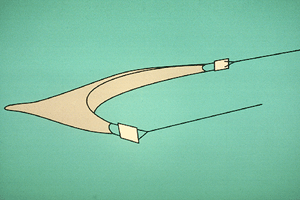
| General Description: The trawl nets are cone-shaped net
(made from two, four or more panels) which are towed, by one
or two boats, on the bottom or in midwater (pelagic). The
cone-shaped body ends in a bag or coded. The horizontal
opening of the gear while it is towed is maintained by
beams ,
otter boards or by the
distance between the two towing vessels (pair
trawling ). Floats
and weights and/or hydrodynamic devices provide for the
vertical opening. Two parallel trawls might be rigged
between two otter boards ( twin trawls ). The mesh size in the
codend or special designed devices is used to regulate the
size and species to be captured. |
| Specific Equipment: According to the type of trawl net
used, netsonde , trawl monitor
sensors (depth, distance, height, speed, symmetry, catch
a.o), otter boards, beam, and other specific equipment can
be employed. |
| Specific Handling Equipment: Winches installed on deck control and
store the warps. Auxiliary
winches , net
drums and lifting tackles are equipment that
assist the handling of the trawl gear. |
| Fishing Vessels using this gear:
Trawlers range
in size from smaller undecked boats, powered by outboard
engines up to large freezer trawlers and factory trawlers
which fish in the most distant waters. |
| Fishing Operations: Trawling is the operation of towing a net
to catch fish and/or shellfish. The trawls are towed either
with bottom contact or in midwater. Different devices
providing the forces to keep the trawls open horizontally
(otter boards, beams and two vessels and vertically (floats
and weights). The catch principle is filtering the water.
The towing speed varies, according to the type of trawl and
trawling, to the target species, etc., from 1 to 7 knots,
the most common being 3 to 5. |
|
| Features |
| Target Species: Bottom, demersal and pelagic species |
| The Gear and its Environment:
|
 | Deployment Area: Trawls are used in sea fisheries and
to a lesser extent also in freshwater where there is
sufficient space for towing and a clean environment
(bottom without too many obstacles, open water without
too much floating debris). |
| Impact on the Environment: See the environmental impact caused
by Bottom
trawls ; Beam trawls ; Midwater trawls . |
| Impact on Aquatic Species: The major potential detrimental
impact of trawling on species can be the capture and
removal from the ecosystem of small sized organisms
and non-target species, which frequently are
discarded at sea. Such impact can be mitigated by
using larger meshes in the codends and/or devices in
the trawl that reduce capture of small and unwanted organisms. |
|
|