| FAO/FIIT Fishing Gear Type Fact-Sheet |
|
| Midwater trawls [TM] | updated : 10-mai-2001 |
|
|
|
| Profile |
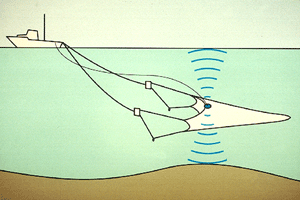
| General Description: A midwater trawl consists of a cone
shaped body, normally made of four panels, ending in a
codend with lateral wings extending forward from the
opening. It is usually much larger than a bottom trawl and
designed and rigged to fish in midwater, including in the
surface water. The front parts are sometimes made with very
large meshes or ropes, which herd the targeted fish inwards
so that they can be overtaken by smaller meshes in the aft
trawl sections. The horizontal opening is maintained either
byotter boards or by towing
the net by two boats (pair
trawling). Floats on the headline and weights
on the groundline often maintain the vertical opening.
Modern large midwater trawls, however, are rigged in such a
way that floats are not required, relying on downward forces
from weights to keep the vertical opening during fishing. |
| Specific Equipment: Asonar is
useful tool to detect fish concentration ahead
the trawler and the trawl path and trawl
depth can be adjusted accordingly. The fishing depth and the
trawl is usually controlled by means of anet
sounder (netsonde) or depth recorder. |
| Specific Handling Equipment: Trawl winches installed on deck
control the trawling wires and store them when not in
use.Gilson winches and
lifting tackle are provided to assist with handling gear at
the vessel.Net drums are common
tools to handle midwater trawls onboard vessels. |
| Fishing Vessels using this gear: This type of trawl may be towed by a single or
two trawlers (pair trawling). |
| Fishing Operations: Midwater trawls are rigged to fish in
midwater, from the surface to great depth depending on the
position of the fish. It may be towed by one or two boats. |
|
| Features |
| Target Species: Pelagic species, sometimes some demersal fish. |
| The Gear and its Environment:
|
 | Deployment Area: Midwater trawling is carried out
mainly at sea, on the continental shelf, sometimes in
deeper waters as well as in some lakes. |
| Impact on the Environment: No impact on bottom habitats and
bottom structures. |
| Impact on Aquatic Species: In most cases it is a single
species fishery, bycatch rates of other species are
low. Incidental catch ofdolphins and marine mammals may
occur in some areas. |
|
|