| FAO/FIIT Fishing Gear Type Fact-Sheet |
|
| Gillnets and entangling nets | updated : 10-mai-2001 |
|
|
|
| Profile |
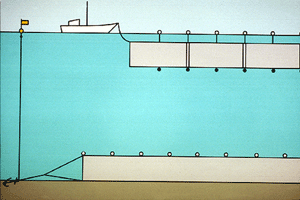
| General Description: Gillnets and entangling nets are
strings of single, double or triple netting walls, vertical,
near by the surface, in midwater on on the bottom, in which
fish will gill, entangle or enmesh. Gillnets and entangling
nets have floats on the upper line (headrope) and, in
general, weights on the ground-line (footrope). Gillnets or
entangling nets consist in single or, less commonly, double
(both are known as "gillnets", strictly speaking)
or triple netting (known as " trammel net") mounted
together on the same frame ropes. Several types of nets may
be combined in one gear (for example,trammel net
combined with gillnet). These nets can be
used either alone or, as is more usual, in large numbers
placed in line ('fleets' of nets). The gear can
set, anchored to the bottom or left drifting, free or
connected with the vessel. |
| Specific Equipment: Small solid floats, usually made of
plastic and spherical, cylindrical or egg-shaped, are
attached to the headrope and weights are evenly distributed
along the footrope. |
| Specific Handling Equipment: Gillnets (any type) can be hauled by
hand, at least from shallow or moderate depth, in
small-scale fisheries (when the total length of net is not
too large). However, the use of gillnet or net hauler is now
very common; sometime apower block
can also be used. The gillnets are, most of
the time, folded on the deck, often within a delimited area
or, in some cases, kept onnet drums. |
| Fishing Vessels using this gear:
Gillnetters
|
| Fishing Operations: The means of capture is that the fish are
gilled, entangled or enmeshed in the netting. Gillnetting
and entangling are two different principles of catching: a
fish being retained by its gills or the whole or part of the
body of the fish being entangled, in the net webbing; one or
the other may happen according to the slack of the netting
on the frame ropes. |
|
| Features |
| Target Species: Pelagic, demersal and benthic species |
| The Gear and its Environment:
|
 | Deployment Area: According to their design, ballasting
and buoyance, these nets may be used to fish near to
thesurface,
inmidwater or at
thebottom, either in
inland and sea waters. |
| Impact on the Environment: Real gillnets, at least those with a
single netting, are, in general, considered as
having a high degree of selectivity, in terms of
fish species, as well as size of the fish which
directly depends on the size of the mesh. Incidental
catch of a number of endangered species such
asturtles,sharks, marine mammals or
seabirds, in certain areas is a matter of growing
concern. Researches are carried out aiming to a
reduction of this risk; at the same time,
International Plans of action for the reduction of
the incidental catch of sharks or the entanglement
of seabird when operating gillnets, were agreed on.
"Ghost fishing", when lost (or discarded)
gillnets, or any piece of netting, drifting or
somehow attached to the bottom, continue, somehow,
is also a serious concern. The use of new material
or mounting can now make that lost nets will not
fish for too long or unlimited time. For the above
mentioned reasons, the United Nations banned, in
1991, the use of large scale high seas driftnets
over 2.5 kilometers long. From the point of view of
environment, in general, it is also worth noting the
low energy consumption for fishing with gillnets. |
|
|