| FAO/FIIT Fishing Gear Type Fact-Sheet |
|
| Bottom otter trawls [OTB] | updated : 10-mai-2001 |
|
|
|
| Profile |
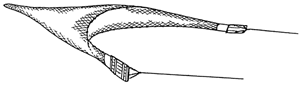
| General Description: A bottom otter trawl is a cone-shaped
net consisting of a body, normally made from two, four and
sometimes more panels, closed by one or
twocodends and with lateral wings
extending forward from the opening. A bottom trawl is kept
open horizontally by twootter
boards. A boat can be rigged to tow a single
or two parallel trawls from the stern or from two
outriggers.Bottom trawls usually
have an extended top panel
(square) to prevent fish from
escaping upwards over the top of the net. The mouth of the
trawl is framed by an headline with floats to open the trawl
vertically and a ground gear, which is designed according to
the bottom condition on the fishing ground so as to maximise
the capture of targets living close to the bottom and at the
same time protect the gear from damage and to facilitate
movements across uneven bottom. |
| Specific Equipment: The horizontal opening of the net is
obtained by two otter boards. The vertical opening is
obtained with floats and/or hydrodynamic devices
(kites) on the upper edge
(floatline) and weights on the
groundrope. Thegroundrope
equipped with rubber
discs,bobbins,spacers
etc. is used at the same time to shield lower leading margin
of the trawl from ground damage whilst maintaining ground
contact. On very rough bottoms specialrock
hopper gears are used. The horizontal
opening of the trawl is obtained by two otter boards (in
cases, forotter twin trawling, two
identical trawls are towed side by side, there will be in
addition to a pair of otter boards, a sledge between the two
nets). There are many models of otter boards: they may be
relatively heavy, made of wood, aluminium and steel or a
combination of these, rectangular or oval shaped and
equipped with a steel sole designed for good contact with
the ground. Instruments to monitor gear performance are
common in modern bottom otter trawling. Such instruments
monitor geometry (door distance, vertical opening, bottom
contact, trawl symmetry a.o), water temperature in trawling
depth, catch, trawl speed and characteristic with selective
grid devices like angle and speed of water flow through the device. |
| Specific Handling Equipment: The main handling equipment of
a trawler is a powerful winch with two
bobbins (or two or more split winches each one consisting in
one bobbin) for storing, shooting and hauling the trawl
warps. The trawlers operating otter trawls
havegallows,gantries
orderricks to handle the heavy
otter boards. The net hauling system varies greatly
depending on the size of the vessel and the type of the
trawl used. A largenet drum can
be used for shooting, hauling and storing the trawl
(including spare ones for additional trawls)). Light wing
trawls may be hauled in bypower
blocks. Heavy bobbin trawls may be lifted
aboard withgilson winches
orquarter ropes. Larger
trawlers are arranged with a horseshoe deck layout for
handling the trawl. |
| Fishing Vessels using this gear: Otter bottom trawls can be used
by side trawlers (are being phased out
gradually), stern
trawlers and outrigger trawlers. The range of
the vessels are from small open boats to large factory trawlers. |
| Fishing Operations: The trawl is designed and rigged to have
bottom contact during fishing and is, depending on the
bottom substrate equipped with different kinds of groundrope
with the purpose of shielding lower leading margin of the
trawl from ground damage whilst maintaining ground contact
and easy move on the bottom. In general the trawler tow a
single trawl. However, recent development is towards
multitrawl rigging where up to four parallel trawls are
towed from the same boat. Twin trawls can be towed from the
stern of the vessel or from outriggers. The latter
technology is widespread in tropical shrimp fisheries where
is called quadtrawling. |
|
| Features |
| Target Species: Bottom and demersal species |
| The Gear and its Environment:
|
 | Deployment Area: Bottom otter trawls can be operated in
a very wide range of depths (from a few meters to around
1500-2000 m), mainly at sea, but also, in some cases in
inland waters e.g. lakes. |
| Impact on the Environment: Bottom otter trawls interact
physically with the bottom sediment, which might
result in removal or damage of sedentary living
organisms (including seaweed or coral) and in the
case of uneven bottom surface displacement of stones
or other larger objects. On flat sandy/muddy bottom
the sediments might be whirled up into the water
masses and suspended. The short and long-term impact
on the bottom environment is still poorly
documented. More research on this impact is urgently needed. |
| Impact on Aquatic Species: The major negative impact of bottom
otter trawls on the biological environment is
related to the capture and frequently discarding of
non target sizes and species both of fish and
non-fish species. Regulation concerning minimum mesh
size in the codend is the most commonly used methods
to limit the capture of non-target fish sizes. In
recent years such size selectivity has been improved
by the introduction of square mesh codends
andselection devices
like grids. Non-target species are normally reduced
by the use of selective devices, like
theTurtle Excluder Device
(TED) in shrimp tropical trawls and
theNordmoere grid to
reduce capture of fish in the northern shrimp fisheries |
|
|