4. Estimates of Water Storage
4.0 Amount of water to be stored
You must first compare your pond water requirements - the water needed to initially fill your pond and to compensate for seepage and evaporation losses (see Section 2) - with the water available from your source (see Section 3).
If you find that your water source provides enough water to fill the pond in a reasonable period of time, to fill it when you want to fill it, and to compensate for water losses throughout the year, you will not need a reservoir.
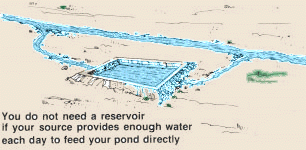
If you find that your water source does not provide enough water to fill the pond and to compensate for water losses at certain times of the year, but there is enough water available over the year, you may decide to build a reservoir and store the water you will need.
If you decide to build a reservoir, you will encounter one of two situations:
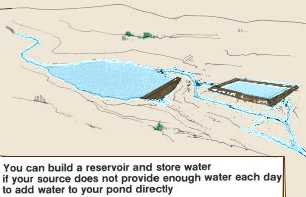
Your source provides a supply of water throughout the year
If your daily water flow is great enough throughout the year to compensate for water losses by seepage and evaporation, but not great enough to fill the pond in a reasonable period of time, and to fill it when you want to fill it, you will only need a reservoir with a volume equal to the pond volume, or even less, since the reservoir is being supplied constantly.
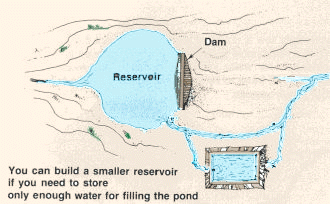
Example
If your daily flow is not great enough throughout the year to fill the pond in a reasonable period of time when you want to fill it, and to compensate for water losses by seepage and evaporation, the reservoir will have to be large enough to provide for the total water requirements.
Example
Your water source dries up completely at certain times of year
If your source does not supply water throughout the year, but dries up at certain times, you should plan to fill your pond during the year either from a reservoir, or directly from the source at a time when there is enough water available.
If you are able initially to fill your pond at a time when water is available, your reservoir need only contain enough water to compensate for water losses by seepage and evaporation during the dry season.
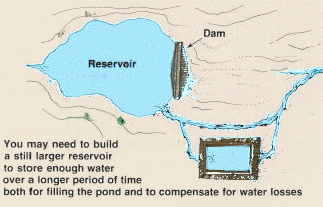
If you are unable initially to fill your pond at a time when there is water available, you may need to build a larger reservoir to store water over a longer period of time, and that will contain enough water to fill the pond and to compensate for water losses.
Water losses by seepage and evaporation from a reservoir
A reservoir is subject to water losses by seepage and evaporation just as a pond is. To offset water losses from a reservoir, plan the water volume of the reservoir 1.5 times greater than the water volume you require to satisfy total water requirements.
Example
4.1 Selecting a site for a reservoir
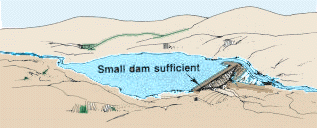
If you are going to build a reservoir, look for a site that will allow you to retain the greatest volume of water with the smallest dam possible. Dams require a great deal of work to build and to maintain, and the smaller the dam, the better.
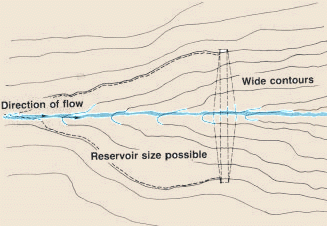
Avoid a site in a valley, relatively open and wide at the downstream end. At such a site you will have to build a large dam.
An unsatisfactory site for a reservoir

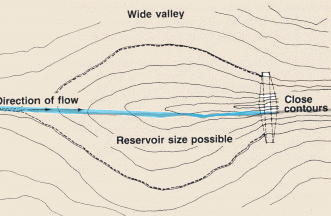
The ideal site for a reservoir is in a wide valley which narrows suddenly, with steep sides at the downstream end. The narrower the valley end, the smaller the dam will have to be.
Example
Choose a site with good soil, which will hold water well. Avoid a sandy site. The place you choose should not have areas of sand that are too large to seal against water loss. If there are large sandy areas, it may be better to look for another site.
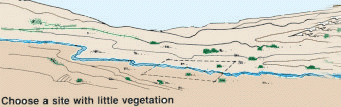
It is good to clear the site of vegetation before building a reservoir. If you plan to do this, avoid choosing a site with too many large trees, which may be difficult to remove.
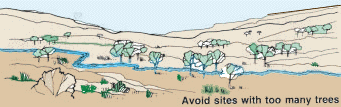
You should choose a site where you can build a reservoir large enough to satisfy your total water requirements. It may be to your advantage to find more than one possible site and choose among them on the basis of:
- Your water requirements (see Section 2.3);
- How large a reservoir is possible at each site (see Section 4.2);
- The topography, soil and vegetation present at each site, as you have seen in this section.
Note: if the water flow of a stream increases greatly during the rainy season, it may be difficult to maintain a dam during this period. If the water level becomes too high the dam may be washed away.
Example
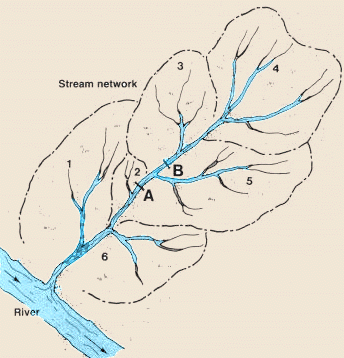
4.2 Determining characteristics of a reservoir
When you have chosen a suitable site for a reservoir and have decided on the place to build the dam, you will have to determine the height of the dam you should build to store the volume of water required. To do this you will need to make one or more approximations to find the reservoir size that will give you the volume desired.
But first you will have to decide on the type of dam you will build. A dam may be built either without a spillway (when the stream water flow is relatively small and constant throughout the year) or with a spillway (when the stream flow is relatively large and/or when it greatly varies from one season to another). If conditions allow it, you should build a dam without a spillway, since it is easier to build. What is a spillway?
Estimating the volume for a reservoir without a spillway
This is a relatively simple method that will give you a rough estimate of reservoir volume. If you plan to build a dam without a spillway, this rough approximation will be enough.
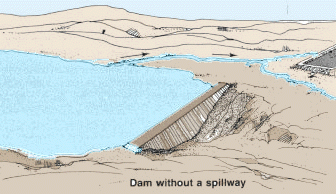
First approximation
Begin by assuming a maximum water depth at the dam of 1.5 m.
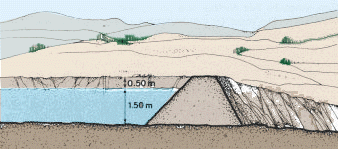
Determine and mark the contour line at this assumed maximum water level using topographical measuring devices. The contour, when marked, will outline the extent of the planned reservoir.

Now measure this contour line (in m) and calculate the approximate volume of water (in m3) that can be held in a reservoir of this size and maximum depth (1.5 m). To do this:
- Square the length of the contour line;
- Divide the result by 37.5 (conversion factor);
- Multiply by the assumed maximum water depth (in this case, 1.5 m) to find the approximate reservoir volume.