A REPORT PREPARED
For
Integrated Rural Fisheries Development Project
NIR/87/010
By
Nyoman Deri
Master Fisherman
This electronic document has been scanned using optical character recognition (OCR) software and careful manual recorrection. Even if the quality of digitalisation is high, the FAO declines all responsibility for any discrepancies that may exist between the present document and its original printed version.
1. Introduction and terms of reference
2.1 Infrastructure
2.2 Activity
4. Conclusions and recommendations
4.1 Conclusions
4.2 Recommendations
The Integrated Rural Fisheries project NIR/87/010 is executed by the Food and Agriculture Organization of the United Nations, to provide necessary technical assistance to Federal Government of Nigeria in the Federal Department of fisheries in their plans to boost Fish production from these core sector of Fisheries in Nigeria.
The project also aims to increase per capita income of artisanal Fisherman through introduction of modern Fishing Technology in order to attract young school leavers into the fishing industry and curb the Rural-Urban drift.
Introduction of new and innovative fishing gear along with small mechanized fishing boats, training of artisanal fisherman and National counterparts was ones of the project objectives that was recognized as the most effective way of bringing modern developments in Fishing Technology to the door-steps of artisanal Fishermen.
Such a development is also the most logical first step in upgrading the artisanal fishermen from the traditional canoe.
In order to attain these sectorial objectives a FAO Master Fisherman was assigned for 24 months to the project from 1st August, 1989 to 31st July, 1991 with terms of reference as follows:
- Test, demonstrate and evaluate the small mechanized fishing boats developed and introduced by the project and develop innovative fishing gear and methods suited to the area.- Conduct village level vocational training courses and train local fishermen in modern fishing technology and upgrade them to be operators of mechanized fishing boat.
- Train National counterparts in small boat fishing technology.
- Assist in setting up a net-loft at the center and undertake the local fabrication of modern fishing gear.
- Submit a brief report of the activities and recommendations to the Director FIO at the end of his assignment.
2.1 Infrastructure
2.2 Activity
Koko is situated 65 km from Benin City the capital of Bendel State. It is the last town upstream of the river mouth linked by road.
Ogheye is the Koko Fisheries Center sub-station and located on the west bank
of the Benin River mouth.
Ogheye is only accessible by boat, there are no roads, water, electrical or
medical facilities and the village suffers from Atlantic Ocean erosion.
The main activities of the villagers are fishing and fisheries related industries. Koko to Ogheye is 45 km, 1,5 hours by fast boat or 5 hours with the project wooden trawler (9,26m).
The Project identified facilities necessary to the Koko Center in order to commence activity. Some infrastructure was in existence from the former project activity of NIR/77/001.
2.1.1 OFFICE AND COMPOUND
A building housed two small offices, one for Federal and one for State Administration purposes. A small storeroom and workshop are being connected to the offices in the compound.
No office facilities were available for project staff. Electrical power supplied by NEPA (National Electrical power authority) formerly intermittent has at present failed completely due to the grid transformer burning out. Not water supply is connected to the compound.
2.1.2 JETTY
A wooden 'T' shaped jetty that had been built by the former project was destroyed during a storm in June, 1990 and has since been rebuilt by NIR/87/010.
2.1.3 VESSELS
Two (2) transport boats were made available to carry project staff from Koko to Ogheye.
Two (2) GRP banana boats produced at the Igbokoda boat yard were introduced to local fishermen. These boats were used intensively for fishing activities using nets and gear designed by the project.
The prototype wooden trawler (9,26m) built by the former project was transferred to the Koko Center in march 1990.
Because repairs were necessary to the hull and engine it was not operational until February, 1991.
2.1.4 WORKSHOP
A small workshop for outboard motor maintenance was established by the project using part of the storeroom. The workshop has basic tools including gas and electric welding equipment and an air compressor.
2.1.5 NET LOFT, ICE PLANT AND COLD STORAGE ROOM
These government inputs were not established due to financial constraints.
2.1.6 ACCOMMODATION
Koko
A semi detached house containing two complete living units situated side by side was rented by the Federal Department of Fisheries as guest house accommodation for project staff. Due to the electrical and water supply problems that occurred, project staff were unable to live there.
Ogheye
The guest house built by the former project had deteriorated into very bad condition. A new guest house under construction by the Federal Department of Fisheries since February, 1990, has not yet been completed due to financial constraints.
2.1.7 NATIONAL STAFF
The Koko center is staffed by Federal Department of Fisheries (F.D.F.) and State fisheries, of Bendel State. The center head is Senior Fisheries Officer, Mr C. C. Moneke F.D.F.
There was fourteen National staff in position since commencement of the project of which 10 (ten) are from FDF and 4 (four) are from State Fisheries. In addition 3 (three) casual laborers were also employed by FDF to serve as security guards of which they are always changing almost every six months due to the fact that their salary was not paid on time.
A list of the staff are attached in appendix 1.
2.2.1 SURVEY OF EXISTING FISHING GEAR
Upon arrival at the Koko duty station in August, 1989 activities relating to Fisheries and fishing gear construction commenced immediately.
A survey of existing fishing gear and methods used by local fishermen was carried out in the project site area. Improvements to fishing gear and methods were identified and modifications were carried out. (Report November, 1989)
2.2.2 ON THE SPOT TRAINING
While awaiting the project order of fishing gear inputs on the job fisheries training was initiated in the villages of Ogheye and Ugogegin. The master fishermen visited the villages regularly every week and stayed there for 3 to 4 days in a week. This activity formed a good relationship between project staff and the local fishermen.
2.2.3 INTRODUCTION OF NEW FISHING GEAR
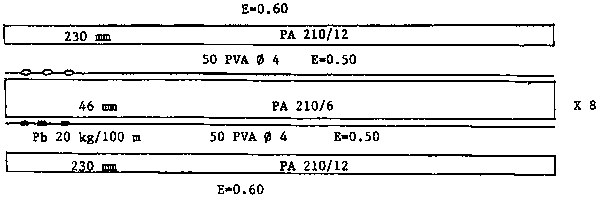
The introduction of new methods such as trammel nets was carried out by the project. 400m of this type of net were constructed and fisheries demonstrations commenced in November, 1990 in conjunction with the formation of the Fisherman's cooperative. Results from this method of fishing were very encouraging.
During the period November 90 to March 91, 20 fishing trips where made with above gear The total fish catch was 686 kgs and average catch per fishing trip was 34.3 kgs.
Catch data are attached in appendix II
Design of the net is attached in appendix V
2.2.4 VOCATIONAL TRAINING COURSE
A village level vocational training course geared towards the construction and mending of various types of fishing gear was conducted in Ogheye village and the Koko center.
Five courses with a duration of two weeks each was organized. Training of local Fishermen on the operational methods of small boat mechanized fishing was given, using the project 9,26 m wooden trawler.
Over 100 artisanal fishermen benefited from the training given in this course, in addition, 45 were trained in outboard motor operation and the repair and maintenance of outboard motors
2.2.5 TRAINING OF NATIONAL COUNTERPARTS
On the job training of national counterparts began at Koko soon after the arrival of the master fisherman.
The counterparts were Federal and State Fisheries staff not familiar with artisanal fisheries methods.
Their experience was with trawling only. However, through intensive training ashore and at sea, the counterparts were familiarized with different methods of fishing and were eventually able not only to design and construct various types of net, but also became able to use them at sea successfully.
2.2.6 IMPLEMENTATION OF DRIFTNET
The implementation of drift net fishing methods using different twine size (210/9) with a mesh size of 140 mm stretched mesh was successfully carried out by the project in harmony with the cooperative societies in the villages.
The results from this experimental type of fishing gear were very encouraging with the fishermen feeling confident that this type of net has a better catch rate than nets made of thicker twine size. They realized that the thinner twine is less visible under water making a zero catch day less frequent.
About 1 000 m of this net was constructed during the training course. During
the period Nov 90 to Jan 91, 23 fishing trips where made with a total catch
of 935 kgs of fish.
Average catch per trip was 40,6 kg.
Catch data is attached in appendix III and design of the net in appendix VI
2.2.7 MODIFICATION OF SHARK NET
Modification of the local shark net (Ususu net) were also carried out by the project in order to improve its fishing efficiency.
The local design of this net has no leads or lead line.
Modifications were made to include this at a ratio of 10 kg per 100 m. Fishing with this modified net was carried out in conjunction with Co-operative fishermen and showed a marked improvement
The fishermen were impressed with the improved catch rate and concluded that the modified net fished more efficiently than the traditional type.
Unfortunately, only 250 m of this net was available for use during the exercise. Not enough to satisfy the demands of the fishermen who requested more net from the project through the cooperative.
During the period Dec 90 to March 91, 18 Fishing trips where made with a total catch of 1276 kgs or 70.8 kg average. Catch data are attached in (appendix IV) and design of the gear in appendix VII.
2.2.8 SMALL MECHANIZED FISHING BOATS INTRODUCED BY THE PROJECT.
The prototype small mechanized fishing boat developed and introduced by the project for the artisanal fishermen was successfully tested using drift net and bottom set nets.
In addition, the boat was used to train fishermen in mechanized boat handling and engine operation.
2.2.9 INTRODUCTION OF GRP BANANA CANOES.
The 7,96 m GRP banana canoes type A85 and A86 produced at the boatyard in Igbokoda were successfully tested and demonstrated by project staff at Koko.
Fishing demonstrations were given to the Co-operatives of Ogheye and Ugogegin Villages.
The canoe proved to be sea-worthy, performing well-at sea, and was well accepted by the local fishermen. More than 65 night fishing trips were made with the canoe between November, 1990 and April, 1991.
2.2.10 ESTABLISHMENT OF STEERING COMMITTEE.
A steering committee was established following the arrival of the project Team Leader in Koko. Its purpose was to identify and solve problems encountered locally that affected the development of fisheries as well as monitoring the activity. A monthly meeting was held at the office of the State Fisheries Department.
2.2.11 CONSTRUCTION OF SMOKING KILN.
Chorkor type smoking kiln with size of 1 × 1 × 0.80 m was built at Ogheye by the fish processing consultant.
Smoking of fish was also demonstrated in order to show to the local fish processor the difference between chokor smoker and traditional smoker.
A similar type of kiln was also built at Koko Center by project staff.
2.2.12 INSTALLATION OF WATER TANKS.
In order to help the community at Ogheye to collect and store rain water, the project staff installed three 500 gallons Fibre-glass tanks in the village. Two of these tanks where installed at the primary school compound and one at fisheries guest house. In addition, one similar tank was also installed at Koko center.
Favorable results have been achieved by the intensive theoretical and on the job training given by the project to both Federal and State Fisheries counterparts. They are now able to perform their work more efficiently and are able to design, construct and use several types of gill nets in fishing operations.
The introduction of gill nets of twine size (210/9) with mesh size 140 mm and modification of shark net received a good response in local fishing communities with many fishermen requesting nets from the project.
The village vocational training courses concerning the various aspects of artisanal fisheries has had a positive impact on the participants;
The courses left an imparted knowledge with the fishermen so that they can construct and mend their own nets.
The two 9,2 m prototype mechanized wooden trawlers which were completed in 1987 have been successfully tried and demonstrated by the project.
They were also used to introduce and train local operators in mechanized fisheries.
The 7,96 m GRP were also tested and well demonstrated.
Regular visits to villages by the master fisherman to give on-the-job training was well accepted by the fishermen and a good working relationship developed between the project staff and local target groups.
4.1 Conclusions
4.2 Recommendations
The limitation of funds with which to operate the center made progress very slow. Most of the facilities intended are still not established.
Training regarding the handling and construction of nets and net mending had to be carried out in the yard of the compound or along the pier jetty due to lack of proper covered facilities.
Without shelter, this operation could not be continued in the rainy season.
Cooperation between local staff (Federal contra State) is inadequate due to confusion over the management of the center, whether it is the responsibility of the Federal or State Departments.
The Federal Center manager found it very difficult to control State fisheries staff. The staffing of the Koko center is a problem and requires serious consideration in future project activity.
In 1980 the Government of Nigeria lunched a subsidiary scheme for artisanal fishermen which included: outboard motors, spare parts and netting materials. Under the scheme many fishermen were able to obtain their own boats, nets and outboard motors which gave them the capacity to go further out to find new fishing grounds.
The objective of all this was to facilitate and develop the fishing Industry as a whole.
However to achieve this development, that is, to make fishermen aware and understand the meaning and importance of increasing their standard of living by modernizing their efforts, the willingness and ability of fishermen to implement efficient development needs to be complimented with extension activities.
To conduct these activities extension officer must have a wide practicable knowledge in relevant methods of fishing. They also have to be patient with criticism because it is known that traditional Fishermen are very difficult to motivate and made to accept new or even modified technology. However, Fishermen will eventually follow advice given by extension officers if the advice is proven to bring benefits and profit.
4.2.1 VILLAGE LEVEL VOCATIONAL TRAINING COURSE:
It is recommended that training of the above nature-should be regularly conducted by the National counterpart staff in order to upgrade artisanal fishermen in the various aspects related to the local industry.
Training course participants should not number more than fifteen (15) persons, and it should not be conducted during the fishing season.
Emphasis should be place more on practical efforts rather than theoretical.
4.2.2 OPERATION OF PROJECT BOAT
An operational work plan should be formulated at the Koko center to ensure the continued operation of Fishing effort following the termination of the project.
Basic fishing gears such as drift nets, bottom set gill nets and trammel nets -designed by the project should continue to be adopted.
4.2.3 EXTENSION SERVICE
The extension service should be restored, incomplete facilities require completion and must be made operational. A full time extension worker should be based at the center and suitably equipped to carry out the duty.
Equipment such as boats and nets for demonstration purposes, transportation and communication equipment should be provided.
4.2.4 FISHING INPUT
A solution needs to be found to counter the high prices of fishing gear, engines and spare parts. The high prices of equipment is a major constraint in the development of artisanal fisheries.
4.2.5 FISHING RIGHT
Stricter control of fishing rights should be exercised by the trawling fleet, conflicts exist between trawlermen and artisanal fishermen because of the fact that the trawlers fish close to the shore and not only disturb and deprive the grounds used by artisanal fishermen, but cause considerable damage to their gear, sometimes causing losses of equipment.
4.2.6 SECURITY
During the period September 1989 to November 1989 Koko Center experienced robberies (twice) and 4 (four) units of outboard motors and fuel tanks where taken away. This happened because security in the center is inadequate.
In order to secure the properties of the project in the center, it is therefore recommended that permanent security guards should be employed (one for day time and two for night time). In addition, an already damaged wire fence surrounding the office compound should be replaced by a concrete wall.
Appendix I
NATIONAL PROJECT PERSONNEL-KOKO CENTER
|
NO |
NAME OF INCUMBENT |
POST DESCRIPTION |
AGENCY |
|
1 |
MR. G.G. MONEKE |
Center manager |
Federal Fisheries |
|
2 |
MR. T.C. MODUNGWO |
Fish processing/counterpart |
do |
|
3 |
MR. F. EGBAIYELO |
Senior masterfisherman/ counterpart |
do |
|
4 |
MR. A.O. BANGBOSHE |
Master fisherman/counterpart |
do |
|
5 |
MR. P. OBOBAIFO |
Fisheries extention/National counterpart |
do |
|
6 |
MR. K. DAWODU |
Engineer |
do |
|
7 |
MR. J. OMATSEYE |
Fisheries extention counterpart |
do |
|
8 |
MR. C. OGUNOROBO |
Driver/mechanic |
do |
|
9 |
MR. J. IGBEN |
Outboard Motor Driver/Mechanic |
do |
|
10 |
MR. M. EDOMI |
Security |
do |
|
11 |
MR. L. ONYECHE |
Senior fisheries officer |
State Fisheries |
|
12 |
MR. P.N.E. UZI |
Engineer |
do |
|
13 |
MR. U. MEGA |
Fisheries Superintendent |
do |
|
14 |
MR P. AYINAKE |
Fisherman |
do |
|
15 |
MR A. AWALA |
Security/Casual |
|
|
16 |
MR B. AKWE |
Security/Casual |
|
|
17 |
MR A. OBAZUAYE |
Security/Casual |
|
Appendix II
FISHING LOG
Fishing gear: Trammel net (400 m)
|
Trip No |
Date |
Fishing Ground |
Depth (m) |
No of Haul |
Fish catch (Kg) Catfish/Croaker/Other |
Total catch |
Remarks |
||
|
1 |
6/11/90 |
Off Ogeye |
12 |
1 |
7 |
2 |
- |
9 |
Many crabs |
|
2 |
20/11/90 |
Off Ogeye |
10 |
1 |
8 |
7 |
- |
15 |
Net twisted |
|
3 |
29/11/90 |
Off Ogeye |
16 |
1 |
25 |
13 |
5 |
43 |
|
|
4 |
30/11/90 |
Off Ogeye |
18 |
1 |
20 |
15 |
11 |
46 |
|
|
5 |
1/12/90 |
Off Ogeye |
16 |
1 |
16 |
7 |
2 |
25 |
Jellyfishes |
|
6 |
7/01/91 |
Off Ogeye |
12 |
1 |
20 |
10 |
5 |
35 |
|
|
7 |
17/01/91 |
Off Ogeye |
18 |
1 |
25 |
13 |
12 |
50 |
|
|
8 |
18/01/91 |
Off Ogeye |
18 |
1 |
15 |
10 |
7 |
32 |
|
|
9 |
22/01/91 |
Off Ogeye |
14 |
1 |
6 |
4 |
6 |
10 |
Small fish |
|
10 |
30/01/91 |
Off Ogeye |
18 |
1 |
8 |
- |
- |
8 |
|
|
11 |
31/01/91 |
Off Ogeye |
18 |
1 |
9 |
11 |
9 |
29 |
|
|
12 |
21/02/91 |
Off Ogeye |
15 |
1 |
45 |
15 |
10 |
75 |
Small fish |
|
13 |
22/02/91 |
Off Ogeye |
12 |
1 |
20 |
8 |
8 |
36 |
|
|
14 |
23/02/91 |
Off Ogeye |
15 |
1 |
40 |
20 |
9 |
69 |
|
|
15 |
24/02/91 |
Off Ogeye |
15 |
1 |
15 |
15 |
6 |
36 |
|
|
16 |
29/02/91 |
Off Ogeye |
15 |
1 |
14 |
18 |
22 |
54 |
|
|
17 |
17/03/91 |
Off Ogeye |
12 |
1 |
10 |
12 |
18 |
40 |
|
|
18 |
20/03/91 |
Off Ogeye |
18 |
1 |
9 |
7 |
4 |
20 |
|
|
19 |
21/03/91 |
Off Ogeye |
12 |
1 |
8 |
8 |
2 |
18 |
|
|
20 |
22/03/91 |
Off Ogeye |
15 |
1 |
8 |
10 |
3 |
21 |
|
|
21 |
24/03/91 |
Off Ogeye |
15 |
1 |
5 |
2 |
2 |
9 |
|
APPENDIX III
FISHING LOG
Fishing gear: Driftnet (1000)
|
Trip No |
Date |
Fishing Ground |
Depth |
No of Haul |
Fish catch (Kg) |
Total catch |
Remarks |
||
|
1 |
6/11/90 |
Off Ogeye |
12 |
1 |
30 |
10 |
- |
40 |
Small fish |
|
2 |
7/11/90 |
Off Ogeye |
12 |
1 |
20 |
10 |
3 |
33 |
|
|
3 |
16/11/90 |
Off Ogeye |
14 |
1 |
20 |
7 |
2 |
29 |
|
|
4 |
21/11/90 |
Off Ogeye |
18 |
1 |
40 |
20 |
10 |
60 |
|
|
5 |
22/11/90 |
Excravos |
18 |
1 |
30 |
15 |
7 |
52 |
|
|
6 |
23/11/90 |
Excravos |
15 |
1 |
15 |
10 |
3 |
28 |
|
|
7 |
24/11/90 |
Excravos |
15 |
1 |
12 |
9 |
- |
21 |
|
|
8 |
25/11/90 |
Excravos |
18 |
1 |
16 |
9 |
2 |
27 |
|
|
9 |
27/11/90 |
Off Ogeye |
18 |
1 |
10 |
3 |
- |
13 |
Net twisted |
|
10 |
28/11/90 |
Off Ogeye |
16 |
1 |
20 |
3 |
3 |
26 |
|
|
11 |
30/11/90 |
Off Ogeye |
18 |
1 |
20 |
8 |
6 |
34 |
|
|
12 |
7/12/90 |
Off Ogeye |
15 |
1 |
25 |
13 |
10 |
48 |
|
|
13 |
9/12/90 |
Off Ogeye |
24 |
1 |
8 |
- |
2 |
10 |
Jellyfish |
|
14 |
11/12/90 |
Off Ogeye |
24 |
1 |
15 |
7 |
5 |
27 |
|
|
15 |
12/12/90 |
Off Ogeye |
18 |
1 |
10 |
6 |
7 |
23 |
|
|
16 |
9/01/91 |
Off Ogeye |
16 |
1 |
20 |
5 |
5 |
30 |
|
|
17 |
19/01/91 |
Off Ogeye |
18 |
1 |
50 |
17 |
5 |
72 |
Small fish |
|
18 |
20/01/91 |
Off Ogeye |
18 |
1 |
40 |
15 |
19 |
74 |
|
|
19 |
21/01/91 |
Off Ogeye |
18 |
1 |
14 |
- |
2 |
16 |
Day time |
|
20 |
23/01/91 |
Off Ogeye |
14 |
1 |
46 |
12 |
9 |
67 |
|
|
21 |
24/01/91 |
Off Ogeye |
15 |
1 |
40 |
15 |
8 |
63 |
|
|
22 |
25/01/91 |
Off Ogeye |
18 |
1 |
35 |
21 |
10 |
66 |
|
|
23 |
20/01/91 |
Off Ogeye |
16 |
1 |
46 |
19 |
11 |
76 |
Small fish |
APPENDIX IV
FISHING LOG
Fishing gear: Shark net (240 m)
|
Trip No |
Date |
Fishing Ground |
Depth (m) |
No of Haul |
Fish catch (Kg) |
Total catch |
Remarks |
|||
|
1 |
5/12/90 |
Off Ogeye |
32 |
1 |
40 |
- |
20 |
25 |
85 |
|
|
2 |
8/12/90 |
Off Ogeye |
32 |
1 |
20 |
- |
5 |
5 |
35 |
|
|
3 |
8/01/91 |
Off Ogeye |
28 |
1 |
7 |
- |
- |
40 |
47 |
|
|
4 |
10/01/91 |
Off Ogeye |
24 |
1 |
4 |
- |
|
3 |
7 |
Net twisted |
|
5 |
13/01/91 |
Off Ogeye |
18 |
1 |
20 |
30 |
5 |
10 |
65 |
|
|
6 |
19/01/91 |
Off Ogeye |
18 |
1 |
1 |
20 |
- |
- |
20 |
Day fishing |
|
7 |
20/01/91 |
Off Ogeye |
18 |
1 |
10 |
- |
- |
20 |
30 |
Day fishing |
|
8 |
21/01/91 |
Off Ogeye |
18 |
1 |
12 |
|
- |
26 |
38 |
|
|
9 |
24/01/91 |
Off Ogeye |
20 |
1 |
30 |
100 |
15 |
5 |
150 |
|
|
10 |
25/01/91 |
Off Ogeye |
18 |
1 |
40 |
30 |
11 |
9 |
90 |
|
|
11 |
27/01/91 |
Off Ogeye |
18 |
1 |
10 |
60 |
5 |
|
75 |
|
|
12 |
28/01/91 |
Off Ogeye |
18 |
1 |
15 |
55 |
9 |
11 |
90 |
|
|
13 |
9/03/91 |
Off Ogeye |
15 |
1 |
26 |
100 |
21 |
19 |
166 |
|
|
14 |
10/03/91 |
Off Ogeye |
18 |
1 |
15 |
|
- |
15 |
30 |
Badweather 650 m net lost |
|
15 |
13/03/91 |
Off Ogeye |
18 |
1 |
48 |
|
- |
11 |
59 |
|
|
16 |
22/03/91 |
Off Ogeye |
15 |
1 |
29 |
10 |
- |
6 |
45 |
|
|
17 |
24/03/91 |
Off Ogeye |
20 |
1 |
104 |
60 |
8 |
9 |
181 |
|
|
18 |
25/03/91 |
Off Ogeye |
20 |
1 |
61 |
- |
7 |
- |
68 |
|
APPENDIX V
Trammel Net
Taplings Length: Lint 138 mm/6 meshes
Armouring 138 mm/1 mesh
APPENDIX VI
Drift Net
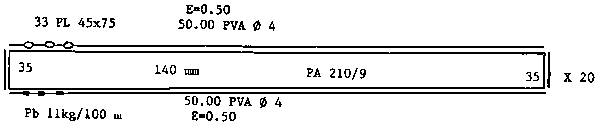
Staplings Length: 140 mm/2 mesh
APPENDIX VII
Drift Net (Shark)
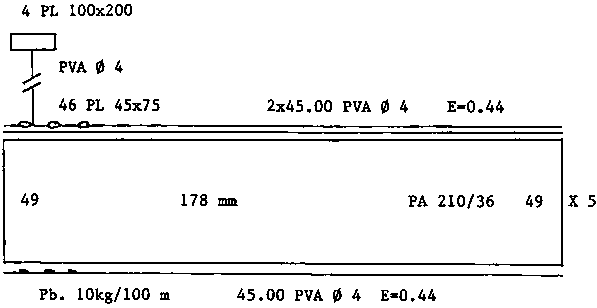
Staplings Length: 160 mm/2 mesh

