1. General Introduction of a Fish
2. Introduction of Fish Culture
3. What Fish to Culture?
4. Cultivable Fish Species
5. What is a Fish Pond?
6. How to Construct a Fish Pond?
7. Pond Fish Culture
8. Record Keeping
9. Problems of Fish Culture
(Prepared for Fishery and Extension Staff)
Prepared by
K.G. RAJBANSHI
Aquaculturist - Consultant
PAK/94/005
1996
1.1 What is Fish?
1.2 Different Types of Fresh Water Fishes.
1.3 Why Fish is Liked as Food?
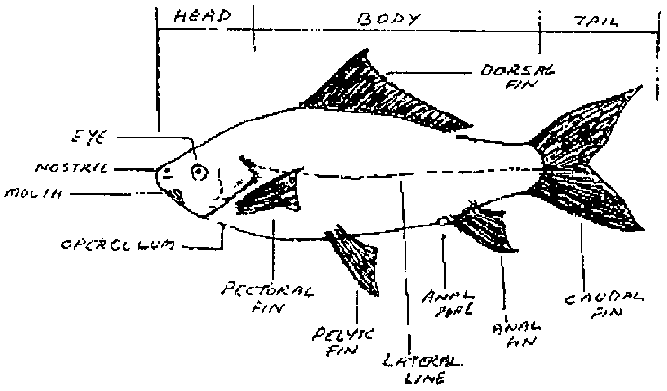
Like any other animal, Fish is also an animal. It lives in water, swims around by means of its body movement and different shaped and sized organs, located at different parts of body called - fins, respires by absorbing oxygen dissolved in the water by means of its special organ called gills, situated on the both sides at the posterior part of the head. The fish has special character for adjusting its body temperature with its media - the water in which it lives. Because of this character, the fish is also called "Cold Blooded Animal". Generally, the body of a fish is broadly divided into three parts; head, body and tail. The fishes are of various shape and of different kinds. The size of fish varies from few centimeters to few meters long even. Small size fish weigh only few grams while the bigger one may even range to over hundreds of kilograms. Some of the fishes live in estuaries and other live in salt water of sea.
Azad Jammu and Kashmir (AJK), being a land locked state, she has only fresh water fishes. There are about 40 different kinds of fresh water fishes in AJK. They range from a small size of few centimeters to bigger size too. These fresh water fishes can't live in sea water.
The fresh water fishes are of two different types;
1) the fish having scales on the body are called Cyprinids and
2) the fish having no scale on body are called Silurids.
The later type of fish differs from the former type in also having second dorsal fin on the body just behind the main dorsal fin in the form of small muscular structure. On the basis of water temperature, these fresh water fishes are broadly grouped into two;
a) Cold Water Fishes and
b) Warm Water Fishes
a) Cold Water Fishes: The different kinds of fishes which prefer to live in lower water temperature are called Cold Water Fishes. Out of many other varieties of cold water fishes Schizothorax spp. locally known as Sawati and Tor spp. locally known as Mahaseer are very famous and are distributed in the cold waters of the central and northern districts. The former fish is very famous for its taste while the later one is very famous for angling than for its taste. Many more different kinds of cold water fishes are also available in AJK.
Schizothorax spp.
Tor spp. - Cold Water Fishes of AJK

Besides the above mentioned fishes, two exotic cold water fishes e.g. Brown Trout and Rainbow Trout have been also introduced long time ago in AJK. The former fish has been released in free waters of northern most district of AJK while the later one is being cultured in the exiting four hatcheries of public sector in limited scale and
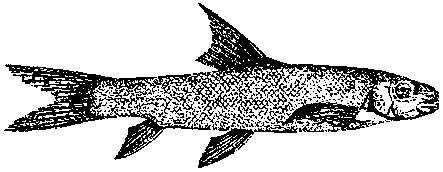
b) Warm Water Fishes: The different kinds of fishes which prefer to live in warm waters of the warmer climatic regions are called Warm Water Fishes. Out of many other varieties, Rohu, Mori and Thaila are abundantly distributed in the rivers, streams and reservoirs of southern districts. All the three fish species are famous for their taste. Besides these fishes, there are many other fishes like Wallgoo attu, Mystus singhala locally known as Molli and Singhada respectively are available in the waters of southern districts.
Rohu
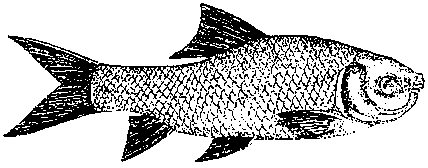
Mori
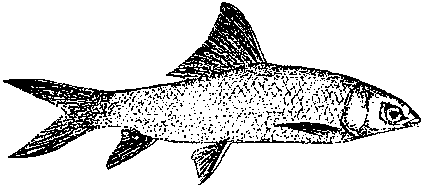
Thaila - Warm Water Fishes of AJK.
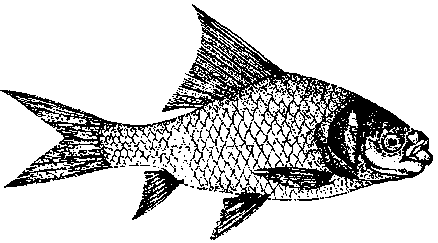
Fish forms an excellent food for human being because of many reasons;
a) very rich in protein.
b) its protein is easily digestible to maximum even by child or also by old person
c) the meat is less fatty and
d) it is cholesterol free meat.
Because of the above quality, the fish meat is called "White Meat" and is recommended to consume even by the ailing person and heart patient. Fish is highly recommended diet particularly to the small children as well as to pregnant and breast feeding women to meet their protein requirement for better growth.
2.1 Why Grow Fish?
2.2 What is Fish Culture?
2.3. Benefits of Fish Culture
In old days there were enough fish in the natural waters such as rivers, streams, swamps and canals from where the fish were caught and supplied enough to people. Today, the situation has changed as there arc fewer fish to catch from the rivers and streams. The reason for this is that, there are many more people due to uncontrolled population growth, so too many fish have been taken from the water. Moreover, the deterioration of environment by deforestation, building of small and big dams for hydropower and irrigation, building of roads, bridges and ever increasing urbanization have not only put maximum fishing pressure but they have also destroyed many fish breeding grounds as a result the fish population has sharply depleted in all waters bodies and now fish is being scarce day after day.
Therefore, for the better health of the people the most nutritious food -the fish need to be made available in the small settlements like villages as well as bigger settlements like town or city for which people should start to raise fish as per the potentiality of a place.
When a last growing improved variety of fish having good taste are cultured in small and controlled water body under controlled conditions and management is called Fish Culture. Like in Agriculture, in fish culture also, the water body is prepared, fertilised, stocked with cultivable fish species, fed with supplementary food and grown to bigger size and ultimately harvested when they attain marketable size.
Fish Culture is being one of the most productive culture practice, therefore, fish culture is very common and widely practised in most of the countries of the world. This fish culture practice do not only produces nutritious food - fish for the improving nutritional status but also helps in generating income and provide job opportunities to the mass of the people. The fish culture is comparatively easier, thus a person affords to look after larger production areas in compare to other agricultural activities. Moreover, by this practice system, fish is produced at low and lower cost and the increased production give economic benefit to the grower. The construction of a water body in the form of small or big pond do not only facilitates to carry fish culture but it also helps in conserving water to use as per the need arises e.g. to fight against the fire or to save the major agricultural crop by irrigation in drought condition.
Fish Culture is beneficial activity as it extends several direct and indirect benefits;
a) in addition to agriculture and animal husbandry, fish culture provides a new commercial avenue,b) provides easily digestible protein rich food - fish, which helps in improving nutritional status of the mass,
c) its production provide additional income to the growers and thus uplifts their purchasing power,
d) moreover, an integrated fish culture approach with (mils - banana/papaya and vegetable farming, with cattle or poultry and duck farming, do not provide fish only but provide many other agricultural and animal husbandry products at low or lower cost which are essentials to the mass and
e) the introduction of integrated fish culture also opens job opportunities to the mass.
Therefore, as per potentiality of a place, fish culture activity need to be promoted for not only to increase the fish production but also to provide the job opportunities to the mass.
3.1 Different Species of Fishes
3.2 What are the Cultivable Fish Species?
3.3 The Carps
3.4 Selection Criteria of a Fish for Culture
There are 40 different species of fresh water fishes in AJK. All these different kinds of fish are not useful to culture in the pond. The cold water fishes grow very slow. Thus they turn out very expensive to the mass of the people. There are many varieties of fish in warm waters of AJK. Some of them are small or smaller in size while others fish species feeds on other fish. Thus they also turn out uneconomical to culture.
Therefore, certain species of fish having different cultivable characters are selected for culture to increase fish production.
All the different kinds of fishes are not cultivable as they have different feeding habits. Some of the fish feeds on only plant origin food, so they are called herbivorous while other fish feeds on insects and its larvae are called insectivorous. Some other fish feed on only fish, they are called carnivorous and while some other fish feed on any thing available in the pond ecosystem and are called omnivorous. The different kinds of fish besides carnivorous can be cultured with other kinds offish as they coexist together without competing with other fish for food. But the carnivorous fish feeds on the other fish and thus it lowers down the fish production. Therefore carnivorous fish is never included together with other fish in culture practice. The carnivorous fish if cultured in mono species system with supplementary feed. Due to supplementary feed, the production of carnivorous fish turns out expensive and again it remains beyond the capacity of the mass of the people. But the herbivorous and omnivorous fishes are easily cultured together and these fishes are mostly of Carp family and are called Cyprinids. In culture practice mostly fish of Carp family are cultured as they do not disturb the others, grow fast and give good production. Therefore, they are called Cultivable Fishes.
Mostly the fishes of Carp family are big in size. The body is covered with small or big scales. They are either herbivorous which feeds on phytoplankton, algae, grasses and zooplankton and the omnivorous fish feeds on any thing decomposed materials, insects and its larvae as well as any supplementary feed made available in the pond. They are easy to grow and they grow faster. Therefore, in fish culture the carp group of fish are most preferred and they are widely cultivated around the world.
Amongst the Carps, there are two groups of fishes; i) one indigenous e.g. Rohu, Mori and Thaila and ii) exotic e.g. Common Carp, Silver Carp, Grass Carp and Bighead Carp The former group offish are widely distributed throughout the Indians Sub-Continent and are called Indian Major Carps and the later group of fish are from China and they are called Chinese Carps. These two groups offish are cultured together in a pond and produced high production per water unit areas.
For fish culture, a cultivable fish species is selected on the following criteria;
a) the fish which utilises efficiently the food made available in the pond by means of manuring or provide commonly available grasses or other by-products of the food grains,b) the fish which exhibit complementary in food habits when grown together with two or more fish species,
c) the fish which grow faster
d) the fish which are non - predatory in nature
e) the fish having good taste and
f) the fish having good market value and demand.
Amongst the cultivable carps, there are two groups of fish which are highly recommended for pond fish culture; i) indigenous which includes Rohu, Mori and Thaila and ii) exotic which includes Silver Carp, Grass Carp and Bighead Carp. The former group of fish are widely distributed throughout the Indian Sub-Continent therefore, they are called Indian Major Carps and later group of fish are widely distributed in China, therefore, they are called Chinese Carps. These two groups of carps are cultured together in a pond and fish production in increased per unit area of water at low or lower cost.
The fish species e.g. Rohu, Mori and Thaila are widely distributed amongst the countries of Indian Sub-Continent e.g. India, Nepal, Bangladesh, Bhutan and Pakistan. These fishes are available in the waters of southern districts - Mirpur of Azad Jammu and Kashmir. Therefore, they are called indigenous fish species.
Rohu
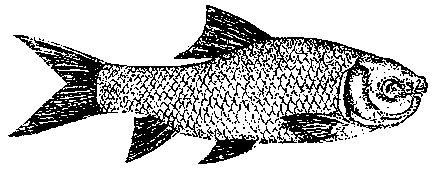
The body is elongated and cylindrical. The big fish attains to 2' - 3' in length. To its body size the head is small. At (the anterior end of the head, it has a mouth and it is characterised by its thick and fringed lip. The fish has big reddish eyes on both side of the head. The whole body is covered with big sized scales. The upper side of the body is brownish while the ventral or abdomen portion is whitish.
The fish feed on small plants and decomposed materials of the pond and grows to a large size. The big fish weigh even 20 - 30 kg The fish is very famous for its taste. The fish is still wild in nature, however, it is easy to culture in pond. In the stagnant water of the pond the fish grow and get sexually mature on second or third years depending on the climatic condition of a place however, the fish does not breed in confined water. Therefore, to breed this fish induced breeding technique is applied. This fish is not difficult to bred in hatchery.
Mori
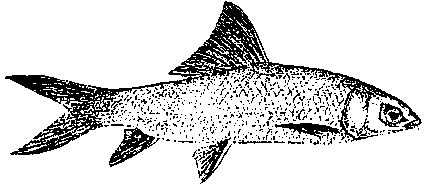
The body is elongated and slightly laterally compressed. The fish attains 2' - 3' in length. The fish has two big eyes on both sides of head. This fish is easily identified by its golden coloured big eyes. The mouth of the fish lies below the head. The body is covered by medium sized scales. The dorsal part of the body is greyish while the ventral part of the body is whitish.
It feeds on bigger plant cells, insects and decomposed material at the bottom and grows faster. The fish ranges to 15-20 kg. in weight. The fish is tasty. The fish easily grown in pond. It sexually matures in two or three years depending on the climatic condition, however, like Rohu, it also does not breed in stagnant water of the pond. Therefore, to breed this fish, induced breeding technique is applied. It is not so difficult to bred the fish in hatchery.
Thaila
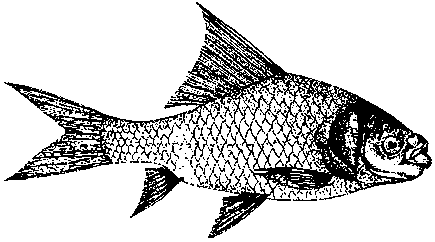
The body offish is laterally compressed. The front portion of the body is more wider than the later portion. The fish is easily recognised by its big sized head and thick lips. The mouth lies at the anterior portion of the head. The body is covered with large sized scales. The dorsal portion of the body is greyish - black while the abdominal portion is whitish.
It feeds on zooplankton and grows very fast. In stagnant water of pond it grows faster than Rohu and Mori, therefore, fish growers prefer this fish very much. Moreover, the fish is considered as one of the fast growing and tasty. Though the fish grows faster and sexually mature in the fourth year in the stagnant water of pond but it does not bred in pond water. To bred this fish, induced breeding technique is applied. Out of the Indian Major Carps, this fish is most difficult to breed in confined water.
The fish species e.g. Common Carp, Silver Carp, Grass Carp and Bighead Carp are originally from China. This variety of fish are cultured throughout the world. Out of the above mentioned fish the common Carp is most cultured fish in the world. This fish is common around the world as its name. Therefore, today the word Chinese carp indicate only Silver Carp, Grass Carp and Bighead Carp. These fishes arc not found in local water bodies, therefore these fishes are called exotic fish. In Pakistan, these fishes were introduced from China as well as Nepal and from Pakistan they have been introduced in AJK.
Common Carp - Scaly
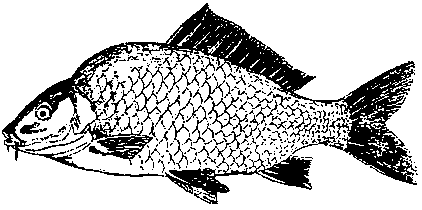
Common Carp - Mirror
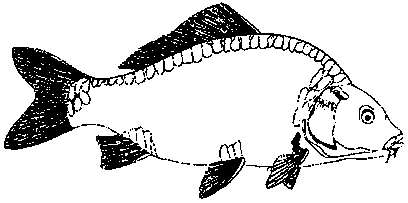
The Common Carp was cultured thousands of years before in China. Today the Common Carp is the most cultured and most domesticated fish around the world. The body of Common Carp is laterally compressed. In its body ratio, the head is small. The anterior portion of the body slopes down to head and it ends with mouth. The mouth has thick lips and is protractible. On the both side of the mouth a pair of sensory organ in the form of barbell are found. It has two small eyes on the sides of the head. The posterior portion of the head has a big sized bone covering the respiratory organ - the gills is called Operculum.
The anterior portion of the body is wider than the other parts. There are many varieties of Common Carp. The Scaly Common Carp has a big scales on whole body, the Mirror type of Common Carp has a row of big shining scale along the dorsal ridge of the body while the rest of the body remains naked. The other type of Common Carp has no scale at all on whole body and third type of Common Carp is called Leather Carp. The fish grow faster in the stagnant water of the pond. It grows to 2' - 3' in length and weigh to 20 -25 kg. Common Carp feed on any available food e.g. any plant, animals and decomposed materials, so this fish is called Omnivorous. The Common Carp grows very fast and sexually matures within a year in the stagnant water of the pond. Unlike other Indian Major Carps, the Common Carp easily breeds even in confined water. Therefore, to maintain its good stock to culture this fish, selection of parental stock and its breeding need to be carried out in controlled conditions, otherwise, the haphazard breeding is sure to degenerate the fish stock and such stock offish exhibits poor growth. The fish is very famous for its taste.
Silver Carp
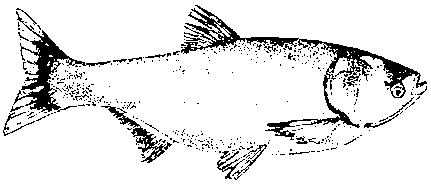
The body is laterally compressed and the abdominal region turns sharp edge like a knife. It grows to 2' - 3' size. To its body size, the head is small but in compare to other fishes its head is large in size. At the anterior end of the head, it has mouth. The mouth is large and its lower lip is slightly longer than the upper one. The eyes are small and is located at the lower portion of the head. The whole body is covered with small silvery white scales and it shines as silver. Therefore, the fish is called Silver Carp. it feeds on small phytoplankton grown in the pond water. The big mouth swallow good quantity of pond water with phytoplankton and it filters the phytoplankton through its gills and feeds on the phytoplankton and grow very fast. It sexually matures within 2 -3 years of culture period depending the climatic condition of a place but do not bred in stagnant water. To bred this fish, induced breeding technique is applied. This fish species is most delicate amongst the Chinese Carps, therefore, careful handling is essential to this fish. The fish is very tasty, when it is fried..
Grass Carp
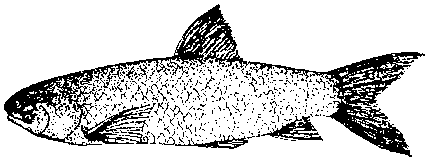
The body is elongated and cylindrical. The fish attains even a meter in length. To its body size, the head is small; It has two big eyes. The anterior part of the head has mouth. The upper lip is slightly longer than the lower. Both the lips arc hard and strong. The whole body is covered with large dull- greenish large sized scales, while the abdomen portion remains whitish in colour.
The fish feeds on any types of grass e.g. aquatic as well as terrestrial, therefore, this fish is called Grass Carps. As it feeds on the grasses, so this fish is being used for biological control of the aquatic weeds of any water body. The fish has been found feeding grasses, forty times of its body weight and grow very fast in warm water. In stagnant water the fish sexually matures in 2 -3 years of culture depending on the climatic condition of a place, however, the fish do not bred in confined water. To bred this fish, induced breeding technique is applied. Though the adult fish feeds on grasses but the fingerlings of grass carp feeds on zooplankton and as it grows to about 3" - 4" it starts feeding grass. The fish is famous for its taste.
Bighead Carp
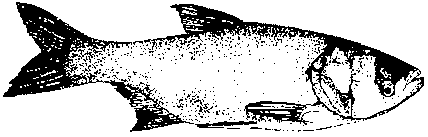
Like Silver Carp, the Bighead Carp is also laterally compressed and its abdomen also forms like knife edge. It grows to 2' -3' size. The fish is easily identified by its big head. The mouth lies at the anterior portion of the head The eyes are small and is located at the lower side of the head. The whole body is covered with small scales. The dorsal side of the body is dull white in colour while the abdomen portion the scales shines like silver.
The fish feeds on zooplankton and grows very fast. It sexually matures within 2 -3 years depending on the climate of the place but like other Chinese Carp, it does not bred in confined water. It needs to bred artificially. This fish has been introduced in AJK only recently in 1996 under the ongoing project. The fish is also tasty.
5.1 Define a Fish Pond?
5.2 Where to build a Fish Pond?
5.3 Pre-requisites of a Suitable Site for a Fish Pond
5.4 Shape and Size of a Fish Pond
Fishes are seen in any natural water bodies e.g. rivers, streams and lakes. Such natural water bodies are either cold where natural fish food is produced less, where as in warm water the fish food is produced more but due to its continuous How the fish food is flushed out in natural waters as a result the fish is produced less. Therefore, to increase fish production, a stagnant water body is developed on a suitable land by excavating earth or erecting earthen dike or dikes around it, where water is stored to stock the fish. The stocked fish are cultured and grown under controlled condition. Such water body is called Fish Pond.
Such fish pond is constructed either in plain/flat land or on a sloppy land. In flat areas the simplest way of constructing a fish pond is to excavate the earth to make a depression on the ground and pile the excavated earth/soil systematically around the depression to give a shape of dike. This type of pond is called excavated pond. Again on a sloppy land, a pond is made by building strong dike or dikes on 1,2 or 3 sides to hold water. This type of pond is called dam pond. A fish pond's shape and size depends on the available land, where the pond is to be constructed.
A fish pond is never constructed haphazardly, as an orderly constructed fish pond is easy to operate and manage too. Therefore, to construct an ideal fish pond, due consideration need to be given on following points;
a) Suitable Site: Any flat and sloppy land is suitable to construct a fish pond provided the soil has capacity to retain the water The soil having gravel or stone or sand fails to hold water. A sloppy land is considered as most suited site for a fish pond because such land does not require to construct all the four dikes because of its terrain and turns out economical to construct.b) Adequate Water: Fish lives in water, so a fish pond needs considerable quantity of water not only to the keep the fish alive but also to grow. Therefore, a reliable perennial water source is essential to plan a fish pond.
c) Closer to Home: To carry out daily routine works in time as well as to have close supervision and to avoid poaching also the fish pond need to be planned closer to the house, otherwise any thing may happen with the water and live fish.
d) Away from any Shade: The sun light is very important for the production of natural food in the fish pond. Therefore, a fish pond need to be built away from the shade or big trees, so that the pond gets sufficient sun light. Moreover, the big trees drops leaves into the pond and make the water quality poor or poorer and
e) Easily Accessible Place: For a fish pond, the site need to be selected with easily accessible place as the fish culture operation needs several inputs regularly e.g. fish seeds, lime, manure and fish feed etc. They need to be transported as per the need. In case of difficult approach, all the inputs need to be again transported to the farm and the operational cost increases due to this inconvenience. Similarly more difficulties has to be faced during the harvest of the farm product too. An easily accessible place not only minimises the labour and transportation cost only but it also facilitates in bringing live fish seeds and transporting the farm products.
5.3.1 Landscape or Topography of the Site
5.3.2 Source of Water
5.3.3 Soil Quality:
Before the decision is made to construct a fish pond, the fishery technician or extension staff need to visit the proposed site and examine thoroughly the following aspects which are pre-requisite to recommend a site as suitable to construct a fish pond;
The proposed sites need to be visited and studied the landscape or topography of the proposed site. The study of the proposed site provides a rough concepts on the height difference from one point to the end point, so that one can roughly layout the pond and estimate an approximate expenditure to construct. By observing the difference of heights of the site an idea is also firmed about its inlet, outlet and soil quantity required to construct the pond or ponds.
Generally, in plain land a depression is made by excavating the soil and the excavated soil is pilled on four sides of the depression to make the dikes and form a fish pond. The fish pond constructed on plain land can't be drained by gravity until and unless there is no depression near- by. Thus the operation of such pond turns out very expensive as such pond is drained by means of water pump only. In compare to the plain land, a sloppy land become easy as well as less expensive in constructing a pond due to its terrain. Moreover, a pond constructed on sloppy land can be easily drained and easily managed.
Without water, fish can't live so a fish pond needs a considerable quantity of water not only to keep the fish alive but also to grow them. Therefore, it is utmost important to examine the water source quantitatively as well as qualitatively before the decision is made to construct a fish pond. A 2" to 4" sized pipe full water in the dry season is considered as enough to operate a good sized pond or a few ponds. The quantity of the water depends on the scale offish culture activity Therefore, while planning the scale of fish culture need to be assessed so that the need of water quantity can be assessed. Besides the quantity of water, quality of water need to be also examined,
i) Water Temperature: The water temperature plays a vital role in the production offish food in the pond ecosystem and ultimately in the production of fish. The cold water is less productive due to its low temperature. Therefore, in cold water fish culture, supplementary feed becomes essential by thus the cost of production shots up and it turns out beyond the reach of the mass of the people. But in warm water with less efforts, different kinds of plant and animal origin natural fish food is produced and the water is made productive. With the increased fish production, the cost of the product is reduced and the fishes are made available to the mass of the people. Therefore, the water with higher temperature is most preferred. In warm water fish culture, above 20° c to 30°C is considered most suitable for fish culture.ii) Alkalinity of Water: The alkaline water having pH. 7-10 is most preferred in fish culture. The acidic water having pH. value below 6 is not at all preferred as such water remains unproductive. Slightly acidic water having pH. value 6 or so is manipulated to alkaline by the use of lime, however, such operation increases the cost of production as well as in such water fish yd several diseases too. Therefore, acidic water having pH. value lower than 7 is not considered as suitable water for fish culture.
iii) Dissolved Oxygen: In fish culture the water quality is defined by the quantity of oxygen dissolved in the water. The purity of water is defined with the higher dissolved oxygen. The rivers and stream's water are naturally aerated and such water naturally contains higher oxygen. In sewerage or polluted water the dissolved oxygen is less and in such water fish culture is never done. The water having below 4 mg./l dissolved oxygen is not preferred for fish culture. Thus for the warm water fish culture, a perennial water source with higher water temperature, alkaline nature and higher percentage of dissolved oxygen is considered as a good water source. The source of water may be a river, stream, canal or deep tube well. An unreliable water source or rain water can't be considered as source of water. In absence of perennial water source, the supply of water is also done by means of pump. But such operation requires purchase of machinery its operation and its maintenance which involves more expenses and such expenses drastically cuts down the profit margin leaving too little profit.
The soil quality need to be examined thoroughly before any recommendation is made to construct a fish pond. A poor soil having higher percentage of sand, gravel, pebbles, rocks fail to retain the water in the pond. Thus in spite of good investment, hard work or having good water source, the soil fails to retain the water as a result the operation fails to develop natural fish food in the pond water. Under such condition the growth offish do not turn out satisfactory and the activity remain uneconomical. Such soil is not considered good soil to construct a fish pond. The soil quality of the proposed site need to be enough to retain water, so that the developed water body remains stagnant and natural food of fish is developed for fish production. Therefore, the clay soil is considered as good soil to construct a fish pond.
Sometimes, after examining the upper layer of good soil a fish pond is recommended, but in lower layer it contains sandy and gravel soil. Therefore, to avoid such mistake during the investigation of the site, a few number of pits need to be dug and soil to be examine. Soil testing of each such site is not possible, therefore, for the field test a practical method of soil testing has been developed e.g. take a fist full of soil and press it tightly within the fist. A good quality of soil makes a compact Dow. Throw the compact Dow high in air and let it fall on the palm or on the ground, if the Dow of soil does not break and does not scattered around, the soil quality is considered good to construct a fish pond. In case of higher percentage of sand in the soil, firstly the soil does not form a compact Dow and secondly on hitting on the palm or ground it breaks up into pieces and get scattered. It is always risky to construct a fish pond on such soil as it does not retain the water. Under such condition, with best efforts even, natural food of fish can't be developed and the fish does not grow.
There is no hard and fast rule in fish culture for the shape and size of a fish pond however, for other various activities offish culture e.g. brood fish stocking, breeding, nursing and rearing purposes a definite shape and sized pond is preferred, Therefore, it is better to decide first for what purposes the pond is to be constructed? Generally, for fish production the fish pond is constructed in any shape and size as per available land, however, from operation and management aspect a rectangular or a square pond is most preferred. A small pond even is used for fish culture or fish production but smaller than 2 kanal pond is not economical. The smaller pond than 2 kanal is usually used for only domestic purposes. A number of small ponds occupy considerable land area under the dikes and thus it deprives a considerable water area from fish production. On other side, the construction of a big pond is no doubt cost effective to construct a fishpond but it turns out difficult to manage the activity. Therefore, a good production pond ranges from 4-10 kanals. The production pond at no cost should be less than 2 kanals as it is not economical.

6.1 Layout the Pond as per Design
6.2 Clear the Site
6.3 Develop Core - Trench if necessary
6.4 Excavation of Earth to build a Dike
6.5 Turf the Dike
6.6 Construction of Water System
Before the construction of a fish pond, the proposed site's landscape, water source and its quality and soil quality must be checked and examined. On finding positive only, it is recommended to construct a fish pond. The various activities are carried out to construct a fish pond;
With the selection of a site, a pond or series of ponds is designed on the basis of the landscape. It is designed in such a way that the dike is made by excavating minimum quantity of soil by thus the construction cost is minimised. The fish pond is constructed either by machine or by labour force depending their availability at a place.
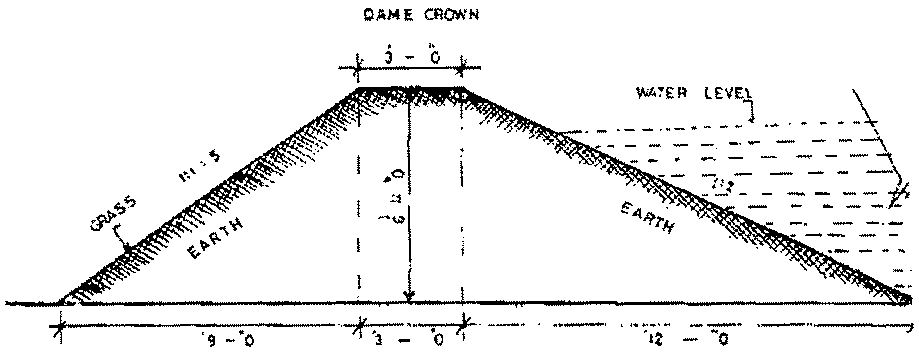
To start the construction work, firstly the site is demarcated by pegging small and big pegs as per the design. Two eight feet high bamboo pegs are fixed at central point of each dike at a distance of 3'. Both the pegs tips are tied at 7' height with a rope to show the lop of the dike which is called Dam Crown. The rope towards the inner side of the future pond is stretched with a ratio of 1:2 slope and at the point where it touches the ground is fixed with the help of small pegs. The same way, the outer rope is also stretched towards the outer side of the dike at the ratio of 1:1,5 slope and fixed on ground as shown in figure.
To avoid the fish kill in summer due to high temperature as well as in winter due to severe cold it is suggested to maintain water level to five feet's for which the pond dikes need to be made six feet high. Therefore, during construction of the pond, the dike need to be raised to seven feet, so that after the compacting of the soil it turns out as proposed six feet high. The outer slope of the dike is usually maintained at the ratio of 1:1.5 while the inner slope of the dike is maintained at the ratio of 1:2 so that the workers can easily walk on gentle slope for the fish culture operations e.g. liming, feeding manuring and netting etc. In case of common dike of two ponds, both the slopes are maintained at the ratio of 1:2. With the above slopes, the inner side slope ends at 12' distance from the inner bamboo of the Dam Crown, if the dam height is maintained to 6'. Similarly, the outer slope of the dike ends at 9' distance from the outer pole of the Dam Crown; Thus, the properly build fish pond dike base width remains 24' in total (9' outer slope + 3' dam crown + 12' inner slope) while the width of Dam Crown remains to 3'.
The layout of the pond gives a fair idea to be covered by the four dikes of pond as well as the area from where the soil to be excavated and where to fill up. First scrape out about 4"" - 6" of top soil need to be scrape out from the site of excavation and the dike site and dump it out of the construction site. Remove all the rocks, trees or tree's loots and bushes from the construction site, so that the filled up soil settle down quickly and yet the dike stronger. In no circumstances, the grass, bushes or roots etc. are left along the dikes. If these items are left under the dike, they start decomposing in due course of time and the dike become weaker. Under such condition there is a danger of water leakage from the dike.
In case some patches of bad soil detected on the construction site, then it is suggested to dug about 3' wide and 3' deep trench in between the two long bamboo poles along the dikes of the pond as shown in Fig. no. This trench is called Core - Trench. This core -trench is also considered as the foundation of the dike. The core -trench is again filled up with good soil and the refilled soil is well rammed. This way, the dike is made strong and stable and stops the seepage. The core-trench is applicable where ever a doubt on soil quality arises, otherwise it is not very common in practice.
While planning a pond itself, the excavation points of the soil is determined and is excavated to the prescribed level. The excavated soil is pilled systematically within the given frame layer after layer and rammed well. If excavation is made by heavy machine, the soil is made compact periodically by machine. Good compact soil make a strong and stable dike. The Fishery as well as Extension Staff must know the calculation formula to find out the exact quantity of soil to build the four dikes of a particular sized pond so that they can be of some help to the farmer. Presume a pond of 75' length * 75' wide and 6' height and now one has to find out the required quantity of soil for the above sized pond. The above said pond's area totals to 5625 square feet and its height is considered as 6'. The inner slope of the dike is at the ratio of 1: 2 and the outer slope is at the ratio of 1:1.5. To calculate the required quantity of soil to the above specification the following formula is to be adopted;

During the construction of the dike due attention need to be given for good compact of the soil. Upon completion of the dikes good variety of grass need to be planted in all dike (inner as well as outer slopes) so that the dike do not erode. Moreover, the turfed grass as it grows, it is also used as a feed to the Grass Carp. Therefore, while selecting the variety of the grass due consideration need to be given to select a grass having characters of soil holding as well as high nutritive value. In AJK condition, some of the indigenous grasses e.g., Cynodon spp., locally known as Khabal and Baru and from improved variety - White Clover Napier - locally known as Mud grass are encouraged to plant on both side of the pond dike.
A fish pond requires water any time. Therefore, a permanent water canal need to be constructed from the source of water to the pond, Thus it does not need to repair all the time. While constructing the permanent canal, it is better to have two parallel grooves on both sides of the canal wall at certain intervals, so that a screen framed on wooden frame is placed to screen the water and to avoid the unwanted fish or any other animals entering into the pond water
A small box like structure as shown in Fig. No. is constructed at the top of the pond where wire gauze of fine screen framed on wooden frame is fixed to screen the water. In case, more water is not needed, it is diverted to the main canal by putting a simple wooden plank at the groove made on the wall of inlet box.
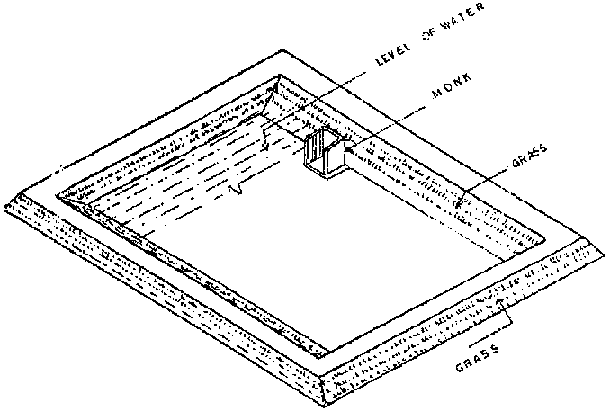
As an inlet of a pond is important, so is the outlet to control and drain the pond water. The outlet structure is constructed within the fish pond at its lowest point permanently. This permanent outlet structure is called - Monk.
To construct a monk, 3' long * 3' wide * 3' deep ditch is excavated at the lowest point of the pond where a platform of above size is erected with bricks. On this platform a typical structure is constructed with bricks which is called Monk. The size of the monk directly depends on the size of a pond. The bigger pond has bigger capacity monk while the smaller pond has small sized Monk. The structure of the Monk is open towards the pond side while the other three sides are closed The walls of left and right sides of the Monk has two equal sized grooves running parallel to the bottom of the Monk. At the floor of Monk also a groove is made. Generally the Monk is made of either bricks or concrete. In case of bricks, it is made with thick wall while in case of concrete one about 4" thick wall is quite enough and functional. At the bottom of the Monk, a drain pipe is fitted on its back side which is laid across the pond dike as outlet pipe. Opposite to outlet pipe, the Monk is open to pond through which the pond water passes.
To make the Monk functional, a number of wooden planks of Monk width are prepared of 1" thickness. The first wooden plank have flat surface at its lower portion as it is placed on the groove made at the bottom surface of Monk, while the upper portion of the plank is engraved as an English " V " having a groove on top. On this groove, the second plank having sharp edge on lower side fits in. Each wooden plank is fitted with a hook at middle to facilitate its handling. Thus one wooden plank is fitted on others on both the grooves of Monk. In the space in between two rows of wooden planks fitted on Monk, wet soil is filled to make the Monk watertight. In need of draining first the filled soil is taken out manually or by means of "Ager" and the wooden plunks are taken out by means of iron hook fitted in wooden frame. While taking out the plank, first row plank is taken out and a wire gauze of fine mesh screen is installed and back rows planks are again taken out. This way by the repeated use of wire gauze screen, the level of the pond is drained out partially or completely as per necessary or convenience.
This way a modern fish pond is constructed and it is made functional to produce fish.
7.1 Fish Culture Practice in AJK
7.2 Preparation of a Fish Pond
7.3 Stocking of Fingerlings/Yearlings
7.4 Fertilisation
7.5 Feeding
7.6 Growth Check-Up
7.7 Production and Harvest
Generally a fast growing improved variety of fish having good taste are cultured in a definite water body under controlled conditions and management is called Pond Fish Culture. Like in Agriculture, in fish culture also the water body - the fish pond is prepared fertilised, stocked with cultivable fish species, fed with supplementary food and grown to bigger size and harvested when they attain marketable size. Out of the different culture practices the pond fish culture is one of the most productive culture practice therefore, pond fish culture is very common and widely practised in most of the countries of the world.
The pond fish culture practice is comparatively easier activity than any other agricultural activities, thus a person affords to look after bigger production area offish production. Moreover, in rural areas the construction of a pond does not only facilitate fish culture but it also help in conserving the water which can be used in case of emergency against the fire or irrigate to save the main crop during the drought condition.
The water body of any shape and size is used for fish culture provided the water source is perennial and the soil is good enough to retain the water. The pond specially made for fish culture are preferred either rectangular or square. The pond size ranges from a small (one kanal) to bigger size of many kanals. The smaller pond has low production capacity and is used for domestic purpose only while the bigger sized pond has high production capacity and is used for commercial production offish. For commercial use a fish pond of minimum size of 2 kanals has been prescribed. The smaller than this size pond fails to recover the expenses occurred for fish culture from its production. Therefore, the minimum size of 2 kanals pond remains pre-requisite for its economic use.
In fish culture, the climatic condition of a particular place directly effects the fish production. A thumb rule offish culture says that the higher the temperature higher the growth and lower the temperature lesser the growth. As per this thumb rule, the fish production remains low in the cold or colder region as in such area the growing period is less or lesser in compare to the warmer areas where as the fish production increases in warm areas as in warm area the natural food of fish is easily produced. This fact is very much applicable in AJK, as its northern districts e.g. Muzaffarabad, Bagh and Poonch Rawalakot remains cold or colder, where the growing period for fish ranges to for 5/6 months in a year, but in compare to the above case the southern districts e.g. Sudhunti - Palandri, Kotli, Mirpur and Bhimber remain warmer in most of the year and fish get longer growing period.
Generally the districts having longer period of cold winter do not get enough warm days to culture and grow the fish. Therefore, in such area either the public sector's hatchery need to distribute yearlings instead of fingerlings to the private sector around the end of March or April when the temperature of water starts rising or the private sector farmers has to raise the fingerlings for two growing seasons to make a fish marketable size. The latter case is not only difficult task but is also expensive to the private sector farmer. Therefore, the public sector need to take responsibility in raising yearlings for their distribution to the private sector, so that the private sector farmers raise yearlings to marketable size in one growing season of 6 -7 months. However, the southern districts of AJK falls under warmer area where fish culture activity can be started by the end of February or in the month of March.
The newly constructed pond is left idle for few months to allow the soil settle down while the old ponds is left dry for few weeks or even months with the harvest of the fish, so that the pond is cleared and dried under the sun light. This way the bottom soil get aerated. In case, pond is left empty for a considerable period, it can be used for a short period crop or vegetable farming. This way the pond is used for producing some other crop than fish and the bottom soil get further aerated.
Generally, with the harvest of the fish the pond remains idle for longer period in colder place rather than warmer area. During this period, the necessary repairs e.g. deepening of the pond, maintenance of inner slope of dikes, inlet, outlet and any other related matters are undertaken.
It need to be planned in such a way that the fish culture activity starts with the rise of the water temperature. Before the reuse of the pond, the pond is treated with lime at the rate of 10 kg per kanal. The lime is broadcasted all around the pond uniformly. The use of lime helps in three different ways; firstly it helps in improving sanitation of a fish pond, secondly it turns the water alkaline and thirdly the lime also functions as fertiliser. After the use of lime the pond is further left to dry for more one or two weeks.
After a certain period of lime use, the pond is filled with fresh and clean water after screening with fine wire gauze screen and is left for more few days. With the filling of water initial dose of manure is applied to develop natural food offish in the pond water. Within few days, effect of the manure is observed with the change of water colour to light to deep green. The greenish or green or brownish coloration of the water is an indication of the growth of phytoplankton and zooplankton in the pond water. At this stage the fingerlings or yearlings are procured and stocked in the pond.
7.3.1 When the fingerlings are available?
7.3.2 Stocking Density/Rate
7.3.3 Fish Ratio
7.3.4 Stocking of Fingerlings/Yearlings
When the fingerlings of cultivable fishes attains 2" - 3" size, they are considered as distributing size. The fingerlings of cultivable fishes are available in different months of the year depending on their breeding season. Therefore attempt should be made to procure the fingerlings earliest possible time so that the growing days is not wasted.
Generally the fingerlings of different cultivable fish species arc available after one month to one and half month (4 -6 weeks) of the breeding of respective fish. The breeding season of the cultivable fish species varies species to species in AJK as follows;
|
Fish Species |
Breeding Season |
|
|
Cold region |
Warm region |
|
|
1. Common Carp |
March/April |
February/March |
|
2. Chinese Carps |
May/June |
April/May |
|
3. Indian Major Carps |
July/August |
June/July |
To be sure to get all cultivable fish species for their stocking in the fish pond demand of the fingerlings as per the water area should be submitted in time, so that the official of Fishery Wing organise themselves in better way. It is suggested to submit the fingerlings demand in the month of February/March in the cold and colder region ad in the month of January/February in warm and warmer region. Accordingly the officials of the Fishery Wing also should take pain either to manage and supply the fingerlings as per schedule time. In colder region fish production is enhanced by the distribution of yearlings of the cultivable fishes by the end of March or beginning of April.
For the first year of culture, the fingerlings of cultivable fish are distributed at free of cost while from second year, the farmer is asked to pay a nominal cost of Rs. 1/fingerling. Not to loose the growing days, it is suggested to stock the fingerlings by April in the cold region while in the warm region in the month of March. The above stocking period becomes viable provided the public sector aims to take pain to distribute fingerlings/yearlings, otherwise, it is not possible besides the Common Carp because the different fish species breed in different period in-between March - July/August. Under such circumstances, a culture practice need to be developed to raise the yearlings or need to develop a fish culture practice with double stocks (one last year's growing fish and second current year produced fingerlings) of fish in pond. Out of the above mentioned two means, the former one is more payee in terms of production. Because of the higher growth of such yearlings. For such grown yearlings the farmer should not be hesitant even to pay high price.
Considering the local conditions and know - how level of the farmers firstly an extensive culture practice should be demonstrated in AJK. Later on, with the orientation, the farmers need to be further oriented towards semi-intensive or intensive farming system. Presently to carry out extensive culture practice it is suggested to stock only 600 fingerlings per kanal of water surface (i.e. 12,000 fingerlings/ha.).
To the above mentioned stocking rate, the ratio of different fish species is determined by the available facility to produce natural food of fish in the pond. In reference to AJK, some of the pocket of a district has either large number of cattle, good cultivation of grasses and well developed poultry which indicate the availability of organic manure and grasses under such condition, aim should be made to use the existing farming system for increased fish production at low cost for which three different stocking ratio of fingerlings/yearlings has been projected as follows;
a) The place where the cattle or poultry manure (cattle dung and chicken litter) are abundantly available at low cost to fertilise the fish pond for the maximum production of phytoplankton. For such case the Silver Carp has been considered as major fish. The major fish is stocked at higher percentage while the other fishes take their share in nominal ratio by means of which the fish production is increased at low cost and least effort,
|
Fish Species |
Percent |
Number of Fingerlings |
|
Silver Carp |
35 |
210 |
|
Grass Carp |
15 |
90 |
|
Common Carp |
10 |
60 |
|
Rohu |
15 |
90 |
|
Mori |
10 |
60 |
|
Thaila |
15 |
90 |
b) The place where the grasses are cultivated as green fodder and is abundantly available to feed the Grass Carp. In such places the Grass carp is considered as major fish species. Like in first case, the major fish takes the higher percentage in stocking while the other fish species are at nominal ratio. In this production model, attempts has been made to feed the Grass Carp as far as possible. Thus the Grass Carp does not get food to grow only but to fertilise the fish pond for further production of natural food to support the other species of fish. Thus a well fed Grass Carp helps to sustain a number of other fishes too. Because of this reason the Grass Carp is considered as "Living Fertiliser Factory" in pond ecosystem.
|
Fish Species |
Percent |
Number of Fingerlings |
|
Grass Carp |
35 |
210 |
|
Silver Carp |
20 |
120 |
|
Common Carp |
10 |
60 |
|
Rohu |
10 |
60 |
|
Mori |
10 |
60 |
|
Thaila |
15 |
90 |
To increase the fish production per water area, integration of Indian Major Carps is very important and is highly recommended, however, observation still need to be made whether the Indian Major Carps can survive the severe cold climatic condition of the northern districts of AJK or not? If the Indian Major Carps fails to survive then the Chinese Carps and Common Carp's yearlings should be distributed to the farmers for culture practice.
c) The place where the availability of manure or poultry litter and grasses are meagre or not available then the process need to be based on the supplementary food for which the Common Carp is considered as major fish. The production of supplementary food is made with many different ingredients derived from agricultural crops and their by - products. These feed ingredients are not locally available and need to be imported from out side AJK for its commercial production. Thus importation of feed ingredients turns out to be expensive and thus the cost of fish feed remains expensive. Therefore, the cost benefits of such feed in fish culture need to be examined with field trails.
With the rise of the water temperature, the fish pond is to be prepared and when the pond water gets good bloom of phytoplankton the fingerlings/yearlings are procured and stocked in the pond, at the rate of 600 fingerlings/yearlings per kanal of water body by the end of March or April in the cooler areas of northern districts while in warmer districts of south the stocking should be carried out by the end of February or March. Thus the production days are not wasted. Under good management the fish attains marketable size by the end of the year.
7.4.1 Purpose of the Fertiliser
7.4.2 Different Kinds of Fertiliser
7.4.3 Dose of Fertiliser
7.4.4 Under/Excessive Use of Manure
The fresh and clean water contains less nutrients. In absence of nutrients, no organism develops. Therefore, some nutrient in the form of manure or fertiliser is introduced in fresh water of a fish pond, so that with the help of sun light some reaction take place and plant or animal origin organisms develop. These plant origin microscopic 01 small organisms arc called phytoplankton. Similarly the animal origin microscopic or small organisms arc called zooplankton. These phytoplankton and zooplankton are the natural food of cultivable fish. Therefore, to produce these organisms abundantly, a certain quantity of manure is used regularly year round.
There are two major kinds of fertiliser - organic and inorganic.
Organic: Any manure produced by organism or animal is called organic manure e.g. cow dung or poultry litter. Such manure contains many elements of which nitrogen and phosphorous are most important to produce organisms in the pond water. The organisms or living animal manure contains little or meagre amount of nitrogen and phosphorous, therefore, such manure are used in considerable quantity to make it effective.
Inorganic: A by-product of chemicals in the form of crystal or liquid are called Inorganic fertiliser. Such fertiliser contains nitrogen and phosphorous in concentrated form. The concentration of nitrogen and phosphorous differs from one commercial brand to other. As the inorganic fertiliser contains nitrogen and phosphorous in concentrated form, so they are used in less quantity than the organic manure.
As the time approaches to use or reuse the fish pond, an initial dose of manure is applied at the rate of 100-200 kg. of cattle dung or 50 kg of chicken litters per kanal. In case, the organic manure is not available, then only it is recommended to use inorganic fertiliser at the rate of 8-12 kg. of nitrogen and 8-12 kg. of phosphorous per kanal. The organic or inorganic fertiliser is broadcasted throughout the pond. With the broadcasting of manure, the pond is filled with fresh and clean water after screening with fine wire gauze.
The newly filled water is left for few days. By then the effect of fertiliser is distinctly seen with the change of water colour to light or deep green. The greenish colour of the water is the effect of the manuring. The colour is the indication about the growth of unicellular and multicellular microscopic plant cells - phytoplankton. The phytoplankton is followed by unicellular and multicellular animal cells - zooplankton.
With the growth of phytoplankton and zooplankton, the fingerlings or yearlings of different cultivable fish species are stocked in the pond. The stocked fingerlings/yearlings go on feeding the developed natural food and grow faster. In absence of natural food in the pond, the fingerlings/yearlings do not get adequate food and get weak and weaker. Specially the transported fingerlings/yearlings which get exhausted in conditioning and transportation cause high mortality within two or three days with hunger or cannibalism. Therefore, preparation of a pond is very important in fish culture. The preparation of a fish pond need to be carried out by the end of March in cold region while in warmer region within earlier par of February, so that the stocking of fingerlings/yearlings is carried out by the middle of April and by the end of February respectively.
With the stocking of fingerlings/yearlings, the developed natural food of fish is consumed. Accordingly the coloration of the pond water starts changing to normal water colour or muddy colour if additional manure or fertiliser is not applied. Therefore, to provide nutrients continuously in me water, application of manure is repeated. It is always better to observe the water colour and as its colour starts changing to light or lighter colour, second or third or fourth application of manure need to be undertaken at the rate of initial dose. As such there is no hard and fast rule on the amount of manure because the effect of manure varies from one place to other place depending on various factor e.g. quality of soil, quantity and quality of water and also depends on the intensity of the sun light too. Therefore, the field worker must be keen observer to note the effect of manure in pond water and changes in water, so that the field worker can make a judicious judgement about when and how much manure is to be used?
However, a field method has been developed to assess the colour of the pond water for which the worker need to go inside the pond and deep the hand up to the elbow in the water and try to read the fingers and palm put horizontally within the water. If the fingers and palm is distinctly visible, it is to understand that it is already late in application of the manure but if it is not distinctly visible due to greenish or brownish colour of the pond water, then it right time for another application. Never be lazy to observe and test the colour of pond water and never be idle to apply the manure in right time. The right time application of manure boosts the growth of natural food of fish and the fish grows faster.
The use of less quantity of manure fails to produce phytoplankton and zooplankton adequately in the pond water. Under such condition the stocked fingerlings/yearlings do not get adequate food and the fish do not show good growth. Therefore, to start fish culture, the pond water area need to be measured and accordingly the quantity of manure is calculated and applied regularly.
The excessive use of the manure is again not at all useful as it deteriorate the water quality and harms the stocked fish. Sometime, it pollutes the water to that level that the stocked fish start dying due to oxygen deficiency. Therefore, the use or reuse of manure should be done judiciously depending on soil, the quantity and quality of water and atmospheric temperature.
Out of the cultivable fish species, few of them are totally dependent on naturally produced fish food, while the other exhibit good growth with additional food provided them in the pond. The latter group offish mainly includes Grass Carp and Common Carp. The fries of Grass Carp feed on zooplankton until they don't grows to bigger size (over to about 4") and later they turns to be herbivorous and depends on aquatic weeds and terrestrial grasses provided from outside. The Grass Carp is a voracious eater and controls the aquatic weeds. Because of this reason the Grass Carp is being used for biological control of aquatic weeds In addition to the aquatic weeds different varieties of terrestrial grasses and other fodder grasses are grown along the banks or dikes of the pond or even in agricultural land to feed the Grass Carp. A Grass Carp feeds forty times of its body weight and grows very fast. A well fed Grass Carp further fertilises the pond water and boosts the production of natural fish food and supports certain number of other fishes also.
The Common Carp is omnivorous fish. It exhibit good growth with the additional food prepared with different ingredients. Such additional food is called Supplementary food. The supplementary feed is either produce commercially for different stages of the fish or it is prepared domestically by mixing many different agricultural crop's by-products as ingredients, fish meal minerals and vitamins too. The supplementary feed efficiency is measured by the ratio of feed used in weight verses the weight gained by the fish. This value is called Food Co-efficient Rate (FCR). The higher the ratio of feeds against the fish growth, itself disqualifies the feed quality. Therefore, attempt is made to decrease the food coefficient value of the feed developed against the fish growth. A good quality of supplementary feed is always high priced and is expensive. Because of its high price, the cost offish production turns out expensive. Therefore, a few agricultural crops by-products e.g. rice bran, wheat bran, mustard oil cake/cotton seed cake some minerals and vitamins are mixed as per availability and prepared supplementary feed. Such supplementary feed is generally used just to supplement the naturally produced fish food in the pond.
The rate of feed differs from small fish to grown one and brood fish too. The rate of supplementary feed is estimated by the body weight of the fish. As the fish grows, the feed percentage is also increased. Generally the growing fish gets 2 percent to even 6 percent of the body weight but totally depends on the fish culture strategy undertaken in managing the farm. Before the breeding season the brood fish are raised with special care in brood fish pond and they are fed at the rate of 2 - 4 percent of the body weight. While raising brood fish attention should be given not to feed the brood fish in excess because the brood fish deposits the excess of energy in the form of fat, he deposition of fat drastically decreases the quantity as well as quality of eggs. Therefore, excess of supplementary feed should not be given to fish.
It is always good to feed the fish in the morning, around one time and at one place. Thus the fish get habituated to the system and gets around the feeding spot around the same time. Thus the feed is utilised to maximum. In case of, higher percentage of feed it is suggested to divide the total quantity of food into two portion and provide morning and evening so that the feed is used maximum and gives good food coefficient rate.
The supplementary feed may be in pellet or in grinned form. The pellet feed are made with special care. The pellet feed may be of floating or submerge types. Such feed is binded with good binder so that it does not disintegrate for a considerable lime in the water. Generally its quality is determined by its binding capacity in the water, this type of supplementary feed is not available in AJK.
Besides, the pellet form of feed, there are different types of grinned form of commercial feed mixed with certain binder. The binder keeps the feed binded when it is mixed with water, A good binder minimises the wastage of the expensive feed. Generally the grinned feed is shocked in water and made balls and are placed in feeding platform made of bamboo plank or tin sheet or wooden plank and is dipped in water. It is suggested to observe the fish while feeding, so that one can know the condition and health of the stocked fish.
In fish culture, the pond condition, water quality and the stocked fish need to be observed regularly, so that any unwanted scenario can be over come in time besides the water quality, the stocked fish also need to be checked fortnightly. The stocked fish is sampled either by cast net or by any other appropriate type of net. The sampled fish number, size and weight are recorded for which a Growth Check Up Card has been developed as shown in Table No. This activity need to be carried out so that the recent record can be compared with the last record and easily estimate the growth rate attained by the fish. By adopting this activity, it is easily assessed the fish health as well as the standing crop in the pond too. Moreover, the new record of tested fish also guides to calculate the required supplementary feed for next fifteen days too.
The concerted efforts made in improving the management is reflected by the maximum growth (grams/growing days) of the fish. The stocked fish are cultured for 6-7 months in the northern districts and 9-10 months in southern districts. As the fish attains about one kilogram or over should be harvested. Generally harvesting offish is carried out during the months of winter when the fish do not grow. The harvest record need to be recorded species wise, in number, and its weight attained by the fish. Such record facilitates to examine the survivals rate offish on species wise and growth rate too.
In any farming system, a number of activities are undertaken, many different kinds of items are procured and farm products are sold generating income to the farm. All such undertaken activities, occurred expenses and the generated incomes are enlisted in a book to analyse the cost and benefits of the activities. Such systematic enlisting of each and every activities, expenses and incomes are called Records and its maintenance as a data is called Record Keeping. Similarly, in fish culture also a number of activities e.g. procurement of fish seeds, their transportation, stocking to harvesting are under taken and many different items and inputs are procured and the farm products are also sold. All these activities are recorded. A good record keeping helps in analysing the usefulness of the activity. Therefore, in fish culture also all the records are maintained for its analysis.
Broadly, the record offish culture is categorised into two records; Technical and Financial.
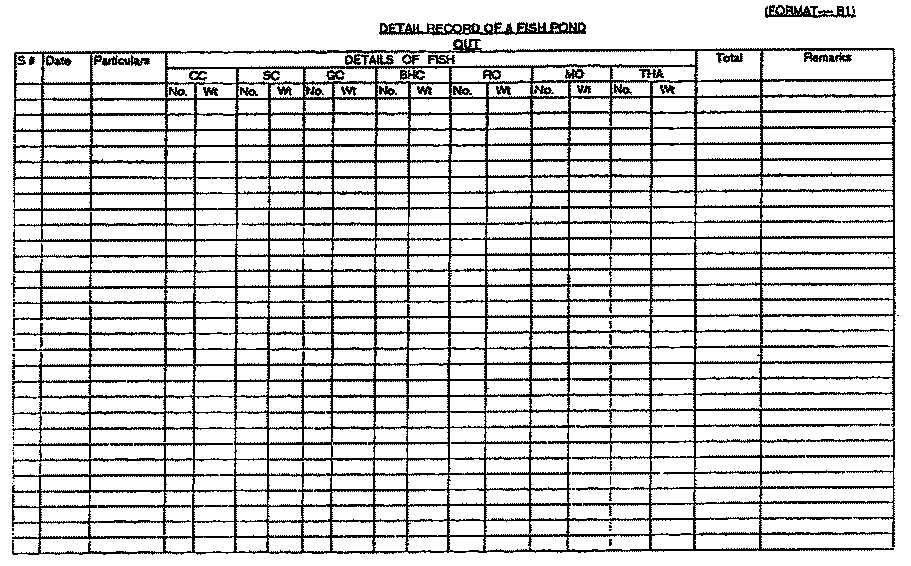
It includes all the activities (minor to major) related with the fish, their stocking, feeding, manuring, brood fish raising, their breeding, nursing, rearing and their distribution, their raising and ultimately their harvesting too. Besides the main activities, many other supporting activities e.g. records on water temperature and water quality etc. are also recorded to monitor the fish culture activity for higher production.
To facilitate the recording system of a fish pond a format with two parts (IN and OUT) has been developed as below;
Detail Record of a Fish Pond (Format - B)
Detail Record of a Fish Pond (Format - B1)
From the inception of the activity to establishment and its operation, what ever expenses occurred and also the income made by the disposal of the farm products are recorded under this heading. Generally, the expenses are divided into two groups;
Capital Expenses and Operational Expenses.
Under this heading, the expenses occurred for the establishment of the activity e.g. purchase of land, feasibility study, fencing, construction of pond or ponds, water system, approach road and other infrastructures are recorded. Generally the expenses which occurs once during the establishment of the activity is only recorded under this heading as shown below;
Table No.
Detail Records on Capital Expenses
|
S. # |
Activities |
Quantity |
Expenditure in Rs. |
|
|
1. |
Purchase of Land |
Kanals |
|
|
|
2. |
Feasibly Study |
- |
|
|
|
3. |
Fencing |
Rft. |
|
|
|
4. |
Approach Road |
Rft. |
|
|
|
5. |
Pond Construction |
|
|
|
|
6.
|
Water System |
|
|
|
|
|
i. Inlet |
|
|
|
|
|
ii. Outlet |
|
|
|
|
7. |
Drainage |
|
|
|
|
8. |
Others |
|
|
|
Under this heading, the expenses occurred for the operation of the fish farm e.g. preparation of a pond, purchase offish seed and their transportation, purchase of manure, feed, medicines and their transportation and labour cost etc. These expenses occur every year for the operation of the activities, therefore, these expenses are called Operation Expenses. The operation expenses is restricted to various production activities for a production cycle only. The efficiency of this expenses is always compared with annual income by the activity. Therefore, the operational expenses need to be oriented towards the production. Moreover, unnecessary expenses in operation reflects the mismanagement too. Therefore, the records of the operational need to be maintained as detail as possible.
Table No.
Detail Records on Operational Expenses
|
S.# |
Activities |
Quantity |
Expenditure in Rs. |
|
|
1. |
Preparation of Pond |
|
|
|
|
|
a) Repair and Maintenance |
w/d |
|
|
|
|
b) Lime |
Kg |
|
|
|
|
c) Water Tax |
|
|
|
|
2. |
Manure |
|
|
|
|
|
a) organic |
Kg |
|
|
|
|
b) inorganic |
Kg |
|
|
|
3. |
Feed |
|
|
|
|
|
a) Supplementary Feed |
Kg |
|
|
|
|
b) Grasses |
Kg |
|
|
|
4. |
Equipment |
|
|
|
|
|
a) Nets |
|
|
|
|
|
b) Instruments |
|
|
|
|
5. |
Chemicals/Medicines |
|
|
|
|
6. |
Labour Cost |
|
|
|
|
|
a) Skilled Labour -Technician |
|
|
|
|
|
b) Semi-Skilled Labour |
|
|
|
|
|
c) Unskilled Labour |
|
|
|
|
7. |
Any Others |
|
|
|
The income record from the sale of farm product is equally important as the Capital and Operational Expenses. Therefore, the details of income record need to be maintained. The detail records of harvest and income helps in analysing the farm productivity and well as the cost benefits of the activity.
The income of a fish farm depends on the strategy undertaken for the implementation of the farm for example if a fish pond has been operated only for table fish operation, then the farm provides the income by disposal of produced fish only. But if a farm has been established for fish production to fish seed production then it provides income from various activities e.g. by the sale of spawn, fries, fingerlings and yearlings besides the table sized fish. Similarly, t he integrated fish farm generates income not only from fish but also from various items of integration too.
9.1 Aquatic Weeds and Their Control
9.2 Aquatic Insects and Their Remedies
9.3 Wild Fishes
9.4 The Water Snake
9.5 Fish Parasites and Diseases
As in any other farming system, in fish culture also a number of problems of its own kinds are encountered. Serious efforts need to be made to resolve them either improving the management or taking a appropriate measures immediately, otherwise it may cause loss by fish kill even in short period. Therefore, a fish farmer need to be a keen observer of the pond water and stocked fish so that the problem is detected at its early stage and is resolved by taking even simple measures.
In any fish pond, different types aquatic weeds, insects and other higher animals e.g. wild fish, snake and birds are very common to see. Out of these animals, the insects are harmful as they prey on the small fries and fingerlings. They also bite and injuries the big fishes. The wild fish, water snake and birds are more harmful animals in the fish pond. They prey on the small fish, so they are called "predator". The presence of any predator in the fish pond prey on the stocked fries or fingerlings and causes a big loss in fish farming. Therefore, the fish farmer must be careful with such harmful predator in the fish pond. On observing such predator immediate measures need to be undertaken either to avoid or kill such predator. Some of the predator e.g. wild fish can be minimised or avoided by improving the management, the other predator e.g. snake can be minimised or avoided by taking preventive measures while some other predator like Fish Otter has still remained as an unresolved problem.
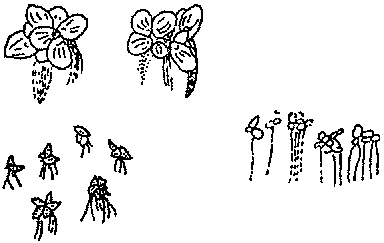
Generally, the vegetation grown in water are called Aquatic Plants or Weeds. There are many different types of aquatic weeds. In the day time the aquatic weeds generates oxygen by means of photosynthesis while in the night they also consume oxygen from the pond water and compete with the stocked fingerlings/yearlings. There are many different types of aquatic weeds and they are broadly classified under three main headings;
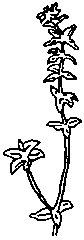
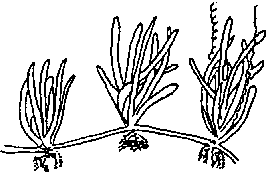
a) Emergent Type: Those aquatic plants/weeds which grow at the bottom of the pond and remains under the water and completes the whole life cycle. These aquatic weeds are Hydrilla, Vallisneria, and Chara.
Hydrilla
Vallisneria
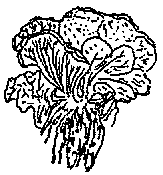
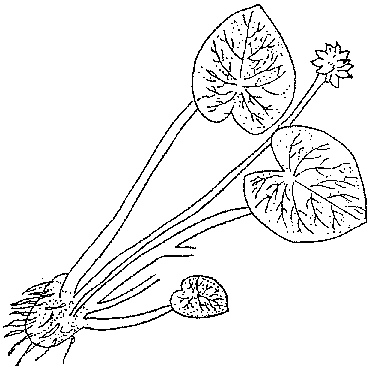
b) Sub-mergent Type: Those aquatic plants or weeds which grows at the bottom of the pond however, the leaves as well as flowers floats on the water surface and completes the life cycle like Nymph and
Pistia
Nymphaea
c) Floating Type: Those aquatic plants or weeds which grow at the surface of the water and remains floating in the water surface are called Floating weeds. These weeds complete the life cycle above the water surface. The floating type of aquatic weeds are; Lemna, Wollfia, and Water Hycainth etc.
Lemna
Water Hycainth
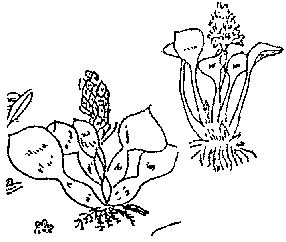
Besides the above aquatic weeds, a number of other lower aquatic plants in the form of thread are also grown which are called Threaded Algae. With the manuring, such threaded algae is very common in a fish pond. Generally these aquatic weeds grow excessively when the pond is very shallow. The excessive growth of such aquatic weeds is harmful to stocked fish in different ways;
1) the floating weeds grows on the water surface of the pond it spreads all over the water surface. Thus it prevents the penetration of light and lowers the water temperature. Under such condition the natural food offish is not produce adequately and the fish either grow slowly or retards the growth.2) in a fish pond organic or inorganic manure is applied to produce natural food of fish but in presence of aquatic weeds, the weeds utilises the manure in maximum and the weeds grow faster than the natural food of fish. Thus the fish don't get sufficient food for their growth.
3) the excessive growth of the aquatic weeds in a fish pond turns out a good shelter for the fish predators to hide or to protect themselves and causes a big loss of stocked fish.
4) the excessive growth of aquatic weeds in a water body does not harm the stocked fish in day time, however, in the night time all these aquatic weeds absorb oxygen of water and causes serious deficiency of oxygen and the fish may even die in lack of oxygen and
5) the decomposition of the excessive weeds in a fish pond deposits silts and it turns out the water body into swampy and thus it shortens the life of a fish pond.
Besides the aquatic weeds, threaded algae is also common. The excessive growth of the threaded algae do not only hinders the movement but also entangles the fries and fingerlings and the fish die. The excessive growth of threaded algae also may cause of oxygen deficiency.
Knowing all these disadvantages of different aquatic weeds in a fish pond, they should not be encouraged to grow them in a fish pond. These aquatic weeds are controlled by the use of chemicals e.g. Copper Sulphate, 2-4-D etc., however, the use of chemical requires accurate dose of the chemicals and definite procedures. Any small mistake may cause total loss of the stocked fish. But today the problem has been very much simplified by the introduction of Grass Carp. In any pond or water body where aquatic weeds are seen it is highly recommended to introduce the Grass Carp and it cleans the aquatic weeds biologically within the short period. Therefore, it is recommended to use appropriate number of Grass Carp in the pond so that the fish production is increased by controlling the aquatic weeds.
In fish culture, a fish pond is fertilised with organic or inorganic fertiliser periodically to produce natural food for the stocked fish. The fertilisation does not only produces phytoplankton and zooplankton as natural food offish but it also produces a number of insects in the fish pond water e.g. Back Swimmer, Water Scorpion, Water Beetle. Ranatra, Gaint Water Bug and larvae of Dragon Flies etc. All these insects live in pond water, therefore, they are called Aquatic Insects. The aquatic insects usually do not kill big fish but harms them causing wound after bites. However, they are very harmful to the eggs in the breeding pond, and the fries or fingerlings in nursery and rearing ponds. As these aquatic insects sucks the fish eggs and kills the fries in large number. Therefore, these aquatic insects are considered as harm full, and measures are taken to minimise or eradicate the insects specially from the nursery and rearing pond.
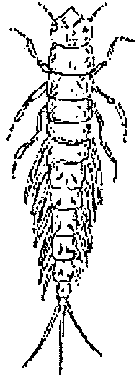
(below) Backswimmer (adult)
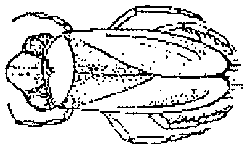
Aquatic Insects
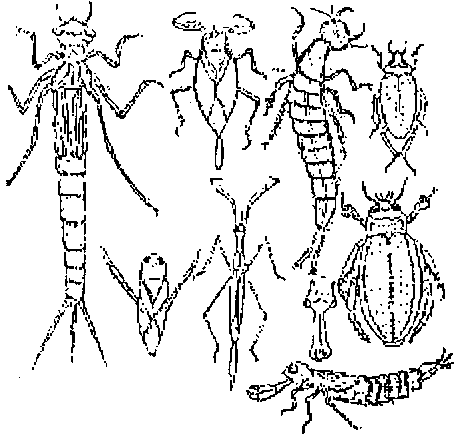
The aquatic insects though live in pond water, however, they can't take the dissolved oxygen from water for respiration. The aquatic insects come to the water surface after a certain interval to inhale the air for oxygen for respiration. Therefore, it is easy to kill these harmful insects by developing a film of emulsion on the surface of the pond water.
In practice, there are two methods to kill these aquatic insects; a) Soap Oil Emulsion and b) Low Speed Diesel or Used Mobil.
a) Soap Oil Emulsion: Generally, low cost Soap and Oil is used in 1: 3 ratio to prepare an emulsion and this emulsion is called Soap Oil Emulsion. For a water body of one kanal about 1 kg. of Soap and 3 Litre of Oil is necessary. The soap is first cut into small pieces and is boiled in water. Once the soap dissolves in the water, oil is poured into it. While pouring the oil, the soap water solution need to be steered well. Once the soap and oil get mixed well a Soap Oil Emulsion is prepared. The soap oil emulsion is very light. It is spread on the pond water with a mug and it spreads on as a thin film layer. When the aquatic insects come to surface to inhale air from atmosphere, it inhale the soap oil emulsion in respiratory tract and get the respiratory tract get choked. Due to choking the aquatic insect die within a short period.The soap oil emulsion is usually used either in the morning or in evening, when there is no wind at all. A light breeze even pushes the light emulsion to one side of the pond. In such condition the insects go to other side of the pond and they do not die. Therefore, the application of the soap oil emulsion need to be undertaken when there is no wind. This method of controlling aquatic insects is very effective. The higher cost of soap and oil is the negative point to this operation however, the higher survival rate of fries and fingerlings by its use fully justifies for the operation.
b) Low Speed Diesel or Used Mobil
The use of low speed diesel or used Mobil is considerably cheaper method to kill the harmful aquatic insects. Due to their easy availability in the market at low or lower price this method is gradually replacing the former method. The low speed diesel or used Mobil oil is used at the rate of 1 litre and 1.5 litre per kanal respectively. The method of their operation is similar to soap oil emulsion. Due to their low cost, easily availability and being effective, these items are being common amongst the fish farmers in the field.
In fish culture, the fishes seen in a fish pond besides the cultivable fishes which are stocked for culture are called Wild Fishes. The wild fishes ranges widely in their size from small to big and their feeding habit also varies from herbivorous to carnivorous too. The herbivorous and omnivorous fishes are not harmful like carnivorous as they do not prey the stocked fish but simply competes for food in the fish pond. All most all carnivorous are dangerous as they go on hunting the fries, fingerlings and yearlings of cultivable fishes. Out of the carnivorous fish, Wallago, Mystus, Channa, Clarius, Heteropneuteus and Notopterous species are most dangerous wild fish and these fishes must be avoided from the fish pond. The presence of such carnivorous fishes in the fish pond specially in nursery and rearing ponds causes serious loss of fries and fingerlings. Sometimes due to negligence some of these fishes enter into the ponds and while harvesting only a limited number of carnivorous fishes are obtained out of the stocked and causes a big loss in fish culture.
Therefore, in managing a fish pond, firstly facilities and secondly the management need to be improved so that the wild fish do not get chance to enter into the fish pond for which a "packa" water supply system need to be developed. Moreover, in such water canal some grooves are developed at certain intervals so that the entering fresh water is filtered through wire gauze of fine mesh. If such structure is not possible to construct for any reason, then the inlet pipe must be tied with wire gauze of fine mesh, so that not even a single egg or fry of wild fish enters into the fry or fingerling pond. Just to avoid the infestation of wild fishes in the fish pond, it is suggested to dry the fish pond every year and keep exposed to sun for few weeks so that the pond become free from wild fishes.
In case of undrainable fish pond, the chances or wild fish survival increases. Therefore to such pond, after harvest the water table should be dropped by pumping out the water or by using it for irrigating any agriculture crop near by. As the water level drops to low point a chemical called " Rotenone "need to be applied at the rate of part per million (ppm) to kill the wild fishes. After the use of this chemical, the pond is left without use at least for 2-3 weeks. Within this period in no circumstances stocking of fish to be done in such fish pond. Only after two to three weeks the fish pond is filled with new water, fertilised and stocked with new fish for culture.
The water snake is a common reptile in fish pond. It is very common in warmer climatic condition where as it is rarely seen in colder region. The water snake may be small or big in size. It has big mouth to swallow even the bigger prey. It has two sharp fangs to hold the prey. The water snake is not a poisonous one, however, people get afraid of it as its bite is very painful. The water snake likes to hunt the fingerlings as well as bigger fish too. The snake can be seen preying even in the day light, however, it likes to prey in the night. The water snake causes a considerable loss of fingerlings as well as yearlings of even 6" - 8". Therefore, once the snake is observed in and around the fish pond, immediately preventive measures, need to be undertaken,
Under the preventive measures, firstly the bushes around the fish pond need to be cleared. These bushes arc considered as shelter place of a snake. By clearing the bushes also it minimises the water snake around the fish pond and secondly an effective snake trap need to be prepared and operate it to trap the water snake.
The Snake Trap:
The snake trap is a simple barrel type of structure. It can be made with locally available small mesh sized wire gauze. It is so simple that one can easily prepare it. To make the snake trap only two items are required. One is small mesh sized wire gauze found in a roll with a width of 4' at the cost of Rs. 30 per running feet and secondly only 20 -25 feet of fine wire at the cost of Rs. 5.00 only.
How to make a Snake Trap?
Take 4' feet of above mentioned sized wire gauze from the local market (i) and cut out one feet width out of it. (ii). The bigger sized wire gauze of (3'*3') rolls back to give a shape of barrel (iii). Both the end of barrel need to be overlapped. The overlapped portion of the barrel is stitched with fine wire from one end to other, so that the barrel shape stands firmly. This completes the first stage of Snake Trap.
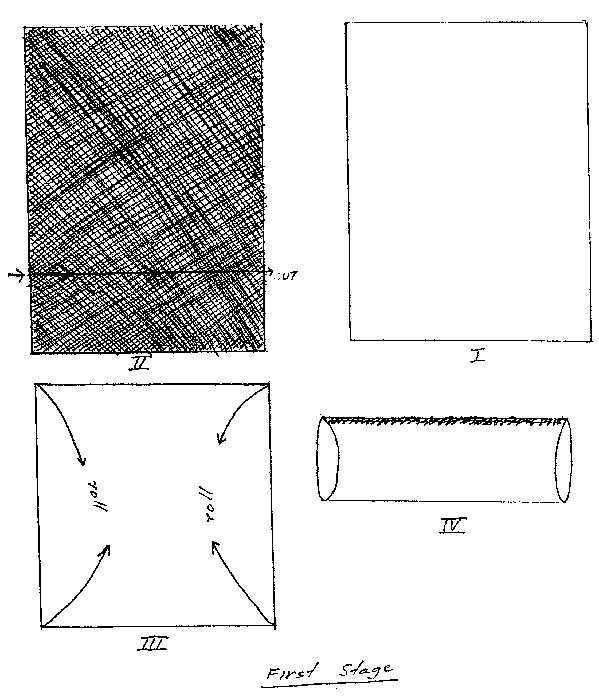
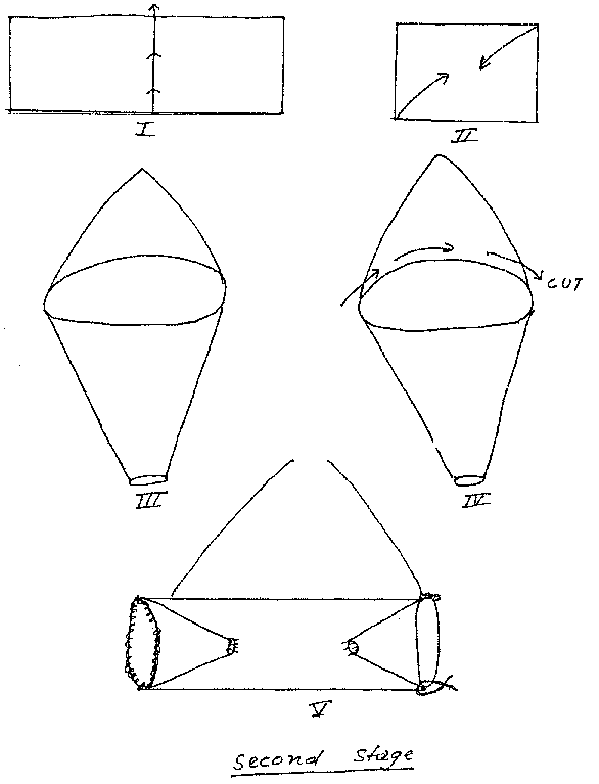
To complete the second stage, take the one feet wide cut piece of wire gauze and further cut it into two pieces (i). Take one cut small piece of wire gauze and fold it diagonally (ii) in such a way that the one end remain with big circle with a wing while the other ends will have 1-1.5 inches hole only (iii).Thus it turns out as a "Funnel". The over lapping side is again stitched with fine wire so that it remains firm. The wing like structure of bigger circle is cut in such a way that the given structure turns out as "funnel " (iv). The second piece of cut wire gauze is also made the same sized funnel. Two funnel shaped structures are inserted into both the end of the barrel shaped structure, so that the narrow hole remains inside the barrel, while the wider portion Fits in with the mouth of the funnel.
In case of some deference in the size of the barrel and funnel, one need to adjust so that the bigger circle of funnel get adjusted exactly with barrel opening. While fixing the funnel with the barrel, the end with 1" hole is directed towards the inner side of the barrel. It is better to check whether the wire at the 1" hole are sharp or pointed enough or not? If not, it is advised to cut out one mesh of wire and make them pointed. One of the wider end of the funnel and the opening of the barrel are tightly woven around the circle with fine wire, so that the funnel does not come out. These funnel shaped structure is fixed in second end of the barrel at two or three points by fine wire, so that in case of need, this funnel structure can be taken out with least effort, otherwise the funnel remains intact with the barrel. At the both end of the snake trap either with fine wire or nylon rope is tied in such a way that the snake trap can be uplifted holding the wire or rope. Now the snake trap is completely ready and is ready for its operation.
How to operate?
The operation of a snake trap has been found effective even in the day light, however, it is usually used at evening or night operation. The snake trap is fixed along the dike of the pond in such a way that half of the funnel hole of the snake trap is dipped under water and other half remains above the water. It is regulated with the help of wire or nylon rope tied on snake trap and a peg fixed on the dike of the pond. After fixing a snake trap, it is covered with some grasses or twinges of bushes to camouflage it. No bait is necessary in snake trap, however, some people prefers to put some live frog or wild fish as bait inside the trap to be sure to see a snake trapped.
In the night, when a snake comes out of its hole in search of its prey, it encounters with the trap and it attempts to peep inside the snake trap through the hole of runnel and gets trapped. As the snake try to peep inside the trap through the hole of funnel and does not see anything in it and tries to go back but the pointed wire of the funnel tip pricks the ventral surface of the snake body and forces to get into the trap. One should not surprise to see two or more snake in the same trap next morning.
Next morning, examine the snake trap, if snake is not found in the trap, one can leave the trap as it is or place it again at evening at other place. But in case, a snake is trapped, the snake remains alive. The water snake is non-poisonous, however, no one like to handle a live snake. Therefore, the snake trap with snake need to be dipped into the water, just loosing the wire or rope tied on the snake trap. The whole snake trap get easily dipped in the water due to the snake's body weight. After 15 to 20 minutes the snake get drowned in water and die. Once it is confirm that the snake is dead take out the snake trap from water and take out one of the funnel which is not fixed properly but simple tighten two or three points so that the dead snake is taken out of the snake trap. The dead snake is buried in a ditch.
Again fix the funnel with the snake trap and prepare it for next operation. This way the water snake problem is minimised to greater extent and stocked fish is saved to grow and gain higher economic returns from fish culture.
9.5.1 Water Leech:
9.5.2 Argulus:
9.5.3 Larnea:
9.5.4 Ichthyopthirius - White Spotted Disease:
9.5.5 Trichodina:
9.5.6 Gyrodactylus:
9.5.7 Dactylogyrus:
Like in any animals, the fish also get infested with parasites and pathogens. In case of such infection, if proper measure is not undertaken in right time, the fish may die. For such infection no single factor remains responsible but a number of different factors remain responsible e.g. deterioration of water quality, lack of balance feed, over feeding, over stocking, injury, bad management and many other adverse conditions. Such parasites and pathogens arc also found in natural waters but in natural water infection chances to other fishes is far less as in natural waters, the water is continuously flowing and moreover in natural water the density of fish population is far less, while in fish culture practice the pond water is kept stagnant and the fish stocked as per water body remains congregated within a definite water area, and in such condition the chances of infection increases considerably.
Out of the reported fish parasites, some of them are very small as they are of only one cell and are called Unicellular while the others are higher animals. Out of these, some of them multiplies very fast and on detection of such parasite if measure is not taken in time, then the whole stock offish get infected and the fish ultimately die. Thus it causes a big loss. Therefore, a good field worker or even a farmer must be always vigilant on observing the pond water quality and the health of stocked fish. On observing any abnormal symptom, the fish need to be examined and take appropriate measures at its earliest stage. Because of the seriousness offish parasites and diseases, it is said " Prevention is better than Cure." Therefore, attempts should be made not to get the fish infected at all.
Therefore, in this Chapter, an attempt is being made to give some information on fish parasites/diseases and the methods of their cures.
Water Leech is very common external parasite of a fish. It is common in a fish pond. The water leech is similar to terrestrial leech, however, its size is small. The water leech is black in colour and a number of transverse stripes on the body. One end of the leech has a disc shaped saucer by means of which it clings to the host while the other end it has a smaller triangular mouth with sharp teeth. With the help of its sharp teeth, it scraps out the host's skin and suck blood. A small number of parasite does not effect adversely to the fish, however, a large number of parasite effects the fish health. A bath of fishes in salt water solution is enough to get reed of this parasite. Resides the salt bath a chemical called - Dipterex treatment in the pond at the ratio of 0.6 ppm parts per million has been found very effective
Water Leech -an ectoparasite
Argulus is an external parasite and is commonly called Carp Lice. The parasite is more or less round and compressed dorso - ventrally. The back side of the parasite is covered by a shield like structure while in ventral side two round saucers, teeth and three pairs of legs are observed. The sucker helps the parasite to cling the host. The sharp teeth of the parasite scrape out the skin offish and make wound to suck the blood. It is mostly found in fins and exposed skin. An infection with low number of parasite may not harm the fish, however, higher number of parasite makes the fish weak and weaker and ultimately die. Usually this parasitic infection takes place either in early spring when the water temperature starts rising or in under- nourished condition. The parasite is either treated with a bath in salt and water solution or for the pond treatment an insecticide called Dipterex is used at the concentration of 0.6 ppm. One or two such treatment of Dipterex is enough to control the parasite.
Argulus - an ectoparasite
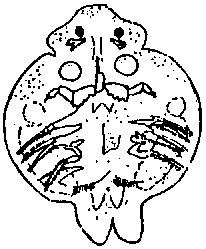
A "T" shaped external parasite is also common amongst the cultivable fishes and it is commonly called Larnea. The anterior portion of "T" penetrates into the skin of the fish leaving the posterior portion outside the skin and it sucks blood. A few number of such parasites do not adversely effect the fish however, higher number of parasites make the fish weak and weaker and ultimately die. This external parasite is also treated with either salt water solution or Dipterex at the concentration of 0.6 ppm.
Larnea - an ectoparasite
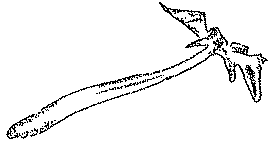
Ichthyopthirius is unicellular parasite. As it is one celled animal it can't be seen by naked eye and with the help of compound microscope only it is seen. The parasite is an unicellular and sub-spherical in structure. It has a mouth, gullet and two nuclei. The outer circle of the cell has fine hair like structures called cilia by means of which the parasite moves from one place to other. The cilia also helps in penetrating the skin of the fish. This small parasite first invades below the skin where it multiplies by binary fission and in shortest time it increases into high number and it burst out with large number of small parasites. At this stage only the breasted point appears as a white spot, so it is called " White Spotted Diseases."
The parasite infects to small fries to big brood fishes too. Generally, it occurs when the water temperature is about to rise from lower temperature. The parasite does not survive above 30o C. Every three to four hours, the parasite multiplies and the number is increased. Therefore, on the detection of the parasite immediately appropriate measure need to be undertaken to treat the fish, otherwise, mass kill of fish may occur any time. The infected fish show symptom of irritation by jumping and also moves at the surface of the water. Highly infected fish is left alone and swims unbalanced way along the shore of the pond. During the infection, the fish loses appetite and gradually become weaker and ultimately die.
On observing this parasite, a chemical called Malachite Green is used for the treatment at the rate of 0.4 ppm. For this disease the pond treatment has been found less effective, therefore, treatment need to be carried out in cement tank and the whole stock offish are transferred to the tank water with medicine. Most difficult part of this treatment is to repeat the treatment for several days to make the fish free from the parasites.
Ichthiopthirius molitrix - White Spotted Disease
It is an external parasite. Its shape is round in the form of a disc. The outer layer is full of fine hairy structure called cilia by means of which the parasite swims in water. The parasite has a adhesive disc by means of which the parasite clings to the host - the fish. The infected fish get irritated and starts jumping in the pond water. Heavily infected fish moves at the surface of the water. Against this parasite also, Malachite Green is used as mentioned in the case of White Spotted Disease.
Trichodina

It is a worm type of external parasite. It is very small in size and it can't be detected by naked eye. It is found on body and fins. It is examined by the help of microscope only.
Gyrodactylus
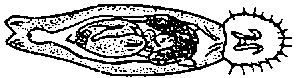
The body of the parasite is elongated and flattened. The posterior end of the parasite has disc shaped adhesive organ with a number of small hooks around its margins by means of which it clings to the host. A considerable number of external parasite make the fish weak and ultimately die. On detection of this parasite also Dipterex is used at the rate of 0.6 ppm. A single application in the pond may not be adequate to control the parasite. Therefore, after each treatment the fish should be examined under the microscope. In case of parasite detection, further treatment need to be applied for second lime or so forth but the interval of two applications must be at least 14 days.
This parasite is also similar to Gyrodactylus. Its size is very small and can't be seen by naked eye. This parasite is less infectious to adult or brood fishes, however, very infectious to the fries and fingerlings. Therefore, the parasites are seen in nursing or rearing ponds. This parasites are usually attached to very soft organ - Gill where it sucks the blood of the host. If it is not detected in its early stage of infection, fries and fingerlings die in mass specially in nursing and rearing ponds. Generally, the presence of the parasite indicates not healthy condition of the pond. Therefore, to avoid this parasite special attention need to be given for better management of the nursing pond by fertilising appropriate quantity of manure at regular intervals to develop adequate natural food for fries, so that the fries get sufficient food and remains healthy. Besides, the natural food, the fries of nursery pond need to be fed with supplementary food so that the fries and fingerlings get adequate food to be healthy. Once the parasite is observed, it may appear regularly and every year too. Therefore, to avoid this parasite or to minimise the mortality from this parasite, the management need to be improved so that the parasite do not get chance to appear.
To control this parasite Dipterex is used at the rate of 0.6 -0.8 ppm, however, a single treatment may not be enough to eradicate the parasite. Therefore, on regular basis the fries need to be examined under microscope and the medicine need to be used several times to control the parasite. The interval of the two treatment should be not less than two weeks.
Dactylogyrus
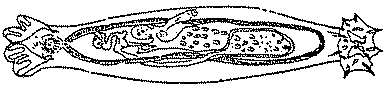
There are many more external as well as internal parasites of fish besides the above mentioned one. Therefore, the fishery and extension staff as well as the fish farmer himself must be always alert in observing the conditions of the pond's water and the health of the stocked fish. It should be always aimed to upgrade or improve the management so that no parasite and pathogen appears in the fish pond.