


IPTRID's main database was developed in 1998 under Access software and reached 5 000 entries by the end of 2004. For technical reasons the IPTRID Secretariat has seen the need to upgrade the existing database into a new and more dynamic one that will be compatible with other FAO similar tools. This effort included a specialized mailing list able to meet the requirements of the Programme.
The new Database, through a series of Access tables and forms, allows the user to:
With its 1 700 entries constantly growing, the new Database represents an important tool for delivering IPTRID researchers' studies and efforts around the world. Thanks to its new functions, helpful information in the field of irrigation and drainage can be supplied to professionals, students, ministries and private companies shortly after their publication.
The IPTRID web site provides information aboutIPTRID's Governance and strategy,the Partners, the beneficiaries, the Network and information related to projects and events of both IPTRID and its partners. All IPTRID publications, such as the GRID Magazine, the issue papers or the Knowledge Synthesis reports are downloadable in Pdf format. Links to IPTRID's Knowledge Systems - WCA-Infonet, CapDevWater and CISEAU - are also available and a large number of field pictures are accessible through the Photo Gallery. Since summer 2005, the French version of the IPTRID web site was made available.
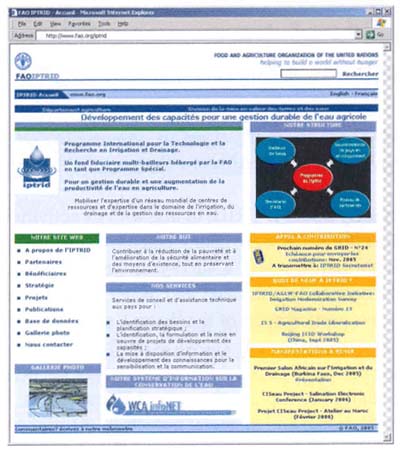
URL: http://www.fao.org/iptrid
IPTRID-AGLW joint database on Capacity Development for Water in Agriculture (CapDevWater)
To establish a reference for its activities on capacity development with special emphasis on technology transfer, IPTRID undertook a worldwide survey to obtain a global overview of the available learning tool for water-involved stakeholders. The survey was presented as an inventory published in April 2005 and is available on the IPTRID web site.
Earlier, and in support to the global challenge, the Water Resources, Development and Management Service (AGLW) of FAO jointly with the ICID Working Group on Capacity Building, undertook the compilation of information about training and educational institutions worldwide and established a web-based database with various education and training courses in irrigation, drainage and flood control.
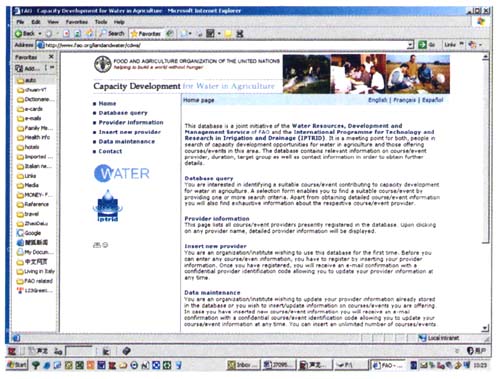
In order to join a common goal, IPTRID and AGLW have decided to merge their work on learning tool provision on capacity development opportunities. The result of the joint effort was the Capacity Development for Water in Agriculture Database (CapDevWater). CapDevWater is a web-based tool that provides information on activities that cover the typically applied instruments used in the process of training the stakeholders involved in irrigated agriculture management. It aims at creating a meeting point for both people in search of capacity development opportunities and those offering these opportunities. The joint database contains relevant information on course/event provider, duration, target group as well as contact information in order to obtain further details.
http://www.fao.org/landandwater/cdwa/
IPTRID/AGLW-FAO Collaborative Initiative: Irrigation Modernization Survey
In early 2002, IPTRID, in line with its activities, decided on the need to document and analyse the efforts that were taking place worldwide in relation to modernization of irrigation systems. With that in mind, a survey on selected cases of irrigation modernization was carried out. Subsequently, the Land and Water Development Division enlarged its involvement with the active participation of the Water Resources, Development and Management Service (AGLW). The activity became known as the Irrigation Modernization Survey Initiative for which eighteen selected cases around the world, where the process of modernization of irrigation systems has actually taken place, have been documented. For each case study, the technical, managerial, institutional and financial aspects of the process that took place were studied.
In order to bring the results of the survey to bring to a broader audience, to provide a tool for updated knowledge of the processes of modernization that actually taking place, and to give local organizations the opportunity to present new cases, the development of a web section that presents the outcome of the survey was decided. The web section has now been finalized and is operational on the FAO/AGLW web site:
http://www.fao.org/landandwater/aglw/watermanagement/modernis.stm)

The IPTRID web site is a prototype platform providing thematic information about irrigated areas issues, such as salinity, water quality or soil erosion. This information platform is first a platform for the capitalization of field experience and the sharing of the know-how between southern countries. The knowledge, project data and research results used to build the information disseminated through this platform have been supplied by the project partners, coming exclusively from the southern countries.
The information presented is practical and summarized addressing a professional audience such as technical advisors or assistants, consulting companies, extension agents, rural development officers or students.
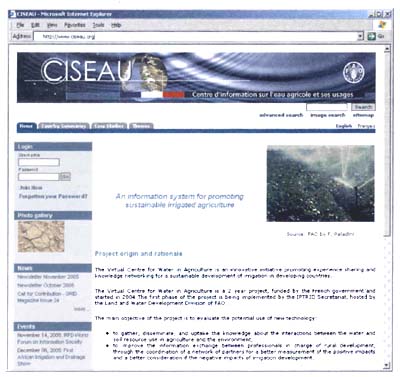
http://www/ciseau.org
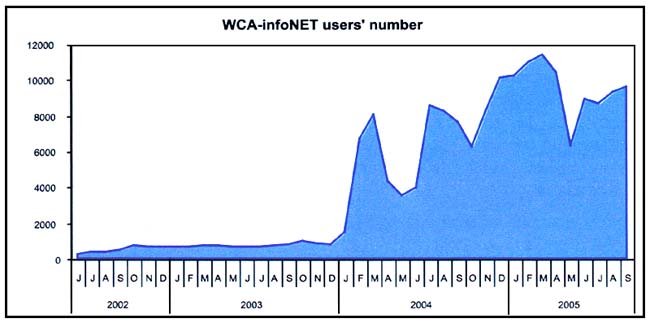
Given the interest shown by a majority of stakeholders who had followed and/or been involved in the development of the WCA-infoNET information system, and in order to determine whether to continue running the system or not, the new management of IPTRID decided to carry out an evaluation of the current situation of the system.
The evaluation study pointed towards a remarkable success of the system's original idea underlying the design, goals and objectives of the project. The study also stressed that the information system needs to be revised, upgraded and managed on a more regular basis, if it is to be sustainable. As a result, IPTRID decided to uplift and upgrade the system and to regularly operate and maintain it. A formal re-launching of WCA-infoNET was made in September 2005.
In terms of content enhancement, the management of WCA-infoNET has made a special effort to add region-selected information through the recruitment of consultants from within the regions for data inputting and through the linkage with regional/national water institutes while centrally coordinating activities. So far, content related to the Near East and South Asia regions has been enhanced with an iteration plan to move to other regions.
Moreover, the system was upgraded with enhanced features and more stability to keep up with the continuous development of the Community Directory System platform that constitutes the fundamental structure of WCA-infoNET. The backbone of the system (its semantic topic tree) was also simplified and reoriented to make it easy-to-use to bring more subscribers and to preserve its current loyal users. However, it is only through the continuous and active support of all stakeholders, both individuals and institutions, that the system can continue running in a sustainable manner, and its threshold value of content estimated at its inception can become a realistic goal.
The GRID magazine is considered IPTRID's flag. Until recently the issues were produced in English and French. Under a request from FAO, the GRID issue number 23 was produced in the five official languages of the organization, adding Spanish, Arabic and Chinese versions. This was done in order to present this product at FAO's Council and Conference Meeting held in November and also as a mechanism to seek support from donors for publications in these three new languages. It is to be noted that the Ministry of Agriculture of Spain already agreed and supported this particular issue while contacts with relevant organizations in China and the Arab world are underway to secure funding for the remaining languages.
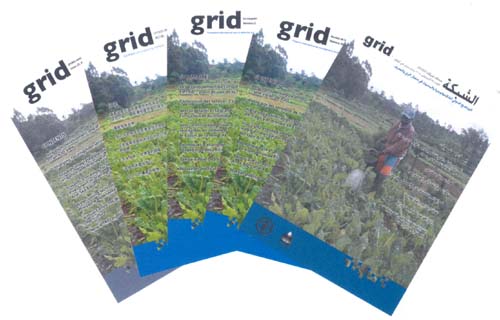
During the reporting period, the Secretariat produced only one issue, instead of two due to the re organization of the Programme related to the change of Programme Manager. However, it is the intention of the Secretariat to resume the production of two issues per year, starting in 2006 with Grid 24 scheduled in February and Grid 25 scheduled in August/September while efforts will be made to have these issues in all 5 languages, this will heavily depend on the contribution of specific donors.
Issue Papers
Events publications
IPTRID Programme reporting
Project reports
