


This study analysed graduation data from 35 institutions in five countries. A total of 31,325 graduates were reported during 1993-2002. Among the sampled institutions, certificate degrees were not offered in Thailand and Vietnam. Diploma was not included in Malaysia and Thailand, while master and PhD was not offered in Laos (Table 2).
Graduation trends during the 10-year period are further analysed by country and gender for each level of education (figures 1-5).
Table 2. Forestry graduates 1993-2002 by country, educational level and gender
Indonesia (n=11) |
Laos (n=5) |
Malaysia(n=3) |
Plilippines (n=10) |
Thailand (n=1) |
Vietnam (n=5) |
Total (n=35) |
|||||||||
Male |
Female |
Male |
Female |
Male |
Female |
Male |
Female |
Male |
Female |
Male |
Female |
Male |
Female |
M+F | |
Certificate |
713 |
53 |
1409 |
269 |
500 |
27 |
696 |
810 |
0 |
0 |
0 |
0 |
3318 |
1159 |
4477 |
Diploma |
2520 |
894 |
1346 |
192 |
0 |
0 |
0 |
0 |
0 |
0 |
35 |
5 |
3901 |
1091 |
4992 |
First degree |
6085 |
2405 |
191 |
31 |
207 |
218 |
1394 |
1226 |
890 |
500 |
5847 |
1365 |
14614 |
5745 |
20359 |
Master |
248 |
104 |
0 |
0 |
16 |
0 |
148 |
58 |
372 |
131 |
223 |
52 |
1007 |
345 |
1352 |
PhD |
11 |
1 |
0 |
0 |
4 |
0 |
66 |
18 |
16 |
10 |
15 |
4 |
112 |
33 |
145 |
Total |
9577 |
3457 |
2946 |
492 |
727 |
245 |
2304 |
2112 |
1278 |
641 |
6120 |
1426 |
22952 |
8373 |
31325 |
Indonesian, Lao, Malaysian and Philippines institutions responded in this category. In the Philippines, graduation decreased substantially between 1993 and 2002. Graduation in Indonesia remained stable. In Laos, graduation fluctuated greatly over the last ten years, with a sharp increase in the past 3 years. Certificate graduation in Malaysia increased with opening of new forestry programmes (Figure 1). It should be noted that the educational level of a certificate degree in forestry differs between countries, and could not be directly compared.
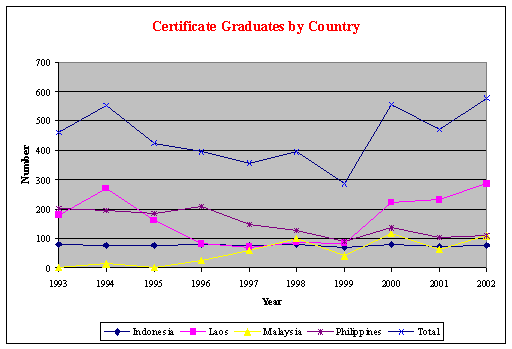
Figure 1. Certificate graduates by country 1993-2002
After a peak in 1995 the total number of diploma graduates decreased sharply, due to a reduction of graduates in Indonesia. An increase was again observed from 1998. The high figure for 2002 is explained by a huge increase in graduates from one single institution, the National University of Laos. This is a result of a national policy of increasing the number of students in colleges and universities. Thai, Malaysian and Philippine institutions in this study did not offer diploma programmes (Figure 2).
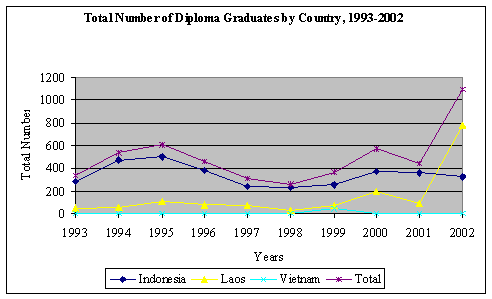
Figure 2. Diploma graduates by country
All countries offer first-degree programmes. Overall, the number of first-degree graduates doubled from 1993 to 2002, but trends differed between countries. In four countries out of six, the number of graduates increased. Philippines and to some extent Thailand had a fairly stable output of graduates over the 10-year period. Graduation increased in Indonesia, Vietnam and Laos. In Vietnam, a sharp increase in the output of BSc graduates was observed after 1999. In Laos, the first batch of BSc Forestry students graduated as late as in 2000 (figure 3).
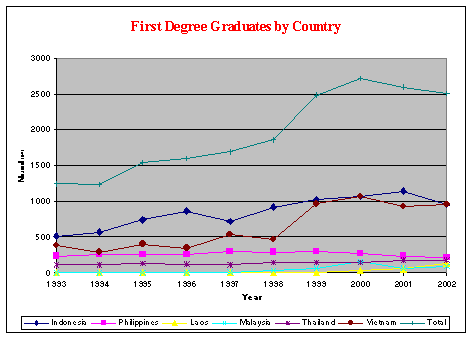
Figure 3. First degree graduates by country
The largest raise in graduation occurred at MSc level, increasing almost three times as from 1997 to 2002. All countries except Philippines increased their output of MSc graduates (MSc forestry is not offered in Laos). Again the variation between countries was significant, with Kasetsart University, Thailand accounting for a large proportion of this increase- up from around 20 gradates per year to some 120 per year in 2001 and 2002. The first MSc Forestry graduates in Vietnam among the responding institutions appeared in 1995 (figure 4).
Considering the large number of first-degree graduates in Indonesia and Philippines, the number of MSc graduates in these two countries was fairly small. In 2002, for example, Philippines had 213 first degree vs. 17 MSc graduates. Indonesia had 947 first degree and 55 MSc graduates, respectively. Over the 10 year period, the output of MSc graduates, as % of the number of first-degree graduates were 4.3% in Indonesia and 7,9 % in the Philippines.
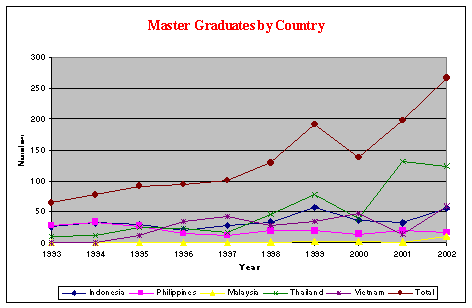
Figure 4. Master graduates by country
The five institutions with PhD graduates (one institution per country, Laos excluded) had a combined total output of 145 during the 10-year period. Sixty % of them graduated in the Philippines. Notably, only 12 PhDs graduated in Indonesia during the 10-year period. Overall, there was an increased PhD graduation although there were big fluctuations from year to year. Only in Thailand could we see a clear upward trend (Figure 5).
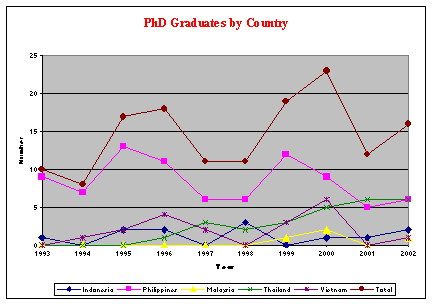
Figure 5. PhD graduates by country
The male and female ratio of graduates varied little between the levels of education. Regionally the study showed between 21.9% and 28.2% of female graduates in the various levels (Table 3).
Table 3. Graduates by gender
No of graduates 1993-2002 |
Male, % |
Female,% | |
Certificate |
4477 |
74.1 |
25.9 |
Diploma |
4992 |
78.1 |
21.9 |
First degree |
20359 |
71.8 |
28.2 |
Master |
1352 |
74.5 |
25.5 |
PhD |
145 |
77.2 |
22.8 |
However, the variation between countries was very significant. The high ratio of female graduates in the Philippines at causes a bias in the regional average. Philippines had an almost 50/50 ratio of male and female graduates at certificate, and first-degree levels. Malaysia also had fairly equal number of male and female first-degree graduates. Laos and Vietnam had a low ratio of female graduates in all their programmes. At Master and PhD level, there was less difference among most countries, Malaysia being the exception with no female MSc graduates. Figures 6-10.
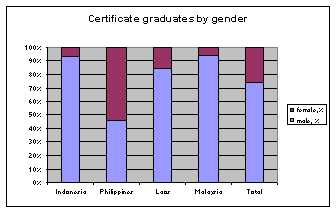
Figure 6. Certificate graduates by gender
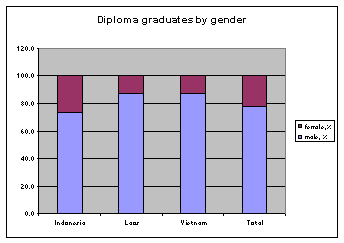
Figure 7. Diploma graduates by gender
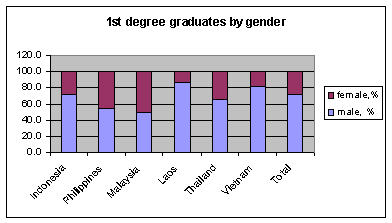
Figure 8. First-degree graduates by gender
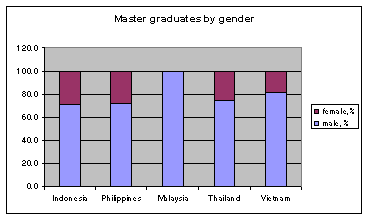
Figure 9. Master graduates by gender
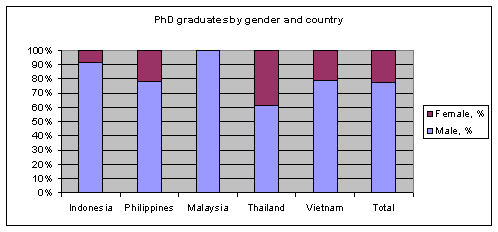
Figure 10. PhD graduates by gender.
