


This section provides information on the method and approach chosen to identify and assess the complementary national variables followed by presentation of the national data and finally a brief assessment.
FSI has used the “Group Convergence Method” (Govil, 2002) for identification and assessment of variables. FSI organized two workshops to identify variables that are necessary to explain condition of forest against this criteria (Theme) using group comprised of experts from various disciplines. It lead to the final list of identified variables and in their valuation based on their temporal trend and related information.
Following seven national variables in addition to the three global variables (Area affected by fire, Area affected by insects, and Area affected by diseases) have been identified as complementary variables. These variables are essential to explain the state of “Health and Vitality” of forest resources in India. However, information is available only for some of them, for the rest of them either information is partially available or not available at all.
a. Status of Natural Regeneration
b. Incidence of Weeds Infestation
c. Incidence of Grazing in different forest types
d. Status of Pollutants
e. Presence of indicator species
f. Density of forest canopy
g. Status of forest fragmentation
Following table indicates sources of data for the additional variables.
Additional Variable |
Information Year |
Source |
Status of Natural Regeneration |
1982 |
SFR1987 State of Forest Resources 1993. Forest Survey of India, Ministry of Environment and Forests, Government of India |
1992 |
SFR1995, State of Forest Resources 1993. Forest Survey of India, Ministry of Environment and Forests, Government of India | |
Incidence of Weed Infestation |
1990s |
Kumar and Rohatgi (1999), The role of invasive weeds in changing floristic diversity, Ann. For. 7(1):147-150. (2) |
Incidence of grazing |
SFRxxx, State of Forest Resources 1993. Forest Survey of India, Ministry of Environment and Forests, Government of India |
(follows from previous page)
Pollutants |
No data is available and hence no source data | |
Density of forest canopy |
1982 |
SFR, 1987 State of Forest Resources 1987. Forest Survey of India, Ministry of Environment and Forests, Government of India. |
1986 |
SFR, 1989 State of Forest Resources 1989. Forest Survey of India, Ministry of Environment and Forests, Government of India. | |
1988 |
SFR, 1991 State of Forest Resources 1991. Forest Survey of India, Ministry of Environment and Forests, Government of India. | |
1990 |
SFR, 1993 State of Forest Resources 1993. Forest Survey of India, Ministry of Environment and Forests, Government of India. | |
1992 |
SFR, 1995 State of Forest Resources 1995. Forest Survey of India, Ministry of Environment and Forests, Government of India. | |
1994 |
SFR, 1997 State of Forest Resources 1993. Forest Survey of India, Ministry of Environment and Forests, Government of India. | |
1997 |
SFR, 1999. State of Forest Resources 1999. Forest Survey of India, Ministry of Environment and Forests, Government of India. | |
2000 |
SFR, 2000. State of Forest Resources 200. Forest Survey of India, Ministry of Environment and Forests, Government of India. | |
Presence of Indicator Species |
||
Forest fragmentation |
1990 |
Independent Pan-Tropical Remote Sensing Survey, 2000. FAO Rome. |
2000 |
Independent Pan-Tropical Remote Sensing Survey, 2000. FAO Rome. | |
Recorded Forest Area |
1990 |
SFR, 1993 State of Forest Resources 1993. Forest Survey of India, Ministry of Environment and Forests, Government of India. |
1992 |
SFR, 1995. State of Forest Resources 1995. Forest Survey of India, Ministry of Environment and Forests, Government of India. | |
1994 |
SFR, 1997. State of Forest Resources, 1997. Forest Survey of India, Ministry of Environment and Forests, Government of India. | |
1997 |
SFR, 1999. State of Forest Resources, 1999. Forest Survey of India, Ministry of Environment and Forests, Government of India. | |
2000 |
SFR, 2001. State of Forest Resources, 2001. Forest Survey of India, Ministry of Environment and Forests, Government of India. |
This section provides information on each of the identified additional variables. It contains relevant definitions, source and source data, temporal trends and its assessment.
Natural regeneration indicates the capacity of ecosystem to sustain the “forests” in perpetuity. The information was collected by FSI while conducting forest inventories. FAI follows a systematic sampling method for its forest inventories where it overlays a 2 ½’x 2 ½’ grid of latitudes and longitudes divides on a 1:50,000 scale topographic sheet to divide it into 36 grid cells and selects two sample points within each such grid for collecting inventory data from a square plot of 0.1 ha at each of these sample points. The FSI lays a 4 m x 4 m plot at each of two sample points to collect supplementary data on natural regeneration.
Definition (FAOA)
No standard national definition is available
Terms |
Definition |
Natural Regeneration |
Natural succession of forest trees on temporarily unstocked forest lands |
Transformation There is no need for transformation of the variable.
Data and Temporal Changes
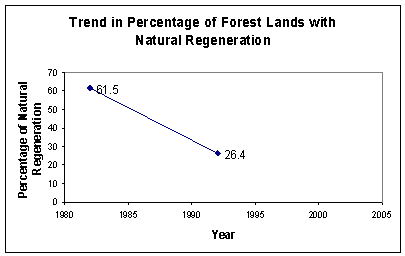
The information on assessment of regeneration is only available for only 1982 and 1992.
Assessment of Variable
The negative trend indicated during 1982 to 1992 is not good for the sustenance of forest resources in the country.
Insect pests are normally present all the time in forest areas and it is only when they cross certain threshold the condition is called “out break”. Majority of insect pests are localized and general feeders but some are quite specific and confine to a particular hosts only. There is lack of systematically recorded data on incidence and damage by forest insects.
Table: Major Insect Pest Problems in Forests, Plantations and Nurseries
Insect pest species |
Common name |
Order/family |
Year of Epidemics/ Mortality |
Cryptothelia cramerii Westwood |
Chir pine defoliator |
Lepidoptera : Psychidae |
First epidemic reported in 1885 from Tons Valley, Uttranchal. Subsequently recorded from H.P. (1928), Kahhula, Pakistan (1934). Recently reported from Rajouri (J&K) in 1989 – 1990. 5% mortality in 2000 ha. area, with 0.3 million trees in J&K; net loss 22.5 million rupees. |
Hoplocerambyx spinicornis Newman |
Sal heart wood borer |
- do - |
Epidemic dates back to 1899 in Singhbhoom, Bihar. Reported from Assam (1906, 1961), H.P. (1‘948 – 1952), M.P. (1905, 1927 – 28, 1948-52, 1959-63), Uttranchal (1916-24, 1934-37, 1958-60, 1961, 1965), West Bengal (1931-34). Recently a very heavy epidemic occurred in M.P. in 1998, affected some million sal trees. |
Hypsipyla robusta Moore |
Toon shoot borer |
- do - |
A serious pest of toon and mahogony, capable of causing 100% mortality in seedlings and young plantations. In India, some of the seriously infested toon plantations were destroyed, causing loss of R.15-30 per acre. Also reported to cause damage in Sri Lanka, Australia, Bangla Desh, Pakistan, Nigeria and West Indies). |
Ectropis deodarae Prout |
Deodar defoliator |
Lepidoptera: Geometridae |
Large areas of deodar forests in the outer ranges of north - western and western Himalaya are often defoliated completely by Ectropis deodarae, causing heavy mortality. Recently, an epidemic of deodar defoliator was reported from Lolab Valley, J&K. Mortality has been as high as 30%. Epidemics have occurred at intervals of about 10 year and may last for 2 or 3 years. |
Eutectona machaeralis Walker |
Teak skeletonizer |
Lepidoptera : Pyralidae |
Major pests of teak, occurring throughout south Asia and some parts of South-East Asia. Complete defoliation by the pests results in more or less leaflessness during most of the growing period. The damage varies from almost negligible to as much as half of the total annual increment. The studies carried out in the past estimate the loss to about 0.051 millions/ha/year. |
Plecoptera reflexa Guenee |
Shisham defoliator |
Lepidoptera : Noctuidae |
Serious epidemic in Changa Manga and Khanewal forest divisions (now in Pakistan) in 1899. Serious epidemics have been recorded from Chichawatni and Khanewal in 1927, 1928, 1932 and in Ambala forest division in 1974 and 1975. |
Dioryctria abietella Devis & Schiffer Mudlor |
Chilgoza cone borer |
Lepidoptera : Pyralidae |
The insect causes, damage to cones and seeds of coniferous species, covering major zoogeographical regions of the world (North-West and Western Himalaya, Afghanistan and Europe and North America). Reported 32.7% damage to Pinus taeda in 1973-74, 1.5-=5.4% in Abies pindrow in Pakistan in 1980 and almost 100% loss in seeds in fully developed cones of Pinus wallichiana in 1986 in Chakrata, Uttranchal. |
Celosterna scabrator Fabr. |
Babul shoot & root borer |
Coleoptera : Cerambycidae |
A most notorious pest of Acacia nilotica reported from Bera (M.P.) in 1890. Incidence of borer attack upto 80% has been reported from the babul planted in unsuitable sites. Reported to be injurious to Acacia catechu, Cassia siamea, Casuarina equisetifolia, Eucalyptus spp., Prosopis juliflora, P.spocigera, Tectona grandis. |
Eligma narcissus Rothschild |
Ailanthus defoliator |
Lepodoptera: Noctuidae |
Defoliates seedlings and young plants (upto 5 years old) in plantations of Ailanthus excelsa and A.triphysa in pennisulan India. During heavy infestation, about 20-40% larvae are found in each leaf, causing heavy damage whereas in nurseries complete defoliation (100%) may occur. A widely distributed species in South – East Asia, east of Phillipines in the Oriental region. |
(follows from previous)
Insect pest species |
Common name |
Order/family |
Year of Epidemics/ Mortality |
Eterusia pulchela |
Khasi pine defoliator |
Lepidoptera : Zygaeniidae |
A large scale epidemic occurred in 1975 in 7500 ha. of Jaintia hills and 2500 ha. in Khasi hills. Affected stands of 5-30 years; heavy mortality (50%). Heavy defoliation occurred again in 1978. Two or more complete defoliations are sufficient to kill the tree. |
Apriona cinerea Cheverolet |
Poplar stem borer |
Coleoptera : Cerambycidae |
A serious problem in cultivation of exotic poplars in India. Mostly 1-3 years old plants are more prone to borer attack. Very common in North-West Himalaya and the adjoining plains region. |
Atteva fabriciella Swedrus |
Ailanthus webworm |
Lepidoptera : Yponomentida |
A major pest in young plantations of Ailanthus excelsa and A.grandis is greater part of India and Pakistan. Repeated defoliations result in increment loss, particularly in plantations growing and hostile soil conditions. Also reported from Kalimantan (Borneo). |
Eucosoma hypsidrves Meyrick |
Spruce bud Worm |
Lepidoptera : Eucosmidae |
A major primary cause of mortality of Picea spp. in the Himalayas. Trees of all ages are attacked. Heavy and repeated infestation results in weakening of the host. |
Calopepla leayana Latreille |
Gamha defoliator |
Coleoptera : Chrysomelidae |
A serious pest of gamhar plantations in Assam, Trefru. Heavy infestation leads to drying up of shoots of young trees and the trees remain leafless for about 4 months of the growing season leading to ultimate death. |
Melosoma populi Linn. |
Poplar defoliator |
Coleoptera : Chrysomelidae |
A serious pest of Poplars and Willows in the temperate Himalayas from J&K to Arunachal Pradesh. |
Clostera cupreata Butler & C. fulgurita (Walker) |
Poplar defoliator |
Lepidoptera : Notodontidae |
A major problem in poplar plantation in tarai region of Uttar Pradesh since 1966 and in Punjab since 1986. Develop into epidemic form after 3rd year of plantation of Poplars. |
Dichomeris eridantis Meyrick |
Shisham leaf roller |
Lepidoptera : Gelechidae |
A major problem in Shisham plantations. |
Lebeda nobilis Walker |
Chir pine defoliator |
Lepidoptera : Lasciocampidae |
Large scale epidemic defoliation in Sankosh Valley chir forest in Bhutan from 1984 to 1986, led to large scale drying of chir. All age classes of pines are attacked. |
Lymantria obfuscate Walker |
Kashmir Willow defoliator |
Lepidoptera : Lymentridae |
Most destructive pest of Willows, results in loss of increment: trees may be killed if they are severely defoliated for more than one year. |
Malacosoma indica Walker |
Forest tent cater pillar |
Lepidoptera : Lascocampidae |
Widespread defoliation epidemics occur in North-West Himalaya. |
Tonica niviferana Walker |
Semul shoot borer |
Lepidoptera : Oecophoridae |
An important pest in Semul nurseries and young plantations. The attacked shoots of the young plants die in due course. The same plant may be attacked again and again. If the attack is repeated consequently for some years, the young plants are killed. |
Hyblea puera Gram |
Teak defoliator |
Lepidoptera : Hybleaidae |
Pest epidemics reported from time to time. |
Assessment
The frequency and extent of incidence is increasing and it is not a good sign for sustenance of forest resources in India.
Invasion of forest lands by alien species or incidence of weeds is the most urgent problem faced by forest resource managers. The forest weeds compete with native and desired forest flora for light, moisture, nutrients and space. They include herbs, shrubs, vines and tree species. Table gives a list of main weeds in forests of India. Survival and growth of selected trees is an important aspect of forest management. Weeds compete with these trees for light, moisture, nutrients and space
Definition No national definition is available.
Transformation Not necessary
Data and Temporal Trend
Not much data is available on this important variable; therefore development of temporal trend is not available.
Table: Main Weeds in Forests of India
Species |
Distribution |
Eupatorium odoratum |
Assam, West Bengal, Bihar, Karnataka, Kerala, Goa, Western Ghat region. |
Lantana camara |
Throughout India, in hilly regions up to 8000 ft. height. |
Mallotus philippensis |
Uttar Pradesh, Uttaranchal, Bihar, Sub-himalayan tract from Punjab eastward ascending up to 4500 ft. West Bengal, Central India. |
Clerodendron viscoscum |
Uttar Pradesh, Uttaranchal, Bihar, Nagaland up to 4500 ft. height |
Moghania chapper |
In Sal forests of Uttar Pradesh and Bihar. |
Ageratum conyzoides |
Uttar Pradesh, Uttaranchal, Bihar, |
Desmodium cylindrica |
Uttar Pradesh, Uttaranchal, Bihar, |
Erienthus munja |
Tall grass in plantations throughout India |
Sacharum spontaneum |
Tall grass in plantations throughout India |
Dendrophthoe falcate |
Parasites in commercial forests of India |
Scurulla parasitica |
Parasites in commercial forests of India |
Cuscuta reflexa |
Parasites in commercial forests of India |
Viscum monoicum |
Uttar Pradesh, Sikkim, Meghalaya, Western Peninsula |
Macrosolen cochinensis |
Parasites in commercial forests of India |
Mikania |
Throughout India |
Parthenium |
Throughout India |
Carthamus oxycantha |
Throughout India |
Argemone maxicana |
Throughout India |
Assessment
There is perception among experts that there is an increasing trend of weed infestation in forest areas. Non availability of data makes the situation worse.
In most of the forests in India, the level and nature of grazing, in general, exceeds the capacity of the forests and thus is one of the most important factor for degradation of forests. One gues estimates that about 100 million cattle graze in forest area against its capacity of about 28 million livestock. This problem gets worse because, neither public not private grazing lands or range lands are scientifically managed in India.
Definition No national definition is available
Transformation It is not necessary
Data and Temporal trends
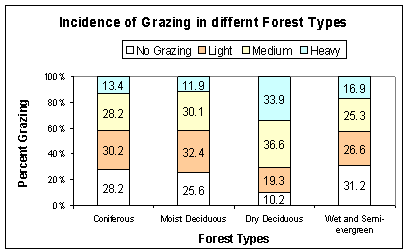
The FSI also conducts a supplementary assessment of the extent of grazing when it is conducting forest inventory in a forest area. The FSI has already covered about 80% of the forest area of the country under ground inventories. It estimates that about 77.6 per cent of forest area of the country is affected by grazing. Of this 17.9% of forest area is affected by high incidences of grazing, 30.7% by medium and 29% by light grazing incidences. Following figure indicates the extent of grazing in different forest types.
Assessment
The forests are under very high incidence of grazing pressure that is more than their capacities. Therefore, it may endanger their long-term sustainability.
Frequent and unplanned fires adversely affect forest stock as well as flow of its goods and services. About 54.7% of India’s forests are fire prone and of this about 9.2% forest areas are affected by frequent forest fires and 45.5% forest areas by occasional fires (FSI, 1997). Further, most of such forest fires are caused by man.
Definition There is no national definition for fire
Transformation Not necessary
Data and Temporal Trend
FSI conducted a study to estimate extent of fire in 1995 through 139 scenes on 1:1 million scale with three lasses (i) fire affected, (ii) smoke and (iii) fire unaffected. An intensive ground verification was done on related 349 toposheets at 1:50,000. The study revealed that during 1995 at national level about 2.31 percent of forest cover was affected by fire.
There is no other study at the national level to indicate the trend.
Assessment
No national level assessment is possible due to lack of data.
The pollutants affect development of plant through their impact on photosynthesis and respiration leading to modified distribution and sustenance of species and their foliar diseases. The sustainability of the any forest relating to the impact of pollutants may be judged either looking their absorbing and mitigation potential or looking the damages due to pollutants.
Definition
Term |
Definition |
Pollutant |
Any substance, which causes pollution, is called a pollutant. Explanation: A pollutant may include any chemical or geo-chemical substance, biotic component or its product, or physical factor that is released intentionally by man into the environment in such a concentration that may have adverse, harmful or unpleasant effects. |
Transformation Not needed
Data and Temporal Trends No Data is available
Assessment
The variable is important but lack of data limits any assessment.
Certain indicator species help to judge the health and vitality of a forest. For example, the presence of palms, orchids, ferns, arboreal mammals, owls, honey bees and butterflies may reflect the stable and healthy forests. It is considered important that India identifies “keystone species” and documents the presence, absence or abundance of such key indicator taxa within the representative forest types.
Definition (UNEP)
No standard national definition is available
Term |
Definition |
Indicator Species |
A species whose status provides information on the overall condition of the ecosystem and of other species in that ecosystem. Explanation It flags changes in biotic or abiotic conditions. They reflect the quality and changes in environmental conditions as well as aspects of community composition. |
Transformation: No data is available hence no question of transformation.
Data and Temporal trend
Necessary information is not available. Recently, few Protected Areas have started systematic monitoring of vegetation structures, rare plants and animals in the country but no assessment has been done for various species as indicators of forest health.
Assessment
The variable is very useful but lack of data limits its utility.
This variable is very important because it expresses the distribution of canopy defines the composition, rates of growth and regeneration of forest stands as canopy controls distribution of sunlight to plants. Any significant change in the forest canopy may have effect on forest succession, growth and composition.
Definition
Term |
Definition |
Canopy Density |
Percent area of land covered by canopy of the trees |
Transformation Not needed
Data and Temporal Trend
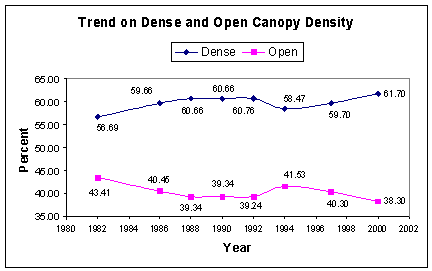
Following figures present the information on the percent of dense and open canopy forest in India.
Assessment
The trend indicates the density of closed forest is increasing. This is a good sign for sustenance of forest resources in India.
The forest fragmentation directly affects the local ecological processes processes both in the short as well as in the long-run and may endanger sustainability of resulting smaller patches of forests. The loss of connectivity between too patches may threaten existence of certain floral and faunal species and may also reduce adaptation resiliency of forest system to climate change. It may also lead to forest and land degradation, soil erosion and depeletion of water storage and flow. Therefore, the “forest fragmentation” is one of key factors for monitoring of sustainability of forest resources.
Definition (CBD’s definition)
No national standard definition is available
Term |
Definition |
Forest Fragmentation |
Any process that results in the conversion of formerly continuous forest into patches of forest separated by non-forest (lands). |
Transformation Not considered necessary
Data and Temporal trend
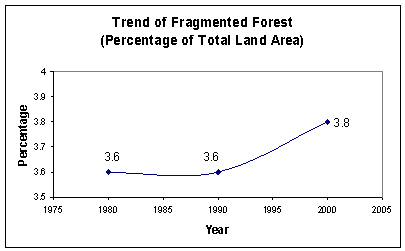
The following presents information on the percentage of fragmented forest in 1980, 1990 and 2000 based on the independent remote sensing implemented by FAO, Rome.
Assessment
The data from independent remote sensing for 1980, 1990 and 2000 on selected sample locations in India indicates that percentage of fragmented forest is increasing since 1990 at a significant rate. This condition of forest is not good for the country.
