


This section provides information on the method and approach chosen to identify and assess the complementary national variables followed by the national data and brief assessment.
India through FSI organised a group comprising of experts from various disciplines to implement the “Group Convergence Method” (Govil, 2002) for identification and assessment of variables. The group identified variables that are necessary to explain condition of forest against this criteria (Theme) but could not asses most of them due to lack of data.
India has identified following five national variables that in addition to the four global variables (Conservation forests, Conservation “Other Wooded lands”, Forest Tree Species, Forest Composition) that are essential to describe the biodiversity in its forests.
a. Area under Protected Areas (PA)
b. Status of Endemic Species (flora)
c. Status of Nationally Threatened Species (flora)
d. Status of Introduced and Invasive Species (flora)
e. Species Richness and Diversity
Following table indicates sources of data for the additional variables.
Additional Variable |
Source |
Extent of Protected Areas |
Gadgil, M. and Meher-Homji, V.M. 1986. Localities of great significance to conservation of India’s biological diversity. Proc. IAS. Suppl. 1986. |
The Wildlife (Protection) Act, 1972, India | |
National Wildlife Database.. Wildlife Institute of India (WII), India. | |
Status of Endemic species |
Chowdhary, H.J. & Murti, S.K. 2000. Plant Diversity and Conservation in India – An Overview. B.S.I. Dehradun. |
Nayar, M.P. 1996. Hot-spot of Endemic Plants of India, Nepal and Bhutan. Thiruvananthapuram, Kerala. | |
Status of Nationally Threatened Species |
Nayar, M.P. and A.R.K. Sastry 1987. Red Data Book of Indian Plants Vol. 1 to 5. BSI, Calcutta. |
Introduced and Invasive Species |
No temporal Data is available |
Species Richness and Diversity |
No temporal Data is available |
This section provides information on each of the identified additional variables. It contains relevant definitions, source and source data, temporal trends and its assessment.
The protected areas (PAs) provide ecological baseline information apart from ecological services including serving as gene banks and providing sustenance to life support system. In India primarily there are two major (National Parks and Sanctuaries) legal categories of PAs to provide legal protection to wildlife. The extent (size) of the PA within each forest types indicates social and political commitment of the country for conserving biodiversity and also the extent to which forest resources are better conserved.
Definitions
National Park |
An area declared, whether under sec.35. or sec.38 or deemed, under sub-section (3) of sec.66 of Wildlife (Protection) Act, 1972 to be declared, as a National Park |
Sanctuary |
An area declared, whether under sec. [26(A)5] or sec 38, or deemed, under sub section (3) of Sec.66 of Wildlife (Protection) Act, 1972 to be declared, as a wildlife sanctuary |
Transformation Not necessary
Data and Temporal Trend
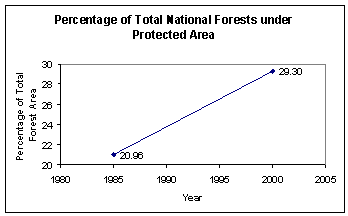
A comparison 1985 and 2000 indicates that number and area of PA has increased from 298 (51 National Parks and 247 Sanctuaries) covering 10.055 million ha to 573 (89 National Parks and 484 Sanctuaries) in covering 15.404 million ha in 2000.
Assessment
Increasing trend number, area and forested area under PA is indicates better sustainability conditions.
Endemism represents the uniqueness of the flora of a region or local area and leads to understand local patterns of bio-diversity. It basically captures the “natural” spatial distribution of species.
Definition (CBD)
Endemic Species |
An endemic species is a native species restricted to a particular geographic region owing to factors such as isolation or in response to soil or climatic conditions. |
Transformation Not necessary
Data and Temporal Trend
India has about 6000 endemic species. The Eastern Himalayas and Western Ghats are included in the list of so far identified 18 "Hotspots" in the world. India has three mega centres (Eastern Himalayas, Western Himalayas, and Western Ghats) and more than 40 sites of high endemism (Nayar, 1996). Few important centres of them are Trans Himalayan Cold desert & Western Himalayan regions, Garhwal-Kumaon Himalayas, Eastern Himalaya, North eastern regions, Aravali hills, Panchmari-Satpura-Bastar region, Chotanagpur plateau, Simlipal-Jeypore hills, Eastern Ghats, Western Ghats, Saurashtra-Kutch region and Andaman and Nicobar Islands. There are about 5725 endemic species out of an estimated 17000 flowering plants. Of this, 3471 are Himalyaan taxa, nearly 2015 are peninsular region & 239 are from Andaman & Nicobar.
There are different estimates of endemics shown by different workers as number of species are added due to more and more explorations and also sometimes decreased due to exclusion of the species from the list of endemics if it is reported from other geographic region.
The trend data on endemic species is not available as normal regular assessments (forest or botanical survey) do not address these species and because no specific survey are done for them to collect temporal data.
Assessment
The variable is important but due to lack of temporal data no trends are available limiting its utility to monitor the sustainability of forest resources.
Regular monitoring of “Threatened species” is very necessary for conservation of biodiversity. In absence of this information no policy or intervention can be designed to ensure sustainability of the biodiversity.
Definition (IUCN)
Threatened Species |
A taxa classified in any of the three IUCN categories namely Critically Endangered, Endangered, or Vulnerable species. |
Transformation Not needed
Data and Temporal Trend
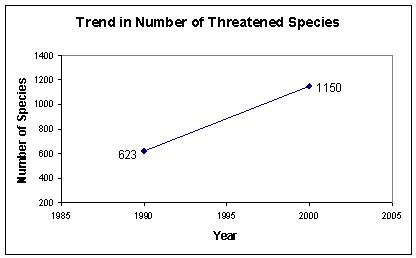
Nayar and Sastry (1987, 1988, 1990) indicate that 623 species were under various categories of threat. During the last decade BSI has identified over 1150 rare/threatened species of flowering plants (Vol. IV & Vol. V of Red Data Book) Following figure presents this trend.
Assessment
The data indicates addition of 527 (1150-623) species but in absence of complete details it is not clear whether these new species have been surveyed for the first time or they were surveyed in past and were not threatened. Assuming that these were surveyed earlier, it can be said that the increase in number of threatened is indicate conditions adverse for sustainability of forest resources.
Introduced species are introduced with some specific objectives while invasive species invade the area naturally. Monitoring of these species is necessary to understand their positive or negative contribution to the sustainability of forest resources.
Definition
Term |
Definition |
Introduced Species |
"Alien species" (synonyms: non-native, non-indigenous, foreign, exotic): a species, subspecies, or lower taxon introduced outside its normal past or present distribution; includes any part, gametes, seeds, eggs, or propagules of such species that might survive and subsequently reproduce. (UNEP/CBD/SBSTTA/6/INF/5 Annex II.) |
Invasive Species |
Invasive species are organisms (usually transported by humans) which successfully establish themselves in, and then overcome, otherwise intact, pre-existing native ecosystems IUCN/SSC (Species Survival Commission) Invasive Species Specialist Group |
Transformation
Not required as no temporal data is available on either of the two variables.
Data and Temporal Trend
Following table provides some of the available information on the introduced species.
Species |
Place of introduction |
Country of origin |
Acacia auriculiformis |
FRI West Bengal, Bihar |
Queensland, Australia |
Acacia decurrents |
Nilgiris (1524m to 2133m) |
-do- |
Acacia mangium |
Dinga,coastal area of south-west Bengal |
Australia |
Acacia mearnsii |
Nilgiris (in 1677at 2286m) Palni Hills (in 1828 at 2438m) |
Australia (S.victoria) and Tasmania |
Acacia dealbata |
Nilgiris (in 1832 above 1524m) |
Tasmania and south Australia. |
Acacia pyenantha |
Nilgiris and U.P. |
-do- |
Acacia tortillas |
Jodhour, Rajasthan |
Israel |
Adenthera microsperma |
F.R.I., Dehra Dun |
Indonesia, Jawa. |
Agathis robusta |
F.R.I., Dehra Dun |
Queensland, Australia. |
Albizia falcate |
Assam |
Indonesia |
Araucaria cunninghamii |
F.R.I., Dehra Dun |
Queensland, Australia |
Bambusa burmenica |
F.R.I., Dehra Dun |
Burma |
Bambusa glaucescens |
F.R.I., Dehra Dun |
China |
Broussonetia papirifera |
Bamanpokri (Bengal), Shahapur (Maharastra), Dandeli (Karnataka), Begur (Tamilnadu) |
China |
Castenea sativa |
Manali (H.P.). Chakrata (U.P.) |
Europe |
Casuarina equestifolia |
Tamil Nadu (in 1860) |
Indonesia |
C. Cunninghamiana |
West Coast of Saurashtra (in 1950) |
Thailand |
C. junghaniana |
Tamilnadu |
Thailand |
Chlorisia specisoa |
New Forest |
S. Brazil |
(follows from previous page)
Species |
Place of introduction |
Country of origin |
Cinnamomum camphora |
New Forest, Saharanpur, Tamil Nadu Karnataka. |
China and Japan |
Christomaria japonica |
Darjeeling (West Bengal) |
Japan |
Dendrocalamus giganteus |
New Forest |
Burma |
Eucalyptus Alba |
New Forest |
Indonesia, N. America |
E.Camaldulensis |
Punjab, U.P. |
Australia |
E.Citriodora |
Londha, Dandeli |
Australia |
E.deglupta |
New Forest |
Indonesia |
E.globulus |
Nilgiris (Tamil Nadu) |
Australia |
E.grandia |
Kerala |
Australia |
E.maculata |
Shahapur (Maharastra) |
Australia |
E.paniculata |
New Forest |
Australia |
E. tereticornis |
U.P., Assam, Punjab |
Australia |
Fagus sylvatica |
Kulu, Manali (H.P) |
Europe |
Fraxinus excelsa |
Kulu, J& K |
Europe |
Havea brasiliensis |
Kerala, Tamil Nadu |
Brazil |
Grevillea pteridifolia |
Amar Kantak (Shahdol), Madhya Pradesh |
Australia |
Grivellea robusta |
New Forest, Mussoorie |
- |
Leucaena leucocephala |
New Forest, Maharastra, Gujarat, Bihar. |
Hawaii, Philippines, El Salvador, Peru. |
Ocroma lagopus |
Tamil Nadu, Karnataka. |
Central America |
Parkinsonia aculeate |
Rajasthan, U.P., Delhi |
Mexico |
Pinus carebaea |
Assan, New forest, M.P. |
Br.Honduras |
P. nigra |
West Bengal, H.P. |
Europe |
p.patula |
West Bengal, Bihar, H.P. |
Mexico |
P.taeda |
H.P. |
U.S.A. |
P. deltoids |
H.P., U.P., Punjab. |
US and European Countries |
Prosopis juliflora |
Rajasthan, M.P. Maharasta, Tamil Nadu |
Mexico |
Assessment
Due to lack of temporal data no trend assessment was done.
Natural ecosystems with more species richness and diversity are considered more resilient than with less. Hence, these variables have the potential to monitor sustainability of forests.
Definition
Species Richness |
The number of species within a region. |
Species Diversity |
The number and variety of species found in a given area in a region. |
Transformation
Not required as data is not available.
Data and Temporal Trend
National level information on these variables is not available for developing temporal trends.
Assessment
No assessment has been attempted as sufficient data is not available.
