


This section first presents the method and approach chosen to identify and assess the complementary national variables and then provides national data and its assessment.
The for identification and assessment of variables, India through FSI used the “Group Convergence Method” (Govil, 2002). Two workshops were organized one for briefing and explaining and second for implementation of Group Convergence Method to arrive at the final list of identified variables. Temporal trends were developed and GCM was used to assess the state and change in these variables with respect to sustainability of forest resources.
Following national variables in addition to the two global variables (“Wood Removal” and “NWFP Removal”) have been identified as complementary national variables that are essential to explain the state of “Production Function” in India and for which some information was available.
a. Per Hectare Growing Stock
b. Rate of Annual Volume (Growing Stock) Increment
c. Extent of Planting Stock Improvement
Additional Variable |
Source |
Per Hectare Growing Stock |
SFR, 1987 State of Forest Resources 1993. Forest Survey of India, Ministry of Environment and Forests, Government of India. |
SFR, 1993 State of Forest Resources 1993. Forest Survey of India, Ministry of Environment and Forests, Government of India. | |
SFR, 1997. State of Forest Resources 1995. Forest Survey of India, Ministry of Environment and Forests, Government of India |
(from previous)
Rate of Annual Volume Increment |
SFR, 1991 State of Forest Resources 1993. Forest Survey of India, Ministry of Environment and Forests, Government of India. |
SFR, 1993 State of Forest Resources 1993. Forest Survey of India, Ministry of Environment and Forests, Government of India. | |
SFR, 1997 State of Forest Resources 1993. Forest Survey of India, Ministry of Environment and Forests, Government of India. | |
Area under improved Planting Stock |
K. Gurumurthi and K. Subramanain. 1997. Research and Extension strategies for Genetics, Tree Improvement and Propagation in ICFRE, Proceedings of National Workshop on Linkage between Forestry Research and Forestry Practices held at ICFRE, Dehra Dun, May, 1997. |
Seedling Seed Orchard for Breeding Tropical Trees. 2000. Institute of Forest Genetics and Tree Breeding, ICFRE, Coimbatore, India. |
This section provides information on each of the identified additional variables. It contains relevant definitions, source and source data, temporal trends and its assessment.
The per hectare growing stock defines the level of flow of goods and services form forests. It is a direct measure of production function of forests. It becomes a measure of sustainability of the forests when its trend is related with annual growth rate of forests and annual production.
Definition
Term |
Definition |
Per Hectare Growing Stock |
The growing stock per unit area (hectare) of forests |
Transformation: Not needed
Data and Temporal Changes
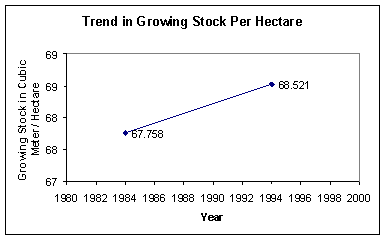
Following table and figure present the growing stock and growing stock per hectare respectively for the years 1984 and 1994.
Year of Assessment |
Forest Cover (million ha) |
Growing stock (million m3) |
1984 |
63880 |
4328 |
1994 |
63340 |
4340 |
Assessment
The increasing trend in Growing Stock per hectare is a good sign for sustainability of the forest resources.
The growing stock and its annual increment define the level of potential flows of good and services from a forests. The management and silviculture system have the capacity to manipulate the annual rate of increment of a forest within a given ecological and biological range. It is a very important variable for sustainable forest management and it basically fixes the value of a forest.
Definition
Transformation Not needed
Data and Temporal Trends
It is difficult to make estimation of annual increment of forest growing stock at national level in India due to large number of forest types and because statistical measurements from well laid out sample plots and tree increment plots are not available for last two or three decades.
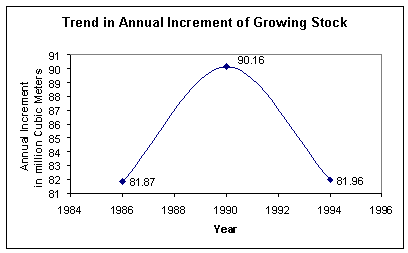
The FSI has opted an alternative approach and used Von Mental’s formula (Increment =2* growing stock/ rotation) to estimate this variable. The FSI assumes a rotation period for each of its inventory stratum and calculates its increment using Von Mental’s formula. Based on this approach, FSI has generated estimates for 1986 ( Assessment year 1989), 1990 (Assessment year 1993) and 1994 (Assessment year 1997).
Assessment
Rise and then decline in the annual increment is within 10 percent limit, which is less than the range of accuracy of its estimation. Therefore, it is difficult to infer whether the change indicates a “trend” or a “fluctuation”.
Productivity and production are directly related to each other. India is one of the oldest and a leading country in terms of age and area under forest plantations but unfortunately not in performance in terms of survival and productivity. Therefore, India has taken steps for Tree improvement programs from beginning of 1960s. This programs consists of improving planting stock through establishment of high quality and productive Seed Production Areas (SPA) Seedling Seed Orchards (SSOs) and Clonal Seed Orchards (CSOs), and adopting improved vegetative propagation techniques and mass multiplication approaches.
Definition No standard national definition available
Transformation Not needed
Data and Temporal trends
The seeds from Seed Production Areas (SPAs) are of superior quality as the parent trees due to their phenotype superiority. SPAs have been established in different states of India over about 10,727 ha.
The Seedling Seed (SSO) Orchard are developed with seedlings of phenotypically and/or genetically superior trees. About 3,018 hectare of SSOs have been raised and established in different states of India.
The Clone Seed Orchard (CSO) have been established over about 1569 ha. different states of India through grafts, cuttings, air-layered plants, tissue cultured plantlets or other methods of vegetative propagation of planting material from a plus trees or elite trees.
However, year-wise break down of above achievement is not available to develop temporal trend for this variable.
Assessment
The variable is important and lays solid foundation to increase productivity of plantation but enough information is not available for assessment.
