


• Introduction to the seminar
on Networking
Mr HASSEN AKROUT
PROJECT CORDINATOR
• UNDP Interest in Networking
Mr MOHSEN BOULAARES
CHIEF OF DIVISION FOR REGIONAL
PROGRAMME-UNDP-NEW YORK
• FAO Experiences in Networking
Mr MARIO PEDINI
SENIOR ADVISOR, AQUACULTURE
DEVELOPMENT-FAO-ROME
• Networking in Agricultural
Research
Mr GHAZI HARIRI
INTERNATIONAL SERVICE
FOR NATIONAL AGRICULTURAL RESEARCH
(ISNAR)
• Networking experience of PAP/RAC
Mr IVAN KATAVIC
PRIORITY ACTION PROGRAMME
REGIONAL ACTIVITY CENTRE
• Aquaculture Networking
Experience of EEC in ASIA
Mr MICHAEL NEW
• Aquaculture Networking
In Latin America
Mr AMEDEO FREDDI
FIRI-FAO-ROME
• Computerized Information
Systems
Mr S. COPPOLA
Mr AMEDEO FREEDDI
FIRI-FAO-ROME
BY HASSEN AKROUT,
PROJECT COORDINATOR.
In its Chapter D related to the immediate objectives, the Project Document has foreseen «the Organization of a seminar on networking», which would be held just before the Steering Committee (Act.1.1.6).
It should be reminded that the main objective of the Project consists in increasing aquaculture production and ensuring on a long term basis, the development and promotion of aquaculture industries. Cooperation among all the countries of the region, is necessary for the realization of this target and MEDRAP II has to support this cooperation and contribute to the institution of permanent structures for the purpose.
It should be reminded also that the development of aquaculture depends on the mastery of artificial reproduction of technology, of aquaculture engineering, food production, pathology, transformation and conditioning techniques, as well as planification and management of aquaculture farms.
Thus we are facing a certain number of objectives and of activities which necessitate the implementation of ways and multiple complex structures that are complementary and interactive on more than one level. This concerns the sectors of Research, Training, Production, Extension etc…
It is by taking into account these themes that are sufficiently detailed in the Project Document and by taking into consideration the orientations taken during the sub-regional meetings in Tunis(7–19 March 1991) that we have proceeded to the elaboration of an activity programme for the years 1991 – 1992. This seminar you are attending, constitutes the starting point of this work plan.
We think that the participation at this impressive meeting of representatives of specialized institutions experienced in networking, besides those of UNDP and FAO, and the members of the Steering Committee as well, should enable reviewing many experiences in terms of networking and setting the appropriate mechanisms for a fruitful and durable regional cooperation. The difficulties met by these experiences should constitute a lesson in our futural endeavour.
Unfortunately many of our guests could not be among us for this meeting.
This is why Mr. brian davy, from the International Development Research Centre (IDRC), CONSTANTIN VAMVAKAS, from EEC, RICHARD RAN DELPH, from the Institute of Aquaculture of Stirling University and BANCHONG TIENSONGRUSMEE, from Network Aquaculture Center in ASIA have apologized for not being able to bring contribution to our works.
However, I would like to thank in your name and mine, Mr. BOULAARES, from UNDP, KATO and PEDINI from FAO, HARIRI from International Service for National Agricultural Research (ISNAR), KATAVIC, from Priority Action Programme Regional Activity Center (PAP/RAC), MICHAEL NEW and AMEDEO FREDDI for agreeing to inform us of their conception of networking and of the experiences known by the organisms and institutions that they represent. Their participation to our debates would help us better conceive the structures and mechanisms of our cooperation at the regional and sub-regional scale, on the network level as a whole as well as on that of the concerned sub-networks.
These are not all at the same stage of identification, nor do they have the same degree of development. The sub-networks of Research and Training could in fact, be immediately implemented, whereas those of Production and Extension could not be committed before the year 1992.
Moreover, the organization of four proposed seminars is the following:
| • | In FRANCE : | 10 – 13 September 1991 | - | Seminar on Training sub-networking. |
| • | In CYPRUS : | 1 – 4 October 1992 | - | Seminar on Research sub-network. |
| • | In ITALY : | October 1992 | - | Seminar on Production sub-network. |
| • | In PORTUGAL : | December 1992 | - | Seminar on Extension sub-network. |
However, a sub-network on Information was proposed by the sub-regional meetings. The participants at these meetings mentioned that the Project Document emphasized the importance of collecting information (see 1.3.1 – 1.3.2 – 1.3.3). It has then implicity sustained the principle of a specialized sub-network.
The following activities are proposed for your appreciations:
| • | In EGYPT | : | 26 – 29 November 191 | - | Seminar on Documentation and Information system. |
| January 1992 | - | Implementation in certain country of a national information system. |
Finally, I would like to mention that from now on, we should think of MEDRAP III, at a time where the project with the structures and conventions that we meanwhile, ought to elaborate, would be fully supported by the concerned Mediterranean countries.
The constitution of an ad hoc committee whose mission is to implement the legislative and institutional aspects necessary for this third phase, is therefore proposed.
The constitution of this committee will be made on the occasion of the next Network Steering Committee, foreseen in Cairo on the 2nd and 3rd of December 1991. Its first meeting will be held in Algiers in June 1992, during the cycle of training on the legislative and socio-economic aspects of the development of aquaculture.
These are the introductive elements I thought, should be proposed to you and again I wish a lot of success to our work.
By Mr. MOHSEN BOULAARES
UNDP NEW YORK
Background :
The Arab and European regions cooperating in MEDRAP network are characterised by profound political and economic development that dictate on participating countries self-sufficiency and selfreliance. A common element in these development is a desire for closer integration of cooperation activities in an effort to reduce the inbalances in the respective regions.
Definition of Networking :
A self-sufficient, cooperative organizational arrangement between designated specialized institutions in different countries that share common goals and interests involving pooling of expertise, information, training facilities and other available resources to achieved higher efficiency and lower costs.
Rationale of Networking :
We distinguish between:
vertical systems of cooperation : defined as cooperation relationships mainly with executing agency/consultants and individual participating organizations;
horizontal systems of cooperation : defined as cooperation between participating countries for the development of an information channelling system for greater contacts among themselves.
Regrettably, the validity of UNDP Regional Programmes is still measured by the amount of direct benefits (inputs) that it can provide. An effort to correct this perception of the Programme as a vertical system of cooperation and not an horizontal one is needed.
This is so because:
The current mood of the GC of UNDP is not in favour of an increase in IPF resources to the Regional Programmes. Funds available in the 5th cycle will be more limited than what they have been during the current cycle. This leaves us with two choices:
smaller number of highly budged projects, or
inputs that assume a catalytic function.
UNDP's experience with European IPF countries has shown that the development of cooperative networks and their initial guidance has a very high catalytic value. Functional networks have been established where the respective institutions contribute each according to its comparative advantage. For some networks, national lead institutions participate equally, while for others, a genuinely regional or inter-regional institution take the lead. Lead institutions relate to each other and jointly introduce innovative new technical and managerial systems. All participants benefit from and contribute to the network.
UNDP Networking experience, goals/impact :
Our objective is the development of sustainable institutional networks through regional cooperative projects with networking as a major feature. Networking is the least-cost route to developing the permanent functional relationships that countries are seeking. The Regional Programme's basic contribution would be provision of the necessary framework for inter-country cooperation based on needs assessment and planning of the network's initial targets and operations. A horizontal system of cooperation means multilateral exchanges between national focal points for the coordination of activities related to the project and dissemination of results. Once selected for regional cooperation, National Focal Points in turn facilitate the development of a national network of cooperating institutions.
Obstacles and Lessons learnt :
Always difficult in the context of Regional Programme to achieve the optimum level of commitment. This leads us to emphasize the need to link regional Programmes more closely with national technical cooperation projects and to identify actual priority requirements as means to ensure governments commitments and contributions in kind (qualified support staff, management time, and, where called for, financial support).
Involvement of non-IPF countries in existing networks and TCDC bridges of cooperation within and outside the networks have proved essential for a state-of-the-art and well-integrated Programme of cooperation with regional/global research and activity groups.
Guidelines/Recommendations for Successful Networking :
Clearly define the strategy and institutional framework for project management. Well-defined objectives, a clear sense of direction and good guidelines for effective project implementations: Spell-out networking as well as substantive activities and outputs that are expected out of each sub-network.
Inventory priorities and requirements of the interested IPF countries (in Europe, an attempt to identify network operational activities through a questionnaire organized by lead institutions was not always successful due to delays in reaction to questionnaire).
Ensure a high level a commitment of participating to project objectives. Usually a result of degree of relevance of regional activities to national development priorities. In an initial stage, government interest may be measured by extensive contribution in kind to project activity.
A NSC that represent all participating countries is responsible for overall policy. NSC must hold regular annual meetings to direct project activity. It is recommended that NSC creates a complementary technical body composed of experts who meet more often to discuss technical matters. In Europe, this proved useful - travel cost was ensured by participating organizations and conference facilities were offered by host institutions. For MEDRAP this could solve the problem of the absence of technical expertise at the project secretariat. Eventually, technical leadership of the various sub-networks could be delegated on the basis of comparative advantage.
Appointment of task forces for each one of the sub-programme in the designated lead countries (hosts of sub-regional centres); task forces will be composed of qualified institutions from each of the participating countries; adoption of provisional work plans by task forces using a standard model prepared for this purpose by the executing agency.
Define role and extent of guidance and leadership by the executing and funding agencies as well as close links with the project secretariat; input role of executing agency and secretariat to liaise with competent international bodies including NGOs must also draw-up a standard model for sub-groups work plans.
Time dedicated by the Project coordinator in close liaison with all participating countries must compile and attach to Project document a list of coordinating authorities and focal points, with full names and addresses. Gradual delegation of administrative responsibilities from executing agency to network secretariat. The project secretariat plays a central role to enhance communication; for example, newsletters regularly issued by the Project coordinator have proved very useful to enhance communication and development of Euroteldev network.
Network sustainability :
There should be a continuing scope for cooperation beyond the completion of the current project and attention should be given to the creation of conditions for possible eventual sustainability of the network:
Funding by UNDP should be gradually replaced by co-sharing arrangements and budgetary contributions from participating countries. Other funding scenarios and commercial applications should be investigated and developed to assist the project to become self-financing.
Countries are encouraged to sign bilateral agreements for further cooperation in specific fields. In Europe, such agreements between participating countries on the one hand and between some of them and the ECE (Executing agency for few projects) proved to be mutually beneficial, and further motivated regional cooperation in the form of feasibility studies on Joint Ventures and commercial activity and applications.
Processes of exchange should be computerized as early as possible.
Project management arrangements and modus operandi for technical cooperation must complement and reinforce one another.
Establishment of Sub-regional networks which reflect different conditions in the participating countries and exchange of information and sharing of knowledge through group meetings represent the most basic methods of networking. Attempts should be made to create more advanced networks including:
development of network consultancies (more than compilation and exchange of lists of experts);
Joint research and Development programmes;
Self-sustainability of networks with commercial application.
THE FAO EXPERIENCE IN AQUACULTURE NETWORKS
BY Mr. MARIO PEDINI
FAO ROME
A. INTRODUCTION
The forms of aquacutlture regional networks which at different periods in time have been put in operation by the FAO are varied. Collaborative work for aquaculture development through some form of network has been carried out mainly though the work of:
commissions like the European Inland Fisheries Advisory Commission (EIFAC), the General Fisheries Council for the Mediterranean (GFCM), the Indo Pacific fisheries Commission (IPFC), which at some stages have established Cooperative Programmes for Research in Aquaculture (COPRAQ), or working groups on aquaculture as was the case of the Commission de Pesca Continental para America Latina (COPESCAL);
projects, of which the most representative is the Network of Aquaculture Centres in Asia (NACA). More recently, also the Aquaculture in Latin America project (AQUILA) has been involved in the organization of networks.
My short presentation is not trying to cover all the cases in the history of FAO Fisheries Department concerned with networks of various forms and nature which had been organized by the FAO in its long experience but, will deal mainly with the organizational aspects, advantages and limitations of some of the various FAO aquaculture network systems, Although project experience of the commissions (with particular emphasis on the EIFAC) as in the future they are perhaps the more likely intergovernmental organization patterns for MEDRAP. The AQUILA project which has established some interesting network mechanism will be presented by Mr. A. FREDDI, Senior Mariculture Expert of that project, and a former staff member of the Italian funded Project for Assistance to Development of Aquaculture in the Mediterranean which was attached to the previous phase of the UNDP funded MEDRAP.
B. THE EXPERIENCE OF THE COMMISSIONS
Due to the limited availability for this presentation I will concentrate in explaining the experience of the EIFAC, on the most successful and more productive one in the FAO set up and the closest to an independent regional organization such as it is intended for the next phase of MEDRAP.
In the other Councils and Commissions, the GFCM COPRAQ and IPFC COPRAQ have not been as fruitful as EIFAC in terms of substantial activities or production of documentation in the period in which they were operational. It has to be mentioned, however, that these COPRAQs were to some extent useful mechanisms in sofar as regional projects were not operational in the respective areas. After the establishment of Mediterranean, Asian and Latin American regional aquaculture development projects the attention of the governments tended to concentrate in the regional projects, as they benifited from external funding, mainly from UNDP but also from other donors.
The assistance given by the FAO to the various commissions or councils consists generally in:
providing a Secretariat for the organization of the various meetings and other events;
following the intersessional work;
providing some funds, within the limited possibilities of the organization, to facilitate the attendance of experts to meetings.
However, not all the commissions or councils have the same structure, and this has motivated also differences in the performance of the various working groups or COPRAQs.
In the case of COPESCAL or IPFC, funds for travel had to be provided by the FAO which seriously limited the number of participants to meetings and did not permit an effective work in the intersessional periods.
The COPRAQs of both GFCM and IPFC have had relatively little impact on the development of aquaculture in the region. They lacked a continuity of action and a clear indentification of a long term work programmes and could not implement real cooperation between the participating institutions apart from the periodic exchange of information which was mainly concentrated on the session meetings. The different level of interest in the research matters selected and the lack of uniformity in the status of aquaculture development in the participating countries of the COPRAQs motivated a lack of effective cooperation through a network in which the various authors submitted research papers on various subjects, and very few of which were coauthored by scientists working in more than institution of the COPRAQ.
In these two commissions as well as in the two other commissions and in the COPESCAL most of the organizative aspects were left to the FAO Secretariat and to the Technical Officer in charge of the geographic area, who carried out the main weight for the organization of the meetings. This resulted in meetings not sufficiently well prepared and in a discontinuous functioning of the COPRAQS due to the workload of the FAO staff. Although in several cases the work of these COPRAQS was useful to identify subject matters for research in aquaculture, the follow up was in most cases taken care of only when regional projects existed in the area.
It could be said that the effectiveness of these COPRAQS has been mainly limited by the lack of funds to permit the exchange of scientist and the funding of collaborative reseach projects which would have been the most desirable situation. If that possibility existed then a different type of organization set up for the servicing of the COPRAQS would have been required in the FAO Fisheries Department.
In case of the EIFAC sub-commissions which dealt with aquaculture related matters, the effectiveness has been considerable, as they had an organizational set up which favoured autonomous work. FAO was seen as the organization to provide a reference framework and to provide political wheight to the decisions reached by the EIFAC bodies. The Commission has not really produced much work in terms of collaborative research but has a very good network of specialists in various disciplines located in many European institutions (usually well equipped) and provided a good forum for discussion of important topics for aquacuture development.
The EIFAC mainly reviewed the status of various disciplines, also providing an analysis of the situation and recommending follow-up work, through the holding of several symposia (nutrition and feed technology, heated effluents, and recirculation technologies, genetics, etc), and it also led to the establishment and adoption of water quality criteria which were important both for fish farming and for inland fisheries development and regulations. It also provide the initial forum which favoured contacts amongst specialists and contributed to the establishment of an European Association of Ichthyopathologists. As a difference with some of the other FAO networks the EIFAC had a much more active intersessional periods and also got involved in broad subject matters like the revision of water quality criteria which were analyzed systematically rather than in a single event like it usually happened in other groups, resulting in a more thorough work which led to the production of reference documentation.
The organization of this Commission was consolidated in the three first Sessions (1960–64). Its origins, however dates back to the early 1950s when several scientists discussed the possibility of having a European body which would take care of the inland waters in a similar way as the ICES was dealing with the seas. A meeting organized in Helsinki in 1956 agreed on the need for international collaboration and requested the FAO Director General to establish an advisory body for Europe. This body was subsequently accepted by the FAO council and was established in 1957. At that point the Organization was responsible for the provision of funds and for setting up a Secretariat.
The first meetings of the Commission took place in Dublin, Ireland in 1960. The objectives and purposes of the commission were to advise on the formulation and implementation of policy and to coordinate the implementation of this policy. Its functions at present are:
to assist in the collection and dissemination of pertinent information;
to propose and assist in the organization of appropriate symposia;
to promoted liaison and cooperation among governmental organizations
to advise on the evolution of an organized approach among interested governments of this region towards the development of inland fisheries as may seem desirable and feasible;
to advise on any other matters appropriate to the promotion of the development and utilization of the inland fisheries within the competence of the Organization.
These functions can generally be achieved by regular meetings of the Commission and of its subsidiary bodies, the Secretariat being responsible for management of its affairs between sessions. the cost of participation is borne by the Member Governments, but the Secretariat is provided by the FAO. Holden, 1981).
In the course of the first session, the Executive Committee (chairman and Vice-chairman) was established. Its duty was to direct and conduct the affairs of EIFAC between sessions. The second session recommended the appointment of a national correspondent and of an alternate to keep the Secretariat informed of changes in the administrations and programmes within each country. This had little success in the following years.
To follow the work recommendations of the session it was decided that the Secretariat should not be involved and it was required that working parties be established to meet between sessions. FAO was asked to make financial assistance available for the intersessional meetings and for interim meetings of the chairman and vice-chairmens.
At the third session, held in 1964 in Austria, the question of financial support to working groups, expert meetings and technical symposia was discussed. At the end of the discussions a crucial resolution was passed by participating governments which indicated that «when the Commission creates a Subcommission … the Director General should inform the Governements, which the officers nominated to the Subcommission or working group serve, requesting … officers to be facilitated in serving for such time as needed and that their necessary expenses be defrayed by the Governments concerned …». The acceptance of this reasoning by the participating Governments has facilitated enormously the work of the Commission and in a way has made it more independent from the availability of funds of the organization. In addition it was accepted that funding in support of activities could be obtained even from the private sector.
The major achievements of the Commission have been primarily due to the work of the three subcommissions (Fisheries Biology and Management, Fish Culture and Diseases, and Fish and Polluted Water), through their working parties, ad hoc groups and symposia on topics of major concern. A COPRAQ was also established following the model of the GFCM in 1974–5 promoting research collaboration on selected topics and recommending a support to research in the area of fish diseases. In this speciality the EIFAC jointly with the International Office of Epizootics held a symposium on the Major Communicable Diseases and their control in 1972 which led to major convention for the control of the Spread of Major Communicable Fish Diseases which in turn led to an amendement of the Zoo-sanitary code of OIE.
Possibly one of the major successes of this Commission has been the production of a series of reports on water quality criteria which were generated by its third sub-commission. They contain critical reviews of the literature and have been accepted by several countries as a basis on which water quality standards can be set within a regulatory framework. The reports have been produced by the working party on water quality criteria established in 1962. Most of the work has been carried by correspondence with the assistance of two conveners since its establishment. Current emphasis for the work of the Commission has been directed towards environmental aspects of aquaculture.
In spite of the fact that the member countries of EIFAC are considered rich, the commission experienced difficulties in obtaining sufficient funding for its expanding activities from 1966 onwards. Furthermore, the Commission required the services of high level experts to provide advice but the countries to which they belonged were sometimes reluctant to release their services for the time required. Finally, in 1974 a crucial step was taken when EIFAC became a Convention bases, self financed Commission. The experience gained in the establishment of EIFAC and its achievements could certainly be a useful element of experience for the MEDRAP to consider in the discussion of its future phase as an independant intergovernemental body.
C. THE EXPERIENCE WITH THE PROJECTS
I will limit my intervention to the work of NACA, the Network of Aquaculture Centres in Asia. This project financed by UNDP was created in 1980 as an outcome of the recommendations of the Kyoto Technical Conference held in 1976 by the FAO. This project was designed to operate within the framework of Technical Cooperation among Developing Countries (TCDC), under which members pooled resources and collaborated the developing aquaculture in the region. A network of four leading centers (China, India, the Philippines and Thailand) was created to implement the activities of the project which had to center on:
manpower training at senior officer level, through long term training and at technician level through shorter courses;
applied research on selected farming systems of importance in the region;
aquaculture information dissemination.
As requested by the UNDP, measures were taken to convert NACA in an independent body at the end of 8 years of direct support from FAO/UNDP and, after lengthy and not always easy negotiations, an intergovernmental organization was created in 1990 which is supposed to continue the work, although initially at reduced scale, through a network system.
The main success of this NACA network has been in training activities which resulted in the training of 140 senior officers which now occupy important positions in the governments they serve. In addition to those senior officers the project trained another 286 technicians through different activities (by 1989). These activities have earned recognition to this project by the participating countries, especially by those not so advanced in aquaculture. Through the project, these countries had the possibility to rapidly train their senior officers with a very comprehensive and articulated multidisciplinary programme, which involved training in each of the four training centers. However the long term training programme was expensive and has proved difficult to maintain in the autonomous phase of NACA, which initially is forced to concentrate on short term training hoping to obtain external financial resources from donor countries to restart the long term training programme.
The research part of the project did not have as much success as the training component. Each of the lead Centers was supposed to focus its research activities on selected aquaculture systems of importance to the host country and to the region, and they should have established links with the national institutions of their own subregions dealing with the research on aquaculture. In this context, the Chinese center, located in Wuxi had to focus on the integrated practices (crop-livestock-fish farming systems). The Indian center located in Dhauli had to work on monoculture and polyculture of carps in ponds, undrainable ponds and reservoirs. The Philippines center based at the Aquaculture Department of the South East Asian Fisheries development Center (SEAFDEC) in Iloilo, was supposed to conduct research on shrimp, milkfish and other brackishwater species. The research programme at the last Lead Center, located in Thailand at the National Inland Fisheries Institute concerned air breathing catfishes, south Asian carps, freshwater prawns and other species of the subregion.
In practice the research programme did not become a truly regional activity although it was important in itself. The inputs of the project were limited and the center continued with what from the very begining were their national programme activities. Linkages with other national centers were limited and, up to today, where the activities have continued through the regional Seafarming Programme in a similar way, the countries not having a Lead center complain about the lack of participation in the research carried out by the Lead Centers and by the lack of guidance of the scientists involved in the Lead Center in similar research to that undertaken by their national centers. What it would seen from this experience is that unless a concerted programme with distribution of tasks is put in practice, effective networking research becomes very difficulty to implement with a system of Lead Centers.
The third major component of this project was information dissemination. This had to be accomplished by:
by establishing a new computerized system for information collection which was part of a global Aquaculture Information System (AQUIS) developed by the Aquaculture Development and Coordination Programme (ADCP). The AQUIS was based at the four Lead Centers and special software had been developed for it by the ADCP.
While the first task was performed without major difficulties, the computerized system, (which called for establishing a new system in the region), with complicated software and requiring highly specialized staff to input analysed data, proved to be a total failure and was abandoned by NACA.
In short, these are the experiences of the NACA which is now moving its first steps as an independent intergovernmental organization. It could be interesting for the Member countries of MEDRAP to follow the development of this new intergovernmental NACA, which preceedes the experience MEDRAP is supposed to pass at the end of the second phase now starting. Many interesting things could be learnt from the troubles experienced by NACA in becoming a fully independant organization without the support of the UNDP or of the FAO but these are issues which could be better discussed in another meeting when the process of creation of an autonomous MEDRAP would have been initiated. At that stage the presence of NACA staff in the discussions would be certainly useful. Thank you very much for your attention.
By Mr. GHAZI HARRI,
(ISNAR)
INTRODUCTION
Networking is a new name for an ancient practice as people are connecting with people since the beginning of the human race. However, organizational modes of collaboration have changed markedly in the second half of this century, particularly in scientific research.
Agricultural research networks (ARNETs) now operate in virtually all areas of research at both regional and international levels. Most ARNETs started in response to either pressing needs which are perceived for new agricultural technologies that cannot be quickly developed at a single research institution, or to share available useful agricultural technologies.
Much agricultural research in the West Asia and North Africa region (WANA) is carried out in isolation, and often in replication of the same activities in neighbouring countries with similar agroecological conditions, and in regional and international research centers working in the region. ARNETs can gather isolated and scattered national elements into stronger regional research programs, with greater chance of success and continuity.
The establishment of ARNETs between researchers in WANA has been the object of many serious efforts including FAO Near East regional projects, e.g., filed crops, rangeland management, land and water use, palm and dates, animal production and health; current UNDP regional projects, e.g., sorghum, rangeland and sheep, use of waste and effluent water in agriculture, and MEDRAP; ICARDA regional projects, e.g., Nile Valley faba bean and wheat projects, nurseries for the evaluation of the genetic potential of cereals, food legumes and forage crops; and SARMAC which is an example of a regional effort to improve agricultural research management in Arab countries.
The rapid increase in the number of ARNETs in developing countries has brought about not only an increasing interest in the networking approach but also an increasing literature on them.
This presentation is not intended to comment on the existing ARNETs but rather to concentrate on certain critical and fundamental aspects which could be relevant to MEDRAP seminar on networking. It gives general outlines of network definition and typology, characteristics, development and management, and problems.
DEFINITION AND TYPOLOGY
In a broad sense, the word«network» or «networking» could mean many things to many people. Webster Dictionary has defined «network» as «an interconnected or interrelated chain, group, or system», «networking» as «the exchange of information or services among individuals, group, or institutions» These definitions tend to cover the overall concept. ARNET, however, could be defined as«a voluntary association of independent individuals or institutions (NARS, parts of NARS, programs, or projects) with a shared purpose to achieve desired goals, whose members contribute resources and participate in two way exchanges or communication».
Common missions, concerns, interests and opportunities provide the basic reasons for systematic group interrelations and the establishment of mechanisms for information or services exchange. Only when shared purpose and common goals are properly identified it is then possible to bring together a critical mass of individual scientists or institutions to constitute an ARNET. However, ARNET should be conceived as a complementary to, and not as a substitute for, national agricultural research efforts.
The ARNET approach brings a catalytic role to focus joint resources systematically on important research topics by establishing critical mass of scientific activity at relatively lower cost each individual countries through gathering isolated, scattered, and fragmented strong national element into stronger regional network program which will ensure greater chances of research success and continuity.
Many types of ARNETs are emerging. These can be classified in three major collections of networks (SPAAR, 1986). A fourth one, material exchange network, was added to SPAAR classification by Plucknett, Smith and Ozgediz (1990), Each type displays the fundamental characteristics of a two-way communication between members and the«lead» or «coordinating» members, and horizontal communication and exchanges between all members. These four types are :
Information Exchange Networks organize and facilitate exchange of ideas and methodologies, and may report on the results of research currently underway.
Material Exchange Networks involve the exchange and testing of plant and animal materials or machinery prototypes. Material exchange networks serve as wholesalers and evaluators for other research programs.
Scientific Consultation Networks involve country-by-country or participant-by-participant focus on common priority research areas initiated and implemented independently by participants who hold regular meetings and have other means to exchange information on research.
Collaborative Research Networks involve joint inter-country planning, implementing, and monitoring of research on problems of mutual concern to countries within a region. These networks could include information exchange, material exchange, technical collaboration, and training.
These types may be considered the ideal goal for any region or group of countries willing to collaborate for solving common problems, However, each type implies a greater commitment associated perhaps with greater complexity in coordination and higher cost for the fourth type.
It has been suggested that there are at least four minimum criteria for calling a joint research activity a network (Winkelmann, 1986; Valverde, 1988):
- a common purpose;
- a two-way flow of information;
- some commitment of resources by all participants; and
- a clear scientific contribution by the participants to the common goals.
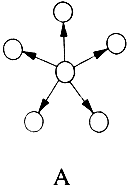
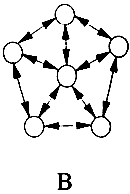
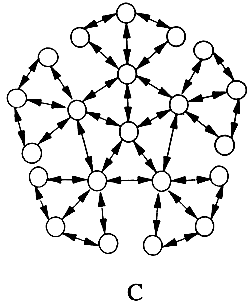
Such amicable relationship between participants of the network greatly facilitate the exchange of information and technology between them. Figure 1 on network linkages depicts the hub-and-spoke model (A) in which information radiates largely from a hub to participants, ignores upwards and horizontal movement of information as well secondary diffusion and feedback, and true network concept models, (B) with the rim effect in which participants collaborate with each others as well as with hub; and (C) where subnetworks at be national level generated by regional or international network in which the above four criteria are performed. Therefore, the essential distinguishing features of a true collaborative network are the horizontal communications and exchange of views, information and materials between its members without necessarily going through the central hub or coordinating institution.
Figure 1 - Network Linkages
 | 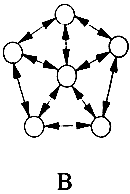 |  |
| Hub-and-spoke | True collaborative |
CHARACTERISTICS OF NETWORKS
In identifying and defining the relevant characteristics of existing successful ARNETs, we have to keep in mind that the use of the adjective «successful» is quite subjective, since few operating networks have been subject to a critical and rigorous analysis.
There are, however, some major characteristics for networks to be successful. Several authors have discussed characteristics of succeful networks which are summarized in Table 1. In our opinion, there are at least 10 characteristics listed in Table 1 essential for successful networks, these are the following :
the importance of the problem to NARS and NARS scientists, and the strong self-interest at national or individual levels in seeking a solution to the problem;
problems which lend themselves to networking efforts should be clearly defined and supported in existing national programs;
strong and effective coordination;
capacity and strong research base to make contribution by participants;
participants capacity to commit resources;
the availability of flexible external funding is considered a necessity for successful operation of the network;
the research problem is widely shared among participants;
the existence of a strong advisory group including NARS leaders;
desire for a formalized training component;
holding regular workshops and meetings.
Other characteristics listed in Table 1 are also desirable to justify the viability of a networking approach.
DEVELOPMENT AND MANAGEMENT OF NETWORKS
Networks are an organizational form but less bureaucratic and hierarchical than institutions. Each network has its own path, which can be evolutionary, arising from spontaneaous needs and shifting priorities, or which can be planned and set in motion from the outset (Plucknett, et al., 1990).
Establishing and developing a network
Some concepts and experience gained from ongoing networks suggest that the prime movers of a networks, such as countries, NARS, individuals or international/regional agencies have a two-fold task of both stimulating and achieving interest of the potential network members, and securing the essential funding to support the establishment of the network. However, scientists who are the prime movers is establishing it network must be dedicated to the network, and their institutions and country research policy makers must be committed to ensure that the network will its objectives.
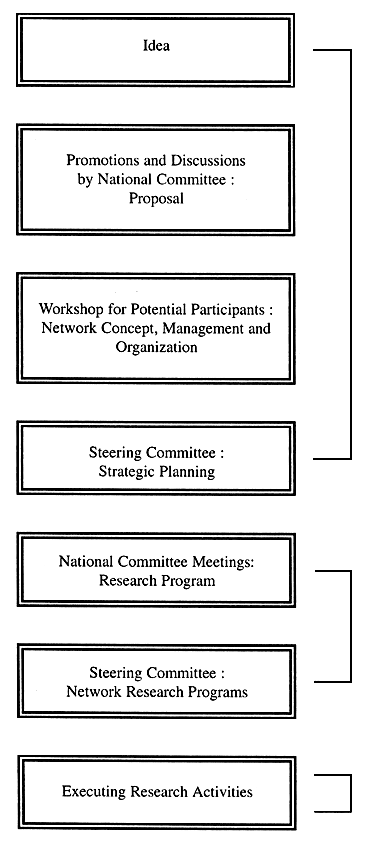
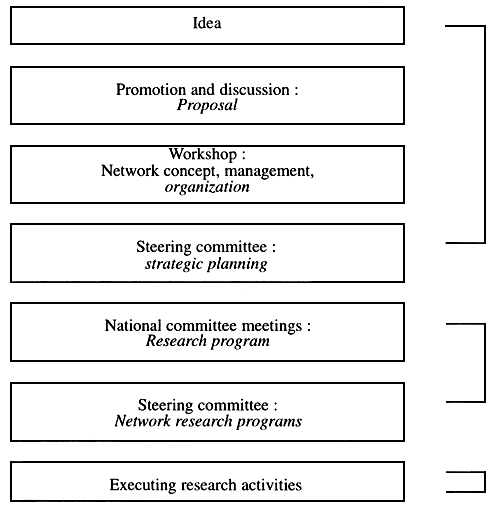
Development phase of a network : three phases could be identified in the development of a research network. These are preliminary and design, planning, and implementation phases (Fig. 2).
Preliminary and design phase : In this phase the network idea to solve important problems is initiated by either an individual sicientist, the leader of a research program, or the corporate wisdom of an institution. A proposal will be developed as the outcome of promotional activities centered on discussions of the network approach with relevant institutions, departments, and government ministries in the countries concerned.
In each potential participating country, a broad-based national committee for the network is formed to coordinate subsequent steps. The national committee membership should include research policy makers and leaders, and researchers. Having research policy makers in the national committee ensures that binding decisions can be made not only to commit government funds to network objectives but to convince it that networking will permit participating countries to collectively concentrate resources to stronger research thrust.
At regional level, a workshop to discuss the network proposal should be held for potential participants of the network. The outcome of such a meeting is the network concept, objectives, management and organization. An apex body of the network will be formed to develop a strategic plan for the network.
Planning phase : At the network participant level, the main output from the planning phase is a preliminary research plan for research problems in the country relevant to the network. The preliminary research plan of network participants will be discussed by the steering committee of the network to prioritize research, allocate resources for these priorities, and to develop modus operandi and budget needs for identified research activities to be implemented by network participants.
Implementation phase : At the end of the planning phase, each country will implement its research program which should be based on the existing programs of research. Each country would be allocated a lead role in the network research according to its recognized and acknowledged strength. Some countries might have no lead role and others several.
Organizational Structure
There is a whole range of organizational models for collaborative networks. Network models vary according to many factors such as level and kind of activities to be performed, and to the type of links with international agencies and centers, bilateral programs, and national institutions.
Once the strategic plan of the network has been developed (Fig.2), an organizational model for the network must be conceived, taking into account flexibility and minimum bureaucracy.
Table 1 - Characteristics considered important for networking by several authors
| Caracteristics | 1 | 2 | 3 | 4 | 5 | 6 | 7 | 8 | 9 | 10 | |
| 1. | Strong self interest (important problem) | x | x | x | x | x | x | x | x | x | x |
| 2. | Clearly defined problem | x | x | x | x | x | x | x | x | x | |
| 3. | Strong/effective coordination/leadership | x | x | x | x | x | x | x | x | x | x |
| 4. | Capacity to make contribution | x | x | x | x | x | x | ||||
| 5. | Participants commit resources | x | x | x | x | x | x | ||||
| 6. | External funding | x | x | x | x | x | x | x | x | ||
| 7. | Problem widely shared | x | x | x | x | x | |||||
| 8. | Effective advisory group | x | x | x | x | x | |||||
| 9. | Scope for new ideas and free exchange | x | x | x | x | ||||||
| 10. | Participants contribute to planning and management | x | x | ||||||||
| 11. | Regional scope | x | |||||||||
| 12. | Clear strategy and theme | x | |||||||||
| 13. | Training and monitoring | x | x | x | x | ||||||
| 14. | Common constraints | x | |||||||||
| 15. | Capacity to adopt and diffuse | x | |||||||||
| 16. | Access to other networks | x | |||||||||
| 17. | Extra funding for national programs | x | |||||||||
| 18. | Realistic research agenda | x | x | ||||||||
| 19. | Regular workshops and meetings | x | x | ||||||||
| 20. | Relatively stable membership | x | |||||||||
| 21. | Flexible research and management | x | |||||||||
| 22. | Long horizons | x | |||||||||
| 23. | Strong communication component | ||||||||||
| 24. | Linkages to basic research | x | |||||||||
| 25. | Authoritative founding document | x | |||||||||
| 26. | Common language | x | |||||||||
1. Plucknett and Smith, 1984
2. Greenland et al., 1987
3. Zandastra, 1986
4. SPAAR, 1986
5. ISNAR, 1985
6. FAO, 1985
7. Valverde, 1988
8. Plucknett, Smith and Ozgediz, 1990
9. Winkelmann, 1987
10. Hariri, this presentation.
Figure 2 - Development Phases of a Network
 | Phase |
| Preliminary and Design | |
| Planning | |
| Implementation |
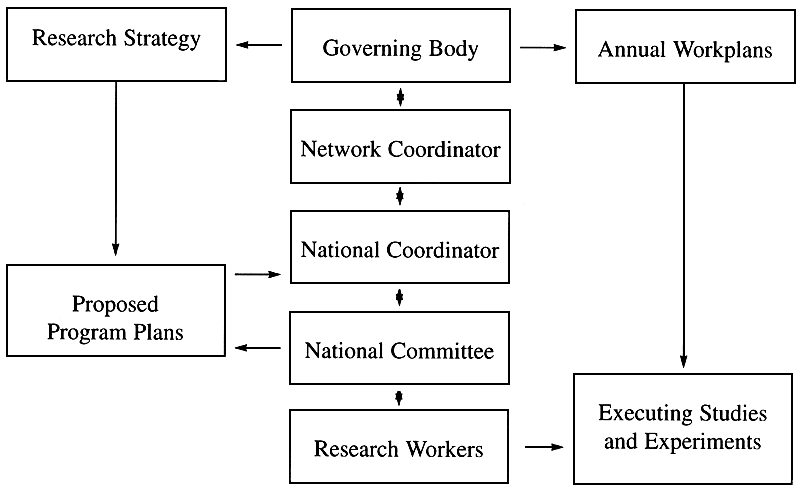
Coordinator : As we mentioned earlier in the characteristics of a successful network strong and effective leadership and coordination is one of the most important factor influencing the performance of a network because of the informal structure of networks. The coordinator is the main actor in any network coordination. It is essential in a collaborative research network that the coordinator have good technical knowledge, good administrative ability, and common respect among the scientists in the network. The problem is finding a coordinator equally strong in all facets (Faris 1988).
Most coordinators present are hired to work full-time. The other extreme is a coordinator elected by a network, usually from NARS, who does the job part-time in addition to normal duties. In many networks, coordinators conduct research activities as well as act as coordinators.
Governance : Networks have several forms of governance. Most networks have steering committees to set research policies and program committees for implementing these policies.
The advantage of a steering committee is that being relatively small it can meet easily and conduct its work efficiently. The size of the steering committee varies from a small group (in the case of an international centre as the coordinating body) to a large group consisting of representatives of participating countries in the network.
Four aspects of governance have been identified by Plucknett et al. (1990) as important of the success of networks:
setting and formulating policies;
overseeing implementation of strategies and plans;
establishing good relationships between the governing body and the network leader (coordinator);
managing the internal affairs of the governing body.
NARS : NARS of the participating countries are the basic executing units of the network. Therefore, it is important to strengthen their role in the network, NARS programs and researchers, the main cells of any network, are constituents of the exchange matrix of ideas, guidance, program strategy, and research activities execution.
Regional organizations : There are many examples where regional organizations play important roles in networking efforts. ACSAD, as an example, has its own research programs as well as regional research networking programs.
The CGIAR International Agricultural Research Centers (IARCs) : In addition to IARCs contributions as sources of improved technologies, IARCS are good promoters of outside funding for the network approach, and could serve at least at the earliest of network development as the control coordinating body. Annex 1 provides an example of the role of the organizational structure and ICARDA in planning and managing the Nile Valley Research Program.
Other international agencies : International organizations can make important contributions and be part of the networking effort. FAO has been promoting network concept in agricultural research through ESCORENA and FAO/IAEA coordinated research programs and other research activities (FAO, 1988).
Donor agencies : Donors are playing an important role in network development through promotion and finance. Their financial contributions are critical and complementing resources efforts provided by country participants of networks.
Developed country institutions : On a mutual basis; developed country institutions participate in the networking efforts with developing countries. The U.S. university system CRSPs IBS-NET, and INTSOY are example of such collaborations. INRA of France, in collaboration with CIRAD and ORSTOM, is supporting cooperative research projects on tropical agriculture especially in French-speaking countries.
Managing activities
The work side of networking includes a cluster of four factors: operational plans, control systems, coordination and communication, and work processes (Plucknett et al., 1990).
Operational plans : In integrated planning processes, normally there are three stages: strategic planning, operational planning, and monitoring and evaluation of research activities.
The strategy formulation for the network is a task for the governing body of the network, In the strategy, a desirable vision of the network's future is described, essential elements of a course it intends to follow to realize that vision is outlined, and a justification for identified course is provided, The strategy encompasses the guiding values of the network , incorporated broad policies adopted by its governing body and reflects the vision of the network coordinator/leader.
Operational planning involves making the strategy of the network operational by translating the strategic options into specific research projects and activities that are needed to achieve network objective. These operational plans are prepared for medium-term, to reflect the country five-year plans for example, and annual research plans. Those plans should be realistic to allow for successful implementation. Over-ambitious plans fail when attempting to implement. Each network participant should ideally have an operational plan of its own that links with the overall operational plan of the network.
Control systems : These systems involve monitoring and evaluation which the network should develop to monitor network program implementation and to assess the outcomes of implementing strategies and operational plans.
Monitoring includes the periodic recording, analysis, reporting, and storage of data on key research indicators of the networks. It primarily provides information on network performance.
Evaluation of network activities occurs before ( ex ante) to assess the potential impact of collaborative research, during (ongoing) to evaluate the performance and quality of research activities in progress, immediately after (ex post) to determine the successful completion, and after development objectives have been achieved (impact).
Coordination and communication : The salient feature of a network is the coordination and communication ability between its members. The contacts in the networks can take many forms; indirectly through mail, newsletter, date or material exchange, or through the coordinator.
Alternatively, direct contacts can be practiced through visits, meeting, workshops, training sessions and monitoring tours. The location of the coordinating unit may change from time to time, but there is always a need for a coordinator. The coordinator is usually elected by network members to serve for the life of the network. Sometimes this position is rotated among network members.
Several mechanisms are used to coordinate and communicate network activities through various channels with decentralized and non-authoritarian nature. Decentralization is a key ingredient is successful networking.
Work process / Members of the network identify the right processes for acrruing out the work including data collection, analysis, testing, field work and similar research activities. However, it may be possible to have data management programs to help handle the administrative details of a network as well as to help effectively using the data generated by collaborative research.
Managing resources
Networks need resources to carry out their activities. Managing human, financial, and physical resources well is vital to maintaining the productivity of a research network, and hence to ensuring continuity of support from country policy makers and donors.
Financial resources : Networks are sometimes not recognized as full-fledged organizations so they may encounter difficulties in acquiring and maintaining financial support.
Network funding is needed for network operation, strengthening NARS financing local network activities, and developing technologies for testing by the network.
Funding of NARS activities within the network should come from the country members. However, the lack of funds is usually the major constraint to most networks to operate effectively. In the case where sufficient government funds are not available, external supplemental funding should be identified through bilateral agreements with donors or through network funds. Small amounts of money can have an important effect on upgrading network trials, e.g., faba bean and wheat trails in Egypt and Sudan. However, external financing of networks should be viewed as short-term measure. Networks should attempt to avoid dependance on external sources for funding but strive to finance their activities from their own local sources.
Human resources : The most important asset of a network is its human resources. Networks that attract competent scientists are most likely to be successful. Scientists are the ones who benefit directly from being involved in a network, especially if they are isolated and have poor facilities for research. They are the direct input into the network and they themselves benefit from attending network workshops and training courses. Many networks have found that training programs, montoring tours, and workshops are essential to foster the members' commitments to the network's guiding values and mission (Plucknett, et al., 1990).
Physical resources : Research stations buildings, land, equipment (general and specialized), supplies and general services are the components of physical resources. For the network to be effective, participants need to have access to the appropriate physical resources necessary for their work. However, the availability of suitable physical resources vary among network members who usually must operate with the existing physical resources. Members of the network should be aware of each others' physical resources and plan their research activities accordingly.
Problems
Even the most successful networks encounter problems. Like other organizations, networks are faced with constraints. The following is an attempt to list some of these organizational and managerial problems:
- research quality;
- NARs involvement in too many networks;
- personnel problems : insufficient trained manpower, rapid turnover of participants (especially among experienced scientists), language differences;
- poor conditions for on-station and on-farm research;
- balance among research fields; crops, livestock and production factor networks;
- Poor planning and unrealistic research programs at country and network levels
- poor funding and poor management of funding;
- poor linkages with technology transfer;
- composition of the governing body;
- poor coordination/leadership;
- poor monitoring and evaluation;
- sustainability/overtime;
- cost effectiveness;
- travel difficulties.
REFERENCES
Bhardwaj, B. 1990. Current status and future plans for wheat and faba bean research. A working paper for ARETP (SUDAN) Mid-Term Review Mission.
FAO. 1985. Cooperative research networks in the Near East. A paper presented at the Near East Regional Commission on Agriculture: First Session, 30 March–2 April, 1985, Cairo, Egypt.
FAO. 1988. Collaborative agriculture research networks for the GCC Countries; A paper presented as the Agriculture Research Network for the GCC Countries Symposium, 17–19 October, Kuwait.
Faris, D.G. 1988. Agricultural research networks : Their structure and function.p.7–18. In «Eastern and Southern Africa Network Coordinators' Review». Manuscript Report 206e, IDRC/CRDI/CIID. Edited by D.G.Faris and A.D.R.KerL: 100 p.
Greenland, D.J., E.T. Craswell, M. Dagg. 1987. International networks and their potential contribution to crop and soil management research. Outlook on Agriculture 16 (1): 42–50.
ISNAR, 1985. Country Report No. R23 : Regional research network-the experience of PRECODEPA. International Service for National Agricultural Research, The Hague.
Plucknett, D.L., N.J.H. Smith, S. Ozgediz, 1990. Networking in International Agricultural Research. Cornell University Press, 224 p.
SPAAR. 1986. African agriculture research networks : Summary papers and tables. Meeting of the Technical Working Group on Networking of the Special Program for African Agricultural Research (SPAAR), Brussels, Belgium, July 7–8.
Valverde, C. 1988. Agricultural research networking : Development and evaluation. Staff Notes 88–26. International Service for National Agricultural Research, The Hague.
Valverde, C. 1990. Research networking : Small countries. A paper presented at the International Workshop on issues and methodology for the analysis of national agricultural research systems in small countries. International Service for National Agricultural Research, The Hague, 29 January – 2 February.
Winkelmann, D.L. 1987. Networking : some impressions from CIMMYT. p. 131–145. In»The impact of research on national agricultural development; First International Meeting of National Agricultural Research Systems and the Second IFARD Global Convention«. Edited by B. Webster and C. Valverde. International Service for National Agriculture Research, The Hague.
Zandstra, J.G. 1986. Canadian support to agricultural research for developing world. Paper presented at the CGIAR Mid-Term Meeting, Ottawa, Canada, 19–23 May.
Annex 1: Planning and Management of the Nile Valley Research Program (NVRP)
(Excerpted from a Working Paper by B.Bhardwaj)
The Nile Valley Research Program (NVRP) is a joint effort between Egypt, Sudan Ethiopia, and ICARDA.
A detailed program of work on faba bean and wheat research, including staff training, is developed and approved annually by national and ICARDA scientists after fully reviewing and discussing the previous season's results through the following efficient and effective mechanisms and procedures.
1. The Annual Coordination Meeting (ACM)
The ACM is held annually in each of the participating countries, i.e., Egypt, Sudan, and Ethiopia; The meeting is attended by the national scientists and extension workers participating in the program, scientist form ICARDA, farmers' representatives, high officials from the Ministry of Agriculture, and production schemes, and representatives from donor country/agency.
The meeting discusses and develops the Annual Work Plan (AWP) for the coming year. The AWP clearly identifies the objectives of each trial/study, treatments and experimental design to be used, trial locations in the country, pre-and post-harvest observations and data collections to be recorded, and scientists in charge and cooperating scientists for each trial/study.
Inputs for developing the AWP are:
previous seasons results
feedback from representatives of farmers and extension workers
on-spot observations of ICARDA and the national scientists from the three participating countries who paricipate during the growing season in the Annual Travelling Workshop.
Training proposals are also developed during the ACM. The proposals clearly identify the type of training, level of trainees, and location of training.
Detailed proposal for workshops, meetings, visits and conference participation are also developed.
2. The National Management Committee (NMC)
The NMC consists of the NVRP's Director General of the ARC, national coordinators for cereals and legumes, the ICARDA Regional Research Coordinator, the NVRP Director of Administration, and donor representatives.
The NMC meets annually immediately after the ACM. The annual budget is prepared for NMC consideration by the NVRP's Director of Administration in consultation with national NVRP coordinators for cereals and legumes taking into account the approved AWP, previous year's expenditure and funding available.
The NMC discusses the AWP and annual budget. The NMC, after critical examination, recommends the AWP budget after incorporating the necessary amendments for final approval by the steering committee of NVRP.
3. The Steering Committee (SC) of the NVRP
The SC consists of the Director General and national NVRP coordinators for cereals and legumes from each of the three participating countries, donor representatives, ICARDA's Deputy Director General, ICARDA's program leaders of cereals and legumes, and NVRP's Director of Administration.
The SC meets twice a year, once in one of the participating countries and once at ICARDA or in one of the donor countries. The SC discusses and approves AWPs of common interest and makes recommendations for improvement.
The AWP and the budget become operational as soon as approved by the SC. The management of actual implementation of AWP and budget is the responsibility of the National NVRP coordinators. The execution of research activities is carried out by multidisciplinary teams in which extention workers and farmers are also involved.
ICARDA provides the necessary germplasm and active technical, logistic and management support. It also undertakes training activities at its headquarters or in-country training in cooperation with national scientists and arranges for training in other institutions abroad as appropriate.
While the national NVRP coodinators are responsible for day-to-day management in the respective countries, the NVRP Director of Administration is responsible for overall management of the programme in the three participating countries.
| Networking in Agricultural Research | |
| • | Definition and typology |
| • | Characteristics of networks |
| • | Development and management of networks |
| • | Problems |
| What is an Agricultural Research Network (ARNETs)? | |
| • | a voluntary association of independent individuals or institutions with a shared purpose to achieve desired goals |
| • | members contribute resources and participate in two-way exchanges or communication |
| 4 minimum criteria | |
| • | a common purpose |
| • | a two-way flow of information |
| • | some commitment of resources by all participants |
| • | a clear scientific contribution by all participants to the common goals |
| Why are ARNETs developed? | |
| • | to promote group interrelations and the establishment of mechanism for information or service exchange |
| • | to complement national agricultural research efforts |
| • | to gather isolated and scattered national elements into stronger regional research programs |
| • | to establish a critical mass of scientific capacity at relatively lower cost to each individual country |
| Types of ARNETs | |||
| • | Information exchange networks | ||
| - | organize and facilitate exchange of ideas and methodologies | ||
| • | Material exchange networks | ||
| - | exchange and testing of plant and animal materials and machine prototypes | ||
| • | Scientific consultation networks | ||
| - | individual network member focus on common priority research areas | ||
| • | Collaborative research networks | ||
| - | joint network member planning, implementation, and monitoring of research on common priority research problems | ||
| Commitment | |
| Degree of : complexity, commitment, cost. | 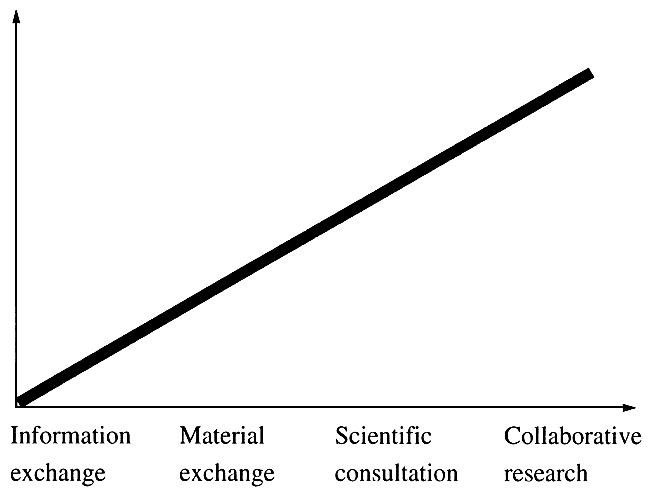 |
| Network linkages | |||
| Figure 1 - Network Linkages | |||
 |  |  | |
| Hub-and-spoke | True collaborative | ||
| Determinants of Successful ARNETs | |
| 1. | the importance of the problem to NARs and NARs scientists |
| 2. | a clearly defined problem already supported in existing national programs |
| 3. | Strong and effective coordination |
| 4. | capacity and strong research base within participating NARs |
| 5. | participant's capacity to commit resources |
| 6. | availability of flexible external funding |
| 7. | commonality of the research problem |
| 8. | the existence of a strong advisory group including NARs leaders |
| 9. | desire for a formalized training component |
| 10. | regular workshops or meetings |
| Establishing and developing a network: Phases | |
 | |
| • Preliminary and Design | |
| • Planning | |
| • Implementation | |
| Organizational structure | ||
| • | Choice of organizational model depends on: | |
| - | level and kind of activities to be performed | |
| - | type of links required with international agencies and centers, bilateral programs and national institutions | |
| - | Should be flexible and with a minimum of bureaucracy | |
| Components-Key Participants | ||
| 1. | Coordinator main actor | |
| - | requires technical knowledge, administrative ability, common respect | |
| 2. | Governance: steering committee | |
| - | set and formulate policies | |
| - | oversee implementation of strategies and plans | |
| - | establish good relationships between the governing body and the coordinator | |
| - | manage the internal affairs of the governing body | |
| 3. | NARs basic executing units | |
| 4. | Regional organisation | |
| 5. | The CGIAR IARCs | |
| 6. | other international agencies | |
| 7. | Donor agencies | |
| 8. | Developed country institutions | |
| Managing activities | ||
| 1. | Integrated planning process | |
| - | strategic planning | |
| - | operational planning | |
| - | monitoring and evaluation | |
| 2. | Control systems (including M&E) | |
| - | provide information on network performance | |
| - | ex ante, during, ex post, after | |
| 3. | Coordination and communication | |
| - | Indirect: mail, newsletter, data or material exchange | |
| - | Direct: visits, meetings, workshops, training sessions, monitoring tours | |
| - | Direct/Indirect: through coordinator | |
| 4. | Work process | |
| - | for data collection, analysis, testing, field work, etc… | |
| Managing resources | ||
| 1. | Financial resources | |
| - | for operation, strengthening NARs, developing technologies | |
| 2. | Human resources | |
| - | competent scientists are the most important assets of a network | |
| 3. | Physical resources | |
| - | access to required station buildings, land, equipment, supplies, and general services is essential | |
| Problems | |
| - | research quality |
| - | NARs involvement in too many networks |
| - | personal problems |
| - | poor conditions for on station or on-farm research |
| - | balance among research fields |
| - | poor planning and unrealistic research programs at country and network levels. |
| - | poor funding and management of funding |
| - | poor linkages with technology transfer |
| - | composition of the governing body |
| - | poor coordination/leadership |
| - | poor monitoring and evaluation |
| - | sustainability over time |
| - | cost effectiveness |
| - | travel difficulties |
| Determining and implementing network research programs | |
 | |
