


| Network Title and Symbol | Environment and Aquaculture in the Mediterranean (EAM) | ||
| Source Support and Finance | Multiple (on-going UNDP/FAO, UNEP/MAP-PAP/RAC, participating institutions, donors …) | ||
| Implementing Party | UNDP/FAO/MEDRAP II and MAP-PAP/RAC | ||
| Duration | 1st phase | : | 1993 |
| 2nd phase | : | 1994 | |
| 3rd phase | : | perennial | |
| Estimated Starting date | June 1993 | ||
FOREWORD
In the elaboration of this document, the following previous existing sources have been considered:
- Project Document RAB/83/016-RER/83/001,1984,(MEDRAP PhaseI).
- Environmental Aspects of Aquaculture Development in the Mediterranean Region (MAP Technical Report Series No. 15) ; 1987.
- Project Document RAB/89/005/A/01/12 - RER/89/009/F/01/12, 1990. (MEDRAP Phase II).
- Networking in Agriculture Research, paper presented by G. Hariri at the MEDRAP II “Networking Seminar” (April 1991).
- Report of the Seminar on Aquaculture and Environment held in Bordeaux, France (March, 1992)
- Report of the Seminar on Lagoon Management, Nantes and Sète, (June 1992),
- Guidelines for the Promotion of Environmental Management of Coastal Aquaculture Development (FAO, Fisheries Technical Paper 328, Rome 1992),
- “Third phase of the Mediterranean Aquaculture Cooperation”, ad hoc Committee report, (June 1992).
- MEDRAP II proposed future organisational structure, activities and budget, report of a consultancy to MEDRAP II by Z.H. Shehadeh, July 1992.
- Implementation of Ecological Criteria for the Rational Development and Protection of Aquaculture in the Mediterranean Region (PAP-10/1992/CP.1),
- Reports of the MEDRAP II Network Steering Committee held in Tirana, (December 1992).
- Notes of a PAP-MEDRAP II meeting on the Network concerning the Environmental Aspects of Aquaculture Management in the Mediterranean Region, (Spilt, March 1993).
1. Description of Aquaculture Sector
The Mediterranean region presents the following charateristics:
- Total population of 364 million (1985, World Bank).
- Total consumption of fishery products : 5 140 000 t.
- Net deficit in fishery products consumption is around 1200000 t, that is close to 3.4 Kg per capita per year.
- Most part the natural fisheries are now at their upper limit of exploitation.
- Most of the countries involved in a process of rapid development of aquaculture, backed by the demand of the regional market for high quality sea-products, by the need to make the best use of certain coastal areas and at last by the need to create employments in these areas.
- Regional aquaculture production estimated at a rounded yearly average of 700 000 t.
2. Mediterranean Aquaculture Cooperation
Common concerns and interested (needs, priorities, problems and opportunities) between the Mediterranean countries have provided basic reason to start a regional programme, under the name of MEDRAP, Mediterranean Regional Aquaculture Development Project, funded by UNDP, to held countries to become more self-supporting in their ability to train and manage human resources for aquaculture development support, in their capability for the supply of essential physical inputs for aquaculture and in their ability to supply good fish products to the consumer.
After two preparatory phases over the years 1979 (RER/78/004) and 1980–1983 (RER/78/004 and RAB/79/003) during which the activities and priorities of the Mediterranean countries have been reviewed and a programme of activities selected, the projects RAB/83/001 have been decided, with FAO as the implementing agency.
Total contribution of UNDP for these projects, implemented over the years 1984–1986 has been over 1 400 000 USD. In addition Italy has contributed with important funds (3 000 000 USD) and permanent experts, as well as, to a lesser extent, France (around 250 000 USD in trust funds, experts and kind) and Spain (around 50 000 USD in kind). Tunisia as hosting country for the headquarters (Institut National Scientifique et Technique pour l'Oceanographie et les peches) has contributed for an amount estimated at 50 000 TND. Other participating countries (Algeria, Cyprus, Egypt, Greece, Malta, Marocco, Portugal, Syria, Turkey, Yougoslavia) have also contributed in kind at their national level.
During this phase, now called MEDRAP I, the stategy has been :
- to select pilot projects in each country : Nador lagoon in Marocco, El Kaia (lake Mellah and Oubeira ) in Algeria, Monastir in Tunisia, Raswa in Egypt, Latakia in Syria, Beymelek lagoon in Turkey, Paphos in Cyprus, Kyparissi in Greece, Rovinj (Limsky Kanal) and Dubrovnik (Ston) in Yougoslavia, Mistra in Malta, Olean (Faro) in Portugal,
- to organize training session in the participating countries (6 session on applied hydrobiology, aquaculture and environment, pathology, nutrition, 6 session on aquaculture technology, 1 session on socio-economics aspects, 3 study tours),
- to provide technical assistance to the pilot project from a small permanent team, to the training session with consultants from the region and to national administrations for the formulation of aquaculture development plans when relevant.
At the end of MEDRAP I, Italy was considering an increase in its involvment in a regional project, under the name of AQUAMED, which would have been a continuation, giving special emphasize to the information aspect.
This project never began, and UNDP thus decided to finance (RAB : 1 882 000 USD, RER : 400 000 USD) a second phase of MEDRAP for the “promotion of aquaculture development through the establishment of a permanent mechanism for cooperation/ coordination in the Mediterranean region. The project aims at the creation of networks of regional aquaculture development institutions together with the strengthening of such institutions and aquaculture inputs supply industry”.
The strategy of MEDRAP II in supporting aquaculture development is the establishment of a permanent regional mechanism, conceived as a complement to national efforts and intended to mobilize regional capabilities and financial resources.
The MEDRAP II Project Document has initially foreseen the establishment of the following specific regional networks:
- Research
- Training
- Extension
- Production
During its first session, the Network Steering Committee decided to add the Information Network.
In Research field, some specific sub-network have been created and another are planned to be constituted with local points in selected countries:
Lagoon Management, in Morocco
Environment aspects of Aquaculture, in Tunisia
Diversification of Production, in Cyprus
Pathology, in Malta
Nutrition, in Portugal
Freshwater Culture, in Egypt
A Project core team at the MEDRAP Coordination Centre, together with national staff in four subregions (see paragraph 3.1), supported by FAO Headquarters, the Associated Countries and consultants, organize the activities, by using the facilities, personnel and equipment available.
The various MEDRAP activities and the national priorities lead to the amendment of the initial options regarding the Networks. The following networks have been retained for a permanent regional cooperation :
- Technology: to promote mainly the Research and Training activities related to Aquaculture technology,
- Socio-Economic and Legal Aspects of Aquaculture: to develop activities on the economic, marketing, financial, and planning aspects,
- Environment and Aquaculture: to support the programmes related to environment and aquaculture.
- Information: to develop a system of collecting, processing, storing and reporting of data and information.
3 . Institutional framework
3.1. MEDRAP II Structure
- National Coordinators : in each participating country, there is an overall focal point of national coordination activities in aquaculture development. With a view to coordinate action within the country and between the project and the participating countries, the Government have each appointed a National project Coordinator who is a member of the Network Steering Committee.
- Network Steering Committee : overall responsibility for decision-making concerning common action under the Project is vested in the Network Steering Committee, who meet periodically, at least once a year, and in which all concerned parties including members and associated countries participate in addition to UNDP and FAO.
- Project Coordination Centre : is located in Tunis and provides overall coordination, secretarial and information services to the member and associated countries. Because of the diversity of subjects and long range difficulties, the participating countries are grouped into four sub-regions and sub-centres.
- Subregional Centers : for each sub-regional centre, a sub-regional coordinator is designated to ensure the promotion, the organisation, the management and the follow-up of the project's activities. The subregional Centers are located in:
Algiers for the subregion of Algeria, Marocco Tunisia and Portugal ;
Tripoli for Lybia, Egypt and Malta;
Nicosia for Cyprus, Lebanon and Syria;
Dubrovnik for Croatia, Turkey, Bulgaria and Albania.
3.2. The organisation of Mediterranean Aquaculture Networks
Taking in account the need of a mechanism to link permanent activities of the regional programme with those funded by donors through other channels and a focal point for external assistance to regional activities, and after review by an ad hoc committee, it has been confirmed that the best way towards perennity, at the end of MEDRAP II, was to rely on the existing institutions, namely General Fisheries Council for the Mediterranean (GFCM), Mediterranean Action Plan /Priority Action Programme /Regional Activity Centre (MAP-PAP/RAC) and Centre International des Hautes Etudes Agronomiques pour la Mediterranee (CIHEAM), who undertake to support the Network and coordinate their activities.
At the third session of the Steering Committee (Tirana, December 1992), the following recommendation concerning the future structure of the Mediterranean Cooperation in Aquaculture were adopted (see figure 1) :
The GFCM will ensure the General Coordination of the future activities and is invited to establish a Sub-Committee on Aquaculture for the purpose.
The PAP/RAC will carry out the Environment and Aquaculture Network activities.
The CIHEAM will be in charge of the Technology Network and the Socio-Economic and Legal Aspects of Aquaculture Network.
The Tunisia Government will host the SIPAM Network which will operate under direct coordination of GFCM Secretariat.
INSTITUTIONAL FRAMEWORK
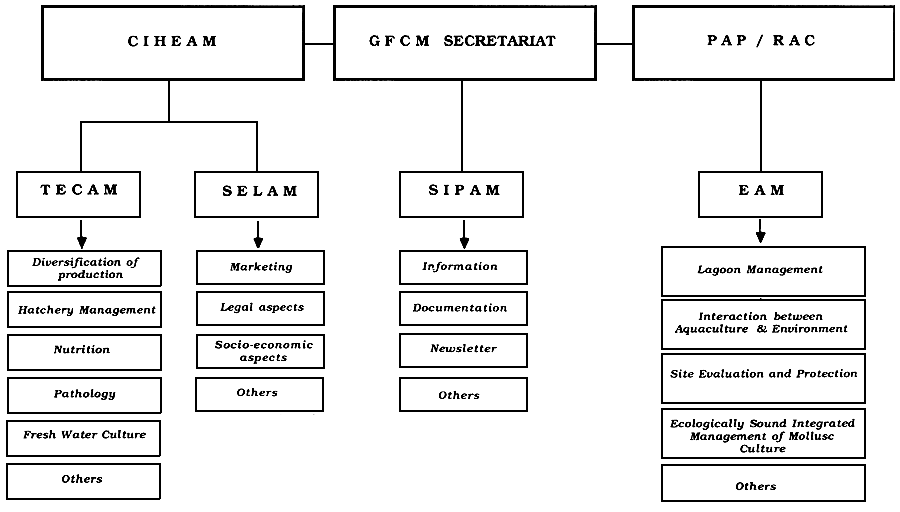
Figure 1
The mutual cooperation between MEDRAP and MAP-PAP/RAC initiated over the period 1984–1987 have allowed the concretisation of several actions undertaken by both sides as regards the environmental aspects and their interactions on Aquaculture. The Mediterranean Action Plan of the United Nations Environment Programme have conducted several studies, and MEDRAP, in both phases, have carried out several activities in order to define effective procedures for proper management of aquaculture in appropriate sites.
An updated document entitled “Implementation of Ecological Criteria for the rational development and protection of aquaculture in the Mediterranean Region - Proposal for a Mediterranean Cooperative Project within the future framework of MEDRAP activities”, elaborated in November 1992 by PAP/RAC upon request of MEDRAP, reflects the common concerns and actions.
The potential of the Mediterranean environments for the development of aquaculture has only recently been fully recognised prompting almost all the countries of the region to start implementing or to plan substantial aquaculture activities.
Most of aquaculture activities are at present being carried out in ways that are to a considerable degree dependent on the resources of the aquaculture site itself, i.e. water quality, nutrients, feed, which means that the selected site must provide these resources in appropriate amounts and quality for the kind of culture to be reared. The maintenance of these initially suitable ecological conditions is a limit for development of aquaculture, as no undue stress should be caused on the environment and on other activities at or near the site. Although aquaculture in the Mediterranean is known for centuries, it has been recently recognised that intensive cultures themselves are capable to endanger environment and production.
For the future, limits for the sites practical for culture purposes should be extended to include not only lagoons, estuaries and sheltered coastal zones but the offshore zones too.
1. General Principles
It is understood that the EAM Network will rely on the following basic principles common to the Networking concepts:
- a common purpose
- a two-way flow of information
- a scientific contribution by the participants to common goals, and
- some commitment of resources by all Members.
2. Development Phases
The EAM Network will be developped in 3 phases:
- a first, phase, of 6 months 91993), to elaborate the Network's strategy, programme of prioritised activities and workplan.
- a second phase, of 12 months (1994), to establish and consolidate an operational and durable network and to effectively address the most urgent environment-related needs and priorities for aquaculture development in the region, considering the limited available funds.
- a third phase, perennial, will lead to perform those activities which are necessary to maintain the network and facilitate common regional strategy, enabling optimum aquaculture development with regards to its environmental aspects.
3. Organisational structures
3.1 Management of Activities
MEDRAP II will coordinate in full responsibility the EAM network activities for 1993. In 1994, MEDRAP and PAP/RAC will jointly coordinate all network activities and will be responsible for its execution.
In 1995 MAP-PAP/RAC will coordinate in full responsibility the EAM Network activities, with the assistance of the MEDRAP II Project Coordination centre, depending on the time of its duration. MAP-PAP/RAC will ensure the continuation of the EAM Network activities after the termination of the MEDRAP II Project.
MAP-PAP/RAC will liaise and collaborate with GFCM to promote the EAM network's operation with other aquaculture networks: TECAM, SELAM and SIPAM.
3.2 Membership:
Could be Members of the EAM Network the Institutions and Individuals belonging to the Mediterranean Region and having good technical and scientific performances in the field.
In order to constitute the network, each interested MEDRAP Country will designate one specialised institution to be Member.
At the end of MEDRAP II Project, any other Institution, and/or Individual belonging to the Mediterranean Countries, and any other Regional and/or International Organisation, interested to join the EAM Network, should notify the coordinator who will proceed to their acceptance in accordance with MAP-PAP/RAC rules.
The Members are requested to precise their contributions to the Network and confirm their obligations.
3.3 The coordinating Institutions:
The Regional Activity Centre for the Priority Actions Program of the Mediterranean Plan (MAP-PAP/RAC) will be the Coordinating Institution of the Network on Environment Aquaculture in the Mediterranean, referred to as EAM Network.
The Coordinating Institution may assign temporary or Permanent Prioritised activities to some Member Institutions to support the activities of the Network.
In this respect and since two prioritised activities related to the EAM Network were identified in the Research field (initially called “Sub-Networks”, see para 2, page 3, “Mediterranean Aquaculture Cooperation”):
- Lagoon Management, in Morocco, and,
- Environmental Aspects of Aquaculture, in Tunisia,
the Coordinating Institution should involve the Institutions concerned in Morocco and Tunisia, as focal points, in the implementation of these activities.
For further prioritised activities, the coordinating Institution may identify appropriate focal points among Members of the Network.
The Regional Centre of EAM Network will be located at PAP/RAC Headquarters in Split.
3.4 The Coordinator:
MAP-PAP/RAC will nominate a coordinator for the Network. The Coordinator should have good technical knowledge in Environment and Aquaculture fields and good administrative ability. His services can be called upon on a full time or a part time basics.
He will be responsible for the management of the network, the coordination of its activities and the identification of external funding sources.
The Coordinator will perform his duties, under the authorities of PAP/RAC Director and in concert with the Coordination Committee, defined hereinafter (see para 3.5).
3.5 Coordination Committee
The Coordination Committee will be composed of:
Representative of FAO/GFCM.
The Coordination Committee will be assisting the coordinator in his duties. The coordination Committee will help the Coordinator in setting up and formulating activities and workplans. The decisions of the Coordination committee will be submitted to the contracting Parties' approval.
The Coordination Committee will hold its first annual meeting, after the termination of MEDRAP II Project.
It is recommended that the EAM Network should be managed with flexibility taking into account the evolution of priorities and needs.
1. OBJECTIVES
Aquaculture requires specific environmental conditions since any intensive type of production is strongly dependant on water quality and on accurate prediction of the ecosystem carrying capacity. Site selection, monitoring and protection of the ecosystem as well as the harmonisation of aquaculture with dominant economic activities in the area, such as the growing human settlements, heavy industries, tourism, agriculture and fisheries are imperative.
It is known, however, that an undesirable consequence of the general improvement of the socio-economic situation is an increased ecological degradation of the coastal areas.
In order to reduce the risks of mismanagement and the hazards of pollution and degradation of the environment, a a scientifically supported planning and well balanced interventions are indispensable.
In this context of interactions between aquaculture and environment, the objectives of the network are:
- to contribute to the optimisation of aquaculture production, through the ecological characterisation of coastal zones, the set-up of site identification methodology, and management guidelines;
- to contribute to the protection of natural environment, and aquaculture production through the monitoring, the establishment of standards recommendations and frame for national legislation;
- to provide information on the environmental performances of aquaculture in order to define its appropriate position within the context of integrated coastal area management (ICAM).
2. TOPICS OF COOPERATION
Taking full account of the experiences of MEDRAP II and PAP/RAC, as well as the results of the UNCED Conference held in Rio in 1992, the following should be considered as Topics of cooperation:
- Potential ecological impact of aquaculture on the environment, and vice versa.
- Site selection for different aquaculture systems.
- Environmentally harmful aquaculture practices.
- Legislation in support of environmentally sound aquaculture.
- Impact of the culture stock on the wildlife habitat.
- Genetical impact of escaped fish on the natural population.
- Development of farm level protocol on the chemical usage.
- Assessment of environmental hazards and impact on aquaculture.
- Assessment of environmental impact as a positive factor in environmental management.
- Assessment of the capacity of the ecosystem to sustain aquaculture development with minimal ecological change.
- Assessment and evaluation of the true consequences of transfer and introduction of exotic organisms.
3. AREAS OF PRIORITY INTEREST
At the EAM Network constitution meeting in Athens on June 1993, the following were considered as the main areas of priority need and interest for the aquaculture in the Mediterranean:
3.1 LAGOON MANAGEMENT
A deep knowledge of the lagoon management is required to ensure a better exploitation of the lagoon. Considering the complexity and diversity of the system, the following may be initiated to avoid the mismanagement:
- Lagoon production potentialities (aquaculture role and impact): hydro-dynamic, biologic and socio-economic studies,
- Definition of a strategy for the lagoon management considering the ecological equilibrium:
methodology approach using the modelisation as a tool,
elaboration of software and guidelines.
- Insuring integrated planning of lagoon management and aquaculture,
- Operation procedures of monitoring.
3.2 INTERACTION BETWEEN AQUACULTURE AND ENVIRONMENT:
The interaction varies following the types of production which can be grouped into four aquaculture systems:
Lagoonar production
Land-based aquaculture
Mollusc culture
Cage culture and similar offshore systems
Four each of these aquaculture systems, interactions with coastal environment include, among others, the following:
- Carrying capacity and self-epuration of the environment in accordance with the culture system.
- Capacity of the ecosystem to sustain aquaculture development with minimal ecological change.
- Impact of the culture stock on the wildlife habitat.
- Consequences of transfer and introduction of new species on the receiving ecosystems.
- Environmental harmful aquaculture practices.
- Consequences of the use of chemicals (antibiotics, pesticides, etc…) on natural production and survival of wild species.
- Impact of farming outfalls and control of their physical, chemical and biological components.
- Use of calibrated model for a specific culture system to predict the impact of aquaculture activity on the environment.
- Assesment and monitoring of potential ecological impacts of aquaculture on the environment.
- Identification of key parameters of aquatic pollution affecting the main aquaculture practices.
- Sanitary status of aquaculture production and stocks.
- Effect of large increase in production on the equilibrium of the supporting ecosystem with emphasis on the pathological hazards.
3.3 SITE EVALUATION AND PROTECTION
The EAM Network will contribute to the protection and preservation of natural environment through specific procedures for monitoring including, among others, the following:
- Definition of appropriate site selection descriptors for aquaculture systems practised in the Mediterranean Region.
- Inventory of sites suitable for different culture systems
- Methodology for the selection of sites: use of modelisation as a tool
- Calibration and validation of the model; to specific culture systems to be used as a common survey tool at the regional scale
- Protection of identified sites within the land-use planning process
3.4 ECOLOGICALLY SOUND INTEGRATED MANAGEMENT OF MOLLUSC CULTURE
The need to ensure the standard quality of mollusc culture in the various production zones will require, among others, the following to be considered for the ecologically sound integrated management of mollusc culture:
- Establishment of a conceptual and operation procedure of monitoring for the development and protection of mollusc culture in the Mediterranean.
- Definition of a realistic and consistent set-up of operations necessary to calibrate and validate the procedure as a whole and its individual component separately.
- Preparation of practical guidelines in monitoring methods and procedures.
- Providing the Mediterranean Governments with common measures which should be taken to prevent hazard for the protection of the consumer.
- Socio-Economic and ecological benefits of mollusc culture (introduction of new species).
- Integrated mollusc culture management plan selected areas (pilote areas).
1. Concerned Parties Inputs
1.1. MEDRAP II will continue during 1994 to support the Network activities and will provide in addition to the necessary operating facilities and administrative personnel, a financial contribution.
1.2. MAP-PAP/RAC, in addition to the basic necessary operating facilities and administrative personnel for the Regional Centre, will provide a financial contribution to the EAM Network programme of activities.
1.3. The Members of the Network will provide the necessary facilities, professional staff, equipment and funds for jointly agreed activities.
1.4. Additional contributes may be provided from potential donors.
2. Available Funds
MEDRAP II will for the implementation of 1993–94–95 programme of activities the amount of US 95, 000 ($ 50, 000 for 1993 and $ 34, 500 for 1994 and US$ 10, 500 for 1995). The PAP/RAC contribution to the EAM programme for 1994–95 will be US$ 95, 000 (US$ 45, 000 for 1994 and US$ 50, 000 for 1995).
The programme of activities for 1994 and the relevant budget is given in Annex 1.
During the joint implementation period, MEDRAP II MAP PAP/RAC will be responsible for monitoring the progress of their respective part of EAM network activities to ensure that the EAM network programme will be implemented in accordance with its objectives and workplans.
At the Network perennial phase, MAP-PAP/RAC will ensure the submission of the progress report to all concerned.
| PAP | MEDRAP II | |||
| 1994 | 1995 | 1994 | 1995 | |
| Intensive Farming - preparatory activities and workshop | - | - | 19,500 | |
| Tunis, April 12–14 | ||||
| Selection and protection of sites suitable for aquaculture-preparatory activities and working group meeting | 18,000 | 26,000 | - | - |
| Split, Oct. 26–28 | ||||
| Lagoon Management - Preparatory activities (guide lines and hydrodynamic model) | - | - | 8,050 | - |
| Nador, March 29–30 | ||||
| Workshop | - | 15,000 | - | 10,500 |
| Monitoring of molluscs culture - preparatory activities and workshop | 20,000 | - | - | - |
| France, July 4 – 6 | ||||
| Miscellaneous (travel and coordination) | 7,000 | 9,000 | 6,950 | - |
| TOTAL | 45,000 | 50,000 | 34,500 | 10,500 |
N.B.: Data compilation for the above activities is estimated at US$ 10,000 to be covered by potential donors.
E A M Budget (1994) in USD
| ITEMS | MEDRAP | PAP/RAC | DONORS | |
|---|---|---|---|---|
| RAB | RER | |||
| Workshop impact | 13,000 | 6,500 | ||
| Working group sites selection | - | - | 18,000 | |
| Working group lagoon dev.methodo. | 6,900 | 1,150 | - | |
| Workshop : molluscs | - | - | 20,000 | |
Sub total | 19,900 | 7,650 | 38,000 | |
| Other expenses of organisations | 2,600 | 350 | ||
| Coordination | 4,000 | - | 7,000 | |
Sub total | 6,600 | 350 | 7,000 | |
| Data compilation for the 4 items | - | - | - | 10,000 (France) |
| Total cumule | 26,500 | 8,000 | 45,000 | 10,000 |
| Total / Institution | 34,500 | 45,000 | 10,000 | |
