


| Network Title and Symbol | SIPAM | ||
| System of Information for the Promotion of Aquaculture in the Mediterranean | |||
| Sector | Aquaculture | ||
| Source of Support and Finance | Multiple (on-going UNDP/FAO, participating countries, Tunisia, France and other donors) | ||
| Implementing party | UNDP/FAO/MEDRAP II GFCM | ||
| Duration | 1st Phase | : | 15 months |
| 2nd phase | : | 12 months | |
| 3rd Phase | : | Perennial | |
| Estimated starting date | October 1993. | ||
FOREWORD
In the elaboration of this document, the following previous existing sources have been considered:
- Project Document RAB/83/016 - RER/83/001, 1984, (MEDRAP Phase I).
- Project Document RAB/89/005/A/01/12 - RER/89/009/F/01/12, 1990. (MEDRAP Phase II).
- Networking in Agricultural Research, paper presented by G. Hariri at the MEDRAP II “Networking Seminar” (April 1991).
- SIPAM, an Information System for the Promotion of Aquaculture in the Mediterranean Region, conceptual design prepared by S.R.Coppola, in Seminar on Documentation and Information, Cairo, 11–13 December 1991 (due to its basic importance, a part of the document - the Conceptual Design - is given in annex 1).
- “Third Phase of the Mediterranean Aquaculture Cooperation”, ad hoc Committee, report, June 1992.
- MEDRAP II proposed future organisational structure, activities and budget, report of a consultancy to MEDRAP II by Z. H. Shehadeh, July 1992.
- MEDRAP II Steering Committee Meeting Report, Tirana, December 1992.
1. Description of Aquaculture Sector
The Mediterranean region presents the following characteristics:
- Total population of 364 million (1985, World Bank).
- Total consumption of fishery products : 5140000 t.
- Net deficit in fishery products consumption is around 1200000 t, that is close to 3.4 kg per capital per year.
- Most part of the natural fisheries are now at their upper limit of exploitation.
- Most of the countries involved in a process of rapid development of aquaculture, backed by the demand of the regional market for high quality sea-products, by the need to make the best use of certain coastal areas and at last by the need to create employments in these areas.
- Regional aquaculture production estimated at a rounded yearly average of 700000 t.
2. Mediterranean Aquaculture Cooperation
Common concern and interests (needs, priorities, problems and opportunities) between the Mediterranean countries have provided basic reasons to start a regional programme, under the name of MEDRAP, Mediterranean Regional Aquaculture Development Project, funded by UNDP, to help countries to become more self-supporting in their ability to train and manage human resources for aquaculture development support, in their capability for the supply of essential physical inputs for aquaculture and in their ability to supply good fish products to the consumer.
After two preparatory phases over the years 1979 (RER/78/004) and 1980–1983 (RER/78/004 and RAB/79/033) during which the activities and priorities of the Mediterranean countries have been reviewed and a programme of activities selected, the projects RAB/83/016 and RER/83/001 have been decided, with FAO as the implementing agency.
Total contribution of UNDP for these projects, implemented over the years 1984–1986 has been over 1 400 000 USD. In addition Italy has contributed important funds (3 000 000 USD) and permanent experts, as well as, tom a lesser extent, France (around 250 000 USD in trust funds, experts and kind) and Spain (around 50 000 USD in kind). Tunisia as hosting country for the headquarters (Institut National Scientifique et Technique pour l'Oceanographie et les Peches) has contributed for an amount estimated at 50 000 TND. Other participating countries (Algeria, Cyprus, Egypt, Greece, Malta, Marocco, Portugal, Syria, Turkey, Yougoslavia) have also contributed in kind at their national level.
During this phase, now called MEDRAP I, the strategy has been:
- to select pilot projects in each country : Nador lagoon in Marocco, El Kaia (lake Mellah and Oubeira) in Algeria, Monastir in Tunisia, Raswa in Egypt, Latakia in Syria, Beymelek lagoon in Turkey, Paphos in Cyprus, Kyparissi in Greece, Rovinj (Limsky Kanal) and Dubrovnik (Ston) in Yougoslavia, Mistra in Malta, Olean (Faro) in Portugal,
- to organize training session in the participating countries (6 sessions on applied hydrobiology, aquaculture and environment, pathology, nutrition, 6 sessions on aquaculture technology, 1 session on socio-economics aspects, 3 study tours),
- to provide technical assistance to the pilot projects from a small permanent team, to the training session with consultants from the region and to the national administrations for the formulation of aquaculture development plans when relevant.
At the end of MEDRAP I, Italy was considering an increase in its involvement in a regional project, under the name of AQUAMED, which could have been a continuation, giving special emphasize to the information aspect.
This project never began, and UNDP thus decided to finance (RAB : 1 882 000 USD, RER : 400 000 USD) a second phase of MEDRAP for the “Promotion of aquaculture development through the establishment of a permanent mechanism for cooperation/ coordination in the Mediterranean region. The project aims at the creation of networks of regional aquaculture development institutions together with the strengthening of such institutions and aquaculture inputs supply industry”.
The strategy of MEDRAP II in supporting aquaculture development in the establishment of a permanent regional mechanism, conceived as a complement to national efforts and intended to mobilize regional capabilities and financial resources.
The MEDRAP II Project Document has initially foreseen the establishment of the following specific regional networks:
- Research
- Training
- Extension
- Production
During its first session, the Network Steering Committee decided to add the Information Network.
In Research field, some specific sub-networks have been created and others are planned to be constituted with focal points in selected countries:
Lagoon Management, in Morocco
Environmental aspects of Aquaculture, in Tunisia
Diversification of Production, in Cyprus
Pathology, in Malta
Nutrition, in Portugal
Freshwater Culture, in Egypt
A project core team at the MEDRAP Coordination Centre, together with national staff in four subregions (see paragraph 3.1), supported by FAO Headquarters, the Associated Countries and consultants, organize the activities, by using the facilities, Personnel and equipment available.
The various MEDRAP activities and the national priorities lead to the amendment of the initial options regarding the Networks. The following networks have been retained for a permanent regional cooperation:
- Technology: to promote mainly the Research and Training activities related to Aquaculture technology,
- Socio-Economic and Legal Aspects of Aquaculture: to develop activities on the economic, marketing, financial, and Planning aspects,
- Environment and Aquaculture: to support the Programmes related to environment and aquaculture.
- Information: to develop a system of collecting, processing, storing and reporting of data and information.
3. Institutional framework
3.1. MEDRAP II Structure
- National Coordinators: in each participating country, there is an overall focal point of national coordination activities in aquaculture development. With a review to coordinate action within the country and between the project and the participating countries, the Governments have each appointed a National Project Coordinator who is a member of the Network Steering Committee.
- Network Steering Committee: overall responsibility for decision-making concern action under the Project is vested in the Network Steering Committee, who meet periodically, at least once a year, and in which all concerned parties including members and associated countries participate in addition to UNDP and FAO.
- Project Coordination Center: is located in Tunis and provides overall coordination, secretarial and information services to the member and associated countries. Because of the diversity of subjects and long range difficulties, the participating countries are grouped into four sub-regions and sub-centres.
- Subregional Centres: for each sub-regional centre, a sub-regional coordinator is designated to ensure the promotion, the organisation, the management and the follow-up of the Project's activities. The subregional Centers are located in :
Algiers for the subregion of Algeria, Marocco Tunisia and Portugal;
Tripoli for Lybia, Egypt and Malta;
Nicosia for Cyprus, Lebanon and Syria;
Dubrovnik for Croatia, turkey, Bulgaria and Albania.
3.2. The Organisation of Mediterranean Aquaculture Networks
Taking into account the need of a mechanism to link permanent activities of the regional programme with those funded by donors through other channels and a focal point for external assistance to regional activities, and after review by an ad hoc committee, it has been confirmed that the best way towards perennity, at the end of MEDRAP II, was to rely on the existing institutions, namely General Fisheries Council for the Mediterranean (GFCM), Mediterranean Action Plan /Priority Action Programme/Regional Activity Centre (MAP-PAP/RAC) Centre International des Hautes Etudes Agronomiques pour la Mediterranee (CIHEAM), who undertake to support the Networks and coordinate their activities.
At the third session of the Steering Committee (Tirana, December 1992), the following recommendations concerning the future structure of the Mediterranean Cooperation in Aquaculture were adopted (see figure 1):
The GFCM will ensure the General Coordination of the future activities and is invited to establish a Sub-Committee on Aquaculture for the purpose.
The PAP/RAC will carry out the Environment and Aquaculture Network activities.
The CIHEAM will be in charge of the Technology Network and the Socio-Economic and Legal Aspects of Aquaculture Network.
The Tunisian Government will host the SIPAM Network which will operate under direct coordination of GFCM Secretariat.
INSTITUTIONAL FRAMEWORK
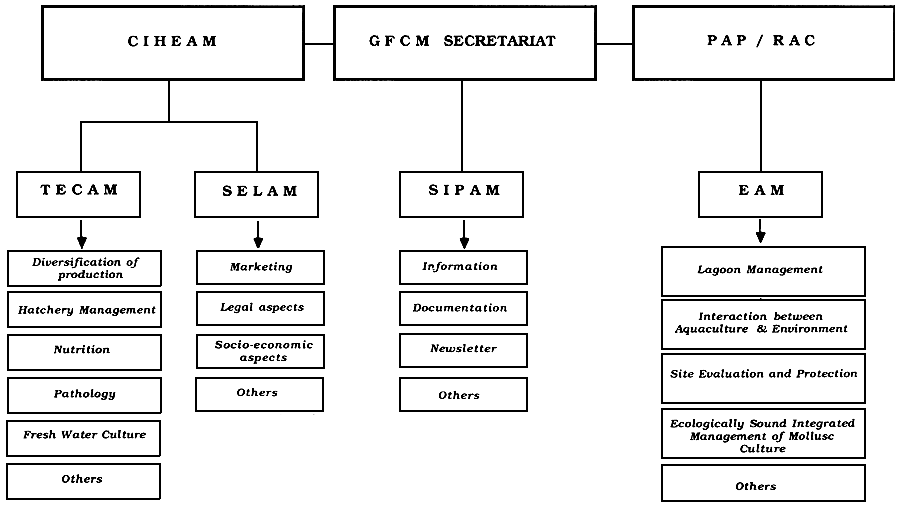
Figure 1
1) Needs for Information System:
The proposed regional Information System, SIPAM, originated mainly from three factors:
- the strong demand for corporate information from the many scientists and administrators involved in planning and promoting aquaculture activities and evaluating projects at the national and regional levels,
- an urgent need of public and private investors, producers, suppliers, researchers, economists, managers, for regional and inter-regional information on aquaculture in order to promote the production technics, the technology, the import/export of aquaculture products and equipment, research and training possiblities, prices, national and international rules and standards, legislation, etc.
- The necessity to disseminate these information and the conclusions of the various Mediterranean Cooperation activities in different subjects through a unique consistent network.
The proposed system will produce useful and usable information through organised methods of selecting, storing, retrieving and reporting of data available from national, and inter-regional sources. The outcome will produce a continuous flow of information which could be used for evaluating, measuring, maintaining and controlling events and performance in aquaculture.
The current widespread availability of reasonably low-priced computers and micro-computers of great capacity makes a project for incorporating a large amount of such multi-disciplinary information into a Desk Information System possible.
It is emphasized that this proposal was discussed and agreed at the Seminar on Information and Documentation held in Cairo from 11–13 December 1991.
2. Expected situation at the end of the project
A currently running, self-sufficient and permanent information system with an instrument and methodology for rapid targeted access to data and information of different types (including production, markets, legislation, technics, etc…)and from different sectors and sources in order to increase the production, to improve the technics and the products quality and the commercialisation.
This system being part of permanent cooperative network for Aquaculture Development in the Mediterranean.
3. Target beneficiaries.
Scientists and administrators involved in planning and promoting of aquaculture activities and evaluating projects at the national and regional levels;
Public and private investors, producers, suppliers, researchers, economists, managers, who have urgent needs for regional and international information on aquaculture in order to promote the production technics, the technology, the import/export of aquaculture products and equipment, research and training possibilities, prices, national and international rules and standards, legislation, etc…
1. General Principles
It is understood that the SIPAM Network will rely on the following basic principles common to the Networking concepts :
- a common purpose
- a two-way flow of information
- a scientific contribution by the participants to common goals, and
- some commitment of resources by all Members.
2. Development phases
The SIPAM Network will developped in 3 phases:
- a first phase, of 15 months starting from October 1st, 1993 considered as a prototype one, During this phase, the conceptual design will be implemented, tested and accepted as operational by the selected participating Members.
- a second phase, of 12 months, will give a complete picture of the project by a confirmation exercice and the extension of the system to other Members.
- a third phase, perennial, will lead to meet the objective of permanent and self-sufficient network.
3. Organisational Structure
3.1 Management of the SIPAM
During the duration of MEDRAP II Project (1993–94), SIPAM will be part of its activities and will be managed by MEDRAP II Coordinator. The MEDRAP Member Countries will be informed of the SIPAM's progress during the MEDRAP Steering Committee Session.
At the termination of MEDRAP(1995), SIPAM will operate under direct coordination of GFCM Secretariat assisted by the “Direction Générale de la Pêche et de l'Aquaculture” (DGPA), Ministry of Agriculture, Tunisia.
3.2 Membership :
Could be Members of the SIPAM Network, Institutions involved in aquaculture data management, designated by their relevant authorities in interested countries of the Mediterranean.
The SIPAM System will start initially with a restricted number of institutions from MEDRAP Countries: Croatia, Cyprus, Egypt, France, Greece, Portugal, Tunisia and Turkey, to be designated by the respective National Coordinators.
3.3 The Coordination Centres :
a) The Regional Centre
SIPAM Regional Centre will be located in Tunis, at the present MEDRAP Headquarters in the Ministry of Agriculture.
The Regional Centre will be responsible for the management of the data bank, the documentation centre and the publication of a newsletter.
a) The National Centres
A National Centre will be established in each participating country. The National Centre will manage the flow of data between the national sources of data and themselves. It will be responsible for the interfacing procedures (installation, training, setting-up, etc…)to the Regional Module.
3.4 The Coordinator :
GFCM in concert with the Tunisian Government will nominate a Coordinator for the network. He should have good technical knowledge in aquaculture in the Mediterranean Region and good administrative ability. He will be hired on a full time basis.
He will be responsible for the management of the network, the coordination of its activities and the identification of external funding sources.
He will perform his duties, under the authority of the GFCM Secretariat, and in concert with the Coordination Committee, defined hereinafter (see para 3.5).
3.5 Coordination Committee
The SIPAM will be guided by a Coordination Committee composed of:
The Coordinator
Two experts to selected by rotation, each 2 years, by the Executive Committee of GFCM, among candidates proposed by the SIPAM Network Members.
Representative of FAO/GFCM.
The Coordination Committee will be responsible for :
- decision-making concerning the Network
- overseeing implementation of the programmes;
- follow-up of the administrative and financial management,
The Coordination Committee will hold its first annual meeting, after the termination of MEDRAP II Project.
It is recommended that the SIPAM Network will be managed with flexibility taking into account the needs of end-users.
1. Development Objectives
SIPAM has two objectives in relation with two functions:
1.1.Information:
The objective of SIPAM is to provide the MEDRAP Project and through it the countries adhering to the project, with an instrument and a methodology for rapid and targeted access to data and information of different types and from different sectors and sources (see Annex 1, the Conceptual Design). This technology could allow, in a further step, all users to establish their own “made-to-measure” research procedures tailored each time to suit their requirements. This objective will be reached through the development of:
- a Regional Information Centre,
- a Documentation Centre,
- a Newsletter
1.2 Inter-connecting role:
The SIPAM system is designed as a Central Data Bank connected to all the Mediterranean Aquaculture Network. Specific non-confidential information generated from other networks on Technology, Social, Economic and Legal Aspects, Environment, etc… will feed the system for an inter-connection role.
2. Immediate Objectives , Outputs and Activities
IMMEDIATE OBJECTIVE 1
The elaboration of a Methodology for the establishment of data base.
Based on the already developped conceptual design approved by the countries of the region, a system design will be made by the project staff with the participation of the users in order that their precise requirement can be met adequately.
A design confirmation meeting will be held to verify that the user needs are met and if necessary introduce the change requests in the design. The programming of the modules of the confirmed design will be develpped by the system programmers within an approved Data Base Managment System (DBMS) shell. The modules developped will be walked-through (tested) to verify that they meet the design specifications as soon as they are available, at the end of which process a final system test will be conducted to ascertain the integrity of the system as a whole. When the developped prototype system is accepted as operational, it will be tested by those countries that may have the equipment and the capability to run the prototype on their system or in the Regional Centre. The intitial data input to the system will be provided by those countries that have the data elements identified as those required for the regional system. The successfull implementation of the prototype system development will complete the phase 1 to the SIPAM Project.
Meanwhile, two data modules will be provided to SIPAM, one module from FAO HQ and one regional module including socio-economic data about the countries from the area (see description of modules in annex 4, SIPAM, the Conceptual Design). This two modules will receive data available at the national level.
OUTPUT 1.1: relevant methodology
The adaptation of the methodology will be the result of a cooperative work between the SIPAM staff in charge of the project and the FAO experts.
Activity 1.1.1: System design
The system analysis phase will, in practice, define the feasibility and et what cost (in terms of resources, risks, etc…) the Project can be implemented.
SIPAM will be composed of “blocks”, each defined by its area of application. The blocks will not be bound to interact to specific external specifications (hard/software); instead, it will be possible to tailor each block to different external formats as necessary according to the interfacing systems (hardware/software platforms) all converted to the same format. This approach has the advantage of enabling the System to be developped stepwise with the possibility of adding to and expanding the elementary modules.
Activity 1.1.2: Design and Set-up of a regional module
The project will design and implement a Regional Module and put at the disposal of the countries available information in a readily access manner to regional data. This Module will be fed with non-confidential data and information of regional interest which each country has put at the disposal of the Project.
OUTPUT 1.2: Establishment of a Data Base
In order to rationalise the development and implementation of a data base, to enhance the possiblity of its success, increase its use and interest by the concerned parties, the system should be linked to national sub-system structured to allow retrieval and feeding processes.
Activity 1.2.1: Design and Implementation of the Data Base and Set-up of the Sub-System the national base with the national sources.
Three major components are normally involved in the design and implementation of any Information System: the Design Unit, the Developing Unit and the End-Users. Each of the applications to be developped will be considered as stand-alone applications with certain INPUT/OUTPUT or LINKAGES constraints to be fitted into each of the Modules. The design Unit is composed of the SIPAM System Manager, Representatives of Member Countries, Selected Representatives of Producers and Suppliers and any other qualified end-users. This group of experts coordinated by the SIPAM System Manager, will decide which applications should be developped and the priorities, as and when required. The Application specifications should contain inter alia: Objective, Possible Source of Data, Users of Particular Interest, Data Entry Format, Data Manipulation, Data Retrieval Format. To be successful, the Design Unit should foresee the optimum that can be obtained from a certain type of data/information, and design the INPUT/OUTPUT requirements as if they were to be carried out manually. It is also recommended to always bear in mind the scope, type and nature of the data to be entered into the system.
Once the Application has been conceived, the Analyst and/or Programmer will translate the requests into a software tool. For the successful implementation of this work, it is imperative that the project provides the services of a System Manager. In order to ensure the permanent control of the system, the Manager should be recruited on a full time basis.
Activity 1.2.2: Training of staff
The Personnel user of the national centres should be trained on the data management and the use of the system.
IMMEDIATE OBJECTIVE 2
Extension of the System
The System Extension is the second phase of the project and will commence upon the completion of the prototyping and its acceptance. The description of the second phase is provided to give a complete picture of the project, but is will be subjected to a confirmation exercise at a meeting of the system users after the trial of the prototype by the users. The objectives of phase 2 may be revised with the experience gained in testing the prototype system and will include the hardware and software requirement of the network nodes, which may effect the total funding of the second phase. This phase foresees the extension of the system to those users who may wish to participate in SIPAM.
OUTPUT 2.1: Extended System
Extension to other countries, including eventual end-users, will be possible once the system is tested. This extension will take place after briefing of Member Countries Representatives on the results of the initial phase and after training of national staff
Activity 2.1.1: Seminar on Evaluation and Information
In order to motivate the national centres, a seminar will be organised to demonstrate the success of the structure, its use and its development possibilities as well as its technical and financial implications at the national level. This seminar will allow the evaluation of the possible evolution of the system.
Activity 2.1.2: Training of national personnel
This activity will be envisaged in the SIPAM Regional Centre or in any other National Centre.
OUTPUT 2.2: Inclusion of External Information
The system, thanks to its architectural design, will allow the use of data bases from other external sources.
Activity 2.2.1: Selection and establishment of an Extented Module.
As complementary data, an Extended SIPAM Module containing information from other data sources, external to MEDRAP and FAO, will be developped. In this Module, data from commercial and non-commercial remote networks may also be considered if found necessary and useful for the completeness of SIPAM.
OUTPUT 2.3: Documentation Centre and Newsletter
The proposed activities will include the development of a Documentation Centre and a Newsletter, for which the funds will be secured by Donors.
Activity 2.3.1: Documentation Centre
The Documentation Centre will collect and hold hard copies and microfiche of textbooks, selected periodicals reports and reprints on subject matter of interest to the programme. Lists of material on hand will be incorporated into the Regional Information data base for access by members. Copies or microfiche of articles will be provided to members on request.
Activity 2.3.2: Newsletter
A Newsletter will be prepared on a PC and issued quarterly to circulate news from members and the Coordinator on progress of work, national developments in aquaculture and related matters.
IMMEDIATE OBJECTIVE 3
Perennity of the Network
The longer-term objective of the project is to attain the self-sufficiency phase.
OUTPUT 3.1: Continuity of the System
The perennity of the System will rely on the training of a management team, working permanently in the SIPAM Regional Centre, and on the set-up of procedures covering the operating costs of the system after completion of MEDRAP's assistance.
Activity 3.1.1: Financial procedures
This 3rd phase of the project will depend on the successfull implementation of the first two phase, and will require a meeting of the responsible national node managers to discuss the modalities of funding the SIPAM to meet the cost of services expected to incur. The total services cost will include the in kind contribution of the network nodes commensurate with the levels of input they provide to the regional system.
Concerned Parties Inputs
1. The Tunisian Government will provide for the Regional Centre:
- The basic necessary facilities
- Administrative support personnel
- Full-time Analyst/Programmer.
2. The Members will provide their national centres the necessary professional staff and equipment as well as maintenance and operating expenses.
The members are requested to precise their contributions to the Network and confirm their obligations.
The major risks may originate from :
the methods and technics to be used in the system;
the know-how of the experts in the Regional Centre and/or in the National Centres.
if the countries' contributions do not materialise.
The first risk (a) may be eliminated by a study on the capacity of the system to answer to the users'needs and to the financial procedures proposed.
The second risk (b) may be eliminated by the securing of the necessary expertise and the provision of training as required.
To avoid these risks, The Coordination Committee will ensure a follow-up on a regular basis.
The Government of Tunisia shall:
agree to host the SIPAM Regional Centre on a permanent basis.
support the Network through IRESA.
MEDRAP Project will support SIPAM during the first phase and eventually extend the assistance to the second phase, depending on the time of its duration.
The French Authorities will contribute to SIPAM with a full time Data Manager during the first phase and eventually extend the assistance to the second phase.
UNDP will support SIPAM during the first phase and eventually extend the assistance to the second phase.
The FAO will assist the Project particularly through the GFCM Secretariat who will contribute to the coordination of the SIPAM activities with those of the other Networks.
SIPAM, in consultation with FAO, will study the legal aspects of collating, copying and providing online any propriatery data to users, when required obtain waiver of copyright for printed documents, including CD ROMs, it intends to provide to requestees.
An evaluation report should be prepared, each year, by SIPAM Regional Centre in concert with GFCM/FAO Experts. The report will be submitted to the concerned parties through their Representatives in the SIPAM Coordination Committee.
