


M. Ilyas Ahmed
Senior Hybrid Rice Breeder, Directorate of Rice Research, Hyderabad-500 030, India
Before discussing the major lessons learned from the Indian experience in development and use of hybrid rice technology, this article gives a very brief background on the initiation of the research project, the network approach, implementation of the project and, finally, the most significant achievements of the last six years.
Having recognized heterosis breeding rice as one of the most feasible methods to increase the productivity and production of rice in the country and thus meet the ever-increasing demand, in 1989 the Government of India initiated a goal-oriented time-bound project, the Development and Use of Hybrid Rice Technology. This Indian Council for Agricultural Research project has been further strengthened by financial support from the United Nations Development Programme (UNDP) and technical support from FAO since September 1991.
 |
 |
The major lessons learnt from the Indian experience in development and use of hybrid rice technology are briefly mentioned below.
For the success of the project it is necessary that adequate time, effort and expertise be put in for proper and detailed planning of the project and then for effective implementation of the planned activities and thorough and regular evaluation and monitoring. Based on the results of evaluation and monitoring, mid-course corrections and modifications should be introduced in the programme.
The following elements are prerequisites for a successful programme:
The large-scale adoption of hybrid rice technology primarily depends on economic and efficient seed production. The maintenance of the purity of seed, successful CMS multiplication and hybrid seed production at various levels are the most important (and at the same time most complex and difficult) factors to consider for a successful project. All time, effort and expertise invested in thorough planning, implementation and monitoring of seed production will pay rich dividends. A prerequisite for a successful seed production programme is the availability of
- There should be a dependable mechanism and source for the regular supply of nucleus seed of the parental lines on a sustainable basis. Otherwise the impurities and contaminants in seed production plots increase season after season and it becomes very difficult to produce pure seed.
- The ideal location and season should be identified for seed production at the beginning of the programme. Pilot studies should be conducted to find out the synchronization parameters of the parental lines before undertaking large-scale seed production.
- There should be a mechanism in the research network to ensure that the seeds of hybrids identified as promising by the national evaluation are immediately produced on a comparatively large scale and that on-farm testing is also undertaken immediately. In India, although many hybrids have been identified as promising, few could be evaluated in the on-farm trials either because of a lack of restorer line seed or because of a lack of the necessary facilities for relatively large-scale seed production. This one factor slows down the pace of the project considerably.
- Synchronization parameters need to be specifically developed for each hybrid combination for different locations and seasons on a pilot basis before large-scale seed production is undertaken.
- It is always advisable to proceed systematically and progressively from a smaller to a larger area while undertaking large-scale seed production. One seed agency in India undertook very large-scale seed production without properly working out the synchronization parameters for the various locations. By the time the parental line seed could be obtained and planted, it was late in the season. Consequently, at 75 percent of the locations there was no proper synchronization of flowering of parental lines, and the seed yields obtained were very low. Such events cause severe setbacks to the programme.
- A very large number of seed production personnel from the public and private sectors, seed growers, progressive farmers and farm women need to be trained thoroughly on various aspects of hybrid rice seed production technology.
- The success of a hybrid should be judged by the ease of seed production as well as by heterosis and other characteristics. The difference in flowering of parental lines should not be more than a week to ten days.
- Finally, grain quality, particularly the consumer's acceptance, plays a major role in determining the price of the final product and hence is a deciding factor in wider adoption of the technology. The cooking and eating qualities depending on local preferences in the target area should be given due consideration when selecting parents at the time of hybrid development. In addition to the increased yield potential, an acceptable quality of grain is also an equally important factor for the programme's success.
- Ultimately, commitment, dedication, hard work and perseverance of all those involved in the programme is required for the successful adoption of this innovative technology on a large scale.
A very broad outline for introducing the hybrid rice technology in a mission mode in other interested Asian countries is presented here.
Policy-makers, senior government officials and senior research managers need to be convinced of the benefits of this technology in achieving gains in productivity and production, and their unstinted support is to be obtained for this programme. Second, all the necessary financial, technical and human resource provisions need to be made for implementation of the programme.
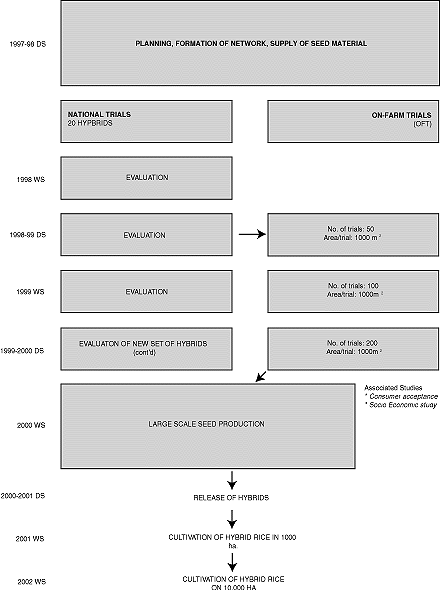
To introduce the technology in the shortest time possible, emphasis is given to the applied aspects that are well focused and goal-oriented. In the technical programme, building up the capacity large-scale seed production within the country in a short time is very important for introducing this technology. Initially, the hybrid combinations need not be developed indigenously. The hybrids primarily developed by IRRI, but also by other countries, that have been found to perform well in some of the Asian countries could be evaluated (Box). Schematic diagrams outlining the research network to be formed for implementation of the project and the processes of evaluation and seed production are given in Figures 1-3, respectively. Only the broad outlines are presented here; the finer details need to be worked out in accordance with the needs and conditions of the different countries. The outline given envisages the start of the evaluation process during the 1998 wet season and the possible release of a hybrid for commercial cultivation by the wet season of 2001, i.e. within three years the technology could be introduced in some other Asian countries, provided it is technically and economically feasible and all other requisite facilities, human resource development and seed production mechanisms are in place.
The ICAR/UNDP/FAO project, Development and Use of Hybrid Rice Technology in India, has been successful in introducing hybrid rice technology in the country within five years of its inception. Major achievements of the project include the release of seven hybrids produced by the public sector and the marketing of seven or eight hybrids by the private sector. During the 1996, 1 300 tonnes of hybrid seed were produced and hybrid rice was cultivated on more than 50 000 ha. In 1997 it is estimated that 3 000 tonnes of hybrid seed have been produced and, during the 1997 wet season, hybrid rice is likely to be cultivated in an area of 125 000 ha.
|
Proposed set of hybrids to be evaluated IR 58025A/KMR 3 (KRH-2)
|
A strong and vibrant hybrid rice research network with all the required infrastructural facilities and human resources for innovative research and large-scale seed production has been created. Research programmes are under way to maintain this technology and enhance heterosis in the years ahead.
Valuable lessons can be drawn from the experiences of this project for the implementation of similar programmes in other interested Asian countries. Relevant points mentioned include: the importance of obtaining the full support of policy-makers, senior government officials and research officers; the importance of sound, detailed planning of all the aspects of the project and of the formation of a research network; the selection of appropriate teams; the free exchange of germplasm and the use of consultants' expertise (critical issues in seed production technology); the involvement of the private sector and NGOs in large-scale seed production; and the need for extensive training programmes and periodical evaluation and monitoring.
 |
An outline of an action plan for introducing this technology in other Asian countries has been presented, based on the conclusion that the experiences gained in this project can be utilized very profitably to implement similar programmes more efficiently in other interested countries.
1 This article was presented at the workshop, Progress in Development and Use of Hybrid Rice Technologies outside China, organized by FAO, 28-30 May 1997, Hanoi, Viet Nam.
Acknowledgements. Acknowledgements are due to the Indian Council for Agricultural Research, New Delhi, and the Directorate of Rice Research, Hyderabad, as well as to all hybrid researchers in India, particularly my colleagues at the Directorate of Rice Research.
Pendant les cinq années de l'exécution du projet ICAR/PNUD/FAO sur le développement et l'utilisation de la technique du riz hybride, les comités d'Etat respectifs chargés de la mise sur le marché des variétés ont distribué, pour la culture commerciale, sept riz hybrides à haut rendement produisant en moyenne 1 à 1,5 tonne de plus à l'hectare que les variétés de contrôle consanguines ayant le plus haut rendement. En outre, le secteur privé a commercialisé sept à huit hybrides. En 1996, la production de semences de riz hybride a atteint 1 300 tonnes et le riz hybride a été cultivé sur une superficie d'environ 50 000 ha. Selon les estimations, il a été produit, en 1997, 3 000 tonnes de semences de riz hybride et pendant la saison des pluies de 1997, 125 000 ha ont été plantés en riz hybride.
On a créé un réseau de recherche sur le riz hybride fort et dynamique doté de toutes les installations d'infrastructure et des ressources humaines nécessaires pour la recherche innovatrice et la production de semences à grande échelle. Les programmes de recherche en cours visent à appuyer cette technique et accroître la vigueur hybride (hétérosis) dans les années à venir. Plus de 10 sociétés de production de semences du secteur privé et cinq du secteur public participent actuellement à la production de semences de riz hybride et à leur commercialisation dans le pays.
D'utiles leçons peuvent être tirées de ce projet pour les programmes analogues réalisés dans d'autres pays d'Asie intéressés. Il a été brièvement question, par exemple, de l'importance du plein appui des décideurs, des cadres supérieurs de l'administration, des attachés de recherche principaux ainsi que des éléments nécessaires suivants: planification bien conçue et détaillée de tous les aspects du projet, formation d'un réseau de recherche, choix des équipes indiquées, échanges sans frais des ressources génétiques, utilisation des connaissances des experts, questions très critiques de la technique de production de semences, participation du secteur privé et des ONG à la production de semences à grande échelle, programmes étendus de formation, ainsi qu'évaluation et surveillance périodiques.
Un schéma d'un plan d'action visant l'introduction de cette technique dans les pays intéressés d'Asie a été présenté. En conclusion, les données d'expérience acquises dans ce projet peuvent être mises à profit pour des programmes analogues dans d'autres pays intéressés d'Asie.
Durante los cinco años de aplicación del proyecto ICAR/PNUD/FAO sobre desarrollo y utilización de tecnología para el arroz híbrido, los comités de los estados respectivos distribuyeron con miras a su cultivo comercial siete híbridos de arroz de alto rendimiento (superior en
1,0-1,5 t/ha al de las variedades testigo autógamas de mayor rendimiento), además de los siete u ocho híbridos comercializados por el sector privado. En 1996, se produjeron 1 300 t de semillas de arroz híbrido y se plantó arroz híbrido en una superficie de unas 50 000 ha. En 1997 se estima que se han producido 3 000 t de semillas y que se han cultivado 125 000 ha durante la estación húmeda.
Se ha creado una red de investigación sobre el arroz híbrido con todas las instalaciones infraestructurales y los recursos humanos necesarios para llevar a cabo una investigación innovadora y una producción de semillas en gran escala. Se han iniciado programas de investigación para promover esta tecnología y aumentar la magnitud de la heterosis en los años venideros. Más de 10 empresas del sector privado y 5 organismos públicos participan actualmente en la producción y comercialización de semillas de arroz híbrido en el país.
De las experiencias de este proyecto pueden sacarse valiosas enseñanzas para la aplicación de programas análogos en otros países de Asia interesados. Entre ellas cabe señalar la importancia de conseguir el pleno apoyo de encargados de formular políticas, altos funcionarios gubernamentales e investigadores cualificados, la importancia de una planificación sólida y detallada de todos los aspectos del proyecto, la formación de una red de investigación, la selección de equipos adecuados, el libre intercambio de germoplasma, el recurso a la competencia de los consultores, cuestiones de importancia decisiva en la tecnología de producción de semillas, participación del sector privado y ONG en la producción de semillas en gran escala, ejecución de amplios programas de capacitación, y evaluación y vigilancia periódicas.
Se ha presentado el esbozo de un plan de acción para la introducción de esta tecnología en los países de Asia interesados, y se ha llegado a la conclusión de que la experiencia adquirida con este proyecto puede ser muy valiosa para la aplicación en dichos países de un programa similar.
