


7.2.1 Empirical modeling
7.2.2 Anticipated long-term trends
7.2.3 Anticipated short-term cycles
This section describes a comprehensive theory within which the dynamics of animal production, range trend, socio-economic aspects of pastoral households and shifting development opportunities could be predicted, predictions tested and hence knowledge advanced. The theory is based on a series of hypotheses deduced from the literature and observations in the southern rangelands during 1980-1991 and the empirical model used in illustrating the theory is given below. The system's dynamics are divided into two components: (1) those due to continuous long-term trends; and (2) those due to short-term cycles driven by episodic events such as low annual rainfall. Understanding each component is relatively straightforward. Interpreting field data to test a component is made difficult because dynamics caused by the cyclic events are superimposed over those caused by the long-term trend.
Past and future dynamics of the Borana system are illustrated using a simple computer simulation model based on observed population trends of cattle and humans. The cattle population was observed during 1980-1991 to be periodically subjected to resource scarcity. Resource limitation is usually instigated by below-average rainfall, which is a variable external to the production system. The magnitude of the effects of low rainfall on the production system, however, is influenced by cattle stocking rate. Stocking rate is an internal system factor that dictates the potential intensity of forage competition among cattle (see Section 6.4.5: Equilibrial versus non-equilibrial population dynamics). In any given year the cattle herd varies between a lower range of stocking rates following a multi-year drought, to a higher range of "ceiling" stocking rates that reflect a yearly variable carrying capacity during non-drought years. The higher the stocking rate the greater the risk of negative, density-dependent effects on the herd from low rainfall. This pattern is hypothesised to operate to a greater extent here than in more arid pastoral systems where the frequency of severe drought disrupts herd growth. It has also been hypothesised that the intensity of density-dependent interactions on the Borana Plateau is greater today than in the past because of the loss of traditional internal and external grazing reserves to population pressure, which limits management flexibility (see Chapter 8: Synthesis and conclusions).
In contrast to cattle, the human population may exhibit a rapid and steady increase in size regardless of annual rainfall (see Section 2.4.3: Human population growth and Section 6.3.2.2: Human welfare). Patterns of marketing behaviour are predicted based on the attempts by the Boran to make up for annual deficits in food energy by selling livestock and livestock products to buy grain. Annual food-energy balances for the human population in the 15475-km2 study area were calculated as functions of annual fluctuations in cattle numbers and productivity in relation to a steady growth in food demand by the human population.
The computer-simulated model was parameterised using data collected in the southern rangelands along with some simplifying assumptions. The model was run for 25 years representing the period 1982 to 2006. This period includes the drought of 1983-84 as well as a hypothetical drought in 1995-96, with all other years assumed to have average rainfall. The modeling work was conducted just prior to the 1990-91 drought. While this affects the accuracy of year-to-year predictions when model results are compared with the field situation, it does not undermine the general validity of the approach.
The pre-drought herd size in 1982 was derived from aerial surveys of Milligan (1983) and drought impact and initial recovery of cattle numbers during 1983-86 were derived from herd monitoring results of Donaldson (1986) and aerial surveys reported in Cossins and Upton (1985: p 139) and Assefa Eshete et al (1987: p 9). Herd growth in average rainfall years during interdrought periods (i.e. 1986-1994; 1997-2006) was assumed to be density dependent (see Section 6.4.5: Equilibrial versus non-equilibrial population dynamics). The first year of drought recovery (i.e. 1985 or 1997) was assumed to have herds showing an annual growth rate of 10.4%, evident from aerial survey data from 1985-86 and found to be an upper limit of growth in other modeling work (Mulugeta Assefa, 1990: p 135). Herds in subsequent drought-recovery years (1986-89; 1998-2001) were assumed to have an annual growth rate of 8% (Mulugeta Assefa, 1990: p 135). The high-density phase was assumed to be reached when the herd size went over 300000 or 19.4 head/km2 following a guideline on an upper limit for carrying capacity for the semi-arid zone from Pratt and Gwynne (1977: p 112; also see empirical observations confirming density dependence in Section 6.3.3: Drought effects in 1990-91). According to the model the cattle herd crossed this threshold of 300000 head in 1989 and 2001. Herds in subsequent high-density phases (i.e. 1990-94; 2002-2006) were arbitrarily assumed to have net rates of growth that gradually declined from 6 to 2% per annum. Relative impacts on the cattle herd of the projected 1995-96 drought were assumed to be similar to those observed in 1983-84 and 226000 head was assigned to be the post-drought stocking rate in 1997.
The optimal percentage of mature cows in the regional herd during average rainfall years was expected to vary between 45%. (Cossins and Upton, 1988b) and 50% (Solomon Desta, nd), with the latter figure presumed to be more likely over the long term as demand for milk increases with human population growth. If the proportion of cows were to exceed 50%, it is envisioned that although milk supply would improve, the cost would be more limitations on investment and risk-mitigating capability since fewer mature male cattle could be maintained (Coppock, 1992b). The proportional decline of mature cows in the regional herd from 45 or 50% in average years to 38% during the peak of drought was inferred from Donaldson (1986).
The fraction of mature cows in milk was assumed to be 0.75 before the 1983-84 drought (Cossins and Upton, 1987) and during other years of drought recovery. During high-density phases, however, this fraction was assumed to be density dependent and was arbitrarily reduced by 0.01 unit each year to a low of 0.68. Milk yield per milking cow was quantified in energy terms as 840 MJ GE/cow/year (Cossins and Upton, 1988b) and this was initially used in pre-drought 1982 and in drought-recovery years. A linear decline from 840 to 420 MJ GE/cow/year (Donaldson, 1986) was assumed during the first to the second drought year. During the high-density phases milk production was assumed to be density dependent and was arbitrarily reduced by 2% each year to a low of 722 MJ GE/cow/year. Total annual energy production from milk was calculated as the number of milk cows times yield per cow.
The most accurate statistics for the human population were assumed to be those of Assefa Eshete et al (1987: p 11) for 1986, which relied on aerial counts of huts along with a ground truth of 4.5 persons per hut based on a survey of 60 encampments (600 households) by Coppock and Mulugeta Mamo (1985). It is important to note that these data yielded a baseline population of about 66000 people for the study area during 1982. This is roughly 60% of the 108000 estimated by Upton (1986a). The main difference in the calculations originated from variation in the estimated number of occupied huts per unit area obtained by aerial survey. The number of people per hut were more similar, as Upton (1986a) used an estimate of four persons per hut, comparable to the 4.5 of Coppock and Mulugeta Mamo (1985). Estimates of Milligan (1983), cited in Upton (1986a), were based on 1.7 occupied huts/km2. Assefa Eshete et al (1987) estimated about 1.1 occupied huts/km2. While these discrepancies will remain unresolved, the research theme remains the same: the steadily increasing dependence on nonpastoral foods by the Boran because of human population growth exceeding the traditional support capabilities of the system.
A net annual growth rate of 2.5% was assumed for the human population in average rainfall years (Lindtjørn, University of Bergen, unpublished data) and this was assumed to be density independent. The human population growth rate assumed during drought was 1% per year (see Section 6.3.2.2: Human welfare). Using the baseline year of 1986 and the growth rate of 2.5%, figures for the human population were back-calculated to estimate how long it is likely that the Boran have been forced to supplement milk-deficient diets with grain. Human immigration and emigration for the pastoral sector were assumed to be neglible overall (AGROTEC/CRG/SEDES Associates 1974f; see Section 2.4.3: Human population growth). The total annual energy requirements for the human population were calculated by multiplying population size times 2336 MJ GE/person/year (FAD/WHO (1973) cited in Upton (1986a): p 21).
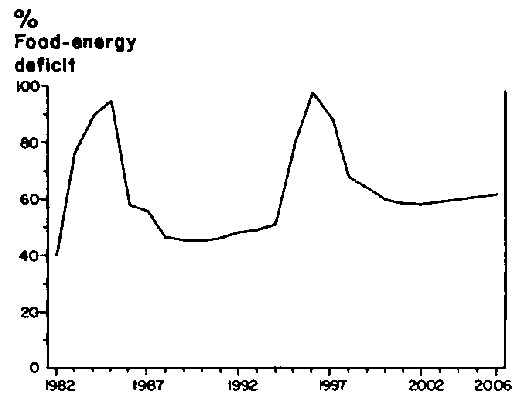
Annual dynamics of populations, milk-energy yield and human energy demand derived from these calculations are shown in Table G1, Annex G. Figure 7.1 (a,c) depicts dynamics for the cattle population and food-energy deficit. Assuming the cattle population periodically reached 275000 head prior to the 1980s, and that 45% of these were mature cows with 0.75 in milk and a milk yield 10% higher than the maximum in the 1980s, it is apparent that this level of cattle productivity could fully support some 37000 people. This suggests that the Boran have been increasingly dependent on grain since around 1960. This is in contrast to the projected dynamics of annual energy deficits from 1982 to 2006 (Figure 7.1c). Even in 1982 the population needed 40% of their energy from grain (note that 32% of dietary energy was provided by grain in household surveys summarised in Figure 6.2a).
Examination of the interdrought periods indicates that the energy deficit will increase to a minimum of 46% in 1986-1994 to 58% in 19982006. This is primarily due to a steady increase in the size of the human population. These low points (or troughs) in interdrought periods are bounded by gradual post-drought declines and pre-drought increases in energy deficits (Figure 7.1c). These were caused, respectively, by gradual recovery of milk-production potential or by subtle increases in density-dependent interactions which reduced milk production. Droughts, in contrast, are times of sharp increases in the milk-energy deficit, primarily caused by a reduced calving percentage, and secondarily by a decline in the milk yield per lactating cow (see Section 6.3.1.2: Cattle productivity). The peak milk-energy deficit of 92% in the 1983-84 drought is similar to the 85% deficit observed in late 1984-85 (see Figure 6.2b). People survive an 85% deficit by collecting bush foods, buying more grain and reducing food intake (see Section 6.3.2.2: Human welfare). It is notable that the projected energy deficit grows during the 199596 drought and this is due to the increase in the human population.
Figure 7.1. Empirical modeling results for cattle stocking rate for the Borana system as located within a 15475-km2 area in the southern rangelands during 1982-2006. - Source: Coppock (1993c)
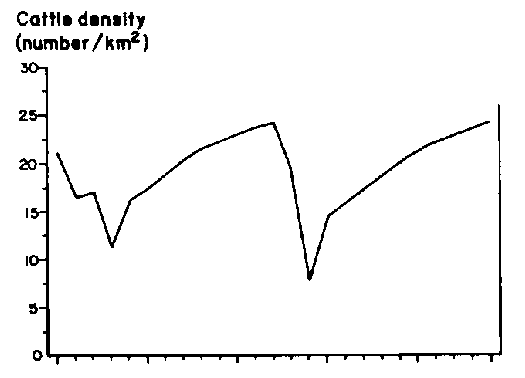
Figure 7.1. Empirical modeling results for ratio of milk cows per person for the Borana system as located within a 15475-km2 area in the southern rangelands during 1982-2006. - Source: Coppock (1993c)
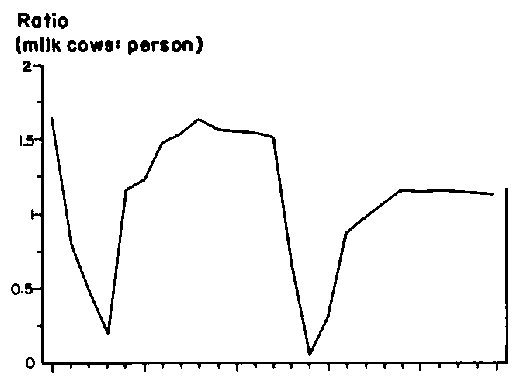
Figure 7.1. Empirical modeling results for per cent annual food-energy deficit for the Borana system as located within a 15475-km2 area in the southern rangelands during 1982-2006. - Source: Coppock (1993c)
Using milking cows per person as a proxy for per capita milk production, the system appears unsustainable in terms of food security (Figure 7.1b). The long-term decline results from human population growth in conjunction with constraints that limit the size of the regional herd with cows not exceeding 50% of the regional herd. The decline would continue until rates of human mortality and emigration balanced rates of birth and immigration. The slope of the decline could be lessened if cows made up an increasing portion of the herd, but this would compromise the economic assets stored as male cattle for drought endurance and recovery, for example. Increasing the proportion of cows is hypothesised as a stimulus to the Boran's practice of trading bulls for cows with highlanders during drought recovery (see Section 5.4.5: Cattle growth and implications for breed persistence). Dynamics for per capita holdings of male cattle are not illustrated but the pattern would be similar to those in Figure 7.1 b. Drought-induced mortality rates for mature male cattle in 1983-84 (22%) were roughly half of that for mature cows (45%); thus the deep drops in the per capita asset index due to drought would not be as severe as that for cows. Similar perspectives have been forwarded for other pastoral systems (see Figure 3.3 on p 26 in Grandin (1991)).
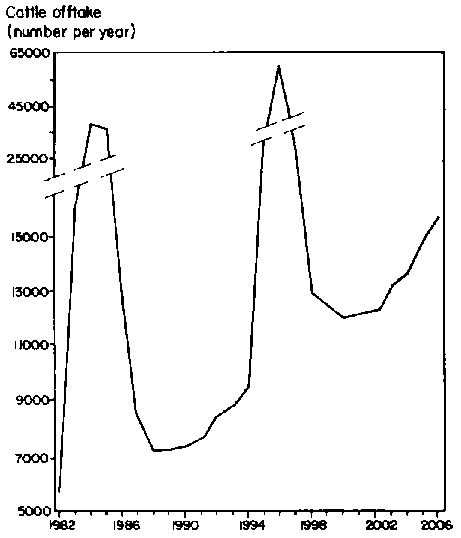
The implications of cattle offtake to buy grain to make up energy deficits are displayed in Figure 7.2. The analysis assumes that the sale of one 250-kg animal will enable the purchase of 625 kg of grain during average rainfall years but that these terms of trade will change in a linear fashion to 209 kg of grain per animal at the peak of a drought (see Section 6.4.3: Decline in terms of trade). This fall in the terms of trade is more conservative than the 75 kg of grain/animal reported in Cossins and Upton (1988a), and is a compromise between this value and higher estimates of Solomon Desta et al (nd). While an offtake of 5516 head (1.7% of total inventory) would enable the purchase of the grain requirement in 1982, this increases to a minimum of 7200 head (2.5% of inventory) and 12000 head (4.1% of inventory) during the 1986-1994 and 1997-2006 inter-drought periods, respectively. These are increases of 30 and 117% compared to 1982. Gradual declines and increases in cattle offtake in inter-drought periods reflect milk production dynamics (above). The overall increase in offtake over time reflects human population growth. Projected offtakes during drought are high both in 1983-84 (36000 head or 16% of inventory) and 1996 (56000 head or 46% of inventory). These are thought to be unrealistically high, however, because of a reduction in pastoral food demand and sales of alternative commodities where possible (Section 6.3.2.2: Human welfare).
Figure7.2. Empirical modeling results for cattle offtake per year m support of grain purchases needed to make up energy defictis for a human population occurring within a 15475-km2; area in the southern rangelands during 1982-2006. - Source: Coppock (1993c).
The above analysis undoubtedly contains errors and assumptions that have not been rigorously tested. The overall conclusion, however, is that the Boran will become increasingly dependent on grain imports and this has implications for increased cattle marketing. The apparent trend of the system is towards unsustainability in terms of per capita milk production and asset accumulation; fewer assets imply greater risk of not recovering from drought, especially for poor and middle-class households (see Section 7.3.3.7: Mitigation of drought impact).
Per capita incomes will probably increase for the Boran, but they could also easily be victimised by risky markets and high grain prices. This could be mitigated, however, by activities such as cultivation and diversification into small ruminants for market (see Section 4.4.4: Traditional marketing rationale). Cultivation carries risks because less than 10% of the landscape may be suitable for sustainable farming (see Section 3.4.1: Ecology and land use). Likewise small ruminants are risky in light of the poor access to veterinary service (see Section 5.4.6: Small ruminants). The general pattern is testable as the interpretation given here is consistent with long-term trends reported for semi-arid Maasailand (Meadows and White, 1979; Grandin, 1987; Solomon Bekure et al, 1991).
7.2.2.1 Cultivation
7.2.2.2 Land annexation
7.2.2.3 Labour availability
7.2.2.4 Wealth stratification
7.2.2.5 Livestock and dairy marketing and herd diversification
7.2.2.6 Cattle herd composition
7.2.2.7 Miscellaneous household activities
7.2.2.8 Range ecology
7.2.2.9 Social aspects
Long-term trends in the production system largely result from population dynamics of both cattle and people. Fundamental shifts in pastoral behaviour are predicted on the basis of the need to acquire more food energy from nonpastoral sources to make up for growing deficits in per capita milk production.
Some aspects of long-term change such as cultivation are well underway today. Although there has been sporadic cultivation among the Boran in the past (see Section 4.4.1.1: Pastoralism and cultivation), it is predicted that cereal cultivation will now become permanent in madda having higher rainfall and water-collecting landscapes that reduce risks of cropping. This will be a natural response of the Boran to per capita milk production declining below a minimum survival threshold. The human population will become increasingly settled in these farming areas and those involved in cultivation will be from all wealth classes with poor households that abandon the pastoral way becoming more common, however.
Draft technology using cattle and camels will expand in farming areas, with intensification of cultivation (including use of manure and better management of plots) taking place only when the best land is all filled, labour is not limiting and when production of grain is perceived by the Boran to decline as a result of reduced soil fertility (Hodgson, 1990). Extensive or low-input farming will thus predominate in the near future. Besides draft power, crop-livestock interactions will be dominated by feeding crop residues to cattle. Because these cultivated areas will happen to be closer to larger towns, and Boran nearer to towns are reportedly to be more amenable to social and economic change (Coppock, 1992b), it is speculated that these situations will offer special opportunities to introduce new technologies and management concepts that could facilitate development of agropastoralism first in certain suitable sites and later filtering elsewhere. Although range-development policy has never officially endorsed cultivation in the southern rangelands, the short-term alternative is widespread hunger and famine vulnerability among the Boran if cultivation is not permitted Alternatives are discussed later in this chapter.
People in drier madda with less favourable landscapes for cultivation will continue to crop on an opportunistic basis only, with frequent failures Hand cultivation of small plots may predominate and only opportunistic feeding of calves on crop residues will occur. But for the most part, households located in these drier areas will remain as pure pastoral operations.
As a response to overcrowding, fodder banks (kalo) have emerged during the past 20 years on the Borana Plateau (Menwyelet Atsedu, 1990; described in Section 7.3.1.2: Grazing management). Kalo are forage reserves "owned" by local residents that have been annexed from communal grazing resources at the madda level of resolution. It is understood that kalo are now a permanent feature of higher potential sites near encampments. Since nearly all encampments surveyed now have kalo, the rapid uptake phase of adoption may already be over (see the analytical framework in Rogers, 1983).
Despite a growing human population, 30 Borana elders expressed concern that labour constraints for livestock rearing were markedly worse in 1990 than in 1980 (D. L. Coppock, ILCA, unpublished data). The source of this problem is the recent increases in emigration rates for younger and poorer male Boran. This group represents the main labour pool for forra herding and raising well water, activities that are less suitable for women and children (see Section 4.3.2: The encampment and the role of cooperative labour). It is anticipated that emigration rates for this group and their male cohorts will continue to increase as the Boran become more aware of outside economic opportunities; and they acknowledge that, compared to their fathers and forefathers, they will have more difficulty gaining livestock wealth in the traditional system because of overpopulation. Emigration of mature males will place additional labour burdens on adult females, youths and children who are less able to leave the traditional sector (Coppock, 1992b). The increased burden of these activities could detract from women's substantial inputs into the management of both households and livestock (see Section 4.3.3: The labour of married women). Fear of labour shortages has contributed to reservations of sending children to school, but leaders acknowledge the increasing importance of education for their youth (D. L. Coppock, ILCA, unpublished data). Another outcome of key labour shortages may be increased human birth rates with families attempting to compensate for future labour shortages (Condon, 1991).
The decreasing ratio of cattle to people, in conjunction with drought and other perturbations, will serve to pauperise a growing proportion of the population. This is due to intensification of density-dependent competitive interactions (see Section 6.4.5: Equilibrial versus non-equilibrial population dynamics). These interactions increase the risks of animal losses for all Boran but the chance that the poor could lose even the critical number of cattle needed for survival is greater (see Section 6.4.2: Wealth effects on herd losses). Below a certain threshold, household heads would have to decide whether to remain in the system or not. Male household heads could easily leave but women household heads may face greater difficulty doing so (above). This could contribute to a higher proportion of women heads of poorer households. Poorer families in food energy-deficit situations should move to pert-urban locations to sell dairy products to buy grain because their small herds prohibit animal sales (see Section 4.4.10: Dairy marketing).
The rate of livestock offtake will increase soonest in drier madda (i.e. where cultivation is not sustainable) as pastoralists are forced to buy more grain to supplement their diets. Increased rates of offtake may be delayed in madda with extensive cultivation but may eventually increase there also. Pressure to sell more cattle should manifest itself in several other ways: (1) younger male cattle will increasingly be sold compared to the past because of a gradual depletion of mature male stock traditionally preferred for sale (Coppock, 1992b); (2) where labour and disease risks permit, herd owners will attempt to produce more small ruminants as a replacement tactic to delay selling more cattle (Coppock, 1992b); and (3) additional emphasis may be placed on selling dairy products. Peri-urban dairy marketing will be far more prevalent than in the past, but flows of products will be highly variable due to climate, market access of households and wealth class (see Section 4.4.10: Dairy marketing).
If prices are allowed to increase for cattle to a level comparable with those offered by the cross-border black market with Kenya as appears feasible (Solomon Desta, TLDP economist, personal communication), the net effect will be: (1) for Ethiopia to harvest more cattle otherwise lost to Kenya; (2) other factors held constant, a substantial price increase may serve to reduce offtake rates overall given the relatively low need of pastoralists for cash income and increasing poverty of the society (Coppock, 1992b); and (3) herd owners whose main goal is to produce livestock for commercial sale will increase (see Section 4.4.6: Market evolution). These persons often have strong links to the traditional sector, but are commonly urban-based and may be absentee owners in some cases. Although this activity will facilitate livestock purchasing by outsiders as adequate types and numbers of animals can be more readily delivered to buyers, commercial herds will increasingly compete with pastoral subsistence herds for resources.
Increased rates of offtake may gradually decrease the proportion of male animals in cattle herds. This will also reduce security during drought, however, because males have important survival and trade attributes important for drought recovery. Households may increasingly trade Boran bulls for highland cows after droughts and the percentage of mature cows in the regional herd could slowly increase (see Section 6.4.4: Traditional drought mitigation tactics).
Although some aspects of dairy marketing may intensify over time (see below), amounts of milk allocated for processing, especially for secondary products such as long-term fermented milk (ititu) and ghee (see Section 4.3.5.1: Milk processing procedures), will steadily decrease as a result of increased demand for fresh milk for home consumption or sale. This will arise from the gradual decrease in the ratio of milking cows to people. Use of non-dairy foods such as bush foods as dietary supplements for people will be undermined by the increasing reliance on grain; and with the traditional knowledge regarding them will thus be lost increasingly (Sperling, 1989).
In the absence of extensive range burning, the long-term trend will probably be for the woody population to gradually increase (see Section 3.3.2: Long term vegetation change). Expansion of the woody segment of the vegetation may not be consistent over time, being instead a series irregular grazing-mediated pulses (see Section 7.2.3: Anticipated short-term cycles). With the continued growth of towns, there will be increased local demand for firewood and charcoal and trees will probably be increasingly harvested by poor pastoralists and urban dwellers to generate income.
Recent political changes in the structure and emphasis of Peasant or Pastoral Associations in Ethiopia will initially result in a strenghtening of the traditional social institutions with which power has been shared in recent years (M. Bassi, Institute of Ethiopian Studies, Addis Abeba, Ethiopia, personal communication). Over time, however, this strengthening may be gradually undermined by defections of young men from the pastoral sector. This may threaten inter-generational transfer of knowledge of traditional rights and responsibilities among males (D. L. Coppock, ILCA, unpublished data).
Observations of Salih (1985) and Waters-Bayer (1988) suggest that as pastoral societies become more commercialised, men increasingly gain control over various aspects of dairy production and marketing previously in the domain of women. This possibility cannot be ruled out for the Boran.
7.2.3.1 Range ecology
7.2.3.2 Livestock productivity
7.2.3.3 Cattle herd composition
7.2.3.4 Marketing of livestock products
7.2.3.5 Land tenure
Short-term cycles are best understood in relation to drought frequency. While these cycles may contribute to long-term trends in terms of wealth stratification, livestock productivity and marketing behaviour, they are most easily visualised as affected by density-dependent dynamics in the cattle population as driven by fluctuation in rainfall. It is important to recall that the cattle population can vary from <10 to >20 head/km2 in just a few years. Elucidating the role of drought frequency in the regulation of livestock productivity, capital accumulation and loss, and environmental degradation is essential for understanding the dynamism of development opportunities and constraints. It is also important to note that these hypothesised patterns are probably relatively new developments to the cattle system connected with the removal of disease on the one hand and watering constraints in conjunction with a loss of grazing reserves on the other (see Section 6.4.5: Equilibrial versus non-equilibrial population dynamics).
These issues have been previously recognised, but they have not been looked into adequately to better understand pastoral development. As with the long-term trends hypothesised above, the following scenarios also assume that: (1) epidemic diseases of livestock will continue to be controlled; (2) labour constraints will have a relatively minor role in limiting animal numbers; (3) opportunities for land expansion remain minimal; (4) and the mortality of cattle in future two-year droughts will be similar to that observed in 1983-84.
To best illustrate the role of drought in Borana it is assumed that a two-year drought occurs once every 10 to 15 years and that came herds take about five years to recover their numbers (see Section 6.4.5: Equilibrial versus non-equilibrial population dynamics). Thus, if droughts are 10 years apart the last five years proceeding the second drought will be the time when livestock populations are high enough to impact the perennial savannah: if droughts are spaced 15 years apart the herds have 10 years to impact the environment. Thus, the longer the interdrought period, the greater the probability that impacts will be severe. This will be further complicated by whether the intervening rainfall is above or below average. If above average, some impacts will be less than if it is below average. (In the following discussion the five years of herd recovery will be termed as the drought-recovery phase, while the remaining period before the next drought will be the high-density phase).
If it is assumed that bush encroachment is encouraged by heavy cattle grazing (see Section 3.4.2: Environmental change), then the high-density phase will be the time when establishment of woody seedlings is most likely to occur. More seedlings may establish if the interdrought period is longer. Establishment may also be facilitated by above-average rainfall (Tamene Yigezu, 1990), but this would be true only to the extent that the grass layer is not in competition with seedlings.
The high-density phase will also be the time when livestock-induced erosion and changes in herbaceous composition and cover will most likely occur. The high-density phase will probably be the time when the pastoralists feel the greatest need to bum the rangeland in order to improve marginal grazing resources.
The standing crop of perennial grasses will be the highest throughout the year during the drought-recovery phase. The extent to which perennial grasses recover from grazing pressure during the previous high-density phase will be largely related to the chance that rainfall will be above average during the recovery phase. The worst scenario for the sustainable productivity of range vegetation is when interdrought periods are long and the rainfall is slightly below average, i.e. high enough for livestock not to die but low enough to not permit adequate recovery of vegetation from heavy grazing. If this happens for several interdrought periods in a row, it could translate into a long-term trend of declining range productivity. If interdrought periods are variable in duration and the volume of rainfall exhibits no clear trends, bush encroachment would occur in a series of irregular pulses.
Per head productivity of cattle in terms of milk output, calving rate, calving interval, average daily weight gain and nutritionally mediated calf survival rates will all be the highest in the recovery phase, even though affected by moderate seasonal fluctuations. This is deduced from producer surveys (see Section 6.4.5: Equilibrial versus non-equilibrial population dynamics) and literature that links animal performance with stocking rate (Jones and Sandland, 1974; Hart et al, 1988). Conversely, these production attributes will all be constrained to a greater degree in the high-density phase, when seasonal fluctuations in production will also be more pronounced. The environment will thus exert greater limitation over livestock productivity in the high-density phase. This control could be mediated through cattle nutrition. Seasonal limitation of nutrition in the drought-recovery phase will primarily be that of protein in dry periods. Minerals may constitute a minor problem during the later stages of the long wet seasons early in the recovery phase as well. In contrast, food energy will become the primary constraint during the high-density phase. At the highest densities of cattle, energy will be insufficient even during the long rains, and thus compromise compensatory weight gain, milk production and reproduction. It was during the high-density phase of 1981-82 that the unusual bimodal lactation curve of Boran cows was observed, probably indicative of a severe seasonal nutritional stress (see Section 5.3.2: Calf growth and milk offtake). It is hypothesised that the bimodal lactation curve is less likely to be observed during drought-recovery phases.
Cattle productivity per unit area, particularly in terms of milk, is hypothesised to be a major driving variable on human behaviour in the system. This is translateable into per capita milk yield at the household level of resolution. Cattle milk production per unit area, overall, will be the lowest in the first few years of the recovery phase and the highest during the first years of the high-density phase, after which it will gradually decrease because of density-dependent interactions (Figure 7.3). In contrast, nutritionally mediated productivity of browsing camels and goats, either per animal or per unit area, will be largely unaffected during the interdrought cycle except for variation induced by fluctuation in rainfall but grazing sheep could suffer from competition from cows in the high-density phase (see Section 3.4.3: Use of native plants). The populations of camels and goats are assumed to be well below any limits imposed by availability of browse in the study area. Disease likely constitutes the most pervasive constraint regarding small ruminants and camels, regardless of population density and rainfall (see Section 5.3.7: Ancillary livestock).
Figure7.3. Conceptual model of milk production dynamics per cow and per unit area during an interdrought cycle of years having average rainfall. - Source: Coppock (1993c).
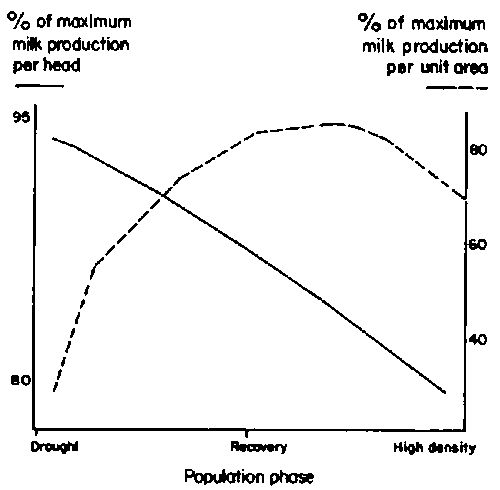
It has been shown that the composition of cattle herds changes to a higher proportion of male animals following drought (see Section 6.4.1: Drought impacts on livestock). Thus a higher proportion of males will characterise the drought-recovery phase and this will gradually lessen in the high-density phase. This contributes to the cycle of milk-production dynamics per hectare noted above, as mediated by resource competition between milk cows and other cattle.
Pastoralists sell livestock and dairy products primarily to buy grain to compensate for a shortage of milk. Thus, from hypotheses for livestock production (above), and assuming no cultivation for simplicity, the need to sell livestock and livestock products would decline sharply during a drought recovery phase, bottom out briefly during one or two years of full herd recovery and then gradually increases again during the high-density phase as a result of a decline in cow productivity per unit area resulting from forage competition (i.e. compare Figure 7.1c on interdrought energy deficits with Figure 7.3 on cow productivity per unit area). Overall, the need to sell will increase if rainfall is below average during the entire interdrought period, and vice versa.
What to sell is a more complicated matter. Households located more than 30 km from market are probably relegated to selling only animals while those located within 30 km can sell both dairy products and animals, giving rise two subsystems. During the recovery phase, no herd owner will want to sell cattle (because what males they have they would want to trade for cows), and thus may opt instead to sell more fresh milk or small ruminants. Fresh milk, sold from a milk-deficit situation, will be the preferred sale item in the recovery phase in the pert-urban subsystem because per capita yields will be insufficient to make butter (see Section 4.3.5: Dairy processing and marketing). Poorer herd owners will always have fewer choices of what to sell compared to wealthy ones. During the high-density phase when capital accumulation and management risks are higher, wealthy herd owners may be more inclined to divert animals toward their social benefits (see below).
It is important to note that these cyclic patterns take place within a gradual long-term trend of increased per capita dairy marketing resulting from a declining ratio of cattle to people, which may be offset by cultivated food production depending on favourable conditions. It is predicted that there will be episodic increases in sales during drought-recovery phases in addition to the generally increased flow of dairy products associated with poor women residing near towns. This will also be influenced by the local contingenies of cultivation.
Denial of reciprocal grazing rights was observed in 1989-90 in heavily populated madda in the central plateau (D. L. Coppock, ILCA, personal observation). The long-standing tradition of allowing the cattle of nonresidents access to local madda resources, in return for future reciprocal access, has probably been fundamental in making diverse grazing and watering options available under times of stress (see Section 2.4.1.7: Water resources). Nevertheless it is predicted that denial of reciprocal grazing fights will become more common during dry seasons in the high-density phase while normal access will be granted during drought-recovery phases.
