7.3.1 Range management and improvements
7.3.2 Land-use policy and agronomic interventions
7.3.3 Animal production strategies
This section reviews intervention concepts based on development experiences backed up by research. Development and research are integrated because the most effective approach involved extension providing appropriate ideas for commodity-oriented research, not the other way around (see Section 1.4.7: Interaction between research ant/development and project impact). Systems research was then used to generate the population-based models of long-term trends and short-term cycles (above). This was intended to provide insights as to when commodity-based interventions should be extended for maximum impact (see Section 7.4: Component interventions and system dynamics).
7.3.1.1 Water-development activities
7.3.1.2 Grazing management
7.3.1.3 Forage improvements
7.3.1.4 Site reclamation
One fundamental goal of range management is to promote an optimal and sustainable level of animal production consistent with maintaining and/or improving a given forage base. This goal may be achieved in a hierarchical fashion (Pratt and Gwynne, 1977: pp 100-138). First, access of livestock to underutilised land must be achieved; and this is usually implemented through water development. Second, once access is secured the timing and intensity of herbivory may be regulated, which involves manipulation of the species, types, numbers and/or distribution of livestock. Third, some intensive inputs may be required to improve the level or distribution of primary production to increase carrying capacity. Fourth and lastly, additional intensive inputs may be required to rehabilitate sites in the event of failing to attain the second or third stages of the hierarchy. In this strategy extensive approaches precede intensive approaches (Herbel, 1983). This is an important point because African range development agents often focus more on intensive approaches consistent with expectations of higher-potential production systems in less risky environments. As a result they put fewer resources towards extensive management. It is thus understandable why efforts involving intensive interventions often fail (D. L. Coppock, ILCA, personal observation; see Chapter 8: Synthesis and conclusions).
Another major issue in African range management is the spread of cultivation. Cultivation is considered as a diversification response of pastoralists to a declining availability of food generated from livestock (see Section 4.4.1.1: Pastoralism and cultivation). At the worst, if cultivation is uncontrolled it could threaten dry-season grazing sites and threaten soil erosion (Moris, Scoones, 1991). If farming can be regulated to develop only in appropriate locations, it could complement livestock production, improve food security and open the door for other interventions dealing with crop-livestock interactions.
This review was organised in a hierarchical fashion according to the conceptual framework of Pratt and Gwynne (1977: pp 100-138) while at the same time attempting to merge range-management concerns with the needs of improved human welfare. As such it recognises that the constraints and objectives of range management in traditional pastoral systems are different from those in commercial ranching (Behnke, 1983; 1984; 1987). The review starts with a section on water development followed by material on grazing management, range improvements, and site rehabilitation.
For pastoral systems improved access to land is most readily achieved through water development. In addition, if water development is designed to be ephemeral it can also be an element of the second stage of range management in terms of seasonal regulation of livestock density and distribution. For the Borana pastoral system, where water for people is in short supply and human labour is a critical input for watering animals, water development must also be more broadly defined in terms of improving human welfare through increased access to water for households and the need to improve labour efficiency. Ideally, the amount and temporal availability of water must only be sufficient to sustain a density of stock commensurate with optimal use of vegetation in a given area. Provision of water in excess of this amount can otherwise lead to environmental damage (Sandford, 1983b).
Extensive water systems for large stock and people
Lack of surface water is perhaps the most defining characteristic of the central Borana Plateau (see Section 1.4.2: History of lowlands development and the TLDP). Partly because the lack of water provided a traditional constraint on cattle numbers, the southern rangelands have been regarded as one of Africa's premier rangelands in terms of vegetation condition and trend (Pratt, 1987a). Starting in 1976, development efforts in SORDU were originally focused on expansion of the wet-season grazing area for cattle through construction of strategically placed ephemeral ponds that were intended to augment the traditional ponds system maintained by the Boran through hand labour. The new ponds were to have moderate capacities in line with promoting sustainable use of adjacent forage resources.
TLDP management was sensistive to problems of unregulated water development that had occurred in other African pastoral systems (Girma Bisrat, PADEP Coordinator, personal communication). Prior to undertaking this activity it was estimated that only 66% of the wet-season range was accessible to cattle because of scarcity of surface water (Cossins, 1983d).
Expansion of wet-season grazing was expected to: (1) prolong a higher level of wet-season nutrition for cattle for one to three more months each year (Cossins, 1983d; Girma Bisrat, PADEP Coordinator, personal communication); (2) promote higher levels of milk production (see Section 5.3.2: Calf growth and milk offtake); (3) improve conditions for animals as they enter dry seasons; (4) reduce pressure on dry-season range adjacent to the deep wells; and (5) help delay the large labour commitment for raising well water (Cossins, 1983c; see Section 2.4.1.7: Water resources). A secondary emphasis was placed on the maintenance and re-excavation of deep wells used in dry seasons. SORDU did most of the work involving deep wells, but ancillary contributions were made by non-governmental organizations such as CARE-Ethiopia and the Norwegian Church. The material here will only briefly highlight important perspectives related to large-scale water development. Readers should consult Section 2.4.1.7: Water resources for background on main types of water sources and their annual contribution to the production system. Other details on water resources may be found in AGROTEC/CRG/SEDES Associates (1974i), Cossins (1983c; 1983d), Donaldson (1983), Irwin (1986a; 1986b; 1986c), EWWCA (1987), Tilaye Bekele (1987), and Hodgson (1990).
The following review does not consider some 40 ponds constructed in projects involving the Ministry of Agriculture or USAID starting in the 1950s. Large permanent ponds such as Beke Pond constructed prior to the initiation of the TLDP have had considerable positive and negative impacts on the production system, outlined in Section 7.1.3: Review of pastoral system dynamics and past interventions. Boreholes and hand pumps have been recently recommended as a means to alleviate water constraints in urban situations (EWWCA, 1987) but have never been strongly considered for the pastoral sector. This is because development philosophy has focused more on augmenting traditional water resources and because pumps used to extract water from boreholes have commonly been unsustainable (Hodgson, 1990).
Ponds
SORDU constructed some 95 ponds, ranging in size from 10000 to 60000 m3 capacity, during 19761986 using heavy machinery. SORDU bore all costs. Roughly 12 ponds were constructed to support three holding ranches (see Section 1.4.5.5: Ranch development) while the rest were built in the traditional pastoral sector. It was expected that the Boran would help maintain the ponds in the pastoral sector. While some ponds have been successful (see Section 7.3.1.2: Grazing management), major problems in sustaining the intervention have involved excessive losses of water through seepage and high rates of siltation through poor watershed management (Irwin, 1986a; 1986b; 1986c; Tilaye Bekele, 1987). Of 37 ponds constructed by 1982, 30% were judged as out of use, another 54% as silted-up but still in use and 5% with substantial seepage problems (Cossins, 1983d: p 6). In another sample of 38 SORDU ponds inspected in 1986,17 (44%) were reported as nonfunctional or "doubtful" (Irwin, 1986a; 1986b). In contrast, only three of 14 ponds constructed by the joint Ministry of Agriculture/USAID activity were scored as nonfunctional (Irwin, 1986a; 1986b).
Failure of pond development at Dembel Wachu Ranch because of seepage problems (Cossins, 1983d) and difficulties in establishing ponds or boreholes at Wollenso Ranch (Menwyelet Atsedu, Colorado State University, personal comunication) seriously undermined implementation of the ranch concept during the 1980s. Some ponds were reportedly built having a larger capacity than warranted by the local ecology (Cossins, 1983d). Water development problems have thus involved both technical and social issues.
While there is evidence that permanent ponds to the north of the study area provided critical and sustained access to previously underutilised grazing resources (see Section 7.1.3: Review of pastoral system dynamics and past interventions), there are no hard data concerning to what degree the SORDU pond programme increased Boran access to wet-season range. Even if it is assumed that increased access is significant, difficulties in maintaining ponds suggest that it is not permanent. One of the key questions is why the Boran have apparently been reluctant to maintain SORDU ponds. A major part of the strategy was that the Boran would desilt ponds using large, metal cattle-drawn scoops (Cossins, 1983d; Abiye Astatke et al, 1986). SORDU hoped to promote this approach in order to reduce demand for foreign exchange for purchasing fuel and spare parts for heavy machinery. While the Boran are willing to train cattle to pull ploughs for cultivation, they have been far less willing to do the same for pond scooping (Hodgson, 1990). This is ironic in view of the fact that Boran have been observed to use pond scoops at their own initiative, to clean manure from cattle corrals manually (R. J. Hodgson, CARE-Ethiopia, personal communication).
These issues seem to bear on the reluctance of the Boran to maintain the SORDU ponds: the simplest hypothesis is that the Boran are unwilling to risk the condition and health of cattle for pond maintenance at stressful times of the year. Cattle have a high socio-economic value being highly prized household assets (Coppock, 1992b). Desilting pond using scoops is laborious, often requiring many days even for moderately sized ponds (D. L. Coppock, ILCA, personal observation). The best time of year to desilt ponds is the warm dry season when soils are dry and easier to handle. Since ponds are located far from wells and in sites where forage has been often depleted, it is difficult to maintain cattle at work sites in terms of providing adequate forage and water. This necessitates a work rotation for cattle that has been difficult to organise and sustain (R. J. Hodgson, CARE-Ethiopia, personal communication).
Since the Boran commonly desilt ponds in the traditional networks using their bare hands (see Section 2.4.1.7: Water resources), it is understood that they are willing to endure relatively worse personal hardships in terms of labour compared to what they are willing to subject their prized animal assets to. Camels have also been used to pull pond scoops. While technically feasible, camels are low in number on the central plateau and are roughly twice the price of cattle (see Section 4.3.4.6: Prices). Camel owners should be no more willing to sacrifice them for a community project than cattle owners, despite requirements for forage and water that make camels easier to manage at dry-season work sites (D. L. Coppock, ILCA, personal observation).
Finally, efforts have been directed at reducing the scoop size and weight by half with the thought that work animals would then be under less stress (R. J. Hodgson, CARE-Ethiopia, personal communication). However, this did not appear to elicit much more interest among the Boran in spite of the modest extension efforts made (D. L. Coppock, ILCA, personal observation). Compared to the apparent failure of the pond scoop, it is noteworthy that a hand-tools programme initiated by CARE-Ethiopia, that sold shovels to the Boran was very successful (Hodgson, 1990). This may illustrate critical differences in technology uptake related to felt needs of the people. The pond scoop was created and implemented using a top-down approach that ignored the cultural values that the Boran have for cattle as socio-economic assets, not as work animals (see Chapter 8: Synthesis and conclusions).
Another constraint against participatory maintenance is the likely expectation of the Boran that since SORDU built the ponds for them for free, SORDU should also maintain them (Cossins, 1983d). This attitude may not have occurred if the Boran had paid or donated labour for the pond construction in the first place. That the Boran become conditioned to receiving "gifts" from development agents, and that this apparently lowers their initiative, has been observed (Hodgson, 1990). In the late 1980s, SORDU policy shifted to promoting a cost-sharing approach in which the Boran helped pay for maintenance of water resources through livestock sales. This is viewed as a positive step to encourage responsibility among the Boran for infrastructural improvements and to promote monetisation, It has been reported that madda residents in Did Hara began to collect substantial sums of money for SORDU to desilt large ponds using heavy machinery in 1989-90 (Shewangizaw Bekele, ILCA, personal communication). Following through on this initiative has been constrained by several factors, however: (1) fuel shortages at that time precluded the chance that SORDU could undertake the work quickly; (2) the longer such a project is delayed, the greater the chance that collected money would be pilfered by some Borana leaders; and (3) the 1990-91 drought subsequently devastated cattle herds (see Section 6.3.3: Drought effects in 1990-91). This meant that capital assets for large projects would have to be delayed until the next high-density phase of the cattle population, likely to start in 1996.
Wells
Efforts to improve well systems have focused on: (1) maintaining physical integrity of operational wells; (2) re-excavation of abandoned wells; and (3) improving efficiency of water extraction. There have been relatively few efforts to consider excavations of new wells. This is not surprising given the large size and depth of tula wells (see Section 2.4.1.7: Water resources).
Efficiency of water extraction involves every aspect of the operations from leaky buckets (okole) used to pass water up the human chains to leaky troughs (fetchana and naninga). The buckets have traditionally been made from buffalo or giraffe hide. Given the scarcity of these species today (see Section 2.4.1.6: Native fauna), there has been concern that replacing worn buckets will be increasingly difficult (Cossins, 1983c; Hodgson, 1990). Plastic or metal buckets may become the norm in the future, but they are often viewed as inferior in terms of ease of handling (Hodgson, 1990). Leaky troughs can be a serious source of inefficiency (Cossins, 1983c). SORDU and other nongovernmental organizations have helped provide cement to repair troughs which were traditionally reinforced with clay. Cement is an important technology that is widely appreciated by the Boran but remains difficult to obtain because of the country's low production (Hodgson, 1990). Cave-ins of well walls occur after heavy rains and projects have been regularly undertaken to reinforce well structures. Other popular projects have involved redesigning and/or adding more well-access ramps for livestock. These projects have commonly involved contributions by the Boran for buying materials and labour in the form of food for work (Hodgson, 1990).
Occasionally there is an initiative by a nongovernmental organization or government ministry that usually work outside of the southern rangelands to install diesel or solar pumps in wells to reduce the need for human labour. This is technically feasible in many wells except perhaps in situations where subsurface recharge rates are very low (EWWCA, 1987). There is a great excitement among the Boran when a demonstration pump is installed (D. L. Coppock, ILCA, personal observation); this is not surprising given the possible reduction in drudgery pumps could offer. Following a study, however, these initiatives have been dropped since 1980s. Diesel pumps were apparently installed in some wells at Dubluk in the late 1970s or early 1980s (Shewangizaw Bekele, ILCA, personal communication). One reported outcome was that influential people then gained control over the wells with pumps since they no longer had to coerce or carry favour among poorer labourers. That poorer people assist in watering herds of the wealthy in return for food and future calves is an important aspect of social leverage in the community (see Section 4.3.2: The encampment and the role of cooperative labour). It is thus not surprising that Boran leaders would favour the use of pumps more than the poor.
More recent initiatives have involved requests by the Boran for SORDU to use heavy machinery at 13 tula wells to lower their floors so as to reduce the shaft distance from well floors (where the troughs are) to the ella or water source by half (Tafesse Mesfin, TLDP General Manager, personal communication). This in turn would shorten the human chains required to lift water. While this could have similar negative effects on the social structure that installing pumps would, at some time SORDU does have to be aware of a looming labour shortages among the Boran in the future and seek a balanced approach to the problem (see Section 7.2.2.3: Labour availability). SORDU must also consider whether water development could help in the reclamation or expansion of key forra or drought reserve areas (see Section 6.4.5: Equilibrial versus non-equilibrial population dynamics).
In 1987-1990 there were numerous requests from the Boran for SORDU to assist with well maintenance and re-excavation using heavy machinery. Work was to be largely paid for by the Boran under the cost-sharing philosophy (above). Over three years activities involved 23 wells and the collection of the equivalent of USD 40000 for operating costs from the Boran (Tamene Yigezu, SORDU manager, personal communication). Well re-excavations have been carefully considered in light of their potential for contributing to local overgrazing; the Boran may attempt, however, to re-excavate wells themselves if they do not get the cooperation from SORDU that they want (Bass), 1990). It is hypothesised that the increase in requests to conduct well-related help during 19871990 reflected increased demand for resources from a cattle herd in a high-density phase. This was also a time when risky cattle assets might have been more readily given up by the wealthy to support status-giving community projects (see Section 7.4: Component interventions and system dynamics).
Local water sources for calves and people
Water tanks and holes
Although there was an emphasis at TLDP on building birka cisterns in Jirdu (Kidane Wolde Yohannes, TLDP Range Ecologist, personal communication), SORDU never promoted water-collecting structures among the Boran. As a result of extension efforts in 1986-87, CARE-Ethiopia responded to a felt need of the Boran for improved houshold access to water by initiating a cistern programme (Hodgson, 1990). The intent was that local cisterns could provide water for households and calves and hence reduce the drudgery of women who had to collect it from ponds and distant wells.
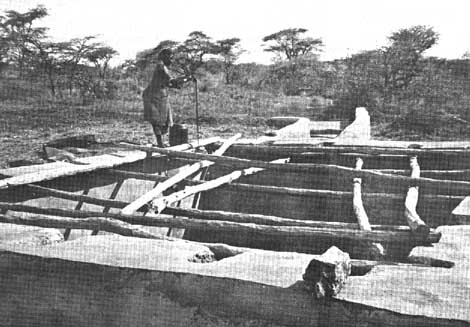
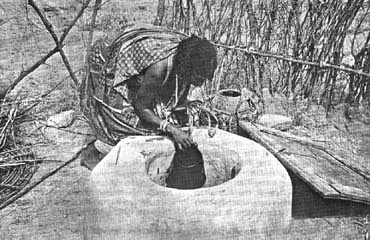
Construction aspects: Cisterns were either: (1) large, rectangular-shaped water tanks (90000 to 150000-litre capacity) for encampments; or (2) smaller, vase-shaped water holes (up to 5000-litre capacity) for one or more households (Plate 7.1 a,b). The water tanks catch runoff from flat surfaces or large rocky shelfs while water holes were to be filled from runoff or manually Using containers to transport water from nearby ponds in wet seasons, i.e. using water otherwise lost to evaporation and seepage. Cisterns can have roofs (for the tanks) or lids (for the holes) made from local materials that reduce evaporation and fouling of water. The water tanks also have a cement channel and silt trap that funnel and hold water before it spills into the tank; water holes may also have these. The idea that water holes could be an appropriate intervention came from observations that women were filling underground grain stores (promoted earlier by CARE-Ethiopia, with hand-carried water (R. J. Hodgson, CARE-Ethiopia, personal communication).
It took several years to improve the design and minimise cracking of both types of cistern (Tesfaye Wogayehu, 1990). Materials required for a large water tank (with dimensions of 5 × 4 × 4 m) include about 50 kg of cement, clean sand, stone, nails, water and chicken wire. The size of a water tank is determined by the length of the warm dry season (typically 90 days), number of families in the targeted encampment(s) and daily water requirements per family (10 litres) and per calf (4-5 litres). An excavation is made in which an initial and final layers of pure cement sandwich five layers of a cement/sand mixture on the walls and floor. After three layers of a cement/sand mixture have set, one layer of chicken wire is nailed to the walls upon which the last two layers of cement/sand mixture are applied. Stone can replace chicken wire if necessary (Hodgson, 1990: p 31). Depending on the size, the total cost of materials, transport and masonry work for a tank ranges from EB 2300 to 3000, roughly the equivalent of selling six to eight bulls.
More details are provided in Tesfaye Wogayehu (1990). This information is reported here only to illustrate the complexity of construction. Once properly built the structure can last for many years with minor maintenance. CARE-Ethiopia has trained locals to undertake masonry work, but the degree of skill required is considerable. In contrast to water tanks, water holes require much smaller amounts of construction materials. Layering of the walls is similar to that for water tanks (Tesfaye Wogayehu, 1990). The cost for the holes is also much cheaper, less than ED 200.
Social and economic implications: Initial experiences in extending the use of cisterns have been reported by Hodgson (1990: pp 30-34, 40, 45). The philosophy is to prioritise those encampments over 20 km from the deep wells as they would be under particular stress in terms of this distance women and calves have to walk to get water in dry seasons. By 1990 less than 10 water tanks and a couple dozen water holes had been built or were on order (D. L. Coppock, ILCA, personal observation).
The first people interested in water tanks were wealthier Borana entrepreneurs and they were implemented as community demonstrations. Female heads of poorer households were able to have water holes built (D. L. Coppock, ILCA, personal observation). Initial problems revolved around subsequent attempts to privatise the water. Some of the new owners of water tanks and holes tried to sell water, a violation of Borana tradition that elicited complaints. This has subsequently been solved to a large degree by promoting community ownership of water tanks. The poor contribute labour in the construction while the wealthy donate cattle to be sold to finance costs (Coppock, 1990a). Everyone who participates thus gains access. The large size of the tanks and increased likelihood of communal use makes these the priority intervention (C. Fütterknecht, CARE-Ethiopia, personal communication).
Rather than donate cattle to build water tanks on a charitable basis to help ease the workloads of women in hauling water, it appears as though the motives of wealthy men in these projects are more to acquire status associated with the construction of a large semi-permanent structure that may be named after them (C. Fütterknecht, CARE-Ethiopia, personal communication). This fits with traditions of well and pond building (see Section 2.4.7.1: Water resources) and with the fact that encampments are also named after the influential aba olla (encampment "fathers"). Water tanks may thus give an outlet for those men of high or intermediate wealth for whom there are not enough status-giving community projects to contribute to.
The concern that the people would be unable or unwilling to pay for the water tanks was dispelled by findings of an external review team. The apparent willingness of the wealthy to translate animals into this novel form of prestige and influence is important in promoting increased livestock marketing and monetisation, in the society. This apparent willingness to translate cattle assets into a physical structure may be related to the increased management risks associated with the high-density phase of the cattle population during 1989-90 (see Section 7.4: Component interventions and system dynamics). With an average of seven head sold per water tank, there are significant local implications for destocking. The major constraints in meeting the high demand for cisterns are the difficulties in procuring construction supplies and perfecting construction techniques to minimise cracking Fütterknecht, 1990).
The main questions that remain in this regard are whether or not cisterns will be incorporated into the broader reciprocal patterns of resource use among madda, how user rights are transferred over time among different individuals, or what implications this has for increased sedentarisation of the population. In a survey of 67 encampments throughout the central plateau, Menwyelet Atsedu (TLDP/ILCA postgraduate researcher, unpublished data) noted that the Boran felt they were more sedentary compared to the past and that this was largely due to the attractions of roads and markets. It is unclear if increased sedentarisation of households is undesirable in normal rainfall years. The regular attempts of madda residents to try to regulate grazing pressure (D. L. Coppock, ILCA, unpublished data) indicate that sedentarisation is manageable as long as labour and land are sufficient to allow forra herds to move out of the area when necessary (see Section 5.3.1: General aspects of cattle management). Indeed, water tanks could be very beneficial because they could allow more families to reside in sites of lower grazing pressure further from the deep wells (Hodgson, 1990: P 30)
Implications for labour, water use and herd productivity: Coppock (1992a) reported a study of the effects of water tanks on women's time allocation, water procurement efficiency and household water use based on an analysis of 64 households during the warm dry season of 1990. Data included: (1) direct observation of 32 married women who had access to cisterns and 32 who did not on a 24-hour basis for one week (distributed over two months); and (2) nightly household interviews to quantify daily water budgets based on recall. Water tanks were located within 1 -km distance from households while wells were within 7 km. Time for collecting water included walking and drawing water. Collecting water was undertaken for household use and calves. Women carry water in 20-litre jerry cans on their backs. One hypothesis was that access to a water tank would have dramatic effects in reducing the time women spend collecting water and a major result would be that women, freed of excessive water-collecting duties, would use their newly acquired time in other productive activities (see Section 4.3.3: The labour of married women). Another hypothesis was that water use by households and calves with access to water tanks would increase over those with no access to water tanks. Data were analysed using a factorial ANOVA (time budgets) or t-tests (water budgets); results are briefly highlighted here.
It was surprising to find that water tanks had only a nominal effect (P<0.05) on time women spent collecting water each week. An average of 3.6 in/woman/week was spent collecting water if they did not have access to a water tank, while those with access spent 3.2 in/woman/week. This suggests that the time women spent collecting water in dry seasons was greatly over estimated, even though this was based on many pre-trial interviews of women (Mulugeta Assefa, 1990).
The paradox of insignificant time savings accruing to women with water tanks was due to the fact that they collected water twice as often. Women with water tanks also appeared to draw water in a more leisurely fashion. Overall time budgets of women in the two treatments did not appreciably differ. Women were active some 16 in/day dominated by leisure (33%), general household management (31 %), water collection (12%), milking cows (7%), child care (6%), other livestock management (5%) and firewood collection (4%). Women with water tanks, however, drew water twice as efficiently as those without access (42 vs 20 litres/hour worked). Water budgets are depicted in Tables 7.1 and 7.2. Families with cisterns collected about 72% more water than those without and the increment largely went to calves, not people. This may have increased calf water intake from 8 to 26 litres/calf/week, and could have been significant in terms of promoting higher intakes of forage also. This could be significant in mitigating calf mortality (Coppock, 1992a: see Section 7.3.3.5: Calf mortality mitigation).
Table 7.1. Volumes of water (litre/house/hold/week) procured by members of 64 Borana households curing the warm dry season (January and February) of 1990.1
|
Water source |
Treatment group |
|||
|
Traditional |
Traditional plus access to cistern |
|||
|
Mean2 |
SE |
Mean2 |
SE |
|
|
Deep well |
39x |
9.4 |
2y |
1.1 |
|
Spring |
12 |
3.4 |
- |
- |
|
Pond |
14x |
5.8 |
4x |
2.5 |
|
Runoff |
6x |
2.3 |
8x |
3.9 |
|
Neighbour |
7x |
2.1 |
<1y |
0.2 |
|
Cement cistern |
- |
- |
120 |
7.4 |
|
Total |
78x |
8.9 |
134y |
7.6 |
1 Data include water transported to the hut and used at the source as reported in nightly group interviews. Water procured at the source may have been estimated less accurately. All means may be divided by 3.9 to obtain litre/person/week.2 Means within a row accompanied by the same letter (x, y) were not significantly different (P>0.05) in t-test comparisons (N = 32). Entries in which zero liters were recorded could not be included in statistical tests.
Source: Coppock (1992a).
Table 7.2. Volumes of water (litre/household/week) used by members of 64 Borana households during the warm dry season (January and February) of 1990.1
|
Water use |
Treatment group |
|||
|
Traditional |
Access to cistern |
|||
|
Mean2 |
SE |
Mean2 |
SE |
|
|
Drinking |
5x |
0.7 |
7x |
0.8 |
|
Washing body |
5x |
0.6 |
6x |
0.8 |
|
Washing clothes |
6x |
1.7 |
7x |
1.3 |
|
Washing utensils |
4x |
0.8 |
4x |
0.9 |
|
Cooking3 |
25x |
3.5 |
26x |
2.8 |
|
Donating4 |
10x |
2.0 |
9x |
1.4 |
|
For calves |
23x |
4.9 |
75y |
5.9 |
|
Total |
78x |
8.9 |
134Y |
7.6 |
1 Data include water used at the hut and the source as reported in nightly group interviews. water used at the source may have been estimated less accurately. All means may be divided by 3.9 to obtain litres/person/week.2 Means within a row accompanied by the same letter (x, y) were not significantly different (P>0.05) in t-test comparisons (N = 32).
3 Includes making maize porridge, tea and coffee.
4 water given away to friends and relatives. This was similar to volumes procured from friends and relatives in Table 7.2.
Source: Coppock (1992a).
The high interest of the Boran in the water tanks belies some of the research results. The Boran believe that water tanks reduce time needed for collecting water and this is an important reason for their strong interest in this intervention. The effects of water tanks on women's work efficiency and organising their daily work load, however, may be more important cues than time savings per se. Water tanks would probably also confer a great benefit by reducing women's time for having water if households are located further than 7 km from the deep wells. Results also suggested that the impact of water tanks may be greater on calves than people through increased water intake. People were very conservative with water from the tanks because they knew that it was a finite supply, and they did not know how long the dry season would be.
Other economic implications: Mulugeta Assefa (1990: pp 46-105) studied the water-tank intervention in the context of improved calf management for households over a 10-year production cycle using a herd-modeling approach. It was assumed in the analysis that improved water intake would occur for calves that had access to water tanks and that this was a key component in the mitigation of calf mortality (Coppock, 1989b). The cost/benefit analysis suggested that use of water tanks should be highly profitable in the long term given the above assumptions. This analysis is described further in Section 7.3.3.5: Calf mortality mitigation.
Other aspects of water development
CARE-Ethiopia and SORDU have engaged in other minor forms of water development on the Borana Plateau. These experiences are reviewed in Hodgson (1990).
In sum, large and small-scale water development has involved many projects and has generally been successful. This success is due in large measure to the perception of the Boran that reliable water resources are crucial to their survival. To what extent, however, the pond programme is sustainable and to what degree ponds have contributed to stabilisation or destabilisation of the system during the past 15 years remains unclear. The cost-sharing philosophy for ponds, wells and cisterns will help identify projects most important to the Boran and encourage livestock offtake and monetisation, in support of improvements in human welfare.
One remaining question on the use of cisterns involves how they could contribute to sedentarisation and local environmental degradation. This can only be addressed through research. For the pond and well programmes the most effective approach is to orient them towards use of heavy machinery and discount the notion that animal traction will ever be a crucial input. The only exception to this would be if animal traction could be marketed as a consumer service; not as something that requires herd owners to sacrifice their own animals for. Cement, shovels and similar technologies are the most important for uptake by the Boran. Access to these is most constrained by the external economy while access to foreign exchange is the ultimate constraint against using heavy machinery. External factors thus may exceed internal factors as root causes of underdevelopment on the Borana Plateau (see Chapter 8: Synthesis and conclusions).
The large-scale water interventions are essentially extensive improvements. The availability of new land for water development, however, has rapidly declined (Solomon Desta, TLDP economist, personal communication). Lack of space may now provide some incentives to the Boran to engage in more intensive activities for range management including aspects of controlled grazing. Some of these perspectives are treated in this section.
The traditional system
As reviewed in Section 2.4.1.7: Water resources, the wells are the critical resource on the Borana Plateau to which access is largely gained through the descent system. Although traditionally no herd owner may be verbally denied access to a given grazing area or madda, rules governing the use of wells can provide some de facto control over access to grazing, especially in times of stress (Bassi, 1990: p 263; Hogg, 1990a; D. L. Coppock, ILCA, personal observation). Even if a herd owner gains access to a new well during time of stress, his herd may be relegated to being last in the watering queue, and rather than water his animals late in the day or at night, he may be forced to go elsewhere (Bass), 1990: p 272). Wealthy and influential men with large herds can also be denied well access if doing so would compromise other but more indigenous users (M. Bassi, Institute of Ethiopian Studies, personal communication). Traditionally, cattle are crudely inventoried in terms of 200-head groups, considered to be the maximum size for herding control (D. L. Coppock, ILCA, personal observation). If a herd owner has two of these groups or less, the community will provide labour for watering. If the herd owner has more animals than this, he must provide his own labour to water the increment above 400 (D. L. Coppock, ILCA, personal observation).
The Borana social system shows a high degree of egalitarianism and this has a great beefing on resource sharing (Asmarom Legesse, 1973; Bassi, 1990; Hogg, 1990a). The pattern of de facto boundary enforcement of madda as mediated by water access, however, appears to be in contrast to some observations to the effect that territorial boundaries seem to disintegrate in a "free for all" when other aspects of the pastoral system are under stress (Helland, 1980a). While the Borana system may superficially appear to be managed as a "grazing commons", this may be more the case within certain madda than among all madda in general. Even within madda there are other subtle means of allocating grazing resources (below). Considerable internal stress can occur when madda are perceived by residents to be overstocked.
The problem today, however, is that there are fewer fallback options outside of the home madda because of a general increase in the population (D. L. Coppock, ILCA, unpublished data). The "tragedy of the commons" model, with inevitable misuse of resources by pastoralists, appears too general for practical application here as elsewhere (see Feeny et al, 1990). Here it is more a case of human overpopulation leading to a breakdown of the traditional regulatory processes that constitutes the main threat to sustainable resource use, not that traditional regulations were never in place (see Chapter 8: Synthesis and conclusions).
Hogg (1990a) described the traditional territorial organisation of the Boran which still exists today. Madda are regional grazing areas associated with well group(s); there are some 35 madda on the central Borana Plateau (see Section 2.4.1.7: Water resources). Madda can be composed of sub-units called deda which are grazing areas customarily used by clusters of neighbouring encampments (olla). Non-residents of these olla however, may also use the deda on occasion. Council meetings are held to discuss aspects of deda management, including demarcation of wet and dry-season grazing areas. Deda residents must obey rules set down by the council. Deda, not madda, are thus the fundamental grazing management units (Hogg, 1990a). Hence Deda are the appropriate unit to consider when it comes to traditional grazing management practices and whether interventions are feasible.
Recent crisis and innovation in the traditional system
Deda and forra management
Increased populations of people and cattle have served to first undermine the forra (satellite) grazing system for cattle (see Section 6.4.5: Equilibrial versus non-equilibrial population dynamics). Traditionally, forra herds would be moved out of their home madda soon after the long rainy season to exploit underutilised areas elsewhere. Out of some 35 madda, roughly seven have been traditionally used by others as fallback forra regions in addition to their role as home madda for their residents. These madda typically have reliable deep wells that function during droughts, and include Burbur (or Borbor), Das, Dubluk, Gayo, Goray, Medecho and Web (see Figure 2.10). The availability of these sites for forra in the late 1980s had been reduced by the growth of the resident population because of immigration of new residents from nearby madda that were overcrowded (D. L. Coppock, ILCA, unpublished data). As one response to this crisis, the leadership of the Dubluk madda decided to prohibit entry of nonresident (forra) herds in 1989. Emboldened by this a similar action was taken by six other forra madda shortly thereafter. An uproar ensued and the Gumi Gayu council, the supreme decision-making body (see Section 2.4.2.2: Some cultural and organisational features), declared that closure of traditional forra madda was unlawful and insisted they be re-opened. The leaders of the forra madda had to comply with this ruling and re-open them (D. L. Coppock, ILCA, unpublished data). It is noteworthy that the crisis of 1989 ensued during the high-density phase of cattle population (see Section 7.2.3: Anticipated short-term cycles). No such crisis was perceived during the drought-recovery phase of 1985-88. Land tenure crises are thus hypothesised to be more of a cyclic, rather than permanent, feature of Boran society (see Section 7.4: Component interventions and system dynamics). The frequency of such crises, however, may now increase because of growth in the human population.
Another response to increasing pressure has been to accomodate both warra (home-based) and forra cattle herds within madda for a longer period each year. Traditionally, madda reserved certain restricted local sites for year-round forra grazing, but these were rarely used. They were often symbolic in nature (D. L. Coppock, ILCA, unpublished data). Some madda residents have responded to increased population pressure by devising innovations in land use and these provide illustrations of how creative thinking can help alleviate grazing problems.
The residents of Gobso madda (Figure 2.10) received recognition from the local government administration in the late 1980s for their new grazing system. The former and current systems are depicted in Figure 7.4 (a,b). The former system was based on warra grazing throughout the year in the vicinity of the deep wells with forra animals being sent outside. This resulted in year-long heavy use of vegetation within the grazing orbit of the wells. The need in recent years to accomodate more people and animals has led the residents of Gobso to dig new ponds away from their existing deep wells so as to gain access to underutilised grazing; these ponds augmented one original pond constructed by SORDU (Figure 7.4b).
Figure 7.4. Schematic depiction of changes in grazing resource allocation for Gobso madda in the southern rangelands during the mid- and the late 1980s. - Old system
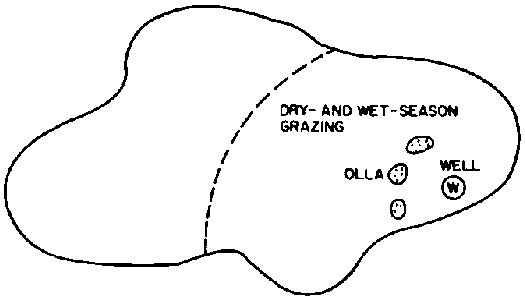
Figure 7.4. Schematic depiction of changes in grazing resource allocation for Gobso madda in the southern rangelands during the midand the late 1980s. - New system
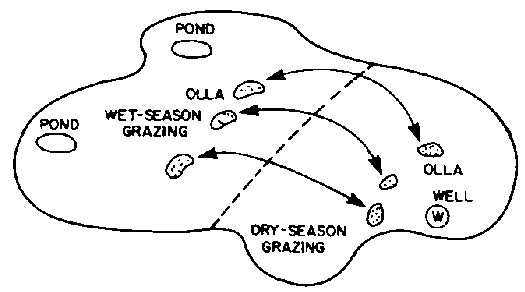
The high utility of these new ponds has led to increased mobility in the madda. Residents now live in the region with ponds during the wet seasons and retreat to the region near the wells in the dry season; with this the vegetation has benefited from a wet season with no grazing. The families maintain encampments in both regions and these are thus vacated for part of the year. Furthermore, the two wet and dry-season regions have been subdivided into warra and forra zones to accomodate forra cattle throughout the year; the madda as a whole is thus divided into four large blocks (Figure 7.4b). This last aspect of the system reduces major uncertainties of forage supply that may otherwise be caused by continuous grazing. Some rest for the vegetation is provided, but the four blocks are not rotated according to seasonal use because of the fundamental problem of uniform water access in the dry season.
The residents of Gobso madda have shown ingenuity in improving their grazing system at the deda level of resolution. Further detail improvements such as rotation grazing may have a scope for implementation in the future but this would probably be influenced in a dynamic fashion by the proposed interdrought cycle (see Section 7.2.3: Anticipated short-term cycles). During the herd-recovery phase no further grazing management is likely required because cattle density is lower. During the high-density phase, however, some aspects of rotation grazing may be implemented when the system is heavily stocked.
In drier pastoral systems, de facto rotation grazing may be practiced simply because of the variable distribution of rainfall; for example herds tracking patches of green-flush may not hit the same patch in successive years. In the Borana system, high population densities and the relatively reliable rainfall give a higher probability that sites are grazed on an annual basis. Thus, while the Gobso example provides an impetus for improved grazing management, it may still ultimately be limited by the spectre of range degradation from heavy grazing of wet-season areas. Again, this would be most likely in the high-density phase of cattle population and particularly if rainfall is slightly below average (see Section 7.2.3.1: Range ecology).
Plants may be most suceptible to heavy use by livestock during wet seasons (Pratt and Gwynne, 1977: p 112). In contrast, heavy grazing during dry seasons may have little permanent effect on vegetation that is largely dormant. Thus, without implementation of rotations, it is necessary that the wet-season grazing area be relatively large in relation to the number of animals and the size of the dry-season grazing area (Pratt and Gwynne, 1977: p 114). In a review of temperate-zone recommendations, Pratt and Gwynne (1977: p 95) noted that removal of standing biomass should not exceed 50%. It is likely that grazing pressure in Borana commonly exceeds this, especially in the high-density phase of the cattle population (D. L. Coppock, ILCA, personal observation).
The ultimate grazing management problem then becomes how to implement grazing rotations under conditions of high population density and the lack of an even distribution of a permanent water supply. Pratt and Gwynne (1977: pp 112-120) give a number of examples of rotational schemes based on two to five blocks, with the general objective to rest at least one of the blocks on successive years. Such approaches are appropriate to ranches, but would have to be significantly modified to accomodate constraints in a pastoral system. The target area may have to be restricted to wet-season areas only and the proportion of land rested each year would have to be small because enlarging them would endanger human welfare over the short term. Herlocker (1986: p 29) reported that for development of Somali grazing areas (degaans), the land area to be rested each year was on the order of 10%, but this was also considered flexible given the variable conditions in different degaans. Despite initial resistance, this plan was reportedly accepted and provided another benefit in terms of a dry-season forage reserve (Herlocker, 1986: p 29).
At another level of resolution, the degree of rest for vegetation during the wet season can be altered from rest-rotation (complete protection) to deferred-rotation, in which use is delayed until seed-set is assured (Heady, 1975). It is speculated that some form of deferred-rotation grazing, with land area on the order of 15% or less, may be applicable for extension to some situations on the Borana Plateau, especially during the high-density phase of the cattle population. Implementation would need to be highly flexible in recognition of the differing resources of madda (see Section 3.3.1: Ecological map and land use), and the residents' having to feel some acute pressure on resources in order for them to be interested. In contrast, the drought-recovery phase of the cattle population presents a natural period for resting vegetation and the effect of the rest would depend on the chance that rainfall during this time is above or below average (see Section 7.2.3.1: Range ecology). Middle-level grazing management such as this on the Borana Plateau has received insufficient attention from research or development. It may be that some forms of a rotational system are already in use during the high-density phase and these should be examined. More case studies of grazing management in madda are required and this should be a high priority.
Kalo and their management
Hogg (1990a) reported that the deda grazing units are further subdivided into ardha (localities), populated by olla (encampments). It is at the encampment level that kalo reserves have been recently carved out of the traditional system and reserved for use by livestock owned by olla residents. Kalo are the ultimate form of land annexation in the Borana system.
Kalo were studied by Menwyelet Atsedu (1990: pp 10-53). Two surveys were conducted in 1988 that included 67 encampments in six madda. Information was collected on the incidence, history, physical features and management of kalo. Other studies were undertaken to assess the effects of kalo on vegetation, results are reported in Section 3.3.3: Short-term vegetation change.
Survey results were interpreted to indicate that the idea for kalo originated from the agropastoral Gujji to the north of the study area. Kalo have been used on the Borana Plateau during the past 20-30 years, and in part this was stimulated by local government administrators. Virtually all surveyed encampments had kalo (Menwyelet Atsedu, 1990). The average age (6.4 years) of kalo was similar to that for the encampments they served. Some (26%) were older then 6.4 years and passed from one nearby encampment to the next over time. Kalo averaged 12 ha in size, with a range of 1-80 ha. If they were less than 5 ha, they were commonly bush-fenced; larger ones were more typically delineated by natural features and protected by decree. Kalo size was determined by the number of young or sick calves anticipated in the coming year for a given encampment as well as by the local forage conditions. If conditions for a given year are expected to be poor, kalo are expanded in size. Most kalo were located on flat land or gentle slopes. These sites commonly had deeper soils and more productive vegetation.
Olla residents all participate in kalo site selection, although the leader (aba olla) has a particularly important role in the final decision. When and how to use kalo is also decided in a similar fashion. Calves may graze kalo in wet seasons when they are at least two months old. In the dry season, however, such young animals are handreared in the home (see Section 5.3.1: General aspects of cattle management) but cut-and-carry forage for them is often collected in the kalo. The main period of use for kalo is the warm dry season and, besides calves, older or sickly milk cows and small ruminants may be allowed access. The most important grasses in calf diets during the dry season obtained in kalo were ranked by Borana respondents as Pennisetum spp, Cysopogon sp, Cenchrus ciliaris and Cynodon sp. Shrubs such as Pappea capensis and Grewia spp were also regarded as important (Menwyelet Atsedu, 1990; see Table B9, Annex B).
Menwyelet Atsedu (1990: pp 43, 4546) studied implications of kalo for the diet quality of grazing calves in the dry season of 1989. Grazing trials were conducted on and off five kalo. The feeding behaviour of four Boran calves was observed in each site for 1.5 h. Bites of all forage were recorded as to plant species and plant part as in Coppock et al (1986b) and forage samples were analysed for nitrogen, in vitro digestible dry matter (IVDDM), fibre fractions, and ash according to procedures of Van Soest and Robertson (1980). Diet composition was calculated based on bite frequency and bite size (dry-matter basis). The nutritive value of diets was estimated by multiplying forage-specific chemical values times the amount of the respective forages in the diet profile to obtain weighted averages (Coppock et al, 1986b). Data were analysed using an ANOVA; and the hypothesis was that diets in kalo would be nutritionally superior to those outside because of a greater diversity of higher quality forages inside kalo, due to protection from continuous grazing.
Results indicated that while calf diets did not differ (P>0.05) between on and off-kalo sites in terms of total bites, bites per minute, or per cent of stem, they did differ (P<0.05) in terms of per cent of leaf in diets, which was greater on kalo than off. This, however, did not translate into a significant difference in diet quality (P>0.05). It was concluded that the major effect of kalo was to provide a higher standing crop of forage for the dry season. In terms other than biomass they did not have any substantial nutritional advantages for calves.
In terms of social control of kalo, Menwyelet Atsedu (1990: p 20) reported that Borana regulation requires a fine of EB 50 to 300 for unauthorised use, but this rarely needed to be enforced. Warnings were more common. In one instance, however, a serious altercation among herd owners over unauthorised use of a kalo was reported in the Dubluk madda in 1989 (D. L. Coppock, ILCA, personal observation).
The emergence of kalo on the Borana Plateau is consistent with recent patterns of protected pastoral lands in Syria (Draz, 1978), Kenya (Oba, 1987; Grandin, 1987), Somalia (MASCOTT, 1986: p 95) and the Sudan (Behnke, 1985). This is considered as a means to protect and conserve local resources under threat from increasing populations. Other interpretations have been made, however, that consider fodder reserves as traditional innovations with implications for improved health management of livestock (G. Perrier, Utah State University, Utah, USA, personal communication). Kalo have become most prominent in madda such as Dubluk and Gayo under threat of internal population growth as well as from forra herds of nonresidents (see previous material in this section).
Menwyelet Atsedu (1990: pp 27-28) concluded that kalo may provide an opportunity to implement forage improvements. While there is a chance that some interventions could be appropriate, it is more likely that these would involve low-input activities consistent with labour constraints such as prescribed burning (D. L. Coppock, ILCA, personal observation). It is less likely that introduced herbaceous legumes would be successful (see Section 7.3.1.3: Forage improvements). This is principally because of the high competition from indigenous species (e.g. Pennisetum spp) on deeper soils, high-management inputs required for establishment and poor performance of exotic pasture legumes in the region to date. It must be remembered that the purpose of kalo is to reserve an increased standing crop of forage for the dry season. Cutting or trampling measures needed to establish new forages early in the wet season (see Mohamed-Saleem et al, 1986) could compromise wet-season forage production and thus bring increased risk for the utility of kalo later in the year (D. L. Coppock, ILCA, personal observation).
The idea that the kalo site could be rotated each year, and thus serve the two purposes of resting wet-season grazing areas (above) and as fodder reserve, is attractive. However, Menwyelet Atsedu (TLDP/ILCA postgraduate researcher; unpublished data) found resistance to this concept because kalo are usually located in the most productive and accessible locations. Changing kalo location from year to year thus incurs risks; i.e. in the event that a poor site is demarcated as kalo for a year in which there is a drought the people could be worse off. It was thought also that degraded pond catchments could be good candidates for kalo as protection would create a fodder reserve and at the same time reduce erosion into the pond (see Section 7.3.1.1: Water development activities). The Boran indicated, however, that this is not feasible: Ponds are used in the wet season when forage is abundant; when the dry season comes the people and calves are taken to the vicinity of deep wells and it is inconvenient to return them to the pond area for grazing (Menwyelet Atsedu, TLDP/ILCA postgraduate researcher, unpublished data).
Destocking
Synopsis of the Borana situation: Range planners are commonly preoccupied with the idea that communal pastoral systems need to be routinely destocked to preserve the environment (Sandford, 1983a). This concept has been mentioned in recent SORDU plans for monitoring range trend. When range trend is observed to be declining from transect surveys in a given madda, facilitation of local destocking is offered as one solution (Hacker, 1988a).
Even if destocking were unanimously regarded as a wise strategy for the southern rangelands (it is controversial; see below), how this would be accomplished is another matter. During the 1980s the Boran reportedly preferred to sell cattle to Kenya on the black market because they received a much higher price than in Ethiopia. It is argued elsewhere (Section 4.4.4: Traditional marketing rationale) that one reason households sought higher prices in Kenya was to reduce the number of cattle they had to sell over the long term, thus giving them a better chance of building their herds. Cattle prices within Ethiopia were regulated and low until 1990, and buyers were mostly government agents whose difficulties in procuring cattle at low prices were widespread (see Section 1.4.4: Has national range development been successful?).
Perhaps the biggest impact of this practice on cattle were registered when the socialist government attempted to periodically fill large demands of cattle in attempts to provide beef for the military, then one of Africa's largest with over 250000 soldiers. Each Pastoral Association (see Section 1.4.3: The SERP and the Pilot Project for a review of PAs) had a quota to fill from among its members, by selling cattle for the low prices offered. This resulted in particularly poor public relations with the Boran (Hodgson, 1990: p 54).
In sum, there have not been large incentives for the Boran to destock even if they had an inclination to do so. The prospects are, however, that cattle offtake will increase as the Boran are forced to buy more grain in the future (see Figure 7.2). In addition, there have been no attempts by the government in the 1980s to destock the southern rangelands in the name of conserving the environment. It is doubtful that there has ever been such an attempt.
While ecological research suggests that the central Borana Plateau has been degraded in terms of bush encroachment and soil erosion (see Section 3.4.2: Environmental change), it is speculated that much of the change due to bush encroachment is reversible with a wise plan of prescribed burning and if grazing is regulated at the deda level of resolution (Section 7.3.1.4: Site reclamation). A more serious environmental problem, however, may involve opportunistic cultivation, which is a response to too few cattle on a per capita basis (see Section 4.4.1.1: Pastoralism and cultivation). Even if stocking rates could be linked to degradation of range productivity, the cyclic pattern of impact resulting from fluctuations in the livestock population would make this trend hard to detect (see Section 7.2.3.1: Range ecology). In other words, while a long-term negative trend in range productivity may exist, it would be obscured by post-drought periods of low cattle numbers and improving range trend, followed by high-density phases of declining range trend. This is hypothesised to be the reason Pratt (1987a) judged SORDU to be in "reasonable" range condition in 1987 (unknown to him this was the drought-recovery phase) while Hacker (1990) concluded SORDU range was in poor condition in 1989 (being in the high-density phase). And yet both are experienced professionals who surveyed sites in the same regions. The guiding philosophy on range trend should be to what extent post-drought recovery of vegetation cancels out deleterious trends that result from the previous high-density phase (see discussion of Walker et al (1987) below). To a large extent this depends on rainfall in the drought-recovery phase, and thus is a probabilistic phenomenon; i. e. sometimes drought-recovery will reverse earlier trends and other times it will not (see Chapter 8: Synthesis and conclusions).
Destocking is universally and fiercely resisted by pastoralists. That is because in reality there are always fewer and fewer "surplus" animals per capita to supply milk or wealth creating capability so that destocking means increasing poverty and risks for survival. In other words, there are everywhere too many people living in an already marginal situation and land scarcity does not allow increases in herd inventory. Borana leaders acknowledge that the central plateau is overstocked during high-density phases and they associate this with bush encroachment, lower cattle productivity and a declining welfare of the society (see Section 3.3.5.2: Household use of plants and pastoral perceptions of range trend and Section 6.3.3: Drought effects in 1990-91).
The problem is that for the vast majority of the population there is no alternative but to suffer perturbations and hope that a string of favourable rainfall years will minimise their difficulties. Most are unable to leave the system. Madda residents may argue among themselves in the high-density phase about possible actions to take to conserve resources (see below) but the declining availability of fullback areas limits their options (D. L. Coppock, ILCA, unpublished data). The Boran say that either such problems need to be solved by the next generation of leaders, or they be provided with government assistance to help them regulate aspects of resource use that the Boran culture is unable to impose upon itself. Imposition of some aspects of resource regulation has been reported as one favourable attribute of the former PAs implemented by the socialist government until 1990 (Solomon Dessalegn, TLDP/ILCA postgraduate researcher, unpublished data).
An increasingly acute "boom and bust" cycle of the cattle population could now be anticipated about every five to ten years in which milk production is chronically compromised and animal assets are needlessly lost (Section 6.4.5: Equilibrial versus non-equilibrial population dynamics). This could be partially remedied by an alternative investment scheme for the middle class and wealthy whereby livestock assets are translated into status-giving community projects and/or banked in the form of simple savings accounts (see Section 7.3.3.6: Cattle marketing). Only in this context could destocking be pursued as a positive intervention because it still permits economic growth and attainment of social status for individuals despite increased population pressure.
It has been hypothesised social attitudes regarding enforcement of resource-use regulations among the Boran will exhibit cyclic patterns depending on cattle density (see Section 7.2.3.4: Marketing of livestock products and Section 7.2.3.5: Land tenure). Research surveys and development experiences have indeed revealed important cyclic change in the attitudes of the Boran towards destocking (D. L. Coppock, ILCA, unpublished data). For example, during the drought-recovery phase it is anticipated that attitudes toward selling cattle will be very conservative and consistent with herd-building objectives. Some animals that have to be sold are done so to satisfy immediate cash needs. All will try to sell milk or small ruminants instead of cattle if possible, but the poor will be forced into selling more cattle because of a lack of any other option (Coppock, 1992b). In the high-density phase the picture is probably different. Poorer households-will still behave as before, but wealthier herd owners may be far more inclined to dispose of some cattle. This is not related to any need to purchase food or clothing, however, but rather as implicit recognition that density-dependent factors are causing a decline in cattle productivity and increasing risks of possible losses in their inventories. In addition, the high-density phase is a time of increased social pressure on the wealthy to destock excess animals so that the milk cows of poorer households can find adequate forage (D. L. Coppock, ILCA, personal observation).
Selling livestock merely for the sake of cash is inconsistent with Borana culture and the practical desires of herd owners to maximise their size. Although it is getting increasingly difficult to maintain a large herd Borana men still aspire for large holdings that in turn increase their wealth, status and political influence (Coppock, 1992b). During the high-density phase it appears that wealthier herd owners are more inclined to destock if they can transfer this form of animal wealth status to one of patronage to a popular community project (D. L. Coppock, ILCA, unpublished data). They thus can sell an animal, ingratiate themselves with their peers for destocking and retain some of the money. Of course, the real benefits that accure to a benefactor of an important project are both social prestige and future access to resources. Certainly these returns in sum are by far greater than losing the animal to density-dependent factors or sudden drought.
Examples of this behaviour in the high-density phase of 1989-90 are numerous on the Borana Plateau. Roughly EB 20000 was collected from herd owners in the Did Hara madda to desilt a large pond, and this was obtained from cattle sales. Bassi (1990: p 275-276) reported that EB 3265 was collected to repair a well at Dubluk madda and other contributions of money for projects have replaced traditional donation of animals to be slaughtered for food at work sites.
Showing the risks of cattle keeping by wealthier herd owners in the high-density phase may convince them of alternate and more secure forms of investment safeguard against risk. The recent interest towards opening bank accounts in Yabelo by some wealthy herd owners is a critical finding in this respect and will be reported in detail in Section 7.3.3.6: Cattle marketing.
Other views on destocking: It is important to note that investigators commonly question whether destocking is worthwhile to pastoral systems. Sandford (1983a: pp 38-43) distinguished between conservative and opportunistic strategies of pastoral livestock production. The conservative approach is to keep a constant number of livestock that could not damage the range during years of lowest rainfall while providing net primary production. The opportunistic approach is to adjust the number of stock up or down in response to variation in forage resources; this may involve timely (efficient) or tardy (inefficent) adjustments. While the conservative strategy has advantages during low-rainfall years (i.e. animal losses would be few and the environment would not be damaged), during times of higher rainfall surplus forage would go unutilised. An assessment of the higher probability of average and above-average rainfall years may indicate that there are great costs for a conservative strategy in terms of livestock production foregone. Sandford (1983a: p 40) illustrated this by a hypothetical example in which a conservative herd owner would produce from 17 to 42% less than an opportunistic herd owner under varied degrees of conservatism in relation to climate. Although the opportunistic strategy may show more livestock production overall, it more consistently threatens to degrade the environment, particularly if adjustments in animal numbers in relation to resources are inefficient.
This last point is critical in evaluating the relative balance of advantages of either strategy. If numbers can be adjusted at the right moment, and if there are no negative carry-over effects of intensive grazing to the future, the opportunistic strategy is probably superior overall. However, Sandford (1983a: p 41) noted that the range management argument is that under an opportunistic strategy livestock numbers are not adjusted properly and that negative carry-over effects on the environment do occur.
In conclusion, Sandford (1983a: pp 40-42) noted that: (1) pastoralists are neither entirely opportunistic nor conservative, but the tendency appears to be more towards the former; (2) the greater the variation in rainfall the greater the opportunity cost of conservatism; and (3) effects of the environment, livestock species, local economy and culture would all be expected to influence the balance of benefits and costs accruing to either strategy.
Abel (1990) and Abel and Blaikie (1990) have explored the consequences of destocking policies for southern Africa. Abel conducted a preliminary analysis of the costs and benefits of opportunistic pastoralism versus conservative ranching in central Botswana by parameterising a simulation model with livestock and soil data for an 11 -year run. It was noted that overall rates of energy output and the gross margin/livestock unit were higher in the ranching system but that energy output and gross margin/hectare were higher in the pastoral system (see Section 4.4.2: Economic comparisons among pastoral systems). The soil erosion resulting from opportunistic pastoral stocking was three times higher than that from ranches, which appeared to support the idea that environmental damage was a cost of opportunism. However, Abel cited Biot (1988) who had concluded that similar rates of soil loss for granitic landscape would not be expected to reduce herbaceous production for 400 years. Abel remarked in a preliminary conclusion that given this information, efforts to destock communal rangelands in Botswana would not be worth the social costs.
Walker et al (1987) studied wildlife population dynamics in response to drought in four conservation areas in southern Africa. The key issue was whether it was necessary to cull wildlife populations under the assumption that overuse of vegetation leads to a progressive deterioration in the habitat, or alternatively, were the habitats resilient enough to recover from overutilisation during periods of decline in wildlife populations due to drought? Conservation areas differed in ecological heterogeneity and management varied from heavy culling to no culling during periods of average rainfall. The dynamics were described for each in a comparative analysis. Drought intensity was similar for all areas. Walker et al concluded that pre-drought culling to preserve habitats was unnecessary if the herbivores had access to sufficient areas of reserved forage, but in instances where forage reserves had been eliminated by water development, pre-drought culling could prevent environmental degradation as well as catastrophic losses of animals during drought.
Relating these views to experience on the Borana Plateau, it must first be stated that the Boran in general appear to be opportunistic producers for social as well as biological reasons (Coppock, 1992b). Differences in behaviour, however, may occur especially among the wealthy in the drought-recovery phase (opportunistic) versus the high-density phase (conservative). Facilitation of incremental destocking among the middle-class and wealthy in the high-density phase is speculated (above) to be an important means to achieve efficient opportunism of production, reduce risk of permanent environmental degradation and reduce potentially wasteful losses of livestock capital. This strategy appears to capture the best elements of opportunism as outlined by Sandford (1983a). While the preliminary conclusion of Abel (1990) regarding the relatively minor costs of erosion is important, evidence from the Borana Plateau suggests that heavy grazing encourages bush encroachment, which likely occurs long before effects of erosion become evident. Even though some degree of bush encroachment is reversible, over the short to medium term it can reduce the utility of land (see Section 3.4.2: Environmental change).
Under these circumstances attention to destocking is warranted but better risk management for human beings is still the main benefit of creative destocking strategies. Experience among the Boran fully supports the perspectives of Walker et al (1987): the pre-drought occupation of forra areas by pastoralists fundamentally undermines the capacity of the system to adjust to future drought impacts (see Section 6.4.5: Equilibrial versus non-equilibrial popuation dynamics). Furthermore, if a high-density phase is long enough and rainfall is slightly below average, environmental degradation will be more likely to have a carry-over effect and undermine prospects for efficient recovery. Attempts to destock even incrementally during the high-density phase could provide safeguards against intense competition and density-dependent effects on cattle productivity and catastrophic herd losses in drought. Another useful, but socially difficult, strategy is to prohibit occupation of forra areas except in years of below average rainfall (Section 7.3.3.7: Mitigation of drought impact).
In summary, there is no reason to assume that the Boran have a vested interest in system sustainability beyond their immediate needs for asset accumulation and survival (see Swift, 1990). Destocking in the context of alternative investment is best justified in terms of system stabilisation to improve the immediate welfare of human beings. It is less justified in terms of promoting sustainability of the environment, which would be difficult to measure and is not as important a problem today as immediate human welfare (see Chapter 8: Synthesis and conclusions).
The next stage in the range management hierarchy is introduction of new forages. It is important that forage interventions may be very difficult to implement in semi-arid environments under communal grazing tenure. Strategies to introduce new forages tend to receive more emphasis than better grazing management in African national programmes. This is because grazing management appears more complex and falls within the realm of social change. Apparently simple technical solutions like planting forages are easier to conceptualise and appear to fall more in the domain of research and development programmes. This does not confirm, however, that forage introductions should be the priority over better grazing management. As noted by Pratt (1987a: p 30) if overgrazing is the problem, it will not be solved by planting something new. New forages will also be eventually exhausted. The high inputs to sustain forage introductions are thus best justified, and will yield more sustainable benefits, if they are within a framework of grazing control. Other constraints related to problems of labour and cultural values regarding improvement of forage resources on the Borana Plateau will also be highlighted in this section.
Compared to higher-potential zones, drier regions of sub-Saharan Africa present fewer options for intervention with exotic leguminous forages, either for herbaceous or woody perennials (Tothill, 1986). Pratt and Gwynne (1977: p 122) noted that most attempts to introduce legumes into East African rangelands have been unsuccessful (apparently including efforts by private ranchers). They mentioned that more trials on legumes were needed but in the meantime all that could be safely recommended is promotion of the best indigenous grasses. In the semi-arid zone the debate about whether to promote indigenous or exotic forages must be tempered by consideration of adaptation to local conditions, including competitive ability against local vegetation tolerance to pests, diseases and a high degree of environmental variability. Plant performance must thus ultimately be judged in terms of persistence, not merely dry-matter yield over the short term.
In their analysis of the ability of African savannah ecosystems to recover from environmental disturbances, Walker and Noy-Meir (1982: pp 584-585) highlighted some attributes of plant species that contribute to system resilience. These included higher reproduction rates under stress, increased net primary production at low levels of above ground biomass, large root reserves and complex seed-dormancy mechanisms. This illustrates the large role of evolution in shaping persistence mechanisms in successful species of indigenous vegetation and suggests that the chance that an exotic would persist in such an environment is likely to be poor. Even in developed range systems with a successful history of legume establishment, persistence of legumes can be threatened by biological and economic changes.
In their review of Australian experiences, Gramshaw et al (1989) variously implicated the reduced use of phosphorus fertilisers, overgrazing, land degradation, new diseases and expansion of cultivation in the decline of introduced pasture legumes; some of these trends were related to general changes in management practices as a result of the falling profitability of ranching since 1970. One other factor calling for a critical review is the presumed role of legumes in fixing large quantities of nitrogen in rangelands. Nitrogen fixation demands considerable energy and it is less likely 'that plants under stressful rangeland conditions would have much energy to spare. Farnsworth et al (1978) reported that the evidence for nitrogen fixation by legumes in drier ecosystems is often equivocal. They also mentioned, however, that possibilities exist for nonsymbiotic nitrogen fixation in the rhizosphere of non-leguminous, native range species.
Exotic herbaceous legumes
Screening and establishment in native rangeland vegetation: The experience to date for the screening and establishing forage legumes in rangeland vegetation in southern Ethiopia is largely based on a series of trials carried out by ILCA (Migongo-Bake, 1986), CARE-Ethiopia (Hodgson, 1990: pp 60-65) and Yohannes Alemseged (1989: pp 136-150). For the most part only summery points will be highlighted here. This is largely because no species or cultivar was viewed as offering outstanding possibilities (Hodgson, 1990: p 62), despite the average or above-average rainfall during the study period from 1985-89. More rigorous evaluation may also be required for firm conclusions to be warranted. In addition, whether because of modest performance or other reasons, the pastoralists have shown little interest in the introduction of species that only serve as livestock forage.
In a review of 10 screening and establishment trials, Hodgson concluded that the most promising lines (with growth form in brackets and in descending order of performance) were: Stylosanthes hamata cv Verano (prone); S. hamata #167 (prone); S. scabra cv Seca (erect); Cassia rotundifolia cv Wynn (prone); Centrosema pascuorum cv Bundy (prone); C. schottii (climber); Desmanthus virgatus (prone); Macrotyloma axillare (climber) and Desmodium discolor (erect).
Stylosanthes spp
Comments are warranted regarding S. hamata cv Verano which was consistently ranked among the best of some 20 forage species initially screened by Migongo-Bake (1986). These results, in conjunction with the availability of seed in Ethiopia, led to its evaluation in most establishment trials. Stylosanthes hamata is regarded elsewhere as an outstanding plant well adapted to drier production conditions (Williams and Burt, 1983). It has, for example, made an important contribution to the beef industry in Australia (Gramshaw et al, 1989: pp 15-16).
Methods of legume establishment reported in Hodgson (1990: p 61) followed the approach of Mohamed-Saleem et al (1986). Sixteen 0.25-ha sites dominated by native vegetation were bush-fenced near encampments at Did Hara, Medecho, Melbana and Web madda. The sites were subjected to grazing and trampling by confined cattle after the starting of the long rains in March 1986. This disturbance was intended to reduce potential competition. To judge soil chemical constraints, triple superphosphate was applied to half of each site (Migongo-Bake, 1986: see Haque et al (1986) for a review of the role of phosphate deficiency in limiting performance of legumes). Seed was scarified, innoculated and broadcast at a rate of 10 kg/ha within a week of site preparation.
Germination rates were evaluated in May and were typically less than 10% at each site; this also was not influenced by the phosphate application (D. L. Coppock, ILCA, unpublished data). Seedling survival monitored through July was generally poor (i.e. <1%). A few instances of spreading were observed during the next two years but growth rates were uniformly low; plants usually never exceeded 7 cm in height. Abiotic constraints were likely important in the failure of S. hamata to perform adequately (see below). It is also speculated that another constraint for establishment could be competition from indigenous grasses (Robertson, 1988; Hodgson, 1990: p 63-64). Establishment was usually attempted on deeper soils (21 m deep) that would have higher water-storage capacity. These sites, however, were commonly dominated by deep-rooted aggressive Pennisetum bunch grasses. These plants were also relatively unpalatable to cattle in rainy periods and this undermined using grazing as an implementation technique.
Better performance of S. hamata cv Verano was observed in cultivated plots (1 × 1 m in size) at Did Hara prepared in 1985 as a yield trial (Migongo-Bake, 1986). Pure swards of S. hamata persisted for the next six years but plants never exceeded 20 cm in height (D. L. Coppock, ILCA, personal observation; Hodgson, 1990: p 64). Robertson (1988) visited Did Hara in 1989 and was encouraged by the seeding and spread of S. hamata cv Verano, S. scabra cv Seca, C. rotundifolia cv Wynn, D. virgatus, C. pascuorum and Macroptilium atropurpureum. Did Hara was the best site of the ILCA/CARE forage-screening programme (Hodgson, 1990: p 62). This was probably because Did Hara receives slightly more annual rainfall (600 mm; see Section 2.4.1.4: Climate, primary production and carrying capacity).
In another approach SORDU broadcast S. hamata cv Verano from a moving vehicle along roadsides throughout the subproject area in 1989. Follow-up surveys indicated very poor establishment (Gossaye Fida, SORDU, personal communication) even though roadside broadcasting had been successful in the Ethiopian highlands with higher rainfall (A. Robertson, FLDP consultant, personal communication).
Yohannes Alemseged (1989: pp 136-150) conducted an experiment to examine effects of ground preparation and manuring on germination and establishment of S. hamata cv Verano on a deep red soil site dominated by Pennisetum mezianum. The experimental design was a randomised split plot with three replicates per treatment. Plots consisted of one of two levels of manuring (0 and 2 kg/m2) and the sub-plots consisted of three types of soil preparation (no preparation, hoeing to 20-cm depth and scratching to 3-cm depth). Seed was scarified, innoculated and broadcast at a rate of 6.6 kg/ha over all plots which were 3 × 3 m in size. Seedlings were counted at 15 and 105 days after sowing.
Results indicated the main positive effects of manuring (P<0.01) and soil preparation (P<0.001) on both germination (within 15 days) and establishment (within 15 to 105 days). Manuring increased germination and establishment by 100 and 49%. respectively. Differences between scratching and hoeing were minor, but relative to no soil preparation both increased germination and establishment by an average of 700 and 83%, respectively. Despite these results, Yohannes Alemseged (1989: p 149) concluded that performance of S. hamata cv Verano was unsatisfactory, which was also based on its very poor performance in another yield trial (see below). Poor performance was attributed to low rates of germination, perhaps due to seed quality.
In sum, even for a relatively superior exotic herbaceous legume, such as S. hamata cv Verano result are at best equivocal and at worst poor in the southern rangelands. Besides problems of management implementation, it is likely that the environment limited performance. Humphreys (1980: p 91) gives 600 mm of annual rainfall as the lower limit for S. hamata and this may explain its better performance at Did Hara. In addition, growth may be limited by the relatively cool temperatures (22 and 15-C on average for the mean and minimum, respectively, for seven sites throughout the year; see Section 2.4.1.4: Climate, primary production and carrying capacity). This was deduced from short internodes and the low growth habit of the mature plants (J. C. Tothill, ILCA, personal communication). Burt et al (1983: p 149) and Gramshaw et al (1989: p 15) listed S. hamata as a semi-arid species best adapted to warmer temperatures without specifying an optimum range. Williams and Gardener (1984: p 184) stated that dry-matter production and stem elongation of S. hamata cv Verano was limited by mean nighttime temperatures below 22 C and mean daily temperatures below 25°C. Temperature is thus probably a significant constraint in the southern rangelands.
In reference to the establishment methods of Mohamed-Saleem et al (1986), Robertson (1988) remarked that it was unfortunate that it had not been attempted on sites subjected to high levels of naturally heavy grazing, consistent with the success of the Ministry of Agriculture in the Ethiopian highlands. Researchers agree that in the event a truly superior legume is identified, the approach of Robertson (1988) could be more viable, and this is for social as well as biological reasons. Experiences on the Borana Plateau have indicated that labour is a common constraint (see Section 4.4.8: Labour and the encampment). Under such conditions it is unrealistic to expect pastoralists to put much effort into legume establishment.
Taking advantage of natural grazing pressure reduces this constraint. Areas near the deep wells may seem viable sites because of the high grazing pressure but this is so only during dry seasons. Wet season production of native grasses near wells is high and this would mean severe competition for introduced legumes (D. L. Coppock, ILCA, personal observation). In contrast, establishing legumes near encampments offers these benefits: (1) year-round grazing gradient to reduce competition; (2) a fertility gradient from manure probably containing enhanced levels of phosphorus; and (3) a local forage resource for young calves which are restricted to graze far from the encampments (see Section 5.3.1: General aspects of cattle management). This approach could be attempted in the future. Hodgson (1990: p 197) listed appropriate establishment sites for 21 leguminous species based on his experiences. This is shown in Table G2, Annex G.
Yield trials of forage and dual-purpose legumes by Yohannes Alemseged
Yohannes Alemseged (1989: pp 106-135) conducted a trial to assess biomass yield and nutrititve value of 10 promising annual and perennial legumes targeted for forage or dual-purpose use (seed for people and forage for livestock). These were selected on the basis of seed availability and screening trials conducted by Migongo-Bake (1986), Hodgson (1990: pp 60-65) and the Norwegian Church Aid (NCA) in Yabelo (Yohannes Alemseged, 1989: p 107-108). The trial employed a complete randomised block design with four replicates per legume and a plot size of 2 × 3 m. Native vegetation was cleared from a fenced area ploughed by oxen. The site was leveled and plots were demarcated with wooden pegs. Six 2-m long rows, 50 cm apart, were sown in each plot on 24 March 1987, at the beginning of the long rains. All seeds were scarified and innoculated using standard methods (Yohannes Alemseged, 1989: p 110). Plots were harvested 116 days later on 18 July. Annual species were harvested at 6 cm above-ground level from the middle 45% of the plot to minimise edge effects. Perennials were harvested at the same height using a variant of a split-plot procedure. Plots were divided length wise and one was randomly selected and harvested on 18 July with the outer two rows discarded to eliminate edge effects. This plot was harvested again for regrowth at the end of the cool dry season (September), after the short rains (November) and in the long dry season (December). Out of the remaining four rows in the other half of the plots, one was randomly selected for harvest in September, November or December to sequentially contrast performance over time. Crude-protein (CP) content of leaves and stems were determined for five species from per cent kjeldahl nitrogen × 6.25 as in AOAC (1980) while estimation of per cent in vitro dry-matter digestibility (IVDDM) followed procedures of Goering and Van Soest (1970). The same analytical procedures were used for determination of whole-plant chemical characteristics of C. rotundifolia and C. schottii, due to their morphology.
Total dry-matter fodder yields of legumes from July to December are presented in Table 7.3 and indicated C. rotundifolia cv Wynn, cowpea (Vigna unguiculata cv White Wonder Trailing) and Lablab purpureus to be the most productive. Effects of harvest date on yields of the five perennials are shown in Table 7.4 and indicated that Macroptilium lathyroides and Cajanus cajan had the highest average productivity. In contrast, there were no differences (P>0.05) among perennials in terms of regrowth. Regrowth typically decreased with sub sequent cuttings except for C. cajan and M. lathyroides (Table 7.4).
Table 7.3. Dry-matter yields (kg/ha) of forage for eight legumes under cultivation conditions at two sample dates in 1987 at Dembel Wachu ranch in the southern rangelands.1
|
Species/Cultivar |
Harvest date2 |
|
|
July |
December |
|
|
Vigna unguiculata cv White Wonder Trailing |
9708 |
9708 |
|
Lablab purpureus |
7949 |
7949 |
|
Macroptilium lathyroides |
5746 |
6483 |
|
Vigna unguiculata cv IT-82 |
6458 |
6458 |
|
Cajanus cajan |
2481 |
3565 |
|
Desmodium discolor |
2048 |
2641 |
|
Cassia rotundifolia cv Wynn |
1168 |
1600 |
|
Centrosema schottii |
619 |
931 |
1 Tabular entries that vary by: (1) 2807 for the July harvest date; or (2) 21267 for the December harvest date, were significantly different (P £ 0.05) according to an LSD (least significant difference) test.2 Planting took place on 23 March or 11 April. Perennials were harvested more than once. See text for details.
Source: Yohannes Alemseged (1989).
Table 7.4. Dry-matter yield (kg/ha) of five perennial forage legumes at different harvesting dates in 1987 planted during March and April at Dembel Wachu ranch in the southern rangelands.
|
Species |
Harvest date1 |
||||
|
July |
September |
November |
December |
Mean2 |
|
|
Cajanus cajan |
2481 |
2385 |
3165 |
3075 |
2717 |
|
Desmodium discolor |
2048 |
1085 |
1185 |
2125 |
1698 |
|
Cassia rotundifolia cv Wynn |
1168 |
1535 |
1070 |
1145 |
1217 |
|
Centrosema schottii |
671 |
715 |
430 |
395 |
555 |
|
Macroptilium lathyroides |
5746 |
2080 |
1865 |
3235 |
3734 |
1 Entries in monthly columns that varied by 2671 were different (P£ 0.05) according to an LSD (least significant difference) test.2 Entries in this column of means that varied by 2590 were different (P£ 0.05) according to an LSD test.
Source: Yohannes Alemseged (1989).
Crude-protein content of plant parts is shown in Table G3, Annex G. Values for leaves were commonly two to three times higher than that for stems. Crude protein content of stems and leaves was affected (P<0.05) by legume at the July harvest date; various interactions also were observed (P<0.05) for legume × harvest date for C. cajan and D. discolor. Whole-plant values for C. rotundifolia and C. schottii typically declined (P<0.05) from July to December.
Digestibility values are shown in Table G4, Annex G. Leaf IVDDM averaged 17 percentage points higher than that for stems over all legumes and sample dates. Stem and leaf IVDDM was affected (P<0.05) by legume and by the July harvest date. Whole-plant values indicated interactions (P<0.05) among legume × harvest dates between C. rotundifolia and C. schottii.
Yohannes Alemseged (1989: pp 128-134) concluded that the annual legumes typically produced more biomass than the perennials, but there was no evidence that annuals and perennials differed in terms of per cent CP or IVDDM. The difference in nutritive value among plant parts, the decline in nutritive value over time and the higher value of regrowth was consistent with previous research literature (Minson, 1977). The nutritive value of all forages was considered outstanding for livestock but the search for dual-purpose crops to feed people as well as livestock was noted as being most appropriate. This need in conjunction with trial performance, suggested that the annual V. unguiculata and L. purpureus as well as perennial C. cajan be prioritised for extension into appropriate intercropping systems in the southern rangelands. Results for an intercropping trial will be reported later.
Exotic woody plants
Screening and establishment trials: Hodgson (1990: pp 69-72) reviewed efforts to establish exotic trees by ILCA (Migongo-Bake, 1986), CARE-Ethiopia, and SORDU. Seeds were usually scarified and inoculated and seedlings were reared under nursery conditions and transplanted to the field. Although most sample sizes were small and conclusions therefore limited, a number of species had done well and may merit further research (Hodgson, 1990: pp 69-71). On well-drained, red upland soils largely at Did Hara and Melbana madda, the most reliable performances have been observed for A. albida (a native elsewhere in Ethiopia), Cassia artemesioides, Prosopis chilensis and P. juliflora. Enterolobium cyclocarpum, Gliricidia septum, Leuceana diversifolia, L. shannoni, Parkinsonia acculeata, Samanea saman and Sesbania sesban have also established. In depressions and other favourable sites where soil moisture was higher, L. leucocephala (cv unstated) has performed adequately.
In general, most trees appeared to grow faster at wetter sites in Did Hara (Hodgson, 1990: pp 69-70). For lowland soils (Vertisols) that are seasonally waterlogged, notable performances of S. sesban and L. leucocephala cv Cunningham and cv Peruvian have occurred. Hodgson (1990: p 70) mentioned growth rates of 3 m in six months for S. sesban. These observations for L. leucocephala in particular are somewhat surprising given environmental guidelines for this species. The minimum temperature limit of 15.5°C (ILCA Plant Sciences Division, unpublished data) suggests that L. leucocephala would perform best below 1400 m elevation on the Borana Plateau, and yet Did Hara is at 1500 m. Skerman (1977) noted a minimum annual rainfall requirement of 750 mm for this species but Did Hara showed less rainfall than this during most of the 1980s. This paradox may be due to landscape effects and L. leucocephala may have a very limited range outside of water-collecting depressions.
In contrast, S. sesban can thrive at 500 mm annual precipitation under cooler temperatures (A. Russell-Smith, ILCA, nd) and appears better adapted for the Borana Plateau. Sesbania sesban may be vulnerable to drought, however. A stand of trees established at Dembel Wachu Ranch in 1986 appeared to be weakened by lack of moisture during the 1987-88 warm dry season and were subsequently killed by termites (D. L. Coppock, ILCA, personal observation).
In summary, Hodgson (1990: p 71) mentioned that S. sesban could be directly planted as seeds in moist sites such as pond catchments. Glyricidia septum and L. leucocephala could be planted as seeds or seedlings in moist depressions (see Table G2, Annex G). Although based on limited experiences, it is apparent that exotic trees have been easier to establish than exotic herbaceous plants, but both may be vulnerable to drought and pests. As with exotic herbaceous legumes, Hodgson (1990: p 71) again expressed reservations regarding the Boran interest in exotic trees. An example from Kenya was cited in Hodgson (1990) that indicated efforts to get the Turkana pastoralists interested in several tree-planting projects had failed.
Promising native forages and management innovations
Native grasses: As noted earlier, experience in East African rangelands supports promotion of promising indigenous species because these are best adapted to local conditions (Pratt and Gwynne, 1977: p 122). While grasses may not be associated with nitrogen fixation (Farnsworth et al, 1978), it cannot be assumed that introduced legumes will always be capable of nitrogen fixation either. The necessity to innoculate seeds of introduced species with specific rhizobia may also undermine the sustainability of intervention if the rhizobia are unable to persist in a new environment.
Common grasses on the Borana Plateau include Cenchrus ciliaris, Cynodon plectostachyus, Chloris roxburghiana and Themeda triandra (see Section 2.4.1.5: Native vegetation). These represent genera that are regarded as superior forages (Pratt and Gwynne, 1977: pp 122-123, 240-246). Their relative advantage may be best realised in terms of improved grazing management, range burning (especially for T. triandra; Pratt and Gywnne, 1977: p 246), site rehabilitation (see below) and feed storage such as hay-making (Hodgson, 1990: pp 57-58).
Hay-making: After three years of often frustrating trials, CARE-Ethiopia achieved success with hay-making from local grasses (Plate 7.2). The Boran have had no tradition of feed preparation and storage. This intervention, targeted towards improved feeding management of calves by women (Hodgson, 1990: pp 57-58), has implications for reducing women's labour in dry seasons because women may invest up to 16% of their time collecting standing grass for calves reared in the home (see Section 4.3.3: Labour of married women). Having a hay stack on hand that was prepared in the previous wet season could substantially reduce this time commitment in dry seasons when women's work loads are higher. Hay-making also could improve calf nutrition because it conserves forage nutrients. Standing grass collected in dry seasons is expected to be poor in protein content and digestibility (Coppock, 1990a) and improved calf management has been viewed as the major intervention pathway in this system (see Section 7.3.3.5: Calf mortality mitigation).
Plate 7.2. A Borana woman and her haystack. - Photograph: Shewangizaw Bekele
Effects of hay-making on dry-season labour for women were examined in conjunction with the study on the effects of water tanks on women's time and household water budgets (see Section 7.3.1.1: Water-development activities). Access or lack of access to a hay stack was included with access or lack of access to water tanks in the factorial design in which 64 women were continuously observed for one week, with 16 per treatment (Coppock, 1992a). Research methods for recording time budgets for collection of standing grass or using hay were the same as previously reported for water collection.
Households with hay stacks had put up 50 to 300 kg of hay after the long rains as part of an extension activity. Hay stacks were located adjacent to family huts. During the warm dry season of 1990 the women in the control group (N = 32) on average spent 2.7 in/woman/week collecting standing grass for calves in the traditional fashion. This was 2.4% of total active time per week, which was considerably lower than the 16% anticipated from interviews (Mulugeta Assefa, 1990). Women who had hay stacks (N = 32) on average spent less than 30 min/woman/week preparing hay for calf feeding. This time saving was significant (P<0.05) but it was less than expected given the overestimated time that women were supposed to spend collecting standing grass. As with the water tanks, the time savings of having hay stacks were small. This belied the enthusiasm for making hay that existed among women in the community, who believed time savings to be the major advantage of hay-making (Brandstetter et al, 1991; Hodgson, 1990). The women also believed that the hay was more nuitritious than standing grass and allowed calves to be fed more regularly (Coppock, 1992a).
In a related study (Coppock, 1991), the opportunity cost of hay-making was evaluated for 62 households during five weeks in May and June after the long rains in 1990. The work was conducted to see if any major labour constraints existed that would prevent women from making hay in a timely fashion. Records were kept for all households in terms of time spent building support platforms, locating, cutting and drying suitable grasses for hay making, transporting and stacking hay. All household labour was inventoried daily as it was expected that women, children and older youths would participate. For any given worker on any given day, the opportunity cost of a hay-making activity was evaluated through interviews that ranked what perceived activities were foregone as a result of time invested in hay-making. Results of the study are briefly highlighted hereunder.
Total hay prepared averaged 121 kg per household (range: 20 to 300 kg). Hay-making statistics are shown in Tables G5 and G6, Annex G. Households made 121 kg of hay in 18 hours over 16 days on average. Rate of hay production was thus 6.2 kg/in. Married women contributed over 80% of the labour but all family members participated. Time taken away from other activities included an average of three hours each for child care and household chores and two hours of leisure. Women could delegate most activities to other family members, however. Women felt that the work demands of hay-making could be easily incorporated into existing schedules. Seventy-three per cent of 85 families that made hay in 1990 said they planned to do so again in 1991 (Coppock, 1991).
It has long been known that hay-making with grasses has advantages for animal feeding (Pratt and Gwynne, 1977: p 128). Mulugeta Assefa (1990: pp 52-55) analysed samples of grass hay put up by Borana women and compared this to samples of standing grass collected from inside and outside nearby kalo enclosures in the long dry season of 1989. Chemical procedures were the same as reported work of Yohannes Alemseged (1989). Results are shown in Table 7.5 and demonstrate that hay-making improved both forage crude protein (CP) and digestibility (IVDDM) by over 70%. Different grass species may also provide hay of varying quality. Coppock et al (1990: p 8) reported CP values for hay made by the Boran from seven species of local grasses in 1989 and these are shown in Table 7.6. These data reflect species differences as well as variation among households in their ability to make nutritious hay, but results suggest that species such as C. ciliaris and P. stramineum may be superior for hay-making.
A 90-day feeding trial was also undertaken with yearling calves to assess benefits of hay-making in terms of calf growth and body condition (Coppock, 1993a). Sixteen calves per treatment were fed under confinement and given water once every three days as is done normally (see Section 5.3.4: Water restriction and cattle productivity). Treatments included: (1) poor quality standing grass (with 4% CP and 30% digestibility on a dry-matter basis) collected in the dry season offered ad libitum; (2) grass hay prepared after the long rains (with 7.5% CP and 44% digestibility on a dry-matter basis) offered ad libitum; and (3) grass hay plus 500 g/head/day of local Acacia tortilis fruits (with 13% CP and 58% digestibility on a dry-matter basis) as a protein supplement. (Using acacia fruits as protein supplements is reviewed later in this section).
Calves were weighed weekly and given a condition score at the beginning and end of the trial using the method of Nicholson and Butterworth (1985). Selected results are shown in Table G8, Annex G. The data indicated that while calves on hay plus acacia fruit diet gained weight, those on hay only maintained their weight and those on traditional standing grass lost weight. Only the animals receiving acacia fruits showed no change in condition score during the trial; animals in the other two treatments showed similar decline in condition score (Coppock, 1993a). There were no differences among treatments in terms of intake of dry matter or organic matter, but both hay diets were superior to the standing-grass diet in terms of nitrogen intake. Calves on the hay diets consumed 27% more water than those on the standing-grass diet. These results suggested that simple hay-making could offer substantial benefits to calf performance over traditional practices, especially when subsistent feeding is a major objective.
Table 7.5. Nutritional characteristics (per cent on a dry-matter basis) for native grasses under different management1 in the dry season of 1988-89 in the southern rangelands.2
|
Factors |
Management |
|||||
|
Hay |
Off-kalo |
kalo |
||||
|
Mean |
SD |
Mean |
SD |
Mean |
SD |
|
|
Nitrogen |
1.14x |
0.21 |
0.72y |
0.15 |
0.59y |
0.05 |
|
In vitro digestible dry master |
51.6x |
6.20 |
30.4y |
7.53 |
30.2y |
5.7 |
1 Where management includes: (1) hay made from grass at the end of the previous wet season; (2) standing grass collected from continuously grazed sites (i.e. off-kalo); or (3) standing grass collected from inside kalo, which are local enclosures to promote deferred use of vegetation (Menwyelet Atsedu, 1990).2 Entries within the same row accompanied by the same letters (x, y) were not significantly different (P£ 0.01) according to a one-way ANOVA (N = 8 random samples per forage category).
Source: Mulugeta Assefa (1990).
Table 7.6. Crude-protein concentrations (per cent on a dry-matter basis) for native grass hay produced by pastoralists under pilot trials in the southern rangelands supervised by CARE-Ethiopia staff in 1989.
|
Species |
Crude protein1 |
|
Cenchrus ciliaris2 |
7.2w |
|
Pennisetum stramineum3 |
6.4wx |
|
Cynodon plectostachyus2 |
6.1 x |
|
Pennisetum mezianum3 |
5.0y |
|
Chloris roxburghiana2 |
4.2yz |
|
Chrysopogon plumulosus2 |
4.0yz |
|
Themeda triandra4 |
3.5z |
1 Per cent kjeldahl N × 6.25; N = 4 per species. Entries accompanied by the same letter (w, x, y, z) were not significantly different (P<0.05) in a one-way ANOVA Using an LSD (least significant difference) test. As a guideline, it may be considered that a 6% crude-protein content and above is more suitable as forage for young calves.2 Genera and species regarded as good indigenous forages (Pratt and Gwynne, 1977).
3 New growth can be palatable but mature growth generally is not (Pratt and Gwynne, 1977).
4 Sometimes this species is not so nutritious when mature, but it is often consumed by livestock (Pratt and Gwynne, 1977).
Source: Coppock et al (1990).
In an economic cost/benefit analysis of improved calf management systems, Mulugeta Assefa (1990) included hay-making as one component which he found to be profitable under the assumption that feeding hay would result in reduced calf mortality This study is reported in Section 7.3.3.5: Calf mortality mitigation.
In summary, advantages of hay-making in terms of women's labour savings in the warm dry season were assessed by research to be minor, but Borana women apparently have time to make hay after the long rains and hay offers improved nutrition for calves. It is likely that hay-making will be rapidly taken up by the Boran (Brandstetter et al, 1991) and while it may be judged as a modest achievement, hay-making does illustrate the principles of successful intervention based on a bottom-up focus on felt needs in the community (Hodgson, 1990; Coppock, 1991). Hay-making is also new to some smallholders in the Ethiopian highlands (T. Varvikko, ILCA, personal communication) and thus it should not be overlooked in favour of introduced technology especially since it is also easily transferred. From experience women already know how much hay they will need for coming years based on the numbers of young calves expected. Key problems involve proper stacking to minimise moisture penetration and spoilage so that some technical oversight from SORDU extension is important. hay-making represents only a minor alteration of an aspect of animal management here that traditionally is intensive (see Section 5.3.1: General aspects of cattle management). It also transforms a communal forage resource into a private one. However, hay-making would only be taken up by households that do not have to move seasonally in response to shortages of water or grazing (Hodgson, 1990) as households would be unable to take hay stacks with them if they move. Hay-making is exclusively for calves in this situation, which is appropriate given seasonal scarcity of resources. Others have proposed feeding hay to milk cows in semi-arid systems (Sullivan et al, 1980) but this would riot be viable here. Considering the model of system dynamics given above, hay-making would be most advantageous in the high-density phase of the cattle population (Section 7.4: Component interventions and system dynamics).
One final question is why hay-making is treated as an innovation here, given that the Boran are clever producers and have exploited this environment for centuries. The simplest answer, of course, is that no Boran ever thought of it before even though it was always necessary and appropriate. An alternative and more interesting explanation is that the need for hay-making is relatively recent. It is probable that hay-making was less necessary or more difficult to implement in the past because of a lower density and higher mobility of the population. Today, under the presumed conditions of a higher livestock density, competition among women who need to collect forage is probably more pronounced. One stimulus for the recent innovation of kalo is probably to improve efficiency of forage collection by women (see Section 7.3.1.2: Grazing management).
Native trees: Results in Section 3.3.5.1: Livestock food habits and Section 3.3.5.2: Household use of plants and pastoral perceptions of range trend illustrate the diversity of native woody plants used as forage, fibre, human food, medicines, fuel and construction materials. This section will focus on the uses of tree as fodder for nutritional supplementation of calves in cut-and-carry feeding systems. A critical resource in this respect are the dry, dehiscent fruits of acacias. These fruits include a spiral-shaped casing (pod) containing seeds. Although indigenous trees usually grow more slowly than exotics, they have advantages in terms of adaptating persistence and forage stability to African pastoral systems (Coughenour et al, 1985). Products from native trees such as dry fruits also have an advantage over leaf fodder from exotic trees in that the fruits are produced in dry seasons when they are most needed. Even though exotics such as Sesbania and Leuceana spp may be established in some situations on the Borana Plateau, they commonly drop their leaves during dry seasons and thus offer no utility at these times (D. L. Coppock, ILCA, personal observation).
Screening trials: In addition to reporting on screening of exotic trees (above), Hodgson (1990: pp 69-72) noted performances of species indigenous to Ethiopia that were uncommon or absent on the Borana Plateau. Good establishment and growth was observed on well-drained red soils for Acacia albida, Moringa stenopetela, Pappea capensis and Tamarindus indica. All should be considered for further research. Acacia albida is well known in Africa as a producer of nutritious dry fruits for livestock (Pratt and Gwynne, 1977: p 257; Tanner et al, 1990). Moringa stenopetela also produces fruits that can be consumed by people and P. capensis is regarded well among the Boran as a dry-season forage for calves in kalo (Menwyelet Atsedu, 1990: p 23). Hodgson (1990: p 71-72) reserved his greatest enthusiasm, however, for A. tortilis. Acacia tortilis is well-known elsewhere for its persistence and production of fruits consumed by livestock and people (Pratt and Gwynne, 1977: p 258; Coughenour et al, 1985; Galvin, 1985; Coppock et al, 1986a; 1986b; Gates and Brown, 1988; Sperling, 1989).
Use of key species: Menwyelet Atsedu (1990: pp 10-28) studied several aspects of the ecology and utility of A. tortilis and A. nilotica fruits on the Borana Plateau. These species were selected because they were ranked as the most important among fruit-producing species by the Boran in a survey (Plate 7.3 a, b). In another survey of 67 encampments, residents of 54 reported that they used acacia fruits as supplements for cattle in dry periods. Fruits are allowed to dry prior to feeding, but are otherwise untreated. Calves most commonly graze fruits off the ground, but some people collect them for calf feeding inside the family hut if the fruits are locally abundant. The contribution of A. tortilis fruits to livestock in dry seasons was universally appreciated. Use of fruits from A. nilotica, however, was restricted to times of drought when other forages are less available. This is because of their inferior palatability and feeding value due to high levels of tannins that have been found elsewhere to have negative effects on livestock nutrition (see below).
Feeding trials: Use of small quantities of high-protein forage from indigenous legumes like acacia trees could improve utilisation of roughage in traditional calf diets on the Borana Plateau. Native legumes, however, may also contain high levels of tannins which may impair protein utilisation Coppock and Reed (1992) examined these questions using feeding trials with sheep and calves. Animal performance based on supplementation with Acacia tortilis fruits or A. brevispica leaves was compared to that based on supplementation with non-tanniniferous legumes, namely cowpea hay (Vigna unguiculata) and lucerne hay (Medicago saliva). Acacia brevispica leaves were chosen as one treatment because they had been found important in diets of browsing stock (see Section 3.3.5.1: Livestock food habits), and means to better utilise this species are important because it is an encroacher at higher elevations (see Section 3.4.2.4: Population ecology of woody species). Leaves of A. brevispica are also commonly available in dry seasons (Woodward, 1988). Cowpea hay could be important in agropastoral situations on the Borana Plateau (Section 7.3.2: Land-use policy and agronomic interventions). Lucerne is not a viable forage for the southern rangelands but its hay was included as a "positive control".
Thirty male sheep (average age seven months; average live weight 17.6 kg) were stratified by weight and allocated into five groups of six animals each for feeding under confinement at Debre Zeit in the highlands. All groups recieved ad libitum access to poor quality grass hay (6.25% CP on a dry-matter basis) as the basal diet. Supplements were offered on an iso-nitrogenous basis to provide nitrogen for 509 of live-weight gain/head/day (ARC, 1980). Animals had ad libitum access to water and salt lick. Treatments included: (1) control diet of grass hay or the grass hay plus; (2) lucerne hay (13.1% CP); (3) cowpea hay (11.3% CP); (4) A. brevispica leaves (18.8% CP); or (5) A. tortilis fruits (14.4% CP). The first experiment was an 84-day growth trial with forage intake and live weight measured daily and weekly, respectively. Average daily gain (ADO) was calculated as the slope from linear regressions. The growth trial was followed by a 10-day metabolism trial with collections of urine and faeces to assess protein utilisation Preparation and analysis of feed samples followed AOAC (1980) and Van Soest and Robertson (1980). Tannins were divided into two components: tannins and other phenolics soluble in aqueous acetone (soluble phenolics) were quantified as in Reed et al (1985) while proanthocyanidin polymers associated with fibre (insoluble proanthocyanidins) were measured as in Reed (1986). Urinary and faecal nitrogen was determined by kjeldahl analysis (AOAC, 1980) and faecal nitrogen was partitioned into soluble and insoluble forms (Mason, 1969). Retained nitrogen was calculated as the difference between intake and excretion. A one-way ANOVA analysed treatment effects on ADG, forage and nutrient intake, diet conversion efficiency, diet digestibility, and nitrogen retention and losses.
In a second trial 125 Boran calves (average age 3.5 months; average live weight 37.4 kg) were stratified by weight and allocated into five groups of 25 animals each for feeding under simulated pastoral management at Dembel Wachu ranch. The experiment consisted of a 94-day growth trial with forage intake and live weights measured daily or weekly, respectively. Milk intake was measured biweekly using a weigh-suckle-weigh method, and water intake was measured biweekly as consumption from buckets. Treatments included: (1) control of restricted suckling that allowed intake of 50% of milk production, grazing for 8 in/day (with a diet quality of 6.3% CP (Coppock and Reed, 1992)) and a once-daily access to water and local salt lick; or the control condition plus: (2) lucerne hay (21.3% CP); (3) cowpea hay (13.1% CP); (4) A. brevispica leaves (16.9% CP); and (5) A. tortilis fruits (15% CP). Supplements were offered to provide nitrogen for 2509 of live-weight gain/head/day (ARC, 1980). Average daily gain was estimated and chemical analyses were performed as in the sheep trial. A one-way ANOVA-analysed treatment effects on ADG intake of supplements and water.
Only highlights of results from growth trials are presented here. Other details are in Coppock and Reed (1992). Compared to supplements, basal hay or grazing diets were consistently lower in nitrogen content and digestibility and higher in per cent fibre and fibre-bound nitrogen. Compared to cowpea or lucerne hay, the acacia materials had a lower percentage of fibre and were higher in tannin content. Acacia brevispica leaves had higher levels of lignin and insoluble proarithocyanidins than A. tortilis fruits, but the fruits were higher in soluble phenolics. In the sheep growth trial animals consumed from 78 to 91 % of supplements on offer. All supplements increased (P<0.05) nitrogen intake by an average of 71% compared to the control. Acacia materials contributed to higher nitrogen intakes than the cowpea hay or lucerne hay (P£ 0.01). Compared to the control growth rates were increased (P£ 0.01) by supplementation by an average of 74% (Table G9, Annex G). Results from the sheep metabolism trial indicated that while all supplemented sheep had similar levels of nitrogen retention, this was accomplished in different ways. The acacia diets contributed to higher losses of nitrogen in the faeces because of the binding effects of tannins in the rumen. The cowpea and lucerne diets contributed to higher levels of nitrogen loss in the urine.
In the calf trial animals consumed from 71 to 86% of the supplements on offer. Nitrogen intakes from supplements ranged from 8.1 g/head/day (A. brevispica) to 14.9 g/head/day (Lucerne). Supplementation increased (P£ 0.01) calf growth rates by 44 to 95% compared to the controls, with lucerne eliciting higher growth rates than other supplements (P£ 0.01; see Table G9, Annex G). Supplementation increased (P£ 0.01) water intake by 15% overall compared to the controls. Calculations of theoretical nitrogen requirements for observed calf performance in relation to actual nitrogen intake from supplements and milk indicated that the supplements probably replaced 40 to 80% of the grazing diet. Use of legumes was thus more on the order of diet substitution rather than supplementation (Coppock and Reed, 1992).
Coppock and Reed (1992) concluded that despite containing tannins, the acacia materials were suitable protein supplements for dry-season diets. They were readily consumed and often produced growth rates similar to those based on lucerne or cowpea hay. The net effect of tannins was thus minor. Such perspectives have been reported elsewhere (Nastis and Malechek, 1981; Tanner, 1988; Woodward, 1988; Nunez-Hernandez et al, 1989).
Variation in concentration and type of tannins in other acacia species have elicited a diversity of feeding responses (Reed et al, 1990; Tanner, 1988; Woodward, 1988; Tanner et al, 1990). Other research indicates that like the acacia materials tested here, leaves of A. seyal or fruits of A. albida can be suitable protein supplements. But fruits of A. nilotica or A. sieberiana are more marginal in value because they elicit excretion rates of faecal nitrogen that can be markedly higher than what is lost as urinary nitrogen from feeding non-tanniniferous forages. For example, phyllodes (modified leaves) of A. cyanophylla can yield pronounced negative imbalances of nitrogen in sheep because of excessive losses of faecal nitrogen (Woodward, 1988).
Productivity of acacias: Nutritive value is only one measure of the utility of a forage. Another critical aspect is productivity and ecological distribution. Despite the high nutritive value of acacia fruits and leaves, the main obstacle to enhancing their use is low productivity.
Mulugeta Assefa (1990: p 57) harvested leaves from 18 A. brevispica shrubs after the short rainy season that ranged in size from 1 to 6 m or more in height. He found an average of 0.7 kg air-dried weight of leaves per shrub. Only shrubs taller than 6 m had leaf biomass that exceeded 4 kg air-dried weight. This problem of low yield per shrub is somewhat offset, however, by the high density of A. brevispica shrubs at higher elevations on the Borana Plateau. Control measures are needed to reduce these thickets.
Menwyelet Atsedu (1990: pp 54-76) studied fruit production of A. tortilis and A. nilotica during an average rainfall year. He selected 50 mature trees of each species at five sites. Understories were cleared and bush-fenced to facilitate collection of fallen fruits three times per week for seven months from early September 1988 to mid-March 1989. Trees were measured for diameter-at-breast height (DBH) and crown area in an attempt to correlate fruit production with tree size using linear regression. Analysis of variance was used to gauge effects of species, site and season on total fruit production. Results indicated that 87 of 100 trees produced fruits, but that production was low and variable over time. Total fruit production on an air-dried basis ranged from 0.1 to 43.9 kg/tree for A. tortilis ( = 6.7 kg) and 0.03 to 44.5 kg/tree for A. nilotica ( = 5.0 kg). About 75% of A. tortilis trees and 85% of A. nilotica trees produced less than 10 kg of fruits during the seven months.
There were no significant correlations of DBH or crown area with fruit production despite large-size differences among trees. It was concluded that such low and variable levels of productivity were not conducive to a sustained use of fruits for livestock feeding at these sites. In a review of the literature, Menwyelet Atsedu (1990: p 72) noted that fruit production in this trial appeared lower than that recorded for other pastoral areas in Africa. Landscape may be an important factor. Large A. tortilis trees along drainages with concentrated moisture have been shown to be quite productive in Kenya (Coughenour et al, 1985). Menwyelet Atsedu (1990: p 73) noted that the most productive trees in his study were found in large bowl-shaped sites that probably collect more moisture. Other than these infrequent bowls, the Borana landscape consists of relatively uniform undulations without drainages (see Section 2.4.1.2: Landscape) which may be unfavourable for maximum fruit production from A. tortilis. The Boran pointed to (Menwyelet Atsedu, 1990: p 19) low and variable fruit production as the major constraints to improved use of these trees for calf-feeding interventions. They said that production varies sharply from year to year. It was thus concluded that one seven-month period is insufficient to assess fruit production. Monitoring for several consecutive years would yield more meaningful results. The variable production of acacias may also be genetically influenced; this massing behaviour is well known among many species of trees. Unpredictability in seed output may be a means of discouraging high levels of seed loss to parasites such as bruchid beetle larvae (Harper, 1977; Southgate, 1983; Pellew and Southgate, 1984).
Other perspectives: In summary, strategic use of local leguminous forages may be important in this system. The low production of A. tortilis fruits and difficulties in harvesting A. brevispica leaves dictate against their use as sole components of improved feeding for calves, however. This is because labour demands may be too high to be practical (Coppock, 1990a). One solution could be to use such supplements with grass hay to replace grazing or the traditional cut-and-carry use of standing grass. Results reported earlier in Table G8, Annex G. illustrate these beneficial and additive effects. What is more the higher the hay quality, the less legume would be needed to "top it up" (Coppock, 1990a). This illustrates that efforts to make better-quality hay could result in less dry-season labour needed for legume collection. In addition, increased water intake for calves as a result of water-tank implementation (Section 7.3.1.1: Water-development activities) may also have positive interactive effects (Coppock, 1989b; see Section 7.3.3.5: Calf mortality mitigation). All this shows the interdependency among calf feeding innovations (Coppock, 1990a).
Forage evaluation reported here as well as other cited work suggests that A. tortilis fruits, A. brevispica leaves, A. seyal leaves and A. albida pods could be combined with grass hay in a diverse regional approach that takes advantage of different distributions of woody plants in the environment (see Section 2.4.1.5: Native vegetation). This could be carried out with selective bush control strategies in mind and the pastoralists may be able to recommend other browses that could be utilised in this fashion. In this regard CARE-Ethiopia has had some success encouraging the Boran to collect and store A. tortilis fruits for the dry season (Hodgson, 1990: pp 56-57, 173-175). In some cases only helping the people get burlap sacks was all that was needed (Hodgson, 1990: p 56). As with hay-making, it may be that increased competition among people for resources is a key factor in the relative ease that CARE-Ethiopia has had in apparently changing some aspects of resource use among the Boran. The Boran have been reported to actively collect acacia fruits during drought when they are desperate for calf forages (D. L. Coppock, ILCA, personal observation). Hence they may do likewise in normal rainfall years under a higher density of consumers.
Development agents should consider planting valuable indigenous trees in suitable sites such as kalo enclosures (see Section 7.3.1.2: Grazing management). Forage stabilisation in times of drought, as well as calf feeding in normal years, could benefit from it (Coughenour et al, 1985; Coppock, 1990a). However, Hodgson (1990: p 71) did express concern about whether the Boran would be interested in planting indigenous trees. The reason being individuals are unlikelly to personally benefit from tree planting because while the costs are endured today, the benefits would not be realised until years later. Menwyelet Atsedu (1990: p 26) reported that the Boran think that A. tortilis, like other trees in general, is increasing. This may be due to the absence of bush fires (see Section 3.3.2: Long-term vegetation change). This is not to say that the people have not collectively expressed concern over the future of A. tortilis. In fact the Borana Gumi Gayu council declared in 1988 that A. tortilis should be a protected tree in 1988 (see Section 2.4.2.2: Some cultural and organisational features).
Finally, if a household has hay of a suitable quality, the added labour needed to collect supplements may not be necessary. Supplementation of hay may only be worth the extra cost if the hay is poor quality or calves are in need of a drastically improved feeding. Households with a pronounced pressure to sell milk, such as the poor who reside near towns (Holder et al, 1991), may be most in need of improved feeding packages for calves. The appropriate goal is to supply feeding to improve the chance of survival and not so much for faster growth of calves per se. This is because the apparent advantage of weight gains is easily lost as the animal matures; feeding above survival needs is thus likely to be wasted (Coppock, 1989b).
As the last stage in the range management hierarchy, reclamation of degraded sites is the most intensive and expensive management activity per unit area (Pratt and Gwynne, 1977: p 122). Because of this, site reclamation may initially appear as an unsuitable activity for communal pastoral systems. Recent experience on the Borana Plateau suggests, however, that when a confined pastoral society is under increasing pressure to secure adequate grazing resources, it may be easier to achieve a concensus on actions to rehabilitate land compared to those intended to slow degradation of land; the latter appears, at least superficially, to be inadequate. From surveys it is apparent that the Boran are interested in participating with SORDU to reclaim sites, but feel that there has been insufficient dialogue to date (Solomon Dessalegn, TLDP/ILCA postgraduate researcher, unpublished data). It is anticipated that effective participation within the community by development agents could achieve a satisfactory level of site-specific control as long as the local community agrees that action is warranted. While some strong leaders in Borana society may help implement local programmes to change several aspects of resource use (Hodgson, 1990), many others require the assistance of outside authorities (Solomon Dessalegn, TLDP/ILCA postgraduate researcher, unpublished data).
Herbaceous layer
Pratt and Gwynne (1977: pp 121-126) reviewed aspects of-reseeding degraded land, and only some species useful for reclamation will be noted here. It must be emphasised that given a nucleus of good perennial grasses, it is easiest to achieve reclamation by bush-fencing or declaring areas off limit by the Boran to permit natural recovery. Some form of protection must be implemented in any case, and if this cannot be done, no amount of seeding will make a difference. According to the proposed model of cattle population dynamics in relation to drought (see Section 7.2.3: Anticipated short-term cycles), it is most likely that successful site rehabilitation will occur during the drought-recovery phase when cattle densities and demand on forage are lower. Pratt and Gwynne recommend East African perennial grasses for reseeding sites and these include some prominent local species such as C. ciliaris, C. roxburghiana, C. dactylon and Enteropogon macrostachyus. Tables A6 to A10, Annex A, give environmental guidelines for some of these species. If in doubt, inspection of similar sites can provide additional information. A discussion of reseeding procedures is provided in Pratt and Gwynne (1977: pp 123-126).
It is envisioned that priority sites for reclamation of the herbaceous layer include those in the upper semi-arid and subhumid zones that are rapidly degrading due to pressure from increasingly sedentary pastoralists (Section 3.4.2: Environmental change). These sites have higher rainfall and cooler temperatures than the rest of the plateau, and thus offer better possibilities for success although not for exotics like S. hamata cv Verano because of the cooler temperatures (Section 7.3.1.3: Forage improvements). One disadvantage, however, is that these regions to the north (not served by wells) occur outside of the traditional madda system and have been in the domain of PA organisational structures. This may require a different approach in terms of getting support from the local people. In addition, the trekking routes through this area that are used to move cattle up-country (Assefa Eshete et al, 1987) present other social challenges for implementation.
Bush control: Field methods and policies
Bush encroachment has occurred on the Borana Plateau over many years and may be exacerbated by the grazing impacts of cattle (Section 3.4.2: Environmental change). If this hypothesis is correct, increases in cattle density should aggravate bush encroachment under suitable rainfall conditions. Bush establishment thus may be most likely to occur as an episodic phenomenon during prolongued periods in the high-density phase of cattle population. Although bush encroachment can limit using land for cattle grazing, it may serve a useful purpose in site protection and rehabilitation (Section 3.3.2: Long-term vegetation change). Bush control programmes must thus be tempered by this consideration.
Prescribed burning: Woody plants may be variously controlled using manual labour, chemicals, prescribed burning, machinery and browsing livestock. Pratt and Gwynne (1977: pp 128-138) provided a review of experiences from East Africa. Although it is acknowledged that fire has variable effects on controlling woody vegetation and more research is needed, it is still the most cost-effective means for bush control in East Africa (Pratt and Gwynne, 1977: p 132).
Solomon Dessalegn (nd) used prescribed burning to assess impact on an acacia community at Wollenso Ranch during the warm dry season of 1989 (Table G10, Annex G). These data indicate that overall mortality rates of trees on two sites were about 30%. Younger trees (<2 m tall) suffered mortalities of 35% while larger specimens lost only 11 % of their numbers. The finding that younger age classes are more susceptible to fire has been reported elsewhere (Norton-Griffiths, 1979; Pellew, 1983; a Tchie and Gakahu, 1989). The protection afforded older trees may be due to increased trunk thickness (which protects vascular tissues), elevation of buds and foliage and whether accumulation of sufficient herbaceous fuel load in the understory is inhibited by shading and/or root competition. Fire is thus only a partial management solution in that it mostly inhibits recruitment of young trees but it still can gradually shift the advantage to grasses. Older trees survive fires to produce seed for the future, however. It is important to note that fire has variable effects related to site and species. For example, it may stimulate germination in some woody species that are adapted to respond positively to burning (e.g. A. brevispica). Adult trees less than 2 m tall may be destroyed by one fire. A large stand of Commiphora sp was completely killed by a wild fire at Dembel Wachu Ranch in 1987 (D. L. Coppock, ILCA, personal observation). Effects of site and species on the susceptibility of trees to fire are reviewed in Pratt and Gwynne (1977: pp 128-138).
Solomon Dessalegn (nd) interviewed leaders of five Pastoral Associations (PAs) in 1989 and found that the Boran used to burn sites once every three years to kill bush, control ticks and improve the nutritional quality and accessibility of grasses. These benefits from burning are well known elsewhere (Hobbs and Spowart, 1984; Coppock and Detling, 1986; Mbui and Stuth, 1986). In the view of the Boran, cattle grazing and absence of fires were mostly responsible for bush encroachment. Government policy restricting range fires was considered by these leaders as a major management constraint. Reserving sites for burning, however, was reportedly more difficult than in the past because of forage demand from a large cattle population (Section 3.2.5.2: Household use of plants and pastoral perceptions of range trend).
A sound range-management programme based on prescribed burning requires years of detailed site-specific research (Pratt and Gwynne, 1977: pp 128-138). This may be a luxury, however, that few national programmes like SORDU can afford. It is noteworthy that the policy prohibiting burning on the Borana Plateau was lifted in 1990 (Tafesse Mesfin, TLDP General Manager, personal communication) because of the perception by local administrators that bush encroachment was a significant threat to the production system. It is expected that the Boran will now be able to recommend sites for burning and SORDU will provide regulation through site evaluation, approval of methods and by helping organise the work (Kidane Wolde Yohannes, TLDP range ecologist, personal communication). The Boran have indicated that they would work with SORDU on bush control (Coppock et al, 1990: pp 21-22). Pratt (1987a: p 22) recommended that with the ban lifted, controlled burning should be allowed in the semi-arid and arid zones where appropriate, but not allowed in upper semi-arid and subhumid zones that are more in need of rehabilitation of the herbaceous layer (see Section 3.4.2: Environmental change).
Without regulation, the danger is that sites may be burned too frequently under today's conditions of higher human and livestock populations. The tendency may be to bum more for short-term gains such as stimulating green flush. Effects of burning on improving forage quality are only short-lived (McGinty et al, 1983; Mbui and Stuth, 1986) and more frequent burning can damage microbes in the topsoil (Biederbeck et al, 1980), expose soil to erosion (All et al, 1986) and kill important forages such as Chloris roxburghiana (Pratt et al, 1966). In contrast, appropriate burning may stimulate increases in Themeda triandra (Pratt and Gwynne, 1977: p 246). This species is an important forage in the north-central part of the Plateau and it has been noted to be in decline possibly as a result, in part, of the absence of fire (Menwyelet Atsedu, 1990: p 83).
Optimal burning frequencies are thus anticipated. Pratt and Gwynne (1977: p 133) noted that a burning interval of three to six years checks most bush encroachment in relatively open areas. Burning experiments with thick bush based on an initial series of annual and biannual fires are also proposed in Pratt (1987a: p 23). If careful records are maintained and site monitoring is carried out, it may be wise to use sites nominated by the Boran as part of a comprehensive research and management programme. One other danger of loosely regulated burning is the threat it may pose to juveniles of useful tree species. For example,
Pellew (1983) and a Tchie and Gakahu (1989) noted that younger age classes of A. tortilis are vulnerable to fire.
The likelihood that higher populations of livestock may reduce the capability to implement burning programmes is a significant constraint, but this will vary among madda. Consideration of the cattle population cycle in response to drought (see Section 7.2.3: Anticipated short-term cycles) may be useful in evaluating opportunities for burning. Early in the drought-recovery phase cattle populations would be lower and forage (fuel load) more abundant. A lighter grazing pressure could also encourage more grass growth that could further keep tree seedlings from emerging after fire. It is stipulated that if burning can be focused to occur in this time frame implementation could be more successful. It may also be expected, however, that the pastoralists will be most interested in burning during the high-density phase, largely for short-term goals of improving cattle nutrition or controlling ticks.
Mechanical and chemical methods: Focusing on Acacia drepanolobium, Solomon Dessalegn (nd) conducted an experiment that included various treatments of manual cutting (stumping), ring-barking and application of used motor oil or TORDON 101 arboricide to stumps. Subsequent mortality rates are shown in Table G11, Annex G. It is apparent that without the use of arboricide, other forms of control were largely ineffective. In addition, A. drepanolobium resprouted easily from stumps not treated with the arboricide, which results in a bushier growth form that is more likely to be obstructive to livestock (Plate 7.4). The ability to regenerate after simple cutting is common among East African trees (Pratt and Gwynne, 1977: pp 133-134). Although the use of an imported chemical may be regarded as inappropriate, it certainly was the most cost-effective means of ensuring kills in this trial. It has been calculated (Coppock et al, 1990: p 24) that with only 1 ml of arboricide/stump, the cost to kill 600 trees/hectare is less than EB 10 which is a small addition to the cost of labour that is otherwise much less effective. One other drawback with chemicals, however, is that their safe use requires careful supervision. Attempts to control bush purely through human labour are thus thought to be expensive, time consuming and largely ineffective. Not surprisingly, the Boran do not express much interest in engaging in such activities unless they are paid or receive Food-for-Work (D.L. Coppock, ILCA, personal observation). The lack of interest in labour-intensive methods for bush clearing among the Boran may reflect time constraints as well as the labile land tenure; i.e. if a location becomes unusable because of bush encroachment, the people can probably still move elsewhere. Options to move are probably declining, however, and this may stimulate interest in bush control among the Boran.
Wood collection: Billé and Assefa Eshete (1983b) noted that while the general effect of pastoralists on trees through wood collection may be locally significant around individual encampments, this is not important for bush control in a regional context. This agrees with the interviews of pastoral leaders by Solomon Dessalegn (nd) in which they indicated that routine harvest of wood for cooking and construction has little effect on tree populations overall (Coppock et al, 1990: p 21).
Charcoal production: Charcoal production from undesirable woody plants is a cost-effective means of bush clearing (Pratt and Gwynne, 1977: p 129; Cossins and Upton, 1988b). Solomon Dessalegn (nd) conducted initial trials using local methods to assess whether some of the encroaching species could be turned into suitable charcoal. There was concern that abundant and apparently useless species such as A. drepanolobium may not make suitable charcoal because of their slender trunks, commonly less than 20 cm in circumference. It was found that the dry-matter yield of charcoal from a standard fresh weight of 350 kg ranged from 16 to 25% for five species (Table 7.7). A good predictor for efficiency of charcoal conversion was per cent moisture of wood (Coppock et al, 1990: p 24). As per cent moisture increased (x) so did the per cent charcoal yield (y) in a significant correlation (y = 0.715x-38.6; r2 = 0.40, P = 0.003, N = 20). Samples of charcoal were taken to Addis Ababa to see if traders could evaluate the quality (Coppock et al, 1990: p 27). There were no repeatable differences among rankings of samples by five traders; so all were judged as similar. The traders, however, regarded acacia charcoal as superior to the non-acacia charcoal that dominates the Addis Ababa market. The lump size was considered adequate and the dull matte finish suggested a good combustibility and absence of sparking (Coppock et al, 1990: p 27).
A cost-benefit study suggested that 9400 kg of charcoal from 600 A. drepanolobium trees/ha could provide a gross return of over EB 7400 if marketed in Addis Ababa (Coppock et al, 1990: p 27). The total cost for 135 man-days of labour, local transport, field supplies and arboricides was estimated as EB 1125/ha. The net profit was on the order of EB 6600/ha. This also assumes that SORDU could transport the charcoal to Addis Ababa at neglible cost when empty cattle trucks go for maintenance. Even if transport costs were included the activity would still be highly profitable (Coppock et al, 1990: p 27).
Table 7.7. Per cent charcoal yield from 350 kg of fresh wood for five Acacia species using local methods during November 1989 in the southern rangelands.1
|
|
Species |
||||
|
A. bussei |
A. drepanolobium |
A. etbaica |
A. mellifera |
A. seyal |
|
|
Per cent yield |
25.0x |
19.5y |
17.4yz |
16.6yz |
15.8z |
1 Each entry is the mean of four replications. Entries accompanied by the same letter (x, y, z) were not significantly different (P<0.01) in a one-way ANOVA with an LSD (toast significant difference) test. In addition, there was a significant effect of replication over time (p = 0.01) which indicated that after the second or third use of the same charcoal-production pit, better conversion was achieved.Source: Coppock et al (1990).
It is thus apparent that bush-encroached sites could be reclaimed using a combination of burning (to eliminate young trees), stumping and chemical application to kill larger trees, which could then be converted into charcoal to recoup the costs and provide profits for other local projects such as water tanks or maintenance of wells and ponds (see Section 7.3.1. 1: Water-development activities). Chemicals are still needed because the stemmy regrowth of stumped trees is probably not useful for further conversion into charcoal (D. L. Coppock, ILCA, personal observation). This approach may be most successful during drought-recovery phases when grazing pressure is lower and cattle are less available for donation for community projects. Organised charcoal-making alone could also provide jobs for pastoralists during drought (see Section 7.3.3.7: Mitigation of drought impact). It is envisioned that this activity could be coordinated and regulated by SORDU. Alternatively, the Boran could attempt to control it themselves as part of bush clearing projects at the deda or madda level of resolution. Other pastoral groups near Awash Park have reportedly taken keen interest in conserving trees that are under pressure from neighbouring urban dwellers. The fact that the pastoralists are armed and the urban dwellers are not allows the pastoralists to regulate collection of fuel wood by the former (C. Schloeder, Ethiopian Wildlife Conservation Organisation, personal communication).
Despite the economic attractiveness of charcoal production, the main concern of SORDU is whether it could be controlled once knowledge of charcoal-making is more widely disseminated (Coppock, 1990b). Experiences elsewhere in Africa support this view (Moris, 1988). Charcoal-making is illegal on the Borana Plateau but small quantities are still produced (D. L. Coppock, ILCA, personal observation). It is likely that in addition to existing regulations, problems of labour, local transport and a low local demand would discourage wider production of charcoal (Coppock, 1990b). Conservatism is warranted as the continued rapid growth of local towns and a declining prosperity of many pastoralists may encourage faster rates of charcoal-making (and/or wood collection) in the future. In addition, there are no assurances that unregulated charcoal production could always be confined to less useful species of trees. To conclude, the major constraint against charcoal production is the ability of SORDU or the Boran themselves to regulate such activities.
Site selection for bush control: At this point it is important to again address the issue of the possible role of bush encroachment in protecting overgrazed sites and contributing to rehabilitation of the top soil through leaf litter (see Section 3.4.2: Environmental change). There are no easy rules for site selection for bush control but a conservative approach would be to avoid bush control in those locations where a very reduced grass cover and heightened soil erosion is apparent. These would be difficult to burn, regardless. In contrast, those sites where the grass cover has recovered, but is only limited in terms of its accessibility, may be considered as priority sites for bush clearing. This would also provide management that is consistent with the hypotheses of the useful role of bush encroachment. Site selection must be undertaken in collaboration with the local people. As with other aspects of range improvements and site rehabilitation, the deda is probably the most appropriate level of social organisation with which to undertake bush control (Section 7.3.1.2: Grazing management).
Role of browsing stock: Pratt and Gwynne (1977: p 138) give examples where goats can be effective in controlling woody plants. They cite an example in Kenya (probably a well-managed ranch) where running goats at a rate of four goats per steer reduced the need for burning to once every six to eight years versus once every three to four years when cattle were managed alone. The Borana pastoralists, however, have stated that browsing stock cannot control bush encroachment (Coppock et al, 1990: p 21). This response is probably due to several factors: (1) the relatively low population density of browsers; (2) the high level of herding coordination probably required to assemble enough browsers to impact trees in a given site; and (3) once woody plants have reached a certain size, browsers can probably inflict only minor damage. In some local instances, however, browsing by small ruminants has probably contributed a degree of regulation. The closely pruned stands of stunted Commiphora spp at Did Hara may be one example (D. L. Coppock, ILCA, personal observation). Goats probably are most useful for controlling bush at the seedling stage and some detailed food-habits trials would be required to test this hypothesis. However, goats could also eat seedlings of valuable tree species and compete with calves for forages such as A. tortilis fruits (Coppock et al, 1986a; see below). Because of their large size and need to consume foods from large abundant trees, camels are relatively useless for bush control compared to small ruminants (Coppock et al, 1986a). In addition, with the exception of A. brevispica, camels do not appear to consume species that are regarded as encroachers (see Section 3.3.5.1: Livestock food habits). With the understanding that too many small ruminants may also be ecologically undesireable, the most effective policy to encourage more targeted impacts by small ruminants could be to provide better veterinary services (see Section 5.4.6: Small ruminants), by prioritising such interventions on a site-specific basis to madda or deda with emerging populations of seedlings of undesireable bush species.
Dealing with the anticipated spread of cultivation on the Borana Plateau represents a major challenge. Central to this is the problem of the conflict between the short-term survival goals of the pastoralists and the longer-term interests of the nation in promoting sustainable use of rangeland resources. In many cases the literature notes the negative effects of opportunistic cultivation on soil fertility and structure as key factors in the degradation of rangelands (Moris, 1988). It is also evident, however, that mixed cropping and livestock systems offer economic advantages to populations by providing a buffering capacity in variable environments (Campbell, 1984). The ideal situation would be to accomodate cultivation only where it is environmentally appropriate, but this places significant burdens on regulatory agencies.
The spread of cultivation in more mesic valleys in the north and south-central portions of the study area (see Section 3.3.1: Ecological map and land use) is speculated to become a permanent fixture in the system (see Section 7.2.2: Anticipated long-term trends). Black soils in valley bottoms are more fertile than red upland soils and far less likely to be degraded (I. Haque, INCA, personal communication; see Section 2.4.1.3: Soils). Valley landscapes will also be the best sites for reliable accumulation of soil moisture and plant growth each year will be less dependent on annual rainfall compared to that on red upland soils. Thus, cultivation in valley bottoms is expected to be less risky and probably could be practiced every year. The main danger of cultivating valley bottoms is the threat to the Pennisetum spp community that characterises these sites. Hodgson (1990: p 66) cited speculation by R. Hacker (TLDP consultant) that the Pennisetum community is of little value to the livestock production system. However, work reported by Menwyelet Atsedu (1990) indicates that Pennisetum spp have value as dry-season forage for calves and other domestic use as roofing material for Borana huts. The stemmy brown appearance of Pennisetum spp in dry seasons gives the impression that it has little feeding value but the Boran report that persistent green tissues are usually available in the tussocks even late in the dry season when no other green herbaceous material is available (D. L. Coppock, ILCA, personal observation).
It is thought that the Boran are aware of local trade-offs between cultivation and maintenance of Pennisetum spp communities, and opt to cultivate. This decision is likely dictated by the need for grain, but the Boran are probably also aware that if they produce their own grain, they need to sell less milk that can benefit calves (Section 5.3.2: Calf growth and milk offtake). In addition, they probably recognise that crop residues can substitute to some degree for the forage lost in the form of Pennisetum spp. Even in a dry year some crop residues will be produced (Cossins and Upton, 1988b) so the land is unlikely to be lost to the production system even during times of stress. It is also important to note that all surveyed encampments in cropping areas such as Did Hara madda have kalo enclosures of Pennisetum spp for calves (Menwyelet Atsedu, 1990). Thus, actions have apparently been taken to accomodate both calf needs as well as cultivation.
In contrast to valley bottoms, cultivation will be more opportunistic and risky on red upland soils. The frequency of cultivation on these sites will be more episodic in nature and most common in the drought-recovery phase of the cattle population because of a shortage of milk for human consumption (Section 7.2.3: Anticipated short-term cycles).
Cultivation has been variously encouraged and discouraged among the Boran by local officials. Some administrators, PAs and nongovernmental organizations have been implicated in encouraging the spread of cultivation while SORDU and other development agents seek to ban cultivation from the rangelands. The lack of a coordinated policy is a hindrance.
The pronounced need for grain among the pastoralists will increase in the future because of population growth, and cultivation is one response to avoid having to sell milk or animals to buy grain (Section 7.2.2: Anticipated long-term trends). Banning cultivation entirely would particularly jeopardise the poor and it would be highly resisted and difficult to enforce. The most appropriate course of action would be to permit cultivation in suitable valley sites but not allow opportunistic farming on red upland soils. Food production and environmental sustainability could thus both be accommodated. Regulatory agents should act through existing pastoral organizations to communicate such strategies and facilitate implementation of regulatory norms where traditional means are not available (see Chapter 8: Synthesis and conclusions). The Boran commonly contend that they recognise the dangers of cultivation for the land and can regulate cultivation themselves; but it is unclear how well they have thought through the issues (Hodgson, 1990: p 85).
A total ban on cultivation has disadvantages to the pastoralists that could also result in costs to the nation in terms of more of the poor moving into local towns. A ban, however, does offer the advantages in forcing increased marketing of livestock and in simplifying the work of regulatory agents that are often incapable of enforcing a piece-meal supervisory approach. The critical issue is thus regulation. It is assumed here that valley bottoms are appropriate for sustained cultivation. Some results from agronomy trials thus warrant mention.
Agronomy trials: Yohannes Alemseged (1989: pp 57-105) investigated legume intercropping strategies for maize. The objective was to assess the complementary or competitive nature of legumes with yields of maize grain. The experiment employed a complete randomised block design with four replicates per treatment. Treatments included: (1) four planting densities of maize (0 (controls for the legumes), 20000, 30000 and 55000 plants/ha); (2) two planting times for legumes (i.e. at the same time as the maize or 20 days later); and (3) four species of annual legumes. Maize was also planted alone in four replicates of each planting density. The legumes included two dual-purpose species (L. purpureus (lablab) and V. unguiculata cv White Wonder Trailing (cowpea)) and two forage species (G. rotundifolia cv Wynn and C. schottii). All legumes were deemed as superior performers from previous screening trials.
Maize seeds were obtained locally while legume seeds were obtained from ILCA. Plots (2 × 3 m) and seeds were prepared as in the forage yield trial reported earlier (see Section 7.3.1.3: Forage improvements). The site was located in a small valley of red soil at Dembel Wachu Ranch. Rows of maize were evenly spaced by 75 cm, and variation in plant density was achieved by altering the distance between seeds within rows. Maize was planted before the main rains on 23 March 1987. Legumes were planted in the middle of the interrow spaces of maize. Seeds of cowpea and lablab were spaced 20 cm within rows while seeds of C. rotundifolia and C. schottii were planted at rates of 10 and 15 kg/ha, respectively. Legume planting dates were either on 23 March or 11 April in an attempt to gauge temporal effects of competition; the 20-day interval was chosen given the short duration of the long rainy season.
Rainfall was initially delayed but subsequently heavy during the next six weeks. Maize was harvested when ripe 109 days later on 9 July, air-dried for 10 days and separated into grain and residue components. Cowpea was harvested from 30 June to 14 July because of uneven ripening. Lablab was harvested on 14 August when ripe. Biomass of both legumes was air-dried. Grain was removed from pods and weighed and residue was separated out. Forage legumes were harvested when the maize was harvested. Cassia rotundifolia was setting seed and C. schottii was beginning to flower at this time. This biomass was also air-dried. Sub-samples of all components for maize and legumes were oven-dried at 60 C for 24 h for determination of dry matter. Data were analysed on a dry-matter basis using ANOVAs with LSD tests to separate means.
Only highlights of results will be presented here. Details are available in Yohannes Alemseged (1989: pp 66-92). The main effects of legumes on yields of maize grain over both planting dates of legume are shown in Table G12, Annex G. Overall, the dual-purpose legumes had a much greater effect on reducing maize yields compared to the forage legumes. This was related to the higher productivity of the dual-purpose species. Over both planting dates and three densities of maize (excluding zero), the highest total dry-matter yields were reported for cowpea (4791 kg/ha; 39% grain), lablab (4051 kg/ha; 26% grain), C. rotundifolia (267 kg/ha) and C. schottii (144 kg/ha). Grain yields overall for cowpea (1991 kg/ha) and lablab (869 kg/ha) were significantly different (P<0.001). Maize, in turn, depressed grain yields of both cowpea and lablab by 46% compared to respective controls (P<0.05), with negligible variation due to maize density and planting date.
Delaying planting time of legumes by 20 days reduced competition and maize yields increased (P<0.05) from 8 to 17% at densities of 20000 and 55000 plants per hectare, respectively. The later planting time for dual-purpose legumes, however, reduced (P<0.05) their grain yields by 57% overall.
Total grain yield (maize plus legume) was only marginally affected by legume planting date, but the proportion comprised of maize tended to increase when legumes were planted later. Over both planting dates and three maize densities (excluding zero), the average total grain yield was highest for cowpea plus maize (4280 kg/ha), followed by maize only (3824 kg/ha), maize plus the forage legumes ( = 3579 kg/ha) and lablab plus maize (3359 kg/ha). Total yield of residue followed similar patterns. Considered across both planting dates and for three densities of maize (excluding zero), the highest average residue yields were for cowpea plus maize (5241 kg/ha), lablab plus maize (4140 kg/ha), maize only (3777 kg/ha) and maize plus the forage legumes ( = 3382 kg/ha).
In sum, it is apparent that despite competitive effects, planting cowpea plus maize yielded greater benefits compared to maize alone in terms of total yield of grain and residue. The lower yields of legume grain at the later planting date, the relatively moderate effect of later planting on yields of maize grain at the lower planting densities of maize, labour considerations and the uncertainties of good rainfall all indicate that planting maize and cowpea at the same time is the best strategy.
Although not observed in this trial, the Boran perceive that cowpea requires less time to mature under a given amount of rainfall than local maize. This is reflected in the observations that cowpea is commonly planted during the short rains (October-November) when prospects for a successful maize harvest are poor (D. L. Coppock, ILCA, personal observation). The true value of intercropping here is thus the mixture of a lower-risk crop (cowpea) with a higher risk crop (maize) under conditions of uncertain precipitation. Production of grain, not forage, is thus more likely, and grain is what the people are most interested in (Hodgson, 1990: p 80). Legume grain may also have a valuable role in diversifying the nutritional base of human diets which focus on milk and maize (Holder et al, 1991). Crop residues for livestock are definitely secondary. This indicates that promotion of dual-purpose legumes, with the priority towards production of human food, would be far more successful than promotion of those intended only as forage.
Management perspectives: The inclusion of a dual-purpose legume such as cowpea also offers possibilities to enhance crop/livestock interactions, particularly through improved calf feeding (also see Table G9, Annex G). The mixture of cowpea and maize not only yielded more crop residues but also of higher nutritional value for animals because of the contribution of cowpea (12.2% CP on a dry-matter basis) (Coppock and Reed, 1992). Dried maize leaves typically only have a CP content of 2.6% on a DM basis (Urio and Kategile, 1987) and thus mixing the two in feeding packages would allow improved utilisation of low-quality maize residues (Tanner et al, 1990). A ratio of cowpea residue to maize leaves on the order of 1:1 would achieve a diet quality of 7.4% CP for young calves, slightly above a minimum requirement of 7% for sustenance. Cowpea hay could also be incorporated into feeding packages based on grass hay (see Section 7.3.1.3: Forage improvements; Plate 7.5). Just in terms of readily accessible biomass, cowpea offers advantages over A. tortilis fruits or A. brevispica leaves in considering constraints of time and labour (Mulugeta Assefa, 1990: p 62-71). Field observations (D. L. Coppock, ILCA, personal observation; Tesfaye Wogayehu, CARE-Ethiopia, personal observation) also indicated that management of cowpea residue is a problem. Higher-quality leaves are deciduous and fall from the plants at harvest and thus are likely to be lost. Besides promoting calf-feeding packages, extension agents need to inform and encourage the people regarding efficient collection and storage of crop residues. The Boran already build corn cribs and put up grass hay (Coppock, 1991) so these concepts are no longer foreign. Harvest comes at a time when seasonal labour burdens are somewhat reduced (see Section 4.3.3: The labour of married women).
Cowpea is already present in the Borana system but more widespread use could be encouraged in appropriate sites. A major problem is the availability of seed. Nongovernmental organizations like the Norwegian Church Aid (NCA) have long been involved in promoting improved cultivation practices among farmers who live on the periphery of the pastoral system. Cultivation of cowpea has been a cornerstone of some of these programmes (D. L. Coppock, ILCA, personal observation). The most sustainable means to improve the availability of cowpea seed among the Boran is for development agents to promote more economic interactions between farmers and pastoralists.
The contribution of cowpea or other dual-purpose legumes to the sustainable use of cultivated areas is unclear. Working in Mali, Hulet and Gosseye (1986) noted that compared to sites planted only with millet, sites where millet was intercropped with cowpea showed a higher soil fertility Although this is also reportedly known by the Boran in some cases (R. J. Hodgson, CARE-Ethiopia, personal communication), there is no evidence that cowpea fixes nitrogen in this environment. What legumes contribute to the maintaining of soil structure is another issue. Highly productive annuals such as cowpea or lablab would probably be much more desired by the Boran than less productive dual-purpose perennials such as G. cajan which performed adequately under multiple harvest treatments. Although as a perennial C. cajan may promote more stability of soil structure as an intercrop, it produces less human food over the short term.
The Boran will not be concerned about the ecological sustainability of cropping sites as long as the suitable cropping area can expand. Indeed, they often do not express a concern about declining soil fertility. This may be because they think it has not happened yet to a significant degree (Hodgson, 1990: p 68) and because they recognise the resilient nature of valley landscapes which are cultivated most often. When people in Did Hara madda were asked why they refrained from adding manure from encampments to their fields in the valley below, they remarked that they did not have to; rainfall washes it down there for them (D. L. Coppock, ILCA, personal observation).
The main point is that intensification of cropping, whether by promotion of soil ridging, intercropping or manure application will fail until such time as the Boran regard it as necessary. When that time comes such activities may still not be implemented because of a shortage of labour. Manure application is a case in point. Encampments are characterised by enormous mounds of manure that has been cleaned from corrals over the years (Donaldson, 1986: p 61), but it is unutilised. Improved use of manure must alleviate the labour problems of transporting it to fields up to 1 km away.
CARE-Ethiopia has attempted to extend two-wheeled carts that can be drawn by oxen or donkeys that cost on the order of EB 325 (Hodgson, 1990: p 36). The Boran are interested in the carts but the problem to date has been the supply as well as the maintenance of these carts. Alternatively, the people may be interested to rent SORDU vehicles to transport manure and this should also be investigated. Hodgson (1990: p 68) reported a distinct lack of interest by the Boran in the intensification of farming although this may change in the future. The Boran at present appear unmotivated to even intercrop legumes. They state that cowpea broadcasted among maize yields suitable results. (D. L. Coppock, ILCA, unpublished data).
If cultivation in valleys is considered to be a viable proposition in terms of local policy and regulation, it must be recognised that increased use of draft power will be required. Draft technology would facilitate expansion of cultivation in all suitable sites and forego the need to rely on human labour alone. Despite the fact that men and women share tasks of cultivation today (Section 4.3.6: Cultivation), it is anticipated that more of the responsibilities of cultivation will fall to women in the future in view of the postulated increase in the emigration rates for men (Section 7.2.2.3: Labour availability). Initial transfer of oxen draft technology has been stimulated by the Boran observing local farmers as well as other pastoralists using animals for farming that were originally trained for pulling scoops to desilt ponds (Section 7.3.1.1: Water-development activities).
7.3.3.1 Mature cattle
7.3.3.2 Camels, donkeys and small ruminants
7.3.3.3 Dairy processing and marketing
7.3.3.4 The calf: Prospects for growth acceleration
7.3.3.5 Calf mortality mitigation
7.3.3.6 Cattle marketing
7.3.3.7 Mitigation of drought impact
This section explores the potential for sustainable improvements in livestock production with their ramifications as regards the cost of implementation and the risks involved in realising their benefits. Interventions that superficially appear to offer the greatest economic returns over the long term may in reality be too risky or difficult to implement. The most appropriate interventions may be those that bring only an incremental improvement. It was demonstrated in Chapter 5 (Livestock husbandry and production) that the Boran are skilled livestock producers and so the scope for sustained improvement may be limited. Risks and costs of intervention are largely dictated by the environment, labour pool and stocking rate. Earlier in this chapter (Section 7.2: A theory of local system dynamics) it was hypothesised that these three factors interact to periodically constrain cattle production. This concept helps illustrate the utility of a systems approach for implementing development interventions.
Milk production: Cows and resource management
The most important production feature of adult cattle to the Boran is milk production, and low offtake of milk in dry periods is the most critical factor affecting human welfare over the short term. As mentioned in Section 7.2.1: Empirical modeling, calving rate and milk production are supposed to be influenced by annual rainfall as mediated by stocking rate. Milk production should thus be dramatically affected by the interdrought cycle (Section 7.2.3: Anticipated short-term cycles). To illustrate, assuming average rainfall throughout an interdrought period, during the first several years of drought-recovery, milk production per cow should be the highest because of low forage competition (i.e. the stocking rate would be <15 head/km2). As the stocking rate increases each year thereafter, milk production per cow should gradually decline. Although dry seasons would cause spot deficits of protein for cow nutrition, the decline would primarily be in response to decreasing availability of forage energy (i.e. forage quantity).
Although scientists commonly think that productivity per head is very important, survival of a subsistence society like the Boran is more influenced by production per unit area, which incorporates stocking rate and productivity per head. This is not to say, however, that households perceive changes in production per unit area, responding only to changes in milk supply for family members. It is to say that as an ecological factor, milk production per unit area is a decisive variable at the population level of resolution. Compared to milk production per cow, milk production per unit area probably shows far more interesting patterns in the interdrought cycle. For example, milk offtake per hectare would be low but increasing in the drought-recovery phase because of a low stocking rate of cows that survived the drought. Milk offtake per hectare would then peak some five years after the end of the drought when the cow component of the regional herd had recovered its numbers through a combination of recruitment and trade. In the following high-density phase, milk offtake per hectare should gradually decline because of competition for forage among cows and a gradual decline in output per cow. These dynamics are shown in Figure 7.3 and reflect patterns reported in research from Jones and Sandland (1974) and Hart et al (1988). If these patterns are correct, over the short term the Boran would probably perceive milk offtake at the household level as slowly rising, peaking and then falling, as long as annual rainfall is near average throughout. Over the long term, however, they might perceive milk yield per person as declining because of rapid human population growth (D. L. Coppock, ILCA, unpublished data).
Appreciation of these milk production patterns is important because they illustrate that: (1) even if widespread supplementation was feasible, nutritional constraints for milk production would change depending on the kind of year; and (2) it would be difficult to assure sustainable increases in milk production without expanding the grazing area or decreasing the male component of the regional herd. For an example of the first scenario, lack of minerals could limit milk productivity during wet seasons of years early in the drought-recovery phase when forage supply is high. Once the herd grew, seasonal protein deficits could become the next main limiting factor. In the high-density phase energy shortage would be the main constraint. For the second scenario, land expansion is difficult because neighbouring areas are likely occupied by other people. While cutting down on male cattle compromises asset accumulation and the ability to recover from drought (see below). Intensification is difficult and risky because internal resources are already scarce due to low rainfall and high densities of consumers. The people have developed attitudes of aversion to taking risk shaped by generations of extensive management.
Besides drought, the other times of greatest per capita shortages in milk production would be in a warm dry season of a below-average rainfall year in either the drought-recovery or the high-density phase of the cattle population. During both phases the quickest and least risky means for a household to increase milk supply is to trade bulls for more cows. Such activity is reportedly on the increase. It is viewed by TLDP as a move that undermines the integrity of the Boran genotype when pastoralists trade for inferior cows from the southern highlands (see Section 5.4.5: Cattle growth and implications for breed persistence). Even if the Boran had the means to intensify cow management in the high-density phase, the high stocking rates in conjunction with chance deficits in annual rainfall makes this very risky. In sum, pervasive constraints of access to forage and water supplies dictate that little can be done directly to improve milk production through enhanced feeding management of cows.
There could be more ways, however, of indirectly enhancing people's access to milk such as improved calf feeding using grass hay, crop residues and acacia supplements and providing supplemental water from cisterns (see Section 7.3.1.1: Water-development activities and Section 7.3.1.3: Forage improvements). These materials could substitute for calf milk intake to some degree and allow people a higher consumption of milk. If calf mortality is mitigated through improved feeding their dams may also remain lactating longer (Donaldson, 1986). Another indirect means to increase fodder for cows is to reduce competition from male cattle. The forra system (Section 5.3.1: General aspects of cattle management) mediates competition between cows and bulls for forage, but madda are under increasing pressure to accommodate forra cattle within (Section 7.3.1.2: Grazing management). Milk production of cows would benefit from enlargement of deda grazing areas through local water development, bush and tick control (see below) and improving forage quality through prescribed burning. Enlargement of forra fall-back areas through carefully planned large-scale water development could ease the pressure. Finally, tactics that encourage selling of males to bank the money or finance community projects would also relieve pressure. Most of these interventions would have their greatest effects on milk production, and be the easiest to implement, during the high-density phase of the cattle population when the people are forced to consider innovations (see Section 7.4: Component interventions and system dynamics). All of these interventions have been previously discussed except banking which is reviewed in Section 7.3.3.6: Cattle marketing.
Health
Perhaps the most straightforward means to increase milk production is through mitigation of tick damage to cow udders. Milk production may be reduced by about 15% simply because of tick challenge which closes off teats (see Section 5.4.3: Cattle mortality and health). In the upper semi-arid and subhumid zones it has been reported that large tracts of grazing land have been abandoned in response to heavy tick infestation (I. DeLange, Holy Ghost Mission, personal communication). Lack of acaricides and prohibition of range burning have reportedly contributed the most to this problem (Coppock, 1990b).
Acaricides have been generally unavailable in Ethiopia during the past 10 to 15 years (Sileshi Zewdie, SORDU veterinarian, personal communication). Lack of foreign exchange for rural development has been the ultimate constraint since acaricides have to be imported. Bureaucratic procurement problems in Addis Ababa have also been reported to limit use of acaricides (Sileshi Zewdie, SORDU veterinarian, personal communication). Acaricides and dipping facilities were available on the Borana Plateau during the Second Livestock Development Project from 1973-1981 when livestock development projects could control procurement of their own imports (Girma Bisrat, PADEP Coordinator, personal communication). Cost in local currency seems to be a minor issue as the Boran are willing to pay for acaricides (Coppock, 1990b). It is remarkable that the use of acaricides is not institutionalised given that they were developed over 50 years ago (Jahnke, 1982: p 164).
One argument against acaricides is speculation that frequent use undermines attainment of a natural resistance to tick-borne diseases. Having introduced their widespread use procurement of acaricides becomes subsequently irregular, it is thought cattle may thus be rendered more vulnerable (G. Smith, former FLDP consultant, personal communication). It is unclear if this assumption is correct. It would be useful to know to what degree immunity to tick-borne diseases is inducible over a cow's lifetime, and whether or not animals can attain lifetime immunity as calves. Even if acaricide use in the form of dipping is deemed inappropriate, implementation of acaricides or other repellents in the form of a salve for udders could be a valuable contribution.
Prescribed burning has been reported as being effective in tick control (Barnett, 1961; Rodgers and Homewood, 1986). This can be another benefit of implementing comprehensive burning programme (Section 7.3.1.4: Site reclamation). It remains unclear, however, which seasons and site types are best for using fire to control tick and whether these approaches would be compatible with those needed for other objectives such as bush control or management of grass swards. It is likely, because of environmental conditions, that most burning would occur at the end of either of the two dry seasons in September and/or March. The population and reproductive status of tick species at these times are presently unknown in the southern rangelands and this requires research.
Live-weight gains: Mineral nutrition
There are two approaches for improving endurance of mature cattle during dry seasons of average rainfall years: (1) dry season supplementation; or (2) promoting an improved body condition of animals before they enter the dry season. As just indicated, resource scarcity during dry seasons makes attempts to supplement diets of large stock with energy or protein impractical. Facilitating weight gain during wet seasons, however, by providing small amounts of mineral supplements could be more feasible in meeting the second objective. This is a time when energy and protein requirements are more reliably met. The Boran traditionally supplement livestock with salt obtained from local volcanic craters. The composition of this salt was found to be 41 % NaCl with minor quantities of macro and trace minerals (Kabaija and Little, 1987).
Kabaija and Little (1991) hypothesised that supplementing the diet of growing male cattle with phosphorus (P) and copper (Cu) would show benefits in terms of improved weight gains. The study was conducted for animals kept on Dembel Wachu Ranch from June 1987 to May 1988, a year of average rainfall. Sixty-four male Boran cattle (averaging two years old with a mean live weight of 200 kg) were vaccinated against common diseases, stratified by weight and randomly distributed among four treatments: (1) supplemented with both P and Cu; (2) supplemented with P only; (3) supplemented with Cu only; and (4) the control (no supplement). Phosporus was offered as bone meal mixed with local salt at a ratio of 2:1 in troughs inside corrals where animals passed the night. Copper was administered in the form of calcium copper acetate given subcutaneously at a rate of one 100-mg dose per animal every six months. Local salt was also offered to treatments 3 and 4 in troughs. Animals were weighed initially and every 45 days thereafter. At each weighing except the last, blood was collected from the jugular vein of all animals and analysed for serum concentrations of Cu. Zn, Ca and Mg using atomic absorption spectrophotometry. Every 45 days samples of grass species and parts commonly eaten by the cattle were hand plucked, separated into species and analysed for concentrations of K, Na, Ca, P, Mg, Fe, Mn, Zn and Cu using atomic absorption spectrophotometry after a wet digestion. A representative sample of soil collected from a depth of up to 15 cm at 90 day intervals was composited from dominant substrate that was well drained and derived from a gneiss/quartz parent material. Soil was analysed for pH and concentrations of the same minerals by atomic absorption spectrophotometry. Data on average daily gain (ADO) and blood-mineral content were analysed using a general linear model procedure.
Only a brief summary of results of this study is presented here. Details are in Kabaija and Little (1991). Averaged across the year, the 16 dominant forage species varied markedly in mineral content and in relation to the minimum mineral concentrations required for ruminants (McDowell, 1985). All species were sufficient in terms of K and Fe; 9, 13 and 14 out of 16 were sufficient in terms of Ca, Zn and Mn, respectively. In contrast, 0, 1, 2 and 2 out of 16 were sufficient in terms of Na, Cu. Mg and P. respectively. The soil had a pH of 6.65 and was below critical levels for concentrations of available P and Cu. Treatment effects considered throughout the year were not significant (P>0.05) for either ADG (195 to 225 g/head/day) or blood serum values. Inspection of seasonal weight dynamics for the treatments (see Figure 1 in Kabaija and Little, 1991) did not indicate any meaningful variation in wet-season gains or dry-season losses. (Also previously noted by AGROTEC/CRG/SEDES Associates (1974h).
Despite indications that forage mineral concentrations were deficient in P and Cu the animals were not affected by supplementation and all showed similar serum values for these elements (Kabaija and Little, 1989: pp 4-5). This seeming paradox may be explained by: (1) the unsuitability of general mineral-nutrition guidelines (McDowell, 1985) for local African conditions; (2) the ability of cattle to obtain their mineral requirements by foraging on a greater variety of grasses and sites than measured in this trial; and/or (3) water as a sources of minerals. The animals in the trial watered at the Dubluk well area, some 14 km from the ranch. Nicholson (1984) reported mineral concentrations for water samples from several wells on the plateau and noted significant concentrations of P and Cu. This shows that drinking water could provide important supplemental minerals and vegetation analysis alone may not be an adequate assessment. In conclusion, while some aspects of mineral nutrition may constrain livestock performance on the plateau, this remains to be proven. In addition, in the attempt to isolate key constraining minerals, development agents must also consider the most appropriate means to rectify the situation. More research may be required on this topic within the framework of improving wet-season performance by cattle early in the drought-recovery phase.
Studies reviewed in Section 5.4.6: Small ruminants and Section 5.4.7: Camels and donkeys indicated that: (1) disease control is the priority production intervention for camels and small ruminants; and (2) basic research is required to assess what constrains growth in donkeys. Small ruminants have their greatest value in diversifying food production and cash income options for households (Coppock, 1992b). Camels and donkeys have their greatest value as beasts of burden alleviating the demand on women. Camels also have value for milk production during drought and, through their capacity for long-distance transport, in contributing to calf (hauling water), food security (hauling grain) and rural development (hauling various construction materials).
Work reported elsewhere supports the philosophy of herd diversification by pastoralists. Keeping camels and small ruminants with cattle can lead to more efficient use of grazing and browse resources (Coppock et al, 1986a). The most beneficial mix of species for households may vary with their wealth. Optimal mixes reportedly confer higher chances of household economic viability in response to drought (Mace and Houston, 1989; Mace, 1990).
Until disease among small ruminants on the Borana Plateau can be better controlled, their production will be perceived by the Boran as a more risky activity than keeping cattle and will thus remain ancillary (Coppock, 1992b). Small ruminant production could, however, serve a valuable role in generating income among the pert-urban poor who must sell their meagre amounts of cow's milk in order to purchase a survival ration of grain (Holder et al, 1991). Despite large efforts by authorities to stimulate came commercialization among the Boran, cattle offtake has been generally disappointing (Section 1.4.4: Has national range development been successful?). And it is ironic that such efforts may have worked much better for small ruminants. This is because cattle have been traditionally viewed by the Boran as a means of generating and storing household wealth; by contrast, small ruminants are valued relatively more for meat and income generation. In addition, when small ruminants are to be sold the seller is not subjected to the social restrictions that may prevent a cattle sale (Coppock, 1992b; see Section 4.3.4.7: Marketing attitudes). Even export markets may be more favourable for sheep compared to cattle and Middle East markets for sheep tend to be less volatile (Solomon Desta, TLDP economist, personal communication).
Survey of 70 encampments in the semi-arid and upper subhumid zones confirmed that most Boran are interested in acquiring more camels both for transport and milk production (Coppock and Mulugeta Mamo, 1985; Coppock, 1988). For 24 Borana households at Beke Pond, holdings of food-producing stock (excluding equines) were assessed to be an average of 70% cattle, 24% goats, 5% sheep and 1 % camels on numerical value basis (Coppock, 1988). The households were asked to express their desired herd composition and they responded in favour of diversification, the average desired composition was 42% cause, 14% goats, 13% sheep and 31 % camels. They were then asked what their biggest problems were in acquiring more camels. Wealthier households cited lack of management knowledge for camels as their major constraint while the intermediate and poor classes stated that camels were too expensive to acquire (camels cost roughly twice as much as cattle; see Section 4.3.4.6: Prices). Strategies by wealthier families to procure camels involved attempts to trade cattle for camels. Population stress may be a contributing factor to a shift in attitudes. So that forward-looking leaders of a few madda groups are actively promoting camel procurement as part of a general strategy for diversification (D. L. Coppock, ILCA, personal observation).
The low availability and poor quality of camels for sale in markets accessible to the Boran have been identified as a major drawback for herd diversification (Hodgson, 1990: pp 122-124; Fütterknecht, 1990: p 16). Camel-keeping Gabra living among the Boran reportedly strive to retain camels within their clan networks and rarely offer prime animals for sale to non-Gabra (Coppock, 1988). The other major camel sources are markets to the south and east of the study area and the Boran feel they must travel through hostile regions to get to these markets.
To tackle this problem, CARE-Ethiopia began to assemble buyers and transport them to camel markets. Purchases were made and animals were herded back to Borana madda. It is hoped that once more of the Boran get used to the idea they would learn to take public transport to markets and help others procure camels (Hodgson, 1990: p 125). If larger numbers are interested, SORDU could coordinate marketing trips on a routine basis and the new owners would require extension help on camel management. For example, in contrast to cattle camels are inducible ovulators and would require a different approach for breeding management (Section 5.4.7: Camels and donkeys).
Expanding the development role of camels on the Borana Plateau has been constrained because local administrators have believed that: (1) camels cause bush encroachment; and (2) camels are "primitive", useless for export and thus not worthy of development attention (D. L. Coppock, ILCA, personal observation). This is consistent with prevailing official attitudes elsewhere (Wilson, 1984: p 173). Contrary to these views, evidence suggests that grazing cattle not camels, are the major factor in bush encroachment (see Section 3.4.2: Environmental and that they are highly desired by the pastoral community. That camels can contribute to economic development was amply shown by Wilson (1984: pp 27, 173) who emphasised their triple-purpose value (i.e. for milk, meat and draft) while pointing out the critical contributions of camel power to the development of railways, telegraph and wool-export capacities in rural Australia in the late 1800 and early 1900s. Although not an export animal for Ethiopia, camel development on the Borana Plateau is viewed as a concession to local needs and values and facilitates opportunism in Borana society.
Milk processing
Section 4.3.5.1: Milk processing procedures described traditional methods of milk processing. Data were collected from 31 instances of butter-making by 20 Borana women to assess whether technical improvements were possible (Coppock et al, in press). Data collection included: (1) milk temperature before and after churning; (2) per cent of lactic acid in whole milk before churning using 10 N sodium hydroxide for titration; (3) churning time; and (4) fat content of whole milk and buttermilk using the Gerber method. Chemical procedures followed O'Mahony (1988). Per cent milk-fat recovery was calculated by subtracting the fat in butter-milk from that of whole milk, dividing this difference by the fat yield of the whole milk and then multiplying by 100. Calculations included specific gravity of 1.032 and 1.036 for whole milk and butter-milk respectively (O'Mahony, 1988). Butter yields were recorded but were not an adequate assessment of fat recovery because moisture content of the butter was not measured.
Only highlights of results are presented here. Details are in Coppock et al (in press). Measurements of butter-making involved women using a traditional gorfa churn having an average volume of 1.7 litres (see Figure 4.3 for a depiction of a gorfa). Gorfa were filled to 60% capacity with milk that had been soured for an average of two days (range: one to five days). Processing statistics are shown in Table G13, Annex G. The average rate of milk-fat recovery was 84%. Butter yields averaged 67±5.69, including moisture. Churning time averaged 40 minutes.
The results suggest that technical improvements in butter-making would be difficult. Efforts have been made here and elsewhere in Ethiopia to introduce a larger milk chum with interior agitators (wooden paddles) to improve butter-making efficiency and reduce the amount of time women spend chiming (O'Mahony and Ephraim Bekele, 1985). The strategy is probably inappropriate for Borana, however, for several reasons (Coppock et al, in press). First, the Boran appear to be very efficient at milk processing despite their crude methods, as they appreciate the subtle factors involved. For example, women chum milk early in the morning when temperatures are cooler, and this facilitates milk-fat recovery (O'Mahony, 1988). The 84% milk-fat recovery rate observed among the Boran compares favourably with the 76% recovery rate for Ethiopian highlanders (also using traditional methods) reported in O'Mahony and Ephraim Bekele (1985). Second, since butter-milk is consumed, milk fat is never "lost" by Borana households making higher levels of efficiency unwarranted. Third, there is no evidence that Borana women consider milk processing tedious. On the contrary, it seems to be regarded as an "enjoyable" social activity (D.L. Coppock, ILCA, personal observation). Fourth, one important long-term trend in the system is postulated to be a declining per capita surplus of milk (see Section 7.2.2.7: Miscellaneous household activities). This suggests that all forms of milk processing involving surpluses will become less common in the future. Fifth and finally, the volume of the improved milk chum in O'Mahony and Ephraim Bekele (1985) is over 10 times that of the Borana gorfa. The size of the gorfa is more appropriate for the small scale of milk processing here.
For an improved milk chum to be successful among the Boran, it must thus improve the efficiency of butter-making for larger-than-average quantities of milk and in that case labour would be an obvious constraint. The only group to which the suggested improvements apply would be a small number of very wealthy households (i.e. those with many cows and few workers) that reside near towns and market butter. Seasonal dynamics of butter production also suggest that improved chums would only be used during the long rains (April through May; see Section 4.3.5: Dairy processing and marketing). The irony is that improved milk chums might have been more widely applicable in this society 30 years ago when per capita milk surpluses were more common; but now this technological window is probably closing (see Section 7.4: Component interventions and system dynamics).
Milk processing will be highly variable from year to year on the Borana Plateau in light of the interdrought cycle proposed in Section 7.2.3: Anticipated short-term cycles. It would be most widespread at the end of the drought-recovery phase of the cattle population because this is the time when per capita surpluses are the greatest. There will be less chance of a surplus: (1) early during the drought-recovery phase because of a shortage of cows or (2) during the high-density phase because of declining production per cow as a result of density-dependent interactions. Gradual increase in the human population will also dictate that the potential peak milk surplus of each interdrought period will become sequentially smaller over time.
In summary, these perspectives are in marked contrast to other situations where improved milk processing and/or dairy development are viewed as viable options for pastoralists (Kerven, 1987a) or agropastoralists (Waters-Bayer, 1988). The differences are probably because these other groups have a lower demand on milk as the dietary mainstay compared to the Boran, either because of less population pressure or because of significant alteration of human diets to include more nonpastoral foods. In addition, while cheese-making has been proposed as a diversification goal in dairy development proposals for pastoralists (Kerven, 1987a), this is unlikely in the southern rangelands because of the small quantity of milk surpluses and lack of technology that prohibits manufacture of hard cheese. Even if hard cheese could be produced, it is unlikely that there is any appreciable local demand for it. By contrast, local demand for soft cheeses is probably higher due to use of cottage cheese in Ethiopian injera and wot cuisine. Making cottage cheese by heating butter-milk, however, is mostly the domain of urban producers or traders who buy milk in the market place. This is because cottage cheese has a very short shelf-life and would spoil during a typical trip to market undertaken by Borana women (Coppock et al, in press).
Dairy marketing
Section 4.3.5: Daily processing and marketing reviews the increasing importance of dairy marketing to Borana households in the pert-urban subsystem. Dairy income is important for women and may enhance household security by delaying sales of capital livestock. The opportunity to sell dairy products may be particularly important for poorer households. Poorer women would preferbly reside nearer to markets so they may sell small quantities of fresh milk on a daily basis in order to buy a survival ration of grain. While this helps meet short-term survival needs, the cost could be in terms of increased risks to malnourished calves and children who consume grain deficient in protein. Today and in the near future, interventions that facilitate dairy marketing but which also mitigate its risks, are far more important to the welfare of the Boran than milk-processing technology.
A gradual increase in dairy marketing may be expected over the long term from a growing population of pert-urban poor (see Section 7.2.2.5: Livestock and dairy marketing and herd diversification). This should have important patterns induced by the interdrought cycle. For example, marketing of fresh milk should be the highest early in the drought-recovery phase when the Boran will be selling from a milk-deficit situation to buy grain and have insufficient animals to sell because of the drought-induced mortalities. Dairy marketing should be the lowest a few years later when cow herds have recovered their numbers, but this would only be for a short time before density-dependent factors begin to reduce milk production per unit area during the high-density phase. Milk and butter marketing should increase during the high-density phase. Marketed milk would increase from poorer households selling from a milk-deficit situation while marketed butter would increase from wealthier households further from town. Butter is butter marketed from outlying areas because it does not spoil as rapidly as fresh milk while fetching a higher price per given unit (see Section 4.3.5.3: Effects of distance to market, wealth and season on pastoral dairy marketing). Wealthier households are the ones that would have the quantities of milk necessary to make butter after their cows had recovered their numbers. Interviews of Borana women and dairy traders were very enlightening in clarifying these cyclic patterns (Holder, 1988; D. L. Coppock, ILCA, unpublished data). For example, women interviewed the same year during the drought-recovery phase commonly stated that selling milk at that time was more important than consuming it directly (Holder, 1988). Butter traders interviewed in 1987 lamented that butter supplies were in a general downward trend, but that periodic increases in louder supply could be expected in markets after "a few more years" (i.e. after recovery of cow numbers following the 1983-84 drought).
In the past dairy income was reportedly used more to purchase nonessential items such as coffee beans or shoes (D. L. Coppock, ILCA, unpublished data). Nowadays it is used more to buy food for subsistence. Thus, it is understood that the need for food energy is the primary reason behind dairy marketing. Assuming similar population pressures for the different regions, where the Boran are able to grow their own grain (such as Did Hara), dairy marketing flows tend to vary inversely with rainfall and crop production so that in years of high maize production dairy marketing would decrease. In drier regions (but near markets) where cultivation is unreliable (such as Medecho), it is more likely that gradual increases in dairy marketing would be observed over the long term. Because per capita surpluses of milk will become increasingly rare over the long term, fresh milk will gradually make up a larger proportion dairy sales. Butter will become less common and traditional products based on surpluses such as long-term fermented ititu and ghee will gradually become more scarce. Dairy marketing may have become more complex because of urban growth in the study area and it is reported that prices for dairy products have also increased (see Section 4.4.10.2: Dairy marketing in a wider perspective). The crucial role of small towns in providing opportunities for selling dairy products cannot be overemphasised.
Given these conditions maintaining an unhindered flow of grain from the farming highlands to the rangelands is crucial in reducing insecurities of food supply and maintaining favourable terms of trade of dairy products for grain (Holder and Coppock, 1992). Likewise, policies and procedures that facilitate the movement of butter from the rangelands to markets in the southern highlands could also be useful because this would increase both demand and prices. Traders have traditionally collected butter from markets in the rangelands and taken it using the public transport to sell in market in the southern highlands (Holden, 1988). This was viable because butter was only periodically regulated at road check points (D. L. Coppock, ILCA, personal observation).
Policy issues related to freeing up grain movements are also related to freeing up livestock marketing channels. These are discussed in Section 7.3.3.6: Cattle marketing. Policies and procedures that improve access by Borana women to local markets by improving infrastructure and transport are also very important. There is scope for reducing the acute need of very poor women in pert-urban settings to sell their little amount of milk for a survival ration of grain, or at least better protect their households from the consequences of this activity. Most of the interventions in this connection have been discussed earlier in this chapter. For example, use of hay-making and water tanks to improve the feeding of calves, deprived of milk because it is sold, would lessen the risk of these calves dying. Improved agronomic practices such as growing dual-purpose legumes (Vigna spp) on suitable sites could help diversify human diets. Ancillary sources of income are needed and could include sales of small ruminants (this requires better veterinary support), poultry production, handicraft production and employment in regulated charcoal manufacturing, site reclamation or infrastructural maintenance projects. The one advantage of targeting pert-urban women for these activities is their enhanced accessibility by urban-based extension agents from SORDU or the Ministry of Agriculture that often do not have sufficient resources to work far from towns anyway.
As a scenario put forth earlier in this chapter indicated life may become more difficult for Borana women in the future. One aspect of this is experience from elsewhere that has shown women gradually losing control of dairying activities and dairy income to men as pastoral societies come under increasing pressure (Salih, 1985; Waters-Bayer, 1988). Even at present, it is occasionally reported that Borana men take their wives' milk money and spend it for themselves; such behaviour is said to be in violation of traditional laws of Borana society (D. L. Coppock, ILCA, personal observation; see Section 2.4.2.2: Some cultural and organisational features). The only feasible means to control such violations in the future is to transcribe tenets of traditional law and incorporate their enforcement within new regulatory bodies that may gradually replace the traditional order. This relates also relates to regulation of resource use and is discussed further in Section 7.4: Component interventions and system dynamics.
Initial modeling
As summarised in Chapter 5: Livestock husbandry end production, slow rates of calf growth have been proposed as a major constraint in the Borana production system. The hypotheis that competition between calves and people for milk leads to low weaning weights, slow calf growth, delayed time to puberty and limited life-time performance in terms of total calves produced per cow were initially forwarded by Nicholson (1983a) and Cossins and Upton (1988b). Competition between calves and people for milk has been cited as an important constraint for livestock production in other pastoral and agropastoral systems (Dahl and Hjort, 1976: pp 143-146; Pratt and Gwynne, 1977: p 36; Wagenaar et al, 1986: p 51; Waters-Bayer, 1988; Preston, 1989; de Leeuw et al, 1991; R. von Kaufmann and R. Blench, ILCA, unpublished data; R. T. Wilson, ILCA, unpublished data). Competition for milk may even be a factor in farming systems having low-yielding breeds of cattle because milk is consumed or sold by households. For example, Mukasa-Mugerwa et al (1989) reported poor calf performance and milk offtakes of 45% for smallholder herds in the Ethiopian highlands; this level of milk offtake is comparable to that observed in pastoral systems (Section 5.4.1: Cattle management. Milk restriction as a reason for poor animal performance is thus probably relevant throughout rural Africa.
Cossins and Upton (1988b: pp 267-272) hypothesised that low weaning weight hinders cattle reproduction. In a review of production data from East Africa, they estimated that, compared to Boran cattle reared under pastoral conditions, Boran heifers raised on commercial ranches have their first calf 14 to 16 months earlier while males from ranches attain mature weights at three years of age rather than five. It was stipulated that the crucial difference in performance occurs during the first 210 days of life when growth rates for pastoral calves average 20% of that for ranch calves (i.e. 140 vs 656 g/head/day). This difference in growth rates was thought to be due to ranch animals having unrestricted access to milk. Cossins and Upton (1988b) stated that milk has a greater economic value than merely to increase weaning weight. They pointed out that, if acceleration of growth prior to weaning could have carry-over effects in terms of a reduced time to puberty, increased mature sale weights, or reduced calf mortality then the benefits of calf nutritional interventions could substantially increase.
Cossins and Upton (1988b: pp 269-270) used analytical modeling methods to examine the economic effects of halving milk offtake for people from 312 to 156 kg per lactation in the Borana system. This represents a decline in offtake from 37 to 18% of total yield (see Section 5.3.2: Calf growth and milk offtake In the absence of experimental data, an increased milk intake of 156 kg per calf was assumed to allow males and females to reach maturity at 320 kg and 230 kg, respectively. (This is roughly 18% higher than the traditional situation (Cossins and Upton, 1987; 1988b)), and is supposed to allow animals to reach mature weights at three years of age rather than four. It was also assumed that compared to the traditional situation, live weights would be increased by 50% at all other intermediate ages while calf mortalities would be reduced by 5%. Results were derived by using a steady-state herd model (Upton, 1986b) structured under the assumption that herd owners seek to manage a fixed number of cattle; this fixed herd size is maintained by offtake counterbalanced by increases in numbers as a result of production improvements. This approach allowed a more straight forward monetary evaluation of production intervention. The analytical unit was the average eight-cow herd introduced in Section 4.3.1: General household structure and economy in average rainfall years.
The benefits of intervention were evaluated in terms of accumulation of food energy from domestic consumption and cash income from sales (Upton, 1986b; Upton, 1989). Results indicated that reducing milk offtake by 50% would not be profitable. When offtake was lowered the output per 250-kg livestock unit was reduced in terms of cash (-11 %) and food energy (-26%), compared to the traditional situation. The traditional practice was interpreted as being valid because it maximised returns of cash and food energy per livestock unit (Cossins and Upton, 1988b: p 270).
Modeling results led Cossins and Upton (1988b: pp 270-272) to hypothesise that supplementation of nursing calves with good quality forage, and possibly water, could compensate calves for milk deprivation and help achieve higher lifetime performance. They also estimated, however, the alternative of providing such resources to milk cows instead of calves. Using the steady-state herd model they contrasted: (1) a cow-feeding option with an increased milk offtake of 3%; (2) a calf-feeding option "A", where feeding results in a reduction of mortality from 25 to 15% in calves and 13 to 10% in yearlings, weaning weights are doubled from 47 to 94 kg/head, culling rates-of immature females increased from 40 to 55% and offtake of immature males is maximised; and (3) a calf-feeding option "B" which is similar to option "A" but milk offtake is also increased by 11 %. Results shown in Table G14, Annex G. indicate that substantial gains in terms of self-sufficiency, animal offtake and cash income could accrue from either calf-feeding options as compared to the cow-feeding one. Cossins and Upton (1988b: p 274) concluded that supplementation of calves through improved forage feeding could result in increased calf growth, earlier maturity, increased productivity and improved human welfare. Similar intervention strategies have been proposed by Wagenaar et al (1986: p 51) and de Leeuw et al (1991).
Field tests of calf supplementation hypotheses
Objectives and methods: A six-year experiment was initiated in early 1986 to test model assumptions used by Cossins and Upton (1988b). The work was designed to examine the globally accepted hypothesis that supplementation of traditionally managed nursing calves with forage and/or water could compensate them for milk deprivation and result in sustained improvements in growth, live weight, body frame characteristics and time to puberty. The trial ended in late 1991. Preliminary results briefly summarised here for females have been analysed by Sovani (1990) and provide a sound test of the above hypothesis; other preliminary results are provided in Coppock (1989b) and ILCA (1989: pp 2-5). Comprehensive results will be reported in a future publication (Coppock and Sovani, in preparation).
Each calf born in 1986 (N = 21 per treatment) and 1987 (N = 17 per treatment) was stratified according to sex and birth date and allocated to one of seven treatments. Six of the treatments were based on a factorial combination of legume hay (three levels offered) and supplemental water (two levels offered) superimposed over a background of traditional pastoral management (for treatment combinations) (Table 7.8). Water was thus considered to be a production constraint. The limited access of Boran calves to water and the role of water restriction in cattle management are reviewed in Section 5.4.1: Cattle management.
Another objective of this trial was to assess the effects of traditional levels of milk restriction on cattle performance, and this required a seventh treatment (described below). The background of simulated pastoral management was characterised by separation of calves from their mothers except for suckling. This consisted of: (1) restricted access to the dam's milk, implemented by allowing calves to suckle two of four quarters once each morning and evening with the goal that they would get roughly 50% of the milk (the remainder being milked out by hand, measured and consumed by people); (2) housing calves individually at night in mud huts where they received hay supplements in buckets; (3) subsistence on a milk diet for the first two months of life, followed by a diet of milk plus grazing with a calf herd for up to eight hours/day in a Pennisetum mezianum community for nine months; and (4) restricted access to water that varied from once every two to three days in wet and dry seasons, respectively. The seventh treatment group received no supplemental hay or water and was managed traditionally in all respects except that animals received access to their mother's milk overnight, which was presumed to be nearly complete access.
The forage supplement consisted of a medium-quality Lucerne hay (Medicago saliva) with 17% CP as a legume "standard". It was not expected that Lucerne would be grown in the rangelands; rather, this selection was based on using a well-recognised forage that would provide the best chance of sustained production improvements. If sustained improvements could not be achieved with Lucerne it would be much less likely that another forage could do so.
Supplementation began at two months of age when the calves began to graze and ceased at the beginning of the subsequent long rains some nine months later when all calves were forcibly weaned. Supplementation thus largely occurred during the dry seasons from July through March in 1986-87 and 1987-88. Hay and water refusals were weighed and removed each morning. Milk intake of calves was estimated using a weigh-suckle-weigh method once every other week (Coppock and Reed, 1992). Background water intake for calves was measured once every other week quantifying consumption from buckets. Empty body weights and shoulder heights were measured bi-weekly prior to weaning. The grazing diet quality of nursing calves was estimated once per month as reported in Coppock and Reed (1992). Calves had access to local salt lick before and after grazing. Animals were vaccinated against important local diseases soon after birth.
After weaning the supplementation phase of the trial was over and all animals were nun together under traditional management until the females reached puberty. The animals were held at neighbouring encampments where they were corralled at night, grazed during the day and watered once every day in wet and once every four days in dry seasons. They walked long distances to feed and water in dry periods. The wells at Dubluk were the dry-season water source and this was over a 20 km round trip from the encampments. During this time males were weighed and measured monthly for frame features until four years of age. The females were measured in a similar fashion until two years of age which was anticipated to be the earliest possible age when puberty could occur. After two years the females were run with breeding bulls at a ratio of 20:1. Every 10 days females were weighed and blood was collected from their jugular veins for analysis of plasma progesterone. Blood was centrifuged on site and plasma was stored at -20°C for future analysis using the Enzyme Linked Immuno Assay (ELISA) technique (Sovani, 1990).
Table 7.8. Factorial treatments1 in a calf growth and development trial used for animals from 2 to 11 months of and sample size of heifers in each treatment from replicate 1 born in 1986 at Dembel Wachu ranch in the southern rangelands.
|
Group |
Hay offered (g/d) |
Extra water offered (i.e. 5l/day) |
N |
|
1 (control)2 |
- |
no |
9 |
|
2 |
400 |
no |
9 |
|
3 |
650 |
no |
13 |
|
4 |
- |
yes |
10 |
|
5 |
400 |
yes |
11 |
|
6 |
650 |
yes |
10 |
1 Treatments were superimposed over a background of traditional management (Coppock, 1989; see text).2 Traditional management (no supplements of forage or water).
Source: Sovani (1990).
Onset of puberty was verified using three complementary methods: (1) animals were observed during daylight hours for successful mounts that were recorded as to date and hour; (2) rectal palpations to detect the presence of a corpus luteum at 40 and 60 days post-mating; and (3) analysis of plasma progesterone levels for four samples collected within 10 days before and 30 days after the observed mount. Plasma progesterone levels over 1.3 ng/ml were indicative of a significant rise in hormone concentrations associated with oestrous. If the palpation and progesterone analyses were found to be positive, the date of mating was considered to be the date of puberty. Routine rectal palpations were also conducted on all animals monthly to provide a back-up in case matings were not observed. Nocturnal mounts were found to be rare.
Analyses for females born in 1986 conducted by Sovani (1990) are reported here. These results are representative of those for other females and males in the trial (D. L. Coppock, ILCA research scientist, unpublished data). Seventy-seven per cent of 62 heifers born in 1986 had become pregnant by July 1990. Data for these animals were analysed using a two-way factorial (hay × water) ANOVA for: (1) weight, height and weight, height ratio at weaning and puberty; (2) average daily gain (ADO) and absolute weight gain from birth to weaning, weaning to puberty, birth to puberty; and (3) time to puberty. All ANOVAs used least-squared means (SAS, 1987) and milk intake (ml/kg LW 0.75) as a covariate. Variation among means was considered significant at P£ 0.05. Background information on treatments is from Coppock (ILCA, unpublished data).
Results: The average birth weight for animals born in 1986 was 18.6 kg and calves were weaned at an average of 333 days. Calves in the six factorial treatments received an average of 1.1 litres/head/day of milk, which represented about 65% of total yield. The average cow produced 511 litres/lactation, which suggested that these cows were poor producers by local standards (see Section 5.3.2: Calf growth and milk offtake Supplemental water was consumed by calves at a rate of 2.6 litres/head/day. This increased water intake for supplemented animals by 142% (i.e. from a background of 1.9 litres/head/day to 4.5 litres/head/day). Intakes of hay averaged 227 g/head/day for the medium level and 388 g/head/day for the high level offered. Calves offered supplemental water plus hay ate 27% more hay on average.
There was an interaction for ADG prior to weaning as a function of hay and water supplementation (P£ 0.05) (Figure 7.5); also at weaning there were main effects of hay (all linear; P<0.05) and water (P<0.001) on absolute weight gain, weight and weight-to-height ratio (Table G 15, Annex G). The milk intake covariate was not significant (P>0.05) in any case. A hay × water interaction occurred (P = 0.05) for age at puberty with a maximum spread of 177 days between the average of the control and the group which received the high level of hay plus supplemental water (not illustrated). There were also persistent effects (P<0.05) of water supplementation on ADG from birth to puberty and height at puberty, with the milk intake covariate significant for several variables (Table G16, Annex G). A schematic diagram of overall growth relationships is presented in Figure 7.6.
In sum, although supplemental water resulted in almost a 30% increase in weaning weight, this did not persist because animals in the control group gained significantly more weight from weaning to puberty, thus nullifying earlier differences (Table 7.9). Average daily gain from weaning to puberty was not different among groups (126 g/head/day for water-supplemented vs 120 g/head/day for those on traditional watering) because animals under traditional watering management took about two months longer to reach puberty, although this was not significant (P>0.05; Figure 7.6).
Figure 7.5. Average daily gain of female calves in response to supplementation with legume hay (three levels) and/or water (two levels). This interaction is based on 11 calves per treatment for animals born in 1986. - Source: Sovani (1990).
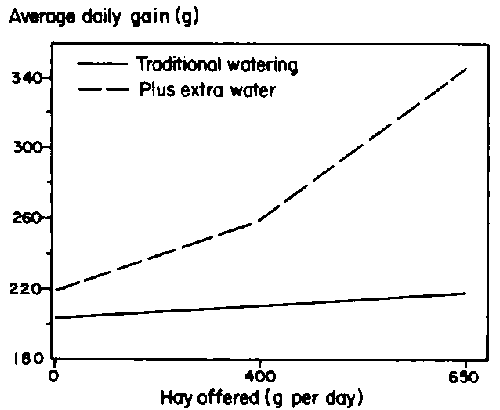
Figure 7.6. Schematic diagram of the effect of water supplementation on growth and time to puberty for heifers born in 1986. Average daily pains (i.e. 111 or 86 g/head/per day) accompany respective growth curves (N = 33 per group). - Source: Sovani (1990).
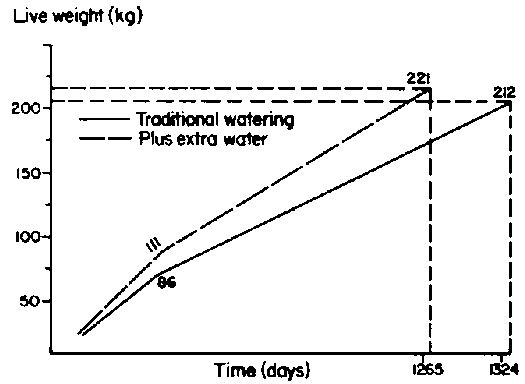
Results for weaning weights confirmed that both water and hay were required for maximum early growth (Donaldson, 1986; Cossins and Upton, 1988b). Work reported by Coppock (1989b) and ILCA (1989: pp 2-5) from analyses of male and female calves showed similar interactions over both 1986 and 1987. In addition, the best treatment of high level of hay plus water resulted in weaning weights that were 96% of those for the seventh treatment, which received traditional management but unrestricted access to milk; it is thus apparent that supplementation with a total of 105 kg of legume hay and 700 litres of water compensated for some 179 litres of milk otherwise lost to each calf. It is notable that supplemental water was required to elicit an improved growth response of calves; hence forage development in the absence of water development may only have a negligible effect on production (Coppock, 1989b).
Improvements of most aspects of production cattle obtained through supplementation did not persist long after weaning (Sovani, 1990). The water × hay interaction was significant for accelerating puberty but this advantage of six months is probably not important for cows that continue to calve after 10 years of age (Mulugeta Assefa, 1990). The six-month advantage may also be heavily influenced by a succission, by chance, of favourable rainfall years and other density-dependent interactions (see below). The ability of control animals to compensate for early nutritional deprivation agrees with other studies (Richardson et al, 1978; Tawonezvi, 1989). All of this research found differences in weaning weight to persist from 1.5 to 11 months past weaning. The significant effects of the milk intake covariate for several parameters at puberty indicates that there is a long-term consequence for milk deprivation and this may be reflected in frame development which could influence mature weight to some degree (Berg and Butterfield, 1976). Under the experimental conditions applied here, however, such long-term costs of milk restriction were small. Results do not support the contention that milk restriction under pastoral conditions constitutes a significant cost to the life-time productivity of cattle, as long as the calf survives (Coppock, 1989b; Sovani, 1990). Another key point is that it is the long period of the post-weaning environment, not the relatively brief pre-weaning conditions, that more likely influences the time to puberty according to the different environments. For example, nearly all of the conceptions studied by Sovani (1990) occurred in the rainy seasons, as previously found by Nicholson (1983a) and Mulugeta Assefa (1990). Had one or two of these rainy periods have failed, there is a high probability that animals would not have come into their first oestrus for many more months, which would give even more time for the gradual harmonisation of growth rates and attainment of puberty. This also underscores the big risks of attempting to improve long-term production parameters in variable environments (Coppock, 1989b). It was fortunate that 1986-90 were largely years of average rainfall; there were no very dry or drought years that could have resulted in big weight losses and thus in wasted expensive inputs.
Table 7.9. Absolute live-weight gain (kg) in water-supplemented and traditionally watered heifers from birth to weaning, weaning to puberty and birth to puberty in the southern Ethiopian rangelands, 1986-1990.
|
Treatment1 |
Period |
||
|
Birth to weaning |
Weaning to puberty |
Birth to puberty |
|
|
Traditional watering |
66.7 |
126.9 |
193 |
|
Supplemental watering |
89.8 |
112.2 |
202.4 |
|
Difference |
23.1 |
14.7 |
9.4 |
|
F-test2 |
*** |
* |
NS |
1 Where traditionally watered calves gained access to water once every two to four days depending on season during 2-11 months of age and supplemented animals were offered an additional five litres of water/day over the traditional situation.2 * and *** indicate significance at P = 0.05 and P = 0.001, respectively.
Source: Sovani (1990).
Based on this preliminary analysis, it is thus apparent that advocates of interventions to accelerate cattle growth in variable environments have failed to recognise the considerable risks as well as the effect of compensatory growth and environmental influence in harmonising production dynamics over time. Their intervention strategy has, at least on the Borana Plateau, also ignored the production values of the pastoralists. While it could be argued that supplementing, at least, nursing male calves so that they may achieve a more profitable sale weight at one year of age is a reasonable approach, this is not an objective of producers here (Coppock, 1992b). The Boran do not want to sell an immature male if they can avoid it; this is done by the poor that have fewer other options (see Section 4.3.4.7: Marketing attitudes). Producers much prefer to sell animals at least three years old because they bring a greater income.
The idea of speeding up cattle growth, whether to achieve a higher market weight for immatures or to reduce age of first calving, is inimical to values of low-input animal production in risky environments. Low-input production has minimal overheads and thus may not count time as a critical management variable. Despite the apparent advantages of improved watering for calves from experimental work, the Boran have repeatedly stated that they will always be conservative in watering calves, because they believe that restricted watering prepares calves to endure restricted watering as adults (D. L. Coppock, ILCA research scientist, personal observation; R. J. Hodgson, CARE-Ethiopia, personal communication).
In sum, hypotheses regarding calf feeding to accelerate growth in a pastoral setting are relatively easy to falsify. In one respect this is because they are conceived within a uni-disciplinary framework; i.e. they make sense as animal production hypotheses but fail because they do not consider the ecological or socio-economic circumstances within which animal production is imbedded. Even in terms of just animal production some of their underpinning logic is faulty. Attempting to compare cattle production parameters within traditional and modern ranching environments, with the assumption that the production levels of ranches represent some form of an attainable standard for the traditional system, is inadvisable given the experience here. The observation that calves grow faster on ranches, and that this is primarily due to milk intake (Nicholson, 1983b; Cossins and Upton, 1988b), is heavily confounded with other characteristics of ranches such as improved breeds and ample forage resources throughout the year. To illustrate this using data from Cossins and Upton (1988b; Figure 2 on p 268), it is likely that much of the difference in four-year weights of Boran cattle between the best animals reared on Laikipia (Kenya) ranches (575 kg) and on the Borana Plateau (275 kg) is probably strongly influenced by breeding and environment as much (if not more than) by calf management. Both Alberro (1986) and Trail and Gregory (1981) reported large increases in mature weights by improved breeds compared to indigenous animals. S. Sovani (ILCA, personal communication) reported that there is little phenotypic similarity between improved Boran cattle at Ethiopia's Abernossa Ranch and the indigenous stock on the Borana Plateau. The point is that when 210-day weights are calculated as percentages of four-year weights, animals on the Borana Plateau achieved 17% while the others achieved 39%, which is a much lower differential than the 325% increase for ranch animals when 210-day weights are compared directly. By three years of age the improved animals had achieved 87% of their four-year weight and the indigenous animals 76%. This suggests that the relative difference in growth had been made up to a higher degree by the indigenous animals between 210 days and three years of age. This undermines the postulate that milk deprivation has a key role in constraining faster attainment of weights at four years.
Furthermore, influences of milk deprivation on calf growth in the Borana system will be subjected to fluctuations caused by density-dependent interactions (see Section 7.2: A theory of local system dynamics). Calf growth may be higher in the recovery phase of the cattle population after drought and lower in the high-density phase. Observations of Nicholson (1983b) on milk production and calf growth (see Section 5.3.2: Calf growth and milk offtake may have been biased toward low because they occurred in the high-density phase proceeding the 1983-84 drought. Similar work conducted in 1985-86 during the early recovery phase could have revealed a different picture, with higher milk production and faster rates of calf growth.
In contrast to accelerating cattle growth, interventions to mitigate calf mortality are more consistent with traditional pastoral values and the shortfalls of risky low-input systems (Coppock, 1989b). Compared to other interventions, attempts to save the life of a calf are more short a lower quantity of resources and the outcome is more of a direct reflection of the management effort with less influence from uncontrollable environmental conditions. Thus, not surprisingly, calf mortality mitigation appears to be a priority of cultural Boran livestock mangement (D. L. Coppock, ILCA, personal observation). Calf management is consequently their most intensive production activity and includes substantial time invested in hand-rearing (see Section 5.3.1: General aspects of cattle management).
In their modeling analyses, Cossins and Upton (1988b) noted that mitigation of calf mortality was unlikely to yield the economic benefits that could accrue from faster calf growth. However, this conclusion is invalid because producer risk was not considered. Another problem is their use of the steady-state herd model (Upton, 1989) with the assumption that herd owners seek to maintain a fixed number of cattle, increases in one age class could detract from benefits derived from others. For example, an increase in calves as a result of mortality mitigation could ultimately have costs in terms of a reduced output from fewer mature cows. In contrast to model assumptions, the Boran seek to expand herd size and calf recruitment is central to this goal (Coppock, 1992b).
Opportunities exist for building upon traditional production values and further intensify calf management using hay-making, small quantities of local legumes and an improved access to water (see Section 7.3.1.1: Water-development activities and Section 7.3.1.3: Forage improvements). The goals of intensification would be to reduce calf mortality in years of average or slightly below average rainfall and improve labour efficiency for women in the process. There is an impetus among the Boran to intensify calf management because of increasing resource competition arising from population pressure (Menwyelet Atsedu, 1990; see Section 7.2.2: Anticipated long-term trends).
It could be argued that sustained reductions in calf mortality, without increased cattle offtake, will ultimately be unsustainable given the conceptual model of density-dependent production (Section 7.2.3: Anticipated short-term cycles). Increases in cattle recruitment, however, could contribute to economic growth, improved food security and sustained overall development if herd turnover is stimulated in the context of food supply, contributions to community projects and banking a portion of livestock capital. These topics are covered in Section 7.3.3.6: Cattle marketing.
Economic implications of calf mortality mitigation
Background: Mulugeta Assefa (1990) conducted a statistical analysis of the effect of family wealth on calf mortality, as reported in Section 5.3.3: Cattle production and pastoral wealth. He (1990: pp 27-45) also quantified (Table 7.10) calf mortality due to disease or nutrition deficiecy from producer interviews. During wetter years relatively more calves were reportedly lost to disease while during drier years more were lost to poor nutrition. Although the highest mortality rates occurred during drought, these probably constitute only a small proportion of total losses for any given decade. This is because of the low drought frequency and the large decline in calving rate induced by drought (Section 6.3.1.2: Cattle productivity). For example, considering an average eight-cow household during 1980-89 and calving rates reported in Section 5.3.3: Cattle production and pastoral wealth and Section 6.3.1.2, on average 14 of 54 calves would have died in the dry years while the one born during the second drought year of 1984 would have had a high risk of dying. This implies, overall, that about 7% of calf deaths would have occurred as a result of drought compared to 93% at other times.
Table 7.10. Annual rates (%) of calf mortality as reportedly due to (1) nutrition-related or (2) all sources combined for animals held by various wealth classes of Borana households across different rainfall years in the southern rangelands. 1
|
Wealth category3 |
Year type2 |
|||||
|
Mortality source |
||||||
|
Average |
Dry |
Drought |
||||
|
Nutrition |
All |
Nutrition |
All |
Nutrition |
All |
|
|
Poor |
15 |
25 |
21 |
26 |
66 |
69 |
|
Middle class |
9 |
21 |
4 |
14 |
36 |
36 |
|
Wealthy |
11 |
19 |
16 |
22 |
60 |
60 |
1 From a sample of so households (30 per wealth class) reporting life histories of 482 cows and 1410 calves (Mulugeta Assefa, 1990).2 Where an average year has a 60:40 distribution of 600± mm of rainfall across long and short wet seasons, respectively; a dry year is an isolated year of lower rainfall (i.e. 450 mm or less); and a drought year is a second consecutive dry year.
3 Where wealth is defined as the ratio of lactating came: reference adults as in ILCA (1981) and Holden and Coppock (1992). See text for details.
Source: Coppock et al (1990).
Objectives and methods: The main objective of the study by Mulugeta Assefa (1990) was to judge the potential profitability of reducing calf mortality using internal resources in average rainfall and dry years and external resources during drought. The tool used for the analysis was a big-economic herd model by von Kaufmann et al (1990) that simulates herd performance for households over a 10-year period. This model had to be parameterised, however, for biological and economic conditions applicable on the Borana Plateau.
Mulugeta Assefa calculated costs of collecting sufficient forage, providing water and implementing veterinary services that could reduce calf mortality by 75% for households in all wealth classes in average rainfall and dry years. Two-thirds of the impact was hypothesised to result from improved nutrition and the remainder from veterinary intervention. Increasing water supply in conjunction with improved feeding (Coppock, 1989b) was hypothesised to increase calf growth rates by 40%. The specific resources included grass hay (Coppock, 1991), local legumes (Yohannes Alemseged, 1989; Coppock and Reed, 1992), water tanks (Hodgson; 1990) and veterinary extension in the context of Service Cooperatives (SCs).
In addition, Mulugeta Assefa (1990: pp 40-43) considered the hypothetical provision of a 97:03 mixture by weight of molasses and urea to reduce calf mortality during drought by 50%. In contrast to the other resources which are locally available, molasses and urea would have had to be brought from the highlands. Molasses and urea were previously found to be useful feed supplementation of Boran cattle during the 1983-84 drought (Donaldson, 1986).
Implementation costs of interventions were primarily calculated on the basis of the value of women's labour in collecting forage and in terms of community monetary expenses for construction and maintenance of water tanks and veterinary services. Benefits were calculated as the summed cash value of cattle and cattle products generated over time as a result of interventions to reduce calf mortality. Cumulative costs were subtracted from cumulative benefits. The resulting statistic from the model was a measure of the Net Present Value or NPV (Workman, 1986) of cattle herd output as a function of intervention. Intervention scenarios are thus contrasted with traditional management to assess economic impacts. Model inputs were modified to accomodate the special characteristics of the Borana system as described in Mulugeta Assefa (1990).
Feeding packages for average rainfall and dry years were calculated to obtain sustenance requirements of energy during a 120-day dry season (i.e. December through March). Sustenance energy requirements for calves (ARC, 1980) added 20% of the cost of the activity, calculations incorporated energy metabolisability and efficiency of use (Mulugeta Assefa, 1990: pp 74-75). It was stipulated that women would collect 110% of the forage required for half of their calves, with an additional 10% lost through wastage.
Mulugeta Assefa (1990: pp 3582) conducted numerous field studies to parameterise the model for local conditions. Yabelo and Mega markets were surveyed to obtain price data for milk, meat, offal, hides and grain for different seasons and rainfall years, a statistical analysis of these data is provided elsewhere (Mulugeta Assefa, 1990: p 50). Nutritional assessments were made of grass hay, A. tortilis fruits and A. brevispica leaves for nitrogen content (AOAC, 1980) and in vitro dry-matter digestibility IVDDM; (Goering and Van Soest, 1970) for determining calf rations. Standing crops of leaves of A. brevispica shrubs in the dry season were assessed by a total harvest of 23 shrubs of varied size classes. Production of fruits from A. tortilis trees was obtained from Menwyelet Atsedu (1990). Use of forage from these woody plants was expected to occur only where they were abundant so that costs of searching for fruits or leaves were discounted in the analysis. Yields and nutritive values of cowpea hay and pidgeon pea (C. cajan) forage were obtained from Yohannes Alemseged (1989) for consideration of calf feeding in a cropping situation.
Labour required to implement forage activities was assessed in Did Hara and Dubluk madda for 60 families (Mulugeta Assefa, 1990: pp 57-73) using interviews of Borana women. Twenty-two of 60 families reported significant seasonal constraints for forage collection while 34 reported shortage of preferred grass as the biggest problem for hay-making For the majority of households, women's labour was most commonly reported as the main option for improving efforts for forage collection. Calculations were based on forage yields, walking and collecting time, and appropriate backloads/woman/trip to estimate the effort required to collect enough material on a dry matter basis. Using sickles to cut grasses to make hay, for example, was determined to yield about 40 kg of fresh weight from a 200-m2 area at the end of the long rainy season. Three 10-kg loads of fresh grass could be cut and carried back to encampments in six hours. further drying and stacking costs of hay-making were determined to be negligible. Consideration of the incremental time (man-days) used in land preparation for forages intercropped with maize was included in the budgets for cowpea and pidgeon pea, along with an opportunity cost penalty for loss of maize grain yield. Grain yield of legumes was considered as additional revenue (Yohannes Alemseged' 1989).
Projected activities reduced or foregone as a result of increased labour allocation for forage collection or cultivation were specified either for the wet season when cultivation and preparation of grass hay would occur, or for the dry season when harvest of cultivated legumes or collection of A. tortilis fruits or A. brevispica leaves would occur. Respondents largely indicated (58 of 60) that more wet-season activities could be incorporated into their existing schedules, but only 40 of 60 reported the same for the dry season (Mulugeta Assefa, 1990)
Monetary costs for collection of each forage were derived from estimating total quantity required per year for half of the calves of each modal family in each wealth class. Seasonal market values for grain used as payment in food-for-work projects were employed to value hourly labour. Rates for food-for-work ranged from 3 to 5 kg of grain per person per six-hour work day in dry and wet periods, respectively (CARE-Ethiopia, unpublished data). This resulted in an estimate of EB 0.12/person/hour in dry seasons versus EB 0.14/person/hour in wet seasons. This translates into a minimum daily wage of EB 0.73 to 0.85, roughly 26% on average of the official national minimum wage of EB 3/person/day. Costs of the collecting sacks and locally made storage structures for feeds were added in, as were market values for cowpea and pidgeon pea seeds. An additional 15% miscellaneous overhead was included.
Costs for water were based on the construction outlay for a 60000-litre water tank in Hodgson (1990: pp 30-35). The straight-line depreciation method was used to determine cost of the tank each year over a 10-year lifespan, with a salvage value of 0% (Mulugeta Assefa, 1990: p 83). Cost of each litre of water per year was derived by dividing yearly cost of the water tank by the volume.
Losses of calves to disease were estimated to be 25% of total modalities during average years (Sileshi Zewdie, SORDU veterinarian, personal communication cited in Mulugeta Assefa, 1990: p 83). This confirmed results in Table 7.10. Although medicines for livestock have been offered free of charge to date, a payment system will come into effect in the future (Tafesse Mesfin, TLDP General Manager, personal communication). Mulugeta Assefa (1990: pp 83-84) thus calculated total health costs as if they were covered by the Boran and by assuming that one local veterinary scout could serve four encampments. Information on the costs of simple equipment, vaccinations and other medicines as well as the optimal periodicity of interventions were obtained from upublished SORDU statistics. Implementation of molasses and urea mixtures in a drought year was based on nutritive value (ILCA Nutrition Unit, Addis Ababa, Ethiopia, unpublished data) and costs of feeds (Ethiopian Sugar Corporation, Addis Ababa, Ethiopia, unpublished data; Ministry of Agriculture, Addis Ababa, Ethiopia, unpublished data), barrels and transport from the highlands to the Borana Plateau (Ethiopian transport Authority, Addis Ababa, Ethiopia, unpublished data). A 10% loss and 15% miscellaneous overhead were added in the final calculations.
The herd model was programmed as an application of the Lotus 1-2-3 release 2.01 programming language (von Kaufmann et al, 1990). The model requires an initial herd structure and production parameter values based on field data. These include age, year-specific mortality rates, calving rates, animal offtake rates, milk production/cow/lactation, length of lactation and dry periods, per cent milk offtake, per cent milk intake, carcass dressing percentage and commodity prices. These data were obtained through cow history documentation from 90 producer interviews (Section 5.3.3: Cattle production and pastoral wealth) and interviews of traders and merchants (Mulugeta Assefa, 1990). Parameter estimates stratified by household wealth and type of rainfall year can be found in Mulugeta Assefa (1990). These include data for herd structures, live weights, dressing percentages, productivity of cattle, commodity prices, per cent of cattle sold, slaughtered or gifted.
Results: Table 7.11 summarises daily costs per calf for routine inputs of forage, water and prophyllaxis as well as emergency provision of molasses and urea. Legumes were costed from 60 to 125% more than the grass hay. Health and watering interventions were cheapest and ranged from 7 to 15% of the costs of grass hay. The molasses and urea mix had a similar per unit cost as the more expensive legumes. Forage and water interventions were to be implemented in the model for 120 and 210 days in both average rainfall and dry years while provision of veterinary care was to be continuous in all years. Molasses and urea mixtures were to be implemented for 180 days in a drought year. Details for price calculations are available in Mulugeta Assefa (1990; Appendix 3).
Table 7.11. Summary of costs of forage, water and health interventions per calf on a daily basis in the southern rangelands.1
|
Intervention |
Cost/calf/day2 |
|
Grass hay |
0.2 |
|
Acacia brevispica loaves |
0.45 |
|
Acacia tortilis fruits |
0.32 |
|
Cajanus cajan |
0.35 |
|
Vigna unguiculata |
0.41 |
|
Molasses and urea |
0.42 |
|
Water tank |
0.031 |
|
Health package |
0.013 |
1 Details of cost determinations may be found in Mulugeta Assefa (1990; appendix 3).2 Ethiopian Birr, where 1 USD = 2.05 EB.
Source: Mulugeta Assefa (1990).
The first analysis was a run of 10 average rainfall years for the control condition (no intervention) for each wealth class. Results were interpreted to indicate that all herds were capable of considerable net rates of growth under optimal conditions. Herds for wealthy, middle class and poor households grew from 91 to 265 head (±191%), 35 to 80 head (±128%) and 14 to 34 head (±143%), respectively (Figure 7.7a). Tabular data for herd sizes, outputs and monetary returns under this scenario are displayed in Mulugeta Assefa (1990: p 133). That pastoral herds can grow rapidly under good rainfall conditions has been shown elsewhere in East Africa. Meadows and White (1979) noted that cattle herds tripled in size during 10 years of high rainfall in Marsabit, Kenya. Other evidence from the southern rangelands suggests that cattle recovered very quickly from the 1983-84 drought during years of average rainfall (Solomon Desta, nd; see Section 6.4.5: Equilibrial versus non-equilibrial Population dynamics).
The next simulation was carried out assuming a varied and random sequence of rainfall years. Years 1, 3-6, 9 and 10 were considered to have average rainfall while years 2 and 7 were dry. Year 8 was a second consecutive dry year regarded as a drought year (see Section 2.4.1.4: Climate, primary production and carrying capacity). This sequence was run using the control (no-intervention) scenario as well as with various interventions.
The control scenario under variable rainfall produced markedly different results compared to those derived under a continuous regime of average rainfall. The net result was that herds of wealthy households grew from 91 to 124 head (±36%), but those for the middle class and poor declined by 9 and 6%, respectively. Dynamics for the herd of the middle-class household are shown in Figure 7.7b.
Mulugeta Assefa (1990) used an "average" feed input over 10 years to represent the modeled impact of the nutritional intervention. This consisted of using an average-priced forage for 9 out of 10 years and the molasses and urea mix for the drought year. This intervention under the variable rainfall scenario resulted in net increases in herd size of 37,17 and 7% for wealthy, middle class and poor households, respectively. This suggested, compared to the control runs, that effects of this intervention could result in a greater impact on the middle class and poor than on the wealthy. This was due to nutrition being a less frequent cause of calf mortality in wealthy households compared to disease (Mulugeta Assefa, 1990; see Section 5.3.3: Cattle production and pastoral wealth). Adding a health package to the feed intervention nearly doubled the positive effect of intervention by causing increases in herd size on the order of 75, 34 and 14% for the wealthy, middle class and poor. Herd dynamics for a middle-class household under variable rainfall conditions based on feed and feed plus health interventions are shown in Figure 7.7b.
Herd dynamics have been portrayed to illustrate general features of the production system and the role of climate variability. Improvements in herd growth resulting from interventions, however, were dictated by modeling objectives. Analysis of NPVs is required to assess profitability. Tables 7.12 to 7.14 give details regarding effects of interventions on the NPV of cumulative net herd output per household in each wealth class. Because it was the cheapest feed, the grass hay yielded, relative to the control, the greatest effect of all forages in increasing NPV, for each wealth class. The middle class and poor appeared to be the most positively affected (Table 7.12). Adding the health package to the hay raised benefits further but the middle class and wealthy appeared to be the most positively affected by the combined intervention when compared to using hay alone (Tables 7.12 and 7.13). This was because, in general, calf nutrition deficiency is a more prevalent production constraint for the poor because of milk competition (Holder et al, 1991; see Section 4.3.5.4: Dairy marketing, human welfare and calf management). Despite their high costs, water tanks resulted in another positive increment to the NPV for each wealth class (Table 7.14).
Figure 7.7. Results from a bio-economic herd model depicting cattle herd growth for three Borana wealth classes under 10 years of average rainfall. - Source: Mulugeta Assefa (1990).
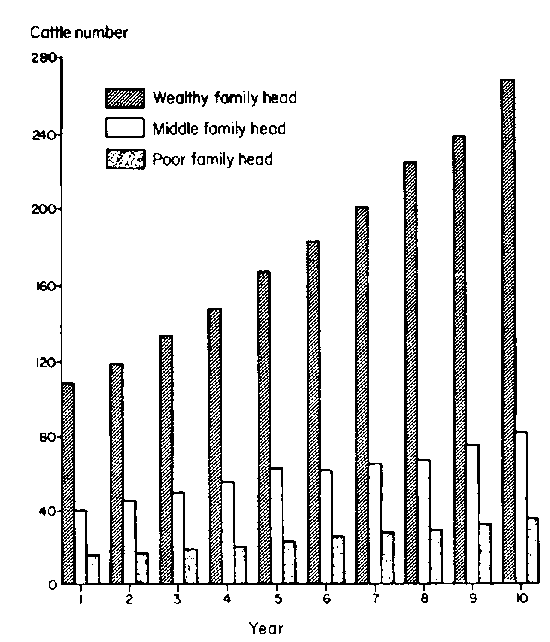
Figure 7.7. Results from a bio-economic herd model depicting cattle herd growth fore middle-crass Borana household under different intervention scenarios for a variable rainfall regime. - Source: Mulugeta Assefa (1990).
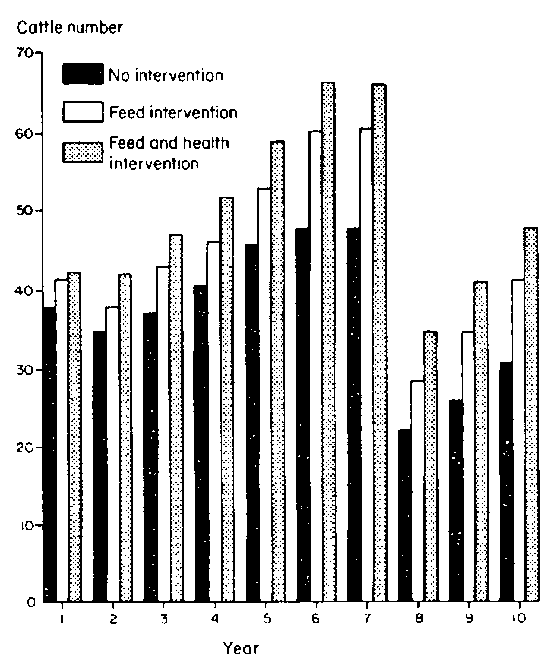
Table 7.12. Effect of production interventions involving calf feeding management on net present value (NPV) of cattle herds held by Borana households of varied wealth as determined using a big-economic model.
|
Intervention |
Wealthy family |
Middle-class family |
Poor family |
|||
|
NPV |
% |
NPV |
% |
NPV |
% |
|
|
Hay |
22920 |
94 |
11155 |
124 |
3452 |
111 |
|
Acacia brevispica leaves |
16004 |
65 |
8975 |
101 |
2727 |
88 |
|
Acacia tortilis fruits |
19600 |
80 |
10109 |
113 |
3104 |
100 |
|
Pigeon pea residue |
18770 |
77 |
9847 |
110 |
3017 |
97 |
|
Cowpea residue |
17110 |
70 |
9324 |
104 |
2843 |
92 |
1 Where NPV is defined as the net total of the discounted values of gross revenues and costs (von Kaufmann et al, 1990). NPV entries equal the sum of 10 annual net returns from implementation of the respective intervention. Units are in EB, where 1 USD = 2.05 EB. The per cent (%) values indicate the NPV resulting from intervention as a per cent of the NPV assuming no intervention. Differences in the relative increase in NPV from intervention among wealth classes largely result from variation in sources of calf. mortality. Nutritional interventions are more important for the calves held by the middle class and poor.Source: Mulugeta Assefa (1990).
Table 7.13. Effect of production interventions involving calf feeding management plus a health package on the net present value (NPV) of cattle herds held by Borana households of varied wealth as determined using a big-economic herd model.1
|
Intervention |
Wealthy family |
Middle-class family |
Poor family |
|||
|
NPV |
% |
NPV |
% |
NPV |
% |
|
|
Hay, plus health package |
40343 |
165 |
19743 |
221 |
4345 |
140 |
|
Acacia brevispica leaves plus health package |
33427 |
136 |
17564 |
197 |
3620 |
117 |
|
Acacia tortilis fruit plus health package |
37023 |
151 |
18697 |
209 |
3997 |
129 |
|
Pigeon pea residue plus health package |
36194 |
148 |
18436 |
206 |
3910 |
126 |
|
Cowpea residue plus health package |
34534 |
141 |
17912 |
201 |
3736 |
120 |
1 Where NPV is defined as the net total of the discounted values of gross revenues and costs (von Kaufmann et al, 1990). NPV entries equal the sum of 10 annual net returns from implementation of the respective intervention. Units are in EB, where 1 USD = 2.05 EB. The percent (%) values indicate the NPV resulting from intervention as a per cent of the NPV assuming no intervention. Variation in impact between these tabular values and those in Table 7.12 reflect impact of calf health intervention.Source: Mulugeta Assefa (1990).
Table 7.14. Effect of production interventions involving calf feeding management, health package and local water development on net present value (NPV) of cattle herds held by Borana households of varied wealth as determined using a big-economic model.1
|
Intervention |
Wealthy family |
Middle-class family |
Poor family |
|||
|
NPV |
% |
NPV |
% |
NPV |
% |
|
|
Hay, health package plus cistern |
43088 |
176 |
20956 |
235 |
4625 |
149 |
|
Acacia brevispica leaves, health package plus cistern |
36172 |
148 |
18776 |
210 |
3900 |
126 |
|
Acacia tortilis fruit, health package plus cistern |
39768 |
162 |
19910 |
223 |
4277 |
138 |
|
Pigeon pea residue, health package plus cistern |
38938 |
159 |
19648 |
220 |
4189 |
135 |
|
Cowpea residue, health package plus cistern |
37278 |
152 |
19125 |
214 |
4016 |
129 |
1 Where NPV is defined as the net total of the discounted values of gross revenues and costs (von Kaufmann et al, 1990). NPV entries equal the sum of 10 annual net returns from implementation of the respective intervention. Units are in EB, where 1 USD = 2.05 Es. The per cent (%) values indicate NPV resulting from intervention as a per cent of the NPV assuming no intervention. Variation in impact between these tabular values and those in Table 7.13 reflect impact of local water development. See the text for assumed impact of water development on calf growth and mortality rates.Source: Mulugeta Assefa (1990).
In summary, work by Mulugeta Assefa (1990) confirmed that calf mortality rates merit attention for production intervention but that the type of intervention should be tailored to the wealth class of the household and type of rainfall year. Feeding packages should be the most important for herds of poor households while health intervention is for those of the wealthy. Field work and modeling results suggest that grass hay is the cheapest and easiest feed intervention to implement but households would be expected to tailor their own supplemental feeding programme based on the availability of local resources. For example, households in close proximity to valuable acacia trees and shrubs could make the best use of these while those cultivating valleys could so of cowpea or pidgeon pea residues. In general, even more expensive interventions such as veterinary extension and cement cisterns are profitable if they contribute to reduced rates of calf mortality.
The study of Mulugeta Assefa (1990) is very useful as a first step in integrating the many factors required for a comprehensive economic evaluation of calf mortality mitigation. Transferability of model results to real world production situations, however, is limited in several respects. First, being able to price inputs infers that there is certainty of their availability. That is commonly not the case. Whether it is cement, vaccines, health extension staff or molasses, the uncertainties about their availability are a more serious obstacle than price. For example, even smallholders in the Ethiopian highlands have difficulty in procuring reliably industrial by-products such as molasses and wheat-milling residues despite the fact they are in the vicinity of factories (D. L. Coppock, ILCA research scientist, unpublished data). The modeling also does not portray adequately day-to-day risks of implementing interventions. Risks of hay spoilage, cracking of water tanks, variable productivity of native legumes over space and time, distance to trek calves to clinics and shortage of grass for hay are all examples of the obstacles that keep more Boran from adopting such innovations. Thus, profitability should not imply that implementation is easy.
The second main problem is that the modeling methodology did not consider production risks of density-dependent interactions. These modeling scenarios are thus probably more relevant to conditions found in the drought-recovery phase rather than those in the high-density phase of the cattle population (see Section 7.2.3: Anticipated short-term cycles).
Offtake dynamics
If reducing calf mortality rates is the most viable production intervention, it has to be conceded that this could ultimately be unsustainable given the resource limitations. For example, without increased offtake, reductions in calf mortality could accelerate manifestation of the negative effects of the high-density phase of the cattle population in the form of reduced milk production, reduced animal condition and increased mortality. Even without calf-management interventions, strategies to increase offtake may be warranted given the apparent increase in the cattle population over the past 15 years, losses of drought reserves and the advent of severe drought-induced losses of livestock capital (AGROTEC/CRG/SEDES Associates, 1974h; Menwyelet Atsedu, 1990; Solomon Desta, nd; see Section 6.4.5: Equilibrial versus non-equilibrial population dynamics).
It is contended that leaving regulation of the cattle population to the environment does not create a viable development situation. Creative means to increase offtake are well justified to help stabilise the system during high-density phases and limit impoverishing losses of livestock capital during drought. While increasing offtake could lessen risks of environmental degradation, degradation is rather too difficult to monitor and evaluate in the context of promoting sustainability of production (see Section 7.2.2: Anticipated long-term trends). One solution is to maintain an increasing cattle wealth through enhanced calf recruitment but transformed into other forms of security compatible with traditional goals. As previously mentioned, this is consistent with the conceptual model of Sandford (1983a: pp 39-43) in which efficient opportunism is the ultimate development goal for African pastoralism (Section 6.4.5: Equilibrial versus non-equilibrial population dynamics).
Stimulating cattle offtake: Despite the contention that cattle marketing may substantially increase as the Boran become more dependent on grain purchases (see Section 7.2.2: Anticipated long-term trends), it remains unclear whether such increases in offtake would be sufficient to markedly reduce the risks of system destabilisation losses of herd capital or environmental degradation. The extent to which increased cereal cultivation or small ruminant production would compensate for a growing need to sell cattle is also unclear. The following discussion offers some practical considerations for stimulating cattle offtake in the context of improving the standard of living and economic security of the Boran. Promoting offtake merely for cash accumulation is recognised as a nontraditional value and is not a viable approach. Cattle offtake that is not translated into other forms of security for the people undermines their immediate survival (see Section 7.3.1.2: Grazing management).
The graph depicting results from empirical modeling of cattle population dynamics from 19822006 was augmented with a horizontal line at a stocking rate of 20 head/km2. This represents a risk threshold for the cattle population entering the high-density phase (Figure 7.1a). This threshold comes from an analysis in Pratt and Gwynne (1977: p 112) who considered 20 cattle/km2 as the optimal stocking density for 600 mm of annual rainfall in East Africa. Above this threshold density-dependent interactions that reduce cattle productivity were postulated to increase. This is also consistent, in general, with opinions of Borana herd owners expressed during the high-density phase in 198990 (see Section 6.4.5: Equilibrial versus nonequilibrial population dynamics). It is recognised, here, however, that variation in annual rainfall will play a very large role in the effectiveness of such a guideline; for example, in a dry year 15 head/km2 could be the threshold while in an unusually wet year 30 head/km2 may be the threshold.
The reason the threshold concept is postulated to work here is largely because the regional herd is under a high degree of spatial confinement and rainfall is reasonably predictable (with the probability of having a near-average rainfall year being around 0.8 (see Section 2.4.1.4: Climate, primary production and carrying capacity). When the regional herds exceed a density of about 20 head/km2, the risk of the herd suffering losses from a moderate decline in annual rainfall becomes greater. A more conservative approach would emphasise a carrying capacity of 217000 head for the region (Section 2.4.1.4: Climate, primary production and carrying capacity). The figure of 300000 head is used here for illustrative purposes and represents a compromise between short-term economic security and risk management over the medium term. Controversies concerning the carrying capacity concept are addressed in Chapter 8: Synthesis and conclusions.
If a regional population of over 310000 head (20 head/km2) becomes risky, it is noteworthy that this population level was reached during 13 out of 25 modeled years (Figure 7.1 a). Annual modeling results illustrated in Table G1, Annex G. indicate that in 1990 there was a cattle population of 334000 head supporting some 77500 people or 13839 households at 5.6 persons each (Mulugeta Assefa, (1990: p 15). The ratio of cattle to people in 1990 was 4.3:1, with a food-energy deficit of 46%. Livestock census data from Solomon Desta (nd) for Arero district in the late 1980s suggested that some 23% of the cattle were mature males, 50% mature females, 12% immature males and 15% immature females.
Extrapolating from data collected by Mulugeta Assefa (1990: pp 1,15) it is further stipulated that 18% (2491) of all households were wealthy, 31% (4290) middle class and 51 % (7058) poor. Sixty-five per cent of all cattle (217100 head) may thus have been owned by the wealthy, 25% (83500 head) by the middle class and 10% (33400) by the poor. For mature males (the most marketable component), of the total population of 76820 most (67% or 51469) were owned by the wealthy, 25% (19205) by the middle class and 8% (6145) by the poor. In terms of households, this indicates that wealthy households had 20.6 mature males each, the middle class 4.5 and the poor 0.9 each.
To avoid undesirable effects during the high-density phase, the ideal situation should have been to encourage an offtake of at least 34000 head and attempted to keep the high-density phase of the population at around 300000 head, or even less in the future. The 34000 head represented roughly half of the inventory of mature males and 66% of the numbers held by the wealthy. The challenge, then, is how to translate a potential loss of 34000 head into an alternative investment for these households. Such investments only need to be less risky than the risk of losing animals during the high-density phase. Considering that 15% of the regional herd was lost in 1989-90 and perhaps another 50% in 1991, these risks are considered to be very high (see Section 6.3.3: Drought effects in 1990-91). There are costs and risks to households and the society at large from keeping too many mature males in the high-density phase. These include the forage consumed by unproductive males that could otherwise be eaten by milk cows, a higher probability that forage in drought reserves will be compromised before it is acutely needed and a higher risk of mature females dying should there be a dry year. These problems are appreciated by Borana elders (D. L. Coppock, ILCA research scientist, unpublished data; Section 6.4.5: Equilibrial versus non-equilibrial population dynamics).
The role of local development projects: The wealthier households could be expected to shoulder the burden of increasing offtake during critical times for the good of the community. The wealthy already destock by contributing animals to fund projects that develop or maintain wells and large ponds. This can involve hundreds of animals in any given year (see Section 7.3.1.1: Water-development activities). By contrast, while construction of cement water tanks may be important to the community overall, it offers less scope for stimulating animal offtake This is because of logistical problems which constrain building a large number of tanks in any given year as well as their low cost. For example, with an average of 10 households per encampment, there may be around 1300 encampments in the study area; and if only half of these desired water tanks, with eight bulls sold per tank (Hodgson, 1990), this implies an offtake of 5200 head in total. The reality is that less than 10 tanks have been built per year in the past (C. Fütterknecht, CARE-Ethiopia, personal communication). Even if 20 tanks could be built each year, it would take over 30 years to satisfy demand. Water tanks are thus a means to provide for only small increments of offtake each year.
Banking: Another option is banking livestock wealth in the form of simple savings accounts. There have been branches of the Commercial Bank of Ethiopia in the southern rangelands since 1985 and bank managers have remarked that the Boran should consider managing some of their animal assets as cash reserves (Bekele Tadesse, Commercial Bank of Ethiopia, personal communication). Local bank representatives have campaigned to encourage them do just that but the attempt has apparently not been fruitful (Bekele Tadesse, Commercial Bank of Ethiopia, personal communication), partly because the local administrators were not providing adequate political support to the process. In memos to the central bank office in Awassa, Bekele Tadesse (1986) reviewed the local banking situation in the southern rangelands. He noted that even though the agropastoral Burji to the north of the Boran were using the bank in Agere Mariam, pastoralists throughout southern Ethiopia in general showed no similar inclination, using banks mainly to replace worn or damaged currency. It was recommended that more seminars be conducted to inform all local people about the use of banks (Bekele Tadesse, 1986).
Banking obviously offers substantial barriers and risks, especially for the uneducated. Lack of education outreach to the Boran thus becomes a major constraint in this regard (Chapter 8: Synthesis and conclusions). Furthermore, banking has also been traditionally viewed by agricultural scientists as economically noncompetitive with livestock in terms of returns on investment (J. Eckert, Colorado State University, personal communication). Livestock traditionally serve as a hedge against inflation and a means to mitigate the effect of droughts (Section 6.4.4: Traditional drought-mitigation tactics). It is speculated here, however, that the scientists have failed to consider financial interventions on the basis of risk management. Research into risk management of animal assets may be very timely for systems under increased population pressure. As will be reviewed in this and later sections, strategic banking is justified for the Boran in terms of risk reduction and famine mitigation for the pastoral households as well as capital generation for communities.
It is understood that the risks of maintaining large herds as traditional investment are becoming greater today than in the past because of overpopulation. That large herds are kept by the Boran primarily as investment yielding social and economic benefits was confirmed by interviews (Coppock, 1992b). If a wealthy herd owner was to sell a fully grown male under the favourable market conditions during the high-density phase, he or she would eliminate the risk of losing that animal should a dry year suddenly arise or because of incompetent herding as this is reportedly an increasing problem for the wealthy (Coppock, 1992b). If an animal is lost while on forra in a remote area, there is no certainty that the carcass will be put to use, in many cases only the hide may be retrieved (Coppock, 1988). Besides reducing household vulnerabilities banking could also benefit poorer neighbours and kins since it would mean less competition for forage to their herds. This assumes, however, that households would not produce more animals to quickly fill a void left by banked animals. Social pressure on the wealthy to move excess animals elsewhere has been reported in some madda during the high-density phase of the cattle population (D. L. Coppock, ILCA, unpublished data).
Since a mature animal wouldn't grow any more, the herd owner's main risk of banking it would be in the form of inflation estimated at 2.6% per annum in Ethiopia during 1980-87 (IBRD, 1989: p 164). But this would be somewhat offset by the 6% interest on the saving accounts (Bekele Tadesse, Commercial Bank of Ethiopia, personal communication). Inflation has probably accelerated recently following the change of government in 1991 and currency devaluation in 1992 (D. L. Coppock, Utah State University, personal observation). It is important to note that a diversification of assets should ideally provide an improved combination of returns and low risk. That bank funds could be subjected to devaluation by inflation, monetary policy and political instability suggests that a major drawback of this intervention lies in the dynamics of the national government (Chapter 8: Synthesis and conclusions).
Banking interventions would have to be implemented in a step-wise manner. For example, three males banked per wealthy household (14% of the mature male inventory per wealthy household) would yield an offtake of 7473 head. With a value of EB 250/head this would yield a total of EB 1.8 million. In addition, if one male were banked for each middle-class household (22% of mature male inventory per middle-class household) this would yield an offtake of 7058 head with a value of around EB 1.7 million. The increase in savings accounts would constitute a major infusion of capital for local urban development; but it is important to note that urban ethnic groups other than the Boran would probably benefit from an increased flow of loans. Step-wise destocking could also have important effects in terms of conserving resources in certain madda, but the greatest initial effects would probably be in terms of improving terms of trade for pastoralists during times of drought (Section 7.3.3.7: Mitigation of drought impact) and providing capital for banks.
There may already be banking occuring among the Boran. There were 106 savings accounts under Borana names held at the Yabelo Branch of the Commercial Bank of Ethiopia in 1991 (Commercial Bank of Ethiopia, unpublished data). While many of these account holders are probably educated urban dwellers, it is suspected that some are influential pastoralists from the traditional sector with urban connections (Bekele Tadesse, Commercial Bank of Ethiopia, personal communication). These bank accounts have an average balance of EB 1260, with a range from EB 6 to 40000. Wealthy herd owners in some madda were under increasing peer pressure to bank a portion of their cattle wealth during the high-density phase of the late 1980s (D. L. Coppock, ILCA, unpublished data). A survey of 30 leaders throughout the western Borana Plateau revealed that they realised that their traditional way of living was changing rapidly (Coppock, 1992b). Nineteen of the 30 were aware of the banking system, and 10 of the 19 were interested in becoming involved in banking. They reportedly suffer from lack of knowledge concerning alternative means of keeping wealth (D. L. Coppock, ILCA, unpublished data).
There are significant problems in making banking a reality for a large segment of the Borana population. Suspicions regarding the practice must be overcome and those who have used banks to date could be useful in a public relations programme. New administrative procedures may have to be devised to accommodate illiteracy in the population and facilitation of deposit and withdrawal of funds may have to include some degree of bank decentralization and/or mobility in remote areas. Some social costs of banking have to be anticipated. While the ultimate decision to sell an animal may; rest with the herd owner, this can be strongly influenced by communal debate (Coppock, 1992b). This implies that people have vested interests in each other's cattle To what extent banking could "privatise" an animal is unclear.
Having more animals out of the system by way of creating another form of wealth may also compromise the ability of the poor to stake claims for animals from the wealthy of the same clan, which is a traditional means of wealth re-distribution (Section 2.4.2.2: Some cultural and organisational features). The social rewards of contributing cattle to community projects and to the poor likely outweigh any that can accrue from banking. Perhaps the ultimate constraint to banking is the cultural value of pastoralists to possess large herds and a lesser interest in saving large sums of money. But this could change with generational shift of values (Coppock, 1992b).
A sustainable yield scenario: Given the above scenario that around 30 to 50% of the herd (34000 head) could be taken off through a combination of local development projects and banking, it needs to be stressed that there would be little interest in such activities during the drought-recovery phase. Interventions of increasing offtake are only viable during the high-density phase (Section 7.4: Component interventions and system dynamics). Indeed, recovery from drought would be a time of bank withdrawals and efforts to stimulate growth in livestock assets. The next issue then becomes how to maintain a level of sustainable harvest to keep the herd size in the vicinity of 300000 head on an annual basis in normal rainfall and dry years during the high-density phases. If animal wealth were banked, the net result would be increased economic security and growth per pastoral households.
The following analysis dealing with sustainable yield assumes that: (1) the composition of the regional herd is similar to that previously mentioned (Solomon Desta, nd); (2) calving rates vary from 0.75 to 0.53 in average rainfall and dry years, respectively; (3) average rate of calf mortality is 21 % in average rainfall and dry years with no interventions; (4) death rates of other immatures vary from 8% (average year) to 10% (dry year; Mulugeta Assefa, 1990: p 90); and (5) death rates for mature animals vary from 6% (average rainfall year) to 10% for dry year (Mulugeta -Assefa, 1990: p 90). The annual intrinsic rate of increase (births minus deaths) for a herd of 300000 head is on the order of 23% and 11% in average rainfall and dry years, respectively. Canceling this out would require offtakes of 69000 or 33000 head per annum while the net annual increase after routine sales is lower than that.
Assuming at least 80% of annual household income is derived from cattle sales and that being EB 74, 356 and 627 for poor, middle-class and wealthy households, respectively (Holder and Coppock, 1992), this implies a total annual cash demand for EB 361 1 389. At EB 250 per head, 14445 animals would need to be sold to cover this figure. This makes the rate of herd increase in an average rainfall year more on the order of 18% or 54000 head. In a dry year the need for grain almost doubles. If it is assumed that: (1) nonessential purchases are foregone and most of the income is spent on grain so that overall cash needs do not increase (Cossins and Upton, 1988a: p 125); and (2) cattle prices drop to EB 175 per head as a midpoint between average rainfall year and drought conditions (Cossins and Upton, 1988a: p 128), it may be inferred that routine offtake in a dry year could climb to some 21000 head. The net rate of increase in a dry year would thus be 4% or 12000 head. All considerations of stimulating offtake assume that animals which are sold leave the system.
We note from this analysis that attempts to maintain a yearly level of 300000 head is a greater challenge in average rainfall years than destocking from 334000 to 300000 head taking the benchmark year of 1990 (above). However, the net increase in dry years may be negligible. If calf management interventions served to reduce mortality rates by half, in average rainfall years the net increase after sales would be 65000 head or 21.7%, while in dry years it would be 20000 head or 6.6%. In the future higher offtakes may be facilitated by an increasing need to purchase ever more grain as a result of population growth (Figure 7.2) and this may control livestock population pressure, failing that it is unlikely that there will always be sufficient community projects to encourage offtakes of a regulatory magnitude given a succession of average rainfall years. Given the reported increased use of money in recent years (Coppock, 1992b), development of Service Cooperatives (see Section 1.4.3: The SERP and the Pilot Project) should stimulate additional offtake if locally desired consumer goods such as grain, clothing, hand tools and cement are offered for sale (Hodgson, 1990; Hogg, 1990b). Still this may only have a minor effect on the cattle population, however. Banking may thus remain as an important option to stimulate offtake but the scale of offtake required to stabilise the system may be unmanageable. Even if every wealthy and middle-class household annually banked from five to two animals, respectively, this would only account for 39% of the annual herd increase in an average rainfall year.
Some comments regarding effects of accelerated offtake on the human component of the system warrant mention. The low ratios of livestock to people in pastoral systems often indicate that the scope for increased offtake is poor (Coppock et al, 1985). It is argued, however, that if such offtake is confined to male animals held by wealthier households, opportunity may exist to shift herd composition in favour of more milk cows and thus increase food security during interdrought periods. As will be discussed, protection against drought should also be improved as a result of banking males because of the poor terms of trade during drought between livestock and grain (Section 7.3.3.7: Mitigation of drought impact). If the present composition of 23% mature males and 50% mature females were shifted to 12% mature males and 61 % mature females in a herd of 300000 head, this would mean an annual yield of 115 million MJ GE from milk and this could reduce the current annual energy deficit from 46% to 35% (Figure 7.1c).
Although the task of managing risk through growing cattle offtake may appear daunting, a major effort to coordinate cattle sales to finance local development projects and promote banking of livestock wealth is needed. Average rainfall years are interrupted by dry years and this may serve to regulate cattle population growth to a high degree (Mulugeta Assefa, 1990). Around 15000 cattle reportedly died in the dry season of 1991 (Section 6.4.5: Equilibrial versus non-equilibrial population dynamics). Regulation by the vagaries of climate implies, however, wastage, so that ways to conserve wealth through an intervention such as banking are important. Arguments that banking is not a viable economic option for pastoral producers need to be reassessed in the light of risk management. Research needs to determine the break-even rates of return from banking that could justify banking interventions. It is also contended that activities in public relations by development agents such as SORDU to promote banking may be more consistent with their technical, logistical and budgetary constraints than are large projects in range management.
Increase in cattle prices: A recent loosening of price controls and transport restrictions for some agricultural commodities in Ethiopia (Ethiopian Herald, 1990) may mean prices for Borana cattle will increase. By early 1991 cattle prices reportedly had risen to about 30% over the previous year (Solomon Desta, TLDP economist, personal communication). Should prices rise to a level competitive with those offered by the black-market trade with Kenya, the Boran would prefer to sell within Ethiopia because it is logistically simpler (Coppock, 1992b). But prices would need to increase considerably for this to occur as black-market prices may average at least 150% greater than those offered internally (FLDP, nd). Should Ethiopian prices become competitive this coul mean capturing about 17000 head of cattle per year otherwise sold to Kenya (Hodgson, 1990: p 177). Despite the fact that the Boran seek higher prices for their cattle, general increases in price are hypothesised to reduce the overall throughput of cattle sold by them (Coppock, 1992b: see Section 4.4.4: Traditional marketing rationale). This would work against the trend among the Boran toward increased cattle sale to buy grain as a result of population pressure (Section 7.2.2: Anticipated long-term trends).
Mitigation of drought impacts on pastoralists has been the subject of much research. Generally it is thought that pastoral populations are increasingly vulnerable to drought due to the effects of overpopulation, range degradation and loss of traditional forage reserves with their buffering capacity (see Section 6.1: introduction). Consequences of such a generally destablised system include increased pauperization of pastoral peoples with a declining capacity for post-drought recovery (Moris, 1988; Sperling, 1989). This may also be exacerbated by inappropriate development tactics (Hogg, 1980; Toulmin, 1986).
The Borana system of southern Ethiopia, long considered one of Africa's most productive and stable rangeland environments (Pratt, 1987a), is now thought to be sliding into a situation of increasing poverty, severe density-dependent interactions and increasing susceptibility to drought as experienced by other pastoral peoples (see Section 6.4.5: Equilibrial versus non-equilibrial population dynamics). Although drought-induced mortality of people may have been negligible in the 1980s, the spectre is one of a growing risk of large-scale human catastrophe in the future, traceable ultimately to a growing human population that remains isolated, has restricted opportunities to emigrate and is increasingly dependent on un-reliable grain markets.
Mitigation of effects during and after droughts
Prioritising rehabilitation measures following drought implicitly acknowledges that little can be done in terms of prevention. Rehabilitation can also be expensive, while it is unlikely that the needs of the Boran for post-drought credit or donations to reconstitute herds (Toulmin, 1986) could compete favourably with other groups in Ethiopia. When droughts occur in the country the entire nation can be affected (RRC, 1985). Farming populations in the highlands that are more vulnerable to drought than pastoralists (Webb et al, 1992) also carry more weight both agriculturally and politically in Ethiopia so limited aid for drought-recovery would most likely be directed to highland systems first.
Employment options: Current strategies to better protect the Boran from the effects of drought are necessary, but some of those are less realistic than others in terms of effective implementation. For one thing, they should be implemented with special consideration of certain groups (e.g. poor female heads of households) that are more vulnerable than others and should receive priority for interventions (Holder et al, 1991).
The simplest option is to provide more nonpastoral employment opportunities at strategic times. This requires agencies to plan in advance and yet be flexible in program delivery. For example, setting aside major projects in bush control for times of drought not only provides, and jobs hence income during the hard times, but may also prepare range sites for faster rehabilitation during the drought-recovery phase of the cattle population (Section 7.2.3.1: Range ecology). These projects could pay for themselves through charcoal production provided that lack of the capability for restricting the scope of charcoal-making, once techniques become widely known, can be dealt with (Section 7.3.1.4: Site reclamation). Similar timing of projects in construction and/or maintenance of water points and roads would also be useful. But planners should see to it that a high percentage of the population are targeted to participate which means that projects should be widely distributed. Provision of jobs would be most useful during November through March in a second consecutive drought year (Section 6.3.1.5: Household economy).
The next advocated tactic of mitigating the effects of drought is promotion of camels for transport (for hauling grain from town) and milk production (Section 6.3.2: Drought effects in the upper semi-arid zone). The effective numbers of camels for each intervention would vary markedly across the study area. For example, if the target is to facilitate acquisition of two male draft camels per encampment, about 2700 will be required. But if the goal is to facilitate acquisition of one milk camel per household, nearly 14000 of them would be required. Given the existing population of 4700 camels in the study area during 1986 (Assefa Eshete et al, 1987: p 9), these proposed additions are quite large. If the Boran were to trade cattle for camels, this could only be achieved during the high-density phase of the cattle population when cattle assets are high. Another intervention using livestock involves promotion of small ruminant production, but sustaining this may be relatively more dependent on timely (and logistically difficult) veterinary support.
Little has been studied on the Borana Plateau regarding nutrition and disease interactions that have been observed to kill many cattle in other pastoral systems during drought (Grandin et al, 1989). It is hoped that even though animals may be predisposed to disease through poor nutrition, a considerable proportion of losses may be avoided if more attention was given to identifying and controlling key diseases. But this requires more investigation.
Interventions which are less likely to succeed are those that involve large inputs of resources to implement or those of which success is dependent on external factors. A good example of the latter is supplementation of milk cows or calves with molasses and urea mixtures (Cossins and Upton, 1988a; Mulugeta Assefa, 1990). Although Mulugeta Assefa (1990) found molasses and urea supplementation of calves to be potentially profitable even when transport costs were included, difficulties in securing sufficient quantities during times of drought could be enormous.
A good example of an intensive intervention are the drought fodder banks based on Opuntia and Atriplex spp, with test plots at several sites in the southern rangelands (Pratt, 1987 a,c). The concept involves using Atriplex spp for protein and energy and spineless cactus for moisture as the basis for a survival ration for animals during drought (de Kock, 1980; Shoop et al, 1977). Menwyelet Atsedu (1990: pp 54-78) contrasted the nutritive values of standing crops and established species in SORDU propagation sites. These included A. nummularia, A. canescens, A. rhagioides and A. undulate as well as introduced and local lines of O. ficus indica var inermis. Details of this evaluation are reported in Menwyelet Atsedu (1990).
Among the Atriplex species, A. undulate had the highest values (P<0.05) per plant for total and edible biomass (1932 and 3659 dry-matter per plant, respectively). Atriplex undulate and A. nummularia had the highest (P<0.05) CP content (22.5 and 21 % on a dry-matter basis, respectively), and both were among the highest in terms of IVDDM (67% for A. nummularia and 60.7% for A. undulate). Compared to the local cactus, the exotic line had over twice the dry weight with a slightly lower (P<0.05) moisture content (85.9 vs 92.6%). No differences were apparent among cacti in terms of per cent CP ( = 6.35%) but the local line had a higher (P<0.05) IVDDM (81 vs 76%). This was interpreted to indicate that A. undulate and the exotic cactus would be the best combination for drought fodder banks on the Borana Plateau.
Although such fodder banks are reportedly successful in Saudi Arabia and the USA (Menwyelet Atsedu, 1990: p 54), it is debatable whether they would be useful in the southern rangelands. This is because: (1) unless sexual reproduction is controlled, the spineless cactus can revert to unusable spiny forms (Turner and Costello, 1942; Benson, 1969; Hyder, 1981); (2) consumption of salty Atriplex can increase water requirements and instill a reduced tolerance of saline water (Wilson, 1966) especially since water in the Borana wells is often saline (Nicholson, 1984)); and (3) feeding Opuntia can result in laxative effects and diarrhoea (Samish and Ellern, 1975; Gibson and Nobel, 1986).
Even if these did not exist, a more significant problem may be amounts of the fodder bank necessary to have an effect on reducing mortality of calves during drought. For example, if the first year of a drought is targeted (because it would be a time of higher absolute calf mortality; Section 6.3.1.2: Cattle productivity) it is assumed that: (1) a 40-kg calf requires 7.3 MJ of metabolisable energy (ME) per day for sustenance (Mulugeta Assefa, 1990: p 74); (2) the calf needs four litres of water per day (Tesfaye Wogayehu, 1990: p 1); (3) calves need to be fed for six months; and (4) an average encampment of 10 households has 39 calves (as inferred from the number of milk cows in 1983 (Table G1, Annex G)). The metabolisable energy in edible A. undulate is 365 9 × 18 MJ GE/kg × 607 IVDDM × 0.81 (ME coefficient) = 3.23 MJ ME/plant. The 39 calves require 51246 MJ ME for six months, so 15865 plants would be required for the fodder bank. Given an optimal density of 1 plant/3m2 (Menwyelet Atsedu, 1990: p 61), an area of 4.7 ha is required only for the Atriplex. Each cactus would yield 30 litres of water (Menwyelet Atsedu, 1990: p 69) and the calves would require 28080 litres over six months. Assuming that the cacti are also spaced at 1 plant/3 m2, the number of plants required is 936, or an additional 0.28 ha. In total about 5 ha is thus needed per encampment. For 1383 encampments this would total 6915 ha, or 0.44% of the study area. The opportunity cost of land close to encampments that would be planted with Atriplex and Opuntia needs to be considered for other types of rainfall years. This analysis itself does not consider the implementation costs or logistical problems of supplying seedlings and clearing an area (Pratt, 1987c: p 2). Whether the pastoralists are willing to engage themselves in such a labour-intensive activity is another question; they have been commonly unwilling to do so even in simpler range development projects (Hodgson, 1990). In addition, the fact that families may periodically move their place of residence would be another disincentive for individual investment in such sites. The Boran are willing to pay for interventions that they feel are important (Hodgson, 1990), so that should always provide the ultimate test.
Finally, it has often been inferred that the Borana have little to sell during drought that has any significant value, but one commodity has been overlooked. Each encampment has tonnes of manure stacked in large mounds that could be marketed to the highlands as fertiliser if an organisation such as SORDU could facilitate the activity by making cattle trucks available for manure transport. The economics of such an effort are unclear, but it merits consideration. A long-term question is whether exporting nutrients from the rangelands would undermine productivity.
Policy options and infrastructural constraints: Cossins and Upton (1988b: p 256) noted the importance of the rapid decline of the terms of trade during drought for the Boran. They further stated that the solution would not be found in local improvements in marketing but instead in national policies for increased food security. Presumably this was referring to policies that encourage more grain production in the highlands, and policies which facilitate more opportunistic and free-flowing movement of grain to the lowlands and livestock to the highlands during times of stress.
One element of the decline in the terms of trade is an increased price for grain due to a low supply and high demand. Local grain production is virtually eliminated during drought and the capacity for deliveries from the highlands is also reduced because, at least in the 1980s, drought occurred at the same time there too. This reduced national grain production and precluded the possibility of surpluses for the rangelands (Maxwell, 1986 cited in Cossins and Upton, 1988a: p 128).
Franzel et al (1989) reviewed the negative impacts of marketing regulations on grain production and distribution in Ethiopia as implemented by the socialist government. They noted that the fixed production quotas and producer prices, as well as regulation of interregional trade and markets, had compromised the national objectives of increased grain production and food self-sufficiency. It was contended that quotas were often inequitable, low producer prices yielded disincentives for grain production and use of inputs and interregional trade restrictions limited access of consumers to grain at cheaper prices. They noted that at current fixed prices, using fertilisers was economic at only one of 35 sites for maize and 12 of 28 sites for wheat. They speculated that price rises on the order of 90% for maize and 73% for wheat would make fertilizers profitable at over 70% of these sites. They felt that the quota system should initially be adjusted in recognition of region-specific characteristics and eventually reduced in favour of providing more incentives and services to private producers. Finally, it was stated that relaxing interregional trade restrictions would be an inexpensive means to help ensure that grain-deficit regions are adequately supplied, with better prices for both producers and consumers as a result. Recent policy initiatives in Ethiopia (Ethiopian Herald, 1990) may result in some improvements in grain production and marketing that could benefit the lowlands in the future. Peasant producers in 1990 will be allowed to sell all their production on the open market as interregional trade restrictions have been loosened (Solomon Desta, TLDP economist, personal communication). One lingering problem has been the effects of government trucking monopolies and rural insecurity due to weapons proliferation. This constrained delivery of grain to the rangelands during the 1990-91 drought, resulting in some of the highest cereal prices in memory and putting the Boran at risk of famine (Section 6.3.3: Drought effects in 1990-91).
The other element of the unfavourable terms of trade on the Borana Plateau is the low price of livestock due to high market supply and low local demand. This kind of squeeze may periodically eliminate any advantages accrued from general increases in livestock price that may avail the Boran better terms of trade in average rainfall or dry years. Presumably one way to help alleviate this problem would be to facilitate purchase of stock by external agents who can sell animals in more favourable markets elsewhere in the country. Solomon Desta et al (nd) noted the problems the Boran had in selling their animals locally during the drought in the past and remarked that external purchasing agents had to cease activities as well. SORDU stopped purchasing stock because of insufficient watering capacity from rainfed ponds on their holding ranches. Cattle bought by the national meat board and taken north of the study area to the Alem Tena and Kuriftu holding grounds did not bring good prices and the spread of disease among the animals led it to halt operations. The Ethiopian Livestock Development Project usually would buy animals and trek them to Melge Wordo for slaughter during nondrought years. During the 1983-84 drought, however, the lack of grazing and water along travel routes led it to cease the activity. These examples all point to the lack of adequate resources to hold and/or trek animals out of the rangelands during drought. Either more attention needs to be given to secure these resources in advance or external agents must be able to rely on trucking to move animals further up country.
Avoiding the ill effects of drought
Banking: Review of options presented thus far makes it apparent that, despite cultural and logistical barriers, promotion of offtake of cattle through banking would be the most effective means of buffering the population from the ill effects of drought. This is because: (1) pre-drought banking would help conserve the monetary value of cattle and thus somewhat cushion the decline in the terms of trade for grain; (2) wasteful losses of stock could be reduced; (3) competition for forage would be lessened in the early stages of a drought to the benefit of milk cows and would serve to reduce pressure on forage reserves; and (4) following a drought there could be a source of local credit for people interested in restocking while a stabilised population could offer a viable local source of animals for redistribution. The key is not only getting the pastoralists interested in banking but also devising a system that allows people in remote areas easy access to their money. Thus, bank personnel should be able to anticipate needs by monitoring the situation through a technical agent such as SORDU. Presumably the failure of the long rains in any given year should be a sufficient indicator that a stressful situation is underway.
The next question is to compare banking options versus the traditional strategy of attempting outlive a drought by gradual herd depletion. Two-and-three-year droughts are considered in this analysis. Data on family sizes and came holdings are derived from Mulugeta Assefa (1990: p 15) and Table 7.15 displays the major findings. These are summarised by wealth class:
Wealthy families: A wealthy family is supposed to have 6.4 persons and 24 mature male cattle and is dependent on milk from 39 cows. During the first year of a drought the calving percentage may drop to 53%, with a decline in the milk yield per cow of 16% (Section 6.3.1.2: Cattle productivity). The total yield of 14584 MJ GE would just about cover total human energy demand of 14950 MJ GE and without any livestock having to be sold or slaughtered. In an extreme case during the second drought year, if the percentage of cows in milk dropped to 10% and milk yield per cow to 50% of pre-drought figures, the total yield of 1638 MJ GE covers only 11% of household energy demand (Table 7.15). Assuming a worst-case terms of trade of 75 kg of grain per every 250-kg animal sold (Cossins and Upton, 1988a), the family would have to sell 10 males (42% of the pre-drought inventory) in the second year to have sufficient food energy from grain, but this is based on the tenuous assumption that there would be no voluntary reduction in energy demand (Webb et al, 1992). A three-year drought may occur only once in a century (Cossins and Upton, 1988a) and if it assumed that one occurs and milk production stops totally, and the terms of trade remain at the level of the previous normal year, another 11 head would have to be sold to cover grain requirements, resulting in near depletion of the mature male component of the herd. Despite such loss of capital livestock, the wealthy families would have food throughout and would be less likely to have to sell productive elements of the herd such as cows or heifers. The situation for the middle class and poor would be much worse.
Middle-class families: With the middle class having 4.8 persons, nine mature males and 14 cows per household, these families could get only 47% of their energy needs from milk during the first drought year and, assuming an intermediate terms of trade of 350 kg of grain per male animal sold, one such would have to be sold to cover the deficit. By the third year of the drought the remaining eight males would have to be sold to cover the 95% energy deficit. By the second year of the drought eight more animals have to be sold and this has to include cows and heifers. In sum, the middle class could have enough food but at a substantial loss to their productive resources.
Table 7.15. Projected food energy deficits, cattle sales required to provide sufficient grain and cattle numbers banked to provide equivalent food security for Borana households of varied wealth during two-or three-year droughts in the southern rangelands.1
|
Wealth category |
Total energy required (MJ GE) |
Per cent energy covered by milk |
250-kg cattle sold for grain |
Per cent of inventory2 |
Cattle banked for security |
|
Two-year drought: |
|||||
|
Wealthy |
29901 |
54 |
103 |
11 |
3 |
|
Middle class |
22426 |
26 |
93 |
26 |
3.1 |
|
Poor |
26163 |
7 |
124 |
92 |
4.4 |
|
Three-year drought: |
|||||
|
Wealthy |
44851 |
36 |
213 |
23 |
6.3 |
|
Middle class |
33638 |
17 |
174 |
48 |
5.5 |
|
Poor |
39245 |
5 |
134 |
1005 |
7.3 |
1 Where energy requirements are based on 2336 MJ GE/person/year (FAO/WHO, 1973); people and cattle per household were from Mulugeta Assefa (1990); and cattle productivity was derived from Donaldson (1986) and Cossins and Upton (1988b). Drought terms of trade of grain from the sale of 250-kg came is assumed as 350 kg/animal in year 1 (i.e. Es 0.70/kg live weight) and 75 kg/1 animal in year 2 (i.e. EB 0.30/kg live weight) and year 3 (Cossins and Upton, 1988a) Banking assumes a conserved value of EB 1/kg live weight.2 Sales as a per cent of pre-drought inventory, where the wealthy, middle class and poor have 91, 35 and 13 head, respectively
(Mulugeta Assefa, 1990).3 Only mature males sold.
4 Mature males and other sex and age classes sold.
5 Insufficient cattle for food security.
Poor families: For the poor, with 5.6 persons, three mature males and five cows per household, only 14% of their energy demand is provided as milk, and two males need to be sold in the first year of drought. In the second year another 10 must be sold to cover a 99% energy deficit, virtually decimating their herd. In year three the poor face starvation.
The preceding discussion does not even consider cattle losses as a result of starvation or disease. Material presented in Section 6.3.2.1: Livestock indicates that mortality losses typically exceed sales by 10-fold. The reason that the Boran emerged from the last drought without total herd decimation was probably because human food intake dropped dramatically and some income was derived from nontraditional sources (Section 6.3.2.2: Human welfare). Relatively few animals were slaughtered and most that died on forra were probably unutilized.
If the pastoralists were to bank some animals prior to the above hypothetical drought, it is argued that the situation would be much better because the value of cattle would have been conserved. The calculations presented in Table 7.15 contrast drought induced sales versus banking and consider variation in terms of trade for each year. Had families banked in anticipation of a two-year drought the losses of livestock through trade would have been reduced on average by 67%. The middle class would not have lost all of their male cattle capital while the poor would not have had to dig as deeply into their pool of cows and heifers and these would not have been decimated. For a three-year drought the losses of stock through trade would have been reduced on the order of 69%, considered here for the wealthy and middle class only. The middle class would have been saved from selling cows or heifers. The poor would have to bank over seven animals to keep them supplied with grain over three years, but this is unrealistic (Table 7.15). The poor, however, could benefit from the increased stability of the inventory of the wealthier classes through food sharing (Webb et al, 1992).
In anticipation of a two-year drought, if wealthy and middle-class households banked three head each and half of all poor households banked one head each, the total offtake would be about 24000 head with a pre-drought value of EB 6 million. Such action would reduce pressure on forage reserves during the high-density phase and bring environmental security. This analysis suggests that under the present reality of high population densities and dependence on grain, retention of males for drought security is a very poor alternative to banking. The practice was more valid in previous generations when per capita resources were more abundant and grain was less necessary to supplement human diets during times of stress. Mature males have other uses in the society, such as for gifts and ceremonial slaughter (Asmarom Legesse, 1973). These uses, however, are probably relatively minor overall and it is not expected that the number of animals banked would affect the supply of animals used for these social purposes.
Grain storage: Another pre drought measure for food security is grain storage. Although the Boran already have built corn cribs to store home-grown maize, they have no experience with grain storage for dry or drought years. Both CARE-Ethiopia and SORDU have initiated grain storage projects. The philosophy behind these projects is to have the Boran save money and animals by purchasing grain when the terms of trade for livestock are favourable, usually after the long rains in July and August. The typical pattern to date, however, has been for the Boran to wait and sell stock in the dry season when they have a specific food problem and hence suffering from poorer terms of trade even in years of average rainfall (Coppock, 1992b). The Boran reportedly understand this shortcoming on their part. The problem is that in general the Boran deal with emergencies after they occur. They thus act as "optimistic gamblers", hoping the weather will break in their favour and that procrastinated sales will be avoided altogether (Coppock, 1992b).
Hodgson (1990: pp 86-97) reviewed attempts by CARE-Ethiopia to get the Boran interested in underground, bottle-shaped grain stores already employed by farmers to the north of the rangelands. To make them, after a hole is excavated in the ground its walls are lined with cement (at a cost of EB 50) or hardened by a week-long fire fueled with wood. After filling the store with grain (the capacity can be several hundred kilograms), a tight-fitting lid is put on and covered with soil so as to maintain an anaerobic environment and protect against insects.
In a comparison of the two types of stores, it was found that the cement-lined variety reduced moisture losses of grain to 2% versus 16% for the fire-hardened one. But it was conceded that improvements could be made to the latter in terms of a longer period of firing and lining the sides with dried grass to better insulate the grain. Besides loss of moisture, grain stores have problems with termites penetrating cracks, frequent opening of the lid allowing oxygen to enter and immobility. The other problem is the difficulty the Boran have in buying cheap grain locally in bulk. Supplies are somewhat limited and merchants buy and hoard grain right after harvest in order to make higher profits during the coming dry season (Hodgson, 1990). In addition, if pastoralists wanted to buy grain from the Agricultural Marketing Corporation (AMC) in the highlands, they would have to overcome a number of bureaucratic obstacles in the process. Such purchases had to come through Service Cooperative (SC) channels and very few of these were developed in the rangelands (see 1.4.3: The SERP and the Pilot Project).
As part of the development of SCs on the Borana Plateau, SORDU has planned to construct large central grain stores for each. These are expensive, however, and administrative and logistical details have yet to be finalised (R. S. Hogg, TLDP consultant, personal communication). Fundamental to the success of these large grain stores is the evolution of SCs into viable entities that benefit the people and gain their trust (Hodgson, 1990: pp 93, 102; see Section 1.4.3: The SERP and the Pilot Project). Surveys by CARE-Ethiopia indicated that given a choice the people prefer to store grain at home (Hodgson, 1990: p 93).
Considering the foregoing scenarios reviewed for food security and banking, it is apparent that in an average rainfall year (with calving rates of 0.75 and milk energy yield per head of 840 MJ GE), middle-class and poor households would require something on the order of 137 and 552 kg of grain for complete food security while the wealthy would need grain on a discretionary basis only. But in a dry year the same situation holds for the wealthy and the grain needed increases for the middle class and poor to 330 and 625 kg per household, respectively. For a two-year drought the wealthy would require some 764 kg, the middle class 921 kg and the poor 1351 kg. Even if these estimates are 50% too high, they still serve to show that home storage of grain is probably only realistic for a normal rainfall year, based on the grain store capacity indicated above. The SC stores would be more practical in dry and drought years.