S.A.O. Adeoye
ILCA Humid Zones Programme
PMB 5320 Ibadan Nigeria
Introduction
Material and methods
Results
Discussion
Conclusion
Summary
A study of the reproductive performance of West African Dwarf goats was undertaken at Fashola (7°31'N, 4°00'E) in southwestern Nigeria from 1982 to 1984. Kidding interval was 261 ± 75 days and litter size 1.6 ± 0.5. Annual reproductive rate was 2.3 kids per doe. Age of dam, month and year of parturition had significant (P<0.05) effects on the kidding interval as did the location in the control group. Neither of two treatments (against PPR and mange and against mange alone) had any significant effect on the kidding interval. Age of dam and treatment both affected the litter size significantly (P<0.05). The data are compared with some other results obtained in Africa.
Improvement in small ruminant production requires a multidimensional approach involving criteria such as basic knowledge about the quantity and quality of the animals being studied coupled with the environmental variables to which they are exposed.
This approach is essential in the humid zone of Nigeria which has for long depended on the less humid part of the country for supplies of beef, mutton and goat meat. This situation has resulted because trypanosomiasis has restricted ruminant production in southern Nigeria to trypanotolerant breeds of cattle, sheep and goats.
In spite of considerable movement of ruminants from northern Nigeria to the south, animal protein consumption is lowest in the south. The level of protein consumption in the south is dictated by the state of animal production in the north and requires urgent action to improve the output of the southern breeds of goats.
This paper provides some data on the reproductive performance of West African Dwarf (WAD) goats in the humid zone of southwestern Nigeria.
Evaluation of reproductive performance of free roaming dwarf goats was based on data from 170 breeding does (i.e. over 12 months old) collected over a two-year period (1982-1984) in seven villages. There were three treatment groups, these being: vaccination with tissue culture rinderpest vaccine against Peste des Petits Ruminants (PPR) and dipped to control mange; dipping only; and a control group (no interventions). The study site was at Fashola (7°31'N, 4°00'E), 80 km north-west of Ibadan and 21 km north-west of Oyo.
The area is a fire subclimax of the rain forest referred to as the derived savanna, and is characterised by extensive grassland interspersed with a few tree species such as locust bean, shea butter, kolanut and oil palm (Hopkins, 1974; Chedda & Crowder, 1977)
The mean annual rainfall is 1100 to 1200 mm with a rainy period of seven to eight months and a dry season of four to five months. Mean annual temperature is 26°C and relative humidity between 80 and 90 per cent.
Data considered in this study were those relating to parturition and births collected from February 1982 to January 1984. Individual records were built up for each doe related to each parturition for type of birth and sex of young. These data were then used to calculate parameters such as kidding interval, time to reconception, litter size and kidding rate. All analyses were by least squares procedures (Harvey, 1977) using fixed models which included the effects of health regime, sex of young, age of dam, month and year of parturition, birth type, location and various interactions.
OBSERVED REPRODUCTIVE PERFORMANCE
The mean kidding interval was 261 ± 75 days with a coefficient of variation of 29 per cent while the mean litter size was 1.6 ± 0.5 with a coefficient of variation of 132 per cent (Table 1).
Time to reconception, derived from kidding interval and gestation period (the latter assumed to be 150 days) was 111 days.
Annual reproductive performance (calculated as: litter size x 365/subsequent parturition interval) was 2.3 kids per doe.
Table 1. Reproductive performance of West African Dwarf goats reared in villages in southwestern Nigeria
|
Parameters |
n |
|
s.e. |
Coefficient of variation (%) |
|
Kidding interval (days) |
170 |
260.6 |
74.5 |
28.9 |
|
Time to reconception (days) |
170 |
110.6 |
NA |
NA |
|
Litter size |
170 |
1.62 |
0.53 |
132.0 |
|
Annual kidding ratea) |
170 |
2.3 |
NA |
NA |
Note: a) Annual kidding rate = litter size x 365/subsequent kidding interval
LEAST SQUARES ANALYSIS
The mean squares for the analysis of variance are laid out in Table 2 and the estimated least squares means in Table 3.
Age of dam had a significant effect on litter size (P<0.01) while its influence on kidding interval approached significance. Year of kidding significantly influenced the kidding interval (P<0.05), the interval of 295 days following parturition in 1982 being 46 days longer than that following a parturition in 1983. The health package did not seem to affect litter size, this being significantly bigger in the control group than in the treatment group receiving both the vaccine and the mange control treatment. Location x treatment effects were significant in the control group only.
Table 2. Mean squares from the analysis of variance for reproductive performance of West African Dwarf goats
|
Source |
Kidding interval |
Litter size |
||
|
d.f. |
M.S. |
d.f. |
M.S. x 10² |
|
|
Age |
4 |
11 521+ |
4 |
101* |
|
Month |
11 |
8 989+ |
11 |
43 |
|
Year |
1 |
33 231** |
1 |
49 |
|
Birth type |
1 |
2 778 |
- |
- |
|
Health regime |
2 |
1 107 |
- |
74* |
|
Village x Regime 1 |
2 |
5 172 |
2 |
19 |
|
Village x Regime 2 |
1 |
13 745 |
1 |
40 |
|
Village x Regime 3 |
1 |
33 339** |
1 |
0 |
|
Regime x Age |
8 |
4 984 |
8 |
50+ |
|
Regime x Year |
2 |
7 818 |
2 |
9 |
|
Month x Year |
10 |
9 837+ |
10 |
33 |
|
Remainder |
126 |
5 693 |
127 |
28 |
** P < 0.01
* P < 0.05
+ Approaching significance
Table 3. Estimated least squares means for reproductive traits of West African Dwarf goats in southwestern Nigeria
|
Variable |
n |
Kidding interval (days) |
Litter size (no) |
|
|
Overall mean |
|
170 |
272 |
1.65 |
|
Age of dam: |
18 months |
27 |
284 |
1.27 |
|
30 months |
37 |
296 |
1.48 |
|
|
42 months |
61 |
241 |
1.81 |
|
|
48 months |
29 |
261 |
1.82 |
|
|
Year: |
1982 |
60 |
295 |
1.57 |
|
1983 |
110 |
249 |
1.74 |
|
|
Health regime: |
1 |
80 |
271 |
1.46 |
|
2 |
57 |
245 |
1.66 |
|
|
3 |
33 |
299 |
1.83 |
|
The reproductive performance evaluated in this study has given results similar to those obtained from previous studies with WAD goats in the humid zone of West Africa and with other types of goats in other parts of Africa. For instance, the kidding interval recorded in this study is similar to the interval obtained by other researchers which varies from 221 to 301 days in most cases (Buadu, 1972; Vohradsky & Sada, 1973; Otchere & Nino, 1976; Oppong & Yebuah, 1981; Mack, 1983).
Kidding interval appeared to decrease with increase in age of dam while the kidding rate increased with age. The optimal kidding rate was obtained between the ages of 36 and 48 months. This finding contradicts results in Devendra & McLeroy (1982) who say that the optimal reproductive performance in tropical goats is attained between five and six years. Surprisingly, time to reconception was prolonged six days (5 per cent) for every additional 100 mm precipitation falling in the post-partum period. This may be due to a higher disease incidence during this period.
The relatively short time to reconception observed in this study may be due to the absence of controlled breeding in goats under the free roaming husbandry system. Does which abort return to oestrus early because they run continuously with bucks (Smith, 1978).
The results obtained from this study show that WAD goats reared traditionally prove to be fertile and prolific. These attributes may, however, be negated by constraints such as disease, nutrition and poor management. Village goats apparently perform better during the dry period when they are virtually free from diseases and/or parasites, can make use of crop by-products and can make good use of feed resources by browsing.
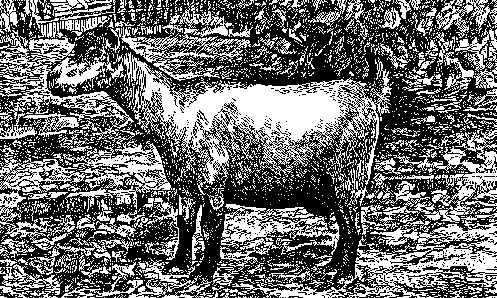
West African Dwarf doe in southwestern Nigeria