J.F.M. Onim,1)2) P.P. Semenye,1)2) and H.A. Fitzhugh2)
1. SR-CRSP, P.O. Box 252, Maseno, Kenya
2. Winrock International, Morrilton, Arkansas, USA
Introduction
Zonal problems
Overcoming nutritional constraints
Summary
Nutritional problems of small ruminants in five African ecological zones are described and analysed. Ways of overcoming nutritional constraints to increased productivity by a series of interventions are discussed. Possibilities include improved production of grasses, various methods (alley cropping, hedgerows) of introduction of legumes into the farming systems, the flattening of the food supply curve by means of conservation and the use of agro-industrial byproducts such as molasses and sugarcane tops. The use of urea and the provision of adequate mineral supplements are also discussed.
There are many species of small ruminants in the wild, including gazelles, impalas, antelopes and deer. The wild small ruminants are highly adapted to their various environments after thousands of years of natural selection. Domesticated small ruminants have, however, been protected by man to the extent that their adaptation to the environment is much less definitive and they appear to be susceptible to a number of constraints including nutritional ones.
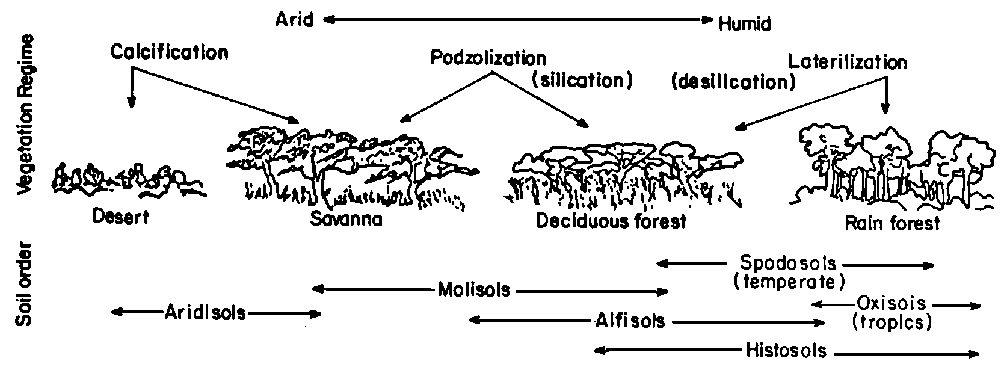
This paper on nutritional constraints to domestic small ruminants in Africa is based on ecological zonation into highlands, humid, sub-humid, semi-arid and arid areas (Figure 1).
HIGHLAND ZONE
This zone mainly covers the Ethiopian and East African highlands where the altitude ranges from 1500 to 4000 m, with a rainfall of over 1000 mm per year. Forage species that grow in this zone include grasses such as Pennisetum, Briachiaria and Panicum and legumes such as Desmodium, Medicago sativa and Trifolium spp.
There are few nutritional constraints to smallstock in this zone. Forage supply and water are adequate throughout the year. Animals are raised under a crop-livestock system with a well developed feed source from crop residues and planted forages such as lucerne for sheep in Morocco and Desmodium and clover in Kenya and Ethiopia.
Figure 1. Relationships among climate, vegetation and soil in Africa
Two nutritional constraints in this area are mineral deficiencies and antinutritional metabolic factors in some of the forages.
Selinium levels in the blood of sheep and goats have been shown to be below the minimum levels in various parts of Kenya (Mbwiria, Dickson & Bell, 1984). Similarly, sodium and phosphorus are also often inadequate from available feeds. Low levels of minerals in highland forages are a result of many environmental factors including the type and composition of the soil and leaching due to heavy rainfall.
An example of this leaching problem may be illustrated by the response of clover to phosphorus application in the Ethiopian highlands. It can be seen from Table 1 that an application of only 5 kg/ha of phosphorus increased DM forage yields by about 180 per cent among five local species and 300 per cent among exotic species.
Some factors that affect animal nutrition and effective metabolism of some of the nutrients in the feeds and forage may be found in some of the plants in the highlands. Examples of these include bloat causing factors that are often associated with lush growth. A good source of protein in the highland zone is lucerne: however, this forage has high levels of esters that can cause abortions in sheep if fed in large quantities.
Table 1. Maximum dry matter yields (kg/ha/day) for nine Trifolium species fertilized at different levels of phosphate
|
Species |
Phosphate applied (kg/ha) |
|||
|
|
0 |
5 |
10 |
|
|
Native:
|
T. quartinianum |
8.15 |
25.93 |
42.22 |
|
T. tembense |
8.30 |
17.50 |
23.33 |
|
|
T. decorum |
5.83 |
15.00 |
28.33 |
|
|
T. steudneri |
4.17 |
15.83 |
26.67 |
|
|
T. rueppellianum |
3.85 |
8.46 |
16.92 |
|
|
T. schimperi |
9.17 |
12.50 |
20.83 |
|
|
Exotic:
|
T. resupinatum |
0.74 |
2.96 |
2.96 |
|
T. subterraneum |
0.74 |
2.96 |
2.22 |
|
|
T. alexandrinum |
0.74 |
1.48 |
0.74 |
|
HUMID ZONE
This is a high rainfall tropical forest zone. Farming is mainly tree-food crop based. There are about 14 million dwarf sheep and goats in the humid West African zone alone. Table 2 shows that Nigeria has 65 per cent of all the sheep and goats in seven West African countries in this zone. Except for Ivory Coast and Guinea where there are slightly more sheep than goats all countries have more goats than sheep. For the seven countries as a whole goats outnumber sheep by 17 per cent.
Nutritional limitations to sheep and goats are poorly researched and documented. The major tree crops are coconuts (Cocos nucifera), cocoa (Theobroma cacao), cashewnuts (Anacardium occidentale), Kola nuts (Cola spp) and oil palms (Elaeis guineensis). The staple food crops are predominantly root crops - cassava, (Manihot esculenta), aroids and sweet potato (Ipomoea batatas) - and maize (Zea mays). Sheep and goats are mainly free-grazing but are tethered during the cropping seasons. Sumberg & Cassaday (1985) have reported that small ruminants also obtain a large proportion of their feed by scavenging in the villages and towns. The scavenging town smallstock, especially goats, thrive extremely well. It would seem therefore that the dustbin and market place scraps provide them with adequate proteins and energy. Their small size helps in that their feed requirements for maintenance and production are also small.
Table 2. Small ruminant populations (106) in humid West Africa
|
Country |
Small Ruminants |
||
|
Goats |
Sheep |
Total |
|
|
Nigeria |
5 621 |
3 476 |
9 097 |
|
Ghana |
1 200 |
990 |
2 190 |
|
Ivory Coast |
816 |
874 |
1 690 |
|
Liberia |
190 |
190 |
380 |
|
Guinea |
79 |
86 |
165 |
|
Sierra Leone |
59 |
20 |
79 |
|
Togo |
45 |
33 |
78 |
|
Total |
8 010 |
5 669 |
13 679 |
There are several ways of improving the nutritional plane of sheep and goats in the humid zone. These include: supplementation with forage legumes such as Gliricidia septum and Leucaena leucocephala grown, for example, as an alley crop; feeding high quality grasses grown in feed banks; and increased utilization of crop residues. Sumberg & Cassady (1985) have reported that lambs from dams which received supplementation with Gliricidia and Leucaena were 30 per cent heavier at 30 days old than those from non-supplemented dams. The ILCA humid zone programme has also demonstrated that through supplemental feeding with grasses like Panicum and Pennisetum from fodder gardens grown near homesteads, tethered sheep and goats have shown increased weight gains.
SUB-HUMID ZONE
The main characteristic of this zone is that it is predominantly one of food crops. Rainfall ranges between 750 and 1500 mm per annum. Human populations are generally denser here than in any other zone in Africa.
The dominant vegetation is deciduous trees with understories of a wide range of tall grasses, shrubs and herbs. Crop farming often takes large areas of land, thereby creating competition between livestock and crops. The little available land for grazing is therefore often overstocked, leading to overgrazing and soil erosion. A typical example of this zone may be illustrated by citing the work by the Small Ruminants-Collaborative Research Support Program (SR-CRSP) in western Kenya. Human population density in this area ranges between 300 and 900 people/km². Many families own less than 1 ha of land and forage available for livestock throughout the year fluctuates widely. There are severe shortage of feed from January to early April. When rains start, there should be adequate forages for the rest of the year, with surpluses from June to August.
SEMI-ARID ZONE
This zone covers approximately 60 per cent of Africa and it has the greatest potential for smallstock development; smallstock are raised mainly by pastoralists. A small proportion are, however, produced from commercial ranches. Rainfall in the semi-arid zones is bimodal in East Africa and unimodal in southern and western Africa. The rainfall range is 200-700 mm. Where degradation is not yet a problem the grasses are perennial and are mainly Hyparrhenia, Digitaria, Chloris, Pennisetum and Themeda species. The woody vegetation is dominated by acacias.
The major nutritional limitation of the semi-arid zone is that of bridging the gap between wet and dry seasons. In the wet season forage is of high quality but because of the high temperatures rapid physiological maturation follows, leading to early lignification. In the dry season the forage is of very low quality with a crude protein content of less than seven per cent and an IVDMD of less than 45 per cent. Small ruminants in this nutritional status cannot meet energy requirements for maintenance. Ewes and does lactating at this stage have to mobilize their body reserves for milk production.
Pastoralists have traditionally been able to regulate grazing by designating grazing areas as either wet or dry. Recently, due to rapidly increasing human populations, much pastoral land has been taken for cropping and consequently mobility has been curtailed, leading to a severe reduction of their grazing area. In addition, legislation such as the Group Ranch Act of Kenya has forced pastoralists to settle. As a consequence of increased sedentarization overstocking has resulted, accompanied by overgrazed areas around the settlements.
ARID ZONE
Approximately 25 per cent of Africa is made up of arid zones that are essentially deserts. Cropping without irrigation is not feasible and the only possible form of livelihood is raising of livestock. In these deserts there are acute shortages of forage and water. Smallstock in these zones generally have a low dry matter intake although there are often high concentrations of protein in their diets.
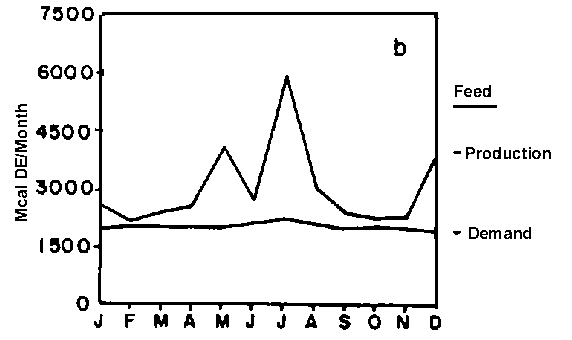
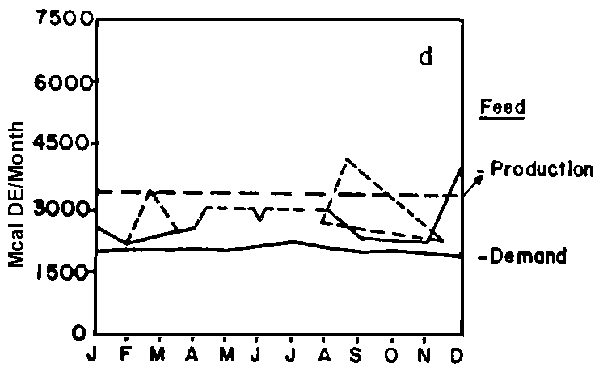
One way of overcoming feed shortages during the dry season is by introducing interventions like planting feed banks and alley cropping forage with food crops or intercropping forage with food crops or hedgerow cut-and-carry forages (Onim et al, 1984). In western Kenya, these interventions improve the feed supply from a monthly average of 2250 Mcal of DE to 3500 Mcal of DE (Figure 2). However, where there is no feed conservation method developed, this improved feed situation cannot benefit the livestock throughout the year because of a poor distribution profile. It is therefore important to develop a suitable conservation method for small scale farmers.
Comparison of traditional and improved technologies on a one-hectare farm in western Kenya
Existing situation
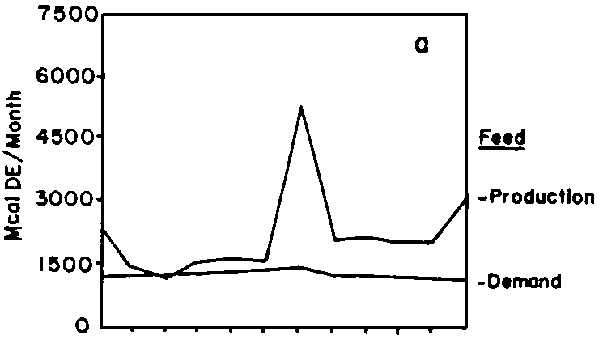
Existing + new forage interventions
Existing + hay baling
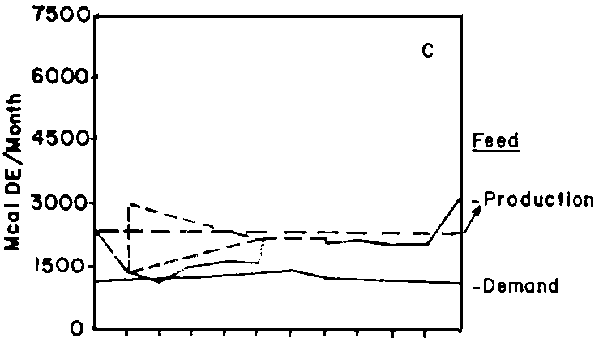
Existing + new forage + hay baling
If surpluses are conserved by deferred grazing or by hay baling or making into silage, these could be fed during periods of feed shortage. Hay baling is perhaps the easiest method. Results in western Kenya (Onim et al, 1985) show that a simple hay baling box is not only accepted by small scale farmers but is also very effective. The only materials required are a wooden box, a grass cutting sickle and sisal twine. One family can make 10 bales each of 20 kg in one month on a part time basis, and four bales a day on a full time basis.
Grasses and legumes are cut and left to dry in the field for two to three days. These can then be baled either in the field or at home. Forages that have been successfully baled include grasses and legumes. The quality of the hay remains good as long as the bales are stored in a dry place. Pigeon pea (Cajanus cajan), Sesbania and Leucaena leaves can be made into a fine leaf hay with a CP content of about 26 per cent. Fresh twigs of these forage legumes are cut and placed on a mat, on a polythene sheet or on cleared ground. After about 12 hours in the sun, the leaves drop and are collected and bagged for future use as feed supplements.
When hay baling is added to in the traditional feed situation, the monthly feed distribution changes from about 2250 Mcal of DE with severe fluctuations to the same figure but stable throughout the year. Similarly, when hay baling is used in the traditional feed supply with improved feed interventions, then the monthly feed distribution changes (Figure 2).
Further improvements have been made to the feed supply by increasing the use of food-forage crops. Onim et al, (1985) have shown that selected cultivars of sweet potato in western Kenya can yield 21 t/ha of fresh tubers and 10 t/ha DM of vines with a CP level of 19 per cent in a period of eight months. Another food-feed crop is pigeon pea. Henke, Work & Burt (1940) have reported that when pigeon pea was grazed by cattle in Hawaii over a period of 179 days, the liveweight gains (kg/ha) were 248 as compared to 140 when the animals were on a mixed pasture of high quality grasses (Pennisetum clandestinum, Chloris gayana and Anoxopus compressus). Whiteman & Norton (1980) have listed 32 references on the uses of pigeon pea as a forage crop for goats, sheep, and cattle. Several other crops that fall into this category include maize, sorghum, pearl millet, finger millet, and cassava. Although cereal stovers have low DE, they can provide maintenance requirements to livestock. The use of sorghum and pearl millet stover in Nigeria's humid zone as a vital source of feed has been reported by Powell (1984).
The potential role of sugarcane tops as a forage could be widely exploited in this zone. Dry matter yields in western Kenya are over 40 t/ha at harvesting. Although this material has high fibre content, it has a mean IVDMD of 45 per cent and a mean CP of 7.6 per cent. These results indicate that sugarcane tops are comparable in quality to medium quality range grasses and hence can constitute a vital source of livestock feed. Sugarcane belts in Africa also have large supplies of energy-rich molasses (Preston, 1985). By using cane tops in conjunction with molasses and nitrogen-rich legumes a high quality nutritional plane is realisable.
It is important that small ruminants have access to adequate quantities of forages and feeds. The available pastures and browses may not provide adequate feeding at certain times of the year. Supplementation is then the answer. This may take simple forms like utilizing deferred pastures, lopping branches and providing leguminous tree pods to smallstock. It may also take more sophisticated forms such as utilization of conserved materials like silage, hay, crop residues and food processing by-products. Any form of supplementation intensifies management but it also increases productivity of the livestock. The economics of such supplementations must be worked out for each situation.
Inadequate levels of CP in most feeds is the most important nutritional constraint in smallstock. The use of urea as a source of nitrogen has been advocated. However, this is a product that is expensive and may not be available to the majority of smallstock producers in Africa when they need it. We strongly advocate increased use of tropical forage legumes as excellent sources of nitrogen (CP of about 26 per cent) that are cheap to produce by smallstock producers even in the humid and semiarid parts of Africa.
Some of the plant nitrogen sources may, however, have antinutritional and antimetabolic problems. These include hydrogen cyanides (HCN) in cassava and sorghums, esters in clovers, and mimosines in some legumes. There are two possible solutions to these problems: scientists should collect and screen germplasm of species with high CP for lower levels of such factors; or find mechanisms of rendering such factors harmless to ruminants. An exciting example of this is the use of mimosine degrading rumen microbes in goats (Jones & Lowry, 1984). These microbes have been found in the rumens of goats in Hawaii and South East Asia but not in Australia. However, when rumen liquor from the mimosine resistant goats was infused into the Australian goats, they were immediately able to consume large quantities of Leucaena without any harm. Multiplying and infusing these microbes into experimental goats and perhaps even sheep in Africa may also increase their consumption of mimosine containing plants and hence productivity.
Energy is the second most important nutritional limitation to ruminants in Africa (Preston, 1985). Much research has been done on the use of crop stover and residues by treating them with sodium hydroxide (NaOH), urea, etc., to make them more acceptable to ruminants. It should, however, be borne in mind that both NaOH and urea are not only expensive but also very corrosive. Using them therefore requires knowledge which small scale farmers may not have. Less corrosive alternatives like soda ash (sodium carbonate) may be used with the same results. We feel that by baling good quality hay and feeding by-products like molasses, brewers' wastes and grain bran whenever available, energy needs of smallstock for maintenance and production can be met. Finally, mineral needs of smallstock should be met by using traditional salt licks where possible, and encouraging the use of commercial mineral licks.