1. The problem
2. Objectives of the study
3. The semi-arid zone
4. Mixed farming systems
5. Environmental management
6. Approach of the study
ILCA's interest in semi-arid mixed farming systems arises from the following arguments (ILCA Project Document, 11 April, 1988):
(1) mixed farming systems are of large and growing importance, not only because existing systems are expanding, but also because formerly specialist livestock or crop production systems are diversifying into crops and livestock respectively;(2) environmental degradation is believed to be proceeding faster in the semi-arid zone (SAZ) than in other ecological zones; and livestock have an important influence on this process;
(3) real household incomes are believed to be low and declining; while livestock make a very significant contribution to incomes, directly through milk and meat output and other products, indirectly through manure, traction and other interactions with crop production, and as investments; and
(4) there is a high potential for improved livestock technology targeted on improving productivity, stability, and sustainability of the farming systems.
McIntire, Bourzat and Pingali's study, Crop livestock interactions in sub-Saharan Africa (1989), is based on the fundamental hypothesis 'that different agroclimates and population densities make possible, and sometimes compel, specific interactions'. In spite of many project failures in livestock development, it is considered that 'the potential for integrated crop and animal production is high. What is required is appropriate analysis of the sequence in which interactions become profitable' (1-2,3). That study systematically investigates, in turn, livestock investment, animal traction, soil fertility maintenance, feed resources, animal production and byproducts. A two-dimensional analytical matrix of agroclimatic zones and population density is used. The analysis is organised around three economic relationships: (i) resource competition between crop and livestock production; (2) complementarily between the two activities; and (3) the circumstances promoting the evolution of mixed farming. The SAZ is one of five agroclimatic divisions of Africa identified by Jahnke (1982). The others are: the arid, subhumid and humid zones, and the highlands. Mixed farming systems are supposed not to occur in the arid zone.
Following Jahnke's continental study of livestock production systems (Jahnke, 1982), and McIntire et al's systematic analysis of crop-livestock interactions and integration, there is now a need for an analytical review of the SAZ. Such a review is justified by the proportional importance of its livestock and human populations, its extent, and its diversity.
The objectives of the present review are twofold:
(1) to regionalize the SAZ, on the basis of agroclimatic and other environmental parameters relevant to livestock production, into environmentally homogeneous units, to which particular mixed farming systems may be assigned.(2) to propose a taxonomy of mixed farming systems; inventory a range of representative systems that are characterised in the literature; and review contemporary trends with respect to environmental management.
The Study is intended to facilitate the targeting of ILCA's research programmes. It is assumed that such research is addressed to the following two objectives (among others):
(1) productivity - to increase output per hectare of livestock products and crops;(2) sustainability - to maximise economic and ecological sustainability in the management of natural resources.
The Study provides environmental and farming system data to assist in the identification of recommendation domains for livestock development.
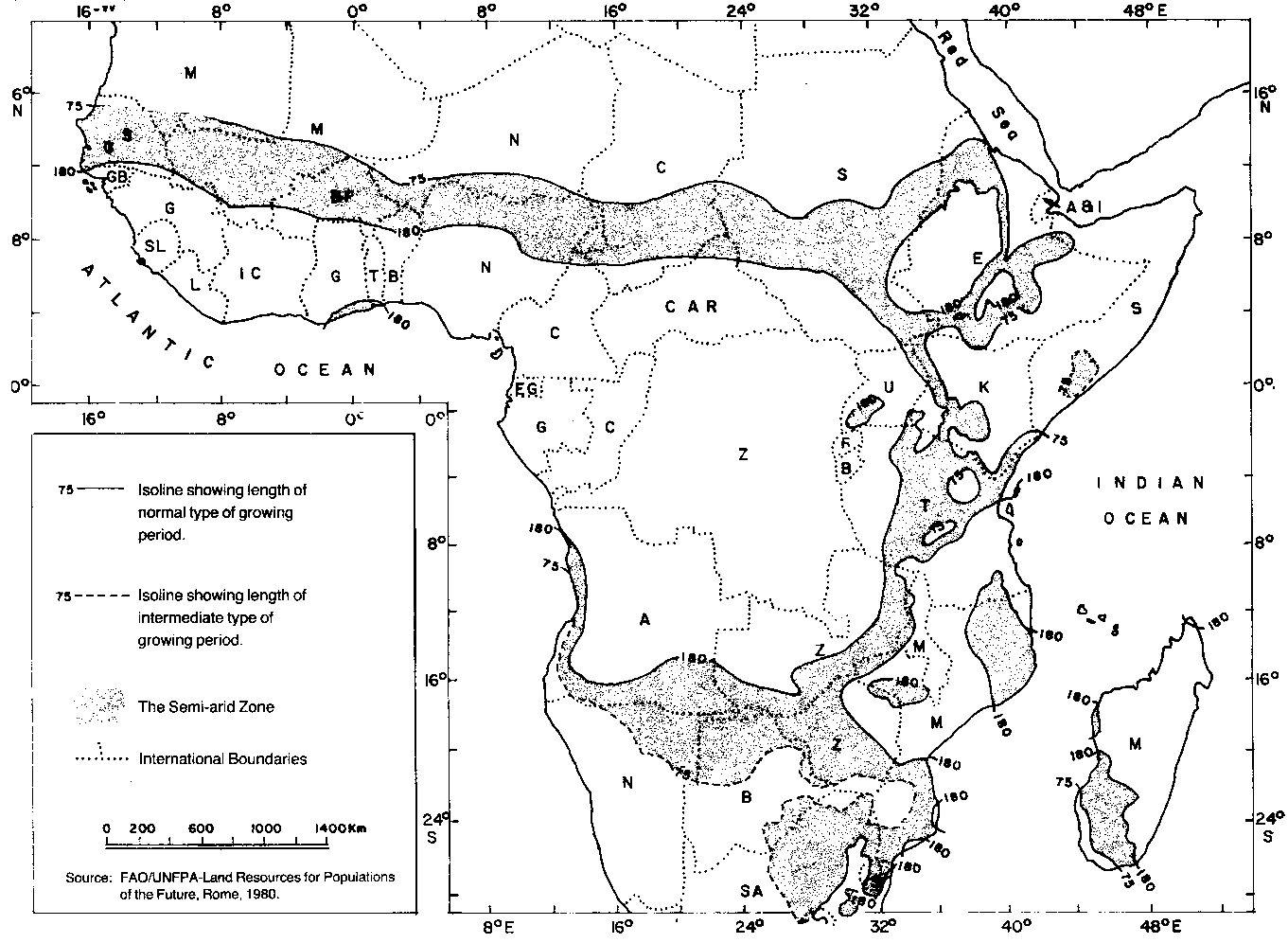
The SAZ is defined by the FAO (1990) as having an annual growing period of 75-179 days. The growing period consists of the humid period, when precipitation (P) exceeds potential evapotranspiration (PET), plus the periods at the start and end of the rainy season when P ³ 0.5 PET, plus the time taken to transpire 100 mm of stored soil moisture (FAO, 1980: 357). Figure 1 shows the SAZ according to this definition. A normal growing period includes a humid period. But in some areas, while there is no humid period (precipitation exceeding PET), there is a period when £ 0.5 PET. This is an intermediate type of growing period. The SAZ is subdivided by the FAO into dry semi-arid (75-119 days' growing period) and moist semiarid (120-179 days). This subdivision is shown in Figure 2.
This definition calls for the revision of that used by Jahnke (1982) and McIntire et al (1989), namely 90-180 days. For ILCA's purposes the new FAO definition is the more appropriate since mixed farming systems occur in the 75-89 day zone, which do not differ in any important respect from those in the 90-119 day zone, and which would otherwise be left out of consideration under the present ILCA policy to de-emphasize work in the Arid Zone (ILCA, 1987). The subdivision into dry and moist semi-arid zones also represents a useful advance on ILCA's provisional delimitation, since there are significant differences between them in cropping potential, pasture productivity, woodland composition and agricultural risk along the ecological gradient.
Jahnke (1982: 17) provides in diagrammatic form an approximate correspondence between his definition and ecological classification schemes used earlier by Chevalier, Aubreville and Keay in West Africa, and by Pratt and Gwynne in East Africa. The exercise demonstrates the scope for differences of judgement. Another scheme, not considered by Jahnke, is that devised by UNESCO and WMO for the World Map of Desertification (UNEP, 1977). This is based on an aridity index (P/ETP - precipitation over evapotranspiration, calculated by Penman's method).
Figure 2. The SAZ of Africa, defined by the 75-179 days LGP, and subdivided into dry and moist sub-zones (FAO, 1982; 1990). In the Cape area, the 75 day isoline is absent and the 90 day is shown instead.
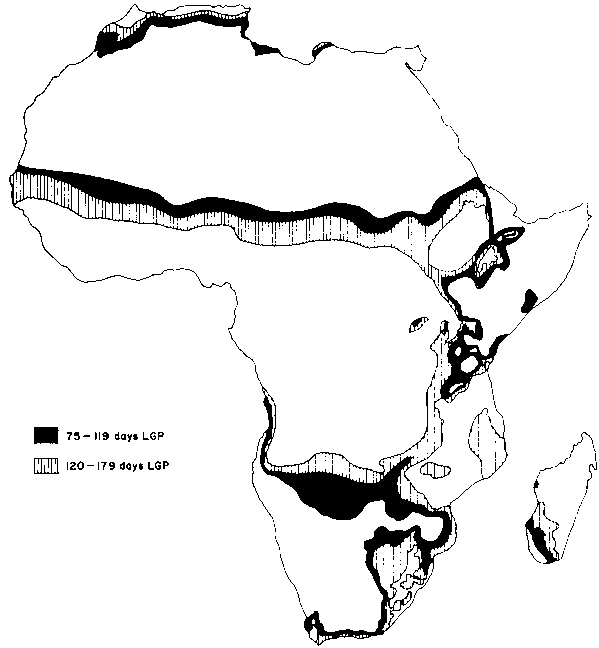
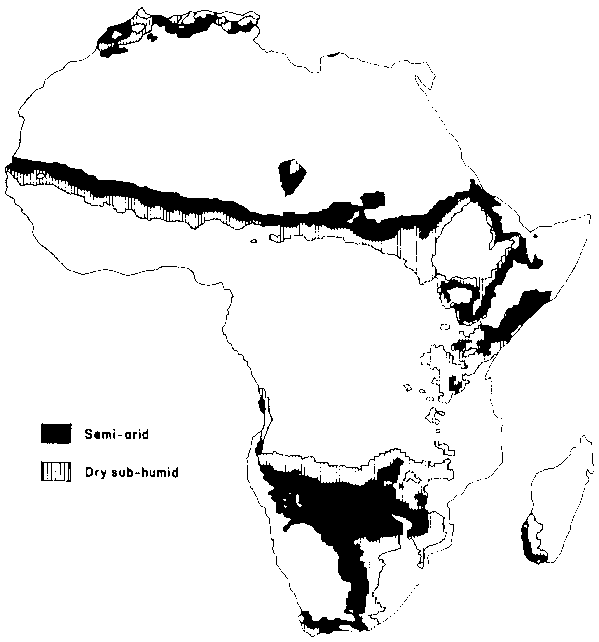
The SAZ is defined by the range 0.20-0.50, and the lower value is stated to correspond to the dry boundary of rainfed agriculture. Subsequent development of this index for the computerised Global Environment Monitoring System (GEMS) permits an intermediate boundary to be added at 0.35, identifying semi-arid (0.20-0.35) and dry sub-humid (0.35-0.50) sub-zones. (Data provided by the Director, GEMS, UNEP, 1990). These zones are shown in Figure 3. A close inspection of Figures 2 and 3 reveals substantial differences in the patterns when individual country perspectives are taken into account.
The existence of alternative definitions is not the only source of uncertainty. The nature of most ecological transitions in Africa has been compounded in recent years by significant shifts in annual isohyets. The FAO growing period zones are based on data series ending about 1975. Partial updating of the growing period zone isolines is presently under way for the Sahel (Land and Water Division, FAO). Therefore farming systems may overlap from one agroclimatic zone, as scientifically defined, into another. This has practical implications for demarcating recommendation domains. One instance is important enough to be mentioned here. Rainfed farming systems are occasionally found on the arid side of the SAZ - as defined by 75 growing days. Such systems have important livestock components; and share the basic characteristics of farming systems within the SAZ. Therefore, all rainfed farming systems (with livestock components) occurring beyond the dry boundary of the SAZ are included within the scope of the present Study. (See Appendix 2 for a note on livestock on irrigation schemes).
The noteworthy spatial characteristics of the SAZ in Africa are:
(1) its continuity and latitudinal orientation in the northern and southern tropics (between approximately 10° and 16°N; 13° and 21°S);(2) its north-south orientation and irregular disposition in association with the highland zone of eastern Africa; and
(3) its incongruent relationship with political boundaries, only one small country (The Gambia) falling entirely within it, and most others containing larger areas of wetter, or drier territory.
Figure 3. The semi-arid and dry sub-humid zones of Africa, defined by UNEP/GEMS/GRID.
Using his definition of 90-180 days, Jahnke (1982) estimated that the SAZ contained the following human and livestock populations.
|
|
Total (000s) |
Percent of Tropical Africa |
|
Human agricultural population |
65,735 |
28 |
|
Cattle |
45,454 |
31 |
|
Sheep |
23,071 |
22 |
|
Goats |
33,215 |
27 |
|
Ruminant livestock units (TLU) |
37,446 |
27 |
|
Total area (km2) |
4,050 |
18 |
Definition and scope
The value of the livestock component
Livestock and intensification
Household viability
For the purpose of this Study, mixed farming systems are understood to exist where both livestock and crop production take place within the same locality, and where ownership of crops or land and livestock are integrated. However, where specialised livestock production takes place in the same locality as crop production, subject to resource-sharing (e.g. grazing of residues), but under separate ownership, such systems may be included. Such flexibility is necessary because of the variety of arrangements that exist covering access to ownership, and management of land and livestock. It should also be noted that some mixed farming systems make use of farm trees for fodder.
No smallholder farming systems have been found in the SAZ lacking a livestock component. Livestock ownership is valued by farmers because it offers the following utilities:
(1) investment capital, available for use in contingencies, relatively divisible;(2) individual wealth creation (including for women);
(3) recurrent income (milk, meat and other products);
(4) manure; (which, if supported by on-farm fodder, re-cycles nutrients at lower cost than inorganic fertilizers);
(5) energy (traction, transport); and
(6) productive uses for farm residuals (crop residues, browse, weeds, boundary plants, uncultivated grassland).
It may be hypothesized that where feed resources, and household wealth, allow, some livestock populations will tend to rise along with the human population, on a per ha basis. Where common property grazing resources are available, the principal constraint on livestock holdings, at the level of the individual household, is likely to be not farm feed supply, but poverty, either necessitating sales, or precluding purchases of animals. It does not seem easy to establish whether a farming system is overloaded with livestock, or can accommodate more animals.
Livestock provide a least-cost route to intensification through their role in nutrient cycling, especially if inorganic fertilizers are increasing in cost. Although mulching and residue incorporation offer technically efficient alternatives, it is unlikely that they are as efficient in their use of labour (McIntire et al, 1989) and they offer none of the additional benefits of livestock ownership (13 above).
The upper limit to nutrient cycling by livestock is set by the amount of feed that the system can generate, or purchase with the proceeds of market output. The upper limit to crop output is set by the fertilization provided by the animals, or purchased with the proceeds of market output. How far such an integrated system can go under smallholder conditions in the SAZ is not known. It is widely believed that animals depend mainly on natural pastures, and the declining quantity and quality of these prevents the production of adequate manure for sustaining yields on arable land.
Recent drought experiences in Africa have emphasized the complementary roles of livestock and crops in maintaining household viability. During crop failures, livestock offer diversified economic options and support smallholder resilience. On the other hand, livestock specialists who have lost all or part of their stock may take up or increase their commitment to farming.
In some areas, increasing privatization of grazing or other resources by capitalized entrepreneurs is supporting intensified market integration in the livestock sector, and at the same time restricting access to these resources by smallholders. Households that specialise in livestock may become marginalised, that is to say their livestock holdings fall below the threshold of household self-sufficiency. Mixed farming offers such households a more productive mode of using land (where it is scarce), more defensible access to resources, a more diversified (and hopefully, resilient) household economy, and an alternative source of investment funds for rebuilding livestock holdings.
Intensification vs degradation
Land - Physical
Land - Institutional
There is now an increasing awareness of the risks of environmental degradation in the SAZ. This justifies a holistic approach to mixed farming systems and their impact on the environment. While animals are often blamed for degradation, they may, on the other hand, be an essential component of intensification, which creates in turn the economic conditions for conservationary land management.
Much past expansion in the commercial output of both crops and livestock has been supported by increased use of land at low inputs of capital and labour. With the diminution of unoccupied land, the transfer of increasing areas of natural vegetation to arable, and intensified competition between grazing and cultivating systems for the available land, farming systems are confronted with a choice between:
(1) a degradational pathway - increasing the frequency of use without additional inputs, failing to replenish soil chemical properties or to conserve physical properties, and(2) a conservationary pathway - increasing inputs, especially of labour, to maintain or raise productivity per ha.
The literature on the SAZ alludes frequently to two kinds of system-crises:
(1) The crisis of pastoralism is the loss of land (via alienation, and arable encroachment, compounded in some areas by private ranching enclosures) plus the growth of human and livestock populations - a Malthusian trap, except where possibilities for dispersal exist.(2) The crisis of extensive farming is the shortening of fallow cycles in relation to the restorative needs of the soils, together with the reduction of the ratio between common property (or open access) natural grazings, on the one hand, and private arable fields, on the other, on which ratio the system of nutrient transfers by means of livestock coralling on arable land depends. Soil fertility is thus expected to decline on both permanent and rotationally fallowed fields.
It is important to determine the extent to which crop-livestock integration offers solutions to these perceived crises. With regard to the crisis of pastoralism, in areas with adequate rainfall to support farming (i.e. the SAZ), there is evidence that smallholder mixed farming is emerging. With regard to the crisis of extensive farming, evidence from the Kano Close-Settled Zone, Nigeria (Mortimore, 1990) suggests that mixed farming (agro-forestry with livestock) can be sustainable under indigenous technical practice in the medium term. The replicability of such a system in other parts of the SAZ, and under drier rainfall conditions, is not known.
The choice of pathway, therefore, is not only relevant to environmental management per se but gives an indication of the future evolution of the system under conditions of continuing population growth.
Land is differentiated locally in terms of the catenary sequence from interfluve to valley bottom. McIntire et al (1989) argue that 'as population densities increase, people intensify production on the mid to upper slopes, move to marginal lands in the upper slopes, or move down the slope. Each option implies some investment in erosion or water control. Typically, the payoff to these investments is highest on the lower slopes and valley bottoms. Therefore, where lower slopes and valley bottoms are available, population growth induces intensification on those lands'. There is much evidence to support this thesis of intensification down the catena, as densities rise.
The corollary is that marginal land on the upper slope, which is more exposed to erosion under natural conditions and may contain hardpan, rock outcrops or thin stony soils, becomes a residual category, because it provides the lowest payoff to intensification. It is often this land that provides visible evidence of degradation in the form of bare surfaces, soil stripping, surface gravel or rock and degraded vegetation communities.
Such residual land is grazed by livestock during the wet season, when the stock must be kept off farmlands, rather than during the dry, when crop residues and valley bottom grazings offer superior nutrition. Neither 'improved' management nor rehabilitation is economic under prevailing conditions; only further increases in population density and prices can create suitable conditions. This case explains why costly schemes to stabilise sand dunes or rehabilitate degraded soils may have little attraction for local resource managers.
The degradation-conservation spectrum is therefore likely to exhibit much local variation, according to the intrinsic properties of different categories of land, and the way these are perceived by the resource managers.
Land is subject to conflicting claims, for example as potential arable (farmers), as grazing, fodder or browse (livestock producers), or as a source of wood fuel, medicines or food (householders). One person's grazing is another's irrigation opportunity. The resolution of such competition may call for complex rules of access within the bounds of a single farming system, as in the following hypothetical example:
|
Use category |
Access |
|
1. compound and garden land |
privatised |
|
2. permanent arable land |
privatised cultivation common or open access grazing |
|
3. intermittent arable and fallows |
private or common access cultivation; open access grazing, wood and fodder collection. |
|
4. grazing land |
open access grazing, wood, fodder collection |
|
5. valley bottom land(shallow dry season water table) |
privatised cultivation, common access grazing |
|
6. Residual, waste, marginal land |
open access. |
(NOTE: common access is restricted to community members; open access is unrestricted.)
In addition, over large areas of the SAZ, community access is subject to legislative restrictions imposed by national or local governments in order to separate ethnic claims to territory. Such restrictions are common in eastern and southern Africa, where not only was land (much of it high potential) alienated for European settlement, but also it has been the practice at various times and places to confine ethnic groups to rangeland territories - for example, in Kenya and in Southern Ethiopia. By contrast, in large areas of the west and north, the division of land between farming and pastoral specialists, or amongst farmers, is subject only to customary allocative control.
The existence and nature of confining boundaries should not be ignored in examining questions of environmental management. Furthermore, the status of customary land tenure is fluid in several areas. Under present economic and political conditions, this should cause concern, especially where farming systems with a livestock component are concerned.
The approach of the present Study is to inventory and review the mixed farming systems of the SAZ, in a typological framework, and to disaggregate the SAZ regionally on the basis of agro-climatic and other environmental criteria. An attempt will then be made to marry these two lines of investigation in terms relevant to ILCA's needs.
Chapter 2 reviews alternative bases for a typology of mixed farming systems. In Chapter 3 the regional disaggregation of the SAZ is described. Chapter 4 reviews and classifies the mixed farming systems. Conclusions and summary are in Chapter 5.