1. Levels of analysis
2. The need for a typology
3. Functional farming systems
4. Economic specialisation, or livestock dependency
5. Patterns of movement
6. Livestock ratios
7. Animal traction
8. Crop-livestock integration
9. Farming intensity
This chapter discusses the conceptualization of the farming system with reference to the livestock component and reviews some alternative typologies that have been employed or proposed. A typological framework that is consistent with ILCA's objectives is then outlined.
It is essential to clarify the conceptualization of the farming system as it relates to the objectives of the present Study.
Farming systems may be analysed at four levels (Tourte, 1984):
1. the field or flock/herd
2. the management unit ('unité de production ou exploitation')
3. the community ('collectivité rurale')
4. the territory ('petite région naturelle' or 'grande région')
At the level of the management unit, livestock and crop production may be regarded as subsystems of the same farming system. Traditional farm management studies operate at this level, and extension services are aimed at decision makers at this level, who are responsible for factor allocations. According to Jahnke (1982: 5), the individual farm Unit is the 'building block' of a production system: 'A livestock production system in the simplest sense is then nothing but a group of similar management units'.
There are however, four reasons why neither of the first two levels is adequate for the analysis of farming systems having a livestock component in the SAZ.
(1) External resources. Livestock operations depend heavily on resources (common or open access grazings, browse, and water) outside the arable farm. At the level of the household or management unit such resources have to be treated as externals whose boundaries and capacity, because shared, cannot be defined. Yet they are not infinite*, and the manner of their use has an important bearing on the sustainability of the system. Cook et al (1984) argue that household-oriented approaches, if they fail to investigate the impact of these externalities on households and their feedback relationships, may run the risk of promoting interventions that contribute to the degradation of the environment.* Unlike the market, which is also external to the household system, and other unmeasurable 'environmental' externals.
(2) Definition of units. At the level of the household, Boulier and Jouve (1988: 55) distinguish four units: residential, consumption, accumulation and production units. They show how among six ethnic groups in West Africa, three different conformations of these units are found, and in only two of the groups are all four units coextensive. These differences have extension implications.
(3) Bounds of units. In livestock management, loaning, sharing, entrustment and other transactions are common; an owner sometimes does not manage all or any of his livestock and a manager may not own all or any of his flock or herd. Furthermore, patterns vary between seasons and from year to year.
(4) Economic differentiation. It is well known that livestock ownership tends towards inequality, notwithstanding various mechanisms for redistribution within the community. This arises from the fact that livestock are (a) a form of investment producing a current income (in which they resemble farm land) and also (b) a self-reproducing asset (in which they differ from farmland). Inequality may be expressed both in the numbers of livestock (e.g. cattle) owned per household or per individual, and in the type owned (cf. cattle versus sheep or goats). In mixed farming, livestock may be owned by all or by only some farm units, whereas it is uncommon within an ethnic group for land ownership to be similarly restricted. Thus the presence of a non-owning sub-group, and the greater and cumulative inequality that often characterises livestock ownership, differentiates the livestock component from the crop component of a mixed farming system. It makes poor sense to exclude non-owning units from the production system, since they live among the livestock owners, interact with them, and may re-enter or drop out from the livestock-owning segment from year to year.
For these reasons it may be questioned whether 'management units which are similar in their structure and in their production functions' accurately describes mixed farming households, and whether they can simply be grouped into an hierarchical farm system (Jahnke, 1982: 52). The concept of the system has to incorporate diversity even competing interests, at the level of the community.
The community level, on the other hand, allows common access resources to be explicitly quantified and their management institutions to be identified. At this level, conflict or competition in the demand for common access resources must be resolved. The community (a village, hamlet, clan or kinship group) has rights to arable land, grazings, woodland, water and wildlife in areas that may not necessarily be contiguous. But in principle, the community system is capable of analysis in terms of soils, hydrology and agro-climatic potential.
At the level of territory. In addition to the diversity contained at the level of the community, functionally or ethnically distinct communities cohabiting a given area for a part or all of the year (e.g. Fulani nomadic cattle breeders and Hausa sedentary farmers) may be analysed explicitly in terms of interaction, contracts, competition and complementarily in resource exploitation. Open access resources must be addressed explicitly at this level of analysis. Environmental and agro-climatic potential can be related to human and livestock populations, and ecological sustainability. Such a territory may be defined as an agro-climatic unit, a river basin or ecosystem; or as an administrative unit.
From the practical standpoint of livestock production and environmental management, a level of analysis higher than that of the single management unit is desirable, for the following reasons:
1. Livestock, being mobile, are not confined within the boundaries of the farm unit, and may graze or be fed on feed obtained from resources exogenous to the farm unit, but within the community area of territory.2. Common or open access resources are subject to management decisions and regulations which are derived from custom, negotiation, or administrative dictate at the community or territorial level, and these are relevant to the question of sustainable resource management.
3. Interactions amongst dissimilar livestock and non-livestock breeding communities, exploiting ethnically or functionally defined niches in the same ecological territory, are also relevant to defining the impact of livestock on the environment.
4. Discrete territories may be used, not only by individual livestock keeping units, but in combination with others; the concept of the system has to take in such spatially dispersed patterns of resource use.
From the standpoint of environmental management, the territorial level of analysis is appropriate, and later in this study a framework of agro-ecological units is proposed for this purpose. Except where a single community operates a homogeneous farming system, such a territory will encompass a mix of farming systems. From a systems typological standpoint, the extent of dissimilarity amongst systems that may exist in a single territory is unmanageable, and therefore the community level is preferred. The level of the single management unit is only appropriate when crop-livestock integration is complete and the use of common or open access resources insignificant.
The levels described above are defined in terms of area as follows:
|
Management unit: |
area over which a management unit exercises controlling rights (residence, arable, fallows) |
|
community: |
areas controlled by constituent management units plus common access resources where community members exercise customary rights (grazings, woodland, river valleys.) |
|
territory: |
area however defined, used by one or more communities, including community areas, plus open access resources subject to no community or management unit control (though customary usage by migrants of grazing or other resources may acquire some recognition). |
Water resources for livestock may be controlled at the level of the management unit or the community, or be uncontrolled under open access; this has many implications.
In their current phase, four of ILCA's six research thrusts are planned to have substantial involvement in the SAZ (ILCA, 1987):
1. small ruminant meat and milk
2. animal traction
3. animal feed resources
4. livestock policy and resource use.
Recurrent themes in the research topics proposed for these thrusts are:
1. production systems, crop-livestock integration and productivity
2. feed resources and management
3. technologies, including draft
4. breeding, reproduction
5. stability and sustainability
6. markets, prices, credit.
Given such a diversity of research objectives, it is legitimate to ask whether a multipurpose typology is a practicable objective. It cannot serve every need.
The justification for a typology arises from the need to order diversity, as a step towards improved understanding. It is known that livestock producers in the SAZ vary on at least seven scales:
1. household dependency on livestock
2. market integration of the livestock enterprise
3. herding movements
4. interactions with farmers
5. integration of crop and livestock production
6. size (and value) of livestock holdings
7. types and breeds of animals kept.
However Jahnke's advice is that to derive groupings from 'a theory of their differentiation (e.g. the distance from the market or factor proportions available) results in a typology that reflects too narrow a spectrum of reality... judgement and pragmatism must still take precedence over principle and rigour' (Jahnke, 1982: 4). Jahnke therefore adapts Ruthenberg's functional classification to the specifications of livestock production. Before following down this road of theoretical agnosticism, a brief review of some available topologies is given.
This review concludes that a number of existing or proposed typologies the functional farming systems of Ruthenberg, classifications based on economic specialisation or livestock dependency, typologies of herd movements, systems based on livestock ratios or characteristics of animal traction - have either theoretical or practical limitations from the standpoint of the present Study. A proposal is made to develop McIntire et al's (1989) sequence of crop-livestock interaction and integration into a tool for inventorying mixed farming systems. But the large number of component elements make an aggregated 'integration score' rather meaningless. Finally, a typology based on farming intensity is proposed, which includes four major types: intensive farming, enclave grazing, enclave farming and grazing. Such a typology has a strong theoretical basis and provides a framework for assigning environmental sustainability ratings to mixed farming systems.
Ruthenberg (1980)used a 7-fold typology of tropical farming systems in which crop-livestock interactions may be summarised as follows:
|
System |
Interactions |
|
1 Shifting cultivation |
few livestock in the forests large scale animal rearing in the dry savannas (no reference to interactions) |
|
2 Fallow systems |
livestock ownership restricted communal use of feed resources (grazing, fallows, residues) manuring exceptional degeneration of livestock performance/condition when feed becomes scarce |
|
3 Ley and dairy systems |
livestock ownership widespread privatized grazing on enclosed holdings improved cattle breeding intensive fodder production |
|
4. Permanent upland cultivation |
livestock ownership widespread traction and manure used residues used grazing, fallows scarce entrustment for seasonal transhumance fodder crops uneconomic substitution of small livestock for cattle |
|
5. Arable irrigation |
cattle not intensively organised large numbers, poor performance |
|
6. Perennial crops |
(no reference to livestock) |
|
7. Grazing systems
|
a. total nomadism |
|
b. semi-nomadism with little or no supplementary arable |
|
|
c. ranching |
Ruthenberg gives livestock no integral role in his classification of farming systems, nor in the evolution from less to more intensive systems which is implicit in his typology. No explicit recognition is given to 'mixed farming systems', though they receive special mention as a separate class in an otherwise similar classification proposed by McDowell and Hildebrand (1980). Livestock are rarely differentiated: cattle most often seem to be implied by the context. Types l, 2, 4 and 7(b) occur in the SAZ and may qualify for the designation 'mixed farming'. But this general functional typology is not ideal for present purposes because it does not derive from differences in the livestock component of the systems, nor from the nature of crop-livestock interactions, but from differences in cropping practice. Its implications for environmental management are not clear either.
Jahnke (1982: 7), however, follows Ruthenberg in proposing the following five classes of livestock production systems in tropical Africa:
1. Pastoral range systems
2. Crop-livestock systems in the lowlands
3. Crop-livestock systems in the highlands
4. Ranching systems
5. Landless livestock production systems.
The interest of the present study mainly concerns the second class, and then only in the SAZ. Jahnke does not propose a subdivision of this class but suggests four gradients, that could conceivably be used as the basis for such a subdivision:
1. agroclimate (cropping system),
2. population pressure (cultivation intensity)
3. tsetse challenge
4. livestock dependency (density, species)
The first three will be incorporated in the environmental disaggregation of the SAZ (Chapter 3); the last is considered below.
Wilson et al (1983), working in Mali, recognise three classes of dependency on livestock on the basis of household revenue or food energy derived from livestock-related activities;
|
1. pastoral |
> 50% gross household revenue or > 20% food energy |
|
2. agro-pastoral |
10-50% gross revenue (i.e., > 50% derived from crops or non-agricultural activities) |
|
3. agricultural |
< 10% gross revenue (i.e., > 90% derived from crops or non-agricultural activities) |
Gross revenue is defined as the value of subsistence plus marketed production, plus the value of transport animals, traction and manure. The study was carried out in Mali, but Swift (nd: 1990?) has proposed to generalise such a classification.
For present purposes, this classification has two limitations: first, household level (management unit) output and income data are not sufficiently widely available in the SAZ; and second, as explained above, the management unit level of analysis does not satisfy the requirements of the present investigation. Also, a finer mesh is needed to capture the diversity contained in the second and third classes. In a study of the livestock economy of northern Nigeria, Fricke (1979) proposed an elaborate 'social-agrarian-geographical' typology of cattle keeping systems. First published in 1969 (in German), this study broke new ground in elevating economic specialisation to prime place over the social criteria traditionally dominant in anthropological studies. Such included: political status (independent/dependent; rulers/ruled; upper/middle/lower classes); value systems (positive/negative attitudes to field cultivation; 'cult' reasons for keeping cattle); and patterns of herd movement (nomadism/transhumance). Fricke's four classes of economic specialisation are:
1. full time cattle-keeping enterprises
2. mixed enterprises
3. part-time enterprises
4. special types
The resulting typology is, however, complex, and the 4 classes and 23 subclasses are not all empirically related in his study to identifiable groups in northern Nigeria, still less are they capable of easy quantification or mapping. The social overburden of this scheme renders it impracticable for extension beyond the Nigerian context, and marginal to the management focus of the present study.
Baxter (1977) and other writers on East African pastoralism use the following typology of pastoral peoples:
1 'Pure' pastoralists who do not cultivate (subdivided into (a) those producing for the wider economy and (b) those only marginally involved in the wider economy);2 primarily pastoral people, frequently transhumant, who cannot subsist by their stock alone (often called agro-pastoralists); and
3 primarily agricultural people who maintain strong pastoral values.
In the wider context of livestock production, the emphasis on 'values' calls for a fourth type to be added to this scheme:
4 agriculturalists who also keep livestock.
Such a scheme cannot adequately cope with the variety of mixed farming systems. While it appears to apply at the community level, recent events in parts of East Africa (impoverishment by war or drought losses) suggest that within a given community, households may end up in different classes, according to their livestock wealth. Households may also (presumably) reclassify themselves as they lose or reconstitute their herds through time.
A typology based on the degree of dependency on livestock may be expected to yield important insights on the choice of economic options at the household level. But it does not directly confront the relations between the livestock and crop production subsystems and the impact of management practices on the environment.
Wilson et al (1983) reject using livestock movements as the basis for classifying livestock production systems in Mali because although the nature of such movements is an important aspect of the system, it is contingent upon it, and diverts attention from the degree of dependency on livestock. It may be noted that the movements of cattle may be quite different from those of small ruminants, whose importance in mixed farming systems is sometimes greater.
On the other hand, Van Raay (1974) argued a consistent relationship - in northern Nigeria - between the movement patterns and socio-economic characteristics of the Fulani stockowners.
|
Movement category |
Socio-economic characteristics |
|
1 Nomadic
|
large herds, migratory grazing |
|
no farming |
|
|
no settlements |
|
|
Fulfulde language |
|
|
strong cultural separatism |
|
|
2 Semi-nomadic
|
smaller herds, transhumance |
|
some farming |
|
|
settlements for the elders |
|
|
Fulfulde language |
|
|
strong cultural separatism |
|
|
3 Semi-settled
|
small herds, transhumance |
|
committed farming |
|
|
permanent settlements |
|
|
Hausa language |
|
|
cultural absorption |
|
|
4 Settled
|
few animals, no transhumance |
|
committed farming |
|
|
permanent settlements |
|
|
Hausa language |
|
|
cultural identity |
|
|
also:
|
elite cattle ownership |
|
commercial herds |
While this typology is sufficiently closely related to management to have potential as a framework for policy, its usefulness may be restricted outside the Fulani-occupied areas of West Africa.
The ratios between cattle and small ruminants would have obvious practical value in extension work, and within a homogeneous cultural area (such as Fulani areas of West Africa). They would be useful proxy indicators of such variables as household livestock wealth, movement patterns, and extent of commitment to farming. They are also relatively sensitive to short-term dynamics in animal ownership, responding (for example) to cycles of impoverishment and reconstitution, following periods of drought-induced mortality or destocking. However from the standpoint of research targeting, such a dynamic indicator may be insufficiently stable in the medium term (10-15 years).
Ratios between breeds would be of interest from a breeding or nutritional perspective, but they provide only very indirect indicators of system properties, unless combined with other variables.
For a typology applicable throughout the SAZ, livestock ratios suffer the fatal flaw of rarely being known on a comparable basis. Since census data are either unreliable, or insufficiently detailed, in most countries, the only source of data is low level aerial surveys. Where these have been carried out, livestock ratios may be available on a country or subregional basis, but unless they can be linked to herd or management units, they remain a poor guide to system operations.
Animal traction appears to lend itself to a taxonomy of mixed farming systems, because more is known about systems using animal draft power than about others (Munzinger, 1982; Starkey and Ndiame, 1988). The presence or absence of draft, the frequency of draft using or owning management units, the relative importance of different draft animals (oxen, donkeys, horses) and the size of plough team or span all suggest themselves as possible taxonomic criteria. Such a classification would have obvious value for animal traction research and extension. (See: Munzinger, 1982) Ownership (as distinct from hiring) of draft cattle has implications for the size of the herd and milk output, especially in Southern Africa where spans of 6 or 8 oxen are used.
McIntire et al. (1989: Chap. 4), investigating the hypothesis that animal traction is the central element of crop-livestock integration, failed to find a general association between animal traction and other techniques, and concluded that the role of draft power is badly understood. Certainly the determinants of the pattern of adoption of animal traction cannot be generalised for tropical Africa as a whole. Its impact on the farming system is difficult to separate from that of other variables. In West Africa, its implications for the livestock component of the farm system are quite different depending on whether draft power is owned or hired. In Ethiopia, the use of draft power is ancient, and apparently unrelated to commercialisation. In Botswana, cattle owning mixed farmers have adopted the plough for subsistence production, using teams of a size that, had they been necessary, would certainly have curtailed adoption of the technology in a non-cattle owning society in West Africa.
Animal traction characteristics, therefore, are not suitable as criteria for a general taxonomy of mixed farming systems.
This issue is central to improving land productivity in the SAZ. It is integral to labour intensification, for which the necessary condition is population growth. A large literature supports the thesis that rural population density explains a high proportion of the observed variation in smallholder farming intensity (defined in terms of frequency of cultivation cycles and labour inputs per ha) in tropical Africa. In the SAZ, livestock are usually a central component in such intensification under smallholder conditions.
McIntire et al (1989) argue strongly that 'farming intensity and crop-livestock interactions increase with population growth and with market infrastructure. The intensification of animal production allows more interactions: farmers invest in cattle, herders manage them, stock eat more crop residues and byproducts, and produce more manure'. Crop-livestock interaction follows an inverted U-pattern through time. 'First, specialised farming and herding societies that trade products give way to mixed farming societies, in which cropping and animal activities are in the same management unit. This movement to mixed farming, which we call the first transition, occurs when opportunities for using less labour intensive techniques of soil fertility maintenance are exhausted as population densities increase, and as the opportunity cost of labour rises. The latter encourages farm mechanization, usually via animal traction; as draft power becomes more valuable, crop farmers start to manage livestock and herders begin to cultivate. As exogenous markets and technologies develop further, there is a reverse movement away from integration and towards specialization, which we call the second transition. These technical changes - fertilizers replacing manure, tractors replacing animals, and supplements replacing fodder crops and pastures - eliminate the cost advantages for a mixed enterprise to provide some of its own inputs. As population density rises, causing land pressure, resource competition occurs within the farm which induces further specialization'.
On the basis of such an hypothesis the following sequence of types can be suggested:
|
|
Increasing population density |
Increasing market Integration |
|
1 No interaction between specialist herders & farmers |
[] |
|
|
2 Interaction between specialists |
[] |
[] |
|
3 Interaction and some integration (farmers acquire livestock; herders take up farming) |
[] |
[] |
|
4 Full integration (no livestock specialists) |
[] |
[] |
|
5 Specialisation (commercial crop and livestock production) |
|
[] |
Such a scheme must apply at the level of the territory, because in the early stages of the sequence, interactions occur between specialist (community level) systems. In practice, types 1, 4 and 5 are rare in the SAZ, leaving only types 2 and 3 to represent rather a wide range of diversity.
At the community level, specific elements of the system may be inventoried and a score assigned on the basis of a scale of integration numbered 0-3, as follows:
|
ELEMENTS |
|
INTEGRATION SCORE |
|
1 Residues
|
0 |
not used for fodder |
|
1 |
open access (0A) grazing of stover and stubble |
|
|
2 |
privatised stover + 0A to stubble |
|
|
3 |
privatised stover + stubble |
|
|
2 Fodder trees
|
0 |
none on farmland |
|
1 |
volunteers protected, 0A browsing |
|
|
2 |
plantings + protection, 0A browsing |
|
|
3 |
privatised, browsed, cut and carried |
|
|
3 Fodder production
|
0 |
none |
|
1 |
cut & carried (C & C) from natural vegetation |
|
|
2 |
C & C + bought/sold |
|
|
3 |
grown on farm and C & C + bought/sold |
|
|
4 Manure
|
0 |
not used for fertilization |
|
1 |
'farm' system (field grazing, night paddocking) |
|
|
2 |
dry pen system, + carrying, + farm system |
|
|
3 |
composting, + carrying, + farm system |
|
|
5 Traction
|
0 |
no animal draft power used |
|
1 |
draft animals owned or rented by minority |
|
|
2 |
draft animals owned or rented by majority |
|
|
3 |
draft animals owned by majority |
|
|
6 Transport
|
0 |
no transport animals |
|
1 |
owned or rented by minority |
|
|
2 |
owned or rented by majority |
|
|
3 |
owned by majority |
|
|
7 Cattle movements
|
0 |
off farm whole year |
|
1 |
outside community area* for part of year |
|
|
2 |
in community area whole year, but off farm part of year |
|
|
3 |
on farm all year |
|
|
8 SR movements
|
0 |
off farm whole year |
|
1 |
outside community area for part of year |
|
|
2 |
in community area whole year, but off farm part of year |
|
|
3 |
on farm all year |
* See definition.
This scheme will be applied to the systems inventoried later in the Study. An aggregate score can be assigned to a system. An absence of any significant indicators of crop-livestock integration will produce a total of 0; the highest possible score is 24. However it is doubtful if such a score will have more than an academic value. It is the ratings for individual elements that have practical significance.
There are strong grounds for attempting to base a typology on farming intensity (frequency of cultivation cycles, or labour inputs per ha):
(1) Under smallholder conditions, farming intensity tends to correlate positively with rural population density.(2) Observations support the thesis that in the SAZ, farming intensity tends to correlate positively with crop-livestock integration.
(3) The more frequent the cultivation cycle, the shorter the fallow cycle tends to become, eventually threatening the sustainability of the fallow system and calling for alternative methods of soil fertility maintenance.
(4) A growing population with shortening fallows is expressed in a negative change in the grazing: arable land ratio. This, it is often argued, threatens the viability of the system of arable fertilization via nutrient transfer by grazing animals.
(5) Given the value of livestock, the ease of acquisition of small ruminants, and low costs of maintenance under conditions of common access grazing, an increase in the small livestock population is often a corollary of growth in the human population. On the other hand, cattle densities fall when grazing and fodder are scarce.
The cultivated percentage provides an indicator of farming intensity (the higher the percentage, the more frequent the cycle of cultivation and the higher the labour inputs per ha). Von Kaufman et al (1983), writing with primary reference to the sub-humid zone, argue that the 'land use factor' (Allen, 1965) provides a guide to the progression from arable cropping to integrated crop and livestock production'. Data on cultivation frequency and labour inputs are not often available, however.
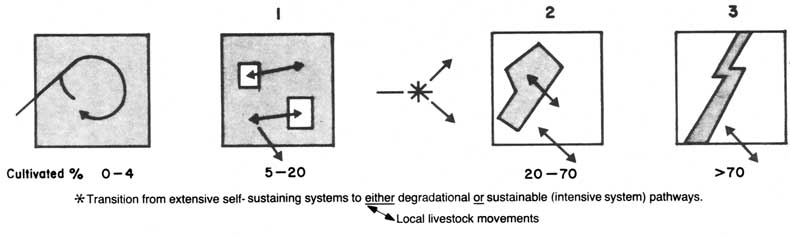
Using the cultivated percentage, four qualitatively distinct types may be proposed (see the diagram following page 31):
|
Zone |
Characteristics |
|
0 Grazing |
no farming except by livestock specialists (<5 per cent cultivated) migrant herds |
|
1 Enclave farming |
low cultivated percentage (<20) low degree of integration common access grazing extensive many livestock specialists migrant herds visiting little nutrient cycling some nutrient transfer long fallows-main fertility strategy no trees on arable |
|
2 Enclave grazing |
high cultivated percentage (20-70) high degree of integration common access grazing restricted some livestock specialists transhumance for cattle nutrient cycling (residues-manure) nutrient transfer (paddocking, field grazing) short fallows-insufficient to maintain fertility of arable some trees on arable |
|
3 Intensive farming |
very high cultivated percentage (>70) highest degree of integration common access grazing limited to residual, marginal or flooded land livestock owned by farmers transhumance or stall feeding for cattle intensive nutrient cycling (residues-manure) very short fallows, or none trees important on arable |
Assigning threshold values to the model must be inexact at present. With regard to Types 2 and 3, Hendy (1977), in a study of animal production in the Kano Close-Settled Zone, Nigeria, plotted the human population/km2 against livestock/km2 and livestock/head of human population. The density of about 80 persons/km had a threshold significance. At lower densities of the human population, the numbers of cattle, donkeys, sheep and goats/km2 all rose with the human population density, and also rose on a per capita basis. Above the density of 80 persons/km2, cattle numbers fell on a per capita basis and the other animals showed no clear trend. This meant that they increased in density/km2, whereas cattle densities declined. A human population density of about 80/km2, in Northern Nigeria at the time when Hendy's data were obtained (late 1960s), corresponded to a cultivated percentage of about 70 (Mortimore, 1970). Areas above this figure are assigned to Type 3.
More recent work by ILCA shows that cattle densities increase with those of the human population until the cultivated percentage reaches about 50 (in the Nigerian Sub-Humid Zone) and about 25 (in the SAZ); thereafter they decline. Above a cultivated percentage of 85, fallows and common access grazing virtually disappear, residual land being mainly used for settlements, rivers, roads, etc; this may be recognised as a sub-type of Type 3, but it is rare to find such high intensities (densities of population over 150/km2) in the SAZ, and there is no evidence of a significant change in livestock management at this level.
With regard to Types 1 and 2, work in the Maradi area of Niger (Gregoire and Raynaut, 1980) indicates that at a regional population density of 30/km2, and a cultivated percentage in the range 35-65, fallows are insufficient to maintain the fertility of arable land. The livestock supported by the grazings and farm residues provide manure for only 25% of the cultivated area. There is a shortage of land and of fodder, and by implication, of fallows and manure. This area may be assigned therefore to Type 2. In their analysis of the impact of drought on six farming systems in semiarid West Africa, Boulier and Jouve (1988) discern no land shortage in systems operating at human population densities of 10/km2 or less. This corresponds to a cultivated percentage of about 10-20, at 1-2 ha/person. Such an area can be assigned to Type 1.
The level of analysis for such a categorisation is that of the community or the territory (see page 12). The model takes no account of uncultivable land and river valley land, (bas-fond, dambo, fadama, flood plain etc.). The first is included in uncultivated land and is assumed to be available for grazing. However, where the percentage of uncultivable land is high, ceiling is set on the cultivable percentage, lowering the threshold percentages for Types l and 2 accordingly. As for river valley land, its effect depends on whether its predominant use is for cultivation, or for dry season grazing. If the first, the grazing sector is weakened; if the second, strengthened. Adjustments could be made for local situations.
The model is based on West African experience and requires verification. The national livestock census, presently in progress in Nigeria, may provide an opportunity to test the model in a range of ecologies and human densities.
None of these types has necessary consequences for degradation or conservation, and therefore one cannot be said to be more sustainable the another. Sustainability depends on:
(1) the nature of the cropping system, with regard to the protection of the physical and chemical properties of the soil;(2) the level of stocking;
(3) the management of localised pressure points such as overgrazed village peripheries, denuded environs of water sources, exposed topographical sites (steep slopes, wind-blown crests); and
(4) annual variability in rainfall and vegetation cover.
However, if these variables are known, the typology provides a framework for assigning environmental sustainability ratings to mixed farming systems. There is plenty of evidence that the choice between a sustainable or degradational pathway involves decisions about labour allocation, and that under conditions of scarce capital, labour-intensive sustainable systems can only evolve where population density is high or increasing.
Since the typological sequence suggested above is fundamentally related to population density, as is the integration sequence of McIntire et al, it may be expected that both sequences, if found valid, will correlate in practice. Farming intensity (expressed as the cultivated percentage) therefore emerges as the most powerful typological principle for the purpose of understanding both crop-livestock interaction/integration and environmental management.