Nd. Mbaye and Ch. Sall
Laboratoire National de l'Elevage et de Recherches Veterinaires
Institut Senegalais de Recherches Agricoles
(ISRA), Dakar-Hann, Senegal
Introduction
Objectives
Material and methods
Results
Conclusion
References
Natural pastures and crop residues, together with agro-industrial byproducts, constitute the principal feed resource in Senegal. An inventory of byproducts was prepared in 1979 by Mongodin and Tascher and various aspects of their use have been discussed by Sall (1985), Mbaye (1982) and Sansoucy and Emery (1982).
Some results obtained in Senegal are summarised in this paper, although they are limited to results concerning groundnut and cotton seed hulls offered alone or in association with more concentrated byproducts such as groundnut cake, cotton seed cake, wheat, rice or maize bran, brewers' dried grain and molasses.
Studies have been concerned with the chemical analysis, voluntary intake by sheep, dry matter digestibility (DMD) organic matter digestibility (OMD) and nitrogen (crude protein) digestibility (CPD) of byproducts.
The results have allowed us to establish preliminary equations relating intake and nutritive value of various feeds to their chemical analysis.
About 90 digestibility trials have been carried out of which 10 were on cattle. Standard methods were used: in vivo and in vitro (Tilley et Terry) digestibility; determination of crude fibre (Weende); total nitrogen and ash content.
The results were submitted to "step wise" regression analysis, permitting either simple linear or multiple equations to be derived.
Feed value of groundnut hulls and cotton seed hulls offered alone (Table 1)
Groundnut hulls and cotton seed hulls are characterized by a high fibre content, averaging 540-550 g/kg DM. Cotton seed hulls were however, more digestible; DMD was found to be 40% when fed alone and 44% when fed with a mineral supplement.
Table 1. Feed value of groundnut hulls and cotton seed hulls offered alone to sheep.
|
No. of trials |
Description |
Intake (g/kg DM) |
% |
g/kg |
FU |
g/kgW0.75 |
|||||
|
DM |
CF |
CP |
DMD |
OMD |
DOM |
DCP |
Energy |
DMI |
DOMI |
||
|
3 |
Groundnut hulls |
966 |
547 |
115* |
26 |
27 |
912 |
41 |
0.05 |
47 |
13 |
|
2 |
Cottonseed hulls |
963 |
547 |
60 |
40 |
41 |
400 |
- |
0.29 |
42 |
17 |
* The high nitrogen content was caused by presence of kernel residues and skins.
Groundnut hulls had a DMD of only 26%. However dry matter intake of groundnut hulls was higher: 47 g DM/W0.75 against 42 g DM/W0.75 for cottonseed hulls which had a higher content of digestible crude protein (40 g per kg DM). This difference was due to the presence of kernel residues and skin debris in the groundnut hulls.
In energy terms, cotton seed hulls contained 0.29 FU per kg, and groundnut hulls only 0.05 FU per kg. The much higher protein content of groundnut hulls (115 g/kg) compared with cottonseed hulls (60 g/kg,) was due to the inclusion of kernel and skin debris in the former. DCP contents differed even more, 41 g/kg versus nil.
Nutritive value of supplemented groundnut hulls and cotton seed hulls
A series of trials was carried out with cattle and sheep using supplemented rations based on groundnut hulls or cotton seed hulls. The groundnut hull incorporation rate varied from 22 to 70%; for cotton seed hulls from 25 to 90%.
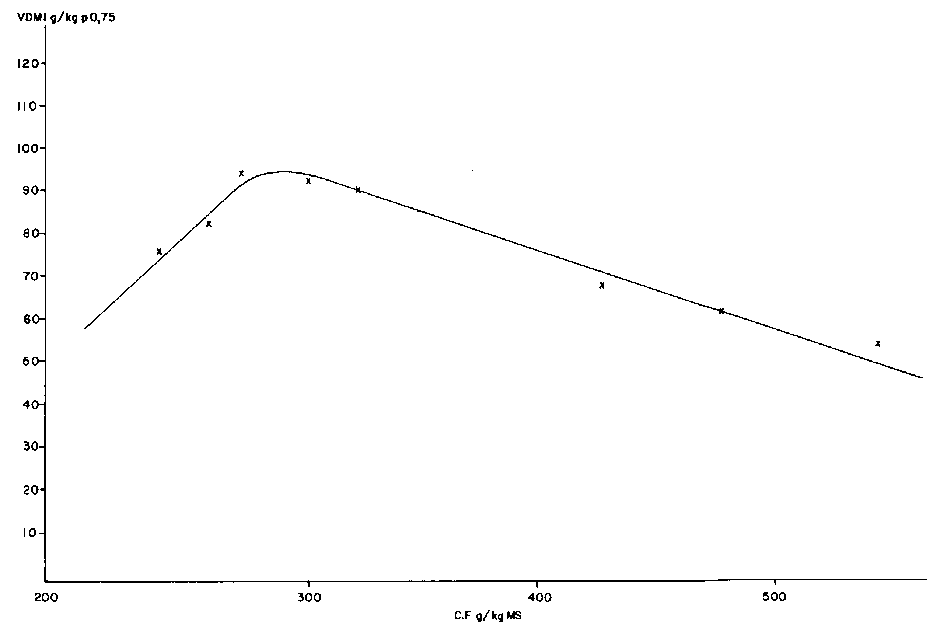
The ingestibility (DMI) of rations consisting essentially of groundnut hulls reached 125 g DM/kg W0.75 at an incorporation rate of 38.5%. At the equivalent incorporation rate (37%), rations based on cotton seed hulls recorded DMI values of up to 94 g DM/kg W0.75. This ingestibility varied with the content of crude fibre of which the optimum content for maximal ingestion was found to be 320 g per kg (Graph 1). This relationship has not been verified with groundnut hulls.
Compounded feeds based on cotton seed hulls were more digestible (59%) than those based on groundnut hulls (47%). Wheat bran and maize bran, mixed with groundnut hull rations were higher in digestibility (DMD between 46 and 55%) and energy content (0.46 to 0.61 FU/kg). Molasses and brewers' grains improved the voluntary intake (107 g DM/kg W0.75).
Groundnut cake combined with molasses gave diets with the highest digestible crude protein content (121 g per kg DM) (Tables 2 and 3).
Cotton seed hull rations were lower in DCP content for a particular supplementation but were higher in digestible organic matter and energy content. However, voluntary dry matter intakes of groundnut hull rations were higher despite the relatively low dry matter digestibility.
In the case of intensive animal production systems, where the objective is high production, rations based on cotton seed hulls would be advisable, because of their rather higher DOM intake (46 compared with 44g/kg W0.75).
Graph I. Intake evolution of cottonseed hull rations in terms of their crude fiber roses
Table 2. Feed value of groundnut hull rations complemented by agro-industrial by-products.
|
No. of Trials |
Principal concentrated feed in the ration |
Intake (g/kg DM) |
p.100 |
g/kg DM |
UF |
g/kgW0.75 |
|||||
|
DM |
OF |
TNM |
DMD |
OMD |
DOM |
DNM |
Energy |
DMI |
DOMI |
||
|
4 |
Maize bran |
955 |
355 |
104 |
55 |
56 |
540 |
52 |
0.60 |
93 |
93 |
|
11 |
Wheat bran |
925 |
373 |
110 |
45 |
47 |
411 |
62 |
0.46 |
83 |
39 |
|
7 |
Brewers' dried grain + molasses |
927 |
313 |
134 |
45 |
46 |
425 |
75 |
0.46 |
107 |
49 |
|
3 |
Groundnut cake + molasses |
924 |
390 |
149 |
41 |
42 |
388 |
121 |
0.26 |
83 |
34 |
Table 3. Feed value of cottonseed hull rations complemented by agro-industrial by-products.
|
No. of trials |
Rations description |
Intake (g/kg DM) |
p.100 |
g/kg DM |
UF |
g/kg W0.75 |
|||||
|
DM |
OF |
TNM |
DMD |
OMD |
DOM |
DNM |
Energy |
DMI |
DOMI |
||
|
1 |
Cottonseed hulls 90 - cottonseed cake 10 |
965 |
475 |
123 |
54 |
55 |
532 |
61 |
0.53 |
93 |
37 |
|
1 |
Cottonseed hulls 82 - cottonseed cake 10 - molasses 8 |
936 |
547 |
84 |
63 |
62 |
580 |
34 |
0.63 |
61 |
38 |
|
2 |
Cottonseed hulls 37 - molasses 15 - wheat bran 30 cottonseed cake 6 - granicalcium 2 - salt 1 |
921 |
327 |
96 |
58 |
59 |
542 |
46 |
0.58 |
94 |
54 |
|
2 |
Cottonseed hull 1 25 - wheat bran 27 5 - ground sorghum 25 - groundnut cake 4 - carbonate of lime |
947 |
282 |
118 |
61 |
63 |
528 |
21 |
0.66 |
83 |
52 |
Prediction of the nutritive value of rations of groundnut hulls complemented with agro-industrial byproducts from their chemical composition
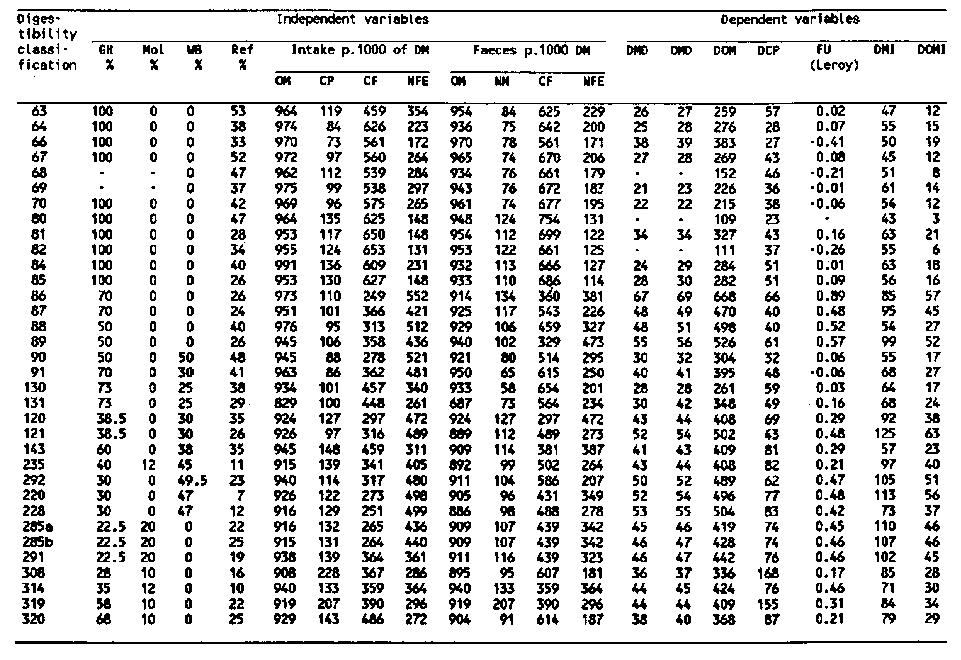
Parameters used for deriving prediction equations from Dakar data are shown in Table 4. The established equations were simple (Table 5) or multiple (Table 6).
Simple equations, i.e., y = ax + b, were less precise, as shown in the correlation coefficients and standard errors, but they were easier to apply.
Dry matter and organic matter digestibilities and also the energy value of the rations were negatively influenced by crude fibre content. Food consumption was related similarly to the groundnut hull incorporation rate.
The most precise relationship was that between total crude protein content (x) and digestible crude protein content (y):
y - 0.91 x - 45.39; r = 0.95; n = 30.
Clearly these results do not include all cases likely to be encountered. However, the results obtained can be used as a working basis for future applications, particularly for field workers who do not have adequate access to means of analysis or to bibliographic facilities to allow them to reach a quick decision.
Table 4. Equations variables for nutritive value prediction of combined groundnut hull rations.
Table 5. Simple prediction equations for nutritive value of groundnut hull rations complemented with agro-industrial byproducts.
|
Dependant variables (y) |
Independant variables |
Regression equations |
Standard error of estimate |
Correlation coefficient |
Data number |
|
DMD (p.100) |
CF (g/kg DM) |
y = - 0.06 x + 66.00 |
7.35 |
0.75 |
30 |
|
OMD (p.100) |
CF (g/kg DM) |
y = - 0.06 x + 67.21 |
7.60 |
- 0.74 |
30 |
|
FU (/kg DM |
CF (g/kg DM) |
y = 0.001 x + 0.810 |
0.19 |
0.68 |
30 |
|
DCP (g/kg DM) |
CP (g/kg DM) |
y = 0.91 x - 45.39 |
10.19 |
0.95 |
30 |
|
DMI (g/kg DM) |
Groundnut hull |
y = 0.61 x + 113.88 |
15.13 |
- 0.75 |
30 |
|
|
(p.100 of the ration) |
y = - 0.38 x + 65.86 |
10.81 |
- 0.71 |
30 |
|
DOMI (g/kg DM) |
" " |
y = - 0.38 x + 65.86 |
10.81 |
0.71 |
30 |
Table 6 Multiple regression equations for predicting nutritive value of groundnut hull rations complemented with agro-industrial byproducts.
|
Nutritive value (dependent variable) |
Multiple regression equation |
Standard error of estimate |
Multiple correlation coefficient |
Data number |
|
DMD |
1) 0.06 NFE - 0.07 NFEF - 0.08 CFF - 0.17 Ref + 68.13 |
4.72 |
0.92 |
30 |
|
2) 0.04 FU - 0.03 CFF + 0.10 CP - 0.37 Ref - 17.06 |
5.68 |
0.88 |
30 |
|
|
3) 0.06 CF - 0.11 DM - 0.41 Ref - 31.50 |
6.11 |
0.85 |
30 |
|
|
4) 0.04 CF - 0.04 CFF + 75.29 |
6.82 |
0.80 |
30 |
|
|
DMD |
1) 0.06 NFE - 0 06 NFEF - 0.09 CFF - 93.96 |
4.87 |
0.91 |
30 |
|
2) 0.03 CF - 0.03 CFF - 0.45 mot - 0.35 Ref + 84.73 |
5.80 |
0.87 |
30 |
|
|
3) 0.04 CF - 0.04 CFF + 76.32 |
6.83 |
0.79 |
30 |
|
|
DOM |
1) 0.66 NFE 0.79 NFEF - 0.91 CFF - 1.20 GH - 2.18 Ref + 83.99 |
44.92 |
0.81 |
30 |
|
2) 0.31 CF - 0.36 CFF + 710.46 |
67.17 |
0.77 |
30 |
|
|
DCP |
1) 0.88 NM - 0.44 CF - 24.49 |
8.50 |
0.97 |
30 |
|
FU |
1) 0 0001 NFE + 0.38 NMF - 0.638 |
0.15 |
0.82 |
30 |
|
2) 0.001 CF + 0.003 NMF + 0.400 |
0.17 |
0.76 |
30 |
|
|
DMI |
1) 0 44 GH - 0.58 Ref + 121.25 |
15.13 |
0.79 |
30 |
|
DOMI |
1) 0.06 NFE - 0.58 Ref + 20.16 |
7.70 |
0.87 |
30 |
Groundnut hulls and cotton seed hulls were included in a series of byproducts studied over several years in Senegal. Our interest in these two byproducts arose in the first place because they were produced near the cities and secondly because they constitute a good raw material to which to add concentrated feeds. They should find ready application in milk production and animal fattening enterprises, perhaps a more profitable use than burning them as industrial fuel in factories.
Mongodin B et Tascher G, 1979. Les sous-produits agro-industriels utilisables dans l'alimentation animale au Senegal. IEMVT/Ministere de la Cooperation, France.
Mbaye Nd, 1982. La problematique de l'elevage en Afrique de l'ouest; l'alimentation du betail. LNERV, Dakar.
Sall Ch, 1985. Description et premiers resultats de quatre operations de recherche sur l'alimentation des ruminants domestiques au Senegal: (3) Valeur alimentaire des rations a base de coques d'oleagineux. Memoire de confirmation. ISRA, pp 41-50.
Sansoucy R et Emery B. Utilisation actuelle des residus de recolte et sous-produits agro-industriels en alimentation animale. Production et sante animale. FAO: (32)5.