


Abstract
Introduction
Materials and methods
Results and discussion
Summary and conclusions
References
A.T. Ayoub
Gezira Research Station, P.O. Box 126, Wad Medani, Sudan.
The ability of four forage legumes (Dolichos lablab, Phaseolus trilobus, Clitoria ternata and Cajanus cajan) to fix atomospheric nitrogen in sole cropping and in association with sorghum (Sorghum vulgare) was assessed using the 15N technique. Dry-matter and total N yields were determined and the potential contribution of each forage crop to the N budget of the Gezira farming system was assessed. Dry matter yields ranged between 3.3 and 7.0 t/ha per cut, and total N yield between 62 and 140 kg N/ha. Mixed cropping greatly reduced the dry-matter and total N yields of P. trilobus, Clitoria ternata and Cajanus cajan, mainly because of the smothering effects of the sorghum. The legumes fixed 60 to 80% of their N requirements, although there was considerable seasonal variation. The total amount of N fixed was equivalent to 55 to 110 kg N/ha per cut. In one out of the three seasons mixed cropping with sorghum reduced the proportion of the N requirement that was fixed by some of the legumes compared with the legumes in sole cropping. It was not clear whether this was due to the depressing effect of the sorghum on the legume, or whether fixed N was transferred to the sorghum. Residual NO3-N varied significantly among the forage crops, and the highest residual value of 26 ppm NO3-N was equivalent to the amount of NO3-N mineralised in an equal period of fallow.
The beneficial effects of a legume in an unfertilized rotation in the Gezira cropping system in Sudan have long been recognised. Also, with the recent need for integration of livestock into the farming system, fodder is becoming more valuable. Attempts have been made at the Gezira Research Station to determine the nitrogen-fixing ability of different forage legumes and their effects on yields of following crops using conventional methods (Muse and Burhan, 1974). The results showed that forage legumes tested were active fixers of atmospheric nitrogen, but data reported were inconsistent. It was also shown that legumes had some beneficial effects on subsequent crops.
The yield of cotton in Gezira is markedly influenced by the level of NO3-N in the soil. However, the effects of heavy manuring on soil NO3 and crop production were shown to be largely confined to the year of application, and no accumulations of nitrates could be detected (Ayoub, 1985).
The objectives of this work were to use the 15N isotope technique to reassess the ability of different forage legumes to fix atmospheric nitrogen, and to use these and other data to calculate the potential contribution of each forage crop to the N budget of the Gezira cropping system.
Forage crops (Dolichos lablab, Phaseolus trilobus, Clitoria ternata, Cajanus cajan, and Sorghum vulgare) were grown in monoculture or in a mixed crop with the legume and sorghum planted in the same hole. The experiment was conducted at the Gezira Research Farm, Sudan, between 1982/83 and 1984/85 on a heavy, alkaline clay low in N and organic matter. Plot size was 4.2 m x 6 m, with a subplot of 1.0 m x 1.8 m at the end of each plot to which 15N was applied. The rest of the plot received ordinary urea at the same rate as the isotope subplot. Plants were sown in early July on ridges 60 cm apart and 20 cm between plant holes with four plants per hole. The plots were arranged in a randomised block design with five replications. Sorghum received urea at the rate of 100 kg N/ha while the legumes and legume-sorghum combinations received urea at the rate of 20 kg N/ha. In the isotope subplots the 15N atom excess of urea was 1.0% in the former and 5.0% in the latter. A basal dressing of 51 kg P/ha was given as triple superphosphate to all plots. All legumes and legume-sorghum plots were inoculated with the appropriate rhizobia two weeks after sowing. The plots were irrigated with water from the Blue Nile once every 2 weeks, and were hand weeded whenever necessary.
Determinations of dry-matter yield, total N yield and 15N/14N ratio assay were carried out at harvest (12 weeks after sowing). Soil samples were taken 6 months after harvest from the root zone in each plot and from an adjacent fallow strip for comparison of the nitrification of the residual N during an incubation period of 6 weeks at set moisture and room temperature.
The International Atomic Energy Agency, Vienna, supplied the 15N-labelled urea and assayed the 15N/14N ratio in the plant samples.
Dry-matter and nitrogen yields
Table 1 shows the dry-matter (DM) yields, N contents and total N yields of different forage crops grown in monoculture or associated with sorghum in 1:1 ratio. The DM yields in monoculture varied between 3.3 and 7.0 t/ha per cut. Three cuts are possible from these crops but for the purpose of this study only one cut was taken. The highest DM yield was produced by sorghum followed by lablab and trilobus and least by cajanus and clitoris. Clitoria had the highest N content followed by trilobus, lablab and cajanus. The N content of sorghum was less than 1.0% and sorghum gave the lowest total N yield despite its high DM yield. The total N yields of lablab and trilobus were appreciably high, followed by clitoria and cajanus.
Table 1. Dry-matter yields, percent N and total N yields of five forage crops grown in monoculture or in 1:1 mixture with sorghum, Gezira (means of two seasons).
|
Crop |
Dry matter(t/ha) |
Percent N |
N yield(kg/ha) |
|
Monoculture |
|
|
|
|
Sorghum |
7.0 |
0.90 |
62.1 |
|
Lablab |
5.4 |
2.53 |
139.1 |
|
Trilobus |
4.9 |
2.82 |
138.2 |
|
Clitoria |
3.3 |
3.10 |
102.1 |
|
Cajanus |
3.5 |
2.08 |
77.3 |
|
Mixed cropping |
|
|
|
|
Sorghum |
3.9 |
0.85 |
32.3 |
|
Lablab |
2.1 |
2.61 |
54.2 |
|
Total |
6.0 |
86.5 |
|
|
|
|
|
|
|
Sorghum |
4.9 |
0.78 |
37.7 |
|
Trilobus |
1.0 |
2.73 |
27.3 |
|
Total |
5.9 |
65.0 |
|
|
|
|
|
|
|
Sorghum |
4.9 |
0.86 |
41.2 |
|
Clitoria |
0.6 |
2.67 |
15.1 |
|
Total |
5.5 |
56.3 |
|
|
|
|
|
|
|
Sorghum |
4.7 |
0.79 |
36.3 |
|
Cajanus |
0.9 |
2.21 |
18.9 |
|
Total |
5.6 |
55.2 |
|
Lablab and sorghum competed well with each other for light and nutrients in the mixed stand, producing a good total DM yield with moderate protein content. Trilobus, clitoria, and cajanus were poor competitors with sorghum and produced less than 42% of their monoculture yields. As a result the N yields of their mixed crops with sorghum did not exceed that of sorghum when grown alone. Further work is being carried out to determine the sorghum-clitoria mixture that will produce the optimum combination of DM and total N yields.
Biological nitrogen fixation
The percentage of total N in the legumes derived from fixation of atmospheric N (% Ndf fix) was determined in the monoculture by the isotopic A value method since the legume and the sorghum received different rates of 15N fertilizer. Where legumes were grown in association with sorghum, and hence both crops received the same rate of 15N fertilizer, % Ndf fix was assessed using the simpler formula:
Ndf fix = 100 [ ( 1- 15N a.e. in legume) / ( 1- 15N a.e. in sorghum)]
where a.e. is percent 15N atom excess in the plant tissue. Both methods seem to give reliable results.
Mean % Ndf fix of the four legumes (Table 2) was 85% in 1983/84 and 60% in 1984/85. Trilobus, lablab and clitoria were the most active fixers while cajanus was the poorest, especially in 1984/85. In 1983/84 % Ndf fix was the same whether the legumes were grown in monoculture or in association with sorghum, while in 1984/85 it was about 30% lower in the mixed crops than in monoculture, clitoria showing the largest reduction when grown in association with sorghum. It is difficult at this stage to determine whether this low value in mixed cropping was due to sorghum depressing legume growth or due to the transfer of fixed nitrogen from the legume to sorghum. If there is transfer of fixed nitrogen from the fixer to the non-fixer the 15N a.e. of the non-fixer will approach that of the fixer and hence percentage apparent N fixation will be low.
Table 2. Percent N derived from fixation by different forage legumes when grown in monoculture or associated with sorghum, Gezira, 1983/84 and 1984/85.
|
Crop |
Percent N |
Mean% N |
|
|
1983/84 |
1984/85 |
||
|
Monoculture |
|
|
|
|
Lablab |
86 |
61 |
74 |
|
Trilobus |
90 |
71 |
81 |
|
Clitoria |
86 |
62 |
74 |
|
Cajanus |
77 |
42 |
60 |
|
Mean |
85 |
59 |
72 |
|
Mixed cropping |
|
|
|
|
Lablab and sorghum |
82 |
46 |
64 |
|
Trilobus and sorghum |
89 |
64 |
77 |
|
Clitoria and sorghum |
78 |
11 |
45 |
|
Cajanus and sorghum |
80 |
34 |
57 |
|
Mean |
82 |
39 |
61 |
Nitrification of residual soil nitrogen
Figure 1 shows the release of NO3-N during the incubation of soil samples taken from the root-zone of different forage crops 6 months after harvest. The NO3-N level before incubation was about 8 kg/ha in the sorghum, cajanus, trilobus, and clitoria plots and 18 kg/ha in the lablab and fallow plots. After one week of incubation NO3-N in soil from trilobus, fallow, and clitoria plots exceeded 24 kg/ha, and in the soil from the lablab plot exceeded 60 kg/ha. After one more week of incubation the NO3-N level dropped by about one-third of its previous level in the lablab, clitoria, fallow, and trilobus soils. This was probably due to the proliferation of microbial growth, which subsided soon after, resulting in steady NO3-N release afterwards. Little NO3-N was released in the sorghum and cajanus soils during the first 2 weeks of incubation, and rates of nitrification in these soils were lower throughout incubation than in the other soils.
Figure 1. Nitrate-N release during incubation of soil samples from the root zone of different forage crops 6 months after harvest.
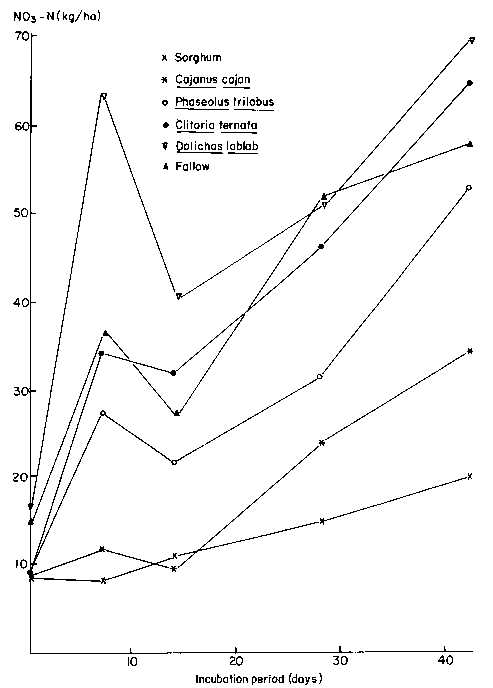
At the end of the incubation period (42 days), the residual NO3-N levels were between 53 and 70 kg/ha in the trilobus, fallow, clitoria, and lablab plots, while in the sorghum and cajanus plots the NO3-N levels were only 20 and 35 kg/ha, respectively. It must be remembered here that the sorghum crop received 100 kg N/ha and each of the legumes received 20 kg N/ha at sowing. A very simplified view of N input-output of each forage crop is discussed in the following section.
Soil nitrogen budget after forage crops
The Gezira soil can supply an average crop with about 60 kg N/ha in a season. This N comes mainly from the mineralisation of the indigenous soil organic N. and possibly from non-symbiotic nitrogen fixation. This figure was taken as the basic value in these calculations, regardless of the differences that may occur in the rhizosphere of the different forage crops.
Lablab and trilobus contributed about 110 kg N/ha to the soil N budget through biological nitrogen fixation while clitoria and cajanus contributed 75 and 55 kg N/ha, respectively. The end-of-season contribution of the different forage crops to soil N through the root system, including nodules, ranged between 10 and 20 kg N/ha (Muse and Burhan, 1974). These values underestimate the actual amount of N contributed, since some of the nodules and fine roots could not be collected. The total non-harvestable N, which was found by subtracting N harvested from total N input, was 108 kg N/ha for sorghum and around 70 kg N/ha for the legumes. The corresponding differences between these values of non-harvestable N and the residual NO3-N values, already shown in Figure 1, indicate the non-recoverable N in the system. Sorghum and, to some extent, cajanus gave high values of non-recoverable N. The non-recoverable N was presumably either in the form of organic N that was not readily decomposable in the soil system or had been lost to the atmosphere as gaseous N. There is evidence that considerable amounts of N are lost from the Gezira soil system through volatilisation of ammonia leading to low recoveries of fertilizer N (Jewitt, 1942). The efficiency of urea-N use by sorghum has been found to be around 23% (Ayoub, 1986). It is therefore reasonable to believe that at least 50% of the N that was not recoverable as NO3-N from the sorghum and cajanus plots may have been lost as gaseous N, resulting in nitrogen deficits of about 45 and 20 kg N/ha in the sorghum and cajanus plots, respectively. Nitrogen deficits, if any, in the lablab, clitoria and trilobus plots were negligible.
The figures in Table 3 were calculated on the assumption that the crops would be cut and removed from the land for fodder. If these forage crops were grazed in situ a considerable part of the harvested N could be recycled to the soil system through the grazing animals.
1. The legumes under study derived about 60 to 80% of their total N needs from N fixation. The amount of N fixed was equivalent to about 55 to 110 kg N/ha per cut.2. Mixed cropping of sorghum in 1:1 ratio with legumes other than lablab resulted in lower total DM and N yields than growing each crop alone, due to the smothering effects of sorghum.
3. An account of the soil N balance sheet after one cut of the forage crops shows the possibility of lablab and clitoria, and to some extent trilobus, in maintaining soil fertility. If these crops were grazed in situ a much higher N gain could be achieved.
Table 3. Potential contribution of different forage crops to the nitrogen budget of Gezira soil.
|
|
Sorghum Lablab Trilobus Clitoria Cajanus |
||||
|
N input (kg N/ha) |
|
||||
|
Mineralisable N |
60 |
60 |
60 |
60 |
60 |
|
Fertilizer N |
100 |
20 |
20 |
20 |
20 |
|
Biologically fixed N |
0 |
107 |
115 |
75 |
55 |
|
Root debris N |
10 |
20 |
15 |
20 |
15 |
|
Total |
170 |
207 |
210 |
175 |
150 |
|
N output(kg N/ha) |
|
||||
|
Harvested crop N |
62 |
139 |
138 |
102 |
77 |
|
N non-harvestable |
|
||||
|
(1-2) |
108 |
68 |
72 |
73 |
73 |
|
Residual NO3-N |
|
||||
|
(see Figure 1) |
20 |
70 |
53 |
65 |
35 |
|
N not recoverable as NO3-N |
|
||||
|
(4-3) |
-88 |
+2 |
-19 |
-8 |
-38 |
Ayoub A T. 1985a. Annual report for 1984/85. Soil Science Section, Gezira Research Station, Wad Medani, Sudan.
Ayoub A T. 1986. 15N labelled urea recovery by different crops in the Sudan Gezira soil. Fert. Res. 9(3):213221.
Jewitt T N. 1942. Loss of ammonia from ammonium sulphate applied to alkaline soils. Soil Sci.. 54:401-409.
Musa M M and Burhan H O. 1974. The relative performance of forage legumes as rotational crops in the Gezira. Exp. Agric. 10:131-140.
