Abstract
Introduction
Phosphorus status of soils
Phosphorus management
Phosphorus nutrition of plants vs animals
Future outlook
References
I. Hague, L.A. Nnadi1 and M.A. Mohamed-Saleem2
Soils and Plant Nutrition Section
ILCA, P.O. Box 5689, Addis Ababa, Ethiopia
1. On sabbatical leave from the Institute for Agricultural Research, Ahmadu Bello University, Zaria, Nigeria. 2. Agronomist, Subhumid Zone Programme, ILCA, PMB 2248, Kaduna, Nigeria.
The paper summarizes available information on the P status of soils, effect of P application on nodulation, dry-matter and seed production, crude-protein and dry-matter digestibility; use of slow release sources of P; differences among species and varieties in their response to P; assessment of P status of forage legumes; P fertilization based on cropping systems and P nutrition of plants vs animals. Future lines of research that need to be undertaken on some of these aspects are also highlighted.
Aubert and Tavernier (1972) reported that Aridisols cover approximately 36.8% of the total area in tropical Africa, Alfisols about 21.0%, Ultisols and Oxisols approximately 22.6% and Entisols 14.1%. Inceptisols and Vertisols cover 2.5 and 2.1% of the total area, respectively. Phosphorus deficiency seems to be one of the most widespread soil constraints in the majority of these soils. Field experiments throughout Africa have demonstrated that crops respond to moderate amounts of P fertilizer and their residues (Le Mare, 1984).
Phosphorus deficiency effects N fixation in legumes through its effect on root infection, nodule development and nodule function and plant growth. Nitrogen fixation by forage legumes in sub-Saharan Africa has been reviewed by Hague and Jutzi (1984), while this paper reviews P investigations with special reference to forage legumes in the region, as background information for future studies.
The P status has been reported in Nigeria (Bates and Baker 1960; Udo and Uzo, 1972; Uzu et al, 1975; Juo and Fox, 1977; Udo, 1977; Udo and Ogunwala, 1977; Udo and Dambo, 1979; Juo, 1981; Kang and Fox, 1981; Le Mare, 1981), Sierra Leone (Odell et al, 1974; Rhodes, 1977), Ghana (Nye and Bertheux, 1957; Oteng and Acquaye, 1971), Kenya (Hinge, 1973), Tanzania (Uriyo and Kasseba, 1973; Uriyo et al, 1977 a, b), Malawi (Maida, 1983), Swaziland (Haque, 1983) and Ethiopia (Desta Beyene, 1984; Sahlemedhin Sertsu and Ali, 1983). Phosphorus status of French speaking countries in Africa and Madagascar and West African savanna soils was reviewed by Pichot and Roche (1972) and Jones and Wild (1975) respectively.
Some of the highlights of above articles and reviews are given below:
· Soils that fix large quantities of P are: Oxisols, Ultisols, Andepts, oxic Alfisols and Inceptisols.· In most soil profiles, total and available P decline with depth and available P of surface soils does not seem to be adequate for optimum crop production.
· In acid soils, most of the applied P is sorbed by various constituents and P sorption increases with depth within the profile due to increasing sesquioxide and clay contents.
· Soil erosion is a serious problem in the region (El-Swaify and Dangler, 1982). However, if the surface soil is eroded, the P requirement for optimum plant growth on most of these soils would increase.
· Crop residue management investigations on a Nigerian soil suggest that the beneficial effect of burning is primarily the addition of P.
· Soil burning (guie) in some parts of the Ethiopian highlands destroys organic matter and sharply increases P availability (Mesfin Abebe, 1981).
Response of forage legumes to applied phosphorus
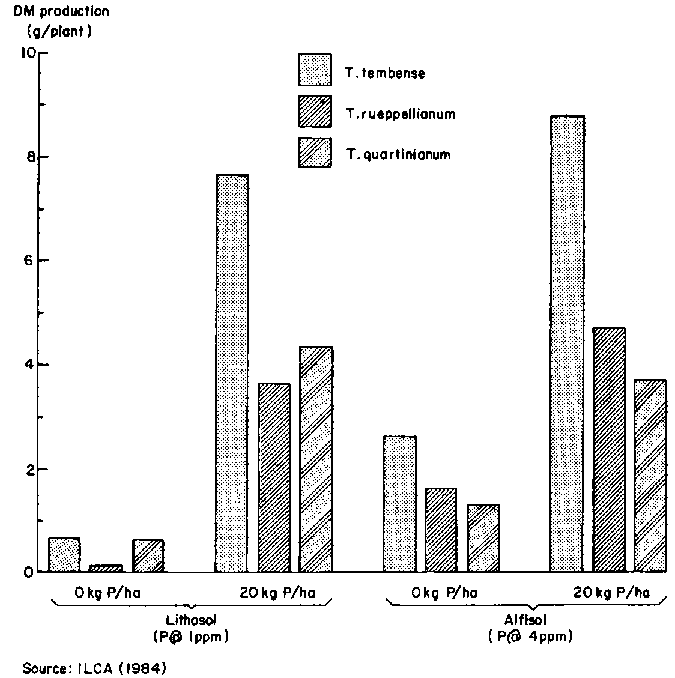
Phosphorus is the most important nutrient in the successful establishment of forage legumes, as indicated in Table 1. The effect of soil type and P supply on dry-matter production of three African clovers is shown in Figure 1. The main conclusions of Haque and Jutzi's (1984) review of African data are outlined below.
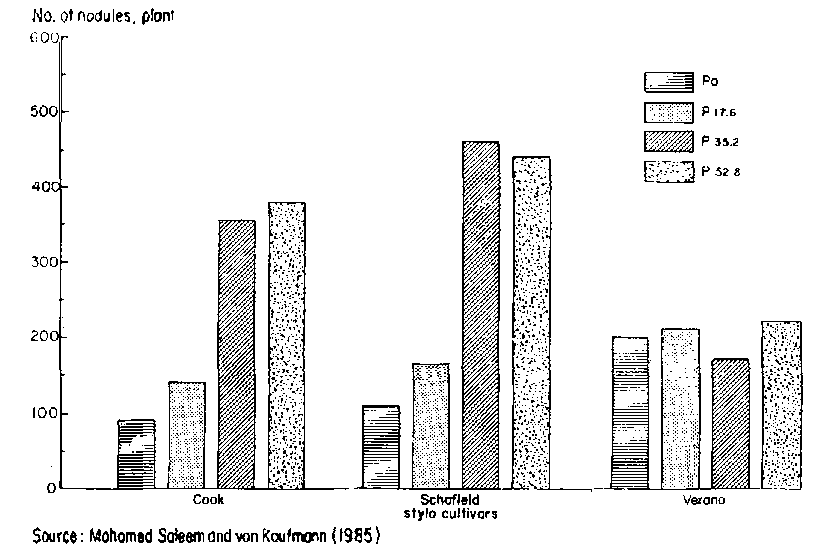
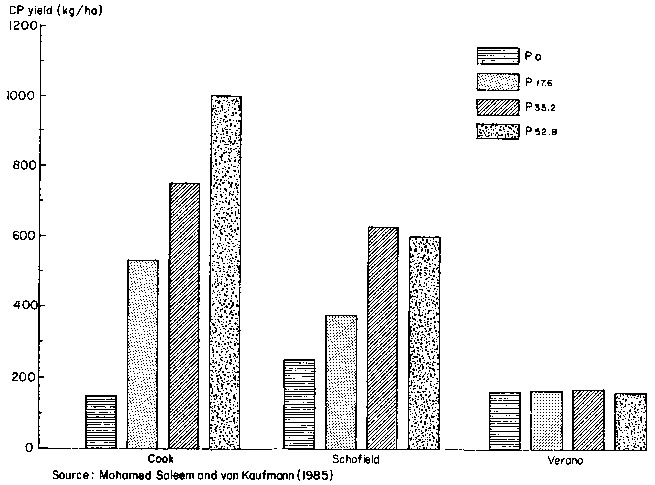
In addition to its effects on dry-matter yields of legumes, P often increases nodulation and hence increases N or crude-protein content, P concentration or uptake by the plant. Phosphorus application may also increase the digestibility of dry matter. Two recent examples of these types of responses reported by Jutzi and Haque (1984) and by Mohamed-Saleem and von Kaufmann (1985) are shown in Table 2 and Figures 2, 3 and 4.
Table 1. Legume yield responses (dry matter/seed) to phosphate application under field conditions.
|
Country |
Species |
P (kg/ha) |
Response (%) |
Reference |
|
Ethiopia |
Native Trifolia (22) |
41 |
16-948 |
Kaburananga and Tsehay Asres(1984) |
|
Native Trifolia (6) |
35 |
155-760 |
Akundabweni (1984) |
|
|
Native Trifolia (3) |
30 |
479 |
Jutzi and Haque (1984) |
|
|
T. steudneri (TSP) |
45 |
723 |
Haque and Jutzi (1985) |
|
|
T. steudneri (PR) |
45 |
704 |
|
|
|
Kenya |
T. subterraneum |
24 |
19 |
Bampus (1957) |
|
T. semipilosum |
- |
+ |
Strange (1961) |
|
|
Desmodium uncinatum |
|
|
|
|
|
D. intortum |
- |
100 |
Kenya et al (1971) |
|
|
T. semipilosum |
|
|
|
|
|
Nigeria |
Leucaena leucocephala |
80 |
- |
Sanginga et al (1984) |
|
|
|
|
|
|
|
S. guianensis |
25 |
45 |
Haggar (1971) |
|
|
S.guianensis |
|
|
|
|
|
cv Cook |
35.2 |
95 |
Mohamed-Saleem and von Kaufmann (1985) |
|
|
S. hamata cv Schofield |
35.2 |
140 |
|
|
|
S. hamata cv Verano |
35.2 |
106 |
|
|
|
Stylosanthes spp. |
9-26 |
+ |
Agishi and Asare (1980) |
|
|
Uganda |
S. guianensis |
|
|
|
|
T. subterraneum |
- |
+ |
Horrell and Court (1965) |
|
|
T. repens |
67 |
+ |
Morrison (1966) |
|
|
T. semipilosum |
26 |
35 |
Suttie (1970) |
|
|
S. gracilis |
67 |
19 |
Wendt (1970) |
|
|
D. intortum |
20 |
82 |
Wendt (1971) |
|
|
Medicago sativa |
197 |
81 |
Olsen and Moe (1977) |
|
|
S. gracilis |
|
10 |
|
|
|
Zimbabwe |
Stylosanthes sp. |
10 |
+ |
Clatworthy (1984) |
Source: Haque and Jutzi (1984)
Use of slow-release phosphorus sources
In acid soils that fix large quantities of P, applying phosphate rock (PR) is often more effective and economical than applying superphosphate. Phosphate rocks are reactive in acid soils and costs per unit of P may be as low as one-third to one-fifth those of superphosphate. The effectiveness of PR depends on its solubility, fineness, time of reaction and the soil pH (Sanchez and Uehara, 1980).
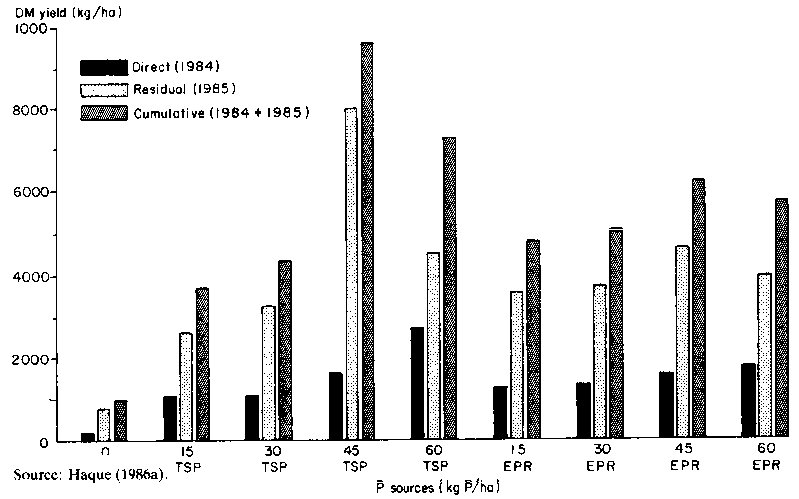
Figure 4 shows the dramatic effects of both triple superphosphate (TSP) and EPR on -Trifoilium steudneri grown on a P-deficient Vertisol. The clover grew very poorly when no P was applied and reacted similarly to both TSP and EPR at 15, 30 and 45 kg P/ha. Triple superphosphate was more effective than EPR only at 60 kg P/ha.
Table 2. Growth characteristics of three African clovers (Trifolium tembense, T. rueppellianum and T. steudneri 6 and 12 weeks after planting, as influenced by N/P fertilizers.
N and P levels (kg N and P/ha)
|
|
Weeks after planting |
Control |
DAP |
TSP |
LSD |
||
|
0/0 |
9/10 |
27/30 |
0/0 |
0/30 |
0.05 |
||
|
Plant weight(g) |
6 |
0.78 |
2.37 |
3.67 |
1.57 |
2.38 |
0.93 |
|
12 |
1.43 |
4.32 |
8.05 |
3.85 |
8.28 |
2.34 |
|
|
Nodules/ plant |
6 |
4.07 |
12.00 |
15.46 |
9.23 |
11.32 |
2.96 |
|
12 |
12.24 |
18.81 |
27.44 |
20.36 |
29.19 |
6.71 |
|
|
Nodule weight (mg) |
6 |
27 |
139 |
139 |
99 |
175 |
22 |
|
12 |
31 |
77 |
180 |
69 |
124 |
31 |
|
|
% P |
6 |
0.20 |
0.26 |
0.39 |
0.29 |
0.34 |
0.04 |
Source: Jutzi and Haque (1984).
Applying 15 kg P/ha as EPR increased dry-matter yield more than six-fold compared with the unfertilized control. Residual effect of TSP and EPR significantly increased dry-matter yield of T. quartinianum as compared with the control. Applying 15 kg P/ha as EPR increased dry-matter yield 3.5-fold over the control (Figure 4).
Many African phosphate rocks are low in chemical reactivity and are unsuitable for direct application on short-season crops (IFDC, 1984). An alternative may be to broadcast the PR and band a soluble source to provide P while the PR dissolves. This technique has been successful in Africa with locally available PR of low citrate solubility (Pichot and Roche, 1972).
Figure 2. Effect of phosphorus on nodulation of three stylo cultivars.
Figure 3. Effect of phosphorus on crude protein production of three stylo cultivars.
The effect of mixtures of TSP and EPR was studied on a Vertisol at Shola using T. quartinianum. All mixtures significantly increased dry-matter yield. A 1:1 mixture of TSP and EPR gave a five-fold increase in dry-matter production of the clover although the highest dry-matter yield was obtained with TSP at 60 kg P/ha. Other mixtures of TSP and EPR gave smaller yield increases, possibly due to the late planting of the experiment (Haque, 1986b).
IFDC phosphate research continues to support the view that acidulated PR is a viable P fertilizer alternative for sub-Saharan Africa (IFDC, 1983).
Species and varietal variation in response to phosphorus
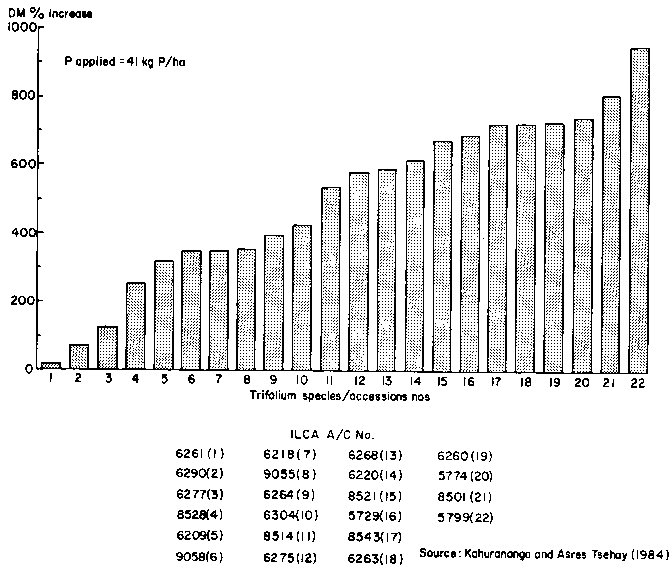
Adapting plants to the soil's limitations rather than the traditional approach of adapting the soil to meet crop requirements is an essential research option for smallholder contexts. Large differences in the response of clover species and varieties to P are displayed in Figure 5. The use of varieties more tolerant to low levels of available P will result in more efficient use of fertilizer P. Clovers tolerant to low P are likely to have lower P concentration in their tissues. Their nutritive value may thus be lower than other cultivars/species. Direct P supplementation to cattle in the form of salts to offset deficiency may be needed.
Assessing phosphorus status in forage legumes
Soil testing: Several methods for determing available soil P have been developed to provide a basis for fertilizer recomendations. Among the methods, Bray, Truog, Morgan, Olsen and Saunder and their modifications have been widely used and their suitability has been reported in West Africa (Halm, 1965; Oteng and Acquaye, 1971; Agboola, 1972; Haque and Lahai 1977), Central Africa (Saunder, 1956; Lungu, 1965) and East Africa (Robinson and Semb, 1968; Osborne and Allan, 1972). Adepetu and Corey (1976) observed that values of P mineralised during cropping correlated better with P uptake by the crop than did values of extractable P. indicating the importance of evaluating the organic-P content of the soil.
Phosphorus sorption isotherms: The soils of sub-Saharan Africa are highly variable. Soil testing services in the region are minimal because of the cost of setting up such services and the time involved in making correlation studies of crop yields and various chemical extractants. The P sorption approach provides a basis for estimating P needs of crops for a given soil-crop combination (Beckwith, 1965; Fox and Kamprath, 1970; Memon and Fox 1983), which is not the case for most conventional methods. Phosphate sorption isotherms have found increasing use in evaluating the P status of forage legumes, and, based on this, external P requirements (the P concentration in soil solution that will give near-maximum yield, usually 95 or 90%) have been determined for some forage legumes (Table 3).
Standley and Moody (1983) obtained critical external values of 0.037. 0.048 and 0.08 ug P/ml for Stylosanthes guianensis cv. Schofield, Centrosema pubescens cv. Centro and Desmodium intortum cv. Greenleaf, respectively. Critical P values of 0.016 to 0.017 ug P/ml have been obtained for the native Ethiopian clovers, Trifolium quartinianum, T. tembense and T. steudneri (Nnadi and Haque, 1985). The very low P requirements of these legumes indicate that they can attain maximum yield with little P fertilization and can compete effectively with grasses for P uptake.
The methodology commonly adopted for P sorption studies is that described by Fox and Kamprath (1970). As with all extractions involving sorbed P compounds in soil, the amount of P in the supernatant is affected by soil-to-solution ratio, shaking time and the addition of microbial suppressants (Probert, 1982). All these factors affect P in supernatant and consequently the critical P requirement. There is a need to standardise the methodology used in these studies.
Table 3. External critical phosphorus values of some forage legumes (phosphorus sorption isotherms).
|
Species |
Critical P ug P/ml |
Source |
|
Stylosanthes hamata |
0.07 |
Probert (1982 |
|
S. scabra |
0. 01 |
" |
|
S. scabra |
0.045 |
" |
|
S. scabra CPI 55818 |
0.03 |
" |
|
S. guianensis |
0.037 |
Standley and Moody (1983) |
|
Centrosema pubescent |
0. 048 |
" |
|
Desmodium intortum |
0.08 |
" |
|
Trifolium pretense |
0.104a |
Wright et al (1984) |
|
Lotus corniculatus |
0.141a |
" |
|
Lathyrus sylvestris L. |
0.074a |
" |
|
Trifolium guartinianum |
0.016 |
Nnadi and Haque (1985) |
|
T. tembense |
0.017 |
" |
|
T. steudneri |
0.016 |
" |
a. For 90% of maximum yield.
Plant analysis and tissue testing: Plant analysis is useful for tree crops, where conventional soil tests do not measure the contribution of sub-soil and there is more time to correct the deficiencies. The concentration of an element within a plant varies with the age of the plant, plant species, cultivar and plant part. However, plant sampling needs to be standardised.
Bouma and Dowling (1982) have developed a rapid and simple leaf test for measuring P status of subterranean clover. The accuracy of this test is due to the fact that it measures the amount of inorganic P present in plant tissue. This inorganic material - found in the cell vacuoles, with some in a 'free' state between reactions - is distinct from the organic form that is tied to organic compounds such as lipids and nucleic acid. The test needs to verified on highland clovers and other forage legumes in the region.
Phosphorus fertilization based on cropping systems
It has been recognised that, for efficient use of nutrients, fertilizer recommendations should take into account the cropping system as a whole rather than individual crops. This is particularly important in the case of P. with which utilisation in the year of application is rather low and residual effects are considerable.
The residual effect of P and the differential capacities of plants to utilise soil and fertilizer P should be taken into account in making P recommendations for legume-based cropping systems.
In most livestock grazing areas in sub-Saharan Africa, soils and plants are low in P. Phosphorus deficiency in grasses has been reported from Kenya (Orr and Holm, 1931: Howard et al, 1962), Tanzania (Naik, 1965), Uganda (Long et al, 1969), Swaziland (FAO, 1978), South Africa (du Toit et al, 1935: 1940) and many other countries of the region.
Phosphorus deficiencies of ruminants have been reported from Botswana, Ghana, Kenya, Malagasy Republic, Malawi, Nigeria, Senegal, Somalia, South Africa, Swaziland, Tanzania, Uganda, Zaire and Zimbabwe (McDowell et al, 1984).
The review highlights P management in sub-Saharan Africa with reference to forage legumes. However, it is obvious that little research has been done on P nutrition of forage legumes and further research in the following areas is necessary to exploit their potential.
· Characterisation of various soil types with respect to P and calibration of P methods using forage legumes.· A considerable number of legumes are indigenous to sub-Saharan Africa but the effect of P on root infection, nodule development and function and BNF have not been studied systematically.
· There seems to be a lack of information on external and internal critical levels of P in forage legumes in the region and there is a need for studying the P requirements of legume-based cropping systems.
· Studies on slow-release sources of P need to be intensified on legume-based cropping systems on various soil types.
· The contribution of P through plant and animal residues and a balance sheet of P in soil/plant systems need to be prepared for various ecosystems.
Adepetu J A and Corey R B. 1976. Organic phosphorus as a predictor of plant available phosphorus in soils of southern Nigeria. Soil Sci. 122:159-164.
Aubert G and Tavernier R. 1972. Soil survey. In: Soils of the humid tropics. National Academy of Sciences, Washington, D.C., pp. 17-34.
Bates J A R and Baker T C N. 1960. Studies on a Nigerian soil II. The distribution of phosphorus in profile and in various soil fraction. J. Soil Sci. 11:257-265.
Beckwith R S. 1965. Sorbed phosphate at standard supernatant concentration as an estimate of the phosphate need of soils. Aust. J. Exp. Agric. Anim. Husb. 5:52-58.
Bouma D and Dowling E J. 1982. Phosphorus status of subterranean clover: a rapid and simple leaf test. Aust. J. Exp. Agric. Anim. Husb. 22:428-436.
Clatworthy J N. 1984. Global ventures in Stylosanthes. III. South East Africa. In: Stace H M and Deye L A (eds). The biology and agronomy of stylosanthes. Academic Press, Australia. pp. 487-501
Corey R B and Schulte E E. 1972. Soil testing and soil fertility evaluation. Tropical Soils Research Seminar, IITA, Ibadan, Nigeria. (Mimeo.)
Desta Beyene. 1984. Diagnosis of phosphorus deficiency in Ethiopian soils. Soil Science Bulletin No. 3. JAR, Addis Ababa, Ethiopia. p. 18.
du Toit P J. Malan A I and Roets. 1935. A study of the mineral content and feeding value of natural pastures in the Union of South Africa. Onderstepport J. Vet. Sci. Anim. Ind. 5:201-214.
du Toit P J. Louw J G and Malan A I. 1940. A study of the mineral content and feeding value of natural pastures in the Union of South Africa. Onderstepport J. Vet. Sci. Anim. Ind. 14:123-127.
El-Swaify S A and Dangler E W. 1982. Rainfall erosion in the tropics: a state of the art. Soil erosion and conservation in the tropics. ASA special publication number 43. Madison, Wisconsin, USA.
FAO (Food and Agriculture Organization) 1978. Swaziland livestock production and extension: Report on project results, conclusion and recommendations. 54 pp.
Fox R L and Kamprath E J. 1970. Phosphate sorption isotherms for evaluating the phosphorous requirements of soils. Soil Sci.. Soc. Am. Proc. 34:902-907.
Halm A T. 1965. Soil test correlation study in Ghana. OAU/STRC Symposium Maint. Improv. Soil Fert. Proc. Pub. 98. pp. 126-130.
Haque I. 1983. Phosphate status of Swaziland soils. Unpublished data. University of Swaziland, Luyengo, Swaziland.
Haque I. 1986a. Direct, residual and cumulative effects of TSP and EPR on dry matter production of clovers on a Vertisol at Shola. Unpublished data, ILCA.
Haque I. 1986b. Effect of mixtures of TSP and phosphate rocks on clovers on a Vertisol at Shola. Unpublished data. ILCA.
Haque I and Jutzi S. 1984. Nitrogen fixation by forage legumes in sub-Saharan Africa: Potential and limitations. ILCA Bulletin 20:2-13.
Haque I and Jutzi S. 1985. Relative effectiveness of refined and rock phosphates on the growth of an African clover. ILCA Newsl. 4(3):5-6.
Haque I and Lahai A C. 1977. Assessment of soil analytical methods for available phosphorus in some Sierra Leone soils. Ghana J. Agric. Sci. 17:199-204.
Hinga G. 1973. Phosphate sorption capacity in relation to properties of several types of Kenya soils. East Afr. Agric. For J. 38(4):400-404.
Howard D A. 1963. Notes on animal diseases. XXIII. Mineral deficiency diseases. East Afr. Agric. For. J. 28:191194.
IFDC (International Fertilizer Development Centre) 1983. Annual report. IFDC, Muscle Shoals, Alabama, USA.
IFDC (International Fertilizer Development Centre) 1984. Annual report. IFDC, Muscle Shoals, Alabama, USA.
Jones M J and Wild A. 1975. Phosphorus. In: Soils of the West Africa Savanna. Technical Communication No. 55. CAB, England. pp. 100-112.
Juo A S R. 1981. Chemical characteristics. In: Greenland D J (ea.). Characterization of soil. Clarendon Press, Oxford, UK. pp. 51-79.
Juo A S R and Fox R L. 1977. Phosphate sorption characteristics of some bench mark soils of West Africa. Soil Sci. 124 (6):370-376.
Jutzi S and Haque I. 1984. Some effects of P and N/P fertilization on three African clovers on a P deficient Vertisol. ILCA Newsl. 3(2):5-6.
Kahurananga J and Tsehay A. 1984. Preliminary assessment of some annual Ethiopian Trifolium species for hay production. Trop. Grassl. 18 (4):215-217.
Kang B T and Fox R L. 1981. Management of soils for continuous production: controlling the nutrient status. In: Greenland D J (ea.). Characterization of soils. Clarendon Press, Oxford, UK. pp. 202-213.
Le Mare P H. 1981. Phosphorus sorption and release. In: Greenland D J (ed.). Characterization of soils. Clarendon Press, Oxford. pp 97-134.
Le Mare P H. 1984. Limitations imposed by nutrient supply in tropical African soils. In: Hawkesworth D L (ed.). Advancing agricultural production in Africa. CAB, Farnham Royal, UK. pp. 357 -361.
Long M I E, Ndyanabo W K, Marshall B and Thorntion D D. 1969. Nutritive value of grasses in Ankola and The Queen Elizabeth National Park, Uganda. 4, Mineral Content. Trop. Agric. (Trinidad) 46:201-209.
Lungu N F. 1965. Correlation of soil phosphorus analytical data with field response to fertilization in Malawi. OAU/STRC. Symposium Maint. Improv. Soil Fert. Proc. 98, p. 349-357.
Maida J H A. 1978. Phosphate availability indices related to phosphate fractions in selected Malawi soils. J. Sci. Food Agric. 29:423-428.
McDowell L R. Conrad J H and Ellis F L. 1984. Mineral deficiencies and their diagnosis. Paper presented at symposium on Herbivore Nutrition in Sub-tropics and Tropics - Problems and Prospects. Pretoria, South Africa.
Memon K S and Fox R L. 1983. Utility of phosphate sorption curves in estimating phosphorous requirements of cereal crops: Wheat (Triticum aestivum). In: Proceedings of third International Congress of phosphorus compounds. Brussels, Belgium. pp. 217-230.
Mesfin Abebe. 1981. Soil burning in Ethiopia. Ethiopian J. Agric. Sci. 3:57-74.
Mohamed-Saleem M A and von Kaufmann R. 1985. Evaluation of stylosanthes for forage improvement in the sub-humid zone of West Africa. I. Effect of phosphorus application on the productivity and quality of three stylosanthes cultivars. (In press).
Naik A H. 1965. The mineral status of grasses and soils of part of the Mbulu district of Tanzania in relation to animal health. East Afr. Agric. J. 31:175-182.
Nnadi L A and Hague I. 1985. Estimating phosphorus requirements of native Ethiopian clovers using phosphorus sorption isotherms. Paper presented at the International Conference on Soil Fertility in the Humid Tropics, 21-26 July, 1985. Ibadan, Nigeria.
Nye P H and Berteaux M H. 1957. The distribution of phosphorus in forest and savannah soils of the Gold Coast and its agricultural significance. J. Agric. Sci. 49:141-159.
Odell R T. Dijkerman J C, van Vuure W. Melsted S W. Beavers A H. Sutton P M, Kurtz L T and Miedema R. 1974. Characteristics, classification and adoptation of soils in selected areas in Sierra Leone, West Africa. Bull 748. College of Agriculture, University of Illinois, Urbana-Champaign; Bull 4. Njala University College, University of Sierra Leone.
Orr J B and Holm A. 1931. Economic advisory council. Sixth Report. 14 pp.
Osborne J F and Allan A Y. 1972. Annual Report 1972. East African Agric. Forestry Research Organization, Nairobi, Kenya. p. 60.
Oteng J V and Acquaye D R. 1971. Studies on the availability of phosphorus in representative soils of Ghana. I. Availability tests by conventional methods. Ghana J. Agric. Sci. 4:171-183.
Pichot J and Roche P. 1972. Phosphore dans les sols tropicaux. Agron. Trop. (France) 27:939-965.
Probert M E. 1982. Phosphate sorption isotherms and their relevance to phosphate requirements of Stylosanthes species. In: Pushparajah E and Hamid Sharifuddin H A (eds). Phosphorus and potassium in the tropics. The Malaysian Society of Soil Science. pp. 181-190.
Rhodes E R. 1977. Phosphorus in Sierra Leone soils. Trop. Agric. (Trinidad) 54(1):77-85.
Robinson J B D and Semb G. 1968. Advisory soil and plant analysis for fertilizer use. I. comparison of soil analysis methods. East Afr. Agric. For. J. 34(1):117139.
Sahlemedhin Sertsu and Muhammed Ali. 1983. Phosphorus sorption characteristics of some Ethiopian soils. Ethiopian J. Agric. Sci. 5 (1):1-12.
Sanchez P A and Uehara G. 1980. Management consideration for acid socils with high phosphorus fixation capacity. In: Khasawneh F E, Sample E C and Kamprath E J (eds). The role of phosphorus in agriculture. ASA/CSSA/SSSA. pp.471-514.
Sanuder D H. 1965. Determination of available phosphorus in tropical soils by extraction with sodium hydroxide. Soil Sci. 82:457-464.
Standley J and Moody P W. 1985. Evaluating the phosphorus requirements of pastures in the tropics. In: Proceedings of the third international congress of phosphorus compounds Brussels, Belgium. pp. 345-353.
Udo E J. 1977. Forms and distribution of phosphorus in three Nigerian soil profiles along a toposequence. Trop. Agric. (Trinidad) 54 (2):149-156.
Udo E J and Dambo V I. 1979. Phosphorus status of the Nigerian coastal plain sands. J. Agric. Sci. (Camb). 93:281-289.
Udo E J and Ogunwale J A. 1977. Phosphorus fraction in selected Nigerian soils. Soil Sci. Soc. Am. J. 41:1141-1146.
Udo E J and Uzu F O. 1972. Characteristics for phosphorus adsorption by some Nigerian soils. Soil Sci. Soc. Am. Proc. 36: 880-883.
Uriyo A P and Kasseba A. 1973. Phosphate fraction in some Tanzania soils. Geoderma 10:181-192.
Uriyo A P. Singh B R and Kasseba A. 1977a. Forms of phosphorus in the separates of three Tanzanian soils belong to Mollisol, Alfisol and Oxisol orders. East Afr. Agric. For. J. 43 (2):120-123.
Uriyo A P. Singh B R and Mtui A L. 1977a. Phosphate sorption in some Tanzanian soils. East Afr. Agric. For. J. 43(2):124-130.
Uzo F O, Juo A S R and Fayemi A A A. 1975. Forms of phosphorus in some important agricultural soils of Nigeria. Soil Sci. 120(3):212-218.