Abstract
Introduction
Major cropping patterns in the SHZ
Methods for introducing forage legumes into cropping systems
Crop-livestock production systems and selection of technique for fodder improvement
Conclusions
References
M.A. Mohamed-Saleem, R. Otsyina and R. von Kaufmann
ILCA Subhumid Zone Programme, Kaduna, Nigeria
The productivity of cattle in the subhumid zone of Nigeria is restricted by the poor feeding quality of the natural vegetation in the dry season. Selective grazing of crop residues provides better quality feed for a short time after crop harvest. Mixed cropping is the standard practice in the Nigerian SHZ and it may therefore be possible to introduce forage legumes into the cropping system to boost the feeding value of crop residues.
Forage legumes can be included in the cropping system by undersowing, inter-row sowing, superimposed cropping or intersod transplanting. Each of these techniques is suited in varying degrees to the different farming and livestock systems. Undersowing and inter-row sowing are likely to be of most interest to mixed farmers, whereas superimposed cropping and intersod transplanting are better suited to agropastoralism and systems in which land is fallowed.
If forage legumes are successfully introduced into the farming systems, they could have a significant impact on cattle production in the subhumid zone.
Crop residues are an important source of feed for livestock in the subhumid zone (SHZ) of Nigeria but their feed quality must be increased if the SHZ is to support a larger cattle population (von Kaufmann, 1979; Powell, 1984; Mohamed-Saleem, 1984; 1985). The SHZ in Nigeria has high rainfall (900-1500 mm) and a long growing season (190-270 days). About 50 to 70% of the area has potential for arable farming (ILCA, 1981). Cultivation is increasing (Bourne and Milligan, 1983), and in an intensively cropped area of the Nigerian SHZ, cattle have been found to spend more than 50% of their grazing time on crop residues early in the dry season. Initially, animals maintain the quality of their diets by selective grazing, but the high-quality portion of crop residues, e.g. immature leaves and grain heads, constitute only about 10% of the total fodder after harvest (Powell, 1984). This is quickly consumed, leaving only very poor-quality fodder during most of the dry season.
Work by ILCA in the SHZ of Nigeria has demonstrated that it is possible to improve the nutritional quality of the diet by including a forage legume in the crop mixture. Techniques for growing forage legumes with grain crops have been developed that require minimal inputs and are compatible with traditional cropping systems, but the identification of appropriate techniques needs careful study of the prevailing farming system.
In West Africa, farmers practice multiple cropping (growing more than one crop on the same piece of land during one calendar year [Beets, 1982]) in order to maximise food security, production per unit land area and labour utilisation. The grain crops grown and husbandry practices are determined not only by the environment but also by socioeconomic factors.
There is no record of the inclusion of forage legumes in traditional cropping patterns, and thus their use is novel to farmers in the SHZ. Therefore, forage legumes will have to be gradually introduced into the cropping systems, while preserving most of the traditional husbandry practices. This paper discribes the design and potential application of some techniques to improve fodder in selected cropping patterns in the SHZ.
The SHZ is considered as a transition zone from tuber and tree crops to cereals and grasses. Some of the main crops grown are listed in Table 1. The cropping pattern in ILCA's case study area in the SHZ is given in Table 2. The choice of crops differs from area to area and between ethnic groups. The main cropping patterns described below for the SHZ cover most of the systems listed by Beets (1982) for tropical countries.
Table 1. Major crops cultivated in the SHZ.
Sorghum (Sorghum bicolor)
Maize (Zea mays)
Acha (Digitaria exilis)
White millet (Pennisetum typhoides)
Rice (Oryza sativa)
Cocoyam (Xanthosoma sagitifolium)
Yam (Dioscoria spp.)
Cassava (Manihot esculenta)
Ginger (Zingiber officinale)
Lima bean (Phaseolus lunatus)
Okra (Hibiscus esculentus)
Sweet potato (Ipomaea batatas)
Finger millet (Tamba) (Eleusine coracana)
Hungry rice (Digitaria iburea)
Cowpea (Vigna unguiculata)
Pepper (Capsicum annum)
Yallo (Solanum aethiopicum)
Spinach (Amaranthus spp.)
Beneseed (Sesamum indicum)
Roselle (Hibiscus sabdaruiffa)
Bitterleaf (Solanum spp.)
Kenaf (Hibiscus connabinus)
Table 2. Cropping patterns in Abet.
|
Crop enterprise |
Mean plot size (ha) |
Percentage of total cultivated area |
|
Millet |
0.53 |
40 |
|
Sorghum/maize |
0.53 |
15 |
|
Sorghum/soya bean |
0.30 |
10 |
|
Sorghum |
0.34 |
9 |
|
Sorghum/maize/soya bean |
0.29 |
6 |
|
Others1 |
|
20 |
1. Others: 59 other cropping enterprises involving the above-mentioned and other crops listed in Table 1.
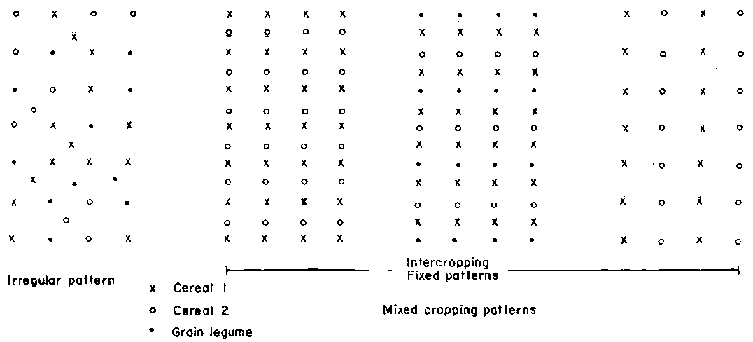
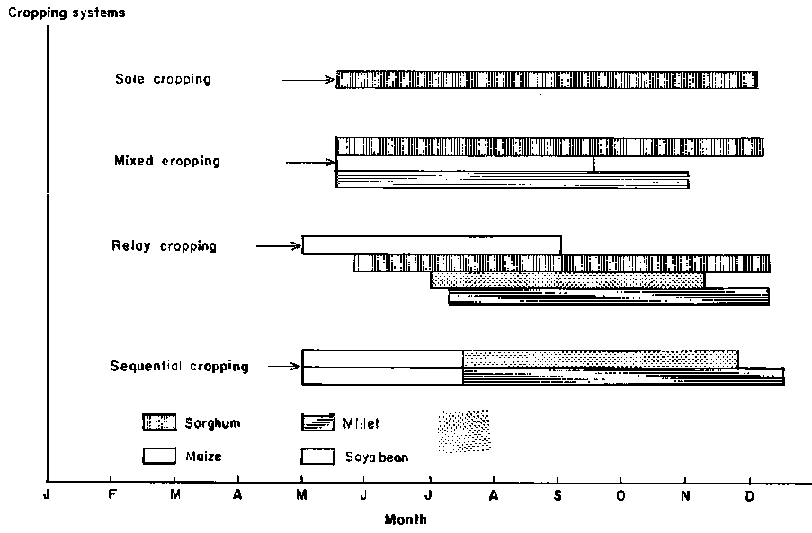
1. Sole cropping: A single crop is grown on an area in any given year. Sole cropping is more common among Fulani agropastoralists than amongst cultivators (Powell, 1984).2. Mixed cropping with annual crops: Different cereals such as maize, sorghum and millet are planted at about the same time in regular or irregular patterns (Figures 1 and 2). Vegetables are also included in some crop combinations. Maize is harvested early and the rest are allowed to grow until the end of the season.
3. Relay cropping with annual crops: This is the most common system, in which a cereal is planted in rows and another cereal(s) or grain legume(s) is planted later within or between the rows of the first crop (Figure 2). There is always a temporal overlap among different crops.
4. Sequential cropping: Around the southern border of the SHZ, farmers plant maize, which is harvested in the milk stage. Grain legumes are then planted on the same land in the same year (Figure 2).
5. Multi-storey cropping: Tree crops such as citrus are very common in the southern part of the zone. The trees are widely spaced, and cereals and vegetables are occasionally planted between the rows of trees.
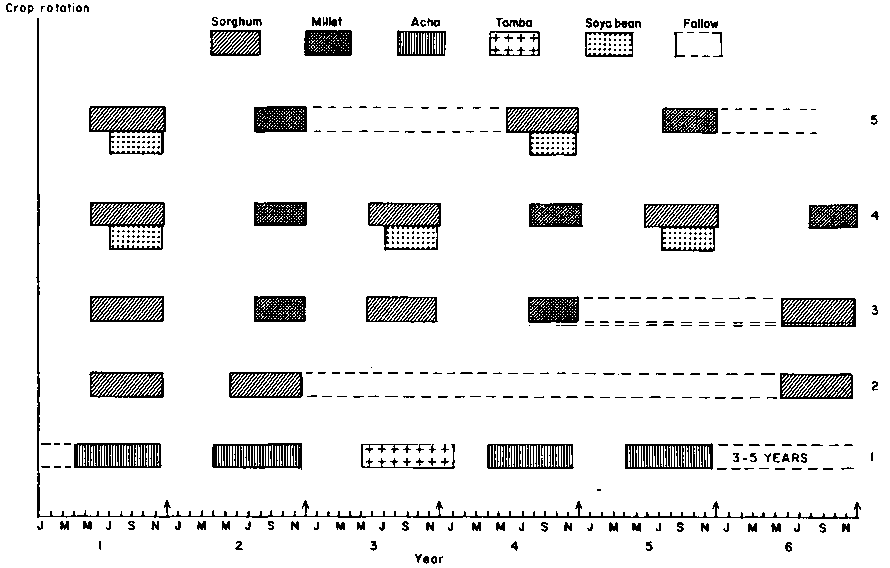
6. Crop rotations and fallow: Fallowing is still a common practice for soil regeneration in the SHZ. With the availability of chemical fertilizers, farmers tend to cultivate land near their homestead continuously. If fallowed, the land is recropped after 2 - 5 years, especially in densely populated areas. Rotation of crops is also a common practice. Examples of some cereal crop rotations are illustrated in Figure 3.
Figure 1. Diagramatic representation of crop geometry in mixed cropping.
Figure 2. Generalised cropping systems in the subhumid zone of Nigeria.
The different cropping patterns and crop rotations described above offer various options for growing forage legumes in association with food crops. A forage legume may be sown:
1. After annual crops have established;
2. At the same time as annual crops;
3. To occupy the fallow between two grain crop phases; or
4. Under permanent crops, primarily as a cover crop.
Undersowing annual crops
In the SHZ cereals are usually grown on ridges. Crops such as sorghum, maize and millet are planted either as sole crops at 0.25 to 0.30 m spacing or in mixtures in rows 0.8 to 1.0 m apart.
Figure 3. Some selected crop rotations in the Nigerian Subhumid zone.
A cereal may also be grown in a mixture with a legume such as groundnut, soya bean or cowpea. Land preparation has the greatest labour demand among the agricultural operations, and since this is done for the grain crop, undersowing the crop with a forage legume after the grain crop has established may be the simplest method. Time of undersowing seems to be critical for legumes, as has been found for Stylosanthes guianensis cv. Cook and S. hamata cv. Verano (Table 3). Planting the stylo 3 to 6 weeks after the sorghum increased the the nutritive value of the fodder without reducing sorghum grain yield, but the delay in undersowing requires additional labour (Nohamed-Saleem, 1985). If the two crops must be planted on the same day, other legumes that are less productive but compete less with the grain crops than stylo may be used (Table 4).
Inter-row sowing
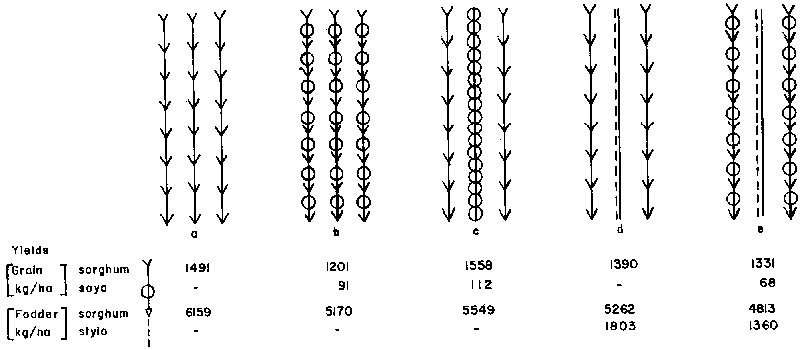
Where a cereal and grain legume are grown in a mixture, the forage legume S. guianensis cv. Cook can be planted between the rows. This requires adjustments to the crop geometry. Traditionally, sorghum and soya bean are planted on every ridge (Figure 4b). In this arrangement, single sorghum stands were spaced at 0.25 to 0.30 m in the row and soya bean was planted in between. By planting a pair of sorghum stands at 0.3 m spacings on alternate ridges or rows, a plant population equivalent to traditional populations was achieved. In this arrangement, soya bean was planted in the row between pairs of sorghum stands and stylo was planted on alternate, crop-free ridges to attain a good compromise for grain and fodder production (Figure 4e, Mohamed-Saleem, 1984).
Superimposed cropping
Superimposed cropping is where a cereal is grown concurrently with forage legumes. The cereal is grown during the rainy season, during which the legume, e.g. stylosanthes, is kept under control by weeding or herbicide application until the crop is able to withstand competition. The legume is then allowed to regenerate from seed. This system requires a large reserve of legume seed in the soil and is dependent on the return of a large amount of seed to the soil after each growing season. Presence of seeds with different degrees of dormancy will ensure regeneration of the legume after land preparation and weeding, which eliminate seedlings from seeds that germinate early in the season.
Table 3. Effect of undersowing stylo on grain yield of sorghum and total available fodder.
|
Time of sowing stylo |
Grain yield (kg/ha) |
Grain yield deviation from C0 |
Fodder yield |
Catculated DCP in total fodder (%) |
Available crude protein (kg/ha) |
|
|
Crop residue (kg/ha) |
Stylo DM (kg/ha) |
|||||
|
|
- Unimproved sorghum + stylo hamata - |
|||||
|
Sole |
1226 |
|
7503 |
|
-1.09 |
180 |
|
crop (C0) |
|
|
(2.4) |
|
|
|
|
With |
357 |
-70 |
1303 |
4010 |
5 02 |
490 |
|
crop (C1) |
|
|
(2 5) |
(11 4) |
|
|
|
After 3 |
1224 |
|
3719 |
1729 |
1.78 |
281 |
|
weeks (C2) |
|
|
(2.0) |
(12.0) |
|
|
|
After 6 |
1287 |
+5 |
4260 |
702 |
-0.19 |
179 |
|
weeks (C3) |
|
|
(2.2) |
(12.0) |
|
|
|
After 9 |
1240 |
+1 |
3919 |
408 |
-0.28 |
142 |
|
weeks (C4) |
|
|
(2.3) |
(12.8) |
|
|
|
|
- Improved sorghum + Cook stylo - |
|||||
|
Sole |
2192 |
- |
8796 |
-0.64 |
255 |
|
|
crop (C0) |
|
|
(2.9) |
|
|
|
|
With |
480 |
- 78 |
2367 |
4334 |
4.66 |
592 |
|
crop (C1) |
|
|
(1.4) |
(12.9) |
|
|
|
After 3 |
1550 |
-29 |
3524 |
3215 |
3.34 |
493 |
|
[leeks (C2) |
|
|
(1.6) |
(13.6) |
|
|
|
After 6 |
1918 |
-13 |
5385 |
2464 |
1.42 |
415 |
|
weeks (C3) |
|
|
(1.4) |
(13.8) |
|
|
|
After 9 |
1980 |
-10 |
7463 |
456 |
0.01 |
283 |
|
weeks (C4) |
|
|
(2.9) |
(14.7) |
|
|
Values in parenthesis indicate actual percentage of CP in the respective fodder.
DCP (Digestible Crude Protein) = 0.899 CP - 3.25
Table 4. Grain and fodder yields of sorghum when planted together with forage legumes.
|
Crop mixture |
Grain yield |
Crop residue |
Legume DM |
Total fodder |
|
kg/ha |
||||
|
Sole sorghum |
1296 |
4667 |
|
|
|
Sorghum + S. hamata |
313 |
1685 |
2778 |
4463 |
|
Sorghum + Cook stylo |
388 |
1555 |
2063 |
3618 |
|
Sorghum + M. atropurpureum |
356 |
2111 |
1296 |
3407 |
|
Sorghum + C. pascuorum |
1019 |
2981 |
1204 |
4185 |
|
Sorghum + A. vaginalis |
1092 |
2519 |
926 |
3445 |
|
Sorghum + M. lathyroides |
1297 |
2741 |
1481 |
4222 |
Intersod transplanting
Transplanting millet is a standard practice in the SHZ. Occasionally, when rains are late or establishment is poor after early planting, sorghum is also transplanted. In an experiment, sorghum and millet transplanted into 30-cm-wide flat strips cut through an established S. hamata cv. Verano pasture at 1-m intervals decreased grain yields by 20-22% as compared with traditional practice of planting on ridges (Mohamed-Saleem, 1984). But the labour required for cutting the strips with a hoe was only one-third of that required for ridging. However, sorghum transplanted on ridges within established stylo pasture gave much higher grain and fodder yields than sorghum planted in areas without stylo (Table 5).
Figure 4. Effect of crop geometry on grain and fodder yields of sorghum - soya bean - stylo mixture.
Table 5. Effect of land preparation and method of crop establishment within stylo on grain and fodder yields of sorghum, Kurmin Biri, 1983.
|
Land preparation |
Planting method |
Yield (kg/ha) |
||
|
Grain |
Crop residue |
Stylo DM |
||
|
Sorghum without stylo |
|
|
|
|
|
Ridge |
Seed |
292 |
2750 |
|
|
|
Transplant |
795 |
4833 |
|
|
Strip hoe |
Seed |
84 |
1646 |
|
|
|
Transplant |
583 |
3667 |
|
|
Sorghum with S. guianensis cv. Cook |
|
|
|
|
|
Ridge and |
Seed |
342 |
2617 |
1440 |
|
no weedicide |
Transplant |
1093 |
4315 |
1512 |
|
Strip hoe and |
Seed |
94 |
1313 |
2205 |
|
no weedicide |
Transplant |
240 |
2050 |
2058 |
|
Ridge and |
Seed |
531 |
3375 |
748 |
|
weedicide |
Transplant |
1563 |
5716 |
760 |
|
Strip hoe |
Seed |
250 |
2207 |
1080 |
|
and weedicide |
Transplant |
563 |
3750 |
942 |
There are four main crop-livestock production systems in the SHZ:
1. Cropping, with residue grazed by pastoralists' cattle.
2. Main emphasis on cropping but with some livestock.
3. Settled agropastoralism: main emphasis on livestock, with subsistence cropping.
4. Settled pastoralism with little or no cropping.
The first is predominant in the Nigerian SHZ, and thus there may not be motivation to improve fodder since the livestock do not belong to the farmers. At present there is no cash return from crop residues in the SHZ, in contrast to the more arid north of the country, where crop residues are sold. Undersowing and inter-row sowing have been found to be more readily taken up by farmers who also have cattle.
Pastoralists crop not more than 1 ha of land because of problems with acquiring land and shortages of labour, which is needed for land preparation. Thus, relay cropping of cereals and forage legumes to provide better-quality forage will have little effect because of the small area cropped. Increasing the feeding value of crop residues by undersowing/inter-row sowing with legumes may be practicable for farmers who own some animals for milking or traction.
Undersowing and inter-row sowing with a forage legume in the last year of the cropping cycle may be useful as means of establishing a legume pasture. Growing Stylosanthes spp. for 1 to 3 years has been found to improve the physical conditions and N status of soil (Mohamed-Saleem, 1984), and growing a legume pasture may be more beneficial than a natural fallow, especially where the fallow period is short due to higher pressure on land (e.g. Figure 3, patterns 2, 3 and 5).
Superimposed cropping and intersod transplanting are suitable for growing cereals within established legume pastures, e.g. fodder banks, or where wet-season grazing is in short supply. Where shortage of land is a constraint for agropastoralists, superimposed cropping offers the possibility of intensive use of land for both grain and fodder production. In areas of low cropping index, an individual farmer often owns more land than he cultivates. Settled pastoralists are able to secure uncropped lands for establishment of fodder banks. Superimposed cropping and intersod transplanting allow areas that are under improved pasture to be cropped without having to resow the pasture annually.
Since transplanting of crops can be delayed until the middle of the growing season, the legume pastures could also offer valuable grazing early in the growing season. By using short-duration, high-yielding varieties and hybrids of maize and sorghum, planting can be delayed, whereby a given piece of land could provide improved grazing early in the growing season and later be planted with a grain crop. This would be useful in areas where the extent of cultivation restricts the area available for wet-season grazing.
When crops are grown in mixtures, the yield of each crop is usually less than when the crop is grown in pure stand, but the farmer is interested in the combined yield of the mixture. However, forage crops do not contribute directly to human food and have no monetary value in most of the SHZ, and thus reduction of the grain yield of the companion crop is not acceptable to the farmer. Therefore, if farmers in the SHZ are to adopt the practice of growing forage legumes in combination with grain crops, reductions in grain yield must be avoided. The competition between forage legumes and grain crops can be minimised by changes in planting geometry and times of planting of crops. If these practices are incorporated into the farming systems in the SHZ of Nigeria they will help to increase both the quantity and the quality of livestock feed available.
Beets W C. 1982. Multiple cropping and tropical farming systems. Cower, Westview Press.
Bourn D and Milligan K. 1983. The dynamics of cattle distribution in the Nigerian subhumid zone. An assessment based on analysis and low intensity, low altitude aerial surveys. Working document 1983. ILCA, Subhumid Zone Programme, Kaduna, Nigeria.
FAO (Food and Agriculture Organization). 1983. Integrating crops and livestock in West Africa. FAO Anim. Prod. Health Paper No. 41, Rome.
ILCA (International Livestock Centre for Africa). 1982. Annual report. The subhumid zone programme. ILCA, Addis Ababa.
von Kaufmann R. 1979. Interaction of livestock production in the subhumid zone of Nigeria. Paper presented at a symposium on the intensification of livestock production in the subhumid zone of West Africa, ILCA/NAPRI, Kaduna, Nigeria, 23 - 30 March 1979.
Mohamed-Saleem M A. 1984. Crop-forage interactions. Paper presented at the 2nd ILCA/NAPRI Symposium on Livestock Production in the Nigerian Subhumid Zone, Lugard Hall, Kaduna, Nigeria, 29 Oct - 2 Nov 1984.
Mohamed-Saleem M A. 1985. Effect of sowing time on the grain yield and fodder potential of sorghum undersown with stylo in the Subhumid zone of Nigeria. Trop. Agric. (Trinidad) 62.
Powell J M. 1984. Crop livestock interaction. Paper presented at the 2nd ILCA/NAPRI Symposium on Livestock Production in the Nigerian Subhumid Zone, Lugard Hall, Kaduna, Nigeria, 29 Oct - 2 Nov 1984.