Abstract
Introduction
Materials and methods
Results
Conclusions
References
H. Hulet and P. Gosseye,
ILCA, B.P. 60, Bamako, Mali
Intercropping cowpea and millet for one year can increase the grain yield of a following millet crop by 15 to 103%. A pure crop of cowpea was also shown to increase the yield of a following millet crop by 16 to 64%. The optimum ratio of cowpea to millet varied, depending on whether fertilizer was applied. When 33 kg P/ha was applied, a mixture containing 45% cowpea gave satisfactory yields of both crops, but without P application including more than 15% cowpea in the mixture reduced millet yields. A single application of 33 kg P/ha increased millet yield by a total of 19.4 kg of grain/kg P over the following 3 years.
Other experiments carried out under two rainfall regimes showed that cowpea yields suffered less than millet yields from the association of the two crops. The 50:50 millet: cowpea ratio provided higher yields than sole cropping under severe drought conditions. Soil moisture retention appeared to be greater under a millet crop than under cowpea.
The agropastoral system in the area studied is changing. Agriculture is penetrating more and more into the north of the area, while livestock production is moving increasingly to the south. The pastoralists are becoming increasingly sedentarised and the population is increasing by 2.5% per annum. As a result the cultivated area in Mali is increasing by 2.6% per annum. The livestock population is increasing by 2 to 4% per annum and the total population (camel, bovine, caprine and ovine) has reached 5.8 million TLU (Tropical Livestock Units) (FAO, 1984). The number of livestock per pastoralist and per farmer is increasing.
As a result of the last two changes, there is a shortage of forage, which is aggravated by increased competition between animal and crop production. This competition is both qualitative (N and energy) and quantitative. The greatest feed shortages are experienced towards the end of the dry season, in April, May and June.
Millet yields in Mali average only about 500 kg of grain per hectare. The low yield is partly the result of the reduction of fallowing, resulting in reduced soil fertility. The soil of the area is poor and the quantity and distribution of rainfall uncertain, making farming risky.
Millet, which is the only cereal that can survive under these conditions, provides between 70 and 95% of human food energy, and is grown as a monocrop on 60% of the cropped land. Cowpea is grown on about 7% of the land, and the grain is used for human consumption, while the stems and leaves are used for animal feed.
ILCA's interest in cowpea stems from the desire to increase forage availability while maintaining or increasing food production, which is the farmers' priority. We would also like to see forage used mainly for feeding oxen, which provide draught power on the farms. Oxen are often in a poor state of nutrition at the start of the ploughing season, since most of the heavy work takes place at the beginning of the rainy season (June/July), when feed from pastures is in short supply. If these animals are supplemented with 2 to 3 kg of dry matter per day, they will be able to provide more work, thereby increasing the amount of land that can be cultivated.
The study area lies between the long-term average rainfall isohyets of 300 and 600 mm of annual rainfall. The rainy season spans three to four months, from June-July to September-October. Table 1 gives rainfall data for the 4 years of the trials and for the two sites. The rainfall totals in the first 2 years of trials at Niono were above average at more than 400 mm, but the following 2 years were well below average with only about 200 mm of rainfall. The Banamba site was wetter than the Niono site, but received less rainfall than expected.
Table 1. Useful rainfall at Niono (1981-1984) and Banamba (1984)
|
Year |
Rainfall (mm) |
|
|
Niono |
Banamba |
|
|
1981 |
411 |
- |
|
1982 |
478 |
- |
|
1983 |
196 |
- |
|
|
(250) |
- |
|
|
220 |
406 |
|
1984 |
(335) |
(445) |
Note: Figures in brackets give the total annual rainfall.
Niono is located at 14° 15' N and 5° 59' W. at 227 metres a.s.l. The ranch on which the trials were done is in the fossil delta of the Niger, west of the central delta, and consists of aeolian dunes. The soils range from loamy sands to sandy loams, and are classified as ferisallitic (French system), eutric nitosol (FAD-UNESCO), or ultic haplustalf (Soil taxomony USA) (see Penning de Vries and Djiteye, 1982). Some physical and chemical characteristics of a soil representative of that at the test site are given in Table 2.
Table 2. Physical and chemical characteristics at various depths of loamy sand soil from Niono, 1983.
|
Depth |
C |
N |
Total P |
Sand |
Loam (%) |
Clay |
||
|
(cm) |
(%) |
(%) |
(ppm) |
Coarse |
Fine |
Coarse |
Fine |
(%) |
|
0 - 10 |
0.3 |
0.01 |
55.2 |
16 |
69 |
7 |
3 |
5 |
|
10 - 20 |
0.3 |
0.01 |
55.2 |
15 |
70 |
6 |
2 |
7 |
|
20 - 30 |
0.1 |
0.02 |
55.2 |
14 |
69 |
6 |
4 |
7 |
|
30 - 40 |
0.1 |
0.02 |
55.2 |
14 |
68 |
6 |
2 |
10 |
|
40 - 60 |
0.1 |
0.01 |
55.2 |
14 |
69 |
3 |
3 |
11 |
|
60 - 80 |
0.1 |
0.01 |
64.8 |
13 |
69 |
6 |
2 |
10 |
|
90 - 100 |
0.1 |
0.01 |
55.2 |
12 |
71 |
4 |
3 |
10 |
The data show that N. C and total P levels are very low. The soil is a loamy sand, with almost 70% fine sand in each soil layer: the percentage of coarse sand decreases with depth. The proportion of loam is always less than 10%, while the proportion of clay increases with depth to a maximum of 10% in the deepest horizons.
Banamba, a new site chosen in 1984, is located at 13°33' N. 7°25' W. in an area that receives more rainfall than Niono. The soils were not analysed, but are of a sandy type in the leached ferruginous soils or aridic haplustalfs category.
Two trials were conducted over 3 consecutive years (1981-83). The first examined the residual effects of a cowpea variety grown in association with millet. The second was aimed at determining the optimum ratio of cowpea to millet to maximise the yields of both crops.
In 1984, a more basic trial was conducted at two sites to gather more information on mixed cropping of these two species.
Experiment 1 (1981-83)
The soils on which the trials were planted had been under millet monocrops in the previous year. The two crops were planted in different association patterns and in different cropping sequences. The close association of the two species on the same ridge was designated by MC, followed by the index 1 or 2 to indicate whether this cropping pattern was applied for 1 or 2 years. Millet and cowpea planted on alternate hills within the same ridge was designated M/C. The prefix 2 or 3 indicates the year in which this treatment was applied. Pure stands of millet were planted for 3 consecutive years, for 2 consecutive years or in only the last year of the trial. A pure stand of cowpea followed by a pure stand of millet was also grown.
Early-maturing (90 days or less) local varieties of millet (Pennisetum americanum (L) Leeke) were used. Three varieties of cowpea (Vigna unguiculata (L) Walp) were used: Voutolomavo, from Mali, in 1981; TVx, 33-lJ, from IITA in Nigeria, in 1982, and TN 88-63, from Niger, in 1983.
The trial was laid out in randomised blocks with four replicates. Plot size was 10 m x 10 m, with a useful subplot size of 6 m x 6 m. Inter-ridge spacing was 90 cm in all treatments. In pure stands of each crop and in treatments in which millet and cowpea were grown in the same hill within the ridge, spacing between hills was also 90 cm. In treatments in which the two crops were planted in separate hills, the spacing between hills was 45 cm. Thus, spacing between two hills of the same crop was 90 cm in all treatments. In each treatment there were 12 345 hills per hectare, each containing two millet plants, plus two cowpea plants where appropriate.
The plots were cultivated with an ox-drawn plough after the beginning of the regular rains. Seeds were hand sown on the ridges. In 1981 and 1982, sowing took place in mid-July, while in 1983 sowing took place at the beginning of August because of the late start of the rains. The crops were thinned 15 days after emergence to 2 plants/hill. Weeds were controlled with two or three hoeings using a data (a hoe with a short handle). Cowpea harvest started in mid-September, while millet harvest continued through the third week of October.
Experiment 2 (1981-83)
This trial investigated the traditional practice of mixing the two species in the same hill. Plots were planted with various proportions of legume in the stand (0, 15, 30 and 45%), with (P+ = 33 kg P/ha) or without (P-) application of single superphosphate. The fertilizer was applied only in the first year in order to study the residual effects of the phosphate. Planting densities and plant populations are shown in Table 3. Experimental design and cultural practices were the same as in Experiment 1.
Table 3. Planting density and plant population of treatments, Experiment 2, Niono, 1981-83.
|
Cowpea |
Millet |
||
|
(%) |
Plants/ha |
(%) |
Plants/ha |
|
0 |
0 |
100 |
24 690 |
|
15 |
3 70p |
85 |
24 690 |
|
30 |
7 400 |
70 |
24 690 |
|
45 |
11 111 |
55 |
24 690 |
Experiment 3 (1984)
The third trial investigated the effects of varying proportions of the two crops grown in association, using a replacement-series model. Treatment 1 (T1) was a pure stand of millet; T2 was 75% millet and 25% cowpea; T3 was 50% millet, 50% cowpea; T4 was 25% millet, 75% cowpea; and T5 was a pure stand of cowpea. The number of hills of each crop in each treatment is shown in Table 4.
Table 4. Number of millet and cowpea hills per hectare in each treatment, Experiment 3, Niono and Banamba, 1984.
|
Treatment |
Millet |
Cowpea |
|
T1 (100% M) |
12345 |
|
|
T2 (75% M-25% C) |
9259 |
6173 |
|
T3 (50% M-50% C) |
6173 |
12345 |
|
T4 (25% M-75% C) |
3086 |
18518 |
|
T5 (100% C) |
- |
24690 |
The trial was laid out in randomised blocks with three replicates. Plot size was 7.2 m x 7.2 m, and yield estimates were made from a subplot of 3.6 m x 3.6 m. The local millet varieties were again used, but the cowpea variety was 59-25, from Colombia.
The water content of the soil under the different cropping patterns was investigated using a gravimetric method at the Niono site.
The association between millet and cowpea had no marked phonological effects on either species, except for a slight delay in the flowering of millet in the MC treatment (Trial 1). The application of fertilizer in the first year of Trial 2 increased early vegetative growth of millet during all 3 years of the trial, but had little effect on cowpea.
Yields were very low in the third and fourth years (1983 and 1984), due to poor rainfall. This makes interpretation of the results difficult. However, the following observations can be made from the results.
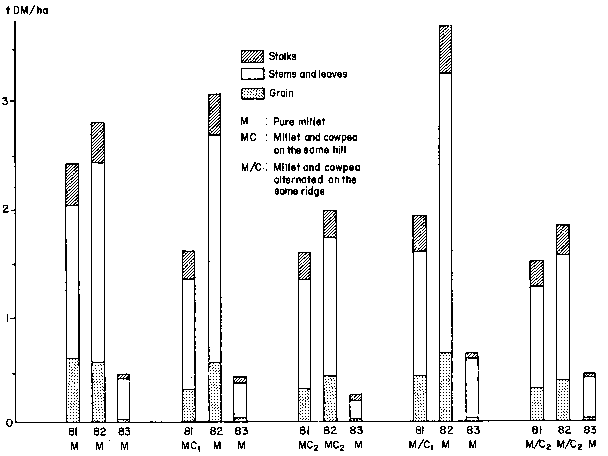
Growing millet and cowpea in mixtures decreased the yield of each crop compared with yields of each in pure stand. Intercropping millet and cowpea for one year reduced the grain yield of millet by 23% (M/C, treatments e and j vs treatment a, Experiment 1, Table 5), while growing the crops in the same hill (MC) reduced the grain yield of millet by 31% (treatments c and i vs treatment a, Experiment 1, Table 5). When these associations were practiced over 2 consecutive years-the yield reduction was larger at 39% (Treatments d and f vs treatment a, Experiment 1, Table 5). Thus it is better to grow the crops in these associations for only one year, followed by a pure stand of millet.
Given this observation, the best, or least disadvantageous, association seems to be alternate cropping (M/C), since this gave the largest increase in yield of a subsequent millet crop (Figure 1, M/C followed by M). This type of intercropping of millet with cowpea was observed to increase the yield of the subsequent millet crop by 103% (2M/C1, treatment j vs a, Experiment 1, Table 5). However, this yield increase is based on the low yields in 1983, due to the exceptionally low rainfall in that year, and similar yield increases should not be expected in more normal years.
Cowpea grown in pure stand for one year increased the grain yield of a subsequent crop of millet by 16% (Treatment b vs treatment a, Experiment 1, Table 5), while growing cowpea in pure stand in the second year increased the yield of the subsequent millet crop by 64% (Treatment h vs treatment a, Experiment 1, Table 5). The dry-matter yield of the cowpea crop was larger in the second year, but this finding should be treated with caution as the cowpea varieties used and rainfall differed between years. The yields of cowpea in intercropped treatments were very much lower than those of cowpea grown in pure stand.
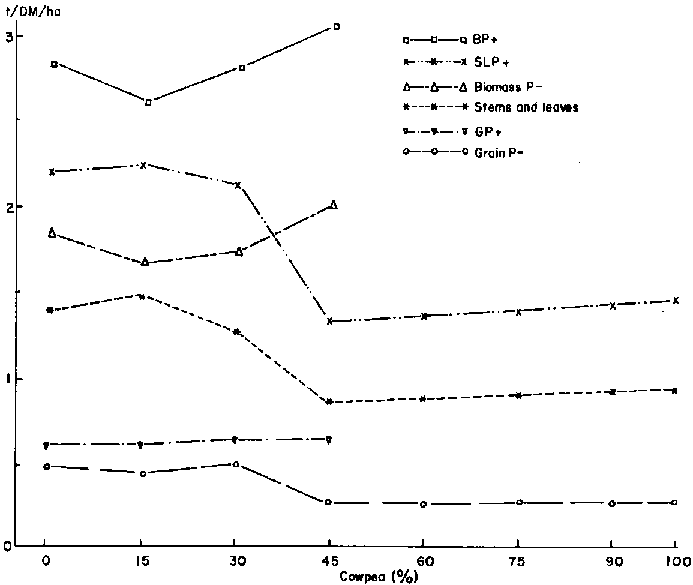
The effect of the different cowpea: millet ratios (Experiment 2) was affected by P application. Application of P in the first year increased the grain yield of millet by 7.7, 9.7 and 2 kg/kg of P in the first, second and third year, respectively. The response of millet to P was much larger when grown in a mixture containing 45% cowpea (Table 6). This mixture gave good yields of both components of the mixture. However, it seems that a mixture containing 30% cowpea gives the best millet yields. When P was applied, increasing the proportion of cowpea in the mixture increased the dry-matter (stem and leaf) yield of millet (Figure 2). Yields of cowpea were very low, especially with regard to grain production, but increased with the proportion of cowpea in the mixture. Applying P reduced the DM yield of cowpea by 30% when cowpea comprised 30% of the mixture, but increased cowpea DM yield by 27% in the mixture containing 45% cowpea (Table 5).
Table 5. Millet yield (grain) and cowpea yield (stems and leaves) over 3 consecutive years of trials with different association patterns (M, C, MC on M/C and with various legume densities and with and without P (33 kg P/ha).
Exp. 1
|
|
Treatment |
Millet yield (kg/ha) |
Cowpea yield (kg DM/ha) |
|||||
|
1981 |
1982 |
1983 |
1981 |
1982 |
1983 |
1981 |
1982 |
|
|
Index |
|
|
|
|
|
|
|
|
|
a |
M |
M |
M |
628 |
589 |
36 |
- |
- |
|
b |
C |
M |
M |
- |
686 |
31 |
968 |
- |
|
c |
MC1 |
M |
M |
327 |
604 |
44 |
500 |
- |
|
d |
MC2 |
MC2 |
M |
327 |
460 |
23 |
562 |
1268 |
|
e |
MC2 |
MC2 |
M |
467 |
679 |
54 |
671 |
- |
|
f |
M/C1 |
M/C2 |
M |
341 |
418 |
28 |
542 |
956 |
|
g |
M/C2 |
M/C2 |
M |
- |
620 |
36 |
- |
_ |
|
h |
- |
2M |
M |
- |
- |
59 |
- |
2869 |
|
I |
- |
2C |
M |
- |
505 |
47 |
- |
942 |
|
j |
- |
2MC |
M |
- |
479 |
78 |
- |
851 |
|
k |
- |
2M/C |
3M |
- |
- |
36 |
- |
- |
|
F Test |
|
|
|
NS |
NS |
NS |
* |
** |
|
led |
|
|
|
/ |
/ |
/ |
295 |
825 |
Exp. 2
|
Application |
Density (%) |
Millet yield (kg/ha) |
Cowpea yield (kg DM/ha) |
||||
|
|
|
1981 |
1982 |
1983 |
1981 |
1982 |
1983 |
|
P+ |
0 |
1004 |
768 |
95 |
- |
- |
- |
|
15 |
859 |
844 |
154 |
58 |
68 |
90 |
|
|
30 |
1030 |
913 |
76 |
116 |
114 |
100 |
|
|
45 |
811 |
1096 |
108 |
234 |
243 |
163 |
|
|
P- |
0 |
854 |
547 |
63 |
- |
- |
- |
|
15 |
676 |
647 |
52 |
69 |
88 |
63 |
|
|
30 |
776 |
647 |
52 |
167 |
183 |
124 |
|
|
45 |
382 |
451 |
10 |
217 |
190 |
95 |
|
|
F test application |
|
* |
* |
* |
NS |
NS |
NS |
|
LSD |
|
167 |
218 |
63 |
/ |
/ |
/ |
|
density |
|
* |
NS |
NS |
** |
NS |
* |
|
LSD |
|
287 |
/ |
/ |
62 |
/ |
32 |
|
application + density |
NS |
NS |
NS |
NS |
NS |
NS |
|
NS = not significant
* = significant at p = 0.05
** = significant at p = 0.01
LSD: least significant difference for the same level of significance as the F-test.
M = millet in sole cropping and C = Cowpea in sole cropping
MC = millet and cowpea in the same hill
M/C = millet and Cowpea alternated.
In the dry year of 1984, cowpea yields were reduced less than those of millet. Under the better conditions in Banamba, cowpea seemed to be insensitive to the presence of millet when grown in association, while the millet seemed to benefit from the association. This can be seen from Figure 3: a straight line indicates that there is no influence on the species, while a curve indicates an effect of the association.
Table 6. Response of millet grain yield to P application in relation to the proportion of cowpea in the mixture, Experiment 2, Niono, 1984-1983.
|
Legume (%) |
kg Grain/kg P |
|
0 |
12.2 |
|
15 |
14.5 |
|
30 |
15.4 |
|
45 |
35.4 |
From Table 7 it is clear that increasing the ratio of one species in the mixture leads to higher yields, at least at the wetter site of Banamba. However, at Niono the pattern is less clear, particularly with regard to millet grain yields (see Table 7, T1 vs T2).
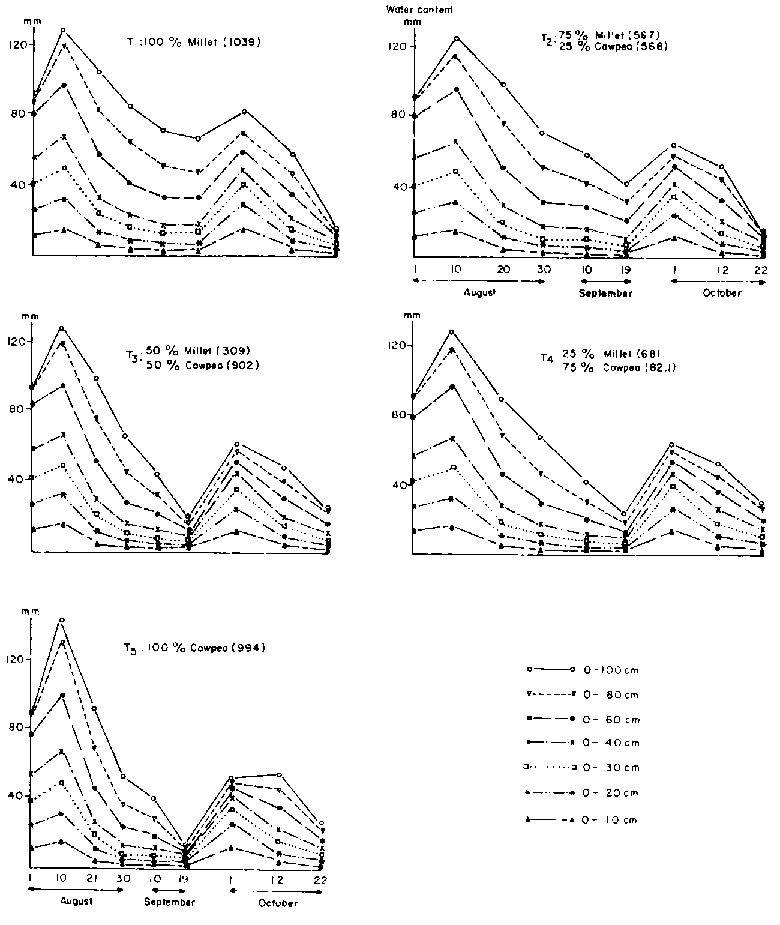
Figure 4 indicates the importance of the millet root system in retaining soil moisture. The soil profile tended to dry out more rapidly under mixtures containing a small proportion of millet than under those with a large proportion of millet in the mixture, particularly in August and September. However, in terms of production, the results differed between the sites. At Niono (220 mm annual rainfall) the best association consisted of 50% of each species, which gave an increase of 24% in total biomass yield. At Banamba the best association was 75% millet and 25% cowpea, which yielded a total of 5 t DM/ha (Figure 3).
Experiments carried out by ICRISAT in Mali between 1979 and 1983 in the 500 to 1000 mm rainfall zone showed that timing of intercropping operations is important. Early sowing of millet and/or cowpea in alternate rows increased yields, particularly of cowpea, as did increasing the proportion of cowpea in the mixture. Including cowpea in the mixture did not decrease the yields of the cereal except under conditions of poor rainfall or low N. It is possible to sow the two crops at different times, sowing the millet first and then the cowpea, but sowing of the cowpea should not be delayed too long, or yield may be reduced. Moreover, if the cowpea is harvested early some N might become available to the millet crop from the decomposition of the N-rich nodules of the cowpea. Recent experiments by the Projet Sectoriel de l'Elevage, demonstrated that intercropping cowpea and millet within the row gave higher millet grain and straw yields than planting in alternate lines or in alternate double lines (Bartholomew, 1985).
Figure 3. Millet and cowpea biomass and cumulative biomass for mixtures of various proportions - Niono
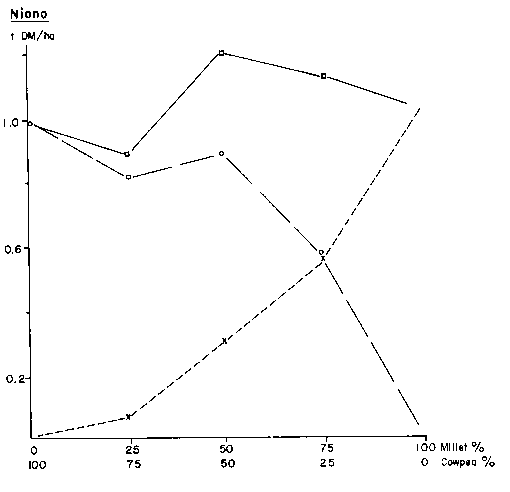
Figure 3. Millet and cowpea biomass and cumulative biomass for mixtures of various proportions - Banamba
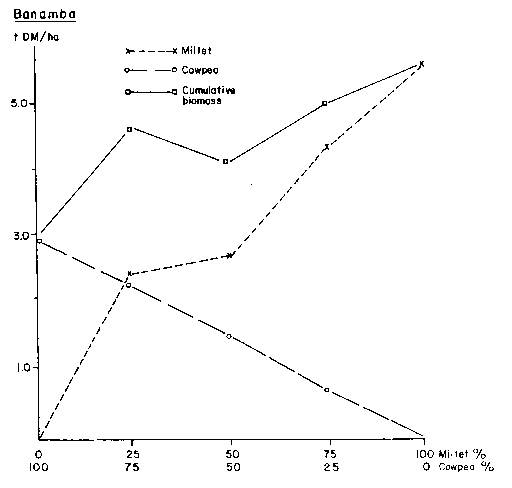
Table 7. Millet yield (grain and stems + leaves) and cowpea yield (grain and stems + leaves) in Experiment 3, Niono and Banamba, 1984.
|
Site |
Treatment |
Millet yield (kg/ha) |
Cowpea yield (kg/ha) |
||
|
Grain |
Stems+ leaves |
Grain |
Stems+ leaves |
||
|
Niono |
T1 |
6 |
815 |
- |
- |
|
(220 mm) |
T2 |
52 |
445 |
7 |
568 |
|
|
T3 |
2 |
293 |
45 |
902 |
|
|
T4 |
1 |
58 |
34 |
821 |
|
|
T5 |
- |
- |
38 |
994 |
|
F test |
|
2.6NS |
9.2** |
1.5NS |
7.7** |
|
LSD |
|
- |
404 |
- |
260 |
|
Banamba |
|
|
|
|
|
|
(400 mm) |
T1 |
1525 |
3511 |
- |
- |
|
|
T2 |
1049 |
2869 |
143 |
671 |
|
|
T3 |
741 |
1601 |
318 |
1479 |
|
|
T4 |
539 |
1621 |
403 |
2222 |
|
|
T5 |
- |
- |
449 |
2902 |
|
F test |
|
11.7** |
6.7** |
7.0** |
16.9** |
|
LSD |
|
592 |
1713 |
312 |
1971 |
T1 = 100% millet;
T2 = 75% millet, 25% cowpea;
T3 = 50% millet, 50% cowpea;
T4 = 25% millet, 75% cowpea;
T5 = 100% cowpea.
NS = not significant.
* = significant at P<0.05.
** = significant at P<0.01.
LSD = least significant difference at the same level of significance as the F test.
It appears that the benefit of growing millet and cowpea in association depends upon the growing conditions. In semiarid zones, farmers will only grow mixtures of millet and cowpea if the yield of the cereal is not reduced, since production of the cereal is their priority. Under these conditions the farmer will not plant more than 6000 cowpea plants per hectare, since higher populations of cowpea reduce millet yield. Our experiments showed that if P fertilizer is available, the farmer can increase the proportion of the legume in the mixture to 50% without decreasing millet yields.
The farmers' current practice is to sow millet and cowpea in the same hill. The alternative practice of having alternate hills of millet and cowpea gives higher yields but makes sowing and harvesting more complicated. Sowing millet and cowpea in alternate lines appears to be the most satisfactory form of intercropping in terms of production, but is perhaps more susceptible to the potentially serious problem of damage by livestock.
However, while growing a pure stand of cowpea seems to benefit the subsequent cereal crop, this cropping system might favour the development of insect pests to which cowpea is susceptible. Without insect control, yields of the cowpea will suffer. Growing the legume in association with the cereal overcomes this problem, and reduces greatly the incidence of insect pests in the legume.
Bartholomew P. 1985. Resultats partiels de la campagne agricole de 1984. Unpublished. Projet Sectoriel de l'Elevage.
FAO (Food and Agriculture Organization). 1984. Production Yearbook. Vol. 38. FAO, Rome, Italy.
Gosseye P and Hulet H. 1982. Etude de l'effet residuel du niebe sur la culture de mil subsequente. Etude de l'incidence de diverges proportions de niebe associe au milt Resultats de la campagne agricole 1981. Programme document No. AZ. 71, ILCA, Mali. 31 pp.
Hulet H. 1983. Resultats de la campagne agricole 1982. Programme document No. AZ.81, ILCA, Mali. 60 pp.
Hulet H. 1984. Resultats de la campagne agricole 1983. Programme document No. A2.102, ILCA, Mali. 55 pp.
Hulet H. 1985. Contribution a l'étude des relations interspecifiques du mil et du niebe cultives en association ou en pur a des densités différentes. Essai d'interprétation de l'influence de diverges techniques culturales sur le profil hydrique du sol et les rendements en milt Resultats de la campagne agricole 1984. Programme document No. AZ.150, ILCA, Mali. 57 pp.
Hulet H and C-osseye P. 1984. Paper presented at the Premier Atelier Régional sur la culture associée dans la zone sahelienne et sahelo-soudanienne de l'Afrique de l'Ouest (200-600 mm). Programme document No. AZ.134, ILCA, Mali. 15 pp.
ICRISAT (International Crops Research Institute for the Semi-Arid Tropics). 1980. Annual Report 1979. ICRISAT, Hyderabad.
ICRISAT (International Crops Research Institute for the Semi-Arid Tropics). 1981. Annual Report 1980. ICRISAT, Hyderabad.
ICRISAT (International Crops Research Institute for the Semi-Arid Tropics). 1983. Annual Report 1982. ICRISAT, Hyderabad.
ICRISAT (International Crops Research Institute for the Semi-Arid Tropics). 1984. Annual Report 1983. ICRISAT, Hyderabad.
Penning de Vries F W T and Djiteye M A. 1982. La productivite des paturages saheliens: Une etude des sols, des vegetations et de l'exploitation de cette ressource naturelle. Pudoc, Wageningen. 525 pp.
Serrafini P. 1984. Intercropping systems. The ICRISAT experience 1979-1983. Paper presented at the Atelier Regional sur la culture associee dans la zone sahelienne et soudano-sahelienne de l'Afrique de l'Ouest (200-600 mm). 26 pp.