Abstract
Introduction
Fodder banks as a source of protein for livestock
Effect of cropping on soil
Probable benefits from stylo to crop production
Implications in the crop-livestock production systems in the SHZ
Conclusions
References
M.A. Mohamed-Saleem, H. Suleiman and R.M. Otsyina
ILCA Subhumid Zone (SHZ) Programme,
PMB 2248, Kaduna, Nigeria
In West Africa, communal grazing usually comprises poor quality grasses which are burnt-off during the dry season. Legume fodder banks can provide high-quality feed during the dry season, and are gaining acceptance among settled pastoralists in the subhumid zone. A well managed fodder bank of Stylosanthes spp. of about 4 hectares can provide protein supplements for 15 to 20 cattle during the dry season. Growing forage legumes also increases yield of subsequent crops. The ability of forage legumes to benefit both crops and livestock will be increasingly important in areas where population pressure is increasing.
Transhumant cattle move across large areas of tropical West Africa in search of better-quality forage, while cattle owned by settled pastoralists are restricted to forage available within herding distance of the home base. The natural herbage is mainly grasses, which are nutritionally adequate for only 3 - 4 months in a year (Mohamed-Saleem, 1984). Crop residues contribute significantly to the dry-season diet of cattle of both nomads and settled pastoralists. About 20% of the Nigerian subhumid zone (SHZ) is cultivated at present, and this proportion is likely to increase rapidly with the growing population (Bourn and Milligan, 1983: Putt et al, 1980).
Pastoralists recognise the need for better pasture as a long-term solution to nutritional shortfalls, especially after the recent sharp price increases and difficulties in obtaining agro-industrial byproducts. But settled pastoralists face the following constraints to forage development:
1. Shortage of labour - all extra labour is required for subsistence cropping.2. Lack of mechanical expertise (not even animal power implements)
3. Little security of tenure on land, hence no longterm commitment to land development. Use of land is controlled by arable farmers who generally have no direct interest in cattle production.
4. Communal grazing by pastoralists.
5. Indiscriminate annual bush burning
Fodder banks (concentrated units of forage legumes established and managed by pastoralists near their homesteads) are gaining acceptance among pastoralists in the SHZ as a means of providing additional protein for sedentary cattle during the dry season.
Floral and edaphic changes that are evident under fodder banks and the increased yields of cereals when such areas are reverted to cropping (Mohamed-Saleem, 1984) also suggest serious considerations of a role for fodder banks in cropping systems. Tropical soils need to be fallowed to maintain their productivity, even at high levels of fertilizer input (Young and Wright, 1980). Thus, growing legumes on land that would otherwise be fallowed might be appropriate in situations in which increasing population pressure has shortened fallow periods.
This paper outlines the principles and practices of fodder-bank establishment and management in the SHZ, and summaries data that indicate the benefit of fodder banks to subsequent crops.
Forage intake by ruminants is reduced severely when the crude protein (CP) content of the herbage is less than 7% (Crowder and Chheda, 1982). Although selective grazing can increase the nutrient intake of the animals, most of the herbage available during the dry season comprises physiologically mature grasses of low nutritive value. Including forage legumes in the diet would be of value, in that they tend to contain more protein than grasses at comparable stages of growth.
Various exotic forage legumes have been introduced into Nigeria and native forage legumes are being collected, in attempts to find species that can provide high-protein feed for livestock. A number of species have shown promise, e.g. Stylosanthes guianensis cvs Cook, Schofield and Endeavour, S. hamata cv. Verano and Townsville stylo (Agishi and Asare, 1980; Agishi, 1982). However, because of the lack of extension work on forages, the forage production technology developed on research stations has not been adopted by traditional livestock producers.
The ILCA SHZ Programme has formulated guidelines for the establishment and management of stylo-based fodder banks:
1. Fence a block of about 4 hectares.
2. Prepare the seed-bed by confining the herd overnight in the area prior to the onset of the rains.
3. Broadcast scarified seeds.
4. Control fast-growing grasses by early grazing.
5. Defer grazing until the dry season to allow the forage to grow.
6. Selected animals graze the fodder bank 2.5 hours per day during the dry season.
7. Ensure sufficient seed drop and stubble for regeneration in the following season.
The fodder bank is sited close to the pastoralist's homestead to prevent animals grazing the fodder bank during the growing season. The land area for fodder banks was determined on the basis of the average number of pregnant and lactating cows in herds, i.e. those animals that are likely to benefit most from improved feeding. In the SHZ of Nigeria the average herd size is about 50 cattle, of which 15 to 20 are cows. Otchere (1984) found that feeding 1 kg of cotton seed cake (30% CP) per day maintained the body weight and productivity of these animals throughout the dry season. With a potential dry-matter yield of 4 to 5 t/ha from stylo (12% CP) a 4 hectare fodder bank would provide enough supplementary feed for the selected animals for 6 months.
A fodder bank is meant to provide protein supplementation and hence the management practices are geared to maximising the proportion of legume in the fodder bank at the end of the growing season. The fodder bank should also last for several years in order to cover the costs of establishment. Gardner (1984) found the following factors to be important for long-term persistence of stylosanthes:
1. Demographic characteristics, in terms of germination, establishment, seedling survival and plant longevity and seed input, dormancy and dispersal;2. Grazing pressure;
3. Soil fertility and fertilizer application;
4. Nitrogen output to the soil/plant system;
5. Other species in the pasture; and
6. Time of first rains.
Stylosanthes hamata fodder banks managed by ILCA researchers have remained productive for several years (Table 1), and the proportion of stylo in the herbage has remained relatively constant. Under correct management, the amount of stylo seed in the soil increases each year (Table 2), and this seed reserve ensures the regeneration of the fodder bank even if some seedlings are killed by periods of drought at the beginning of the rainy seasons. Strategic grazing early in the growing season controls the growth of other forage species and helps to maintain a high proportion of stylo in the fodder bank.
Table 1. Total dry-matter yield and percentage stylo in fodder banks at five locations under different management.
|
Management |
|
Age of fodder bank (years) |
||||
|
1 |
2 |
3 |
4 |
5 |
||
|
Researcher managed - researcher executed -K' Bird - |
(a)* |
6824 |
7350 |
4748 |
6546 |
|
|
|
(b) |
56.0 |
55.4 |
62.0 |
61.0 |
|
|
Researcher managed - pastoralist executed -K'Biri - |
(a) |
6101 |
4191 |
5742 |
5006 |
4789 |
|
|
(b) |
60.1 |
68.9 |
62.6 |
52.0 |
53.0 |
|
Pastoralist managed - pastoralist executed - Kachia - |
(a) |
7111 |
5278 |
|
|
|
|
|
(b) |
68.0 |
64.5 |
|
|
|
|
Pastoralist managed - pastoralist executed - Kontagora - |
(a) |
6120 |
|
|
|
|
|
|
(b) |
52.2 |
|
|
|
|
|
Pastoralist managed - pastoralist executed - Ganawuri - |
(a) |
7900 |
|
|
|
|
|
|
(b) |
59.6 |
|
|
|
|
|
Researcher managed - pastoralist executed - Abet - |
(a) |
4281 |
4900 |
5278 |
5469 |
4789 |
|
|
(b) |
58.4 |
63.0 |
64.5 |
70.1 |
71.0 |
* (a) Total dry-matter yield (kg/ha).
(b) % weight of stylo.
Table 2. Number of seeds/m2 recovered prior to the beginning of rains from fodder banks under different management practices.
|
Management |
Year |
||||
|
1 |
2 |
3 |
4 |
5 |
|
|
Researcher managed-researcher executed |
941 |
2839 |
2745 |
3102 |
|
|
Researcher managed-pastoralist executed |
1328 |
2160 |
648 |
270 |
|
|
Pastoralist managed-pastoralist executed |
1529 |
1372 |
1824 |
|
|
|
Pastoralist managed-pastoralist executed (mismanaged) |
27 |
Resown |
46 |
|
|
Grazing studies on researcher-managed fodder banks (Bayer, 1984) showed that grazing for 2 or 4 hours per day resulted in a highly significant reduction in liveweight losses despite overstocking. There were also indications of a reduction in effective grazing time on free range if animals had access to a fodder bank.
The productivity, legume composition and persistence of fodder banks have been found to vary with changes in management practices introduced by the pastoralists to suit their convenience. Some pastoralists would not confine their cattle to the fodder bank area in order to prepare the seed bed by trampling as it interfered with the time of manuring crop fields. Early grazing to control grass growth in the fodder banks was not practiced by some pastoralists because they believed that grazing on freshly manured fields increased the risk of worm infestation, or because they thought that the animals would damage the stylo seedlings. In these cases the legumes in the fodder bank were smothered by tall grasses. Untimely and prolonged grazing, overstocking, and fire probably caused deterioration of some fodder banks after the first year. S. guianensis cv Cook is a perennial and flowers at the beginning of the dry season, and pastoralists had to resow in the second year when cattle were allowed to graze before seed was set.
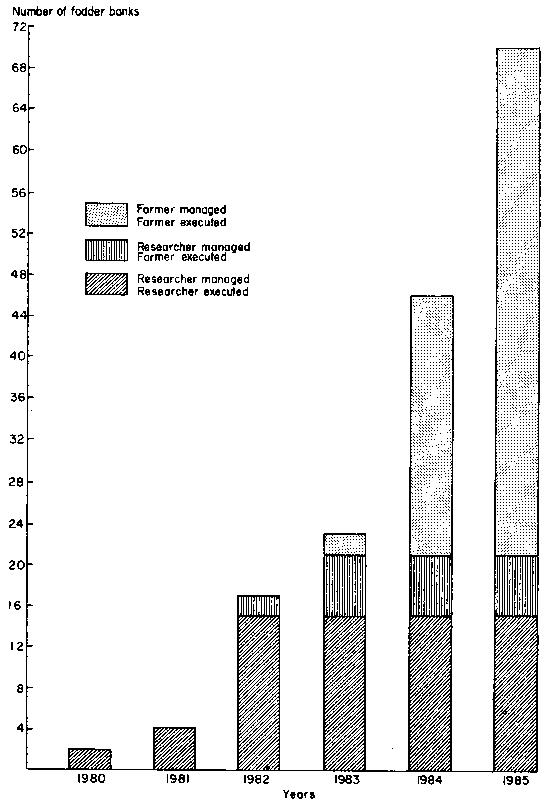
It has been difficult to persuade pastoralists to restrict the use of fodder banks to the most responsive animals in the herd, i.e. pregnant and lactating cows, because they believe that the weakest animals in the herd are most in need of higher-quality feed. Although stocking rates higher than that recommended in the guidelines did not affect seedling emergence and proportion of S. hamata cv. Verano in the fodder bank, it reduced the seed reserve considerably, probably due to animals licking seed from the ground at the end of the dry season. However, repeated overstocking tends to reduce the productivity of the fodder bank after 2 to 3 years. Pastoralists established fodder banks for a number of reasons, including land aquisition and survival feeding, and the number of fodder banks in the subhumid zone of Nigeria increased from only 2 in 1980 to 70 in 1985 (Figure 1). More will be developed in the second livestock development project.
In the SHZ of Nigeria pastoralists are generally landless. However, a relationship between cropping and livestock enterprises has been observed (Bourne and Milligan, 1983), in that cattle population density increased with cultivation intensity up to a level at which 50% of the land was under cultivation. Pastoralists were found to settle amongst the arable farming community for many reasons, the most important of which are access to land for cropping and crop residues. As the farming population increases, access to land may become difficult for the pastoralists, as land is preferentially allocated to people more closely related to the farming community. However, even in intensively cropped areas, a farmer normally owns more land than he cultivates. Some pieces of land close to the dwelling are continuously cultivated in preference to others in distant locations (Powell, 1984).
Figure 1. Number of fodder banks at various levels of management in Nigerian subhumid zone, 1980-85.
In the savannah region, of which the SHZ is a part, intensification of agricultural production, such as continuous cropping, complete land clearing and mechanised farming, leads to accelerated soil erosion resulting in a reduction in the nutrient content of the surface soil and in its ability to retain nutrients. It also becomes coarser in texture. Savannah soils are usually subjected to exceptionally high-intensity rains and kinetic energy loads during the wet season (Kowal and Kassam, 1978). A fast-growing legume cover crop would protect the soil and help to reduce soil erosion.
The legume component in the fodder bank increases soil N through fixation of atmospheric N and decay of root nodules and by increasing the proportion of nitrifiable N (Vallis and Gardner, 1984). This encourages the establishment of nitrophilous species (Gardner, 1984), resulting in changes in the botanical composition of the fodder bank. The plant composition of a 4-year-old fodder bank of S. hamata cv. Verano at Kachia grazing reserve is given in Table 3.
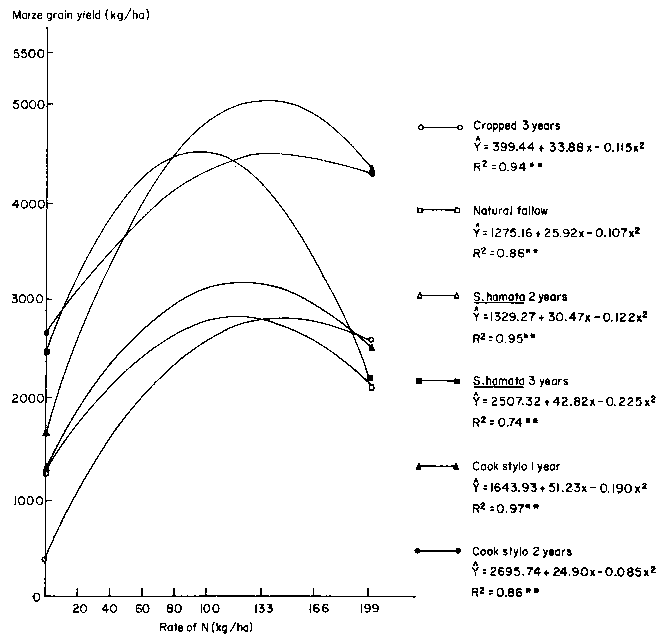
Maize was grown on land that had been under fodder banks for 1 to 3 years to assess the amount of N made available by the legume. Maize was also grown on adjacent land that had either been fallowed or had been continuously cropped for 3 years. The grain yield of maize on land that had been under stylo was significantly higher than that of maize on continuously cropped land (Figure 2). The yields of maize on land that had been fallowed or under stylo were compared with the N-response curve of maize grown on continuously cropped land, to give an indication of the amount of N made available by the previous cropping treatments (Table 4). Growing S. guianensis for 2 years gave the largest increase in apparent N availability of 100 kg N/ha. However, even with increasing rates of N application the yield differences persisted, and these differences could only have been due to factors other than N accretion in the soil.
Table 3. Frequency distribution (%) of major grasses in a 4-year-old S. hamata cv. Verano fodder bank, Kachia grazing reserve.
|
Species |
Natural Vegetation |
Fodder bank |
|
Andropogon spp. |
6.2 |
13.3 |
|
Brachiaria spp. |
8.3 |
|
|
Digitaria spp. |
0.8 |
|
|
Hyparrhenia spp. |
11.4 |
16.1 |
|
Louditia spp. |
40.7 |
4.0 |
|
Panicum spp. |
0.8 |
|
|
Paspalum spp. |
1.4 |
0.4 |
|
Pennisetum spp. |
|
0.5 |
|
Setaria spp. |
0.6 |
0.8 |
|
Others |
24.4 |
5.6 |
|
Legume |
|
|
|
S. hamata cv. Verano |
59.3 |
|
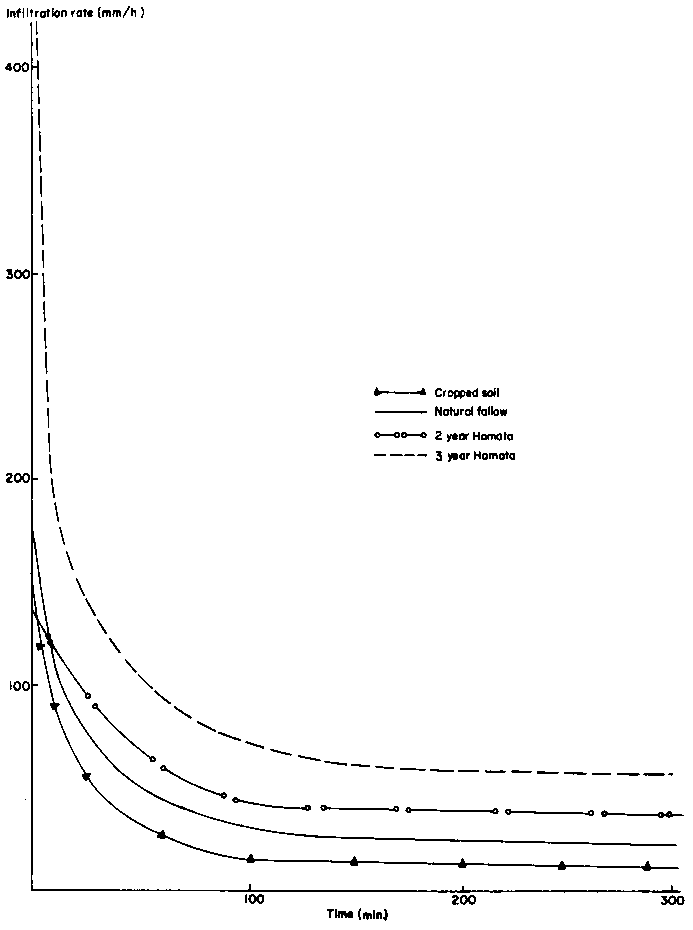
Differences were observed in bulk density, water infiltration rates, water-holding capacity, and gravel, organic-matter and N contents among the soils under the different cropping treatments (Table 5 and Figure 3). However, the physical properties of the soil were not monitored continuously and some of these differences may have been due to inherent variability of the soils.
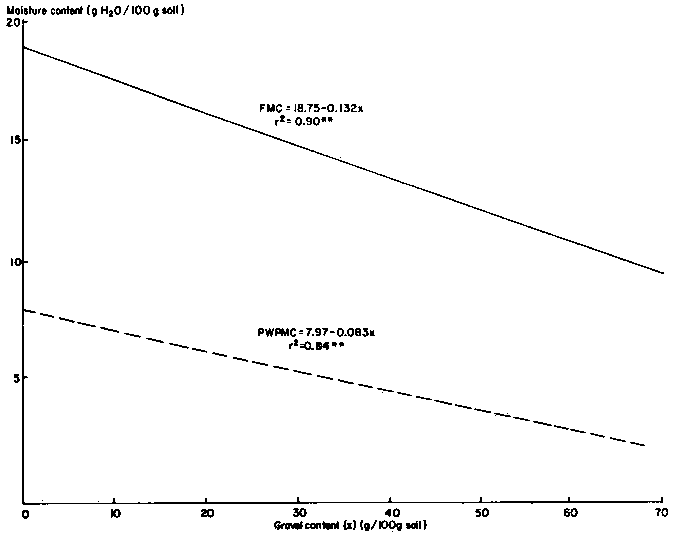
The results indicate that experiments should be conducted to assess the influence of forage legumes on the physical properties of soils. It is possible that the ramification of the stylo root system and the vegetative cover, which would reduce soil erosion, had effects on the bulk density and the gravel percentage of the soil. As can be seen in Figure 4, there is a negative relationship between the water-holding capacity and the gravel content of the soil. Blondell (1965), in Senegal, found that sorghum grain yields increased by 600 kg/ha for each reduction in bulk density of 0.10 g/cm3.
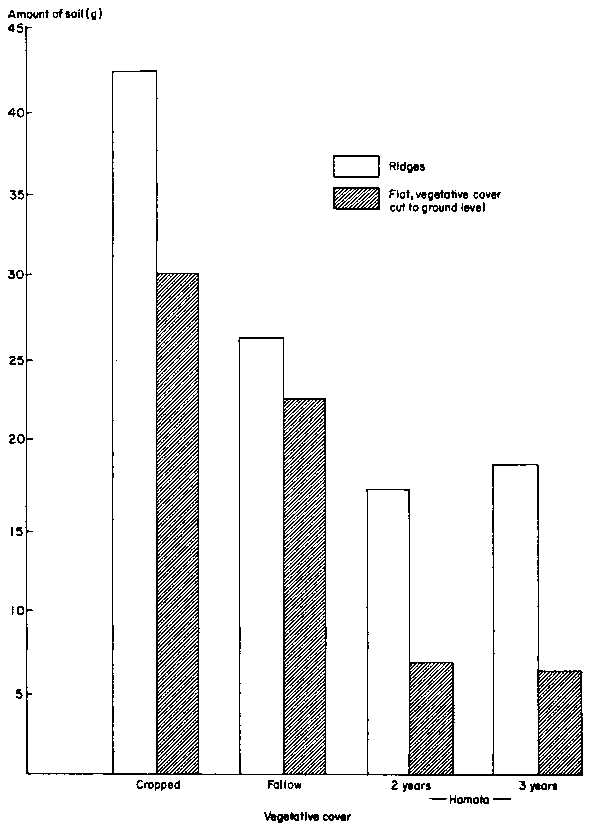
A preliminary observation using soil splash traps showed that the loss of soil during the growing season was considerably less from soil that had been under stylo than from soil that had been fallowed or cropped continuously (Figure 5).
Table 4. Grain yield of maize without N fertilizer and calculated amount of N contributed by previous cropping history.
|
Cropping history |
Maize grain yield at zero N (kg/ha) |
N contribution1 (kg/ha) |
|
Cropped 3 years |
461 |
|
|
Natural fallow |
1275 |
30 |
|
S. hamata 2 years |
1369 |
32 |
|
S. hamata 3 years |
2507 |
90 |
|
S. guianensis 1 year |
1643 |
44 |
|
S. guianensis 2 years |
2696 |
100 |
1. Amount of N required on cropped soil to give yield equivalent to that at 0 N under alternative cropping history.
Due to its long growing period and high rainfall, the SHZ offers great potential for agricultural expansion. However, the favourable climatic conditions cannot be fully exploited unless soil fertility is improved and erosion controlled. The reduction in tsetse infestation by using pesticides and controlling its habitat had led to an increase in the human and livestock populations and this will further increase pressure on land.
Powell (1984) observed that farmers in the SHZ are gradually adopting high-energy crops such as maize in preference to millet and sorghum. One of the factors that contributed to this change was the availability of chemical fertilizers. Although fertilizer(s) can replace nutrients and meet crop requirements, their efficiency is reduced if the soil structure is weak and is prone to erosion and runoff. To maintain a favourable structure of the major soil types in the SHZ, Young and Wright (1980) recommend rest periods by reverting to natural vegetation for 1 year in 4, 3 years in 5 and 4 years in 5 for high, intermediate and low input levels, respectively.
Table 5. Preliminary data on some soil physical properties for different experimental sites, Kachia grazing reserve.
|
|
Cropped soil |
Fallow soil |
Hamata soil |
|
|
2 yrs |
3 yrs |
|||
|
Gravel content (g/100 g) in 0-10 cm depth |
||||
|
|
58 ± 3 |
21 ± 9 |
12 ± 8 |
|
|
Particle size distribution (%) of fine earth fraction |
||||
|
Coarse sand |
|
35 |
21 |
34 |
|
Fine sand |
37 |
43 |
43 |
|
|
silt |
14 |
17 |
11 |
|
|
Clay |
14 |
19 |
11 |
|
|
|
Soil bulk density (g/cm3) |
|||
|
1.75 |
1.61 |
1.54 |
1.42 |
|
|
Available water holding capacity (g/100 g) |
||||
|
|
7.3 |
10.6 |
10.2 |
|
|
Field moisture capacity (g/100 g) |
||||
|
|
10.4 |
|
18.5 |
|
|
Organic matter content (%) values corrected for gravel |
||||
|
|
1.04 |
1.76 |
2.72 |
|
Measurements carried out by Dr. P.N. Vine, University of Ibadan.
Figure 3. Water infiltration rates rates (mm/hour) at some experimental sites at Kurmin Biri.
Introducing a fast growing legume such as Stylosanthes spp. into the cropping system, which will occupy the required rest period, could provide more benefit to the crops than a natural vegetation.
Techniques to fit forage legumes into cropping systems are available (Mohamed-Saleem et al, this volume). Farmers who do not own livestock may also benefit from the legume if land is leased to pastoralists for the establishment of fodder banks.
Figure 5. Total amount of soil collected in splash traps (78 cm rimmed funnels) during one growing season after ridging or vegetative cover cut to ground level.
The crop and livestock production potential of the SHZ can only be realised through the improvement of soil fertility and stability. Data show that the yields of cereal crops are higher on land that has been under forage legumes such as S. hamata than on land that has been fallowed. The forage legume also provides good-quality feed for livestock that could offset deficiencies in natural herbage, and pastoralists in the SHZ of Nigeria are showing interest in the use of fodder banks. The dual roles of forage legumes in benefiting both crops and livestock need to be exploited to increase agropastoral production in the subhumid zone.
Agishi E C and Asare E O. 1980. Pasture establishment and seed production in the savannas of Nigeria. Proceedings of the 1980 livestock and veterinary conference. AERLS and NAPRI. pp 282-301.
Agishi E C. 1982. Verano stylo - a promising new legume for Nigerian savannas. National conference on beef production, Kaduna, Nigeria, July 1982.
Bayer W. 1984. Fodder utilization. ILCA/NAPRI symposium on livestock Production in the subhumid zone of Nigeria, Lugard Hall, Kaduna, Nigeria, 30 Oct - 2 Nov 1984.
Blondel D. 1965. Premiers élément sur l'influence de la densité apparente du sol sur la croissance racinarie de l'arachide et du sorgho. Ses conséquences sur le rendements. (Quoted from Soils of W. Africa. CAB, Technical Communication No. 55).
Bourne D and Milligan K. 1983. The dynamics of cattle distribution in the Nigerian Subhumid Zone. An assessment based on analysis and low attitude aerial surveys. Working document 1983, ILCA, SHP, Kaduna, Nigeria.
Crowder L V and Chheda H R. 1982. Tropical grassland husbandry. Longmans, New York.
Gardner C J. 1984. The dynamics of stylosanthes pastures. In: Stace H M and Edye L A (eds). The biology and agronomy of stylosanthes. Academic Press.
Kowal J M and Kassam A H. 1978. Agricultural ecology of savanna. A study of West Africa. Clarendon Press, Oxford.
Mohamed-Saleem M A. 1984. Crop forage interactions. Paper presented at the ILCA/NAPRI symposium on livestock production in the subhumid zone of Nigeria, Lugard Hall, Kaduna, Nigeria 30 Oct - 2 Nov 1984.
Otchere E O. 1984. The effects of supplementary feeding of Bunaji cattle in the subhumid zone of Nigeria. Paper presented at the ILCA/NAPRI symposium on livestock production in the subhumid zone of Nigeria, Lugard Hall, Kaduna, Nigeria. 30 Oct - 2 Nov 1984.
Powell J M. 1984. Cropping systems in the subhumid zone of Nigeria. Paper presented at the ILCA/NAPRI symposium on livestock production in the subhumid zone of Nigeria. 30 Oct - 2 Nov 1984.
Putt S N H. Shan A P M, Mathewman R W. David D M, Underwood, James D D, Hellman M J and Ellis P R. 1980. The social and economic implications of trypanosomiasis control. A study of its impact on livestock production and rural development in northern Nigeria. Veterinary Epidemiology and Economic Research Unit, University of Reading.
Vallis I and Gardener C J. 1984. Nitrogen inputs into agricultural systems by Stylosanthes. In: Stace H M and Edye L A (eds). The biology and agronomy of stylosanthes. Academic Press.
Young A and Wright A C S. 1980. Rest periods requirements of tropical and sub-tropical soils under annual crops. In: Land resources for populations of the future. FAO, Rome. pp. 197-268.