Abstract
Introduction
Materials and methods
Results
Discussion
Conclusions
Acknowledgements
References
Martin L. Kusekwa1 and Anselm B. Lwoga2
1TALIRO, Livestock Production Research Institute, Private Bag, Mpwapwa, Tanzania.
2Sokoine University of Agriculture, P.O. Box 3001, Morogoro,
Tanzania.
In this study, which was conducted at Tengeru, Arusha, in northern Tanzania, over 61 weeks, nine pasture legumes were oversown into natural pastures. Four seedbed preparation methods were used, namely burning, hard grazing, cultivation and normal grazing (control) with or without phosphatic fertilizer.
Sixteen seedling and plant counts were made to determine germination, establishment and survival of the legumes. Of the nine legumes, Desmodium intortum (cv Greenleaf desmodium) and Macroptilium atropurpureum (cv Siratro) were significantly better than the other legumes in terms of germination, establishment, survival and percentage contribution to total dry matter. For most legumes, establishment was most successful following burning or hard grazing of the native pastures.
The implications of these findings are discussed with special reference to the possibilities of improving natural grasslands by introducing selected pasture legumes by oversowing.
Located in East Africa, 1° south of the equator, Tanzania has a human population of about 20 million (17.5 million by the 1978 census) and a ruminant livestock population of 12.1 million cattle, 5.5 million goats and 3.6 million sheep (Ministry of Agriculture, 1979). Of its total area of 93.7 million hectares, 60% is natural grasslands which are available for grazing (Ministry of Livestock Development, 1983). These grasslands are mostly in ecoclimatic zones IV and V described by Pratt et al (1966). They are characterised by low, erratic rainfall, usually 760 mm or less total annual rainfall, and a high evapotranspiration potential of more than 1800 mm. Grasses, of which Themeda and Hyparrhenia species are dominant, grow rapidly and quickly reach flowering and seeding stages during the rainy season (French, 1957).
The natural grasslands are the sole source of feed for over 90% of the country's ruminant livestock and herbivorous game. However, the productivity and quality of the herbage from these natural grasslands are low (Calo, 1976). Any attempt to increase the productivity of the country's ruminant livestock must, therefore, involve development and improvement of these natural grasslands.
The three main approaches to development and improvement of natural grasslands are (a) improvement of their management and utilisation, (b) introduction of suitable improved pasture species into the natural pastures, and (c) a combination of the first two approaches, whereby improved legume species are introduced into natural grasslands by oversowing and the resulting pastures subjected to improved management and utilisation (Kusekwa and Lugenja, 1983; Lwoga, 1978; 1979; 1983).
In Tanzania, the first approach is constrained by the inherent low productivity and low quality of herbage of the existing plant species in the natural grasslands (Calo, 1976; Mannetje, 1981). Replacing existing plant species with improved ones by cultivation and seeding is, on the other hand, unlikely due to the high costs involved. Thus, the third approach, oversowing, seems to be the most realistic. Oversowing involves seeding directly, either by sod seeding or surface broadcasting, into a live, chemically killed or partly disturbed natural grassland (Cook, 1980). In East Africa, Keya and Eijnatten (1975) and Stobbs (1969) observed that oversowing was a possible method for improving natural grasslands. Keya and Kalangi (1973) in Kenya reported successful oversowing of the legume, Desmodium uncinatum into a Hyparrhenia-spp.-dominated natural grassland with superphosphate fertilizer applied at the rate of 500 kg/ha. This pointed to the need to correct mineral dificiencies for the successful establishment of pasture species with a high fertility requirement. Walker (1977) also pointed out the need for phosphatic fertilizers with legume-based pastures.
Work in Tanzania on oversowing of promising pasture legumes is scanty. Lane and Lwoga (1978) at Morogoro, Tanzania, observed that oversowing of pasture legumes needed further investigation.
This study was aimed at determining the best methods of oversowing pasture legumes into natural grasslands, with or without the application of phosphatic fertilizers. This paper reports results of an experiment in which nine legumes were oversown into natural grasslands at Tengeru, Arusha, in northern Tanzania.
The experiment was conducted from April 1979 to June 1980 at the Livestock Training Institute, Tengeru in Arusha, northern Tanzania, 3° 24' S and 36° 47' E at an altitude of 1260 metres above sea level. The climate is subhumid, with a mean annual rainfall of about 1100 mm and maximum temperature of 28.2° C during February and 12.3° C minimum temperature in July.
Table 1 shows the rainfall during the experimental period along with the 20-year mean monthly rainfall.
Table 1. Monthly rainfall for April 1979 to June 1980 and the 20-year mean monthly rainfall, Tengeru,
Tanzania.
|
Month |
Rainfall |
Rain |
20-year mean |
|
|
Rainfall |
Rain |
|||
|
(mm) |
days |
(mm) |
days |
|
|
April 1979 |
305.1 |
21 |
365 |
19 |
|
May 1979 |
241.0 |
21 |
145 |
18 |
|
June 1979 |
2.7 |
2 |
30 |
4 |
|
July 1979 |
1.4 |
2 |
15 |
6 |
|
August 1979 |
12.0 |
3 |
13 |
7 |
|
September 1979 |
25.8 |
6 |
12 |
5 |
|
October 1979 |
57.2 |
11 |
47 |
12 |
|
November 1979 |
Nil |
Nil |
93 |
13 |
|
December 1979 |
21.1 |
6 |
101 |
9 |
|
January 1980 |
28.8 |
4 |
59 |
4 |
|
February 1980 |
62.4 |
6 |
61 |
3 |
|
March 1980 |
49.2 |
6 |
143 |
8 |
|
Total for 12 months |
806.7 |
88 |
1084 |
108 |
|
April 1980 |
259.2 |
15 |
365 |
19 |
|
May 1980 |
101.7 |
16 |
145 |
18 |
|
June 1980 |
1.4 |
2 |
30 |
4 |
|
Total for experimental period |
1146.3 |
118 |
1624 |
149 |
The experimental site was under natural pasture and had for many years been subjected to light grazing, and had thus reverted to acacia bush. Desirable grasses, which comprised about 80% of the botanical composition of the pasture, included Bothriochloa insculpta, Cynodon dactylon and Panicum spp. Legumes present were Rhynchosia spp. and Vigna spp. Predominant weedy species were Ageratum conyzoides and Bidens pilosa.
Soils at Tengeru are dark brown, silty, clay-loam developed on colluvium, derived mainly from lavas (Anderson and Naveh, 1968); but the soils at the trial site were mainly vertisols with their usual characteristic of being waterlogged during the rainy season and cracking in the dry season.
The experimental treatments comprised factorial combinations of four seedbed preparation methods, three levels of P application and nine legume species. A randomised block design with split plots was used with two replicates. Seedbed preparation methods were the mainplot treatments and 27 combinations between P fertilizer levels and legume species were the subplot treatments.
Seed preparation treatments were as follows:
Normal grazing (control): Dry dairy cows grazed off about 50% of the available dry matter, followed by hand trimming. This treatment simulated a normally grazed natural pasture.
Hard grazing: Dry dairy cows grazed off about 50% of available dry matter, followed by hand slashing of the pasture to remove about 75% of available total dry matter. This treatment simulated a closely or overgrazed natural pasture.
Burning: Paraquat was applied at 0.5 kg a.i./ha to desiccate the pasture, which was then burned. This simulated a burnt natural pasture, a common feature in these areas.
Cultivation: Heavy discing was done using a tractor-drawn disc plough to destroy the existing vegetation.
Legume species sown are shown in Table 2.
Table 2. Legume species used in the trial.
|
Species/cuttivar |
Germination (%) |
Number of seeds/plot |
Number of seeds/quadrat (1000 cm2) |
Number of pure germinating seeds/quadrat |
|
|
Minimum |
Actual |
||||
|
Macroptilium atropurpureum (cv Siratro) |
70 |
70 |
450 |
4 |
4 |
|
Medicago sativa (cv Hunter River) |
80 |
33.3 |
7920 |
66 |
27 |
|
Stylosanthes hamata (cv Verano stylo) |
40 |
40 |
1320 |
11 |
11 |
|
Stylosanthes humilis (cv Townsville stylo) |
40 |
12.9 |
6600 |
55 |
18 |
|
Desmodium intortum (cv Greenleaf desmodium) |
70 |
70 |
3775 |
31 |
31 |
|
Desmodium uncinatum (cv Silverleaf desmodium) |
70 |
70 |
1100 |
9 |
9 |
|
Leucaena leucocephala (cv Standard leucaena) |
60 |
40 |
288 |
3 |
2 |
|
Neonotonia wightii (cv Cooper glycine) |
60 |
6.3 |
9240 |
77 |
8 |
|
Clitoria ternatea (cv Clitoria) |
60 |
60 |
408 |
4 |
4 |
Fertilizer was broadcast at sowing at 0 (P0), 23.1 (P1) and 46.2 kg P/ha (P2).
Sowing : The legumes species were surface sown on 3 m x 4 m subplots after having been inoculated with the appropriate rhizobia. Sowing date was 12 April 1979.
Measurements: The number of seedlings or plants per subplot was estimated by taking seedling/plant counts in four randomly placed 1000 cm quadrats (40 cm x 25 cm) in each subplot. Sixteen counts were made at weekly intervals to determine germination, establishment and survival of the oversown legume species. The last count was taken 140 days after sowing on 30 August 1979. Dry-matter production and botanical composition were also determined by separation of herbage samples from three 1000 cm quadrats per subplot. These measurements were taken 55 weeks and 61 weeks after sowing on 2 May 1980 and 13 June 1980, respectively. Other observations made included scoring for vigour, leafiness, colour (greenness), uniformity (cover) and presence of pests and diseases.
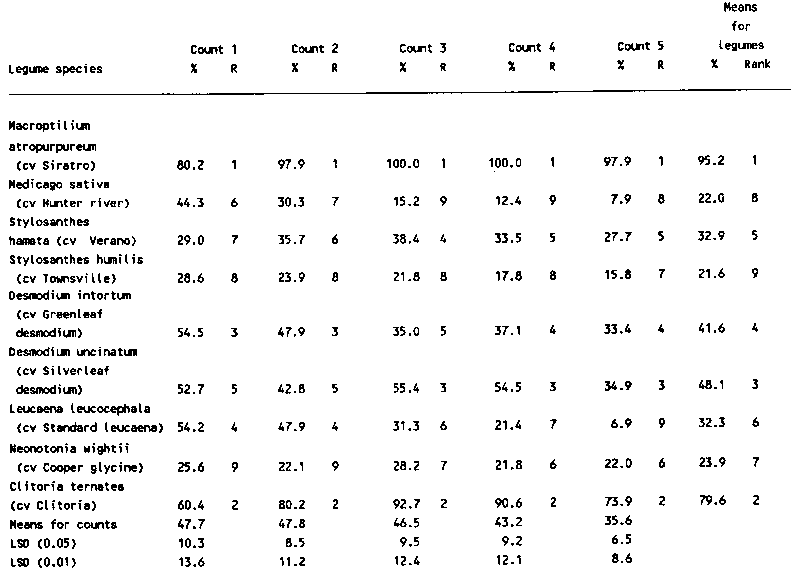
In this paper, results for five seedling or plant counts are given: (1) 7 days after sowing, on 19 April 1979, corresponding to germination; (2) 28 days later, on 17 May 1979, corresponding to establishment; (3) 63 days after sowing, on 14 June 1979; (4) 98 days after sowing, on 19 July 1979; (5) final count taken 140 days after sowing, on 30 August 1979. Germination of lucerne and Greenleaf desmodium was first observed 5 days after sowing.
Table 3 shows that Siratro was consistently superior to the other legumes in terms of germination, establishment, growth and survival. It was followed by clitoria then the desmodiums. The means of counts 1-3 differed significantly from the means of counts 4 and 5 (P< 0.05), suggesting that some seedlings died after establishment.
Table 4 shows that hard grazing and burning favoured germination, establishment, growth and survival of the legumes oversown on natural pasture, although the differences between the grazing and burning treatments was not significant. The establishment, growth and survival of the legumes was significantly poorer in the cultivated treatment than in the other three treatments.
Table 4. Effects of methods of seedbed preparation on germination, establishment, growth and survival of legumes oversown into a natural pasture, Tengeru, Tanzania, 1979/80.
|
Seedbed preparation methods |
Counts |
Mean |
||||
|
1 |
2 |
3 |
4 |
5 |
||
|
Burning |
49.3 |
47.9 |
44.2 |
46.5 |
38.8 |
45.3 |
|
Hard grazing |
52.5 |
54.7 |
51.9 |
48.7 |
39.5 |
49.5 |
|
Cultivation |
43.5 |
39.3 |
37.8 |
33.6 |
27.8 |
36.4 |
|
Normal grazing |
45.6 |
48.7 |
52.0 |
44.1 |
36.3 |
45.3 |
|
Means |
47.7 |
47.8 |
46.5 |
43.2 |
35.6 |
|
|
LSD (0.05) |
NS |
12.6 |
12.7 |
12.3 |
12.5 |
|
NS not significant (P>0.05).
Phosphorus application had no significant effect on any Of the plant counts. However, from the third plant count up to the final count, there were indications that higher levels of P favoured the establishment and survival of oversown legumes.
The total dry-matter yields from plots oversown with the various legumes did not differ significantly. Greenleaf desmodium and Siratro plots, however, gave the highest yields, of 3.6 and 3.5 t DM/ha, respectively. Seedbed preparation methods and P application did not have significant effects on the percentage contribution of legumes to total dry-matter yields.
Table 5 shows that the percentage legume contribution to total-dry matter yields at the first harvest was highest in Siratro plots followed by Greenleaf desmodium and lowest in lucerne and Townsville stylo plots.
Table 5. Ranking of legume species by percentage contribution to total dry-matter yields. Harvest 1 taken 55 weeks after sowing and harvest 2 after 6 weeks regrowth from harvest 1.
|
Legume |
Harvest 1 |
Harvest 2 |
Mean |
|||
|
% |
Rank |
% |
Rank |
% |
Rank |
|
|
Siratro |
38.0 |
1 |
26.0 |
1 |
32.0 |
1 |
|
Lucerne |
0.8 |
7 |
0.4 |
8 |
0.6 |
8 |
|
Verano stylo |
12.2 |
4 |
12.8 |
3 |
12.5 |
3 |
|
Townsville stylo |
0.2 |
8 |
1.3 |
7 |
0.75 |
7 |
|
Greenleaf desmodium |
27.8 |
2 |
7.9 |
5 |
17.85 |
2 |
|
Silverleaf desmodium |
11.0 |
5 |
4.2 |
6 |
7.6 |
6 |
|
Leucaena |
0.0 |
9 |
0.0 |
9 |
0.0 |
9 |
|
Cooper glycine |
10.2 |
6 |
14.0 |
2 |
12.1 |
4 |
|
Clitoria |
12.8 |
3 |
11.1 |
4 |
11.95 |
5 |
|
Mean |
12.60 |
8.60 |
|
|
|
|
|
LSD (0.05) |
3.15 |
3.23 |
|
|
|
|
|
LSD (0.01) |
5.36 |
5.56 |
|
|
|
|
At the second harvest, which was taken 6 weeks later, performance, in descending order, was Siratro, Cooper glycine, Verano stylo, Clitoria, Greenleaf desmodium, Silverleaf desmodium, Townsville stylo, lucerne and then leucaena. This indicated that legume regrowth over the 6 weeks varied with species.
Germination
The necessary activities for a seed to complete the process of germination include: water imbibition, germination, radicle entry to the soil and commencement of root growth. This is a simple process in a cultivated seedbed where the soil is wet enough. For oversown (surface sown) seeds the relative humidity of the micro-environment surrounding the seed is important (Campbell, 1973; Campbell and Swain, 1973; Cook, 1980). In this study, there were no significant effects of the various seedbed treatments on germination, an indication of the presence of adequate surface soil moisture at sowing and during the germination phase. This is in agreement with observations made by various workers, that where surface soil moisture is not limiting, oversown seeds germinate well (Cook, 1980; Keya and Kalangi, 1973; Kusekwa, 1977; Lwoga, 1983; Massa and Mannetje, 1982).
However, the legumes differed in their abilities to germinate under the various oversowing conditions: Siratro was superior to the rest of the legume species. This is in agreement with the work by Cook and Lowe (1977) who observed that Siratro seedlings are vigorous and well adapted to a range of soil and climatic conditions.
Establishment and growth
Establishment and growth of the legumes (counts 2 to 4) were significantly poorer in the cultivated treatment than in the burning, hard grazing and normal grazing treatments. The bare soil surface was prone to rapid drying, which resulted in the death of some seedlings. However, it appeared that the main cause of seedling loss was competition from native vegetation, as was also found by Cook (1980). In the burning and hard grazing treatments, which suppressed growth of the native vegetation, establishment and growth of the oversown legumes was much better than in the other treatments. However, as soon as the native vegetation began to regrow it was apparent that competition occurred and the less competitive species such as lucerne and leucaena started to die off. Twining legumes and those that are tolerant to shading, namely Cooper glycine, Siratro, Clitoria and the desmodiums (Humphreys, 1981) did not seem to be greatly affected by the competition from the native vegetation. Tothill and Jones (1977) observed that Siratro was capable of smothering the native vegetation due to its vigour and the build-up of soil nitrogen from nitrogen fixation.
Early survival
Survival of the oversown legume species was indicated by plant count 16, taken 140 days after sowing, and by the percentage legume contributions to total dry-matter yields of the plots 55 weeks after sowing. Survival was influenced by the individual legumes ability to withstand competition from the existing vegetation and to tolerate other environmental stresses, such as moisture stress (Cook, 1980). Siratro showed the greatest survival, followed by Greenleaf desmodium. At the second harvest 6 weeks later, regrowth of the legumes varied, but Siratro was again superior to the other legumes. Leucaena disappeared from all plots before the first harvest.
Fertilizer P application did not have a significant effect on the survival of the legume species, although survival of some of the legumes was slightly increased at higher levels of P application. Rayment et al (1977) observed small increases in dry-matter yield of Siratro/grass pastures with top-dressed P fertilizer at rates up to 60 kg P/ha. Therefore, larger responses could have been obtained at higher P application rates.
The following conclusions could be drawn from this investigation:
1. Oversowing legumes into native pastures should be carried out when surface soil moisture conditions are likely to be adequate both at and after sowing and preferably for most of the growing period.2. Competition from native vegetation should be reduced by burning or close grazing in order to aid the establishment of the legumes.
3. Sowing should be timed such that the legumes are well established before the onset of the dry season.
4. More screening work should be done to determine which legume species are suitable for oversowing i.e. those with seedlings that can establish under oversowing conditions characterised by severe competition and environmental stresses such as severe dry spells.
5. Under the climatic and soil conditions of the trial site, Siratro and Greenleaf desmodium emerged as the most suitable legume species for oversowing in the area.
We are most grateful for advice and help from: G. Sudi, L.M. Ngigwana, E. Mavura, J. K. K Msechu, J. J Mbekelu and J. C. Tothill. We are indebted to the Royal Netherlands Government through the Horticulture Project at Tengeru, the Tanzania National Scientific Research Council, the World Food Programme - Dairy Development Project, Tanzania, the International Development Research Centre (IDRC), Ottawa, Canada, the International Livestock Centre for Africa (ILCA), the Tanzania Livestock Research Organization (TALIRO) and the Sokoine University of Agriculture, Morogoro, for their support.
Anderson G D and Naveh Z. 1968. Promising pasture plants for northern Tanzania. V. Overall comparisons of promising plants. East Afr. Agric. For. J. 34: 84.
Calo L L. 1976. Supplementary feeding. Proc. 3rd Scientific Conf. Tanzania Soc. of Anim. Prod. 3:33.
Campbell M H. 1973. Factors responsible for losses during germination, radicle entry, establishment and survival of surface sown pasture species. J. Aust. Inst. Agric. Sci. 39:194.
Campbell M H and Swain F G. 1973. Factors causing losses during the establishment of surface sown pastures. J. Range Man. 26(5):355.
Cook S J. 1980. Establishing pasture species in existing swards: A review. Trop. Grassl. 14(3): 181.
Cook S J and Lowe K F. 1977. Establishment of Siratro pastures. Trop. Grassl. 11(1): 41.
French M H. 1957. Nutritional value of tropical grasses and fodders. Herbage Abstr. 27:1.
Humphreys L R. 1981. Environmental adaptation of tropical pasture plants. MacMillian Publishers Ltd. London.
Keya N C O and van Eijnaten C L M. 1975. Studies on oversowing natural grasslands in Kenya. Effects of seed inoculation and pelleting on the nodulation and productivity of Desmodium uncinatum. East Afr. Agric. For. J. 40:351.
Keya N C O and Kalangi D W. 1973. The seeding and superphosphate rates for the establishment of Desmodium uncinatum by oversowing uncultivated grasslands of western Kenya. Trop. Grassl. 7(3): 319.
Kusekwa M L. 1977. A study of the germination and establishment of lucerne (Medicago sativa L.) oversown on an uncultivated grass sward. M. Agric. Sci. Thesis. Massey Universtiy, Palmerston North, New Zealand. 135 pp.
Kusekwa M L and Lugenja M M S. 1983. Pasture production and utilization in Tanzania. Proc. 10th Scientific Conf. Tanzania society of Anim. Prod. 10: 145.
Lane I R and Lwoga A B. 1978. Pasture agronomy and improvement of natural pastures. Proc. 5th Scientific Conf. Tanzania Society of Anim. Prod. 5: 134.
Lwoga A B. 1978. Nitrogen on East African pasture. Proc. 3rd General Conf. Association for the Advancement of Agric. Sciences in Africa, Ibadan, Vol 11:133.
Lwoga A B. 1979. Pasture research and development in Tanzania. Paper presented at the Agric Res. Workshop, Arusha, Tanzania, 25 Feb-3 March, 1979.
Lwoga A B. 1983. The potentials of forage legumes in the exploitation of grazing resources in Tanzania. Paper presented at a symposium on the role of biology in the development and utilisation of natural resources in Tanzania, Dar-Es-Salaam 26 - 29 Sept 1983.
Mannetje L't. 1981. Problems of animal production form tropical pastures. In: M Hacker J B (ed.). Nutritional limits to animal production from pastures. p 67.
Massa F E and t'Mannetje L. 1982. Behaviour of Townsville stylo in a native pasture at the Narayen Research station in south-east Queensland. Trop. Grassl. 16(4):186.
Ministry of Agriculture, Tanzania 1979. The 1978 Livestock count in mainland Tanzania and beef demand and supply. Dar-Es-Salaam. 554 pp.
Ministry of Livestock Development, Tanzania 1983. The livestock policy of Tanzania. Dar-Es-Salaam. 25 pp.
Pratt D J. Greenway P J and Gwynne M D. 1966. A classification of East African rangelands. J. Appl. Ecol. 3: 369.
Rayment G E, Bruce R C and Robbins G B. 1977. Response of established Siratro pastures in south east Queensland to phosphorus fertilizer. Trop. Grassl. 11(1): 65.
Stobbs T H. 1969. Animal production from Hyparrhenia grasslands oversown with Stylosanthes gracilis. East Afr. Agric. For. J. 35: 128.
Tothill J C and Jones R M. 1977. Stability in sown and oversown Siratro pastures. Trop. Grassl. 11(1): 55.
Walker B. 1977. Productivity of Macroptilium atropurpureum (cv Siratro) pastures. Trop. Grassl. 11(1): 79.