Abstract
Introduction
National seed programmes and some selected experiences with herbage seed production
References
S. Jutzi
Highlands Programme, ILCA, P.O.Box 5689,
Addis Ababa, Ethiopia
Activities in the fields of herbage seed production and research are relatively underdeveloped throughout sub-Saharan Africa. The only exceptions appear to be Kenya and Zimbabwe, where domestic seed production, mainly of grasses, has reached appreciable levels. Most reports on seed production of forage crops also centre on these two countries, with Kenya concentrating on grasses and Zimbabwe on forage legumes.
There is little application of national seed legislation to herbage seed due to the small scale of commercial operations. Of 25 countries for which information is available, only Kenya reported full implementation of seed quality control measures and advanced levels of herbage seed production and distribution. There are very few opportunities for training in herbage seed production, handling and marketing in sub-Saharan Africa. In the light of this situation ILCA is proposing to implement a herbage seed production, training, outreach and research unit at ILCA headquarters in Addis Ababa. This unit should be a major supporting activity for the regional forage research networks being developed.
Seeds play a vital role in agricultural development for both food crops and forage and pasture crops. The commercial demand for herbage seed, however, depends very much on the emphasis given by governments to pasture development in their livestock policies. It is also a function of the relative priorities assigned to range management and sown pastures. Historically, the emphasis in southern Africa has been on range management, and research on sown pastures or range reinforcement and replacement techniques has started only recently in most sub-Saharan countries. Kenya and Zimbabwe are exceptions, and have a somewhat longer experience in this field. These two countries are also the only ones with a herbage seed industry strong enough to offer sizeable quantities of herbage seed on export markets.
Pasture research in national programmes and in regional and international centres has gained momentum in the last two decades, and many pasture development schemes have been implemented in the region. The corresponding higher demand for herbage seed has not, however, been matched by increased domestic production of herbage seed. Most of the increased demand for herbage seed comes from the state sector or livestock development projects. Such demands are usually met by imports and are thus not conducive to the development of a domestic herbage seed industry. Agricultural subsistence economies are unlikely to develop high and continuous commercial demands for herbage seed. Thus, it is only the comparatively small farming sector with surplus livestock produce and accessible commercial outlets which can develop a genuine demand for herbage seed.
Most African governments have passed legislation designed to regulate the domestic seed market and for phyto-sanitary control of seed imports and exports. This legislation refers to all plant material used for propagation and is the legal framework for all seed-related activities. Based on this legislation the governments have set up seed industry development programmes, which are generally oriented towards the most important food crops and give different priorities to the private and public sectors. In contrast to Asia and especially Latin America, African governments tend to prefer state-controlled seed production rather than to develop private seed enterprises, although there are a few exceptions.
Herbage seed production is generally considered in national seed industry programmes, but is always given rather low priority, and production targets and time frames are not stipulated.
Seed programmes for food crops have a considerable influence on livestock feeding in many African countries since food crop residues are an important source of livestock feed in Africa (Kassila, 1984). The introduction of new crop species and cultivars is likely to change the quantity and/or quality of crop residues produced and will thus influence the performance of livestock. The livestock sectors in national economies therefore have a genuine interest in the use of feed value criteria in the breeding and selection of food crops. The differences in feed values of crop residues even within a given crop species (e.g. sorghum) are considerable and warrant more attention by plant breeders (Reed et al, 1985).
There are few reports of research on herbage seed production from sub-Saharan Africa. Generally such research is not part of coordinated efforts to support production. Kenya and Zimbabwe are the major exceptions.
This paper gives an overview of some national efforts to develop seed production infrastructure. It then highlights some of the research on seed production in herbage crops and finally outlines some recent developments in terms of regional and international activities to support national efforts for increased herbage seed production.
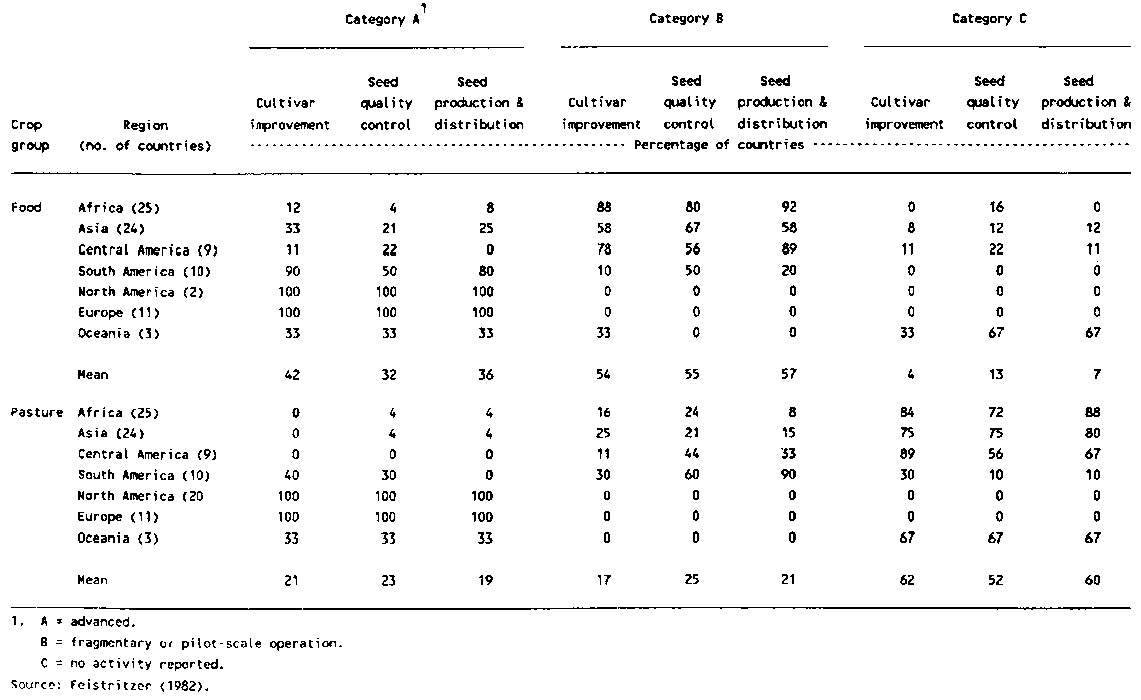
A national seed industry is composed of several equally important components which extend-from cultivar improvement and evaluation by agricultural research institutions, over seed quality control measures carried out by governmental seed certification offices, to seed production and distribution done by public and/or private organisations. In 1979/80, FAO reviewed seed-industry-related activities in 84 countries: 25 in Africa, 24 in Asia, 9 in Central America, 10 in South America, 11 in Europe, 3 in Oceania and 2 in North America (Feistritzer, 1982).
Although most of the countries had active research institutes, few of the developing countries had enough installations for the production, quality control and distribution of improved seeds.
In Table 1 the countries are grouped into three categories according to the development of their food crop and pasture seed industries: those with advanced seed industry, those with fragmentary or pilot-scale operations and those with no substantial seed industry.
Africa ranks last for the three basic seed industry components (cultivar improvement, seed quality control and production and distribution) and for the two crop groups reviewed (food and pasture). There are, however, appreciable differences among African countries in terms of their efforts and achievements. Kenya and Zimbabwe have undoubtedly made the greatest progress in the development of sizeable commercial supplies of improved seed of both food and pasture crops. Their cases are presented in more detail below. Seed-related activities are more recent in Ethiopia, Ivory Coast, Madagascar, Malawi, Nigeria and Zambia. Many African countries did not make substantial efforts to set up a domestic seed industry until the 1970s.
In 1973 the FAO Seed Improvement and Development Programme (SIDP) was implemented. By 1980, SIDP covered 118 countries and another 25 countries cooperated in seed exchange activities. SIDP had a major impact on the discussions about national seed industry development in many African countries with incipient seed activties. Some of the better documented SIDP missions were to Gambia (FAO, 1975), Burkina Fasso (FAO, 1976a), Swaziland (FAO, 1976b), Ethiopia (FAO, 1977), Cameroon (FAO, 1978a), Mauritania (FAO, 1978b) and Nigeria (FAO, 1979). In each case, herbage seed is covered by the national seed programme but obviously no such programme gives first priority to herbage seed.
Table 1. Production and distribution of quality seed of food and pasture crops, 1979/80.
The Kenyan experience
Oggema (1983), reporting on the Kenyan seed industry, lists five elements necessary for reliable seed production:
1. An assured source of basic seed material;
2. Existence of seed production companies;
3. Existence of regulatory services;
4. Registered seed growers; and
5. Demand for the seed after production.
Kenya has a network of agricultural research stations which continuously provide basic seed of tested cultivars to seed producers. The main stations are the Njoro National Plant Breeding Station, the Thika National Agricultural Research Station and the Katumani Dryland Research Station.
Commercial seed production in Kenya is left to the private sector. There are more than a dozen seed companies, the major ones being the Kenya Seed Company, Njoro Seed Company, East African Seed Company, Simpsons and Whitelaw and Kerchoff. Most of these companies contract farmers to produce seed under supervision. The companies provide the initial seed and also often provide required inputs to facilitate application of appropriate technology.
Kenya has a comprehensive law that controls seed activities. It could be implemented for the seed quality control for which the National Seed Quality Control Services (NSQCS) at Lanet are responsible.
Any new variety has to be grown in National Variety Performance Trials (NVPT) and in Distinctness, Uniformity and Stability (DUS) trials. The National Seed and Plant Varieties Act does not yet protect plant breeder's rights, and the regulatory services are limited to those crops with a plant breeding research component.
The NSQCS keeps an annual list of seed growers who conform to the seed legislations for the crop they grow. The majority of seed growers are in the Rift Valley and a few in the Central Province. Seed farmers usually sell their seed stocks through the Kenya Farmers Association (KFA), which is an agricultural supply and service organisation with branch offices throughout the country, although there are several other agents and shop-keepers who sell seed on behalf of the companies. It is estimated that the national seed industry meets about 40% of the country's seed requirements, the remainder being landraces.
The Kenya Seed Company (KSC) is of special interest. Based in Kitale, KSC was established in 1956 by a group of farmers in response to demand for seed of improved grass and legume varieties recommended by the Grasslands Research Station in the same town. Hazelden (1982) describes the history and activities of this company some detail. The company has expanded its activities to crops other than pasture but maintains a strong interest in pasture crops, working mainly with grasses, all of them selected from indigenous material. The KSC produces large quantities of Chloris gayana (several cultivars) and Setaria anceps (=sphacelata), and smaller quantities of Panicum coloratum and Brachiaria rusiziensis seed. The company contracts farmers in the Kitale area for approximately 2000 ha of grass for seed annually. Of the domestic sales 15-20% go to small-scale farmers, the rest to large farm units and for export. The company maintains that pasture legumes have never been particularly successful in extensive ley farming. It has sometimes been involved in legume seed production, but only on a small scale. It appears that the Kitale Agricultural
Research Station is the only place where seed of some tropical legumes (Desmodium spp.) is still produced (Boonman, 1978a). Lucerne (Medicago sativa), a widely used legume, is imported and seed of this and other legumes is also handled by KSC for re-exportation.
The Zimbabwean experience
Seed legislation in Zimbabwe dates back to 1952 when quality testing was made compulsory for the more important crops (Hanssen, 1982). The Seed Services section of the Department of Research and Specialist Services is the official certifying authority. Pasture grass and legume seed multiplication in the Zimbabwean Seed Certification Scheme is done by members of the Zimbabwean Pasture Seed Growers Association (Davis and Hanssen, 1972). Barnes (1968) reported that many farmers in Zimbabwe prefer to establish their own seed-increase plots using small amounts of certified seed. This practice helps them avoid heavy expenses and acquaints many farmers with the technical problems related to herbage seed production.
Pasture seed is commonly harvested by hand. Seed yields are reasonable due to adequate fertilizer and plant protection inputs. Commercial emphasis was and still is on the production of grass seed. Eragrostis curvula (Weeping Lovegrass) is widely used. Cynodon plectostachyus (African Stargrass) is one of the African grasses that have been successfully introduced to other continents. However, like Pennisetum spp., it is propagated by means of root splittings or rhizomes. Several well-seeding Paspalum spp. are also widely used and commercialised in Zimbabwe (P. plicatulum, P. quenoarum, P. notatum), along with Panicum maximum and Chloris gayana. Seed of Zimbabwe Sudan grass (Sorghum verticilliflorum) is also produced.
Excellent progress has been made in Zimbabwe in the development of pasture legumes for use in mixtures with grasses. Trifolium semipilosum (Kenya white clover), Lotononis bainesii and Desmodium intortum (Greenleaf) showed particular promise in the early years of commercial forage legume utilisation (Barnes, 1965). This work with legumes, which included pest resistance, breeding for cultivar evaluation and selection and production of rhizobium inoculants and seed production, was started in the early 1960s (West, 1964). At same time, Zimbabwe developed probably the only infrastructure of practical relevance in the subcontinent for the production of rhizobium inoculants for forage legumes. This reflects the importance given to pasture legumes and production of their seed in Zimbabwe. Commercial experience with an impressive range of pasture legumes for many ecological conditions has been gained: Trifolium repens, T. pretense and Medicago sativa were used under irrigation in cool, high elevation areas. The African clovers Trifolium semipilosum and T. rueppellianum competed with T. repens in rain-fed, legume-based pastures in the high-rainfall highlands. T. semipilosum, Cajanus indicus, Desmodium discolor and D. intortum were used in the high-rainfall main cropping areas to sustain livestock production. Some of these legumes were also used extensively for over-sowing in range improvement.
A widely used method of range improvement is to rest the range (veld) during the whole of the growing season (Gill, 1938). After the pasture has set seed in autumn, stock are allowed to graze during winter. The animals thus help the seed to be shed and to be trampled into the soil. After commercial pasture seed became available, such range improvement methods could be complemented with oversowing techniques.
The Zimbabwean seed industry has recently developed a tree seed centre at the Forest Research Centre to provide seed to the member countries of the Southern Africa Development Co-ordinating Conference (BBC, The Farming World, June 11-13, 1985). This initiative is particularly important for the support of regional efforts in agroforestry and sylvi-pastoral activities.
The Zambian experience
An FAO grassland mission to Northern Rhodesia (Zambia) in 1955 recommended that a country-wide programme of grass and legume seed production should be set up (FAO, 1955). This recommendation was made on the basis of numerous reports from individual farmers and from experiment stations who were successfully using sown pastures. However, the national seed legislation, the basis of any seed industry development, was passed only after independence.
Plant breeding and agronomic evaluation is the responsibility of the Research Branch of the Ministry of Agriculture and is coordinated from the Mount Makulu Research Station at Chilanga, which was established in 1953. The Zambia Seed Company (Zamseed) was created to deal with the production, processing, storage and nation-wide supply of high-quality seed, at a minimum cost to the consumer (Wellving, 1983). The state-controlled Zamseed is responsible for multiplying and distributing cultivars released by the cultivars Release Committee. Zamseed is also responsible for all seed imports and exports. It carries out the seed production through the Zambia Seed Producers Association (ZSPA). Much of the seed processing, especially of the large grains such as maize, is done on the farms. Seed is tested and certified by the Seed Control and Certification Institute (SCCI) at Mount Makulu. Zamseed furnishes the certified seed to retailers such as Namboard, cooperative unions and others.
While the Zambian seed industry reportedly meets about 40% of the national requirements for seed of improved cultivars of the major food and industrial crops (the rest being met by landraces), the production of herbage seeds is lagging behind (Cranford, 1975). Nonetheless, some commercial seed of nine pasture legumes was reported to be available (Cranford, 1978), including Rhynchosia sublobata (cv. Mukolo), an indigenous accession. The most important legume species an offer were Stylosanthes guianensis, Macroptilium atropurpureum, Neonotonia wightii, Desmodium uncinatum and Leucaena leucocephala. Certified seed of grasses (Eragrostis curvula, Cenchrus ciliaris, Setaria anceps, Chloris gayana and Panicum maximum) was also available.
A comprehensive seed production handbook has been published by the Zambia Department of Agriculture (Welving, 1984), giving valuable practical advice to seed growers and indicating seed yields that are likely to be achieved with a number of pasture legumes under Zambian conditions.
Herbage seed production in West Africa
Production of herbage and pasture seed has received little attention from national agricultural research systems in anglophone West Africa (Adegbola, 1971), despite early reports on pasture research in Nigeria (Ahlgreen et al, 1959; Rains, 1963) and Ghana (Evans, 1961) emphasising the importance of an adequate supply of seed in making the research results applicable. Very little work has been reported from Sierra Leone, Liberia or the Gambia on forage crop introduction and evaluation. Sierra Leone has recently started an effective Seed Multiplication Project (kreul, 1984) but this deals only with rice seed at present. However, production of seed of other crops, such as pasture crops, could be integrated into the project relatively easily if needed. The Nigerian National Seed Service also concentrates mainly on food crops (Joshua and Singh, 1982).
There is a considerable amount of information of the suitability and performance of herbage species, both indigenous and introduced, in West Africa. For example, McIlory (1962) established lists of grasses and legumes adapted to the guinea savannah, the derived savannah and the rainforest ecosystems in West Africa, based on agronomic evaluations. The legumes listed included the genera Stylosanthes, Centrosema, Calopogonium, Pueraria and Neonotonia. ILCA has successfully devised feed production systems in the humid and subhumid ecosystems of Nigeria using
Stylosanthes spp., Gliricidia sepium and Leucaena leucocephala (Sumberg and McIntire, 1985). Sumberg (1985) also reported on the seed production of Gliricidia sepium.
The situation in francophone West Africa is generally similar to that in anglophone West Africa. Comprehensive reports on pasture research are available; for example, Borget (1971) reported the results of 5 years' work at the Institut de Recherches Agricoles Tropicales in Senegal, Bourkina Fasso, Niger, Dahomey, Cameroon, Gabon and the Central African Republic. A wide range of grasses and herbage legumes were found to be suitable for commercial use in pasture development, but none of these countries has yet established a domestic herbage seed production industry. All have implemented national seed production programmes with emphasis on food crops.
The same is also true of Mali (Anon., 1973), where a large seed multiplication scheme was established in 1977 (Giacich and Toure, 1982) dealing with the major food crops. It appears that the Ivory Coast was the first francophone West African country to implement a pilot scheme on pasture and pasture seed development (Anon., 1971), although Madagascar has undertaken similar efforts.
Other herbage seed production initiatives
The seed industry in Sudan, described by Joshi (1978), concentrates on major food crops. However, Douglas (1976), when reviewing the national seed programme, expressed the need to integrate pasture seed production into the scheme. In Ethiopia the seed production industry is state controlled. Seed is produced by the Ethiopian Seed Corporation, which was set up in 1979 and is affiliated to the Ministry of State Farms. The Corporation produces relatively small amounts of seed of herbage species (Vicia villosa ssp. dasycarpa, Avena sativa) for use on state farms and for sale to institutes. More recently, commercial quantities of seed of some herbage species have been produced by the Arsi Rural Development Unit and the Ministry of Agriculture, Soil and Water Conservation Department and Feeds and Forage Project.
In Tanzania there is virtually no commercial-scale production of herbage seed. Multiplication activities are restricted to government experiment stations (Rwebangira, 1978), a situation found in many other countries in sub-Saharan Africa.
PROSPECTS FOR REGIONAL SUPPORT OF HERBAGE SEED PRODUCTION
"A country which does not produce its own agricultural seed is a country without agricultural technology of its own and ultimately a country without sovereinty" (Rolon Anaya, 1977).
National efforts to increase domestic production of herbage seed can be decisively enhanced by regional and international supporting activities, which include training, exchange of germplasm, provision of documentation and consultancies. At present such supporting activities do not exist in Africa. CIAT, a CGIAR-supported research centre based in Colombia, appears to be the only institution in the developing world that provides services of this kind. However, CIAT's supporting activities are intended mainly to service the needs of countries in Latin America, and its activities would have to be increased substantially to meet the needs of Africa.
Training staff in seed technology and research can provide national programmes with leaders for their domestic herbage seed production projects. Research, training and outreach activities on a regional basis can improve communications, increase the uniformity of seed standards and procedures and increase the flow of germplasm among the countries of the region.
ILCA is developing such support facilities at its headquarters in Addis Ababa, Ethiopia. The Centre recognises that effective herbage seed production, processing and marketing programmes in its mandate countries are essential to the success of the pasture research being conducted by ILCA. Seed certification schemes run by the national programmes are a logical step in the use and maintenance of promising plant germplasm.
The objectives of the Herbage Seed Unit that will be set up at ILCA HQ will be to:
· Train staff from private and public institutions, primarily in sub-Saharan Africa, in herbage seed production, drying, processing, storage, marketing, quality control and seed programme development;· Provide consultancies and to collaborate in management and technical aspects of herbage seed programmes and seed industry. The major focus of these activities will be to increase the availability of seed to farmers. Whenever possible, the Herbage Seed Unit will draw upon African expertise and former trainees to address local problems;
· Multiply and distribute sufficient seed of high quality to ILCA's field programmes for primary testing of germplasm in different ecological zones in Africa, and to assist in the propagation and introduction of the commodities of other international agricultural research centres (IARCs) in sub-Saharan Africa;
· Help to develop the framework of policy decisions needed to build stronger national seed programmes and seed enterprises in the region; and to
· Strengthen the capabilities of the seed industry in the target countries, to enable them to produce and supply high-quality seed. In this, the Herbage Seed Unit will concentrate on commodities in which ILCA has major activities, such as forage legumes, or in which ILCA has relay responsibilities, such as for materials produced by other IARCs.
A symposium held in Zimbabwe in October 1984 proposed that a forage research network be established for eastern and southern Africa (PANESA), to be sponsored by the International Development Research Centre (IDRC). The United States Agency for International Development (USAID) has since shown interest in expanding this network to cover West Africa. The activities of this network will soon be starting and there will be a need to increase ILCA's seed production capacity to produce the seed needed by the network participants. PANESA will also be an important channel for the outreach activities proposed for the Herbage Seed Unit.
Adegbola A A. 1971. Research on forage crops in anglophone West Africa. University of Ibadan, Ibadan, 27 pp.
Anon. 1971. Forage crop research in West Africa. Seminar held at the University of Ibadan. Summary of discussions. Ibadan. 18 pp.
Anon. 1973. Compte rendu des activites et resultats de la section de diffusion et controle des semences selectionnees. Ministere de la Production (Mali). Institut d'Economie Rurale.
Barnes D L. 1965. Improved dryland pastures in the sandveld. Grassland Research Station, Marandellas,
Zimbabwe.
Barnes, D.L. 1968. Dryland pastures. Rhod. Agric. J. 65:6-13.
Borget M. 1971. Recherches fourrageres menees par l'IRAT en Afrique tropicale et a Madagascar. Seminaire sur les cultures fourrageres. Universite d'Ibadan, Ibadan.
Cranford R Q. 1975. Seed production in pasture legumes. Productive Farming (Zambia) 22:5-6.
Cranford R Q. 1978. Plant breeding. Pasture grasses and legumes. Report on the work carried out at Mount Makulu and other stations between March 1967 and April 1978. Mount Makulu Research Station, Chilanga.
Davis A G and Hanssen K B. 1972. Rhodesia Pasture Seed Growers Association. Proc. Grassl. Soc. South Afr. 7:98-104.
Douglas J. 1976. Report on the seed programme of the Sudan. In: International Workshop on Agricultural Research and Development in the Sudan. 37 pp.
Evans D C P. 1961. A review of past and present work connected with grassland, pasture and fodder problems in Ghana. First Grassland Symposium, Scientific Services Division, Ministry of Agriculture, Accra, Ghana.
FAO (Food and Agriculture Organization). 1955. Report of FAO grassland mission on Northern Rhodesia. FAO, Rome. 68 pp.
FAO (Food and Agriculture Organization). 1975. Seed Industry Development Programme (SIDP), Gambia. Plant Production and Protection Division. FAO Access No. 28890, 15 pp.
FAO (Food and Agriculture Organization). 1976a. Seed Industry Development Programme (SIDP), Upper Volta. Plant Production and Protection Division. FAO Access No. 34645. 20 pp.
FAO (Food and Agriculture Organization). 1976b. Seed Industry Development Programme (SIDP), Swaziland. Plant Production and Protection Division. FAO Access No. 34644. 41 pp.
FAO (Food and Agriculture Organization). 1977. Seed Improvement and Development Programme (SIDP), Ethiopia. Plant Production and Protection Division. FAO Access No. 38943. 47 pp.
FAO (Food and Agriculture Organization). 1978a. Seed Improvement and Development Programme (SIDP), Cameroon. Plant Production and Protection Division. FAO-AGPC-SIDP./78/10.
FAO (Food and Agriculture Organization). 1978b. Seed Improvement and Development Programme (SIDP), Mauritania. Plant Production and Protection Division. FAO Access No. 41144.
FAO (Food and Agriculture Organization). 1979. Seed Improvement and Development Programme (SIDP), Nigeria. Plant Production and Protection Division. FAO-AGP SIDP/79/1.
Feistritzer W P. 1982. World seed production and supply. In: Seeds. FAO Plant Production and Protection Paper 39. FAO, Rome.
Giacich W and Toure O. 1982. Seed farms in Mali. In: Seeds. FAO Plant Production and Protection Paper 39. pp. 496509. FAO, Rome.
Gill G A. 1938. Deferred grazing, seeds shed by cattle during grazing. Rhod. Agric. J. XXXV (9) :765-766.
Hanssen X B. 1982. Seed Services, a service to farmers. Zimb. Agric. J. 79(1):1-5.
Hazelden E J R. 1982. Kenya Seed Company. In: Seeds. FAO Plant Production and Protection Paper 39. pp. 522-531.
Joshi M S. 1978. The seed industry in Sudan. In: Holmes J C (ea.). Technology for increasing food production. Proceedings of the second FAO/SIDA seminar on field crops in Africa and the Near East, Lahore, Pakistan. pp. 351-355.
Joshua A and Singh A. 1982. National Seed Service, Nigeria. In: Seeds. FAO Plant Production and Protection Paper 39. FAO, Rome.
Kreul W. 1984. Improved seed production. A recent example of a seed multiplication project in Sierra Leone. Quart. J. Int. Agric. 23(1):51-64.
McIlory R J. 1962. Grassland improvement and utilization in Nigeria. Outlook in Agriculture 4:174-179.
Oggema M W. 1983. Seed production and marketing in Kenya. In: Holmes J C and Tahir W M (eds). More food from better technology. FAO, Rome. pp. 259-262.
Rains A B. 1963. Grassland research in northern Nigeria 1952/62. Samaru Misc. Paper No. 1, Institute for Agricultural Research, Ahmadu Bello University, Zaria, Nigeria.
Reed J. Tedla A and Jutzi S. 1985. Large differences in digestibility of crop residues from sorghum varieties. ILCA Newsletter 5(1):5-6.
Rolon Anaya E. 1977. Empresa Productora de Semillas Forrajeras (SEFO), Feasibility Study. University of Cochabamba, Bolivia.
Rwebangira J A. 1978. Pasture development in Tanzania. Proceedings of the fifth scientific conference, Tanga. Tanzania Society of Animal Production.
Sumberg J E and McIntire J. 1985. An economic analysis of alley farming with small ruminants. ILCA, Addis Ababa, Ethiopia.
Sumberg J E. 1985. Note on flowering and seed production in a young Gliricidia sepium seed orchard. Trop. Agric. (Trinidad) 62(1): 17-19.
West O. 1964. Pasture management and improvement in Rhodesia. Rhod. Agric. J. 61:119-125.
Wellving A H A. 1983. An introduction to the Zambian seed industry. In: Holmes J C and Tahir W M (eds). More food from better technology. FAO, Rome.
Wellving A H A. 1984. Seed production handbook of Zambia. Department of Agriculture, Lusaka.