J.N. Clatworthy
Grasslands Research Station, P/B, Marondera, Zimbabwe
C. Madakadze
Henderson Research Station, Zimbabwe
Introduction
Methodology
Results
Discussion
References
Abstract
Results of screening trials with pasture legumes in Zimbabwe are reviewed. The Stylosanthes spp. proved especially suitable for reinforcement of native grazing on sandy soils because of their ability to establish under adverse conditions and to persist and spread under grazing. On heavier soils or on ploughed land a wider range of legumes showed promise, with Desmodium spp. outstanding in the higher rainfall areas. On an infertile sand in a lower rainfall region only Macrotyloma axillare cv Archer and Macroptilium atropurpureum cv Siratro were productive.
The importance of defining the likely role of legumes in local livestock production systems and relating the evaluation procedure to this use is stressed. This is illustrated in the trials described by an increasing trend towards including grazing in the evaluation process.
The introduction and evaluation of potential pasture grasses and legumes occupy a large proportion of the time of most pasture research teams and it is obvious that this is a field in which the PANESA network will be deeply involved. The pasture section at Grasslands Research Station has, since the mid-1950's but particularly since 1970, been involved in the introduction, evaluation and incorporation into farming systems of forage and pasture legumes. During this period the section made many mistakes, learnt many lessons and changed its ideas and methods several times. In the hope that these experiences may be of interest to other workers in this field in Eastern and southern Africa, an attempt has been made to summarise the experiences in this paper. Most of the results presented and discussed here have been published elsewhere, and for that reason the methods employed are not described in detail. Emphasis is placed on comparisons of several species or strains under common conditions rather than on comparisons of techniques involving only one or a few strains.
Introduction Nursery
The procedures used in the introduction nursery (Clatworthy 1975) are similar to those used in almost all introduction nurseries worldwide. Seeds are inoculated with Rhizobium strains known or thought likely to be effective on that species and are sown in a single row on fertilized soil. The nursery beds may be watered to ensure establishment but not thereafter. Records are kept of the habit, vigour, persistence, flowering date and flower characteristics, seed set, disease and pest attack and other features of interest for each introduction. The beds are kept weed-free for the first two seasons but not after that. Only in exceptional cases are plants harvested from the nursery.
Seed is reaped from all lines initially to ensure a reserve of seed, but once this has been achieved, more seed is bulked only from those lines showing promise.
Where feasible, cattle are allowed access to the introduction nursery from the fourth year onwards so that the acceptability of the legumes to stock can be observed. The introduction nursery is intended only as a very coarse screen to eliminate those plants which are obviously unsuited to conditions in the area. A large proportion of the introductions will warrant further testing to determine their agricultural potential, and it is with the techniques which should be used for this testing that this paper is primarily concerned.
The introduction nursery is on Grasslands Research Station (18° 11's, 31° 30'E, 1630 m.a.s.l., 873 mm a.a.r., granite-derived sandy loam soils). Other trials to be discussed were carried out on Henderson Research Station (17° 35'S, 30° 58'E, 1290 m.a.s.l., 869 mm a.a.r., mainly silty clay loam soils derived from metasediments) and Makoholi Experiment Station (19° 50'S, 30° 47'E, 1200 m.a.s.l., 650 mm a.a.r., granite derived sandy soils). In all cases fertilizers were applied, but, to save space, details of fertilizer treatments are not given here.
Establishment
Included in this section on establishment are trials in which seedling density or establishment percentages were determined, even though the work was primarily intended for some other purpose. For this reason the same experiment may be discussed under two or more headings.
Veld Reinforcement
With the anticipation that the main benefit from the use of pasture legumes would come from their introduction into large areas of native grazing- or veld, early trials therefore concentrated on this aspect of the work.
Experiment 1. (Clatworthy and Thomas, 1972). Seeded at Grasslands in December, 1964 on native grassland on an infertile coarse sand.
Treatments comprised:
unsprayed or sprayed with 1.4 l/ha of Gramoxone
disced to 25 or 100 mm depth
left bare or mulched with 500 kg/ha of hay after seeding
Desmodium intortum, Lotononis bainesii, L. listii,
Stylosanthes guianensis and Trifolium semipilosum.
The seed was broadcast on the soil surface and was not covered, except by mulch on the appropriate plots. Surviving plants were counted on three occasions in the ten months following seeding.
Experiment 2. (Clatworthy, 1980). At Grasslands and Henderson, mainly to test the effects of grazing management on the persistence of twelve legume strains seeded into disced veldt The legume seeds were broadcast on the soil surface in December, 1970 and plants were counted in February and July and early in the next rains.
Experiment 7. Seeds of 13 strains of Stylosanthes spp. and of Siratro were sown on fertilised disced strips in native grassland at Chibero Agricultural College (18° 06's, 30° 40'E, 1335 m.a.s.l., 805 mm a.a.r., clay soil derived from dolerite) and at Matopos Research Station (20° 24'S, 28° 28'E, 1340 m.a.s.l., 585 mm a.a.r., coarse sand derived from granite) in December, 1981. seeding rates were calculated to allow 400 viable seeds of the Stylosanthes spp. or 150 of Siratro. The seed was dropped in a line on the soil surface and then lightly raked. The paddocks concerned were included in the normal grazing rotations and seedlings were counted at the end of the establishment season.
Sown Pastures
Quite early in the work it became obvious that farmers were mainly sowing pasture legumes on ploughed land, usually after a period of cropping, and accordingly, increased emphasis was placed on this aspect.
Experiment 3a. (Grant, 1976). Approximately 250 viable seeds of Desmodium intortum. Oxley fine-stem stylo and Siratro were sown on three dates in the 1973-74 season on the surface or in drills 10 mm deep on soil which had been fumigated with methyl bromide.
Experiment 3b. (Grant, 1976). The same three legumes were sown in 1974-75 late in the dry season, just before the rains or after rain had fallen and the first crop of weeds been destroyed. Half the area was fumigated with methyl bromide, all seeds were sown in drills 10 mm deep and half the plots were mulched with broken maize cobs after seeding. In both of these experiments seedings were counted frequently, with the final count during the following rains.
Experiment 4. (Clatworthy, in press, a). Twelve strains of Stylosanthes spp. covering S. fruticosa, S. guianensis, S. humilis, S. scabra, S. subsericea and S. viscosa were sown on ploughed and disced land at Grasslands and Henderson (1973-74) and at Makoholi (1974-75) at a constant seed rate of 10.7 kg/ha. Five strains were common to all three sites; others were chosen on the basis of likely adaptation to the particular site. The seed was broadcast and lightly covered and seedlings were counted approximately two months after sowing.
Experiment 5. (Clatworthy, in press, b). Twelve strains of legumes which it was thought might prove suitable for use in ley pastures were sown on ploughed and disced land at Grasslands and Henderson (1973-74) and at Makoholi (1974-75). Six strains were common to all sites and the others were chosen on the basis of their likely adaptation to that area. Seeds were sown at rates applicable to commercial use in shallow drills 0.5 m apart and were kept weed-free during the season of establishment. Seedlings were counted at Grasslands and Makoholi early in the first dry season after sowing.
Evaluation Trials
Included in this section are trials in which the comparative performance of a number of legume strains, in terms of yield, persistence, acceptability to stock or other desirable features, is determined over several years.
Undercutting Only
Experiment 4. (Clatworthy, in press, a). Twelve strains of Stylosanthes spp. were sown at Grasslands, Henderson and Makoholi. Yields were determined by cutting to a height of 75 mm once or twice per season.
Cutting Trials Involving Grazing
Combined with cutting
Experiment 5. (Clatworthy, in press, b). Twelve legume strains with potential for use in ley pastures were sown at Grasslands, Henderson and Makoholi. Yields were determined by harvesting quadrats from each plot twice or three times per season. After each sampling a group of cattle were put into the experiment and remained there until the most selected legumes had been grazed to approximately the sampling height. After the cattle had been removed, the apparent acceptability of each legume was scored and the whole experiment was then slashed to sampling height.
Alternating with cutting
Experiment 6. Thirty lines of Neonotonia wightii and four of perennial Glycine spp., with Silverleaf desmodium and Siratro as controls, were sown in replicated rows at Henderson. At the end of the establishment season the rows were sampled for measurement of dry-matter yield and of seed production. In the following season half of each row was harvested four times, and half once, and yields were again measured. The trial area was then fenced and grazed hard by cattle for two seasons; grazing was sufficiently severe that topping after grazing was not necessary. In the fifth season the plants were again harvested to determine how well they had survived the grazing.
Grazing Trials
Experiment 2. (Clatworthy, 1980). Twelve legumes were sown in replicated blocks on disced veld at Grasslands and at Henderson. Each trial was fenced into six paddocks which were grazed at 250 and 50 cdh in the growing season only, in the dry season only or year-round using a simulated rotational grazing system. The percentage frequency of occurrence of the legumes, and of other species, was determined early in the dry season each year. The trial at Henderson was burnt by a very hot escaped fire in July, 1976. In the late dry season of 1978 the herbage in both trials was mown and removed and in February, 1979 quadrats were harvested from each plot for yield determination.
Experiment 7. Plants of 13 Stylosanthes spp. and of Siratro which had been sown on disced strips through grazed veld were counted annually in the late growing season in order to measure their persistence and spread. Notes were also made of such features as plant vigour, degree of grazing and any obvious signs of disease or pest attack.
Establishment
Veld Reinforcement
Experiment 1. The seed was sown onto moist soil, but seeding was followed by a period of hot, dry weather. Both the herbicide spray and deep discing improved establishment, but the effect was not additive. Mulching had little effect although it caused an initial increase in seedling numbers on the shallowly-disced treatment. Table 1 shows that the legumes fell into three distinct categories: Stylosanthes guianensis had good initial establishment and good survival; Lotononis bainesii and L. listii had poor initial establishment but excellent survival, while Desmodium intortum and Trifolium semipilosum had moderate to poor initial establishment and poor survival. As a result of this experiment, most of the establishment trials done between 1965 and 1970 were done with S. guianensis only.
Table 1. Total surviving plants of five legumes seeded onto disced sandveld at Grasslands Research station, on 24 December, 1964.
|
|
Date of count |
||
|
Feb 1965 |
May 1965 |
Oct 1965 |
|
|
Desmodium intortum |
37 |
13 |
5 |
|
Lotononis bainesii |
32 |
32 |
34 |
|
L. listii |
10 |
11 |
9 |
|
Stylosanthes guianensis |
379 |
305 |
280 |
|
Trifolium semipilosum |
66 |
26 |
12 |
Experiment 2. The twelve legumes were sown on disced veld in December, 1970. At Grasslands seeding was followed by a hot, dry period, but the weather at Henderson was considerably more favourable for establishment. Stands of all legumes were therefore denser at Henderson. At Grasslands the Stylosanthes spp. had the largest establishment percentages, especially at the count after the dry season. At Henderson the differences in establishment percentages were much smaller and all legumes except the two Lotononis spp. produced good stands.
Table 2. Establishment as percentage of viable seed of 12 legumes sown on disced veld at Grasslands and Henderson Research Stations in December, 1970.
|
Legumes |
Grasslands |
Henderson |
||||
|
Feb '71 |
July '71 |
Nov '71 |
Feb '71 |
July '71 |
Feb '72 |
|
|
D. intortum |
6.43 |
0.26 |
0.04 |
27.92 |
15.07 |
7.78 |
|
D. sandwicense |
10.78 |
0.45 |
0.09 |
39.89 |
25.81 |
16.72 |
|
D. uncinatum |
14.70 |
0.20 |
0.03 |
61.46 |
43.65 |
33.91 |
|
L. bainesii |
0.10 |
0.00 |
0.01 |
0.58 |
0.39 |
0.39 |
|
L. listii |
0.72 |
0.01 |
0.01 |
1.92 |
0.80 |
0.61 |
|
M. atropurpureum |
25.70 |
6.40 |
6.53 |
34.18 |
28.15 |
23.37 |
|
N. wightii |
46.46 |
5.07 |
3.58 |
96.13 |
76.13 |
50.08 |
|
5. fruticosa |
14.25 |
15.55 |
15.00 |
18.82 |
15.99 |
15.76 |
|
S. guianensis Scho |
30.56 |
24.55 |
12.13 |
45.84 |
44.32 |
43.72 |
|
S. guianensis Oxley |
30.61 |
30.60 |
20.45 |
24.36 |
19.41 |
16.30 |
|
S. guianensis erect |
55.90 |
53.43 |
18.78 |
95.39 |
88.18 |
72.69 |
|
S. humilis |
17.90 |
16.66 |
9.96 |
17.89 |
14.39 |
15.78 |
Sown Pastures
Experiment 3a. The three legumes were sown on three dates, either in shallow drills or on the surface of moist soil which had been fumigated with methyl bromide. The numbers of seedlings which had emerged three weeks after seeding are shown in Table 3. There was little difference in stand densities between the first two sowings, but the third date produced the greatest emergence. Sowing in drills had a marked beneficial effect, which was least with Siratro and greatest with Desmodium intortum.
Table 3. Effects of date and of depth of sowing on the numbers of seedlings of three pasture legumes three weeks after seeding.
|
Date sown |
Pasture legume |
Surface sown |
Drilled 10 mm deep |
|
|
1 Nov '73
|
Oxley stylo |
20 |
82 |
|
|
Siratro |
52 |
85 |
||
|
Desmodium intortum |
6 |
131 |
||
|
|
Mean |
26 |
99 |
|
|
Oxley stylo |
8 |
90 |
||
|
23 Nov '73
|
Siratro |
56 |
104 |
|
|
Desmodium intortum |
9 |
106 |
||
|
|
Mean |
24 |
100 |
|
|
Oxley stylo |
26 |
161 |
||
|
4 Jan '74
|
Siratro |
84 |
161 |
|
|
Desmodium intortum |
24 |
208 |
||
|
|
Mean |
4 |
177 |
|
Experiment 3b. The same three legumes were sown on three dates in shallow drills on soil which had or had not been fumigated with methyl bromide and which were or were not covered with a mulch after sowing. Table 4 shows the number of seedlings which established in the various treatments. Mulching proved beneficial, and the effect was consistent for the three legumes. soil fumigation also increased establishment and the effect was most marked with Desmodium intortum, which virtually failed on the unfumigated plots.
Table 4. Effects of soil fumigation with methyl bromide and of mulching with 10 t/ha of broken maize cob on mean seedling numbers of three pasture legumes.
|
|
Unmulched |
Mulched |
|
|
|
Not fumigated |
||||
|
|
Oxley stylo |
38 |
62 |
|
|
|
Siratro |
35 |
43 |
|
|
|
Desmodium intortum |
3 |
9 |
|
|
|
Mean |
25 |
38 |
32 |
|
Fumigated |
||||
|
|
Oxley stylo |
64 |
72 |
|
|
|
Siratro |
42 |
56 |
|
|
|
Desmodium intortum |
45 |
68 |
|
|
|
Mean |
50 |
65 |
58 |
The results of these two experiments confirm those already presented for the veld reinforcement trials which showed that Desmodium intortum is considerably more susceptible to stress during seedling establishment than are Siratro or Oxley fine-stem stylo.
Experiment 4. Twelve strains of Stylosanthes spp. (but not the same 12 at each site) were sown on ploughed and disced land at Grasslands, Henderson and Makoholi. Seedlings were counted approximately two months after sowing, and at Grasslands and Henderson differences between the strains in seedling density were highly significant. Seedling density was not affected by seed size but was positively correlated with germination percentage.
When establishment was expressed as percentage of viable seeds sown, there were significant differences between the strains at all three sites. There was a consistent negative correlation between establishment percentage and the germination percentage of the seed sample. This must have resulted from the germination in the field of some hard seed which did not germinate in the incubator. Seed size had no effect on establishment percentage.
Experiment 5. Twelve strains of legumes with possible potential for use in ley pastures were sown in shallow drills on ploughed and disced land at Grasslands, Henderson and Makoholi. At Grasslands and Makoholi seedlings were counted approximately six months after seeding, and at both sites differences in seedling density were highly significant. Seed size had no effect on seedling density (showing that the different seeding rates were effective in reducing variation), but seedling density was again positively correlated with germination percentage. Establishment percentage of viable seeds sown was negatively correlated with the number of seeds per gram, showing that larger seeds had a greater probability of successful establishment.
These counts were done in June, by which time in Experiment 2 the Stylosanthes spp. had shown superior survival at Grasslands over the other genera under the rigorous conditions of veld reinforcement in a season of below-average rainfall. This advantage was not demonstrated in the present trial in the easier conditions on ploughed land on which weeds were controlled and in a very wet season.
Evaluation Trials
Undercutting Only
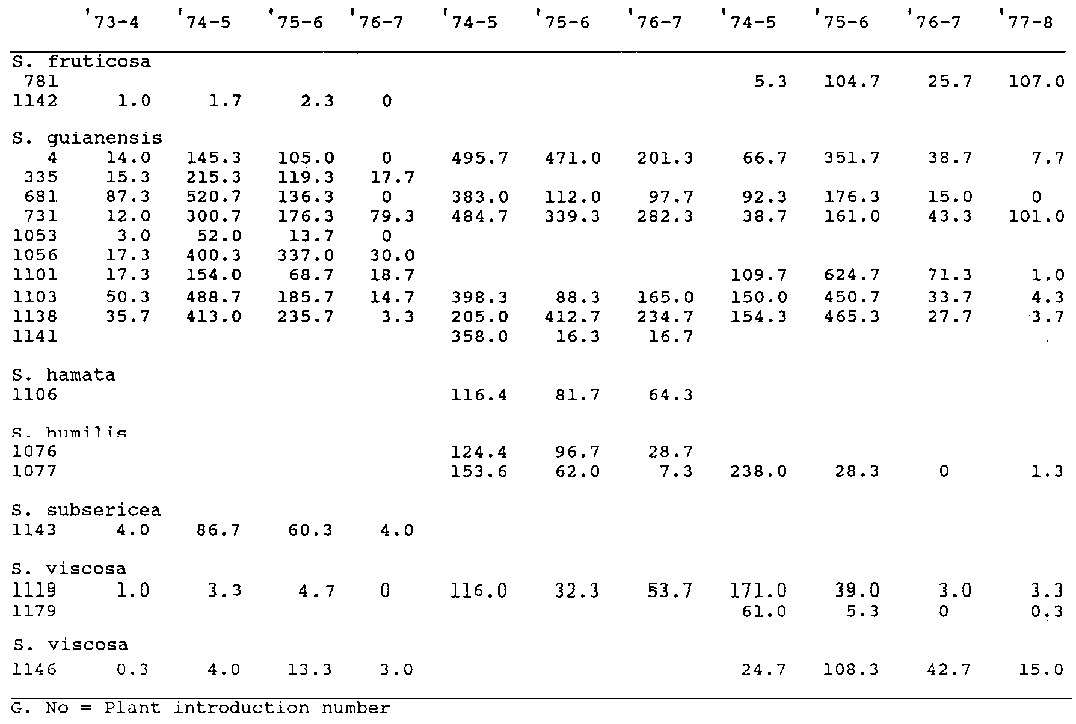
Experiment 4. Twelve strains of Stylosanthes spp. covering a total of seven species, with five strains common to all sites, were sown at Grasslands, Henderson and Makoholi and were harvested once or twice per season for a minimum of three years. The results presented in Table 5 show that in the season after sowing, maximum herbage yields of stylo at all sites were close to or greater than 5 t/ha of dry matter. Strains of Stylosanthes guianensis were the highest-yielding at all sites, the solitary exception being in the establishment season at Makoholi where greater yields were produced by the annual species S. humilis and S. subsericea. But the persistence of the stylos was poor, and few lines were productive by the fourth year of the trial. Even strains such as Oxley fine-stem stylo, which was known to persist well under grazing at Grasslands, had declined markedly by the fourth harvest season. From observations in grazed plots, there appeared to be a rough correspondence between the persistence of the strains under cutting and under grazing. Nonetheless the results provided only very poor indication of the possible value of the Stylosanthes spp. under grazing conditions, especially for the annual species for which the cutting treatments effectively prevented seeding and regeneration.
Cutting Trials Involving Grazing
a) Combined with cutting
Experiment 5. Twelve strains of legumes of potential value in ley pastures were sown in shallow drills on ploughed and disced land and were kept reasonably weed-free in the establishment season. From the second season onwards, yields were determined by harvesting quadrats from each plot. After sampling, cattle grazed the trial until the most palatable legumes had been grazed to approximately sampling height. The cattle were then removed, the extent to which the different legumes had been grazed was noted and the trial mown.
Table 5. Dry-matter yields (g/sq.m) of Stylosanthes strains at three sites in Zimbabwe.
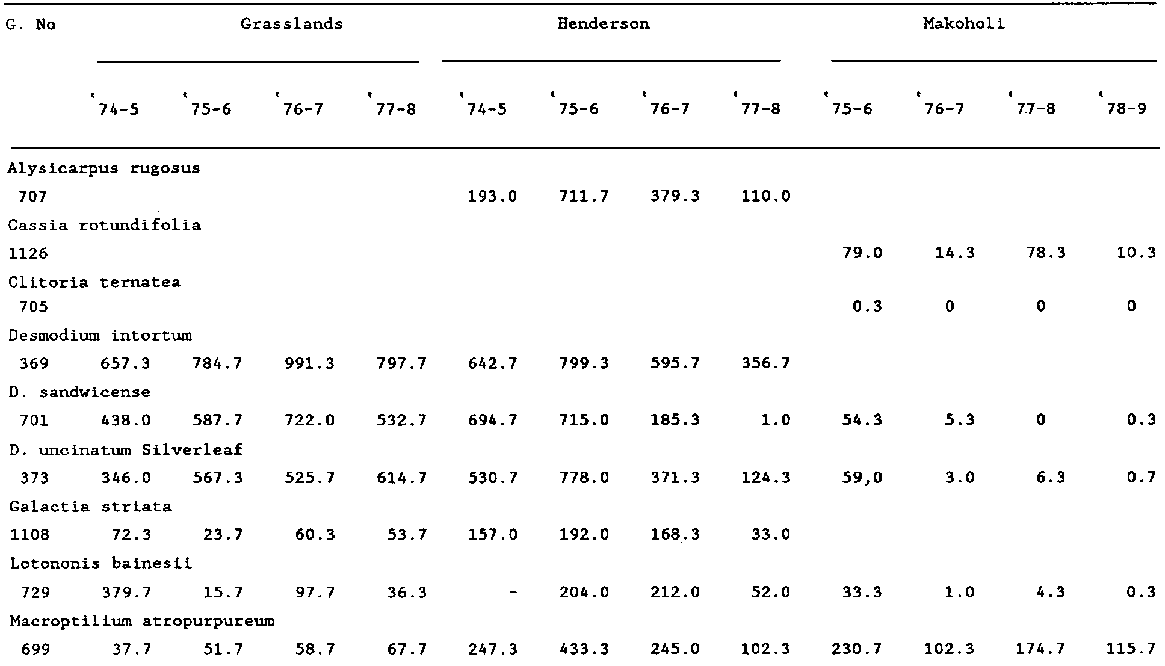
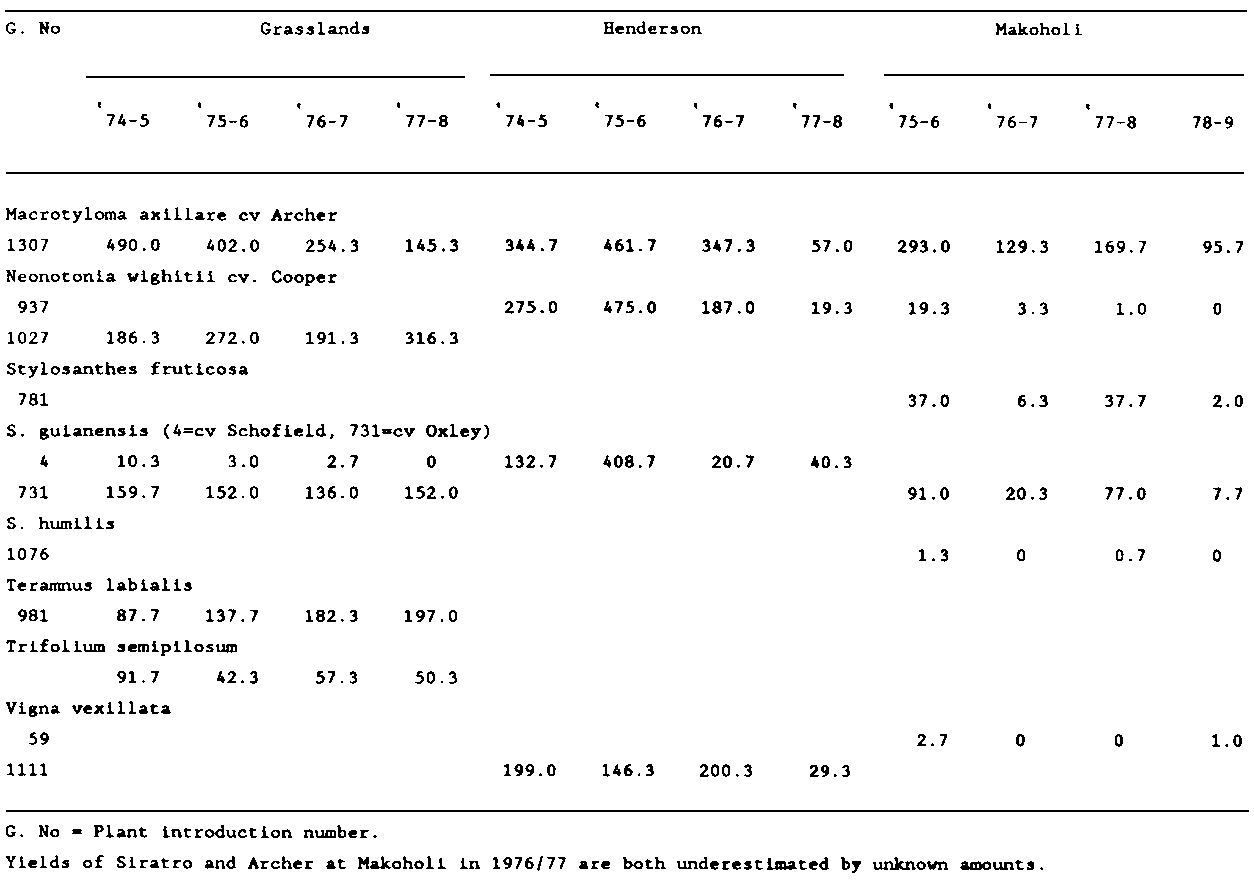
At both Grasslands and Henderson Desmodium intortum was the outstanding legume, with an average annual yield of more than 8 t/ha at Grasslands and 6 t/ha at Henderson. The other two Desmodium strains were also highly productive, as was Archer but Archer proved considerably less acceptable to cattle than the other legumes.
At Henderson, fire burnt the whole trial after the second sampling season and affected all the legumes, although none was completely eliminated. Yields in the final season were very low compared with previous years, perhaps because the poorly drained site became waterlogged in a year of exceptionally heavy rain. Work in Australia has shown that few of the pasture legumes can tolerate prolonged waterlogging (McIvor, 1976).
At Makoholi only Archer (1.7 t/ha) and Siratro (1.6 t/ha) were productive. Results at this site were very different from those at Grasslands and Henderson. Makoholi would normally be regarded as having submarginal rainfall for sown pastures but this trial coincided with a period of above-average rainfall, and a more likely reason for the failure of the legumes would be the inherently low soil fertility.
The effect of grazing in these trials was very small as the plots were topped immediately after grazing, and for all practical purposes these could be regarded as pure cutting trials. In ley pastures the main selection criterion is to produce the maximum yield of herbage over a relatively short life of the pasture, and that can be measured sufficiently accurately in cutting trials. The main advantage from the use of animals in this trial was that it demonstrated clearly the very low acceptability of Archer.
(b) Alternating with cutting
Experiment 6. Thirty lines of Neonotonia wightii, four of perennial Glycine spp. and Siratro and Silverleaf desmodium were sown in replicated rows at Henderson. When sampled at the end of the establishment season, the highest yielding legumes were Silverleaf desmodium and three strains of N. wightii cv Cooper, CPI 25702 (from which Cooper was selected) and an introduction from Angola which was almost certainly also Cooper. In the second season, half of each row was harvested four times and the other half at the end of the growing season only. The same four legumes were again the highest-yielding. The trial was then fenced and grazed by cattle for two seasons. In either season there was a detectable difference in the acceptability of the various strains, and in both seasons grazing was sufficiently severe that slashing was unnecessary.
In the final year the legumes were harvested twice to measure their persistence after the period of grazing. At this harvest the three Cooper lines and Silverleaf desmodium produced yields below average, and the three highest-yielding lines were all Neonotonia wightii strains of Zimbabwean origin. These were very similar in their visual characteristics and in flowering time, and it is intended to combine them and release the mixture as a pasture cultivar.
This trial illustrates the need to continue screening for a reasonable period before conclusions are reached. It is tempting to ascribe the failure of the Cooper lines to a lesser ability to withstand grazing, but, in the absence of a cutting-only control this is not justified and may have been merely an effect of time. At least, though, we can be confident that our selected lines will persist for the normal life of a pasture, even under severe grazing pressure.
Grazing Trials
Experiment 2. Twelve legumes were sown in six replicated blocks on disced land at Grasslands and Henderson. Each legume was sown in two plots in each block. The blocks were fenced separately and were grazed at two stocking rates in the dry season only, the wet season only, and year-round using a simulated rotational grazing system.
At Grasslands only the five stylo strains and Siratro established in reasonable density, and of these Oxley fine-stem stylo proved outstanding. It persisted well and spread into plots in which it had not been sown and appeared particularly favoured by grazing during the growing season.
At Henderson a much wider range of legumes established and persisted throughout the trial. Schofield stylo initially was outstanding but it appeared short-lived and Silverleaf desmodium was the most impressive legume in the middle stages. The fire in 1976 affected all the legumes, although none was completely eliminated, but Lotononis bainesii and L. listii recovered rapidly and were the most prominent legumes at the end of the trial. Silverleaf desmodium was especially favoured by grazing in the dry season only while the Lotononis spp. grew best in plots which were grazed in the growing season.
The large differences between the results from the two sites in this trial emphasise the need for multi-site testing covering a range of soil and climatic conditions if results are to have a widespread applicability. The results also emphasise the need for the long continuation of trials and also for recurrent natural hazards, such as fire, to be incorporated in the design. The season of grazing treatments proved useful, doubling the stocking rate did not. This type of trial is of value in determining which strains justify large-scale testing in animal production experiments.
Experiment 7. Seeds of a range of Stylosanthes spp. and of Siratro were sown on disced strips in veld and grazed in normal farm practice. Surviving plants were counted at intervals, normally in the late growing season of each year. The results are a combination of the ability of each strain to establish and to persist. At nearly all sites the greatest number of seedlings were from S. guianensis strains, but S. scabra proved hardier and had a greater percentage survival. At Grasslands in 1984 there was evidence of increases in stand density of S. fruticosa, S. viscosa and all S. scabra lines, and this trend continued into 1986. All of the stylos were grazed and even the notoriously-unpalatable S. viscosa appeared to be well eaten by the late dry season.
In Zimbabwe, as in most parts of the tropical and subtropical world, the main legumes used in pastures are of Central or South American origin. Few locally collected legumes were included in the trials described here: of these, Stylosanthes fruticosa could prove of importance in the medium-rainfall parts of Zimbabwe and Neonotonia wightii on heavier soils in the better-watered areas. Indigenous strains of Alysicarpus rugosus, Lotononis listii, Macrotyloma axillare and Teramnus labialis (all of which performed well in one or more of the trials described in this paper) also occur in Zimbabwe. However, diseases and pests have posed problems with indigenous strains, especially when grown in pure stands for seed production and may limit their usefulness compared with introductions.
For national institutions with limited resources the most logical first stage is to introduce strains of pasture plants of proven or suggested value under similar conditions elsewhere and to test those. Inevitably research and extension workers and farmers will collect, on a casual basis, seeds of grasses or legumes which catch their attention, usually because of productivity, growth habit or acceptability to stock. This is healthy and can pay big dividends, but it is doubtful if a heavy commitment to pasture plant collection is a wise use of national resources and it is disturbing that emphasis has been given to plant collection at the IDRC/PANESA/ILCA training course in "Forage Plant Introduction and Evaluation" in October, 1986.
There are excellent chapters on pasture plant evaluation in several books (Straw et al., 1976; 't Mannetje et al., 1976; Cameron and McIvor, 1980; Jones and Walker, 1983). The stages which have evolved in this paper largely echo those which are outlined by those authors, particularly in regard to the need to consider the likely use of the plant from an early stage in the evaluation process. This is especially relevant in Africa, with its multiplicity of livestock production systems, ranging from intensive cut-and-carry milk production to extensive and largely uncontrolled grazing of rangeland. For cut-and-carry system the yield of the forage is the most important criterion, and this can be adequately assessed in simple cutting trials, ideally combined with some assessment of the nutritional value of the herbage. For rangeland improvement, the criteria of success depend more on persistence and spread under grazing, which can really only be measured in situ. The likely use of the forage plants within the local farming systems will need to be borne in mind in planning the evaluation trials within the PANESA network. Except in the most basic stage, that of the observation nursery, the type of accession chosen for testing, and the form of treatments imposed, should be defined to a great extent by the role the plant is to play in the livestock system. In many cases in Africa the farming systems, the roles of livestock within them and the potential benefits which can be derived by the growing of forage plants, are not yet clearly defined and this makes the task of the researcher dealing with small-scale farming systems more difficult than that of the worker with well-defined commercial livestock operations. The authors believe, though, it should be possible to postulate suitable roles and types of forage plants for each area and to derive likely "short lists" of promising lines for more detailed evaluation. They query whether time will be best spent testing a complete and common spectrum of pasture grasses and legumes under the full range of conditions covered by the PANESA region as that seems a complete negation of the region's collective experience built up over so many years.
A major deficiency of the experiments on ploughed land described in this paper is that in all cases the legumes were sown in pure stands. Except when intended as protein banks, either grazed in situ or cut and conserved, there are considerable advantages to combining a grass with the legume, and the selection of productive and compatible mixtures is a complex and demanding task. Again, though, a great deal can be learnt from experience under similar conditions elsewhere. In particular we in PANESA need to study the methods used, and the lessons learnt, by the extensive and growing Tropical Pastures Evaluation Network (RIEPT) in South America and the neighbouring regions. Unfortunately the manuals of procedure produced by RIEPT are all in Spanish, which limits their usefulness in Africa, but it would be of great value if a senior member of that network (and also possibly of the South East Asia/Pacific Forage Research and Development Program) attend future PANESA workshops.
Cameron, D.G. and McIvor, J.G. 1980. Evaluation. In: R J Clements and D G Cameron (eds), Collection and testing of tropical forage plants. CSIRO, Australia. pp. 71-87.
Clatworthy, J.N. 1975. Introduction and preliminary screening of pasture legumes at Marandellas, Rhodesia, 1967-73. Proceedings of the Grasslands Society of Southern Africa 10:57-63.
Clatworthy, J.N. 1980. Screening legumes for veld reinforcement. Proceedings of the Grasslands Society of Southern Africa 15:111-116.
Clatworthy, J.N. (in press, a). Establishment and yield of pasture legumes under cutting in Zimbabwe. I. Stylosanthes spp. Zimbabwe Journal of Agricultural Research.
Clatworthy, J.N. (in press, b). Establishment and yield of pasture legumes under cutting in Zimbabwe II. Legumes for ley pastures. Zimbabwe Journal of Agricultural Research.
Clatworthy, J.N. and Thomas, P.I. 1972. Establishment of Stylosanthes guianensis in Marandellas sandveld. Proceedings of the Grassland Society of Southern Africa. 7:76-83.
Grant, P.J. 1976. Some factors affecting the field establishment of sub-tropical pasture legumes in Rhodesia. Proceedings of the Grasslands Society of Southern Africa 11:97-102.
Jones, R.J. and Walker, B. 1983. Strategies for evaluating forage plants. In: J G McIvor and R A Bray (eds), Genetic resources of forage plants. CSIRO, Australia. pp. 185-201.
't Mannetje, L., Jones, R.J. and Stobbs, T.H. 1976. Pasture evaluation by grazing experiments. In: N H Shaw and W W Bryan (eds), Tropical pasture research: Principles and Methods. Commonwealth Agricultural Bureau, Bulletin 51:194-234.
McIvor, J.G. 1976. The effect of waterlogging on the growth of Stylosanthes guianensis. Tropical Grasslands 10:173-178.
Shaw, N.H., Jones, R.M., Edye, L.A. and Bryan, W.W. 1976. Developing and testing new pastures. In: N H Shaw and W W Bran (eds), Tropical pasture research: Principles and methods. Commonwealth Agricultural Bureau, Bulletin 51.