


Gubungano Tacheba and Arabia Moyo
Animal Production Research Unit, Botswana
Introduction
Range agronomy methodology
Results
Discussion and conclusion
References
Abstract
Botswana vegetation is arbitrarily classified into the hardveld, sandveld and Okavango deltaveld. In spite of this arbitrary subdivision some species are specific to a particular vegetation type. The species vary generally in their nutritive value; woody plants (12.63% CP; 47.60% DMD) are relatively higher than grasses (5.49% CP and 40.61% DMD). Within a species there is a seasonal variation in nutritive value. For instance Panicum maximum is higher in the wet season (10. 4% CP; 60% DMD) than in the dry season (8.7% CP; 36% DMD).
Agronomic trials were initiated in the 1970/71 season, but these were discontinued and resumed in 1976 with a broader objective of screening a wide range of germplasm suitable for pasture production. These trials were terminated in 1982 only to resume in 1986. It was found that Macroptilium atropurpureum, Leucaena leucocephala, Lablab purpureus and Cenchrus ciliaris were the most promising species. Current collaborative trials with ICRISAT and ILCA involve the screening of varieties of millet and sorghum, some forage grasses and legumes. In future focus will be directed to indigenous species as well.
Where fertilizer application tests to range were conducted a yield increase was recorded, but economic feasibility indicated that it would be of no practical value in the immediate future.
Botswana, extending from 18°S to 27°S and 20°E and 29°E is situated on the Southern African Plateau with a mean altitude of 1,000 m.a.s.l. It covers 582,000 sq. km with marked topographical features mainly in the east on the hardveld, where the soil is capable of supporting arable agriculture. The hardveld is a narrow strip covering about 20% of the country. In the northwest is the Okavango Delta. The rest of the country is covered by the Kalahari sand.
Rainfall averages 450 mm per annum. There is great variation in amount and distribution from location to location and from year to year. The rainfall is highest in the northeast at 650-700 mm decreasing to a minimum of 100-200 mm in the southwest. Rainfall occurs in October-April and over 90% of rain occurs in November to March. Beginning and end of rains are equally unreliable. Early planting might suffer from drought, or late planting may never get established.
Evaporation often exceeds 2 m per annum, and humidity is low. There is quite a large difference between morning humidity and afternoon humidity. Temperatures reach 31°C in December and January, and daily variation averages 13°C. Frost is common in winter in the south.
Livestock form an important industry accounting for 20% of the foreign exchange economy. In 1982 the cattle population was 3 million; this figure dropped to 2.5 million by 1986 due to drought. However, the cattle population has been increasing as drought years are often followed by good rain years. Cattle density is high in the hardveld: however, in the past few years the Kalahari has been intruded upon by large numbers due to opening of more ground waters. The Okavango delta is still lightly used due to the trypanosomiasis-transmitting tsetse fly, and in other areas range degradation is widespread, especially around watering points.
There are a number of reports that categorise the vegetation of Botswana, notably those by Wear and Yalala (1971), DVH (1979) and Timberlake (1980). There are three major vegetation types in Botswana. The first of these, the hardveld type, is characterised by grasses Panicum coloratum, Themeda triandra, Cenchrus ciliaris, Enneapogon cenchroides, Eragrostis superba, Chloris gayana, Heteropogon contortus, Brachiaria deflexa and Bothriochloa insculpta. It is associated with such woody plants as Acacia karroo, Albizzia anthelmintica, Balanites aegyptiaca, Colophospermum mopane, Combretum apiculatum, Grewia bicolor, G. flavescens, G. monticola, Lonchocarpus capassa and Terminalia prunioides. The second type which is specific to the Kalahari sandveld consists of grasses, Eragrostis pallens, Stipagrostis uniplumis, Anthephora pubescens, Schmidtia pappophoroides and Megaloprotachne albescens associated with woody plants Grewia avellana, G. retinervis, Lonchocarpus nelsii and Terminalia sericea.
The last type is specific to the Okavango Delta, and it includes the grasses Phragmites communis, Dichanthium papillusum, Panicum repens, Andropogon encomus, Echinochloa pyramidelis, Imperata cylindrica, and woody plants Ficus verruculosa and Hyphaene crinata.
The purpose of this paper is to discuss the forage values and review some of these forage species that have been tried for pasture in Botswana.
The history of range agronomy in Botswana goes back to 1970 for only a short period (FAO, 1971). The work resumed in 1976 and continued up to 1982 when there was a cessation of fodder plant screening from 1983 to 1985. Finally the work resumed again in 1986. The range agronomy section has tested promising species into farming systems programmes with local farmers. These were primarily the introduced species Stylosanthes humilis, Neonotonia wightii, Macroptilium atropurpureum, Stylosanthes guianensis and Rhynchosia sublobata. It has also determined the nutritive value (CP% and DMD%) of a variety of range grass and woody plants in some vegetation types.
At some stage in the screening programme (1976/77), the increase in rangeland yield by applying fertilizer was tested at Morapedi in an Acacia erioloba tree savanna on the Kalahari sandveld. A combination of nitrogen and phosphorus was applied in the form of urea and superphosphate respectively. Urea was applied at four levels (0, 50, 100, 150 kg/ha) and superphosphate at two levels (0, 33.2 kg/ha). The fertilizer work was extended to Marale in 1979 with a vegetation cover composed of Acacia nigrescens/Combretum apiculatum tree savanna in the hardveld. Three fertilizers, nitrogen, phosphorus and potassium in the form of ammonium sulphate, superphosphate and potassium chloride respectively were applied in combinations of two. Levels of ammonium sulphate were 0, 250, 500 and 750 kg/ha; those for superphosphate were 0, 400 and 800 kg/ha, while those for potassium chloride were 0 and 50 kg/ha.
The nutritive values in terms of crude protein and dry-matter digestibility of some range grasses in the hardveld and the Kalahari sandveld are shown in Tables 1 and 2 respectively. The hardveld grasses are generally of a higher nutritive value than those of the Kalahari sandveld. These data are means over a 29 month period. However, within this period it was observed that protein values were quite high during the wet season, resulting in good livestock performance on them. During the dry seasons the range grasses were characterised by low protein values, lower than maintenance requirement, and thus animals lost weight.
Table 1. Crude protein (CP) and dry-matter digestibility (DMD) of some range grasses in the hardveld, values in %.
|
Species |
CP |
DMD |
Source |
|
Aristida congesta |
4.9 |
37 |
APRU, 1977 |
|
Panicum maximum |
8.8 |
49 |
APRU, 1977 |
|
Eragrostis rigidior |
3.6 |
33 |
APRU, 1977 |
|
Enneapogon cenchroides |
5.3 |
40 |
APRU, 1977 |
|
Heteropogon contortus |
4.5 |
39 |
APRU, 1977 |
|
Brachiaria nigropedata |
6.8 |
43 |
APRU, 1977 |
|
Urochloa trichopus |
8.0 |
46 |
APRU, 1977 |
|
Bothriochloa insculpta |
6.4 |
39 |
APRU, 1977 |
|
Digitaria eriantha |
6.3 |
47 |
APRU, 1977 |
|
Means |
6.1 |
41 |
APRU, 1977 |
Note: APRU 1977 values are averages of 29 months.
Tables 3 and 4 show the nutritive values of some wood range plants in the hardveld and the Kalahari sandveld, respectively. There are no major discernible differences between the nutritive values of hardveld and sandveld species. However, the woody species are generally higher in nutritive value than grasses in both vegetation types. This means that browsing is an important supplementation feed resource for these animals on range.
Results of the exotic plants screening work indicated that Stylosanthes spp. and Macroptilium atropurpureum made good establishment and persisted for years. Amongst the five Cenchrus ciliaris cultivars tested (Table 5), Western Australia did poorly in all the years. Mahalapye yields were better for Cenchrus sp. than those at Sebele. Mahalapye is in the central hardveld with average rainfall of 450 mm per annum, but Sebele is in the southern hardveld with a rainfall of 500 mm. At Sebele the Cenchrus sp. established poorly due to heavy weed competition. The other grasses Cynodon dactylon, Eragrostis culvula, Urochloa mosambicensis and Panicum coloratum showed lower forage yields due to weed ingestation. There was however reasonable yields from Eragrostis culvula, Urochloa mosambicensis and Panicum coloratum especially at Mahalapye.
Table 2. Crude protein (CP) and dry-matter digestibility (DID) of some range grasses in the Kalahari sandveld, values in %.
|
Species |
CP |
DMD |
Source |
|
Aristida congesta |
4.4 |
37 |
APRU, 1977 |
|
Eragrostis lehmanniana |
4.0 |
33 |
APRU, 1977 |
|
Eragrostis pollens |
3.9 |
32 |
APRU, 1977 |
|
Stipagrostis uniplumis |
4.2 |
32 |
APRU, 1977 |
|
Anthephora pubescens |
6.0 |
49 |
APRU, 1977 |
|
Schmidtia pappophoroides |
5.5 |
48 |
APRU, 1977 |
|
Brachiaria nigropedata |
6.5 |
42 |
APRU, 1977 |
|
Pogonathria squarrossa |
3.9 |
38 |
APRU, 1977 |
|
Digitaria eriantha |
5.8 |
47 |
APRU, 1977 |
|
Means |
4.9 |
39 |
APRU, 1977 |
Note: APRU 1977 values are averages of 29 months.
Table 3. Crude protein (CP) and dry-matter digestibility (DMD) of some range woody plant leaves in the hardveld, values in %.
|
Species |
CP |
DMD |
Source |
|
Acacia tortilis |
14.6 |
43 |
APRU, 1985 |
|
Acacia karroo |
12.8 |
40 |
APRU, 1985 |
|
Balanites aegyptiaca |
9.7 |
54 |
APRU, 1985 |
|
Boscia albitrunca |
16.7 |
na |
FAO, 1971 |
|
Boscia foetida |
8.0 |
na |
FAO, 1971 |
|
Colophospermum mopane |
8.1 |
na |
FAO, 1971 |
|
Combretum apiculatum |
9.7 |
na |
FAO, 1971 |
|
Combretum hereoense |
10.7 |
50 |
APRU, 1985 |
|
Grewia bicolor |
12.4 |
28 |
APRU, 1985 |
|
Grewia flava |
12.5 |
49 |
APRU, 1985 |
|
Lonchocarpus capassa |
12.4 |
na |
FAO, 1971 |
|
Tarchonanthus camphoratus |
10.9 |
53 |
APRU, 1985 |
|
Terminalia sericea |
7.7 |
na |
FAO, 1971 |
|
Ziziphus mucronata |
12.0 |
61 |
APRU, 1985 |
|
Means |
11.3 |
47* |
|
Note: APRU 1985 values are averages of 12 months and FAO 1971 are samples of April/May 1970.*Means of eight species only.
Table 4. Crude protein (CP) dry-matter digestibility (DMD) of some range woody plant leaves in the Kalahari sandveld, values in %.
|
Species |
CP |
DMD |
Source |
|
Boscia albitrunca |
17.9 |
57 |
Skarpe1 |
|
Grewia flava |
15.2 |
40 |
Skarpe1 |
|
Grewia retinervis |
16.3 |
55 |
Skarpe1 |
|
Lonchocarpus nelsii |
21.2 |
45 |
Skarpe1 |
|
Tarchonanthus camphoratus |
10.0 |
33 |
Skarpe1 |
|
Terminalia sericea |
7.0 |
37 |
Skarpe1 |
|
Ziziphus mucronata |
19.4 |
69 |
Skarpe1 |
|
Means |
13.1 |
48 |
|
Note: Values are averages of 2 months, February and June 1977-1979.1 Skarpe, C. Gaborone, Botswana, unpublished data.
Table 5. Yield of some pasture species at Mahalapye and Sebele in kg per ha in 1978, 1979 and 1980.
|
Species
|
Mahalapye |
Sebele |
|||||
|
1978 |
1979 |
1980 |
1978 |
1979 |
1980 |
||
|
Cenchrus ciliaris |
|||||||
|
|
cv Molopo |
1192 |
4749 |
|
|
3948 |
4700 |
|
|
cv Biloela |
2803 |
4153 |
|
|
3189 |
|
|
|
cv Gayndah |
1395 |
3623 |
|
|
1161 |
|
|
|
cv U.S.A. |
2790 |
4115 |
|
|
2698 |
5300 |
|
|
cv Western Aust. |
Trace |
Trace |
|
|
Trace |
0 |
|
Cenchrus sentigerus |
670 |
Trace* |
|
|
Trace |
|
|
|
Cynodon dactylon |
|||||||
|
|
cv Giant Bermuda |
799 |
1915* |
|
|
|
|
|
Eragrostis curvula |
|||||||
|
|
cv Ermelo |
4287 |
2509* |
|
|
2709 |
|
|
Urochloa mosambicensis |
2855 |
2015* |
|
|
|
|
|
|
Panicum coloratum |
|||||||
|
|
cv Bambatsi |
|
2513* |
|
|
|
1900 |
|
Siratro |
1704 |
2802* |
|
|
3528 |
1500 |
|
|
Phasey Bean |
1093 |
2086* |
|
|
7130 |
|
|
|
Leichardt Dolichos |
4165 |
3500 |
|
|
|
|
|
|
Desmodium intortum |
|
|
|
|
|
|
|
|
D. uncinatum |
|
|
|
|
|
|
|
|
Dolichos lablab |
|
|
|
|
5168 |
5000 |
|
|
Leucaena leucocephala |
|||||||
|
|
cv Peru |
550 |
2100 |
|
|
|
|
|
|
cv Cunningham |
420 |
2266 |
|
|
|
|
|
|
cv Hawaian Cross |
410 |
3233 |
|
|
|
|
|
|
cv Hawaian Giant |
|
2000 |
|
|
|
|
*Production from plots planted the previous year.Source: APRU (1978, 1979, 1980, 1981).
Amongst the legumes, Macroptilium atropurpureum cv Siratro, Lablab purpureus cv Leichardt and Macroptilium lathyroides established well and gave reasonable yields. Based on this work Lablab purpureus is now being grown in dairy farming systems project areas.
Leucaena leucocephala was established at Morale (near Mahalapye). The plant is susceptible to frost although it has shown the ability to regrow once weather conditions warm up. The major problem interfering with its successful establishment is white termite attack and wildlife and goats that hammer it hard, hence affecting its maintenance under range.
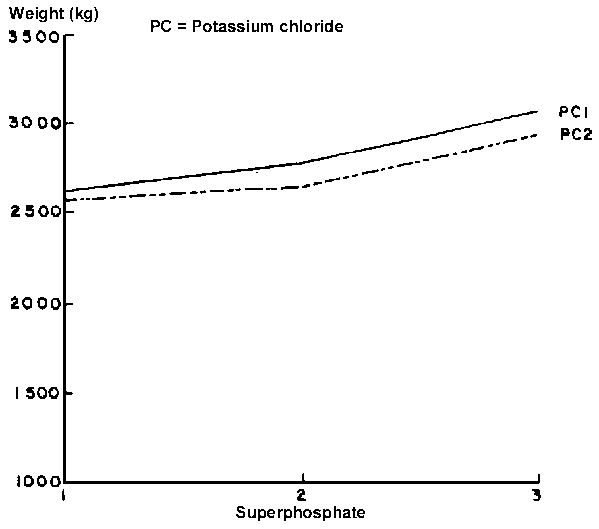
Results of the fertilizer trials indicated no significant increase in range productivity to levels of urea application beyond 50 kg/ha when phosphorus was held at zero. But when phosphorus was increased to 332 kg/ha the yield was increased at the other levels of urea application (Figure 1). Figures 2, 3 and 4 show yields of three grasses (Digitaria, Eragrostis and Urochloa spp.) in response to fertilizer. Nitrogen reduced yield at 500 kg/ha and beyond when superphosphate was held at zero (Figure 2). This response was similar to that of ammonium sulphate and potassium chloride, when ammonium sulphate was increased beyond 500 kg/ha and potassium chloride was held at 50 kg/ha yield was reduced (Figure 3). Figure 4 shows that an increase in superphosphate increased yield more when potassium chloride was held at zero.
Figure 1. Response of rangeland yield to nitrogen and phosphorus.
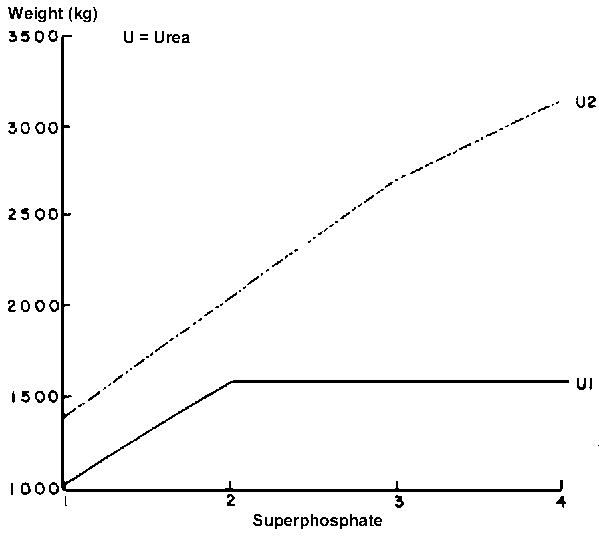
Figure 2. Response of rangeland yield to nitrogen and phosphorus.
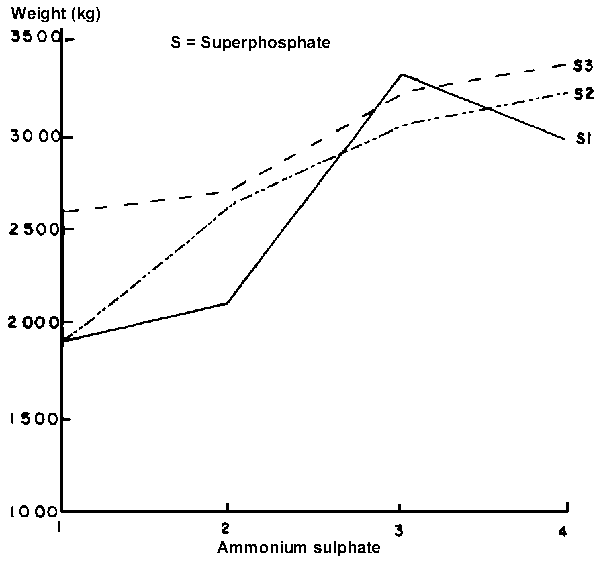
Figure 3. Response of rangeland yield to nitrogen and phosphorus.
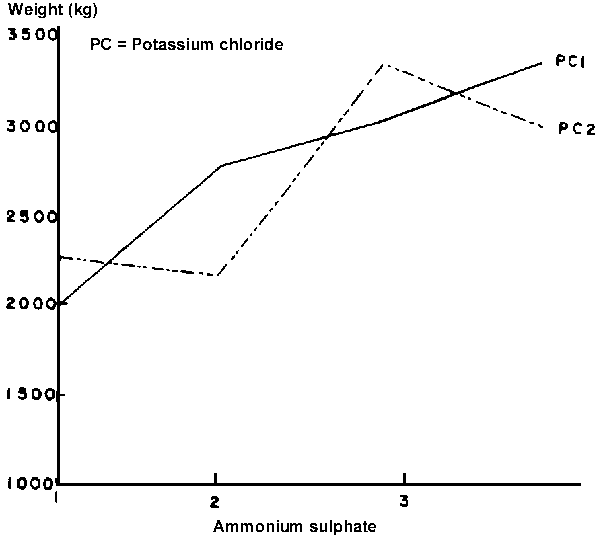
Figure 4. Response of rangeland yield to nitrogen and phosphorus.
For Botswana, a country that has suffered from a succession of droughts, there appears to be limited scope for planted perennial pasture plants. Annuals render themselves better to easy incorporation in arable farming systems than perennials. The latter might pose problems of eradication in cropping systems.
Interest in fertilizer trials ought to be reduced as the economic feasibility has indicated that fertilizer application to the range is unlikely to be of practical value in the immediate future. The current trends in research are geared to collaboration with ICRISAT and ILCA to come up with various cultivars of fodder millets, fodder sorghums and some specialised grasses and fodder legumes that would easily fit in small-scale crop-livestock farming systems. Indigenous fodders ought to be an integral part of this work.
APRU (Animal Production Research Unit). An integrated programme of beef cattle and range research in Botswana. Ministry of Agriculture, Gaborone, Botswana.
APRU. 1978. Livestock and range research in Botswana. Ministry of Agriculture, Gaborone, Botswana.
APRU. 1979. Livestock and range research in Botswana. Ministry of Agriculture, Gaborone, Botswana.
APRU. 1982. Livestock and range research in Botswana. Ministry of Agriculture, Gaborone, Botswana.
APRU. 1985. Livestock and range research in Botswana. Ministry of Agriculture, Gaborone, Botswana.
DHV. 1971. Countrywide Animal and Range Assessment Project. Vol. 3. Ministry of Commerce and Industry, Gaborone, Botswana.
FAO. 1971. Range ecology in Botswana. Technical document No. 2. FAO, Rome.
Timberlake, J. 1980. Vegetation map of South East Botswana. Ministry of Agriculture, Gaborone, Botswana.
Wear, P.R. and Yalala A. 1971. Provisional vegetation map of Botswana. Government Printer, Gaborone, Botswana.
