M. Karachi
National Dryland Farming Research Station
P.O. Box 340, Machakos, Kenya
Introduction
Materials and methods
Results
Discussion
Acknowledgements
References
Abstract
Dry-matter production, forage nutritive value and seed yield of Lablab purpureus ecotypes were studied over a two year period. Total and green leaf DM production ranged from 2000 kg to 12000 kg ha-1 and 400 kg to 3300 ha-1 respectively. The leaf/stem ratio declined by 3.7 to 4.5 times with maturity. In vitro dry-matter digestibility and protein content of green leaf and stem declined by 10% to 15% units and 3% to 5% units respectively. Phosphorus content was not affected by forage maturity. Seed yields of 400 to 1800 kg ha-1 with crude protein content of 24% to 29% (DM basis) was recorded. It was concluded that the DM yield, forage nutritive value and seed yield make Lablab an attractive proposition in livestock/crop farming systems.
Over 200 genotypes of Lablab purpureus are recognised (Pulseglove, 1968). This germplasm has been exploited as a source of human food (Skerman, 1977), forage for livestock (Hamilton et al., 1970; Hendricksen and Myles, 1980) and as green manure or cover crop (Pulseglove, 1968).
In Kenya, Lablab finds its greatest use in the small-scale sector mainly as a source of grain for human consumption. However, the current trends in farming emphasise the use of multipurpose crops that fit into integrated livestock/crop farming patterns. The investigations reported examined the potential contribution by Lablab in livestock/crop farming systems.
The experiments were conducted at the Lanet Beef Research Station, Nakuru, altitude 1860 m. Precipitation, mean maximum and minimum temperatures during the trials periods were: 611 mm and 623 mm; 24.5°C and 24.8°C; 9.5°C and 9.2°C in 1982 and 1983 respectively. The soil is a deep sandy loam with good water holding capacity. The major nutrient status was: K(me) 1.0, P(ppm) 1.9 and N(%) 0.10 with a pH(H2O) of 5.5.
The cultivar Valo (black seeded) was introduced from India. Nakuru (black and brown seeded) and Kakamega (black seeded) on the other hand, are local ecotypes grown in the Rift Valley and western Kenya respectively. Seeds were sown after 25 mm of germination rain was received each year at a rate of 7 kg ha-1. Plots (5 m²) were arranged in randomised complete blocks with four replications. At sowing, fertilizers were applied at the rates of 10 kg P ha-1, 4 kg K ha-1 and 0.40 kg Cu ha-1 as single superphosphate, muriate of potash and copper sulphate respectively.
Plots were harvested at monthly intervals after three-months' growth from germination. Harvests were taken from 1 m² quadrats excluding the guard row. Harvest four did not include the seed yield components. Material was cut approximately 5 cm above the ground and the bulk weight taken. Any shed leaves were separately collected and weighed. A subsample from each replicate was separated into leaf and stem fractions. The separated fractions and a subsample from the abscissed leaves were weighed and subsequently dried at 75°C for 24 hours for dry-matter (DM) determination. Seed pods were included in the stem DM yield in harvests one to three. The dried green leaf and stem fractions were ground (2 mm) and used for determination of dry-matter digestibility, crude protein (%N x 6.25) and phosphorus contents. Nitrogen was estimated using the micro-Kjeldahl method (Havilah et al., 1977) and phosphorus by X-ray fluorescence spectroscopy. Dry-matter digestibility was estimated by in vitro digestibility method calibrated with lucerne of known in vivo digestibility. The data were subjected to analysis of variance.
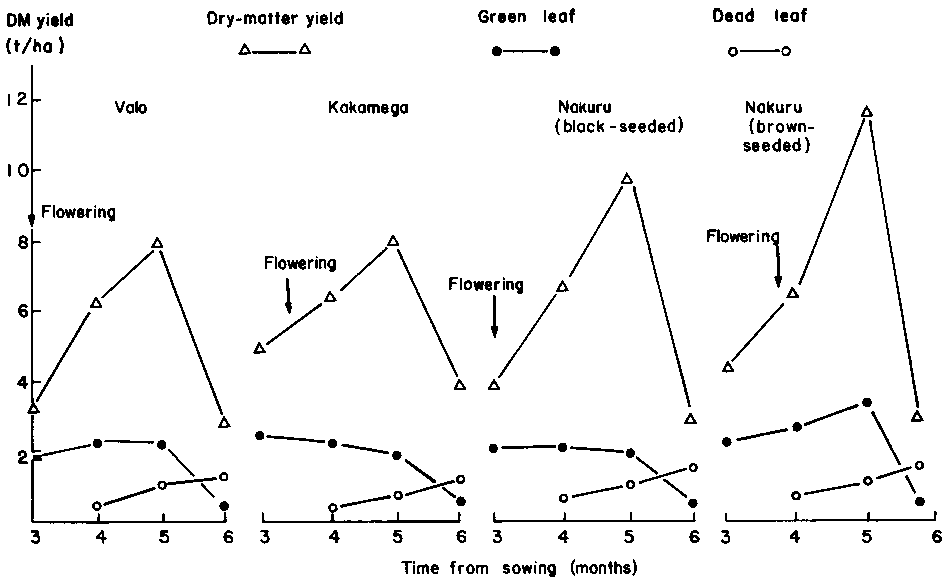
All ecotypes nodulated effectively with cowpea rhizobia in the soil; 23, 27, 22 and 19 effective nodules were recorded in Valo, Kakamega, Nakuru (black seeded) and Nakuru (brown seeded) respectively. Time to flowering differed by 20 to 30 days (Figure 1).
Total green DM yields ranged from 2000 to 12000 kg ha-1, and most of the yield was stem (Figure 1). Green leaf DM yields ranged from 400 to 3300 kg ha-1. However all ecotypes maintained green leaf DM yields above 2000 kg ha-1 between three and five months of growth. Leaf shedding increased with maturity. This was associated with a progressive decline, 3.7 to 4.5 times with time, in leaf/stem ratio according to the following models:
1. Y = 1.51 - .33 X R² =.80 (Valo)
2. Y = 1.17 - .25 X R² =.76 (Kakamega)
3. Y = 1.25 - .28 X R² =.74 (Nakuru, black seeded)
4. Y = 1.41 - .31 X R² =.90 (Nakuru, brown seeded)
Where Y is leaf/stem ratio and X is sampling time in months after sowing.
Trends of dry-matter digestibility, protein and phosphorus contents in green leaf and stem with time are shown in Table 1. Digestibility was higher (P<0.01) in leaf than stem but declined by 10% to 15% units over time in both fractions. The decline in leaf digestibility was slightly higher than in the stem fraction: 0.17, 0.17, 0.10 vs 0.14, 0.09, 0.12 and 0.08% units day-1 in Valo, Kakamega, Nakuru (black seeded) and Nakuru (brown seeded) for leaf and stem components respectively between three and six months of growth. Protein content was higher (P<0.01) in leaf than stem, and declined by 3% to 5% units in both fraction over time. Phosphorus content showed no significant changes with time.
Table 1. Leaf/stem ratio, dry-matter digestibility, crude protein and phosphorus contents in green forage fractions.
|
Ecotype |
Time (1) |
Leaf/Stem |
Digestibility (%) |
Crude protein (%) |
Phosphorus (%) |
|||
|
ratio |
Leaf |
Stem |
Leaf |
Stem |
Lear |
Stem |
||
|
Valo |
3 |
1.26d* |
74.3b |
56.8b |
21.4 |
14.5b |
0.38 |
0.41 |
|
4 |
0.72c |
66.5b |
53.4b |
19.5 |
14.0ab |
0.36 |
0.40 |
|
|
5 |
0.41b |
61.3ab |
49.6ab |
18.4 |
13.7ab |
0.35 |
0.44 |
|
|
6 |
0.28a |
58.4a |
44.2a |
17.6 |
9.1a |
0.37 |
0.44 |
|
|
Kakamega |
3 |
1.03c |
75.8b |
52.3b |
20.3 |
13.1b |
0.33 |
0.42 |
|
4 |
0.47b |
70.3b |
50.9b |
19.1 |
12.7ab |
0.32 |
0.41 |
|
|
5 |
0.41b |
66.4ab |
47.3ab |
17.8 |
11.2ab |
0.29 |
0.43 |
|
|
6 |
0.28a |
60.3a |
44.1a |
17.4 |
8.1a |
0.3 |
0.46 |
|
|
Nakuru (black-seeded) |
3 |
1.16c |
72.9b |
58.2b |
20.5 |
13.4b |
0.36 |
0.42 |
|
4 |
0.43b |
70.3ab |
55.6ab |
18.6 |
12.6ab |
0.31 |
0.40 |
|
|
5 |
0.29a |
68.4ab |
50.9ab |
17.7 |
11.4ab |
0.32 |
0.45 |
|
|
6 |
0.31a |
64.3a |
47.4a |
17.1 |
7.6a |
0.38 |
0.44 |
|
|
Nakuru (brown-seeded) |
3 |
1.17c |
74.9b |
56.3b |
22.0 |
14.4b |
0.36 |
0.43 |
|
4 |
0.71b |
72.3ab |
53.4ab |
19.8 |
13.5b |
0.35 |
0.47 |
|
|
5 |
0.60b |
69.8ab |
52.6ab |
18.1 |
10.1ab |
0.35 |
0.42 |
|
|
6 |
0.31a |
65.7a |
49.3a |
17.3 |
6.2a |
0.33 |
0.45 |
|
(1) Time was in months from sowing.* Means per attribute within an ecotype not followed by a common letter differ (P<.05) according to Duncan's multiple range test.
Seed yield was a function of seed pods m-2. All ecotypes had an average of 2 seeds pod-1. Nakuru (brown-seeded) out-yielded (P<0.5) the other ecotypes (Table 2). Seed protein content was similar (P>0.05).
Table 2. Component of seed yield: Seed yield and crude protein content in seed.
|
Ecotype |
Components of seed yield |
Seed yield (kg/ha-1) |
Crude protein (%) |
|
|
Pods m-2 |
Seed m-2 |
|||
|
Valo |
190a* |
232a |
733.7a |
28.5 |
|
Kakamega |
172a |
292a |
655.9a |
27.3 |
|
Nakuru (black-seeded) |
166a |
246a |
409.4a |
24.1 |
|
Nakuru (brown-seeded) |
325b |
860b |
1812.1b |
28.2 |
*Means within each column not followed by a common letter differ (P<0.05) according to Duncan's multiple range test.
The variation in time to flowering confirms the existence of physiological differences with Lablab purpureus ecotypes (Pulseglove, 1968). This variation could be exploited in selecting germplasm suitable to a particular area.
Green total and leaf DM yields were higher than those recorded for Lablab purpureus cv. Rongai (Murtagh and Dougherty, 1968; Hendricksen and Minson, 1986). The ceiling-leaf DM yields suggested by Murtagh and Dougherty (1968) are lower than that contained in this study. Leaf retention characteristic exhibited by the Nakuru (brown seeded) ecotype indicated a useful attribute under grazing, and generally all ecotypes maintained more than 2000 kg ha-1 green leaf content longer in the growing season than cv. Rongai (Hendricksen and Minson, 1986).
The decline in DM digestibility and crude protein content in the foliage with maturity is consistent with reports on other tropical pasture legumes (Jones, 1969; Norton, 1982). This decline was also associated with increased rates of leaf fall. However, the green leaf fraction maintained favourable levels of protein and digestible fractions. This was probably due to retranslocation of nutrients from the senescing leaves. Phosphorus content varied least with maturity. Partly, this is because phosphorus is not subjected to extensive retranslocation between plant organs.
All ecotypes yielded more seed than was recorded by Davies and Hutton (1970) but lower, except Nakuru (brown-seeded), than was reported by Pulseglove (1968). The data on pods m-2 and seeds m-2 and their effects on final seed yield appear to suggest there were differences in seed size, hence a potential to select for high seed yield among the existing materials. The protein content in the seed further shows a legume with potential use as human food.
A substantial amount of leaf abscission occurred late in the season. This was the period (5 to 6 months of growth) when seeds were approaching maturity. As the shed leaves would not be available for grazing, studies are needed to investigate the time to optimise both the DM and seed yields. Overall, the DM yields, forage nutritive value, seed yield and its crude protein content show that Lablab purpureus would contribute considerably in livestock/crop farming systems.
The author is thankful to S. Gativiku for technical assistance. Seeds of Valo ecotype were obtained from the Director, National Seed Quality Control Station, Nakuru. This paper is published with the permission of the Director of Research, Ministry of Livestock Development, Kenya.
Davies, J.G. and Hutton, E.M. 1970. Tropical and subtropical pasture species. In: R.M. Moore (ed.), Australian grasslands. ANU Press, Canberra.
Hamilton, R.I., Lambourne, L.J., Roe, R. and Minson, D.J. 1970. Quality of tropical grasses for milk production. Proc. XI. International Grasslands Congress Surfers Paradie., Australia. pp. 860-864.
Havilah, E.J., Wallis, D.M., Morris, R. and Woolnough, J.A. 1977. A micro-colorimetric method for determination of ammonia in Kjeldahl digests with a manual spectrophotometer. Lab. Proc. 26:545-547.
Hendricksen, R.E. and Minson, D.J. 1986. Growth, canopy structure and chemical composition of Lablab purpureus cv Rongai and Samford, S.E. Queensland. Trop. Grasslds. 19:81-87.
Hendricksen, R.E. and Myles, D.J. 1980. Methods of using Rongai Lablab for beef cattle production. Proc. Aust. Agron. Conf. Q.A.C. Lawes. p.257.
Jones, R.J. 1969. A note on the in vitro digestibility of two tropical legumes. Phaseolus atropurpureus and Desmodium intortum. J. Aust. Inst. Agric. Sci. 35:62-63.
Murtagh, G.J. and Dougherty, A.B. 1968. Relative yields of Lablab and velvet bean. Trop. Grasslds. 2:57-63.
Norton, B.M. 1982. Differences between species in forage quality. In: J.B. Hacker (ed.), Nutritional limits to animal production from pastures. C.A.B. Farmhouse, London.
Pulseglove, J.W. 1968. Dicotyledons I. In: Tropical Crops. John Wiley and Sons, New York, U.S.A. pp. 273-276.
Skerman, P.J. 1977. Lablab purpureus (L) sweet. In: Tropical forage legumes. FAO plant production and protection series, No. 2. pp. 314-322.