


J.H. Rasambainarivo and R. Razafindratsita
Departement de Recherches Zootechniques et Veterinaires
Division Alimentation Animale
B. P. 4 - Antananarivo, Malagasy Republic
Introduction
Methodology
Results
Conclusion
References
Ruminant production is far more important than that of non-ruminant in the Malagasy state. The livestock population is distributed as follows (MPAEF, 1986):
|
Cattle |
10,485,000 |
|
Sheep and goats |
1,829,000 |
|
Pigs |
1,350,000 |
Of the 12,341,000 ruminants, more than 90% are raised in an extensive system. This is predominant in the western and southern parts of the island, where land is still available for grazing, as the human population density is rather low between six to eight persons/km².
The Malagasy cattle owner is also a rice producer. He lives in a sedentary system and his priorities for keeping animals are obviously different from those in developed countries. So productivity may be understood as the high number of zebu cattle which reflect his wealth and the ability to sell and/or slaughter at the occasion of traditional festivals. Productivity also means the working capacities of the zebu herds for draught, their manure and milk yield. For the national economy on the other hand, livestock productivity means the meat for domestic consumption and export.
This paper analyses the different patterns of zebu cattle productivity in order to make some suggestions for research priorities and productivity improvements.
Data presented here were collected from two sources: the first was from Ministry surveys (MDRRA, 1979; MPAEF, 1986) and the second from the Miadana Research Station.
Ministry Surveys
Two surveys were carried out during the last ten years. The first was from November 1978 to February 1979; the second from June to December 1984. The purpose of these studies was to acquire some data about the main features of the livestock population. The surveys used the stratified sampling procedure. It is clear that the collected information was not complete and accurate. But by such periodic appraisal it is possible to get the major trends of the national herd.
Experimental station
Miadana Station (15° 36'5; 46° 38'E) is the only research station covering the western and southern zones. It is located 60 km from Mahajanga, and the mean annual rainfall is 1,450 mm. Some data on the zebu weight gains and reproduction performances of improved management systems were collected from this station.
The extensive livestock system is well spread all over Madagascar, but the western and southern provinces are the most representative of the system. These two provinces cover 318,000 km, nearly 55% of the island's total area, and 61% of the national zebu cattle herd is raised in these two provinces. The climate varies from subhumid in the northern part to sub-arid in the southern region. The rains fall between November and April, and the dry season may last six to nine months of the year.
Feed Resources
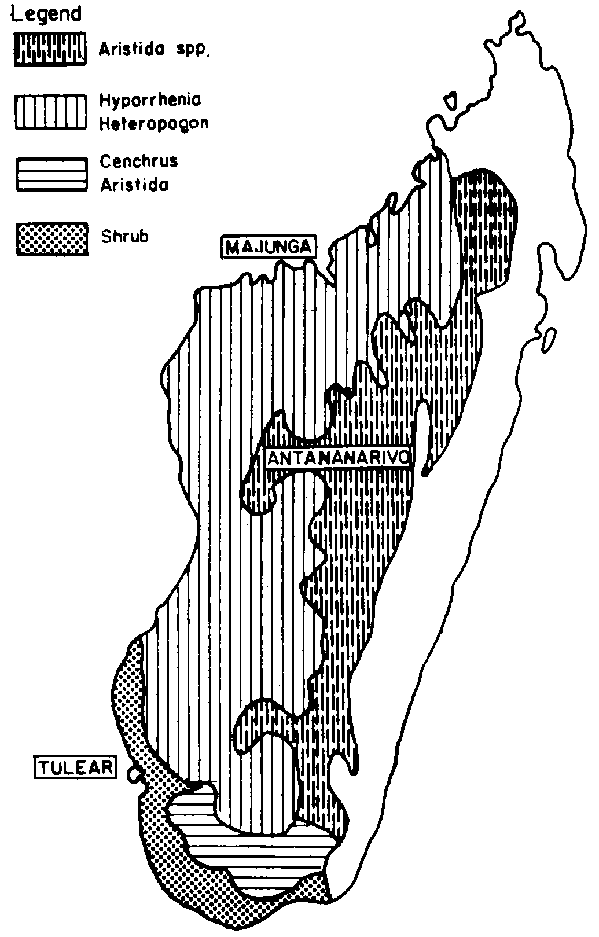
The most important feed resources are natural pastures, crop residues and to a limited extent, improved pastures. The grazing lands are dominated by four grass species: Heteropogon contortus, Hyparrhenia rufa, Chrysopogon serulatus and Aristida rufescens (Figure 1) (Cabanys and Razafindrastsita, 1971; Granier and Bigot, 1972; Morat, 1972; Suttie, 1974a). In the south the grasses are replaced by shrubs.
Generally the edible dry matter available during the rainy season is sufficient as the stock is not able to eat all the grass produced. After the rainy season there is a rapid change of nutritive value in the grassland. Crude protein content particularly may be as low as 2% in September (Figure 2). The management of this natural grassland is not controlled, except in the Androy region (south), where there is a traditional deferred grazing area ranging from 2 to 200 ha, which is only grazed in the dry season. This deferred grazing land is called Adily (Ratsimba-Rajohn and Razafindratsita, 1977). It belongs to a family or a local community, and their livestock are the only ones authorised to graze on it.
Several pasture improvement tests were performed (Borget, 1971; Suttie and Hablutzel, 1975; Rasambainarivo et al., 1980), particularly with leguminous species. The best adapted are Stylosanthes guianensis, Stylosanthes humilis, Stylosanthes hamata and Macroptilium atropurpureum (siratro), but they failed in practical extension due to socio-economic reasons.
In the south, thorny cactus is a traditional multipurpose plant. It is firstly used as fence around villages and fields. It is also cut, burnt and distributed to livestock in the dry season. The mature fruit is appreciated by humans. Some thornless cacti were tested (Suttie and Matzernmiller, personal communication); they give higher yield in terms of fodder although their management is more difficult, and they cannot be used as fences, so their extension is very limited.
Figure 1. Grazing lands in western and southern Madagascar.
Since rice is planted all over the island, rice straw is therefore the most common crop residue. It is usually left in the field after threshing and consumed by zebu cattle without any treatment. Weeds growing in the rice fields are also grazed after harvest. Other crop residues are maize and sorghum stovers, cassava, sweet potatoes, vines and groundnut haulms. A survey carried out in 1977 indicated that 70% of the cattle owners utilise crop residues for animal feeding.
Agro-industrial by-products are not available for extensive livestock due to their high cost and transport problems.
Herd Structure
The Malagasy zebu is the major breed constituting the extensive cattle population. Herd composition (Table 1) indicates that females are more numerous than males and the bull:cow ratio is about 1:18. No culling of infertile females is practiced because legally they are not to be slaughtered. More than half of the stock are four years old and over, and about 11% are more than ten years old. In this old group the majority are castrated males.
Figure 2. Crude protein contents of natural pasture in western and southern Madagascar provinces.
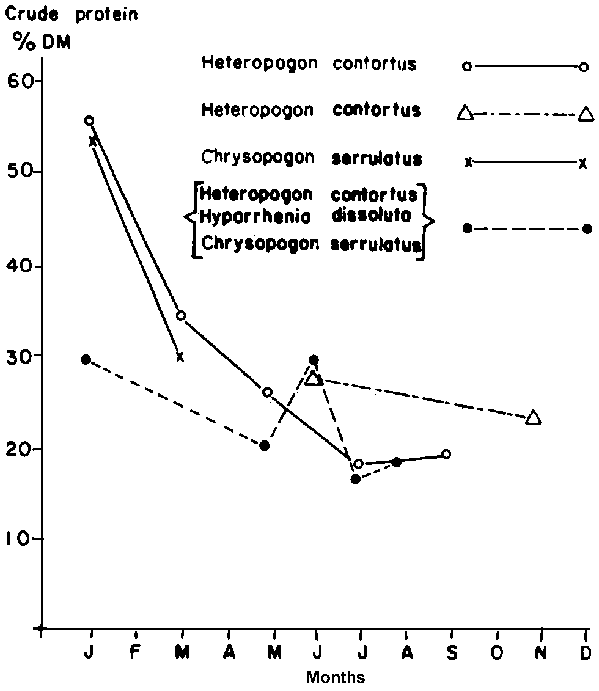
Table 1. Composition of household herd in Faritany Mohajanga in 1984.
|
Age (years) |
Males |
Females |
Total |
|
Less than 1 |
8.4 |
9.2 |
17.6 |
|
1 - 3 |
12.0 |
14.0 |
26.0 |
|
4 - 9 |
15.3* |
30.0 |
45.3 |
|
10 and over |
3.6* |
7.4 |
11.0 |
|
Total |
39.4 |
60.6 |
100.0 |
* 11.8% are castrated males.
Source: Sarniguet and Hartier (1986).
Reproduction Performances
Reproduction performance data are presented in Table 2. The data were collected all over Mahananga Province. The data for Miadana Station are averages for a ten-year period. The calving rate is quite variable in the traditional management system, ranging from 44.7% to 68.6%. In the "Miadana" conditions, the mean rate is 67.3% (Rakotobe-Ralako, 1987).
Table 2. Extensive reproduction performance.
|
|
Regional Mahajanga survey |
Miadana station |
|
Calving rates (%) |
58 |
67 ± 8 |
|
Age at first calving (months) |
60 |
54 |
|
Calving interval (days) |
420 |
377 |
In the extensive situation the age at first calving is longer. The calving interval is also longer. These data are in agreement with the report by Rakotobe-Ralako, (personal communication) who reported that in well-managed herds of zebu cattle age at first calving may be as short as 28 months compared to a range of 48 to 68 months under extensive management. The calving interval was extended in extensive management systems.
Mortality varies widely depending on the age. The most important mortality is that of calves less than one year old; 21% of these calves die in the extensive system conditions. The mortality rate decreases as the zebu get older, and the overall mortality is estimated to stabilise at 7.5%. All these reproduction data will vary depending on seasonal availability of nutrition.
Liveweight Changes
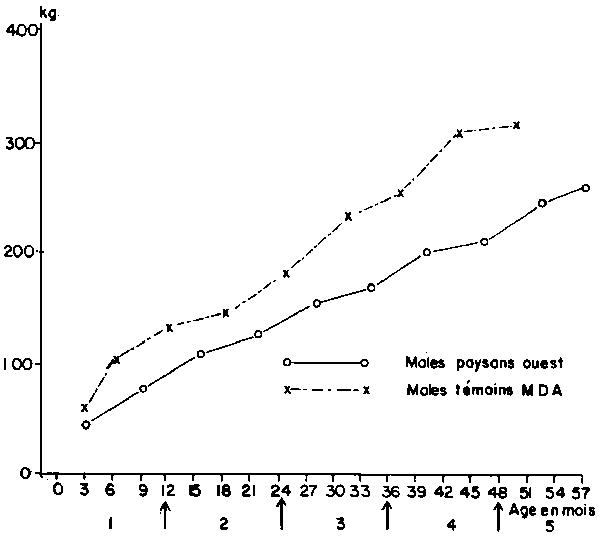
The general pattern of Malagasy zebu growth in extensive system is presented in Figure 3 which compares small-scale owner and research station cattle. As expected, the rate of growth of the better managed station cattle is higher than that of the extensively managed. Even at the end of 48 months after birth the station-managed cattle are heavier by about 50-75 kg (Ratovonirina, 1983).
Considering the growth rates within the first 36 months, it is evident that the worst period lies between the 6th and 18th month of age. This period coincides with weaning, a period when daily weight gain decreases from 458 g to only 90 g/day.
Figure 3. Weights of Malagasy Zebu in extensive and station conditions.
Source: Ratovonirina (1983).
Comparative livestock productivity studies have shown that stocking natural grasslands at one animal/ha induces a weight loss whereas on legume reinforced planted pastures stocked at the rate of three animals/ha the animals were able to gain at 0.3 kg/day. These data show the potential for improvement of the extensive grazing land resources in Madagascar (Rasambainarivo et al., 1985).
Slaughter Performances
Nearly all the cattle slaughtered are zebu coming from extensive systems. These slaughters represent a national carcass consumption of 13.1 kg/ha/annum. This figure is doubtful as there are a lot of cattle slaughtered but not recorded. The mean carcass weight of Malagasy zebu cattle is 172 kg. The majority of slaughtered zebu are more than eight years old. Nevertheless, in a better environment the zebu carcass may weigh 200 kg (Gilibert, 1971).
Milk Production
Milk production is low in extensive systems. Data were collected in the suburbs of Mahajanga. The mean individual cow production is estimated at 350 litres for a 200-day lactation (Planchenault, 1986). In the deep south of the Androy region, milk is also produced and traditionally processed, but milk production records are not available.
From the data reviewed, it is evident that the major factor limiting production of the zebu cattle in Madagascar under extensive production system is inadequate nutrition which leads to poor reproduction and weight gain performance. The zebu cattle may not be expressing their full potential as a result of the nutrition problem under these conditions. Notwithstanding the socio-economic constraints to improving livestock production, an improvement of the feed resource would invariably increase the reproduction performance of cows and reduce calf mortality.
More accurate information about the different management systems is required, and more comprehensive surveys must be carried out. Additional research information should be gathered about the status of bovines on-farm. And all of these data have to be used with a computer model for a production system simulation. As beef production is a rather complex enterprise, improvement can only be successful if it is carried out by interdisciplinary teams on national and regional level.
Borget, M. 1971. Recherche et production fourragere en Republique Malgache. I.R.A.T., Paris.
Cabanys, Y. and Razafindratsita, R. 1971. Reconnaissance agrostologique du Sud de Madagascar. I.E.M.V.T. Region de Recherches de Madagascar.
FO. FI. FA. 1971. Pre-enguete sur l'utilisation des residus des recoltes et de la potentialite de fumier de porc dans l'Androy. FO. FI. FA/Division Economie Rurale.
Gilibert, J. 1971. Valuers boucheras des zebus a Madagascar. Rev. Elev. Med. Vet. Pays Trop. 24(3):445-465.
Granier, P. 1971. Problemes poses par le developpement de l'elevage dans le Sud de Madagascar. Etudes preliminaires. Rapport destine a la Sogreah. I.E.M.V.T. - Region de Recherches de Madagascar.
Granier, P. and Bigot, A. 1972. Donnees preliminaires pour une etude de l'Elevage bovin dans la province de Majunga. I.E.M.V.T. Region de Recherches de Madagascar.
M.D.R.R.A. 1979. Ministere du Developpement Rural et de la Reforme Agraric.
Morat, P.H. 1972. Contribution a l'etude des savanes du Sud-ouest de Madagascar. These de Docteur-es-Sciences Naturelles, Paris-Sud, Contre d'Orsay.
M.P.A.E.F. 1986. Rapport d'activites de la Direction de l'Elevage.
Planchenault, D. 1986. Etude de la speculation. Production laitiere autour de la ville de Mahajanga. Inst. d'Elev. et de Med. Vet. des Pays Trop. - Maisons-Alfort.
Quesnel, N. and Sarniguet, J. 1979. Etude de la commercialisation due betail et des prix de la viande a Madagascar. Tome I :Estimation et caracteristiques due cheptel. M.D.R.R.A. Sedes.
Rasambainarivo, J.H., Rakotozandirndrainy, R. and Razafindrata, R. 1985. Les sous-produits de coton. Utilization en alimentation animal (croissance et embouche bovines). D.R.Z.V. Division Alimentation Animale.
Rasambainarivo, J.H., Rakotozandrindrainy, R. Razafindratsita, R. and Rabehanitriniony, M. 1986. Productions des paturages ameliores dans deux regions due Faritany de Mahajanga. Academie Malgache et Colloque International sur l'Amelioration de l'Elevage en zone tropical: cas de Madagascar.
Ratovonirina, E. 1983. Amelioration genetique du zebu malgache. Memoire de fin d'etudes, E.E.S.S.A. Universite de Madagascar.
Ratsimba-Rajohn, R. and Razafindratsita, R. 1977. Rapport de tournee dans l'Androy. D.R.Z.V./Division Alimentation Animale.
Sarniguet, J. and Hartier, P. 1986. Recensement du cheptel des Faitany d'Antananarivo et Mahajanga. Enquete 1984. M.P.A.E.F./Direction de l'Elevage et Sedes.
Sarniguet, J. and Vindrinet, R. 1979. Etude de la commercialisation du betail et des prix de la viande a Madagascar. Tome 2 :Analyse economique des filieres et propositions. M.D.R.R.A. et Sedes.
Suttie, J.M. 1974. La situation agrostologique et les problemes du developpement de l'elevage dans la zone d'intervention de la SODEMO. Compte-rendu de mission. Project FAO-CMCF MAD. 16.
Suttie, J.M. 1974a. Les paturages naturels et les plantes fourrageres de l'Androy Sedimentaires. Leurs roles dans la production animale. FAO-PNUD.
Suttie, J.M. and Hablutzel, H. 1975. La promotion de la culture de la Raketa (Opuntia ficus indica) dans l'Androy en vue de l'amelioration de l'alimentation du troupeau des ruminants. FAO-PNUD.
