P.N. de Leeuw and R. Nyambaka
International Livestock Centre for Africa
P.O. Box 46847, Nairobi, Kenya
Introduction
Methods and data sources
Results and discussion
Conclusions
References
Abstract
Relationships between rainfall and peak biomass were analyzed for eight sites in arid and semi-arid areas in Kenya and northern Tanzania. These sites received average annual rainfall ranging from 200-600 mm falling mostly in a bimodal pattern. Regression equations of seasonal biomass were significant for all sites explaining 56 to 99% of the variation. Predicted seasonal biomass was 1200-2000 kg DM ha-1 at 300 mm and 2100-3900 kg DM at 500 mm of rainfall. Differences between sites were due to species composition, soil type and herbaceous cover density. These data sets were compared to similar regressions for west and southern Africa. It was concluded that productivity per unit of rainfall in East Africa was higher than these other regions because of bimodal rainfall and higher soil fertility.
In recent years relationships between seasonal rainfall and end of season herbaceous biomass have been published for several regions in Africa. For the Sahelo-Sudanian region data were compiled by Le Houerou and Hoste (1977) followed by studies in Mali by Penning de Vries and Djiteye (1982). For Eastern and southern Africa regressions between annual rainfall and herbaceous biomass were developed by Deshmuck (1984) which showed that per unit of rainfall biomass production in this region was twice as high as in West Africa. However, similar regressions for southern Africa given by Rutherford (1978) indicate that productivity of rangelands in Zimbabwe and Botswana is much lower than in East Africa.
The purpose of this paper is to focus on the productivity of rangelands in arid and semi-arid Eastern Africa and indicate which factors are responsible for the substantial higher levels of productivity in this region as compared to southern and western Africa.
Relationships between rainfall and peak biomass were analysed for sites in Kenya and Tanzania. All sites were located in areas with arid or semi-arid climates having seasonal rainfall ranging from 100 to 600 mm falling mostly in a bimodal pattern due to their location around the equator (Tables 1 and 2).
Raw data were obtained for three sites in semi-arid Kenya: (1) Kiboko Research Station (Too, 1985); (2) Athi plains (Potter, 1985); and (3) Tsavo National Park (van Wijngaarden, 1985). These three sites are all located within the pastoral land use zone (cf. Jaetzold and Schmidt, 1983). Additional data sets were used as supplementary sources: Amboseli (Western and Grimsdell, 1979), Serengeti (Sinclair, 1979; Braun, 1973).
Table 1. Relationships between rainfall and herbaceous standing above-ground biomass in bimodal rainfall areas in Kenya and Tanzania.
|
Area |
Average annual rainfallb/ |
Principal genera |
100 kg |
300 DM |
500 ha-1 |
|
Amboseli (IV)b/ |
300-550 |
Sporobolus-Pennisetum |
10 |
760 |
1510 |
|
Kiboko (V) |
450-900 |
Digitaria-Chloris |
670 |
1490 |
2300 |
|
Serengeti (IV) |
600-1100 |
Sporobolus |
-a/ |
1190 |
2150 |
|
Tsavo (VI) |
300-550 |
Chloris-Chysopogon |
420 |
2020 |
3620 |
|
Serengeti (IV) |
600-1100 |
Themeda |
-a/ |
1570 |
3700 |
|
Serengeti (IV) |
600-1100 |
Themeda in woodlands |
470 |
1790 |
3100 |
|
Athi (V) |
450-900 |
Themeda |
10 |
1370 |
3860 |
|
Serengeti (IV) |
600-1100 |
Andropogon |
-a/ |
1520 |
3230 |
a/ The data did not cover rainfall below 200-250 mm.
b/ IV-VI Moisture availability zones and the annual rainfall according to Braun (in Sombroek et al, 1982).
Table 2. Regression equations for seasonal rainfall on standing biomass in East Africa.
|
Area |
Equation |
Reference | |
|
Amboseli |
Y = -367+3.8X |
(N = 6; R² = 0.99) |
Western and Grimsdell (1979) |
|
Kiboko |
Y = + 262 + 4.41 |
(N = 38; R² = 0.78) |
Too (1985) |
|
Serengeti |
Y = 262 + 4.8X |
(N = 7; R² = 0.93) |
Braun (1973) |
|
Tsavo |
Y = 380 + 8.0X |
(N = 89; R² = 0.65) |
van Wijngaarden (1985) |
|
Serengeti |
Y= -1644 + 10.7X |
(N = 12; R² = 0.62) |
Braun (1973) |
|
Serengeti |
Y = -185 + 6.6X |
(N = 24; R² = 0.90) |
Sinclair (1979) |
|
Athi |
Y = -251 + 1.2X + 0.01X2 |
(N = 24; R² = 0.95) |
Potter (1985) |
|
Serengeti |
Y = -1052+8.6X |
(N = 10; R² = 0.56) |
Braun (1973) |
Y = Biomass in kg DM ha-1; X = rainfall in mm.
In Kiboko a clipping trial was carried out from February 1982 to December 1984 in four neighbouring vegetation types. The plant cover consisted mainly of perennial grasses with a medium to light cover (10-30%) of Acacia and Commiphora shrubs and low trees. Seven different cutting regimes were applied together with two defoliation intensities (cutting at 5 and 12.5 cm height). Within each vegetation type the 14 treatment combinations were repeated on land that was burned prior to the start of the trial an-d also on unburned land. Only data from the high intensity defoliation treatments were used assuming that harvesting at 5 cm height best represented available biomass. As the effect on herbaceous biomass growth of burning and vegetation type or their interactions were not significant (Too, 1985), these were combined in the re-analysis, giving 38 pairs of data of cumulative seasonal rainfall and resulting biomass.
The study in Tsavo National Park was designed to investigate and describe the ecosystem and to "quantify the climate-soil-vegetation-large herbivore interactions and to develop a model describing these relationships quantitatively" (van Wijngaarden, 1985, p. 149). To this end, herbage productivity was measured in representative vegetation types over five rainy seasons during 1976-78. Data on seasonal rainfall, clipped herbaceous biomass, cover density of the perennial and annual grass as well as the woody component were made available for 88 sample plots, which were used for regression analysis.
The site in the Athi plains was located in the treeless Themeda grasslands. The trial design was a factorial with five defoliation frequencies (3-, 6-, 9-, 12- and 15-week cutting intervals) each at three heights of cutting (5, 10 and 15 cm). Treatments were applied from April 1974 to December 1978 covering ten growing seasons. Data on rainfall, evapotranspiration and biomass growth were given for three-weekly periods for the entire duration of the trial. As for Kiboko, only data for the high defoliation intensity (i.e. 5 cm) were used for the analysis. As the medium defoliation frequencies produced the highest biomass, only the cutting intervals of six and nine weeks were included in the analysis. This provided 24 pairs of cumulative seasonal rainfall and its resultant grass biomass production.
For the other locations, relationships between standing biomass and annual instead of seasonal rainfall were available. For the Amboseli plains (Figure 1) the data covered the period 1973-78 (Western and Grimsdell, 1979). Similarly for the Serengeti plains, data were extracted and re-analyzed from Sinclair (1979) and from Braun (1973).
All sites were either protected or were located where grazing pressure was low. Standing biomass was measured through clipping either at ground level or at 5 cm above ground. In most areas, end of season biomass was recorded except in Kiboko (Too, 1985) and in the Athi plains where several defoliation regimes were combined.
Effect of Rainfall
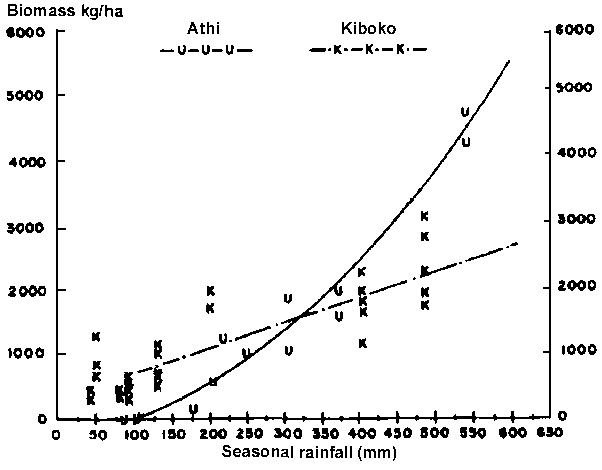
The results of regression analyses Of seasonal rainfall on biomass are shown in Tables 1 and 2. The proportion of the variation explained by rainfall ranged from 56 to 99% and was significant in all cases. Linear regressions were as good as quadratic ones except for the data from the Athi plains (Table 2). The response to rainfall increases positively with the total amount per season. In the arid zone (Amboseli) biomass yield is only 3.8 kg DM ha-1 per mm of rainfall increasing to 10.7 kg in the tall Themeda grasslands in the Serengeti.
However, responses to rainfall in Tsavo were twice as high as in Kiboko (8.0 and 4.1 kg DM/mm of rain respectively) although the latter site receives more rainfall. This is most likely due to differences in grass cover density. The average density in Tsavo was 60% whereas Too (1985) reported that herbaceous cover in his trial area varied from 15-40%.
Biomass yield at the lower range of rainfall (100-200 mm) was much higher in Tsavo and Kiboko than in the Athi plains (Figure 1). In Kiboko harvesting was confined mainly to rainy seasons; hence for some of the cutting regimes, further growth occurred after the last cut which was carried over into the next season inflating the response to the next rains. However, in Tsavo only new season growth was recorded.
In the Athi plains, a quadratic function gave the best fit, because the data set represented a series of very dry and very wet growing seasons. The trial started towards the end of a long dry period (1972-76), and during the five seasons from December 1974 to January 1977, seasonal rainfall averaged 200 mm producing only 200 kg DM/ha or only 1 kg DM ha-1/mm of rain. Rain fell in small, isolated showers; hence the moisture index (P/Et) (cf. Sombroek et al., 1982) for any three-week period never exceeded 0.5. This long dry period was followed by 20 months of good rains. From March 1977 up to December 1978 seasonal rains averaged 365 mm and in each of the four seasons there was a moisture surplus (P/Et>1) for at least six weeks. Early in 1978 over 500 mm of rain fell within 3.5 months producing close to 5 t DM biomass (Figure 1).
Soil and Herbaceous Cover
The effect of rainfall on productivity is influenced by soil type and the density of the herbaceous cover. The high biomass of the Themeda grasslands in the Serengeti and Athi plains is attributed to the relatively high fertility of the deep Vertisols over basalt (Sombroek et al, 1982). Standing biomass of 3-4 t DM/ha-1 were recorded on similar soils in Kajiado (Page et al, 1975; Karue, 1975) and Masai Mara (Boutton and Tieszen n.d.). The effect of soil type on primary production was studied in Tsavo. For the same rainfall and plant density standing biomass on deep well drained sandy clays was 30-55% percent higher than on shallow gravelly soils (Table 3).
Table 3. The effect of seasonal rainfall, plant cover and herbaceous soil type on end of season standing biomass in Tsavo National Park, Kenya.
|
|
Rainfall (mm) |
|||||
|
100 |
300 |
|||||
|
Percent cover |
||||||
|
Perennial grass |
10 |
20 |
40 |
10 |
20 |
40 |
|
Annual grass |
10 |
30 |
40 |
10 |
30 |
40 |
|
|
Standing biomass, kg DM ha-1 |
|||||
|
Deep soila/ |
200 |
450 |
760 |
600 |
1350 |
2270 |
|
Shallow soilb/ |
150 |
290 |
590 |
450 |
860 |
1760 |
Derived from van Wijngaarden (1985).
a/ Ferral- and Luvisols.
b/ Cambisols.
The density of herbaceous cover is another important factor influencing primary productivity. In Tsavo, primary productivity increased threefold when grass cover increased from 20 to 80% (Table 3). Low plant cover partially explains the poor response to rainfall in the Kiboko and Amboseli areas. In the latter area herbaceous cover is usually below 10% (Lamprey, personal communication).
Comparison with West and Southern Africa
Re-analysis of the data from West Africa for the rainfall range of 100-600 mm produced a regression equation Y = -152 + 3.2 x (N = 26; R² = 0.73) giving a standing biomass of 800 and 1450 kg DM/ha-1 for rainfalls 300 mm and 500 mm respectively. Similar relationships were given by Penning de Vries and Djiteye (1982) for the Sahel in Mali; or very close to those for Amboseli (Table 1). The low Sahel primary productivity was attributed to (1) poor and often sandy soils deficient in nitrogen and phosphorus; (2) high rates of evaporation during the growing season; (3) soil capping increasing runoff and impeding infiltration. As a result, the vegetation consists mainly of short-lived annuals with shallow root systems (Le Houerou and Hoste, 1977), while plant density is usually below 35% and end-of-season standing biomass of annual grasses maximally-was 1.0-1.5 t/ha when density was 2035% (Wagenaar and de Ridder, 1985).
Rutherford (1978) showed that for the Colophospermum mopane savanna in Zimbabwe, 300 mm and 500 mm rainfall produced approximately 1000 and 1500 kg DM ha-1 or close to the West African data. Much lower productivity was recorded in Botswana (22-23°S) during 1983-84 by Prince and Astle (1986). Although total seasonal rainfall varied from 360 to 530 mm, standing green biomass ranged only from 100-600 kg DM/ha (in 3 sites) with very low cover value (6-20%). High woody cover (mean of 30%) and poor distribution of the rainfall were held responsible for the low herbage growth. Dancy et al. (1986) for the same period and at the same latitude in Botswana reported peak standing biomass yields (in May 1984) from 200-1700 kg/ha-1. Low yields were related to low plant density, which was in turn caused by high grazing pressure. Ungrazed areas had dense cover (65%) and yields of 1700 kg DM ha-1, which at an annual rainfall of 550 mm conforms to the equation of Rutherford (1978). This level of productivity is similar to the average peak biomass of 1900 kg DM ha-1 reported by APRU (1977) for seven moderately grazed ranches receiving an average rainfall of 450 mm. Earlier work in Botswana confirmed the effect of stocking rate on peak biomass. McKay (1968) found that rangelands with an average rainfall of 300 mm grazed at high and moderate stocking rates for an eight-year period produced 400 and 1360 kg DM ha-1 respectively.
The relationships established in Table 1 indicate that productivity is generally lower than given by the equation of Deshmukh (1984)(300 mm:2350 kg DM ha-1, 500 mm:4050 kg DM ha-1), but also that productivity for unit of seasonal rainfall in East Africa is higher than that in either West or southern Africa. The equation of Deshmukh (1984) is distorted by the inclusion of annual and perennial grasslands together from very different environments with both monomodal and bimodal rainfall regimes extending from latitudes 23°S to 4°N. Furthermore, the selective use of data sets of questionable value reduces its predictive value. 1/
1/ A large part of the equation is determined by nine data in Namibia and Marsabit in northern Kenya (cf Herlocher and Dolan, 1980). According to Rutherford (1978, p.629) "...the data from Namibia are maximal values for localized areas. It appears that these data be recognized as accumulated plant mass present at the time of sampling and not as annual production which might be in the order of half or less..." The ten data sets from Marsabit include sparse annual grasslands with 200 mm of rain together with perennial grasslands producing up to 8 t DM ha-1 with 700 mm of rain. These perennial grasslands are often found near riverbeds (with run-on moisture) or on isolated mountain sites at 2000 m elevations. These two data sets represent 58% of the total data used to construct the equation. Another six points have been derived from Braun (1973, Figure 5); this figure showed 63 data points covering four different vegetation types two of which were used in Tables 1 and 2 (see equations 5 and 8).
In conclusion, it appears that East African rangelands are more productive per unit of rainfall than those in West and Southern Africa. A combination of factors contribute to this: bimodal rainfall usually falls in well determined seasons of two-three months in length broken by a short dry season. This pattern allows perennial grasses to survive across seasons but encourages short-lived annuals to fill space adding to the overall biomass yield.
Soils are generally more fertile as they are derived from basaltic parent material or when underlain by basement complex surface horizons and are often enriched by volcanic ash deposits.
Finally, extreme caution is required when rainfall-biomass equations that are derived from protected or ungrazed sites are used for prediction of rangeland resources under heavy grazing pressure. Such equations should be adjusted for actual plant cover which is a prime determinant in the rainfall response levels of rangeland vegetations.
APRU. 1977. An integrated programme of beef cattle and range research in Botswana, 1970-77. Gaborone: Ministry of Agriculture, Botswana.
Boutton, T.W. and Tieszen, L.L. n.d. Estimation of vegetative biomass by spectral reflectance in an East Africa grassland. J. Range Management (in press?).
Braun, H.M.H. 1973. Primary production in the Serengeti: Purpose, methods and some results of research. Ann. Univ. d'Abidjan (E) 6:171-188.
Dancy, K.J., Webster, R. and Abel, N.O.J. 1986. Estimating and mapping grass cover and biomass from low-level photographic sampling. Int. J. Remote Sensing 7:1679-1704.
Deshmukh, I.K. 1984. A common relationship between precipitation and Grassland peak biomass for East and Southern Africa. Afr. J. Ecol. 22:181-186.
Herlocher, D.J. and Dolan, R.A. 1980. Primary productivity of the herb layer and its relation to rainfall. IPAL Tech: Rep. A3, MAB Nairobi. pp. 22-29.
Jaetzold, R. and Schmidt, H. 1983. Farm Management in Kenya, Vol. II C East Kenya. Ministry of Agriculture, Nairobi, Kenya.
Karue, C.N. 1975. The nutritive value of herbage in semi-arid lands in East Africa. II. Seasonal influence on the nutritive value of Themeda triandra. E. Afr. Agric. For. J. 40:372-387.
Le Houerou, H.N. and Hoste, C.H. 1977. Rangeland production and annual rainfall relations in the Mediterranean basin and in the African Sahelo-Sudanian zone. J. Range Management 30:163-178.
McKay, A.D. 1968. Rangeland productivity in Botswana. E. Afr. Agric. For. J. 34:178-193.
Page, C.P., Lusigi, W.J. and Mumukha, P.W. 1975. Vegetation studies in selected areas in Kajiado District. Mimeo, UNDP/FAO Wildlife Management Project, Nairobi.
Penning de Vries, F.W.T. and Djiteye, M.A. (eds). 1982. La productivite des paturages saheliens. Agric. Res. Reports 918. PUDOC, Wageningen, The Netherlands.
Potter, H.L. 1985. Aspects of climate, herbage growth and animal production in a semi-arid area of Kenya. Ph.D. thesis, University of Nairobi, Nairobi, Kenya.
Prince, S.D. and Astle, W.L. 1986. Satellite remote sensing of rangelands in Botswana. Int. J. Remote Sensing 7:1533-1553.
Rutherford, M.C. 1978. Primary production ecology in Southern Africa. In: M.J.A. Werger (ed.), Bibliography and ecology of southern Africa. Dr. W. Junk Publishers, The Hague. pp. 621-659.
Sinclair, A.R.E. 1979. The eruption of the ruminants. In: A.R.E. Sinclair and M. Norton-Griffiths (eds), Serengeti, dynamics of an ecosystem. University of Chicago Press, Chicago. pp. 82-103.
Sombroek, W.G., Braun, H.M.H. and van der Pouw, B.J.A. 1982. Exploratory Soil Map and Agro-climatic Zone Map of Kenya 1980, Kenya Soil Survey, Rep. EI, Nairobi.
Too, D.K. 1985. Effects of defoliation frequency and intensity on production of four burned and unburned bushed grassland communities in South-Central Kenya. M.Sc. thesis, Texas A & M University, Texas, USA.
Wagenaar, K.T. and de Ridder, N. 1985. Estimates of biomass production and distribution in the Integrated Livestock Project (ILP) in the Republic of Niger. Internal Report, ILCA, Addis Ababa.
Western, D. and Grimsdell, J.J.R. 1979. Measuring the distribution of animals in relation to the environment. Handbook No. 2, African Wildlife Leadership Foundation, Nairobi.
Wijngaarden, W. van. 1985. Elephants-Trees-Grass-Grazers: relationships between climate, soil, vegetation and large herbivores in a semi-arid savanna ecosystem. ITC Publ. No. 4, Enschede, Netherlands.