John McIntire and Siegfried Debrah
ILCA, P.O. Box 5689, Addis Ababa.
Abstract
Introduction
Role of forage legumes in livestock systems
Seasonality in feed supply
Seasonality of animal movements
Competition for land and labour
Complementarity of forage legumes
Forages in smallholder systems
Forages in pastoral and semi-pastoral systems
Specialized forage production
Why forages are not widely adopted
Research implications and recommendations
Research emphasis
Reference
Acknowledgements
Progress in the incorporation of forage legumes into farming systems in sub-saharan Africa to alleviate livestock nutrition problems has been slow. This paper explains the reasons by showing how forages fit into smallholder and pastoral systems. It then speculates on the kinds of technical research that might accelerate their incorporation into current production systems.
Among the constraints facing livestock development in Africa, inadequate feed supplies stands out as one of the most important. Seasonal variations in feed quantity and quality cause fluctuations in animal nutrition and productivity throughout the year. One recommended means of relieving the nutritional constraint is to incorporate forage legumes into animal diets. Such legumes can be grown in pure stands on farms, incorporated into natural pastures, intercropped or cultivated in fodder banks. Progress in such incorporation on the sub-continent has been slow. This paper seeks to explain why it has been slow by showing how forages fit into farming systems. The use of forage legumes in this paper is discussed in the contexts of seasonality of other feeds, particularly natural pastures and crop residues, the seasonality in animal movements, the competitiveness for land and labour of forage legumes with other feeds in smallholder as well as pastoral production systems in sub-saharan Africa. The paper argues that the principal constraints to the introduction of forage legumes into smallholder and pastoral systems is not their supply, that is, not the fact that they do not grow in sufficient quantities but that they are demanded only in special circumstances, ones which are not generally found in the sub-continent. This explanation then serves as the basis for some speculations about the kinds of technical research which might be carried out to accelerate the incorporation of such legume crops into the current animal production systems.
The paper also discusses forage legumes in the contexts of seasonality competiveness and complementarily and shows how these attributes fit into the smallholder and pastoral systems. The reasons why forage legumes are not widely adopted on the sub-continent are discussed. This is followed by a discussion of research implications and recommendations.
Forages play varying roles in the different livestock production systems. In general, however, they are important as adjuncts to crop residues and natural pastures and may be used to fill the feed gaps during the periods of inadequate crop residue and natural pasture supply. Even in the presence of abundant crop residues, which are often free feed for ruminants, forage crops, especially legumes, are needed to improve the utilization of crop residues. Crop residues are potential energy sources while forage legumes provide protein. Forages also provide benefits to other crops. When used in rotation with other crops, they provide benefits such as soil fertility through their nitrogen-fixing ability and are also useful in breaking insect, weed or disease cycles which are likely to occur in their absence. In many situations however, forages compete with other crops. In land-scarce smallholder systems, forages may compete with other crops for land while in land-abundant pastoral systems, they may compete for the herder's labour.
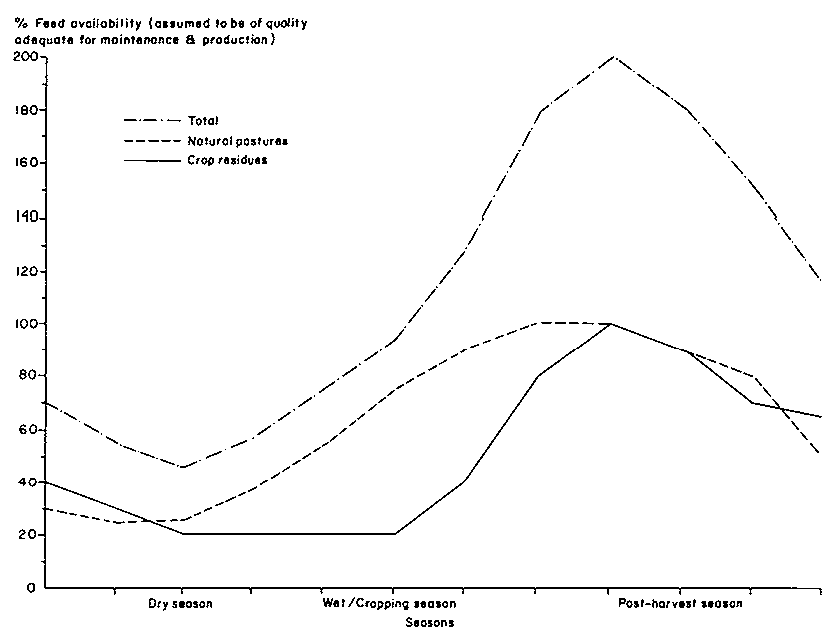
Figure 1. Hypothetical profile of crop residue and pasture availability.
A common production problem faced by pastoralists, agro-pastoralists as well as smallholders is the seasonality in the quantity and quality of animal feeds; particularly natural pastures and crop residues. In the absence of irrigation, a hypothetical production profile of natural pastures and crop residues in the dry, wet and post-harvest seasons is shown in Figure 1. The vertical axis shows total availability of crop residues and natural pastures, assumed to be of quality adequate for maintenance and production. The horizontal axis depicts the production calendar.
Crop residues are only about 20% available, relative to their maximum, early in the cropping season, peak towards 100% at the end of the cropping season and then decline to about 60% in the post-harvest season. Natural pasture supply begins to rise sooner during the cropping season than crop residues. The supply rises from about 30% availability at the beginning of the cropping season, peaks towards 100% and declines to about 50% during the post-harvest season. This kind of pattern leads to proposition 1 about the supplementary role of forages which may be of relevance to forage research.
Proposition 1: Forages are most useful during periods of low quantity and quality of crop residues and natural pastures.
Seasonality in animal movements can be defined according to the degree of crop-livestock interactions depicted in Figure 2.
Fig. 2
|
Crop-Livestock Interactions Continuum | ||
|
LOW INTERACTION |
MODERATE INTERACTION |
HIGH INTERACTION |
|
Extensive nomadic movement; free grazing; limited use of crop residues. |
Limited animal movements; more use of crop residues |
Animals kept on farm year round; crop residues form the main available roughage. |
With low interations, there are extensive nomadic movements of animals characterized by free grazing of natural pastures. There is little cropping and crop residues are unavailable for feeding animals. With low to moderate interaction, there is more crop production and less animal movement. More crop residues are fed as herds are closer to sites of crop production. With high integration, animals are kept on the farm year round and consume crop residues as a major share of their diet. Herds are generally less mobile in such systems. This explanation leads to the proposition 2 about forage production vis-a-vis seasonal movement of animals:
Proposition 2: The less mobile a herd is, the more favourable are conditions for forage production and vice versa.
In the African context crop-livestock relations are positively related to population density. At very low population density, animals and crops will be managed by separate units and there will be little physical contact between the two; animals will graze open pastures. This situation introduces proposition 3.
Proposition 3: At low population densities, a new crop such as forage legumes will compete for the farmer's labour.
Under high population density, there will be very close interaction; animals will graze crop residues and will be managed and owned by cultivators, a system that generates proposition 4.
Proposition 4: At high population and cultivation densities, a new crop such as forage legumes competes for land.
In addition to contributing to soil nitrogen and providing a break in cereal dominated rotations, forage legumes contribute significantly to livestock production in crop-livestock systems. Low quality crop residues need nitrogen supplementation, which could be provided by forage legumes, to become productive diets. In the Ethiopian highlands, for example, Vicia faba is not fed to livestock except in combination with cereal straw (Anderson 1985). It is also possible that forage legumes will increase both food crop production and quantity of crop residues available for livestock feed.
Wet Season Use
The use of forages during the cropping season for smallholders depends on animal mobility. Where animals are not mobile, forage production is an option if their benefits exceed the combined opportunity cost of such substitutes as leaf strippings, crop thinnings, pastures or cut hays. As noted above, where animals are highly mobile, then they are distant from forage production sites and would only benefit from such forage if conserved for the dry season. In terms of wet season use we propound proposition 5.
Proposition 5: Because of earlier pasture growth during the wet season, forages are not likely to have a comparative advantage at that time unless they are selected for rapid early growth and can support higher grazing pressure. However, if pasture land is limited, forages may be an option in the wet season. This proposition holds whatever the degree of mobility.
Post-Harvest Use
Under normal weather conditions, crop residues become available in high quantity soon after harvesting. Their utilization, in most cases, is not labour intensive since they can be grazed in situ and may be preferred to forages in the post-harvest season. They may contain high quality fractions for a short period after harvesting. In such a situation proposition 6 can be advanced.
Proposition 6: Crop residues will dominate forage use during the post-harvest season if they are of high enough quality to be fed alone.
Although the post-harvest period is short, it is probably the least relevant for forages. An exception is found in root crop systems where crop residues are less available.
Dry Season Use
This is the most relevant time for forages because of the general absence of crop residues (unless preserved earlier) and natural pastures. The critical constraint is soil moisture, but if forage can be cultivated on residual moisture it can fill the feed gap. The alternative is the use of conserved forages from the wet season for dry season use.
African pastoral systems are subsistence-oriented and based on seasonal milk production. The system is characterized by an acute conflict between milk intake for calves and milk offtake by humans. Because of low nutritional levels and lack of water, an animal's ability to produce milk under stress and to survive may be more important to pastoralists than high yields.
The introduction of forage crops into the pastoral system requires different considerations than in the smallholder system. First, potential competition between forages and crop residues is low or non-existent mainly because the system is not based on crop production. Second, labour use in pastoral systems is much less than in cropping systems. Third, local spatial risk in a pastoral environment is probably higher than in an annual cropping system. In the pastoral system there is a strong incentive for animal mobility to minimize risks. These considerations lead to the following propositions about the place of forage legumes in a pastoral system:
Proposition 7: The introduction of forage crops in a pastoral system implies less herd mobility more total labour input per production unit, and higher short term risks.
Proposition 8: Forage crops might be suitable for herds which are at least partially sedentary. If such herds are managed by women and children leaving the men to manage the mobile herd, labour demands for forages would be high relative to supply.
Proposition 9: Forages in pastoral systems would not face competition from crop residues and would not compete for land, but might compete with natural pastures in the wet season and for herding labour.
Loss of competition from crop residues means that, in contrast to smallholder systems, the post-harvest/early dry seasons are highest potential periods for forages. In view of the conflict between milk for calves and for humans, options for forages may be to supplement dams or calves. But it is better to grow forages for these purposes or to grow food crops for humans and leave milk for calves? Food crops face the same water constraint and the same labour constraint that forages face if there is extensive herd mobility. However, in terms of productivity in calories per labour input, food crops may be more efficient. It is to be understood that food crops and forages are only a solution to the milk conflict for that part of the herd that stays near the home site. For the mobile part, neither forages nor crops are an option and the mobility conflict remains.
The above considerations apply to a smallholder or to a pastoralist producing forage crops for his own animals. What if he produces forage for sale? Demand constraints, in terms of competition from crop residues and pastures, still apply by season. Therefore what is necessary is an external market for forage and animal products. Such markets would usually be urban where there is year-round demand for milk and no seasonal competition from pastures and crop residues. On the supply side, the same arguments apply. Forage production will be done if it does not compete for land and if it is not too labour intensive; proposition 10.
Proposition 10: Forage production for sale will occur on common properties where land competition is low, the only costs to the producer will be collecting and transportation. It will also occur on private lands of low quality.
However, both sites are unfavourable production, irrespective of its labor intensity, but they provide saleable fodder at low cost. Production from marginal lands will fall when population density rises enough to make it necessary to cultivate or graze such lands.
Proposition 11: Specialized forage production will occur where urban demand is good, or where the specialized producer can assure food supplies via the market, or he is a small part of an extended family who has no responsibility for family food supply.
Forage crops are neither widely adopted for own use nor for specialized production; principally because of demand and supply constraints unique to forages and the production system. There are two conflicting forces militating against forage adoption in smallholder and pastoral or agro-pastoral systems. One is land abundance and site heterogeneity associated with it. Land abundance is unfavourable to forage use in extensive smallholder and in pastoral and agro-pastoral systems because such systems are based on herd mobility and on cropping with low labour input per hectare. Accordingly, forages compete with pastures and crop residues which can be grazed at low labour input (Propositions 2, 3 and 6). In pastoral systems, the structure of labour input is also unfavourable to intensive forage production (Propositions 7 and 8).
The second force is land scarcity, since forage production must then compete with food crop production for land (Proposition 4). In land-scarce smallholder systems with close integration of crops and animals, crop residues are the main animal feed. The availability of crop residues reduces the demand for forages. Lack of herd mobility and irrigation would be favourable to forage production.
Forage crops are not widely adopted as specialized products for sale mainly because of the structure of market demand. As mentioned earlier, specialized forage markets would usually be urban. Problems of transporting cut forage and the impossibility of transporting uncut forage limit use to production sites, for the producer's own animals. The specialized producer is also likely to face competition from the other feeds.
The preceding sections highlight seasonality and other considerations in forage production and adoption in the smallholder and pastoral agro-pastoral systems. The challenge to forage researchers is to match this erratic pattern with continued feed requirements throughout the year.
In the wet season, forage demand is constrained by the existence of competitors such as grass, crop thinnings and leaf strippings. Forages must be selected to fit into relatively small or specialized niches to provide additional benefits. A selection strategy for the wet season would have to select for:
a) earliness; that is forages which can be sown with the first rains to provide major benefits before grasses, thinnings and leaf strippings become available.b) tolerance for intercropping; if forages can be grown as intercrops, in whatever spatial arrangement, then they do not compete for land and compete less for labour than forages grown in pure stands. They may in addition suppress weeds and fix nutrients, both of which would benefit the other crop in the mixture, and
c) tolerance for marginal environments; select those which thrive on marginal lands or which can fit into fallow cycles. Each of these niches may be small and research for fitting into one might entail high experimental costs.
Assuming no severe crop failures, crop residues become available at low labour costs in the post-harvest season. If they are of high enough quality and type to be fed alone, forages become less important as animal feed in this season. A selection strategy for forages would include selection for harvest when crop residues are no longer available or when their quality falls off. These might be forages grown in relay systems, or those planted with residual moisture after the main harvest.
Forages are most relevant for dry-season use. A selection strategy would include:
a) selection for growth on residual moisture with deep rooting species. This would make forages available into the dry season without irrigation;b) selection for conservation quality in forages grown in the wet season if the dry season is reliably dry;
c) selection for forages which can be grazed as opposed to cut and carry only;
d) selection for forages which do not interfere with land preparation for the next cropping season. The latter conflict may be particularly severe in bi-modal rainfall regimes, where the short rains are necessary to prepare land for the crop in the long rains. It should be noted that browse species meet most of these criteria.
Research emphasis should be in areas of high population density with low herd mobility. Research into intercropping, serial and relay cropping of cereals with legumes, and alley cropping might increase feed without diverting land from food crops. Forage research emphasis should also be on marginal lands unsuitable for food crop production or with residual moisture available after harvests. Forage research should be carefully evaluated in extensive smallholder areas, and in pastoral areas. The advantages of extensive grazing are such that it will be difficult to adopt forages unless some very special conditions are met. In these areas, supplementation should be provided by purchased supplements since they do not pose a conservation problem, do not compete for labour, and do not inhibit mobility.
The updating of the existing feed data base to allow the construction of feed supply and demand profiles is essential for estimating feed gaps which might be filled by forages. Forage crops can then be screened for periods during which they are available and for their competitiveness and complementarily with other crops.
The use of irrigation trials should be viewed with scepticism. The reasoning here is that the constraint to forage use is not production, that is the capacity to grow them, but the demand for them by livestock owners in view of the alternatives available. Therefore, irrigation trials, while they provide useful information on growth characteristics, do not address the fundamental issue, which is fitting forages into existing systems. Even though irrigation gives a powerful impetus to forage production and use by providing high quality feed in the dry season, it is relatively rare in sub-saharan Africa and should not be the main focus of a research programme.
The present forage valuation system may be underestimating the economic profitability of forage crops. An economic valuation of any crop comes down to a comparison between crop value and crop cost. Forage crops, being intermediate products, suffer from difficulties and inconsistencies in their valuation. There is generally no accepted yield unit, hence no consistent valuation method for forages. Forage yields are directly valued in tons per hectare, dry matter (DM), animal unit months (AUMs) of carrying capacity, beef, milk or wool produced per hectare, or as nutritional components such as total digestible nutrients (TDN) or crude protein (CP). Indirectly, many prefer to value forages by starting from the final product and inputting forage value backwards. Since different valuation methods result in various economic values, research emphasis could be directed towards a consistent valuation method for forage crops.
Anderson F.M. 1985. "Farmer Circumstances in Ethiopia and the Improvement of Animal Feed Resources" Paper presented at the PANESA Workshop on "Animal Feed Resources for Small-Scale Livestock Producers", Nairobi, Kenya, Nov. 11-15.
The following colleagues provided helpful comments on an earlier draft of this paper: S. Sandford, G. Gryseels, S. Jutzi, G. Rodriguez and J. Tothill.