M J Scarr
National Livestock Projects Department, PMB 2222 Kaduna, Nigeria
Abstract
Cattle fattening in Nigeria
Agro-industrial by-products presently available
Future potential
Conclusions
References
Agro-industrial by-products and crop residues represent a vast animal feed resource, which is as yet largely unexploited. Considerable research has been, and is being, carried out on the potential of these by-products and crop residues but to date, very little effective practical application has been achieved. This paper concentrates on their use for ruminant nutrition, as due to their ability to digest low quality feeds and roughages, ruminants can utilise these products more effectively than monogastric livestock, and in doing so, they are not competing for human feed resources. If this optimal utilization can be achieved, then considerable increases in animal production will follow, helping to reduce the acknowledged animal protein deficit. This production will be achieved at a lower cost than before, resulting in improved net profits and most importantly, in foreign exchange savings.
Cattle fattening has been an established practice in Nigeria for some time, but in the past, largely carried out by butchers and cattle traders, being the only category with the resources to buy both cattle and feed. This traditional fattening was largely inefficient, and consisted mainly of the purchase of low priced cattle in the dry season and merely keeping them alive until the wet season. During Nigeria's First Livestock Development Programme (FLDP), the Livestock Project Unit (LPU) developed and promoted the smallholder fattening of cattle. Essentially, this was achieved by the provision of supervised credit, enabling the smallholder to purchase 4 cattle, sufficient supplementary feed for a 120 day fattening period, also to purchase anthelmintics and to cover other miscellaneous charges.
The cattle used for this smallholder fattening scheme (SHFS), are the indigenous cattle of Northern Nigeria (white Fulani, Red Fulani and Sokoto Gudali) in the range of 300-350 kg live weight; although in Southern Nigeria the smaller Ndama cattle in the range of 200-250 kg liveweight were used. The Southern States of Nigeria are infested with tsetse fly, and thus most cattle fattening is carried out in Northern Nigeria which is comparatively tsetse free. The aim is to purchase healthy fairly mature bulls or oxen in poor to lean condition, the combination of improved animal health and improved feeding maximises the benefits of compensatory growth, thus obtaining the optimum liveweight gain. In addition to their supplementary feed, the cattle are provided with crop residues, or grass in the wet season. The target feeding standards are to achieve a daily intake of 56.40 M.J. of metabolisable energy (M.E.) and 540 gm crude protein, theoretically allowing a daily liveweight gain of 0.5 kg per head.
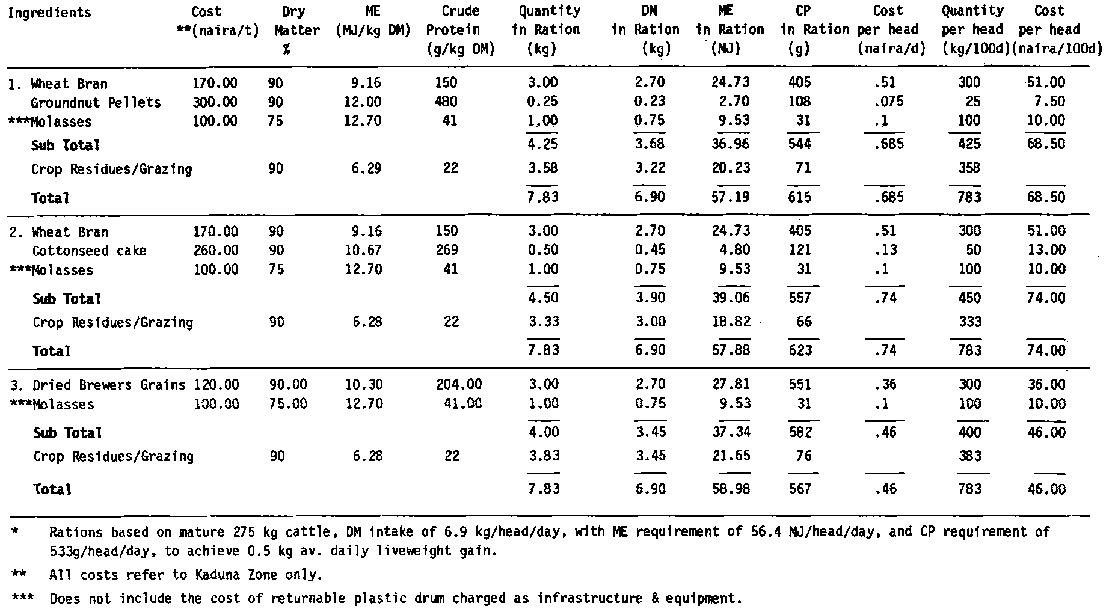
The actual supplementary feed rations vary according to the availability and cost of the ingredients. The 3 most common rations are shown in Table 1, and provide a daily allowance of 3 kg wheat offals or dried brewers grains and 1 kg molasses, and may use groundnut or cottonseed cake. The ration using dried brewers grains and molasses is considerably cheaper, but unfortunately its use is limited by the present low availability of dried brewers grains.
It has proved very difficult to obtain reliable information on the actual liveweight gains achieved; the cattle are weighed at purhcase, but only rarely has it been possible to achieve reliable sale weights. However, from the liveweight gains achieved by two groups of cattle in NE Nigeria (Table 2) it seems reasonable to assume that the target daily liveweight gain of 0.5 kg has been achieved. In view of the gains acheived in the first periods of fattening (Table 2) it seems possible that if the standard fattening period was reduced to 100 days, gains approximating 0.7 - 0.8 kg/d might be achieved, with the added advantage of rendering two fattening cycles per year feasible. Further close study of feed utilization and cattle gains is presently being conducted in Kaduna State.
Wheat Offals
The present practice in Nigeria is to market one product, a combination of weatings and wheat bran containing approximately 10 MJ metabolisable energy and 150 crude protein per kg dry matter. Wheat offals are generally widely available and cost about N 140 per tonne; a considerable quantity is also exported, but this material constitutes a major ingredient of LPU's cattle fattening rations, particularly as dried brewers grains are not readily available in Northern Nigeria.
Cottonseed cake
In 1975, 125,000 tonnes of cottonseed were purchased for processing, whereas in 1983 only 11,946 tonnes of cottonseed were available, producing only 6,081 tonnes of cake. In 1978 the average price per tonne was N50, and is now N 300. The approximate energy and protein values are 11.0 MJ ME and 269 gm crude protein per kg dry matter. Its use in monogastric rations is restricted due to the presence of gossypol, but it is widely used and well accepted by cattle and sheep. It was first used in 1962/63 for supplementary feeding of cattle to reduce mortality and weight loss during the dry season (Anon 1962/63). Initially the quantities used were small but gradually increased, until during the Supplementary Feed Programme 1970-75, a total of 22,488 tonnes were used for dry season supplementation (Anon 1975). The main constraints to the present and future use of cottonseed cake are its declining production and escalating price.
Table 1. Examples of Nigerian Smallholder fattening rations* (Data from LDP: LPU)
Table 2. Two examples (A + B) of cattle liveweight gains in smallholder fattening enterprises in north eastern Nigeria.
|
|
A |
B |
||||
|
Period 1 |
Period 2 |
Total |
Period 1 |
Period 2 |
Total |
|
|
No. of |
||||||
|
Cattle |
|
53 |
|
|
61 |
|
|
Total gain (kg) |
3515 |
1550 |
5065 |
4156 |
2300 |
6456 |
|
Total cattle fattening days |
4127 |
4053 |
8180 |
5135 |
5266 |
10419 |
|
Mean fattening period (days) |
77.87 |
76.47 |
154.34 |
84.48 |
86.33 |
170.80 |
|
Mean liveweight gain (kg/d) |
0.85 |
0.38 |
0.62 |
0.81 |
0.44 |
0.62 |
Groundnut cake
In 1974, 450,000 tonnes of groundnuts were purchased for processing, whereas in 1983, less than 20,000 tonnes were purchased, a potential of less than 10,000 tonnes of groundnut cake. In 1978, the average price per tonne was N 220, but is now N 600. The approximate energy and protein values are 12 MJ of ME, and 486 gm of crude protein per kg dry matter. This also has been used for dry season supplementation since 1962/63, although in smaller quantities; during the 1970-75 supplementary feed programme only 4,568 tonnes were used (Anon 1975). It was also used as a protein ingredient in the cattle fattening rations during the First Livestock Development Programme. Unlike cottonseed cake, it can also be used for monogatric nutrition, and thus is widely used in compounded feeds for pigs and poultry. The main constraints to its use are availability and price; other factors influencing its use are high oil content and the aflatoxin level, which can become unacceptably high, if the groundnuts are of poor quality, or badly stored.
Palm Kernel Meal
In 1974, 293,000 tonnes of palm kernels were purchased for processing, and in 1983, 173,000 tonnes were purchased, of which 85,000 tonnes were exported, the remainder being processed, producing 47,300 tonnes of palm kernel cake/pellets. The approximate energy and protein values are 12 MJ of ME and 207 gm crude protein. Its use to date has been limited, due to its alleged unpalatability, and at present the bulk (75%) of this product is exported.
Molasses
There are two sugar cane processing factories in Nigeria, the Nigerian Sugar Company at Bacita, in Kwara State, and Savannah Sugar Company at Numan, in Gongola State. The Nigerian Sugar Company sells the bulk of its molasses for the distillation of alcohol, but estimates that there could be up to 3,000 tonnes available for animal feeding during 1984-1985; their present price is N 60 to N 65 per tonne. The Savannah Sugar Company is prepared to sell all its molasses for animal feeding; in previous years production varied from 7,000 to 10,000 tonnes. Although no molasses was produced during 1983-1984, the 1984-1985 production was estimated at 10,000 tonnes. Prior to October 1983, the price was N 15 per tonne, and is now N 45. The approximate energy and protein values of molasses are 12.7 MJ of ME and 41 gm of crude protein per kg dry matter. It is a cheap source of energy, has the further benefit of being extremely palatable, and is frequently used to encourage the intake of other less palatable feeds. It can be fed to all livestock, but due to its laxative effect, inclusion rates should not exceed 10% for poultry, and 20% for pigs; this rate is also recommended for cattle and sheep, but under certain systems this can be exceeded (Preston & Willis 1970; Preston 1972). The main constraint to the use of molasses, apart from its laxative effect, is the high cost of transport, and handling problems in actually getting the molasses to the smallholder.
Dried Brewers Grains
At present, the annual production of dried brewers grains in Nigeria is just under 10,000 tonnes, the approximate energy and protein values are 10.3 MJ ME and 204 gm of crude protein per kg dry matter. The cost per tonne varies from N 45 to N 120. At present only 20% of the available brewers grains is being dried. Apart from availability, the main constraint to the use of dried brewers grains is transport; the majority of Nigeria's breweries are in the South, whereas the cattle are in the North. This can involve distances of up to 1400 km which greatly increases the cost to the farmer.
Rice Bran
Until recently, the bulk of Nigeria's rice was milled locally, and the quantities available have been small and scattered. The Nigerian Grains Board is now responsible for the majority of rice milling and by 1985 expected to have 6,000 tonnes of rice bran available for sale. The approximate energy and protein values of a recent sample were 10.8 MJ ME and 140 gm of crude protein per kg. High fibre content limits its use by mongatric animals, but it can be utilized by ruminants. The major constraint is the high oil content which limits its storage life; stabilising is required, further adding to costs.
Crop Residues
The major crop residues are maize, sorghum and rice straw; smaller quantities of millet straw are also available. These have traditionally been used by Nigeria's pastoralists, the cattle and sheep being allowed to graze on the crop residues, in return for the manurial value of their dung. However, sorghum straw in particular contains a far higher proportion of lignin than the temperate cereal straws, which reduces its nutritive value and also the actual dry matter intake by the cattle.
Small scale treatment of maize and sorghum straw with urea, an adaptation of the ammonification of rice straw using urea (Saadullah et al 1981) has been initiated in Kano (W.B. Ritchie unpublished data). The sorghum stover was placed in a polythene lined pit and 5% urea added (1 kg urea in 10 litres of water per 20 kg sorghum straw); when full the pit was sealed for 20 days. This treatment increased the crude protein content of the sorghum straw from 2.2% to 11.9%, increased its digestibility and estimated ME value, and the voluntary intake of the treated straw was greater than that of untreated straw.
The various by-products presently available have been compared on the basis of costs per unit ME and crude protein (Table 3). Palm Kernel meal and dried brewers grains are the cheapest sources of crude protein, and molasses, palm kernel meal, and dried brewers grains are the cheapest sources of ME. However, palm kernel meal is mainly exported, while the total annual production of dried brewers grains is less than 10,000 tonnes. Thus the by-product with the greatest potential is molasses, especially in close proximity to the Savannah Sugar Company where transport costs will be lower. There is also scope for an increased use of wheat offals, in that exports could be reduced, although the price is rapidly escalating. Millers now sell wheat offals for the same price as they pay for imported wheat. The traditional protein supplements, cottonseed cake and groundnut cake also are rapidly becoming prohibitively expensive.
Dried Brewers Grains
Present production is approximately 10,000 tonnes per annum, and a survey of breweries indicates that a further 28,600 tonnes could be produced by those breweries that indicated an interest in drying their spent grains. This quantity could provide sufficient feed, if fed at 3 kg per head for 100 days, to fatten an additional 95,333 head of cattle, with a potential liveweight gain of 6,673,333 kg, and a potential saleable meat production of 6,000 tonnes. If eventually the other breweries also dried their spent grains, the additional 12,000 tonnes would help to produce a further 2,500 tonnes of saleable meat. This appears to justify Government intervention, to ensure that this valuable by-product is made more available as a livestock feed (Adegbola 1976).
Palm Kernel Meal
This probably has a potential for increased use second to that of dried brewers grains. Reports from Latin America (Chico & Shultz 1976) indicate that palm kernel meal can be used for ruminants, and that up to 2-3 kg per head can be fed to cattle. It is almost certain that its reputation for unpalatability is unjustified and that its present and previous under-utilization has been due to the earlier availability and low cost of cottonseed cake and groundnut cake. Further research into its use in Nigeria is certainly warranted.
Molasses
There is considerable scope for an increased use of molasses firstly as a liquid feed and secondly as an important constituent of a molasses/urea feed. A prototype mineralized molasses/urea feed has been produced, further improvements are required, and a decision will have to be made as to whether to produce a feed block, or pellets, or both. It is important to restrict the intake of urea to less than 100 g per head per day for cattle, and to less than 10 g per head per day for sheep. This is usually done by limiting intake by the degree of hardness of the block, but it could also be done by restricting the intake of pellets. It must be remembered that this molasses/urea feed is only suitable for ruminants and cannot be fed to monogastric animals. However, it could be safely fed to cattle and sheep as a partial substitute for cottonseed cake and groundnut cake, and at half the cost per 100 g crude protein (Table 3). If this feed can be successfully produced and marketed as a mineralised molasses/urea block or pellet, it would have a tremendous effect on Nigeria's cattle production and reproduction.
Table 3. Costs of by-products in Kaduna, per unit of metabolisable energy (ME) and of crude protein (CP).
|
|
COST PER TONNE IN KADUNA |
DRY MATTER PERCENTAGE |
ME MJ/kg DM |
CP (g/kg DM) |
COST PER KG DRY MATTER |
COST PER 10 MJ |
COST PER 100 g CP |
|
Palm Kernel Meal |
140.00 |
90 |
12.20 |
207 |
0.16 |
0.13 |
0.08 |
|
Dried Brewers Grains |
120.00 |
90 |
10.30 |
204 |
0.13 |
0.13 |
0.07 |
|
Wheat Bran |
170.00 |
90 |
10.10 |
150 |
0.19 |
0.19 |
0.13 |
|
Cotton Seed Cake |
330.00 |
90 |
11.00 |
269 |
0.39 |
0.33 |
0.14 |
|
Groundnut Pellets |
630.00 |
90 |
12.00 |
486 |
0.70 |
0.58 |
0.14 |
|
Molasses (only) |
100.00 |
75 |
12.70 |
41 |
0.13 |
0.10 |
0.33 |
|
Rice Bran (proposed) |
90.00 |
90 |
10.80 |
140 |
0.10 |
0.09 |
0.07 |
|
Sorghum Crop Residue |
0.00 |
89 |
6.28 |
22 |
0.00 |
0.00 |
0.00 |
|
Treated Sorghum Crop Residue |
0.00 |
85 |
7.50 |
120 |
0.00 |
0.00 |
0.00 |
|
Dried Brewers Grains |
80.00 |
90 |
10.30 |
204 |
0.09 |
0.09 |
0.04 |
|
Mineralised Molasses/urea feed* |
250.00 |
80 |
7.76 |
220 |
0.31 |
0.40 |
0.14 |
|
Mineralised Molasses/urea feed** |
150.00 |
80 |
4.50 |
225 |
0.19 |
0.42 |
0.08 |
* Using wheat bran
** Using ground maize cobs
Rice Bran
An estimated 6,000 tonnes are available annually as a potential livestock feed, providing that it can be effectively stabilised. If then fed as a supplement, at 3 kg per head per day together with 1 kg of the mineralised molasses/urea feed, similar liveweight gains to those achieved on dried brewers grains and molasses might be achieved, i.e. 0.7 - 0.8 kg liveweight gain per head per day. Thus the 6,000 tonnes of rice bran would help to provide sufficient feed to fatten an additional 20,000 cattle, representing a potential incremental meat production of 1,260 tonnes of saleable meat.
Wheat Offals
In order to make more locally produced feed available for poultry and pig production, the flour millers should be encouraged to separate the wheat offals into "weating" and wheat bran. The weatings could then be used for pigs and poultry, and the wheat bran would still be available for cattle and sheep. In addition the millers should be encouraged to make these products available to Nigeria at a reasonable price, rather than to export them as they are doing at present.
Dried Brewers Yeast
Present production is approximately 400 tonnes per annum, and this could be increased to at least 2,500 tonnes if the potential production could be achieved. This would represent a saving of 2,000 tonnes in the annual imports of protein concentrates for poultry and pig feeding.
If as discussed above, more breweries were persuaded to dry their spent grains, only the prior separation of the yeast from the grains would be required.
Cottonseed cake and Groundnut cake
Both these products are over-priced at present, largely because oil seed processing capacity vastly exceeds the availability of cottonseed and groundnuts for processing. If the Nigerian Cotton Board and the Nigerian Groundnut Board can take steps to ensure a higher production of cottonseed and groundnuts processing costs would be reduced, which might lead to a reduction in the selling price of cottonseed cake and groundnut cake.
Crop Residue
These are on the whole being utilised, but there is considerable scope for more effective utilisation. The treatment of crop residues by ammonification using urea, initiated by the Kano Agricultural and Rural Development Project, should be replicated in other project areas where the necessary extension supervision is available. There are at present 13 Agricultural Development Projects and 11 River Basin Rural Development Projects in Nigeria, the main aim of which is to increase crop production. If this crop residue can be successfully treated using urea, the resulting increases in digestibility, crude protein and metabolisable energy could well benefit animal production.
Dry Season Supplementation
Most of Nigeria's estimated 9.3 million cattle are located in the Northern States and experience a dry season at least of five to six months duration, during which the poor quality feed produces weight loss which is often severe. Reduced fertility and increased mortality are common, and these effects can be alleviated by dry season supplementation. There are approximately 8 million cattle in Northern Nigeria, at least 3 million of these are breeding cows, their present calving percentage approximates 45%, overall herd mortality about 7%, and calf mortality 20%. If dry season supplementation were made available to those breeding cows, it is quite possible that calving percentage could increase to 50% (a potential increase of 150,000 calves), herd mortality could be reduced to 5%, (a potential saving of 60,000 breeding cows) and calf mortality could be reduced from 20% to 10% (a potential saving of 150,000 calves). In addition to the above savings, it would also be reasonable to expect heavier weaning weights. Thus although more difficult to quantify, the benefits from dry season supplementation could be far greater and longer term than those from cattle fattening.
Due to the ever increasing cost of supplementary feed in recent years, the ILCA sub-humid team has introduced the fodder bank concept, a protected area of protein rich forage, usually of Stylosanthes spp., kept as a reserve for dry season grazing by selected animals. ILCA and LPU have successfully introduced this fodder bank method of supplementation to settled and semi-settled pastoralists in Kaduna State, and are now monitoring its introduction to other Northern States. One of the most acceptable methods of establishment is to undersow a cereal crop with Stylosanthes seed, since the farmer, having cleared the land, wishes to crop it before using it as a fodder bank. This has the additional advantage of increasing the integration of crops and livestock, and increases the value of the crop residue.
There is tremendous scope for an increased and more efficient utilisation of agro-industrial by-products and crop residues which will result in a significant increase in animal production. Dried brewers grains alone could cater for an annual increase of over 8,000 tonnes of beef, which would help both to reduce Nigeria's animal protein deficit and reduce imports. Further increases would be made possible by an improved utilisation of palm kernel meal and rice bran, and also from an increase in the urea treatment of crop residues.
This paper has concentrated on the use of by-products and crop residues for small-scale ruminant fattening, but they can also be used for dry season supplementation, although the benefits of this are more difficult to quantify. If they were used also for intensive or feed-lot fattening, such production established in close proximity to the major feed sources would result in considerable reduction in feed costs. The by-products and methods of utilisation described in this paper are not specific to Nigeria, they are found and can be applied throughout the tropical world.
Adegbola A. A. Utilisation of Agro-Industrial By-Products in Africa (1977). New Feed Resources, FAO.
Anon. 1962/63 Annual Report, Veterinary Division, MANR, Northern Nigeria.
Anon. 1975 FLD Livestock Feed Study Report. Chico and Shultz, 1977. New Feed Resources, FAO.
Ogunfowora et al. (1975). Livestock Feed Study Report for Federal Livestock Department, Kaduna, Nigeria.
Preston T.R. and Willis M.B. 1970. A new look at Molasses for Livestock Feeding. Feedstuffs 42: 20.
Preston T.R. 1972. Molasses as the Major Energy Source for Beef Cattle. World Animal Review Nutritional Diet et (ea. Bourne GH).
Saadullah et al. 1981. Tropical Animal Production 1981 6: 30-36.