


Thomas L. Nordblom
Farm Resource Management Program, International Center for Agricultural Research in the Dry Areas (ICARDA), P.O. Box 5466, Aleppo, Syria
Introduction
Joint products of cropping
Shock absorbers for farming systems
Crop residues for livestock
Aggregate livestock and residues
References
Discussion
The importance to farmers of crop residues for feeding ruminant livestock has long been neglected, if not falsely maligned, by scientists who define their success only in terms of grain yield per hectare. The error in this neglect is proven when a farmer rejects an "improved" cultivar because of its clearly inferior straw quality.
This paper argues that we are really dealing with joint products of cropping in North Africa and West Asia, rather than simply incidental residues. Ruminant livestock add value to and stabilize many farming systems by providing means for storing wealth and for marketing large parts of the farm's crop residues.
High-quality crop residues are in short supply in this region. Well-directed plant breeding, in collaboration with animal nutritionists, may be the surest and most economical path to enhance these important feed resources: new cultivars which, from the farmers' viewpoint, are truly "improved".
The farming systems approach to research requires us to look at problems and evaluate possible solutions from the viewpoints of farmers. In much of North Africa and West Asia, when farmers sow their crops they expect to get feed for their livestock at harvest (and sometimes before), and this expectation is clearly part of the reason for growing the crop and managing it in the ways they do.
In economic terms, the livestock feed and the grain are considered by many farmers as "joint products." In some cases, from the farmers' viewpoint, the market value of the harvested straw from a field equals the value of the grain: e.g. lentil straw in Syria (Nordblom and Halimeh, 1982), and wheat straw in Egypt (Sallam et al, 1986). These are, of course, not representative of all straws in all countries: the point is that grain is neither the only, nor always the main, reason for growing a crop in this region.
One would like to have a simple term that captures the sense of "all those joint-products of cropping which go for livestock feed and which are not grain." Finding no such word, I will stick to "crop residues for livestock." This recognizes that other greater or lesser proportions of the non-grain biomass are shattered, trampled, ploughed under or burned in the field, hauled away for use as fuel, in manufacturing (e.g. for paper or press board) or for animal bedding.
There is even competition between use of crop residues for livestock versus their use to maintain soil organic matter balances and stabilize crop productivity, particularly where soil erosion is a threat (Anderson, 1978). This has been flagged as a serious problem in the drier farming areas of Syria where the livestock have been winning the competition and the soils losing (Jaubert and Oglah, 1985). Organic-matter levels in these soils, after many years of almost complete removal of crop biomass, are very low (Cooper et al, 1987). Research is now underway at ICARDA to determine the effects of various stubble management and tillage practices on soil structure and stability. Water infiltration rates and water-holding capacities are aspects of special interest. Control of erosion and sustained levels of productivity are the goals. Even though standing stubbles can be sold for grazing, the loss of some of these fees may be more than compensated by long-term sustainability of crop production if stubbles can be managed to the soil's best advantage.
The somewhat derogatory terms, "crop residue" and "agricultural waste" must have originated in the temperate climates of northern Europe and the British Isles. In a review of alternative practical methods for exploiting cereal straws, as fuel, feed and fertilizer, Staniforth (1982, p. 1) stated that:
the use and disposal of a huge and growing surplus of straw presents British agriculture with one of its most serious problems.
It is easy to understand this European perspective on crop residues as an over-abundant obstacle to clean tillage and clean air. Crop residues are often difficult to deal with: scattered over the fields after harvest, they are invariably bulky, awkward and costly (per unit of weight or value) to collect, transport and store.
In a global review of potential uses of crop residues as animal feeds, Kossila (1985) pointed out that countries with the highest ratios of "grain eating" to "grass eating" livestock also tend to have the highest productions of fibrous crop residues relative to numbers of "grass eaters." In Europe, "grain eaters" (in 1981) amounted to nearly 34% of total livestock units; in contrast, for the majority of Middle Eastern countries, "grain eaters" comprised less than 5% of total animal units (Kossila, 1985, pp. 5 and 8)
In drier and warmer rainfed farming areas of North Africa and West Asia, farmers' perspectives on crop residues are often fundamentally different from those in Europe. Here, crop residues are seen by farmers as highly desirable joint products of cropping. Cropping intensities (and crop yields) in these rainfed systems are low, with gaps of several months between harvest of one crop and sowing of the next. This often coincides with the rainless summer months, affording considerable flexibility in handling crop residues in the field and allowing time for this to be done by labour-intensive methods, using labour of low opportunity cost (i.e. of women and children).
As in Europe, however, crop residues in this region are bulky and expensive or impossible to transport (e.g. stubbles). These materials are always cheapest in the places where they are produced. The demand for their use as livestock feeds is derived from the demand for animal products and the other reasons farmers maintain livestock. The existence of abundant crop residues can create an economic niche for ruminant livestock in the area.
Several cases of "joint products," which are not strictly "after harvest residues," should be mentioned because they are part of the bioeconomic context. When Pakistani farmers sow wheat, they expect to take two or more hand-cuttings of the vegetative growth for livestock feed before allowing the grain crop to mature (ICARDA, 1987, p. 18). In northeast Syria, barley crops in the green stage are grazed by sheep in winter, then allowed to mature to produce grain and straw (Nordblom, 1983a). In Egypt maize leaves are stripped from plants before harvest (Soliman et al, 1985). There is also the flexibility to use grazing ruminants to harvest a poor crop in a year when rains fail, where the expected value of the harvested crop, minus the harvesting cost, is less than the value of the crop for direct grazing (Nordblom, 1983b; Mazid and Hallajian, 1983). This practice is widespread in northern Syria (Somel et al, 1984) and southeast Turkey (Yurdakul et al, 1987), with the proportions of farmers doing this varying from district to district and from year to year, depending on crop and pasture growth and on cost/price conditions.
Often there are distinct tradeoffs between the options-green forage, grain and crop residues following harvest-in terms of quantity, quality and time of availability (Miller et al, 1979, p. 40).
Ruminant livestock provide the only means to capture economic value from many pasture resources and crop residues. They are flexible in dietary inputs and levels of output performance, in terms of fertility and rates of milk and meat production. They are mobile and may be trekked to the various grazing sources where and when they are cheapest: around the farm, to the roadsides, to native pastures etc. Their flexibility includes the important capacity to gain weight when feed is good and cheap, then metabolise the stored fat to survive periods when feed conditions are poor.
The ability of ruminants to utilise many combinations of pasture, crop residues and concentrate feeds, and to accept changes in these through the seasons of the year and between years, is a great advantage. This allows farmers to use the cheapest available feeds consistent with desired performance. At many sites, these combinations alter from year to year as conditions change (Mazid and Hallajian, 1983; Nordblom, 1983a and 1983b; Mazid et al, 1984).
The key role of crop residues is in the maintenance diets of breeding stock: diets for lactation or work require higher energy concentration, as do fattening diets. In Syria, for example, crop residues form the main diet of breeding sheep flocks, with concentrate feeds (mainly barley grain) added at lambing and during lactation (Jaubert and Oglah, 1985; Nordblom and Thomson, 1987; Nordblom, 1987; Thomson, 1987).
When prices for slaughter animals or dairy products are high relative to grain prices, farmers are tempted to increase livestock production by adding grain to the diet. For the farmer, grain in fattening and dairy diets can be highly economical (Brokken et al, 1980; Heady and Bhide, 1984) and because of the demand for grain by dairy and fattening enterprises, surplus grain production and storage capacity is encouraged, often well beyond that needed for direct human consumption.
When grain for human consumption is in short supply, reflected in high prices relative to dairy products and meat, livestock diets may be shifted towards lower energy maintenance levels and away from grains. In emergencies, central governments may intervene to accelerate this shift. Livestock may also be sold for slaughter or for transport to areas with cheaper feed. Thus, the grain that would have gone to produce high value meat or dairy products can be diverted quickly to direct human consumption, serving a crucial role for human survival in emergencies (Sarma, 1986, p. 50). The crop residues which are jointly produced with the extra crop areas add to the ease with which grain can be diverted rapidly from livestock to human consumption.
Among the world's developing regions, North Africa and the Middle East have the highest projected growth rate (6.1% annually) in the use of major food crops as livestock feed. Human consumption of base staples is expected to grow by only 2.5% annually to the turn of the century, just less than the projected rate of population growth: livestock and poultry are expected to take larger shares of per caput use of base staples as higher incomes are achieved (Paulino, 1986, p.40). According to Sarma and Yeung (1985, p. 57) demand for feed and fodder will increase rapidly in the coming decades, encouraging more intensive land use and more efficient use of crop residues.
Finally, livestock often serve as the store of farmers' wealth: liquid, mobile, prestigious and more secure than other forms of savings in many parts of the region. The combined flexibilities of ruminant livestock, recognized since antiquity, means they serve as reliable "shock absorbers," to provide important physical and economic cushioning, thereby stabilizing and enriching the quality of life in many farming systems. It is in the context of such integrated use of ruminants in farming systems that we consider the importance of crop residues in North Africa and West Asia.
A basic problem in the study of national or regional feed trends is the lack of reliable data on feed use (Sarma, 1986, p. 513. This is particularly true of most crop residues and of grains which are fed on the farms where they are grown and never enter the market. Because they are mobile and a key store of wealth for farmers in this region, livestock are notoriously difficult to count with confidence. These facts mean one must make a number of assumptions about the national aggregations of livestock numbers, and national aggregations of diverse classes of crop residues, in order to present a simple picture of the use of these feed resources. This section of the paper is devoted to those assumptions.
A simple picture is necessarily abstract and incomplete: in this case, the list of omissions may be longer than that of inclusions. To begin with, only 15 countries of the region have been selected for discussion: Afghanistan, Algeria, Egypt, Ethiopia, Iran, Iraq, Jordan, Libya, Morocco, Pakistan, Saudi Arabia, Sudan, Syria, Tunisia and Turkey; these were arbitrarily chosen by the author only to illustrate some of the general tendencies.
Only sheep, goats and cattle have been selected for review in this paper. Inevitably this has resulted in missing some important classes of livestock (e.g. buffaloes in Egypt and Pakistan, camels in Sudan etc), but these three classes are found in large numbers in all 15 countries and offer grounds for rough comparisons. Data on livestock numbers, by country for 1965 and 1985, were taken from the FAO Production Yearbook. An arbitrary weighting scheme was used to aggregate "animal units" in each country: one "animal unit" equals one cow or five sheep or five goats. The result (Appendix 1) is a very gross indicator of comparable "animal units" for each country in 1965 and 1985.
The crops producing "residues for livestock" are likewise numerous. Ten crops were chosen for discussion purposes-wheat, barley, rice, maize, sorghum and millet (as one), sugar-cane, sugar beets, lentils, faba beans and cotton-since these are the main sources in this region. What is wanted here is a gross indication of dry matter quantities of the various residues offered to livestock, not simply the total quantities produced.
Beginning with the national crop statistics published in the FAO Production Yearbook series, a number of assumptions are needed in order to estimate the amounts of crop residues for livestock grazing and feeding. The assumed multiplication factors (applied in Appendix 2), for the 10 classes of crop residues are explained below:
WHEAT: Beginning with a harvest index of 47 (grain is 47% of the above-ground biomass), and considering burning, trampling, shattering and handling losses, it is assumed that only 0.8 kg of wheat straw and chaff is offered to livestock for each kilogram of wheat grain harvested.
BARLEY: With a harvest index of 41, it is assumed that 1.2 kg of residue is offered to livestock for each kilogram of barley grain harvested. This allows for some field losses but considers that barley straw is more fully used than wheat straw, partly because barley is grown in drier areas where feed is in shorter supply relative to livestock numbers.
RICE: Rice has a similar harvest index to barley, but lower feed value than barley straw (much rice straw is used for bedding, fuel and paper manufacture). It is assumed that only 0.6 kg of rice straw and chaff is fed for each kilogram of rice grain harvested.
MAIZE: Leaf stripping for fodder and use of the best parts of harvest residues by livestock amount, it is assumed, to only 2 kg of dry matter for each kilogram of maize grain harvested. The tough lower stalks are used for fuel.
SORGHUM AND MILLET: The ratios of grain to total above-ground biomass are taken to be about 1 to 6 for both crops. Given that the poorer part of the stover is used for fuel, the dry-weight ratio of residues fed to grain harvested is assumed to be only 3 to 1.
SUGAR-CANE: It is assumed that only one kilogram of sugar-cane residue dry matter (stripped leaves and bagasse) is offered to livestock for every 10 kg of raw cane harvested. This considers that about 60% of the bagasse is used for fuel in the sugar mills (Ensminger and Olentine, 1978).
SUGAR-BEET: The tops are normally grazed by livestock after the beets are harvested, amounting to about 30 g dry-weight for every kilogram of raw beets. About 1 kg DM of beet pulp goes to livestock feeding for every 15 kg of raw sugar-beet harvested. Therefore, total dry-weight residues for livestock feed (tops and pulps) are assumed to amount to only 0.1 kg for each kilogram of raw beet harvested.
LENTIL: Lentil crops are characterised by harvest indices-which increase with increasing seed yield; and in this region great care is taken in hand harvest of the crop to preserve the residues for livestock feed (Nordblom and Halimeh, 1982). For the sake of simplicity, however, it is assumed that 1 kg of lentil crop residue is available to livestock for each kilogram of seed harvested.
FABA BEANS: The residues of this crop are used for feed and fuel in this region (Salkini et al, 1982). Allowing that the tougher stem parts go for fuel, it is assumed the amount of faba bean leaf and stem dry matter used as feed equals the weight of seed harvested for human consumption.
COTTON: In this region, cotton seed and the leaves of cotton plants are important livestock feeds, and the woody stalks are used for fuel. It is assumed that the dry weight of leaves grazed, plus the amount of seed material fed to livestock, amount to 2 kg for each kilogram of cotton seed harvested.
Using these weighting factors, estimated amounts of "crop residues for livestock" were derived from the FAO data for each crop, for both 1965 and 1985; these are given in Appendix 2 as a service to those who do not agree with my weighting scheme. As is also the case in Appendix l, readers can find the original FAO estimates and make their own "corrected" aggregations.
The results of these gross aggregations of "animal units" (in millions of head) and of "10 crop residues for livestock" (in millions of tonnes) are given in Figure 1 and Table 1. Use of the arbitrary multipliers in deriving these results reduces any discussion of significant digits to a simple warning: anything beyond the first digit cannot be trusted. This is not a great worry for the present purpose since we find differences, in some cases, of two orders of magnitude between countries, and large shifts over time within countries: it was most convenient to plot these values on log scales.
One satisfying point in presenting such estimates is that all readers will be pleased in some way: those who are well informed on the crop-livestock relations in any of these countries will be pleased to attack my figures on solid grounds (1) of omitted classes of livestock and crop residues, (2) of the arbitrary weighting used in the aggregations, and (3) the inherent limitations of the data sources; these people and others may be pleased with the similarities found, across large and small agricultural sectors, in the indicated relations between livestock and crop residues for livestock.
Figure 1. Sheep, goat and cattle "animal units" and crop residues for livestock in selected countries of North Africa and West Asia 1965 and 1985.
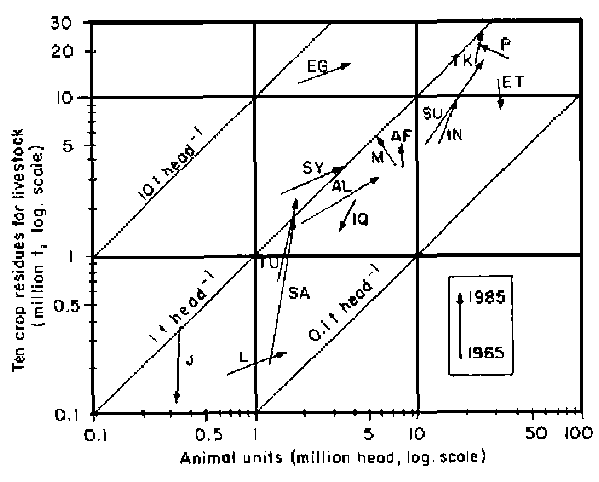
The diagonals crossing Figure 1 are lines of constant quantities of residues offered per animal unit, and succeeding diagonals differ by one order of magnitude: the upper of these represents 10 tonnes (t) of residue per animal unit, the middle diagonal is one tonne and the lower line is 0.1 t per animal unit. Although there were great differences between countries in absolute quantities of residues for livestock-and in livestock numbers, the relative quantities (t head-1) were remarkably similar in 1965 and 1985. The 15-country average was about 0.9 t head-1 in both 1965 and 1985, with the majority of countries showing increases in both crop production and animal inventories. Excepting Egypt, the 14-country averages were 0.6 and 0.7 t per head in 1965 and 1985, respectively, with standard deviations of about 0.3 t.
Table 1. Sheep, goat and cattle "animal units" (AU) and crop residues for livestock (CR) in selected countries of North Africa and West Asia, 1965 and 1985.
|
|
AU1 (head × 106) (A) |
CR2 (t × 106) (R) |
Residue per AU (t head-1) (R/A) | |||
|
Country |
1965 |
1985 |
1965 |
1985 |
1965 |
1985 |
|
Afghanistan |
8.1 |
8.4 |
4.1 |
4.8 |
0.5 |
0.6 |
|
Algeria |
2.1 |
6.0 |
1.6 |
2.9 |
0.8 |
0.5 |
|
Egypt |
2.1 |
3.8 |
12.1 |
15.8 |
5.6 |
4.1 |
|
Ethiopia |
34.0 |
34.2 |
12.2 |
9.0 |
0.4 |
0.3 |
|
Iran |
14.4 |
18.0 |
5.0 |
8.7 |
0.4 |
0.5 |
|
Iraq |
4.0 |
3.7 |
2.0 |
1.5 |
0.5 |
0.4 |
|
Jordan |
0.4 |
0.3 |
0.4 |
0.1 |
1.1 |
0.4 |
|
Libya |
0.7 |
1.5 |
0.2 |
0.2 |
0.3 |
0.2 |
|
Morocco |
7.5 |
5.9 |
3.3 |
5.6 |
0.4 |
1.0 |
|
Pakistan |
39.7 |
27.5 |
21.0 |
23.7 |
0.5 |
0.9 |
|
Saudi Arabia |
1.2 |
1.8 |
0.2 |
1.7 |
0.2 |
0.9 |
|
Sudan |
10.2 |
26.5 |
4.7 |
15.9 |
0.5 |
0.6 |
|
Syria |
1.7 |
3.7 |
2.5 |
3.5 |
1.5 |
1.0 |
|
Tunisia |
1.5 |
1.9 |
0.7 |
2.0 |
0.5 |
1.1 |
|
Turkey |
24.0 |
28.0 |
14.3 |
28.7 |
0.6 |
1.0 |
1. See Appendix l for details on livestock aggregation.
2. See Appendix 2 for details on aggregation of 10 residues.
The existence of some 1.5 million donkeys, 2.2 million buffaloes and 0.1 million camels, in addition to the sheep, goats and cattle, effectively doubles the number of animal units given for Egypt in Table 1. This would reduce the apparent quantities of crop residue used per animal unit, bringing them closer to, but still well above, those of the other 14 countries. On the other hand, availability of native pasture grazing in Egypt is very limited in comparison with that in most countries of the region. The chief forage crop in Egypt, berseem clover (Trifolium alexandrinum), and crop residues form the main diets of ruminant livestock.
Assuming that a 500 kg animal unit (such as a cow) consumes 2% of its body weight in dry matter each day, yearly consumption would be 730% of body weight, or about 3.6 t. If one compares this with our estimated regional average residue intake of 0.9 t per animal unit, we must account for the remaining two thirds of the diet with forage crops, grazing of native pasture and concentrates. Some proportion of the latter is potential human food, bid away in the market by lactating and fattening animals because it is profitable.
Considerable attention has been focused on ways to improve the use (intake and digestibility) of residues for livestock by combining these materials in diets with supplements or by treating them with chemicals (ARNAB, 1986; Doyle et al, 1986; El Shazly et al, 1983; Kategile et al, 1981; Kiflewahid et al, 1983; Wanapat and Devendra, 1985). The practical difficulties, human and animal health hazards and economics of chemical treatment of straws (with sodium hydroxide, ammonia, urea etc), are matters of concern.
It is clear that chemical treatments are most effective where farmers have good control over the processes and adequate facilities. Such conditions are unlikely for the great majority of the region's small farmers in the foreseeable future. Therefore, chemical treatments will not be a widespread solution for increasing the value of crop residues in livestock diets for most small farmers.
A bright spot, offering the potential for widespread improvement in straw values, appears in the practical possibilities for breeding and selection of plant cultivars which produce both good grain yields and more digestible crop residues, enabling their greater substitution for grains and native pastures in ruminant diets. This will require collaborative efforts of animal scientists and plant breeders. The reward will be low-cost seed, profitably adopted by small farmers because it satisfies their needs for feed and grain. Priorities for this research should be the major grains: barley, wheat and maize, sorghum and millet, and rice. The time has passed when we, in our plant breeding work, could afford to ignore a main cropping objective of farmers in this region: to produce feed.
Anderson D C. 1978. Use of cereal residues in beef cattle production systems. Journal of Animal Science 46:849-861.
ARNAB (African Research Network for Agricultural Byproducts). 1986. Towards optimal feeding of agricultural byproducts to livestock in Africa. Proceedings of a workshop held at the University of Alexandria, Egypt, October 1985. ILCA, Addis Ababa, Ethiopia.
Brokken R F. O'Connor C W and Nordblom T L. 1980. Costs of reducing grain feeding of beef cattle. Agricultural Economic Report 459. Economics, Statistics and Cooperatives Service, United States Department of Agriculture, Washington DC, USA.
Cooper P J M, Gregory P J. Tully D and Harris H C. 1987. Improving water use efficiency of annual crops in the rainfed farming systems of West Asia and North Africa. Experimental Agriculture 23:113-158.
Doyle P T. Devendra C and Pearce G R. 1986. Rice straw as a feed for ruminants. International Development Programme of Australian Universities and Colleges, Canberra, Australia.
El-Shazly K, Borhami B E, Soliman S M, Shehata M N and Abou-El-Einein O (eds). 1983. Utilization of low quality roughages with special reference to developing countries. Proceedings of a workshop held in Alexandria, Egypt, 14-17 March 1983. Faculty of Agriculture, University of Alexandria, Egypt.
Ensminger M E and Olentine C G. 1978. Feeds and nutrition - Complete. The Ensminger Publishing Company, 3699 East Sierra Avenue, Clovis, California 93612, USA.
FAO (Food and Agriculture Organization of the United Nations). FAO production yearbook. Various issues. FAO, Rome, Italy.
Heady E O and Bhide S. 1984. Livestock production functions. Iowa State University Press, Ames, Iowa, USA.
ICARDA (International Center for Agricultural Research in the Dry Areas). 1987. High-elevation research in Pakistan: The MART/AZRI project annual report for 1986. ICARDA-110en, ICARDA, Aleppo, Syria.
Jaubert R and Oglah M. 1985. Farming systems management in the Bueda/Breda subarea, 1983/84. Farming Systems Program Research Report No. 13. International Center for Agricultural Research in the Dry Areas, Aleppo, Syria.
Kategile J A, Said A N and Sundstøl F (eds). 1981. Utilization of low quality roughages in Africa. Proceedings of a workshop held at Arusha, Tanzania, 18-22 January 1981. Agricultural University of Norway, Aas, Norway.
Kiflewahid B. Potts G R and Drysdale R M (eds). 1983. By-product utilization for animal production. Proceedings of a workshop held at Nairobi, 26-30 September 1982. IDRC 206e. International Development Research Centre, Ottawa, Canada.
Kossila V L. 1985. Global review of the potential use of crop residues as animal feed. In: T R Preston, V L Kossila, J Goodwin and S B Reed (eds), Better utilization of crop residues and by-products in animal feeding: Research guidelines. 1. State of knowledge. Proceedings of the FAO/ILCA Expert Consultation held at ILCA, Addis Ababa, 5-9 March 1984. FAO Animal Production and Health Paper 50. Food and Agriculture Organization of the United Nations, Rome, Italy.
Mazid A and Hallajian M. 1983. Crop livestock interactions. Information from a barley survey in Syria. Report No. 10, Farming Systems Program, International Center for Agricultural Research in the Dry Areas, Aleppo, Syria.
Mazid A, Hallajian M, Somel K and Nordblom T L. 1984. The contribution of forage and fodder from barley crops in western Syria. RACHIS 3(1):17-19. International Center for Agricultural Research in the Dry Areas, Aleppo, Syria.
Miller S F. Bolton F E, Booster D E, Fitch J B. Jackson T L, Miller R F. Nordblom T L and Winward A L. 1979. Dryland agriculture in winter precipitation regions of the world: Status of the technical art. Dryland Agriculture Technical Committee, Office of International Agriculture, Oregon State University, Corvallis, Oregon, USA.
Nordblom T L. 1983a. Livestock-crop interactions: The case of green stage grazing. Discussion Paper No. 9. International Center for Agricultural Research in the Dry Areas, Aleppo, Syria.
Nordblom T L. 1983b. Livestock-crop interactions: The decision to harvest or to graze mature grain crops. Discussion Paper No. 10. International Center for Agricultural Research in the Dry Areas, Aleppo, Syria.
Nordblom T L. 1987. Farming practices in southern Idleb Province, Syria: 1985 survey results. ICARDA-107En. International Center for Agricultural Research in the Dry Areas, Aleppo, Syria.
Nordblom T L and Halimeh H. 1982. Lentil crop residues make a difference. LENS 9:8-10. International Center for Agricultural Research in the Dry Areas, Aleppo, Syria.
Nordblom T L and Thomson E F. 1987. A whole-farm model based on experimental flocks and crop rotations in northwest Syria. ICARDA-102En. International Center for Agricultural Research in the Dry Areas, Aleppo, Syria.
Paulino L A. 1986. Foods in the Third World: Past trends and projections to 2000. Research Report 52. International Food Policy Research Institute, Washington DC, USA.
Salkini A B. Halimeh H. Mazid A and Nordblom T L. 1982. National and farm level perspectives on faba bean production in crop-livestock systems in Syria, Egypt and Sudan. FABIS 4:5-8. International Center for Agricultural Research in the Dry Areas, Aleppo, Syria.
Sallam M S. Shaker M H Z. Abd-El-Wahab, A S A, Katab R A K M, El-Gamasy I M and Sayed A G E. 1986. Constraints facing productivity of wheat, and extension possibilities for improving its productivity, in both Sohag and Qena Governorates, Upper Egypt. Agricultural Extension and Rural Development Research Institute, Agricultural Research Center, Ministry of Agriculture, Cairo, Egypt.
Sarma J S. 1986. Cereal feed use in the Third World: Past trends and projections to 2000. Research Report 57. International Food Policy Research Institute, Washington DC, USA.
Sarma J S and Yeung P. 1985. Livestock products in the Third World: Past trends and projections to 1990 and 2000. Research Report 49. International Food Policy Research Institute, Washington DC, USA.
Soliman I M, Khafagi E A, Saleh Youssef M E, Hathout M K and Moussa A A. 1985. Farmers' responses to three summer forages in the Nile Delta. In: T L Nordblom, A K H Ahmed and G R Potts (eds), Research methodology for livestock on farm trials. Proceedings of a workshop held at ICARDA, Aleppo, 25-28 March 1985. IDRC-242e. International Development Research Centre, Ottawa, Canada. pp. 83-100.
Somel K, Mazid A and Hallajian M. 1984. Survey of barley producers, northern Syria, 1981/82. Research Report 12, Vol. III. Farming Systems Program, International Center for Agricultural Research in the Dry Areas, Aleppo, Syria.
Staniforth A R. 1982. Straw for fuel, feed and fertilizer? Farming Press Limited, Wharfedale Road, Ipswich, Suffolk, UK.
Thomson E F. 1987. Feeding systems and sheep husbandry in the barley belt of Syria. ICARDA-106En. International Center for Agricultural Research in the Dry Areas, Aleppo, Syria.
Wanapat M and Devendra C (eds). 1985. Relevance of crop residues as animal feeds in developing countries. Proceedings of an international workshop held in Khon Kaen, Thailand. Funny Press, 549/1 Soi Senanikom 1, Phaholyothim 32, Bangkok.
Yurdakul 0, Erkan O. Genc I, Bedestenci C, Kirtok Y and Direk M. 1987. Economics of barley production in the southeast Turkey. Cukurova University Publishing Center, Adana, Turkey.
Appendix 1. Sheep, goat and cattle numbers in selected countries of North Africa and West Asia, 1965 and 1985.
|
|
|
Sheep |
Goats |
Cattle |
AU1 |
|
Country |
Year |
1000 hd | |||
|
Afghanistan |
1965 |
19 000 |
3 200 |
3 674 |
8 114 |
|
|
1985 |
20 000 |
3 000 |
3 750 |
8 350 |
|
Algeria |
1965 |
5 000 |
1 642 |
731 |
2 059 |
|
|
1985 |
18 000 |
3 010 |
1 750 |
5 952 |
|
Egypt |
1965 |
1 855 |
787 |
1 609 |
2 136 |
|
|
1985 |
2 500 |
2 650 |
2 800 |
3 830 |
|
Ethiopia |
1965 |
24 951 |
17 991 |
25 370 |
33 958 |
|
|
1985 |
23 500 |
17 260 |
26 000 |
34 152 |
|
Iran |
1965 |
24 500 |
17 600 |
5 945 |
14 365 |
|
|
1985 |
34 500 |
13 600 |
8 350 |
17 970 |
|
Iraq |
1965 |
11 040 |
1 845 |
1 455 |
4 032 |
|
|
1985 |
8 500 |
2 350 |
1 500 |
3 670 |
|
Jordan |
1965 |
803 |
651 |
65 |
356 |
|
|
1985 |
990 |
500 |
35 |
333 |
|
Libya |
1965 |
1 461 |
1 339 |
109 |
669 |
|
|
1985 |
5 500 |
900 |
200 |
1 480 |
|
Morocco |
1965 |
15 150 |
7 500 |
3 000 |
7 530 |
|
|
1985 |
12 000 |
4 500 |
2 600 |
5 900 |
|
Pakistan |
1965 |
10 800 |
11 600 |
35 200 |
39 680 |
|
|
1985 |
25 037 |
29 726 |
16 549 |
27 502 |
|
Saudi |
1965 |
3 300 |
2 341 |
102 |
1 230 |
|
Arabia |
1985 |
3 800 |
2 454 |
540 |
1 791 |
|
Sudan |
1965 |
8 660 |
6 850 |
7 100 |
10 202 |
|
|
1985 |
19 000 |
13 500 |
20 000 |
26 500 |
|
Syria |
1965 |
5 075 |
818 |
508 |
1 687 |
|
|
1985 |
13 665 |
1 060 |
740 |
3 685 |
|
Tunisia |
1965 |
3 767 |
527 |
592 |
1 451 |
|
|
1985 |
5 220 |
940 |
620 |
1 852 |
|
Turkey |
1965 |
32 654 |
21 162 |
13 211 |
23 974 |
|
|
1985 |
40 391 |
13 100 |
17 300 |
27 998 |
Source: FAO Production Yearbooks 1967 and 1985.1. AU - animal unit - 1 cow or 5 sheep or 5 goats.
Appendix 2. Estimated crop residues (1000 t) for livestock in selected countries of North Africa and West Asia, 1965 and 1985.
|
Country |
Year |
Wheat |
Barley |
Rice |
Maize |
Sorghum & millet |
Sugar cane |
|
Afghanistan |
1965 |
1 826 |
456 |
228 |
1 440 |
- |
- |
|
|
1985 |
2 280 |
408 |
288 |
1 600 |
120 |
7 |
|
Algeria |
1965 |
1 058 |
455 |
2 |
8 |
3 |
- |
|
|
1985 |
1 320 |
1 554 |
1 |
2 |
9 |
9 |
|
Egypt |
1965 |
1 280 |
156 |
1 117 |
4 282 |
2 418 |
474 |
|
|
1985 |
1 499 |
180 |
1 387 |
7 964 |
1 950 |
914 |
|
Ethiopia |
1965 |
235 |
964 |
- |
1 460 |
9 180 |
75 |
|
|
1985 |
560 |
1 200 |
- |
2 800 |
3 600 |
170 |
|
Iran |
1965 |
2 400 |
1 200 |
507 |
28 |
54 |
25 |
|
|
1985 |
4 800 |
1 980 |
660 |
100 |
135 |
215 |
|
Iraq |
1965 |
804 |
968 |
119 |
8 |
18 |
- |
|
|
1985 |
520 |
840 |
63 |
64 |
9 |
9 |
|
Jordan |
1965 |
222 |
114 |
- |
- |
30 |
- |
|
|
1985 |
80 |
36 |
- |
- |
- |
- |
|
Libya |
1965 |
46 |
115 |
- |
2 |
6 |
- |
|
|
1985 |
119 |
96 |
- |
2 |
15 |
- |
|
Morocco |
1965 |
1 052 |
1 427 |
10 |
544 |
27 |
- |
|
|
1985 |
1 920 |
2 520 |
6 |
560 |
69 |
78 |
|
Pakistan |
1965 |
3 700 |
156 |
10 677 |
1 086 |
1 110 |
2 500 |
|
|
1985 |
9 280 |
193 |
2 700 |
2 060 |
1 560 |
3 214 |
|
Saudi |
1965 |
118 |
38 |
2 |
- |
45 |
- |
|
Arabia |
1985 |
1 360 |
14 |
- |
8 |
285 |
- |
|
Sudan |
1965 |
45 |
- |
1 |
24 |
4 041 |
19 |
|
|
1985 |
63 |
- |
4 |
80 |
14 487 |
480 |
|
Syria |
1965 |
834 |
828 |
1 |
12 |
132 |
- |
|
|
1985 |
1 371 |
1 244 |
- |
126 |
27 |
- |
|
Tunisia |
1965 |
416 |
216 |
- |
- |
15 |
- |
|
|
1985 |
1 120 |
823 |
- |
- |
18 |
- |
|
Turkey |
1965 |
6 904 |
3 960 |
130 |
1 890 |
180 |
- |
|
|
1985 |
13 626 |
7 800 |
159 |
3 800 |
45 |
- |
|
Factors1 |
0.8 |
1.2 |
0.6 |
2.0 |
3.0 |
0.1 |
|
1. Data on crop yields from FAO Production Yearbooks 1967 and 1985 were multiplied by these factors to derive these estimates.
McDowell: The livestock units that can be maintained on a given quantity of roughage depends on the grazing behaviour of the animal species involved. You have given a factor of 8 to 10 sheep per livestock unit, but on the basis of grazing behaviour a factor of 5 would be more appropriate with a factor of 3 for goats.
Nordblom: This shows that small ruminants are less efficient. If the weight of 500 kg cow is converted to metabolic body weight it is equivalent to only five 50 kg sheep.
Fussell: We have observed in Niger that despite a 50% increase in the availability of crop residue, animal population increased by only 13%. It seems that the usefullness of crop residues as feed is low because the nutritive value of pasture is greater.
Nordblom: It cannot be said that animals are present because crop residues are available or, conversely, that crops are grown to provide residues for animals. Nevertheless the two are somehow associated.
