Vappu Kossila
Institute of Animal Production, Finnish Agricultural Research Centre, SF-31600 Jokioinen, Finland
Introduction
Methods
Results
Conclusion
References
Discussion
The need to improve utilisation of crop residues in developing countries has received considerable attention in recent years, but there have been few studies on the availability of fibrous crop residues in relation to their potential for feeding livestock. The availability of crop residues is closely related to the farming system, the crop produced and the intensity of cultivation. The potential for use of crop residues as livestock feed is greatest in integrated crop/livestock farming systems. Where crop and livestock production are segregated, most crop residues are wasted. Crop residues are also wasted or used for non-feed purposes in many smallholder crop/livestock systems in developing countries.
In this study the amounts of crop residues (not including agro-industrial byproducts) available on farm have been estimated. Fibrous crop residues from cereals (straw, hulls, husks, cobs, awns, chaff etc) are the most important. Their use as livestock feed is limited mainly to ruminants. More detailed presentations of the methods used and global data are presented elsewhere (Kossila, 1984; Kossila, 1985).
The following procedure is an outline of methods used to estimate the availability of crop residues in relation to livestock numbers:
1. Define the area of study (single farm, village, county, province, country, group of countries, region, world) and estimate the area of cropped land. Farm and village-level studies should be conducted before starting development projects aimed at introducing improved livestock production technology into smallholder farming systems in developing countries.2. Select the crops to be included in the study, estimate the crop yield per area per annum and determine the yield of crop residues on the basis of grain yields. Examples of multipliers used for converting yield of cereal grain into yield of crop residue are given in Table 1. Multipliers for other important crops are given in Table 2. These are highly variable and should be determined regionally.
3. A livestock census should be taken if no reliable data are available. Livestock numbers should be converted into livestock units (LU). The researcher needs to decide which livestock unit to use: the tropical livestock unit is a 250 kg bovine at maintenance, whereas the LU used in most developed countries is a 500 kg bovine at maintenance. The choice should be clearly stated and not confused. Some examples of multipliers used to convert livestock numbers into LU are given in Table 3. However, comparisons of availability of fibrous crop residues per LU should be interpreted with care because of large differences among ruminants in feeding behaviour and nutritional physiology (Van Soest, 1982).
Table 1. Multipliers used to convert cereal grain yields to fibrous byproduct quantities in different regions.
|
|
Africa |
North & Central America |
South America |
Asia |
Europe |
Oceania |
USSR |
|
Wheat |
2.0 |
1.5 |
1.2 |
1.3 |
1.0 |
1.3 |
1.0 |
|
Rice, paddy |
|
1.3 |
|
||||
|
Barley |
1.5 |
1.2 |
1.3 |
1.3 |
1.2 |
1.3 |
1.3 |
|
Maize |
3.0 |
2.0 |
3.0 |
3.0 |
2.0 |
3.0 |
3.0 |
|
Rye |
|
2.0 |
|
||||
|
Oats |
1.5 |
1.3 |
1.3 |
1.3 |
1.3 |
1.3 |
1.3 |
|
Millet |
5.0 |
4.0 |
4.0 |
4.0 |
4.0 |
4.0 |
4.0 |
|
Sorghum |
5.0 |
4.0 |
4.0 |
4.0 |
4.0 |
4.0 |
4.0 |
|
Buckwheat |
|
3.0 |
|
||||
|
Mixed grains |
|
3.0 |
|
||||
Table 2. Multipliers used in converting various commodities into dry-matter yields of their fibrous byproducts.
|
Commodity |
Multiplier |
|
Sugar-cane (fresh) |
0.25 |
|
Roots and tubers (fresh |
0.20 |
|
Pulses (dry) |
4.00 |
|
Nuts (dry) |
2.00 |
|
Oilseeds and oilplant residues (dry) |
4.00 |
|
Vegetables, melons etc (fresh) |
0.25 |
|
Fruits, berries (fresh) |
0.40 |
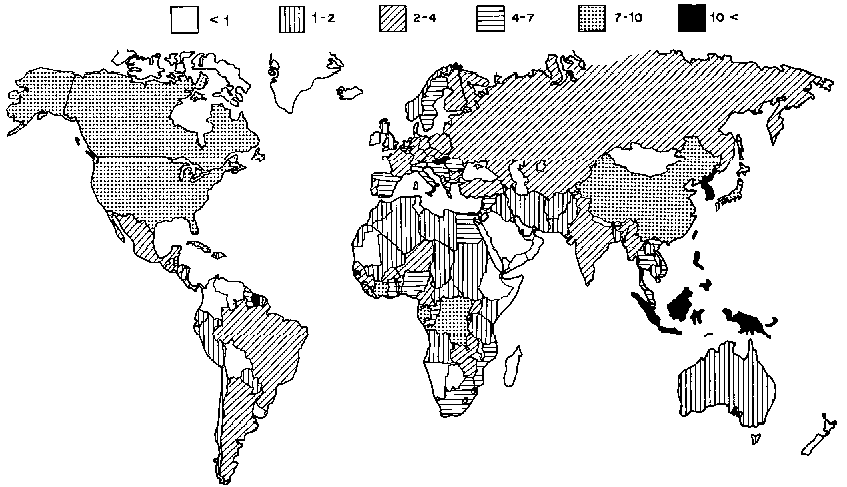
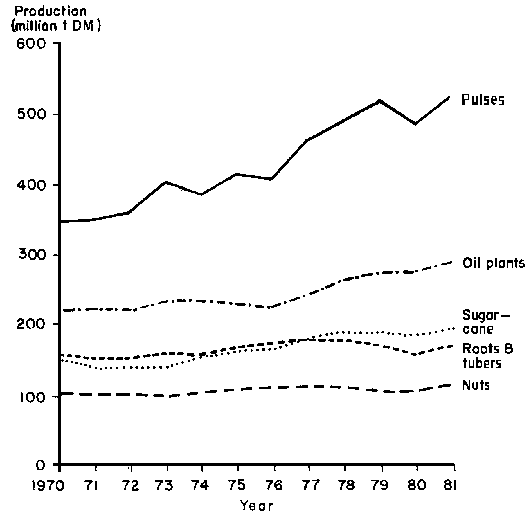
The quantities of fibrous crop residues (cereals, sugar-cane and other crops) in relation to livestock numbers by country are shown in Figure 1. In 1981, the average estimated amount of fibrous crop residues per LU was 2811 kg, with the highest regional average (5480 kg) in North and Central America and the lowest average (1019 kg) in Oceania. Quantity of fibrous crop residues increased from 1970 to 1981 by about 36% (Figures 2 and 3) whereas the number of grass eaters (i.e. ruminants) increased by only 10%.
Table 3. Multipliers used in converting livestock numbers into livestock units (1 LU=500 kg live weight).
|
|
Africa |
North & Central America |
South America |
Asia |
Europe |
Oceania |
USSR |
|
Horses and mules |
0.9 |
1.0 |
1.0 |
0.8 |
1.0 |
1.0 |
0.9 |
|
Asses |
0.6 |
0.7 |
0.7 |
0.6 |
0.7 |
0.7 |
0.7 |
|
Cattle |
0.6 |
0 9 |
0.8 |
0.7 |
0.9 |
0.8 |
0.8 |
|
Buffaloes |
|
1.0 |
|
||||
|
Camels |
|
1.1 |
|
||||
|
Pigs |
0.16 |
0.30 |
0.20 |
0.18 |
0.30 |
0.18 |
0.30 |
|
Sheep |
0.08 |
0.11 |
0.10 |
0.09 |
0.11 |
0.11 |
0.09 |
|
Goats |
0.07 |
0.08 |
0.07 |
0.08 |
0.10 |
0.10 |
0.08 |
|
Chickens & ducks |
0.012 |
0.015 |
0.012 |
0.012 |
0.015 |
0.015 |
0.015 |
|
Turkeys |
|
0.035 |
|
||||
Quantity of residues (t DM per LU of grass eaters)
Figure 2. World production of cereal crop residues, 1970-81.
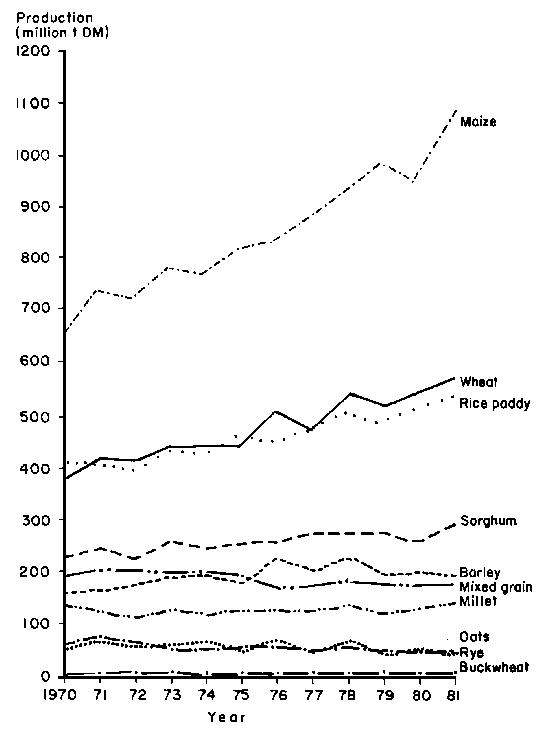
Figure 3. World production of fibrous residues from pulses and other crops, 1970-81.
In many countries the amount of crop residue exceeds the amount that can be used. These include the USA, Canada, most European countries, a few Near Eastern countries, a belt of countries from Mozambique to the southwest coast in Africa, China, Korean PDR, Korean Republic, and most countries and islands of Southeast Asia. Many other countries have a low ratio of available crop residues to grass-eater LUs. These include most countries in North, East and southern Africa and many countries in the Middle East.
In 1981, Africa had about 12% of the world population of grass eaters but produced only about 8% of the world's fibrous crop residues. The residues in greatest supply were maize (95.7 million tonnes), sorghum (55.2 million tonnes) and millet (51.4 million tonnes).
Most countries in sub-Saharan Africa with a low ratio of crop residues to LUs have large areas of arid to semi-arid rangelands, large livestock populations and relatively low production of cereals (Table 4). Countries with a high ratio were mainly in the humid zone of West Africa where cereal yields are higher but cattle populations are severely limited by trypanosomiasis (Table 4).
Large quantities of fibrous crop residues are already used as animal feed in many developing countries. There are also many areas in developing countries where ruminant livestock starve due to lack of feed. However, globally, it is apparent that cereal production has increased at a greater rate than livestock numbers over the last 10 to 15 years. These trends indicate that research should be strongly directed towards improving utilisation of fibrous crop residues as livestock feed.
Table 4. Quantity of fibrous crop residues per grass-eater LU, sub-Saharan Africa, 1981.
|
Quantity (kg DM LU-1) |
Countries |
|
<600 |
Botswana, Ethiopia, Madagascar, Mauritania, Namibia, Somalia |
|
600-1999 |
Angola, Central African Republic, Chad, Guinea, Kenya, Lesotho, Mali, Sudan, Tanzania |
|
2000-3999 |
Burkina Faso, Benin, Cameroon, Cape Verde, Comoros, Gambia, Guinea Bissau, Niger, Uganda, Senegal, Swaziland, Zambia, Zimbabwe |
|
4000-6999 |
Burundi, Congo, Ghana, Malawi, Mozambique, Nigeria, Sierra Leone, Togo |
|
7000-10 000 |
Gabon, Cote d'Ivoire, Liberia, Rwanda, Zaire |
Kossila V. 1984. Location and potential feed use. Chapter 2 in: F Sundstøl and E Owen (eds), Straw and other fibrous by-products as feed. Elsevier, Amsterdam, the Netherlands. pp. 4-24.
Kossila V. 1985. Global review of the potential use of crop residues as animal feed. In: T R Preston, V L Kossila, J Goodwin and S B Reed (eds), Better utilization of crop residues and by-products in animal feeding. 1. State of knowledge. FAO Animal Production and Health Paper 50. Food and Agriculture Organization of the United Nations, Rome. pp. 1-13.
Van Soest P J. 1982. Nutritional ecology of the ruminant. O & B Books, Corvallis, Oregon, USA.
Thomson: Cotton crop residues are important in Mediterranean countries such as Syria and Egypt. Could you comment on the availability and use of this material?
Kossila: Cotton residues were included in my calculations but much more information is needed on the amounts available for animal feeding compared relative to other uses.