Abstract
Résumé
Introduction
Materials and methods
Results and discussion
Summary and implications
References
Andargachew Kebede¹ and Ray Brokken²
1 Senior expert, Planning Department
Ministry of State Farms Development
P O Box 5765, Addis Ababa, Ethiopia
2 Livestock Economics Division
ILCA, P O Box 5689
Addis Ababa, Ethiopia
Nine key Ethiopian central highland markets were surveyed for a period of one year beginning in January and ending in December of 1989 to determine the effects of certain animal and market characteristics on price and the pattern of sheep prices in relation to seasons. Each market was surveyed once a week on the main market day. Price, weight, sex, age, colour, condition score, breed and buyers' purpose were recorded for all completed transactions. A total of 50 062 cases were recorded.
Three markets, each representing redistributive, intermediate and terminal markets, as identified by buyers' purpose were chosen for further analysis. Considerable weekly price variation was evident. Animal characteristics (weight, age, condition, sex, colour) as well as buyers) purpose and seasons were variably important in explaining variations in price among animals within weeks. Variations in the composition of these characteristics from week to week were among factors underlying changes in weekly mean prices. R² varied from 0.2669 to 0.3583 for price-per-kilogram model and from 0.7822 to 0.8413 for price-per-head model in the three markets.
Neuf marchés des hauts plateaux éthiopiens ont été suivis en 1989 pour analyser l'effet des caractéristiques des animaux des marches et des saisons sur le prix des moutons. Le principal jour de marché chaque semaine, le prix, le poids, le sexe, l'âge, la robe, l'état corporel, la race et la raison d'achat de tous les animaux vendus ont été enregistrés (50 062 ventes au total).
Trois marches, chacun représentant un marché de redistribution, intermédiaire et terminal, ont été choisi pour l'analyse. Les variations hebdomadaires de prix sont importantes . Les caractéristiques des moutons (âge, poids, robe, sexe, état corporel), la raison d'achat et les fêtes expliquent de façon variable les variations de prix chaque semaine. D'une semaine à l'autre, le prix hebdomadaire moyen varie avec la composition de ces caractéristiques. Pour les trots marches, R² varie de 0,2659 a 0,3583 pour le modèle du prix au kg et de 0,7822 a 0,8413 pour celui du prix per animal.
The central highlands of Ethiopia represent an important sheep producing area accounting for 75 per cent of-the nation's flock. Central highland farmers generally consider livestock a more reliable form of wealth than other alternatives. An average of three head of sheep are slaughtered per year per family. About 40 per cent of farmers' cash income from animal trade is accounted for by sale of sheep (Gryseels, 1988).
Development activities of the Ministry of Agriculture (MOA) have focused mainly on distribution of crossbred rams in limited parts of the country. The Institute of Agricultural Research (JAR) and the International Livestock Centre for Africa (ILCA) undertake research activities with the aim of improving productivity of indigenous sheep through a combination of improved management, feeding, genetic selection and health care. The ultimate goal of such interventions is to improve the welfare of producers through increased production and income. Interventions addressing increased production need to consider the market aspect simultaneously.
Farmers benefit from efficient markets which transimit information and ensure minimum marketing margins. Farmers need to be aware of the preferred characteristics of animals as well as price patterns so that they can plan breeding and fattening programmes and breed selection consistent with the best seasonal prices and consumers' preferences.
There is very little literature on marketing of small ruminants in Ethiopia. Ayele Gebre-Mariam and Hillmann (1975, unpublished) tried to determine, factors affecting differences in price levels in a given market and between markets at various rounds of (a central highlands livestock) survey. The most vivid shortcoming of this study was that the data were collected during an abnormal (drought) year and as a result its conclusions may not necessarily be representative.
The objectives of the present study are to: (i) determine overall market composition by basic animal characteristics, (ii) determine intra-annual price patterns and factors underlying intra-annual price variations.
In the central highlands, as in nearly all other parts of the country, there is no regular market information on prices and supplies, nor formalised grades and standards. Agreement on price is reached by a long one-on-one bargaining between a seller and a buyer. Animals are sold on a per-head basis. Under such circumstances, prices paid will reflect buyers' preference for various animal characteristics (sex, weight, age, condition, breed, colour), the purpose as to whether the animals are purchased for consumption, breeding, the season of the year and the bargaining skills of buyers and sellers.
Nine key central highland markets most of them purposively selected to capture the main pattern of movement of sheep and benefit from ILCA's outreach research stations were included in a sheep market survey. The survey was undertaken on the main weekly market day for a period of one year (January to December 1989). Due to technical reasons, the survey in a few markets was started and completed a few weeks later. The survey at Degollo was interrupted much earlier due to security problems.
All completed transactions on ordinary market days and as many completed transactions as could be tracked on festival market days were recorded at the exit gate if fenced, or at one or two of the most frequented departure routes if open market places. This procedure minimised enumerators' decisions about sampling. A festival market was represented by two market days: the market falling on the festival day (or the market closest to the festival day ) and the one preceding it. Price, weight, sex, age, condition, colour, number offered and sold, buyers' purpose, buyer and seller type, and time of sale were recorded. In all, 50 062 animals were recorded (Shola 6453, Addisu Shola 1922, Debre Berhan 8609, Deneba 7326, Enewari 3638, Degollo 7808, Ginchi 9263, Debre Zeit 3619, Dejen 1424).
Age was approximated by the type and number of teeth. Condition was assessed by the different degrees of fatness on and around the back bone, in the loin area and the last rib, and above the kidney (Carles, 1983). While Carles discussed six conditions scores, only four ranging from one for poor to four for very fat sheep where used in the present study.
This condition scoring technique was designed for thin-tailed sheep and might not be the most appropriate for the type of sheep found in the central highlands. However, uniformity of condition scores was ensured by repeated comparisons of the scores of different enumerators for given flock of sheep. No official scoring technique has been established for Ethiopian fat-tailed sheep, to the authors' knowledge.
Due to the difficulty in identifying specific breeds in the market place, sheep were classified into: hairy thin-tailed, wooled thin-tailed, fat-tailed and fat-rumped (Minutes of the National Technical Committee on National Sheep Research and Development Policy, Addis Ababa, 1974 unpublished).
To select representative markets for analysis the markets included in the survey were classified on the basis of buyers' purpose (for approaches used in market classification see for example: Herman Tilahun, 1979; Solomon Bekure and Negussie, 1983). All the markets included in the survey fall into terminal or redistributive categories (Table 1). Although classified as a terminal, the Debre Berhan market was almost equally important as a redistributive market. Shola and Degollo, the most typical terminal and redistributive markets, respectively, and Debre Berhan, an intermediate market, were selected for analysis.
Table 1. Classification of markets by major purpose of purchasing.
|
|
Purpose of purchasing (%) |
|||
|
Reproduction & fattening |
Slaughtering |
Resale |
||
|
Redistributive markets |
|
|
|
|
|
|
Degollo |
10.40- |
8.50 |
81.10 |
|
|
Ginchi |
16.20 |
26.10 |
57.70 |
|
|
Enewari |
12.30 |
34.70 |
53.00 |
|
|
Deneba |
25.00 |
25.90 |
49.10 |
|
Terminal markets |
|
|
|
|
|
|
Addisu Shola |
0.20 |
98.80 |
1.00 |
|
|
Shola |
1.20 |
98.50 |
0.30 |
|
|
Dejen |
2.00 |
97.00 |
1.0 |
|
|
Debre Zeit |
940 |
90.10 |
0.50 |
|
|
Debre Berhan |
7 70 |
46.70 |
45.60 |
The following equation was estimated in order to determine factors affecting sheep prices for each of the markets selected for analysis.

Where:
P = price per kilogram in Ethiopian Birr, W is weight in kilogram, T is time in week; F, S, A, C, K and R are dummy sets signifying season, sex, age condition, colour, and purpose of buying, respectively. The bis are structural parameter of the equation.
Overall market composition by basic animal characteristics
Sex distribution of sheep sold varied from market to market (Table 2). Male sheep were dominant at the terminal and redistributive markets. Female sheep made the largest proportion in the intermediate market. Castrated sheep were second in importance to entire males in the terminal market but of little significance in the other markets.
In general, sheep sold in the central highlands were mainly lambs of less than a year age. Relatively higher proportions of young sheep were recorded in the redistributive market. Sheep of average condition were dominant in all markets. The terminal market had the largest proportion of fat and very fat sheep. The largest proportion of poor sheep were recorded at the intermediate market. Colour variability was less pronounced than other animal characteristics. All sheep were fat-tailed type at the intermediate and redistributive markets and this type also predominated in the terminal market. Fat-rumped sheep represented only a very small proportion in the terminal market.
Table 2. Percentage market composition of central highland markets by animal characteristics and type of market
|
Animal characteristics
|
Type of market |
|||
|
Terminal market |
Intermediate market |
Redistributive market |
||
|
A. Sex: |
||||
|
|
Male |
sots |
43.0 |
56.4 |
|
|
Castrate |
38.5 |
9.9 |
4.2 |
|
|
Female |
11.0 |
47.1 |
39.4 |
|
B. Age (year): |
||||
|
|
< 1 |
62.4 |
72.8 |
86.0 |
|
|
2 |
26.6 |
6.9 |
4.8 |
|
|
3 |
2.4 |
6.1 |
2.1 |
|
|
> 4 |
8.6 |
14.2 |
7.1 |
|
C. Condition: |
||||
|
|
Poor |
1 3.6 |
29.8 |
5.6 |
|
|
Average |
55 3 |
64.9 |
90 0 |
|
|
Fat |
21.1 |
4.9 |
4.1 |
|
|
Very fat |
10.0 |
0 4 |
0.3 |
|
D. Colour: |
||||
|
|
White |
28.0 |
19.0 |
20.6 |
|
|
Brown |
29.0 |
35 3 |
34.4 |
|
|
Black and white |
11.6 |
24.0 |
11.6 |
|
|
Black and other |
31.4 |
21.7 |
33 4 |
Intra annual sheep price pattern
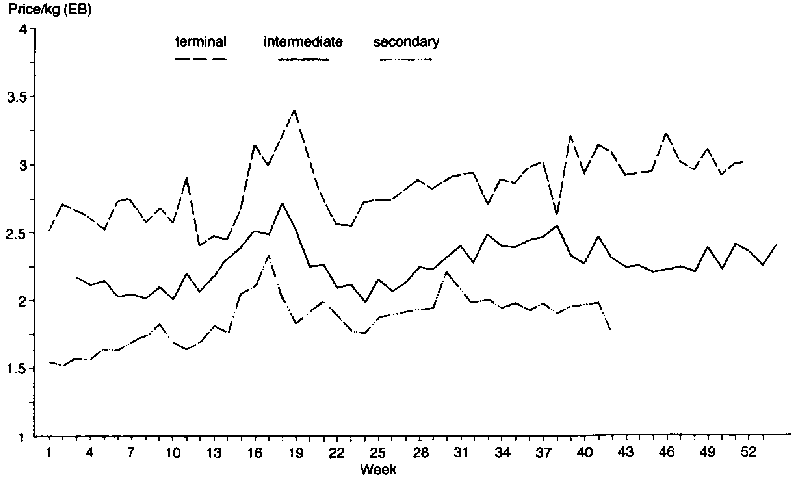
Considerable weekly mean price variation was apparent in the three markets (Figure 1). Average prices were highest in the terminal market and lowest in the redistributive market throughout the survey period. Overall annual mean prices per kilogram for the terminal, intermediate and redistributive markets were 2.84, 2.26 and 1.85 Birr, respectively. The highest weekly mean price per kilogram for the terminal market occurred during Id-al-fater (Ramadan) which fell a week after the Ethiopian Easter. The highest price per kilogram for the intermediate market occurred during the Ethiopian Easter.
Figure 1. Weekly mean price of sheep in three markets
Both the quantity purchased and offered for sale considerably increase during religious festivals. The lowest demand for sheep is expected to occur during fasting periods. Apart from producers' response to increased demand for sheep during-festivals, seasonality of supply is affected by producers need for cash and lambing pattern. Gryseels (1988) noted that small ruminants were the first to be considered for sale when food and seed grain stocks were depleted. The highest demand for grain seed and the lowest stock of food grain occurs during June to end of September. In addition cash needs are high before the harvests begin. Gryseels (1988) also reported that the peak lambing season was from September to November and relatively equally distributed during the rest of the year.
Factors underlying intra-annual price variations
Table 3 presents probability levels of (F) tests of significance of the variables included in the price/kg eqation for each of the markets under consideration. The results indicate that most factors are significant in two out of the three markets and that all variables are significant in at least one market. The R²s from this model (0.3238, 0.2659, and 0.3583 for the terminal, intermediate and redistributive markets, respectively) were superior to those calculated using antilogs from a log-linear model (0.3047, 0.2596 and 0.3583). A price-per-head equation fitted with variation generated R²s of 0.7822, 0.7973 and 0.8413 for the terminal, intermediate, and redistributive markets, respectively. However, because of the large week-to-week variation in weight, to be seen later, price per kg was used in the analysis. Moreover, price per head was predicted equally well by estimated price per kg multiplied by actual weights. The R*2s calculated from the alternative price per head estimate (0.7852, 0.7971, and 0.8415 for the terminal, intermediate & redistributive markets, respectively) were almost equal to the R2 generated from the actual price-per-head equation.
R*2 = 1 - (E(Pi - piWi)2 / E(Pi - p) 2)
where:
Pi is observed price per head of the ith sheep; pi is the predicted price per kg; Wi is the observed weight of the ith sheep.
Annex 1 records estimated parameters of the price-per-kg equation for the terminal, intermediate and redistributive markets. Positive and negative coefficients within a set of dummy variables signify premiums and discounts, respectively, relative to the dummy in the base in Ethiopian birr (EB). The t test was used to check whether the individual premiums or discounts were different from zero.
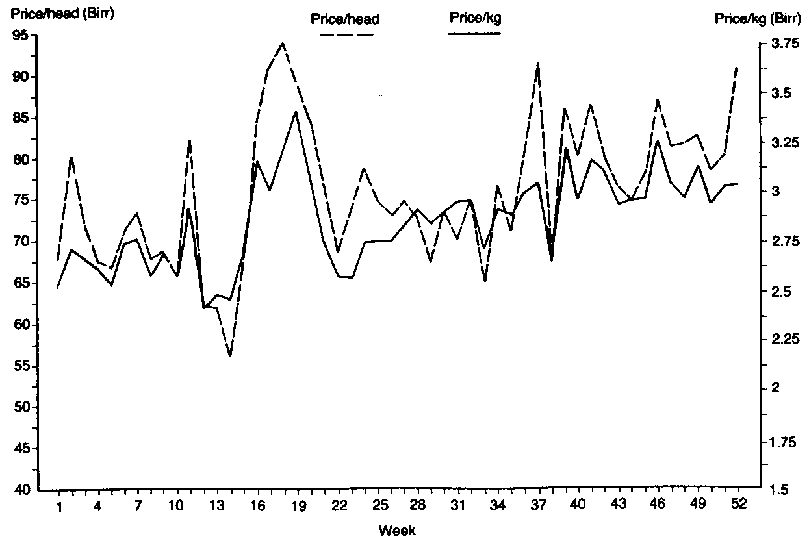
The different patterns of variation in price per head and price per kg caused by week to week variation in average weights is shown by plotting mean price per head and mean price per kg on the same graph (Figure 2) for the terminal market.
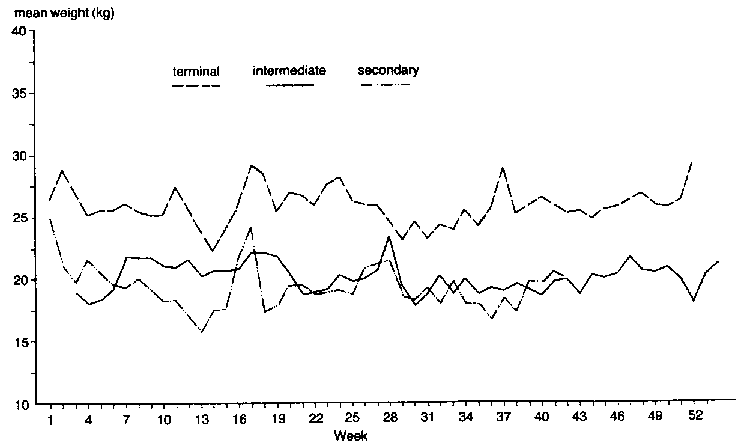
If the weights did not vary at all from week to week, the two price lines would maintain a constant difference. Sheep sold in the terminal market were on the average heavier than in either of the other two markets (Figure 3). The overall annual mean weight for the terminal, intermediate end redistributive markets were 26.6, 20.2 and 19.7 kilograms, respectively.
Table 3. Probability levels (Pr>F) of tests of significance of factors included in price per kg equation for the terminal, intermediate and redistributive markets.
|
|
Terminal market |
Intermediate market |
Redistributive market |
|
Weight |
0.0001 |
0.0041 |
0.0105 |
|
Weight |
0.0001 |
0.0032 |
0.0001 |
|
Week |
0.0054 |
0.0147 |
0.0001 |
|
Season |
0.0001 |
0.0001 |
0.0617 |
|
Sex |
0.0012 |
0.0017 |
0.5284 |
|
Age |
0.5601 |
0.0001 |
0.0022 |
|
Condition |
0.5961 |
0.0001 |
0.0001 |
|
Colour |
0.0001 |
0.0001 |
0.0001 |
|
Buyer's purpose |
na |
0.0064 |
0.0001 |
|
Weight x time |
0.9905 |
0.1483 |
0.0322 |
|
Weight x sex |
0.0281 |
0.0972 |
0.1488 |
|
Weight x age |
0.6965 |
0.0001 |
0.0577 |
|
Weight x condition |
0.7998 |
0.0001 |
0.0060 |
|
Weight x buyer's purp. |
na |
0.0154 |
0.0016 |
|
Weight x season |
0.0001 |
0.0001 |
0.0001 |
|
Week x sex |
0.0011 |
0.0007 |
0.0001 |
|
Week x age |
0.2381 |
0.4499 |
0.0164 |
|
Week x condition |
0.0006 |
0.0383 |
0.0003 |
na = not applicable, virtually all for slaughtering.
Figure 2. Weekly, mean prices of sheep in A terminal market.
Figure 3. Weekly mean weight of sheep in three markets.
The quadratic structure of the effect of weight on price per kg indicates that prices first decline to a minimum and increase as weight increases. The equations for males, castrates and females were calculated and plotted for each of the three markets in order to determine the pattern of price variation in relation to animal weight (figures not included). Most of the males and females in the terminal market were less than one year of age. Their weights ranged both above and below w*¹. The mean weight of the male group was slightly smaller than w* while, for females, mean weight was slightly larger than w* . Thus for males and females premiums in price per kg were offered both as weights decreased below w* and increased above w* . The mean weight of castrates was well above w* indicating that price per kg was strongly rising with increasing weights. This reflects a higher demand for castrates that are both fat and heavy and results in higher per animal price for castrates.
(1. Signifies the weights at which minimum price per kg occurs.)
The picture is similar in the intermediate market but somewhat different in the redistributive market. In the redistributive market, prices per kg of all three sex categories are strongly rising as weights increase. One can only speculate as to why the relationship between price per kg and weight are so different from the other two markets. The redistributive market is quite remote and animals are purchased mainly for resale where as they are nearly all purchased for slaughtering in the terminal market and for slaughtering and resale in the intermediate market. Animals purchased for resale must be trekked a long distance from the country to terminal markets. Perhaps these conditions explain the emphasis favouring higher weights in the redistributive market.
A significantly higher premium offered for castrates in all the three markets was not unexpected. Castrated and fattened sheep locally known as mukit (also applicable to goats) are on the average the heaviest group.
Castrates are relatively old, 70 per cent of them between two and four years, and fat to very fat in condition (55 per cent of them fall in this category). Gryseels (1988) noted that farmers castrate sheep for fattening in order to fetch prices.
Generally, consumers prefer lambs because of their tenderness and low weight. The low weight translates to low price per head. Certain colours are preferred to others and especially so for some localised occasions. Sheep sold during the Easter and Id-al-fater weeks received the highest premiums in all the markets. The purpose for which sheep were bought made significant overall price differentials in the intermediate and redistributive markets. Virtually all sheep were bought for slaughter at the terminal market. A significant time trend was indicated in the three markets. However, this was not considered as a regular within-year cyclical phenomenon.
Characteristics of sheep varied among the central highland markets, partly reflecting consumers' preference. For example, in contrast to the terminal market where sheep were purchased mainly for slaughter, relatively higher proportion of female sheep were observed in the intermediate redistributive markets. Female sheep predominated in the intermediate market. The proportion of castrates, fat and very fat sheep was highest in the terminal market. However, most sheep sold in the central highland markets were of average condition and lambs of less than a year age.
There is a considerable week-to-week variation throughout the year in sheep prices per kg in the central highland markets. These variations are related to variations in overall supply and demand as well as in characteristics of animals offered for sale. Factors affecting the number offered for sale include taking advantage of high demand during festivals, lambing season, as well as cash needs for crop inputs and later for food purchases just before harvest when grain stores are low.
Animal characteristics that affect price per kg are weight, sex, age, condition and colour. In addition, the purpose for which the animal was purchased, whether for resale, slaughter, fattening or reproduction, affected price. Market composition with respect to these characteristics varied from week to week which suggests that weekly mean prices per kg vary partly due to varying market composition effect. A significant time trend over the year was also observed in two of the three markets analysed. Though this trend may continue into the next year, it is not regarded as a within-year cyclical phenomenon.
Calculation of predicted price per kg multiplied by the observed weight demonstrated that the price-per-kilogram model is of equal predictive value for price per head when weight is known. Given the high variation in weights both within and between weeks, the price per kg would seem to be more useful market information than price per head.
The results suggest that there may be some benefit from co-ordinating fattening, breeding and marketing programmes to take the best advantage from some preferred animal characteristics and selected festival markets. However, further analysis will be needed for optimising fattening and controlled breeding programmes. For example, production analysis is needed on costs as well as animal response to alternative fattening programmes and seasonal grazing to use in combination with information generated in the present study on effects of weight, age, condition, and seasons on prices.
Carles A B. 1983. Sheep production in the tropics. Oxford University Press, New York, USA. 213 pp.
Gryseels G. 1988. Role of livestock on mixed smallholder farms in the Ethiopian highlands. A case study from the Baso and Worena wereda near Debre Berhan. PhD dissertation, Wageningen Agricultural University. The Netherlands. 249 pp.
Herman L. 1979. The livestock and meat marketing system in Upper Volta: Summary of evaluation of economic efficiency. In: Shapiro K H (ed), Livestock production and marketing in the Entente States of West Africa Summary report. CRED (Center for Research on Economic Development), University of Michigan, Ann Arbor Michigan, USA.
Solomon Bekure and Tilahun Negussie. 1983. Livestock marketing studies. In: Pastoral systems research in sub-Saharan Africa. Proceedings of the IDRC/ILCA workshop held at ILCA, Addis Ababa, Ethiopia, 21-24 March 1983. ILCA, Addis Ababa, Ethiopia. pp. 327360.
Annex 1. Estimated parameters of price/kg equation for the terminal, intermediate and redistributive markets.
|
|
Terminal market |
Intermediate market |
Redistributive market | |
|
Intercept |
2.9967** |
3.0769** |
1.6915 | |
|
Weight |
-0.0595** |
-0.0496 |
-0.0425 | |
|
Weight2 |
0.0015** |
0.0008** |
0.0008 | |
|
Time |
0.0115 |
0.0024 |
0.0504 | |
|
Sex : | ||||
|
|
Male |
0.3134** |
0.1856** |
-0.0010 |
|
|
Castrate |
0.5037** |
0.2607 |
0.1374 |
|
|
Female |
0.0000 |
0.0000 |
0.0000 |
|
Age (year): | ||||
|
Less than 1 |
0.2078 |
0.9619** |
0.4526 | |
|
1 |
0.1293 |
0.6331** |
0.4273 | |
|
2 |
-0.0070 |
0.4099* |
0.7036 | |
|
3 |
-0.2094 |
0.6306** |
0.3545 | |
|
4 |
-0.0259 |
0.0781 |
0.4760 | |
|
Over 4 |
0.0000 |
0.0000 |
0.0000 | |
|
Condition: | ||||
|
|
Poor |
-0.4272 |
-1.1680 |
-0.4633 |
|
|
Average |
-0.3303 |
-1.6154 |
-0.4452 |
|
|
Fat |
-0.2619 |
-0.7811 |
0.3283 |
|
|
Very fat |
0.0000 |
0.0000 |
0.0000 |
|
Colour: | ||||
|
|
White |
0.0805** |
0.1197** |
0.0563 |
|
|
Brown |
0.0544** |
0.1029** |
0.0217 |
|
|
Black and white |
- 0.0018 |
0.0276 |
- 0.0455 |
|
|
Black |
0.0000 |
0.0000 |
0.0000 |
|
Buyer's purp: | ||||
|
|
Resale |
na |
-0.1361 |
-0.1201 |
|
|
Slaughter |
na |
-0.1417 |
-0.2942 |
|
|
Fattening |
na |
0.2724 |
-0.0349 |
|
|
Reproduction |
na |
0.0000 |
0.0000 |
|
Season: | ||||
|
|
Christmas |
-0.2202* |
-0.3758** |
0.0022 |
|
|
Easter |
0.1804 |
0.3179** |
-0 0079 |
|
|
Id-al-fater |
0.5626** |
0.3139** |
0.2809 |
|
|
Id-al-adha |
0.2886 |
-0 2129* |
0.0321 |
|
|
New Year |
-0.4876** |
-0.3139** |
-0.0456 |
|
|
Maulid |
-0.2702 |
-0.0391 ** |
-0.2401 |
|
|
Lent |
-0.1456 |
-0.2799** |
0.0055 |
|
|
Non-festival |
0.0000 |
0.0000 |
0.0000 |
|
Interaction with weight: |
|
|
| |
|
Weight X time |
0.0000 |
-0.0001 |
-0.0001 | |
|
Weight X sex: | ||||
|
|
Male |
-.0107* |
-0.0055* |
0 0033 |
|
|
Castrate |
-0.0122* |
-0 0045 |
0.0041 |
|
|
Female |
0.0000 |
0.0000 |
0.0000 |
|
Weight X age (year): | ||||
|
Less than 1 |
0 0070 |
-0.0172* |
-0 0047 | |
|
1 |
-0.0030 |
-0.0061 |
-0.0060 | |
|
2 |
0.0004 |
0.0012 |
-0.0148 | |
|
3 |
0.0050 |
-0.0049 |
-0.0030 | |
|
4 |
0.0003 |
0.0109 |
-0.0089 | |
|
over 4 |
0.0000 |
0.0000 |
0.0000 | |
|
Weight x condition: | ||||
|
|
Poor |
0.0106 |
-0.0042 |
0.0115 |
|
|
Average |
0.0059 |
0.0253 |
0.0204 |
|
|
Fat |
0.0041 |
0.0058 |
0.0074 |
|
|
Very fat |
0.0000 |
0.0000 |
0.0000 |
|
Weight x buyer's purpose: | ||||
|
|
Resale |
na |
0.0101 |
0.0076 |
|
|
Slaughter |
na |
0.0127* |
0.0131 |
|
|
Fattening |
na |
-0.0053 |
0.0031 |
|
|
Reproduction |
na |
0 0000 |
0 0000 |
|
Weight x season: | ||||
|
|
Christmas |
0.0096* |
0.0138** |
-0.0070 |
|
|
Easter |
0.0051 |
-0 0037 |
0.0144 |
|
|
Id-al-fater |
0.0023 |
-0.0061 |
-0.0102 |
|
|
Id-al-adha |
-0.0096 |
0.0074 |
-0.0011 |
|
|
New Year |
0.0199** |
0.0249** |
0.0016 |
|
|
Maulid |
0.0123 |
0.0060 |
0.0070 |
|
|
Lent |
0.0045 |
0.0165** |
0.0054** |
|
|
Non-festival |
0.0000 |
0 0000 |
0.0000 |
|
Interaction with week: | ||||
|
Week x sex: |
|
|
| |
|
|
Male |
-0.0055** |
-0.0013 |
-0 0040** |
|
|
Castrate |
-0.0015 |
0.0055** |
-0.0013 |
|
|
Female |
0.0000 |
0.0000 |
0.0000 |
|
Week x age: | ||||
|
Less than 1 |
0.0041 |
-0.0044 |
0.0030 | |
|
1 |
0.0044 |
-0.0026 |
0.0078** | |
|
2 |
0.0059* |
-0.0027 |
0.0038 | |
|
3 |
0.0042 |
-0.0033 |
0.0088* | |
|
4 |
0.0030 |
-0.0030 |
0.0052* | |
|
Over 4 |
0.0000 |
0.0000 |
0.0000 | |
|
Week x condition: | ||||
|
|
Poor |
-0.0039 |
0.0088 |
-0.0321 * |
|
|
Average |
-0.0017 |
0.0111 |
-0.0342** |
|
|
Fat |
0.0040 |
0.0126 |
-0.0409** |
|
|
Very fat |
0.0000 |
0.0000 |
0.0000 |
|
N |
6221 |
8546 |
7779 | |
|
R² (price/kg) |
0.3238 |
0.2659 |
0.3583 | |
* P<0.05; ** P<0.01.
na = not applicable, virtually all for slaughter.