


Abstract
Résumé
Introduction
Materials and methods
Results and discussion
Policy implications
References
J.P. Ayissi Mbala
Institut National de Développement Rural (INADER)
University Centre of Dschang, B.P. 2221, Dschang, Cameroon
An analysis of the quantity-price and income relationship, and consumer reactions at the retail level of goat meat is presented. A demand model was developed using either the linear, semi-logarithmic or double-logarithmic functional forms.
Cette communication présente une analyse des relations entre la consommation de viande de chèvres, son prix et le revenu au Cameroun, ainsi que les réactions des consommateurs au niveau du commerce de détail. Un modèle de demande est développé en utilisant des fonctions linéaires, semi-logarithmique et logarithmique double.
In Cameroon, the consumption of meat and other livestock products is particularly affected by the geographical setting of the country. The livestock producing areas are located far away from the main consumption areas of the South. This situation, coupled with the poor system of husbandry and the inadequate marketing infrastructure, has resulted in an insufficient supply of meat from all types of livestock.
During the early part of the past decade, Cameroon experienced a rapid increase in population (3.0%) as well as a steady increase in the Gross Domestic Products. Recent estimates indicate that the domestic meat supply has not been able to meet the internal demand. Table 1 reveals a shortage of 55.7 thousand tons of meat from all livestock species. Another factor which affects the consumption of meat in the country is the uneven distribution of the available supply. This situation is indicated in Table 2. Regions situated further away from the producing areas receive very little meat from any source. Consequently, it is evident that as a result of its geographical setting and other related problems, the country's domestic demand for meat and livestock products is unlikely to be met, if emphasis is placed as it is at present, on cattle production alone.
Table 1. Supply and demand for meat by province (1986/87).
|
Provinces |
Population 1986 ('000) |
Total meat demand (tons) |
Total meat production (tons) |
Balance (tons) |
|
Extreme north |
1 727.5 |
26 586.2 |
22 396.5 |
- 4 189.2 |
|
North |
607.5 |
9349.4 |
7 876.5 |
- 1 472.6 |
|
Adamaoua |
422.5 |
6 502.3 |
26 270.0 |
19 767.7 |
|
East |
475.9 |
7 324.0 |
7144.0 |
- 180.1 |
|
North-west |
1 221.5 |
18 798.9 |
16 967.4 |
- 1 831.5 |
|
West |
1 330.3 |
20 473.3 |
9 111.3 |
-11 362.1 |
|
Subtotal |
5 785.2 |
89 034.2 |
89 766.0 |
731.7 |
|
South-west |
824.7 |
12692.1 |
1 517.2 |
-11 175.0 |
|
South |
406.6 |
6 257.6 |
1 344.6 |
- 4 913.0 |
|
Littoral |
1 677.6 |
25 818.3 |
4 176.2 |
-21 642.0 |
|
Central |
1 742.3 |
26 967.9 |
8 248.1 |
-18 719.8 |
|
Subtotal |
4661.2 |
71 735.9 |
15286.0 |
-56449.9 |
|
Total |
10 446.4 |
160 770.1 |
105 052.0 |
-55 718.1 |
In Cameroon, sheep and goat production ranks first among ruminants in terms of numbers, although in terms of total meat output they are second to cattle. According to recent estimates there is a total of 437 thousand goat and 240 thousand sheep farms with populations of 3.5 million and 1.5 million, respectively (MOA, 1984). The figures indicate that goat and sheep production is a major economic activity in terms of the number of people employed and as a source of revenue, especially in the main producing areas of the country. Consequently, it is imperative that all the available types of livestock be exploited. It is also important that the potential demand for the various types of meat should be estimated so as to evaluate their marketing potential. This is necessary for effective planning of future livestock development programmes.
Table 2. Total meat production and animal species by region (1986/1987).
|
Provinces |
Beef (tons) |
Mutton (tons) |
Goat meat (tons) |
Pork (tons) |
Poultry (tons) |
Total (tons) |
|
Extreme north |
13408 |
4 378 |
2831 |
346 |
1 333 |
22396 |
|
North |
5 492 |
727 |
780 |
344 |
534 |
7 877 |
|
Adamaoua |
25 360 |
375 |
303 |
38 |
194 |
26 270 |
|
East |
3 795 |
465 |
608 |
1 798 |
478 |
7 144 |
|
North-west |
11640 |
718 |
328 |
2 140 |
2 142 |
16 967 |
|
west |
3 991 |
628 |
1 729 |
1 852 |
912 |
9 111 |
|
Subtotal |
63 686 |
7 291 |
6 678 |
6 518 |
5 593 |
89 766 |
|
South-west |
93 |
73 |
153 |
923 |
275 |
1 517 |
|
South |
6 |
251 |
424 |
395 |
269 |
1 345 |
|
Littoral |
55 |
12 |
9 |
1 983 |
2 118 |
4 176 |
|
Central |
514 |
192 |
432 |
1 365 |
5 745 |
8 248 |
|
Subtotal |
668 |
528 |
1 017 |
4666 |
8407 |
15286 |
|
Total |
64354 |
7819 |
7695 |
11 184 |
14000 |
105052 |
|
Per cent |
61.3 |
7.4 |
7.3 |
10.6 |
14.3 |
100 |
If the production of goat meat has to be increased as a measure for alleviating the shortage in the present meat supply, it is important to determine its demand in relation to other types of meat in the country. This is necessary because consumer reaction to goat meat should be taken into consideration by government and other interested bodies in planning future investments in livestock development. This paper attempts to evaluate consumers, response with respect to price changes in goat meat and other types of meat as well as the effects of increasing income on consumption. Due to lack of accurate data relating to the consumption of all types of meat, the analysis is limited to only two principal types of meat (goat meat and beef) for which data were available.
The analysis is based on official time series data covering a period of twelve years. This period may statistically be regarded as inadequate to guarantee a satisfactory estimate of the demand for the product. It may be argued that such an exercise which has the initial constraint of limited data is subject to a wide margin of error. On the other hand, it is also a fact that observations covering a long period of time pose some statistical and economic problems of analysis. In this respect, it is important to note that factors affecting demand do change over time and therefore estimates based on long periods of observations may not reflect these changes. However, it is hoped that subject to the methodology and the analytical techniques used, the results obtained here will be indicative of the true situation and will serve as a pioneering attempt.
The principal factors affecting the demand for meat in general include:
a) the amount and distribution of per capita income in the population
b) the availability and prices of substitutes
c) the retail price of the commodity.
There are, however, other factors such as tastes, consumer preferences for different cuts of meat, religious and traditional affiliations of the people and other not easily quantifiable factors. In this paper, the demand for goat meat and the effects of income, price and substitutes on consumption are the major consideration in the analysis.
The per capita consumption of goat meat is taken as the dependent variable. The total consumption figures used are the annual time-series data of the official slaughter of goats. These are published in the annual reports of the Ministry of Livestock and Animal Industries. It is perhaps important to mention that these slaughter figures may not represent the actual consumption of goat meat. This is because a substantial number of goats is slaughtered privately for home consumption especially during festivities such as funeral ceremonies, marriages etc. However, since these private slaughters do not enter the marketing system, they are not directly guided by the normal market forces of supply that only the official marketed stock may be affected by the main factors that cause variations in demand.
In order to obtain the per capita consumption, the recorded number of goats slaughtered is converted into kg equivalent for fresh goat meat by using a mean carcass weight, which in the case of goats in Cameroon has officially been estimated at 12 kg (1966-1979). The yearly totals of fresh goat meat are then divided by the estimated population to obtain the per capita consumption.
The independent variables constitute the per capita income and prices. Income is a very important factor in the study of the demand for food and other agricultural products but the problems it presents in most demand studies result from the concept and actual definition of income. However, for the purpose of this paper, income is defined as the "real income". This means that the actual money incomes as represented by the values of the GDP have to be deflated by an inflation factor. This inflation factor is taken to be the consumer price index. In other words, the formula for estimating 'real income' is as follows:

The prices used in this analysis are the average annual retail prices of the various types of fresh meat. These are also published by the Office of Statistics in the Ministry of Livestock and Animal Industries. These prices were also deflated by the consumer price index in order to make adjustments for changes in the money values. The prices obtained can therefore be termed 'real price'. According to the theory of consumption, an equal percentage change in the prices of all commodities as well as in the money incomes of consumers should not disturb the pattern of quantities demanded or consumed (Fox, 1968).
The demand model developed for analysis is based on the fact that the quantity of purchased goat meat consumed per head of the population can be said to be a function of the price of goat meat, the real per capita income of the population, the price of beef and a disturbance term (U). Beef has been chosen as a substitute since it is, from a priori knowledge, the most popular though expensive type of meat in the country. The production and marketing of mutton is comparatively marginal relative to goat meat and the pork consumption is also heavily influenced by religious inclinations. These two types of meat have not been considered in the analysis. The demand model can, therefore, be represented in the following function form:
|
Cgmt = f(Pgmt, Pbt, Yg, U) |
(1) |
Where:
Cgmt = per capita consumption of goat meat in time t
Pgmt = price of goat meat in time t (in francs CFA)
Yt = income per capita in time t
Pbt = price of beef in time t
U = disturbance term. The term is assumed to be normally and independently distributed with a mean zero and unit variance.
In estimating the demand for meat and other food products, several statistical methods and techniques have been developed to determine the relationship between consumption, income and prices. These methods and techniques have their advantages and limitations. For this paper, the linear function, the semi-logarithmic function, and the double-logarithmic function were tried.
The functions were employed in a least square multiple regression analysis so as to find out which of the function best fits the available data. The three functional forms were then transformed into the following estimating equations:
a) Linear equations:
|
Cgm = a + b1 + b2 pbt + b3 Yt |
(2) |
b) Semi-logarithmic equation:
|
Cgm = a + b1 Log Pgmt + Log Pbt + b3 LogYt |
(3) |
c) Double-logarithmic equation:
|
LogCgm = a + b1 Log Pgmt + b2 Log Pbt + b3 Log Yt |
(4) |
Where a = the constant term (point of intercept)
b1 .... b3 = regression coefficients of the explanatory variables.
It is believed that statistical data can only trace a theoretical demand curve if that curve (demand) remains fixed while the supply curve shifts (Oni, 1972). In the present case, it cannot be claimed that the demand schedule for goat meat in the country has remained fixed, but the slaughter data exhibits a less violent fluctuation when compared with the limited market offtake by the producers. Consequently, it can be assumed that the statistically derived demand function will trace out the true demand for goat meat in the country. This identification problem and the possible remedies have been considered by Johnston (1963) and Fox (1968).
Furthermore, from a priori knowledge of the situation, the price of goat meat at the retail does not bear any relationship to producer prices. This is because the producer prices are somewhat officially predetermined and there is also the limitation of the willingness of producers to sell a set of drawings at each point of time. In other words, the impossibility of repeated drawing as envisaged in the notions of probability and statistical inference would not necessarily constitute any serious obstacle to make generalisations on the results obtained from the data used.
Of the three estimating equations tested, the linear and double-log functions were selected for further analysis. This is because they largely satisfied the a priori expectations of the demand for goat meat. The results obtained from the two equations are presented in Tables 3 and 4, respectively. The two equations were further subjected to a series of combinations. Since one of the major objectives of the analysis was to determine the effects of price and income on the consumption of goat meat, it is important to know their separate effects upon the dependent variables. This would be difficult if the explanatory variables are highly correlated.
Table 3. Regression results explaining the demand for goat meat using the linear function.
|
Dependent variable |
Constant term |
Real income per capita (y) |
Price of goat meat (Pgmt) |
Price of beef (pbt) |
Price ratio |
R² |
Drot statistics |
|
i) Cgmt¹
|
-3.820 |
0.189++ |
- |
- |
- |
0.88 |
1.31 |
|
SE |
|
|
|
|
|
|
|
|
t. ratio |
|
|
|
|
|
|
|
|
ii) Cgmt
|
-3.690 |
0.260++ |
-1.595 |
- |
- |
0.92 |
2.06 |
|
SE |
(0.035) |
(0.672) |
|
|
|
|
|
|
t . ratio |
7.43 |
2.37 |
|
|
|
|
|
|
iii) Cgmt
|
-3.832 |
0.256++ |
-1.618 |
0.114 |
- |
0.93 |
2.05 |
|
SE |
(0.041) |
(0.720) |
(0.053) |
|
|
|
|
|
t. ratio |
6.24 |
2.25 |
0.21 |
|
|
|
|
|
iv) Cgmt
|
-6.491 |
0.197++ |
- |
- |
1.508+ |
0.92 |
2.07 |
|
SE |
(0.019) |
|
|
(0.666) |
|
|
|
|
t. ratio |
10.36 |
|
|
2.26 |
|
|
++ = significant at the 1 per cent level.
+ = significant at the 5 per cent level.
1. Cgmt = per capita consumption of goat meat in time t.
Nonetheless, in order to carry out the exercise of identifying the individual effects of the independent variables, the stepwise multiple regression technique has been employed in the two estimating equations.
Furthermore, the price ratio of beef and goat meat was introduced into the equations as a separate explanatory variable. This technique makes it possible to identify the individual as well as the cumulative or additional effects of the regressors on the dependent variable. The process of eliminating some of the variables from the equations also served as a means of reducing the multi-collinearity between them. In view of the fact that time-series data are susceptible to auto-correlated errors, the residual were also calculated and the various equations were tested for their presence by the Durbin-Watson statistics (Dwt).
Table 4. Regression results explaining the demand for goat meat-using the double log function.
|
Dependent variable |
Constant term |
Log per capita income (Yt) |
Log price of goat meat (pgmt) |
Log price of beef (pbt) |
Log ratio beef goat meat Pb/pgmt |
R² |
Drot statistics |
|
i) Log Cgmt¹
|
-2.605 |
1.973++ |
- |
- |
- |
0.83 |
1.11 |
|
SE |
(0.285) |
|
|
|
|
|
|
|
t. ratio |
6.92 |
|
|
|
|
|
|
|
ii) Log Cgmt
|
- 3.393 |
2.566++ |
-0.602 |
- |
- |
0.85 |
1.28 |
|
SE |
(0.565) |
(0.499) |
|
|
|
|
|
|
t. ratio |
4.54 |
1.21 |
|
|
|
|
|
|
iii) Log Cgmt
|
-2.929 |
2.058++ |
-0.901+ |
0.947+ |
- |
0.90 |
2.32 |
|
SE |
(0.533) |
(0.444) |
(0.441) |
- |
|
|
|
|
t. ratio |
3.86 |
2.03 |
2.15 |
|
|
|
|
|
iv) Log Cgmt
|
-2.954 |
2.084++ |
- |
- |
0.898++ |
0.89 |
2.12 |
|
SE |
(0.239) |
|
|
(0.264) |
|
|
|
|
t. ratio |
8.72 |
|
|
|
|
|
++ = significant at 1 per cent level.
+ = significant at 5 per cent level.
1. Cgmt = per capita consumption of goat meat in time t.
From the estimating functions of the equations presented in Tables 3 and 4, the equation (iii) in Table 4 from the double-log function was selected as the lead equation. This is because it contains all the important explanatory variables and fulfills most of the a priori expectations on the demand for goat meat. The coefficient of the price variables and that of income have the correct negative and positive signs, respectively, and they are significantly different from zero and statistically significant at 1 per cent. Their residuals are not auto-correlated as tested by the Durbin Watson statistics (Dwt). The joint effects of all the explanatory variables of the equation is to explain 90 per cent of the variation in the dependent variable and coefficient of multiple determination (R²) is highly significant (0.90). Furthermore, the standard errors of estimates are relatively low.
In order to properly analyse and draw reasonable conclusions on the consumption of goat meat in terms of quantity-price and income relationships, it is necessary to estimate also the price and income elasticities of demand. The different elasticities from the estimating functions were consequently calculated as follows:
From the linear function:

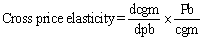

The various elasticities were calculated at the mean values of the variables. In the double-logarithmic function, the regression estimates of the coefficients of the appropriate variables are taken as the direct elasticities. The various elasticity estimates from the two functions are presented in Table 5.
In the literature, very little attention has been given to goats in economic research. Consequently, there are few estimates of income elasticity of demand for goat meat. In many cases, even in countries where goat is popular, the income elasticity is calculated jointly with mutton and lamb. Table 6 shows various estimates of the income elasticities of demand for the different types of meat in some African countries. The income elasticity estimates for mutton and lamb (which often includes goat meat) in some of these countries are similar to those obtained from our equations and it might be said that the consistency of the results presented in Table 5 leads to some credibility to the estimates.
The direct price elasticity of demand for goat meat (EPgm) has the correct negative sign in each of the estimating equations. With reference to the lead equation (iii) of the double-log-function, the direct price elasticity is -0.90. This can be taken as almost unit elasticity in terms of price. It indicates that goat consumption will increase by 0.9 per cent if the price falls by 1 per cent. The cross price elasticity of goat meat and beef has the correct positive sign and is also close to unity (0.95). This implies that the demand for goat meat has approximately unit elasticity in relation to the price of beef. This agrees with a priori expectations and knowledge of the actual marketing situation of goat meat in the country. As a result of the limited supply of beef in most parts of the country and the consequent increase in beef prices, the demand for goat meat has increased rapidly in recent years. Furthermore, the positive sign of the cross price elasticity with (Epb) confirms the fact that beef and goat meat can be taken as substitute products.
Table 5. Estimates of price and income elasticities of demand for goat meat.
|
Functional form |
Direct price elasticity (E pgm) |
Cross price elasticity with beef (E Pb/pgmt) |
Income elasticity (Ey) |
|
Linear function |
-0.85 |
0.84 |
2.3 |
|
Double-log function |
0. 90 |
0 95 |
2.05 |
Table 6. Some estimates of income elasticity of demand for different types of meat in some African countries
|
Country |
All meat |
Beef |
Lamb |
Pork |
Poultry |
|
Sudan |
0.90 |
0.60 |
1.50 |
- |
1.00 |
|
Gabon |
0.82 |
1.20 |
1.00 |
1.00 |
1.00 |
|
Chad |
0.85 |
0.90 |
0.80 |
1.00 |
1.00 |
|
Nigeria |
1.13 |
1.30 |
1.20 |
1.20 |
1.00 |
|
Ghana |
0.98 |
1.30 |
1.50 |
1.00 |
1.00 |
|
Sierra Leone |
1.20 |
1.50 |
1.50 |
1.20 |
1.00 |
Source: FAO (1974).
The income elasticity of demand for goat meat is also positive and far greater than unity (2.1).. It signifies that with any 1-per cent increase in income, the consumption of goat meat is likely to increase by 2.1 per cent. On the whole, the demand estimates indicate that goat meat is almost price-and highly income-elastic.
Although the demand estimates reveal a high income elasticity, it is perhaps important to remark that the estimated increase in the consumption of goat meat will occur only if the distribution of income continue in the present proportion. On the other hand, if the increased income goes to the wealthier section of the population, the increased consumption of goat meat will involve only the privileged few who can afford it rather than the majority of the population. Furthermore, with almost a unit cross-price elasticity with beef, increased consumption of goat meat will depend on the price of beef which generally is regarded as a superior type of meat. The implication of this situation is that if the production of goat meat is to be increased as a measure of increasing the overall supply of meat in the country, it is important to adopt a cheaper and efficient method of production and marketing than it is at present. This is necessary because any increase in the consumption of goat meat will depend greatly on its price relation with beef. Goat meat has to be produced and marketed at competitive prices with beef and perhaps that of meat. It is also important to note that government policy of fixing producer prices may not necessarily serve as incentive for increasing production, especially if the fixed prices do not bear any relationship with prices at the retail level.
The importance of goats as a source of meat supply in the country has been revealed and from the demand analysis, there is the need to determine the cost effectiveness in goat production as a necessary condition for increased output. Finally, it is important to remark that any effort undertaken by the State or individuals at stepping up inter-regional production and improving the efficiency and distribution of goat meat will be consistent with the economic growth as well as the nutritional requirements of the country as a whole.
FAO (Food and Agricultural Organization of the United Nations) 1974. Agricultural commodity projections 1975-1985. FAO, Rome.
Fox K A. 1968. Intermediate economic statistics. John Willy and Sons Inc., New York, USA. Johnston J. 1963. Econometric models. McGraw-Hill Book Co. inc., New York, USA.
Ministry of Livestock and Animal Industries, 1966 1979. Annual reports. Yaounde, Cameroon.
MOA (Ministry of Agriculture). 1984. Agricultural census Yaounde. Yaounde, Cameroon. Oni S A. 1972. A short-run demand for beef in western Nigeria. The Nigerian Journal of Economics and Social Studies. University of Ibadan, Ibadan, Nigeria.
