Abstract
Résumé
Introduction
The small ruminant meat production structure
Small ruminant trade
Consumption of small ruminant meat
Conclusion
References
Senait Seyoum
International Livestock Centre for Africa
P O Box 5689, Addis Ababa, Ethiopia
Small ruminants are an integral part of traditional crop-livestock production systems in sub-Saharan Africa (SSA). Meat is one of their major products. This report looks at aggregate patterns and trends in consumption and production of and trade in small ruminant meat in the four regions of SSA (East West, central and southern).
The preliminary results highlight two important points. Firstly, there are regional differences in the consumption of small ruminant meat These are differences which may be associated with variation in flock dynamics (size, structure and growth) and productivity, production constraints and trends in the production and consumption of other types of meat Secondly, there is a strong consumer preference for sheep and goat meat in most regions of SSA, as shown by the increase in small ruminant slaughter offtake over the past two decades.
In East, West and central Africa, relatively large and increasing small ruminant flocks, stable carcass yields and/or sustained production of other meats seem to have offset the potentially negative impact of high small stock offtake on flock growth and productivity. In contrast, in southern Africa growth of sheep and goat flocks is slow and carcass yield is low and slaughter offtake of other meats (e.g. beef) are declining and hence may not sustain the continuing demand for small ruminant meat in this region in coming years.
Les petits ruminants font partie intégrante des systèmes de production agricole de l'Afrique subsaharienne. Leur principale fonction est la production de viande. La présente communication étudie les caractéristiques et les tendances globales de la consommation, de la production et de la commercialisation de la viande des petits ruminants dans les quatre principales régions d'Afrique subsaharienne.
On constate des différences marquées entre ces régions en ce qui concerne la consommation. Elles dépendent de paramètres tels que la taille, la composition, la croissance et la productivité des troupeaux, et également des tendances de la production et de la consommation des autres types de viande. A en juger par l'augmentation continue du taux d'exploitation des petits ruminants en Afrique subsaharienne au cours des vingt dernières années, la viande de mouton et de chèvre est plutôt bien appréciée dans la majeure partie de cette région. Toutefois, compte tenu de la faible croissance des rendements à l'abattage des effectifs des petits ruminants ainsi que de la baisse des taux d'exploitation des autres espèces animales (ex: bovins), cette tendance ne pourra vraisemblablement pas se maintenir au cours des prochaines années.
En Afrique de l'Est et en Afrique occidentale et centrale, les effectifs relativement plus nombreux et croissants ajoutés à des rendements à l'abattage plutôt stables et/ou à une production relativement soutenue de viande d'autres espèces, semblent compenser l'effet éventuel des taux d'exploitation élevés sur la croissance et la productivité des troupeaux de petits ruminants. En revanche, en Afrique australe, l'augmentation du taux d'exploitation du troupeau ovin a été très soutenue depuis 1974. Son effectif déjà limité pourra difficilement compenser la baisse du taux d'exploitation du troupeau bovin.
In many areas of sub-Saharan Africa (SSA), livestock raising is an important economic activity from which food (ment, milk) and non-food commodities (manure, traction, hides and skins, wool etc.) and cash income are derived. Meat is one of the most important livestock products. In 1975, meat accounted for about 47% of the gross value of total SSA livestock output (Addis Anteneh et al, 1988).
In spite of this, per caput consumption of all kinds of meats (including beef, small ruminant meat, poultry and pork) averaged 10 kg in 1986/88 in SSA (FAO, 1988; 1989), compared with about 81.8 kg in Europe in 1987 (MLC, 1990). The low level of meat consumption in SSA is primarily due to the low level of meat production per caput which in turn is a consequence of the low productivity of the livestock sub-sector in the region. Between 1974/76 and 1986/88 per caput meat production and per caput consumption increased at annual rates of -0.7% and 0.1%, respectively (FAO, 1988; 1989). Furthermore, given recent developments in the region e.g. rapid population growth and urbanisation, rising input costs, foreign exchange shortages and slow income growth, future prospects seem to be for stagnant or even declining meat consumption, with the likelihood of severe food shortages and growing calorie-protein deficiencies for the bulk of the population (Reutlinger, 1980).
Such prospects underscore the urgent need for increasing food production in SSA. New technologies must be developed that enhance production and appropriate livestock development policies must be designed. A prerequisite to this is an understanding of production consumption of and trade in animal products.
This paper is based on a preliminary study of the nature and scale of small ruminant meat production, consumption and trade in different regions of SSA.
The study focused on small ruminant meat for three reasons: First, present knowledge of small ruminant meat demand patterns in SSA and of factors underlying them, is inadequate. As a result, it has often been difficult to identify potential market opportunities for small ruminant meat and to devise efficient ways of exploiting such opportunities. Second, consumption of beef which has traditionally dominated meat consumption in SSA, is declining relative to consumption of other meats, including mutton and lamb (FAO, 1988). Third although small ruminants currently play a minor role in supplying SSA with meat, they hold promise for increasing meat production and smallholder incomes; compared with cattle, small ruminants require fewer resources, have shorter production cycles, faster rates of growth and greater environmental adaptability. The paper is organised in four sections: Section 1 deals with the small ruminant meat production structure and looks at livestock population, carcass weight, herd/flock offtake and aggregate meat production trends; Section 2 provides information on small ruminant trade flows; in Section 3, aggregate small ruminant meat consumption are determined for the four regions of SSA; in the final section (4), the prospects for increasing small ruminant production and consumption in SSA and their policy implications are discussed.
Small ruminant populations, distribution and growth
Populations and distribution
Small ruminants are found throughout SSA. Most small ruminants are found in the arid and semi-arid zones of the Sahel and East Africa (ILCA, 1980), mainly in pastoral and agropastoral systems. Flock in these areas are generally large (up to 100 head per household) and are often kept with other livestock for both meat and milk production.
Small ruminants are comparatively less important in humid and subhumid zones. Nevertheless, it is estimated that in 1981, about a third of SSA's small ruminant population was found in these ecological zones (Onim et al, 1986). In both zones, smallstock are mostly kept by smallholder who rely mainly on crops but keep small ruminants as a subsidiary source of income and meat and a safeguard against crop failure and low crop prices.
Table 1 shows the regional distribution of cattle and small ruminants in SSA in 1988. Small ruminants outnumber cattle by 1.6:1 in SSA as a whole and by 2.7:1 in West Africa.
The main concentrations of small ruminants in 1988 were in East and West Africa, which accounted for 88 and 93% of the sub-continent's goats and sheep. It probably reflects environmental (drought, feed availability, disease) and socioeconomic (land scarcity, management system, profitability of sheep/goat production, consumer preferences) conditions.
Goats are more numerous than sheep in SSA (Table 1) particularly in southern and central Africa. The reasons for these distribution patterns are not very clear but seem to be related to differences in physiological/adaptation characteristics and socio-economic roles of sheep and goats. In much of Africa, sheep production is a relatively market-oriented activity aimed mainly at satisfying urban and ceremonial demand for meat (CRED, 1980; Nestel, 1986). In contrast, goat production tends to be subsistence oriented and to cater to the needs of a larger number of rural and lower income consumers (Zimbabwe Government, 1987).
Growth rates
Table 2 shows the annual growth rates of cattle and small ruminant populations in the four regions of SSA between 1961/65 and 1986/88. It appears that over the past two decades, the overall population of cattle, sheep and goats has grown slowly in SSA, at annual rates averaging 1.5,1.8 and 15%, respectively. However, small ruminant populations in SSA increased faster than cattle populations, between 1974/76 and 1986/88 when they grew at an average annual rate of about 2%, compared to 1.5% for cattle stocks. The consistently higher growth of small ruminants relative to cattle in West Africa suggests that a major shift, from came to smallstock, has occurred in this region, where considerable constraints inhibit expansion in cattle numbers.
Table 1. Distribution of sheep and goat population in sub-Saharan Africa, 1988
|
|
Cattle |
Sheep |
Goats |
SR/ cattle ratios |
Goat/ Sheep Ratios |
Cattle |
Sheep |
Goats |
Cattle |
Sheep |
Goats |
|
('000 heads) |
|
|
(no/km2) |
(no/pers) |
|||||||
|
Central Africa |
12663 |
5020 |
10279 |
1.2 |
2.0 |
2.4 |
1.0 |
2.0 |
0.2 |
0.1 |
0.1 |
|
East Africa |
85710 |
69140 |
68900 |
1.6 |
1.0 |
14.9 |
12.0 |
12.0 |
0.6 |
0.5 |
0.5 |
|
Southern Africa |
24899 |
3302 |
7020 |
0.4 |
2.1 |
7.8 |
1.0 |
2.2 |
0.4 |
0.1 |
0.1 |
|
SSA |
160713 |
120066 |
144687 |
1.6 |
1.2 |
7.5 |
5.6 |
6.7 |
0.3 |
0.3 |
0.3 |
Notes
Regional groupings are based on ILCA's classification of sub-Saharan African countries. SSA is taken to include 39 countries, West Africa 16, Central Africa 8, East Africa 6 and Southern Africa 9. Regional totals and averages were computed using FAO (1989) data for these countries.Source: FAO (1989) Production Tapes and own calculations.
SR (small ruminants) = sheep stock + goat stocks.
SSA = sub-Saharan Africa.
Carcass weights, offtake and meat production
Carcass weights
The meat production of different livestock species is reflected in their carcass weights. Information on carcass yields is therefore useful in comparing and determining the actual and potential values of different meat-producing animals.
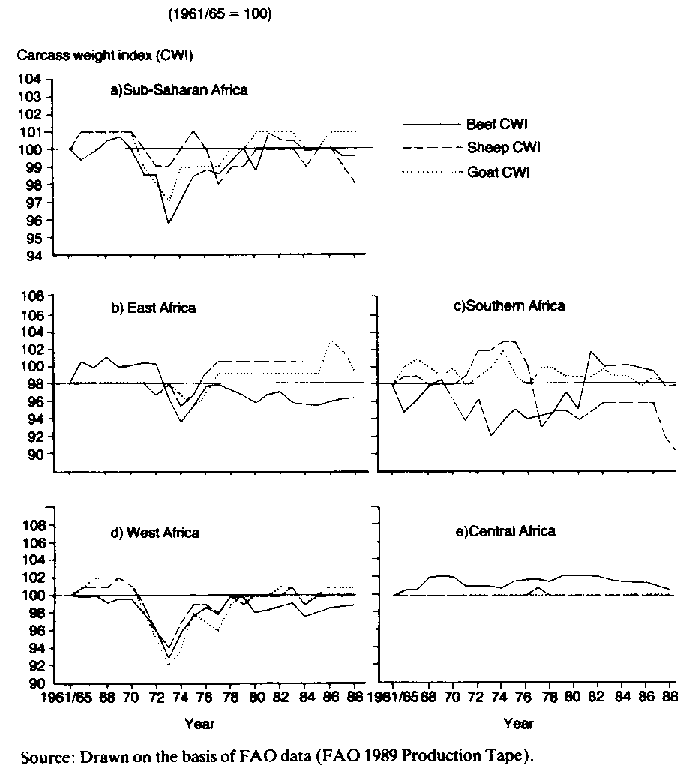
Average small ruminant carcass weights, estimated from aggregate FAO meat production and slaughter data, are highest in southern Africa and lowest in central Africa. In 1986/88, goat carcasses weighed an average 12.2, 11.7, 10.8 and 10.3 kg, respectively, in southern, West, East and central Africa. The equivalent regional figures for sheep carcasses were 11.6, 11.8, 12.9 and 11.8 kg, respectively.
Figure 1 shows the evolution of cattle, sheep and goat carcass weight indices in different regions of SSA between 1961 and 1988. Indices for these figures were calculated by taking 1961/65 annual carcass weight averages, for each species and region, as a base. Thus, on an equivalent basis, small ruminant carcass weights have generally been maintained at higher levels than beef carcass weights. The marked fall in carcass weight indices in the early 1 970's particularly evident for West and East Africa reflects a period of draught. On the whole, the trends described above suggest that small ruminants have a great potential for meat production than do cattle especially in traditional production systems.
Offtake rates
Although definitions vary, "offtake" is generally taken to represent the proportion of animals annually leaving the total herd/flock due to deaths, slaughters, sales or other transactions e.g. exchanges, gifts, loans. In SSA the measurement of smallstock offtake is subject to a high degree of inaccuracy, partly because of lack of reliable data on small ruminant population, growth and production parameters but also because this largely rural and unofficial nature of smallstock slaughter and marketing makes data collection difficult. The estimates of offtake and conclusions presented in this section should therefore be interpreted with caution.
While not exactly quantifying offtake, estimates of offtake, obtained rather arbitrarily by dividing FAO data on slaughters by total livestock numbers give a rough idea of offtake patterns and trends in SSA. These estimates indicate that in 1986/88, sheep offtake rates were highest in central and East Africa (32.1% and 29.6%, respectively) and lowest in West and southern Africa (27.4% and 25.7%). A different picture presents itself for goat offtake rates in 1986/88, these being highest in West and southern Africa (35.6% and 31.3%, respectively) and lowest in East and central Africa (26.9% and 29.9%, respectively).
Table 2. Annual growth rates (%) of cattle, sheep and goat populations in SSA between 1961/65-1974/76-1986/88.
|
|
Cattle |
Sheep |
Goats |
Small ruminants |
||||||||
|
1961/6 |
1974/7 |
1961/6 |
1961/6 |
1974/7 |
1961/6 |
1961/6 |
1974/7 |
1961/6 |
1961/6 |
1974/7 |
1961/6 |
|
|
West Africa |
-0.25 |
1.36 |
0.55 |
2.16 |
2.30 |
2.23 |
0.86 |
1.70 |
1.28 |
1.36 |
1.95 |
1.65 |
|
Central Africa |
4.00 |
2.80 |
3.40 |
2.29 |
2.07 |
2.18 |
4.34 |
1.94 |
3.13 |
3.62 |
1.98 |
2.80 |
|
East Africa |
1.93 |
1.55 |
1.74 |
1.14 |
2.01 |
1.58 |
0.87 |
2.07 |
1.47 |
1.01 |
2.04 |
1.52 |
|
Southern Africa |
2.50 |
0.92 |
1.70 |
2.70 |
-0.26 |
1.21 |
5.00 |
0.55 |
2.75 |
4.13 |
0.28 |
2.19 |
|
SSA |
1.56 |
1.49 |
1.53 |
1.58 |
2.04 |
1.81 |
1.25 |
1.83 |
1.54 |
1.39 |
1.93 |
1.66 |
Regional groupings are as defined in Table 1: growth rates are per cent annual growth rates calculated calculated on the basis of 1961/65, 1974/76 and 1986/88 annual averages.
Source: Own computations based on FAO (1989) Production Tapes.
Source: Drawn on the basis of FAO data (FAO 1989 Production Tape).
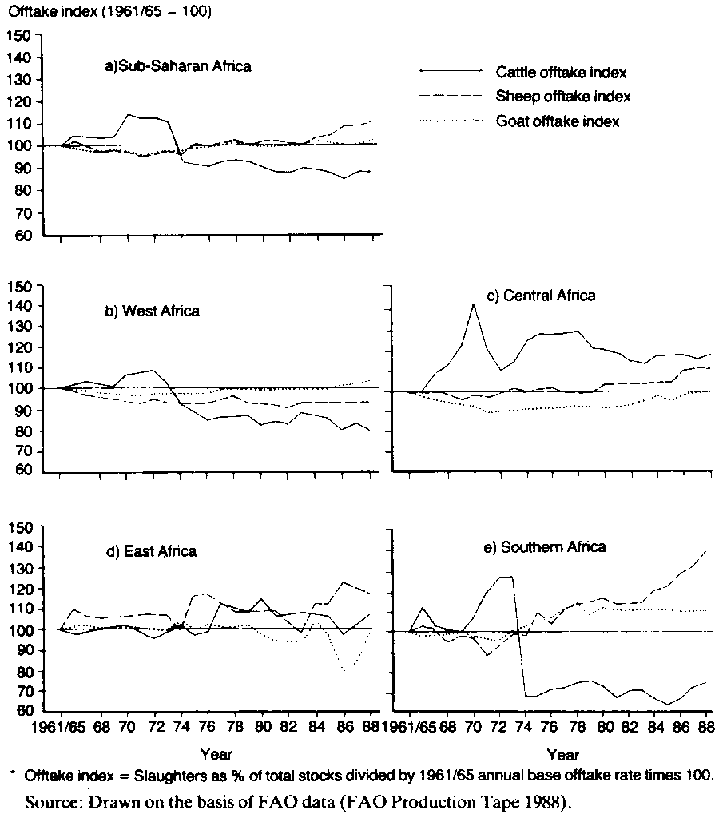
Figure 2 shows the evolution of small ruminant and cattle offtake indices in each region of SSA. From 1961/65 to 1973/74, smallstock offtake indices in SSA as a whole were lower than cattle offtake indices, but thereafter smallstock offtake indices was higher than cattle offtake indices. This trend was most pronounced in southern Africa, but was also evident in West Africa. Differences in the evolution of sheep and goat offtake rates are also apparent. For much of the 1960s and 1970s, sheep and goat offtake indices for SSA as a whole were similar. Around 1982 sheep offtake indices started to exceed goat offtake indices. The only exception to this generalisation was West Africa where goat offtake though low, consistently exceeded sheep offtake
While all this implies that smallstock, particularly sheep, are being slaughtered to a greater extent than cattle, the population and carcass weight trends that have accompanied offtake trends in some regions are cause for concern. Table 3 provides regional population, offtake and carcass weight growth rates for cattle, sheep and goats between 1974/76 and 1986/88. In West Africa, cattle offtake growth (1.15% p.a.) almost equalled growth in cattle population (1.36% p.a.) and exceeded growth in carcass yields (0.37% p.a.). In contrast, small ruminant offtake grow slower (at 0.39% p.a.) than either small ruminant numbers (1.95% p.a.) or carcass yields (0.69% p.a. on average). In view of this, the prospects for meeting future meat demand in this region through increased goat/sheep production may be envisaged.
The slow growth of cattle offtake (0.09% p.a.), in central Africa, was accompanied by an increase in cattle stocks (2.80% p.a.), and decline in carcass weights (-0.05% p.a.). This probably reflects this use of cattle for purposes other than meat production and factors constraining productivity increases in this predominantly humid region. Smallstock offtake grew at a relatively faster rate (0.53% p. a. for goats and 0.76% p.a. for sheep) in this region, and does not seem to have been detrimental to flock growth and productivity since small ruminant stocks increased (1.98% p.a.) and carcass weights were relatively stable (0.03% p.a. for sheep and 0.12% p.a for goats). There would thus seem to be room for increasing small stock, particularly sheep, in this region provided that population and carcass weight trends remain favourable.
In East Africa, cattle offtake is declining (at -0.20% p.a.) and cattle number and carcass yield are increasing slowly (1.55% and 0.02% p.a., respectively). In spite of this region having large and growing small ruminant populations (2.03% p.a.) and rather favourable carcass weight trends (0.38% p.a.), small stock offtake has also grown slowly. The observed decline in goat offtake (-0.59% p.a.) is probably due to low demand for goat meat. The growth in sheep offtake (0.56% p.a.) suggests a greater reliance on sheep than on goats in this region. However, there is a need for more country-specific studies looking at unofficial slaughter, trade and constraints e.g. low productivity and vulnerability of smallstock to changing environmental, management and market conditions, before coming to definite conclusions about small stock offtake in East Africa.
In southern Africa, cattle offtake is declining (-0.72% p.a.), as are carcass yields (0.27% p.a.), and small offtake rates are increasing (at 1.14% p.a. for sheep and 0.75% p.a. for goats). This suggests some substitution of sheep/goat meat for beef. However, the slow growth, or declining of small ruminant stocks (0.55% p.a. for goats and -0.07% for sheep) indicates that current levels of offtake cannot be supported unless flock productivity is increased.
Table 3. Comparison of livestock offtake, population and carcass weight rates (% p.a between 1974/76 and 1986/88) in different regions of SSA
|
|
Cattle |
Sheep |
Goats |
||||||
|
Offtake rate |
Stocks |
Carcass weight |
Offtake rate |
Stocks |
Carcass weight |
Offtake rate |
Stocks |
Carcass weight |
|
|
West Africa |
1.15 |
1.36 |
0.37 |
0.37 |
2.30 |
0.62 |
0.41 |
1.70 |
0.76 |
|
Central Africa |
0.09 |
2.80 |
-0.05 |
0.76 |
2.07 |
0.03 |
0.53 |
1.94 |
0.12 |
|
East Africa |
-0.20 |
1.55 |
0.02 |
0.56 |
2.01 |
0.48 |
-0.59 |
2.07 |
0.27 |
|
Southern Africa |
-0.72 |
0.92 |
-0.27 |
1.14 |
-0.26 |
-0.07 |
0.75 |
0.55 |
0.01 |
|
SSA |
0.14 |
1.49 |
0.03 |
0.53 |
2.04 |
0.49 |
-0.01 |
1.83 |
0.48 |
Offtake and carcass weights are as defined in text. Growth rates calculated on the basis of 1974/76 and 1986/76 and 1986/88 average cattle, sheep and goat offtake rates, stocks and carcass weights.
Source: Own computations based on FAO (1989) Production Tapes.
Overall, the emerging picture is one of substantial regional differences in the evolution of offtake rates in SSA. Over the past decade, cattle offtake increased in West and central Africa while it declined in southern and East Africa. In contrast, small stock offtake increased in almost all regions, the only exception being East Africa where goat offtake declined between 1979 and 1986. Southern Africa had the fastest growing rates of offtake of small ruminants.
Meat production
Domestic production of small ruminant meat in SSA is hard to quantify because of lack of reliable data. The most complete available data on small ruminant meat production come from FAO which defines meat production as meat from animals slaughtered within national boundaries, irrespective of their origin. This includes the meat equivalent of imported animals and excludes that of exported animals. As such, it does not accurately represent domestic production. However, FAO production statistics adjusted for net trade in meat provide general indications of regional small ruminant meat production patterns and trends in SSA.
Table 4 presents 1986/88 estimates of total and per caput domestic production of sheep, goat and small ruminant meat in the four regions of SSA. East and West Africa accounted for 92% of domestic small ruminant meat production in 1986/88. A similar pattern was observed for per caput production. Goat meat production generally exceeded sheep meat production except in East Africa.
Table 4 also gives growth rates of per caput small ruminant meat production between 1961/65 and 1974/76,1974/76 and 1986/88 and 1961/65 and 1986/88. Over the 1961/651974/76 period, per caput production declined at an average annual rate of 1.49% in SSA as a whole, annual growth rates being negative in East and West Africa (-1.89% and 1.71%, respectively) and positive in southern and central Africa (2.63% and 0.37%, respectively). Between 1974/76 and central Africa (2.63% and 0.3%, respectively). Between 1974/76 and 1986/88, per caput production declined in all regions of SSA. Considering that human populations grew fastest in East and West Africa between 1974/76 and 1986/88 (at rates averaging 3.08 and 3.19% p.a.), this suggests an increase in domestic small ruminant meat production in these regions.
In most traditional systems of SSA, small stock are kept as a means of generating cash income, as well as a source of meat/milk for direct household consumption. A sizeable proportion of small ruminant trade is also carried out through unofficial marketing channels, at either village or regional levels. Given this production, consumption and marketing traits, reliable data on small ruminant trade flows in SSA are difficult-to come by. The small ruminant trade presented in this section are based on aggregate FAO statistics and thus should be viewed with caution.
Table 4. Total and per caput small ruminant meat production¹, in SSA, 1986/88 and per caput small ruminant meat production growth rates between 1961/65 and 1986/88.
|
|
Total production |
Per caput production |
Per caputa SR méat prod. growth rates (%p.a) |
||||||
|
Sheep méat |
Goat méat |
SR méat2 |
Sheep méat |
Goat méat |
SR méat |
1961/65-1974/76 |
1974/76-1986/88 |
1961/65-1986/88 |
|
|
('000 MT) |
Kg/pers. |
||||||||
|
West Africa |
135 |
241 |
375 |
0.73 |
1.30 |
2.02 |
-1.71 |
-0.26 |
-0.99 |
|
Central Africa |
17 |
30 |
47 |
0.25 |
0.44 |
0.68 |
0.37 |
-0.26 |
0.05 |
|
East Africa |
263 |
201 |
487 |
1.91 |
1.46 |
3.46 |
-1.89 |
-0.77 |
-1.33 |
|
Southern Africa |
6 |
26 |
32 |
0.19 |
0.71 |
0.90 |
2.63 |
-1.97 |
0.31 |
|
SSA |
422 |
498 |
941 |
0.98 |
1.16 |
2.17 |
-1.49 |
-0.58 |
-1.03 |
1. SR meat production is defined as meat from sheep and goats slaughtered within national boundaires irrespective of their origin plus net exports of small stock (as live and meat). As goat trade were not available no such adjustment was made for goat meat.
2. SR meat production totals do not add up to the sum of sheep and goat meat production since they include net exports of live sheep and goats which are not disaggregated by species in FAO data.
Source: Own computations based on FAO (1988 and 1989)
Figures 3 and 4 show total imports and exports of sheep and goats in SSA and its four regions. Since FAO statistics do not differentiate between live sheep and goats and do not cover trade in goat meat, the information provided relates to imports/exports of fresh sheep meat and of live sheep and goats combined.
Small ruminant trade in SSA is not very substantial (Figure 3). In 1987, it involved a total of 44,118 t, almost 5% of the sub-continent's estimated total production of small ruminant meat in that year. However, differences are apparent in the composition and evolution of exports and imports. Of the total volume traded in 1987, 26 493 t, or 60%, consisted of exports and 17 625 t, or 40%, of imports. Small ruminant exports in SSA also appear to be subject to fluctuation which may reflect the influence of drought.
East and West Africa account for the majority of small ruminant exports (Figure 4). However, exports declined from 17 556 t in 1961/65 to 10 061 t in 1985/87 in West Africa, and rose from 12 559 t in 1961/65 to 23 326 t in 1985/87 in East Africa. This rapid expansion of exports in East Africa was probably the result of growing demand for small ruminant meat in the Near East in the late 1970s and 1980s (Schluter, 1984). Whether this demand was met through increased local small ruminant production or curtailment of domestic demand in this region cannot, however, be clearly ascertained.
West Africa accounted for the majority at small ruminant imports (Figure 4), although imports were markedly lower after 1961/65.
Between 1961/65 and 1987, West Africa moved from being a net exporter of live sheep and goats to being a net importer. The reverse was true in East Africa where net exports, especially of live sheep and goats, increased substantially. In southern Africa, small ruminant trade was limited; in the 1980's exports of live small stock virtually came to a standstill in this region while fresh sheep meat imports increased substantially. In central Africa small ruminant trade is insignificant.
Total and per caput consumption
Aggregate consumption of small ruminant meat can be roughly estimated by adding up small ruminant meat production and net trade figures. However, in the particular context of SSA, limited coverage and unreliability of data render measurement of consumption difficult. The estimates of small ruminant meat consumption presented in this section are based on FAO data on slaughtered production and net trade in small ruminants and should therefore be seen as only rough indicators of consumption. Since FAO trade data were not available for 1988, average annual 1985/87 net export figures were deducted from 1986/88 production figures to get estimates of 1986/88 small ruminant meat consumption.
Figure 3. Total imports and exports of small ruminants in SSA, 1961/65-87.
Figure 4. Regional trade in small ruminants in SSA. 1961165. 1974/76 and 1985/87.
Source: FAO Trade Tape (FAO, 1988).
Table 5 presents 1986/88 estimates of total and per caput consumption of sheep, goat and small ruminant meat in different regions of SSA. In total, annual consumption of small ruminant meat in SSA amounted to 906 000 t, most of which was consumed in East (440 000 t) and West Africa (378 000). Goat meat consumption exceeded sheep meat consumption except in East Africa. Much of the same picture is observed for per caput small ruminant meat consumption (Table 5).
Growth rates
Based on the previous estimates, Table 6 presents annual growth rates of total and per caput small ruminant meat consumption in different regions of SSA between 1961/65 and 1986/88, and during the two split periods of 1961/65-1974/76 and 1974/76-1986/88. Between 1961/65 and 1986/88, total consumption of small ruminant meat in SSA grew at an average annual rate of 1.86%, growing faster in the 1974/76-1986/88 period (2.72% p.a.) than in the 1961/65-1974/76 period (1% p.a.). These rates reflect trends in West and East Africa, where total consumption growth was very slow between 1961/65-1974/76 (0.86% and 0.68% p.a., respectively), but picked up between 1974/76 and 1986/88 (3.18% and 2.45% p.a., respectively). In sharp contrast to East and West Africa, total consumption growth in southern Africa was very fast between 1961/65 and 1974/76 (4.41% p.a.), but slowed down substantially between 1974/76 and 1986/88 (1.62%. p.a.). In central Africa, growth rates did not differ much between the two periods and total small ruminant consumption grew at an average rate of 2.69% p.a. 1961/65-1986/88. Though mostly negative, regional growth rates in per caput consumption of ruminant meat show similar trends.
The place of small ruminants in overall meat consumption
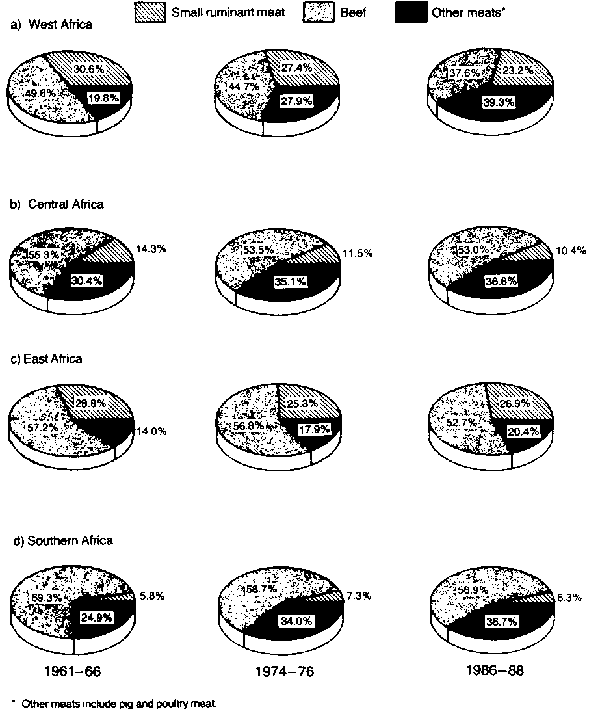
Given the previous picture of small ruminant meat consumption in SSA, there is a need to determine its importance in overall meat consumption. Figure 5, which is teased on 1961/65,1974/76 and 1986/88 average annual estimates of per caput consumption of the four major types of meat consumed in SSA i.e. beef, small ruminant, poultry and pig meat, gives an idea of the composition and evolution of meat consumption in SSA.
Beef is the dominant meat consumed in SSA, its share in meat consumption in 1986/88 ranging from as high as 57% in southern Africa to as low as 38% in West Africa. However, beef consumption seems to be declining in most regions of SSA, particularly in West Africa where its share in overall meat consumption fell from about 50% in 1961/65 to 38% in 1986/88.
Table 5. Total and per caput small ruminant meat consumption¹ in SSA, 1986/88.
|
|
Total consumption |
Per caput consumption |
||||
|
Sheep meat |
Goat meat |
SR meat² |
Sheep meat |
Goat meat |
SR meat² |
|
|
('000 t) |
(kg/pers ) |
|||||
|
West Africa |
136 |
241 |
378 |
0.73 |
1.30 |
2.03 |
|
Central Africa |
18 |
30 |
49 |
0.26 |
0.44 |
0.70 |
|
East Africa |
263 |
201 |
440 |
1.91 |
1.46 |
3.29 |
|
Southern Africa |
13 |
26 |
39 |
0.33 |
0.71 |
1.04 |
|
SSA |
430 |
498 |
906 |
1.00 |
1.16 |
2.13 |
1. Meat consumption is defined as meat from sheep and goats slaughtered within national boundaries irrespective of their origin minus net exports of sheep and goat meat. As goat trade figures are not available no such adjustment was made for goat meat consumption.
2. Totals do not add up to the sum of sheep and goat meat consumption due to deduction of net exports of live sheep and goats (carcass weight). FAO trade figures are not provided separately for sheep and goats.
Source: Own computations based on FAO (1989 and 1988).
Table 6. Annual growth rates ¹ of total and per caput small ruminant meat consumption in SSA between 1961/65 and 1986/88.
|
|
Total SR meat consumption |
Per caput SR meat consumption |
||||
|
1961 /65-1974/76 |
1974/76-1986/88 |
1961 /65-1986/88 |
1961 /65-1974/76 |
1974/76-1986/88 |
1961 /65-1986/88 |
|
|
West Africa |
0.86 |
3.18 |
2.01 |
-1.98 |
-0.01 |
-1.00 |
|
Central Africa |
2.63 |
2.75 |
2.69 |
0.33 |
-0.31 |
0.01 |
|
East Africa |
0.68 |
2.45 |
1.56 |
-2.07 |
-0.39 |
-1.23 |
|
Southern Africa |
4.41 |
1.62 |
3.00 |
1.97 |
1.43 |
0.26 |
|
SSA |
1.00 |
2.72 |
1.86 |
-1.68 |
-0.26 |
-0.98 |
1. Growth rates are per cent annual growth rates calculated on the basis of 1961/65, 1974/76 and 1986/88 annual average total and per caput SR meat consumption levels.
Source: Table 5 and own computations.
Figure 5. Structure of meat consumption in SSA by region, 1961/65, 1974/76 and 1 985/87.
* Other meats include pig and poultry meat.
Source: Adapted from FAO data (FAO 1988 and 1889).
In 1961/65, small ruminant meat accounted for between 6% and 31% of total meat consumption in the four regions. In recent years, poultry and pig meat have come to account for a significant and increasing portion of meat consumption, especially in West and southern Africa. The reasons behind these consumption patterns and trends are not very clear.
This report has looked at aggregate patterns and trends in production, and trade in and consumption of small ruminant meat in SSA between 1961 and 1988. The evidence presented shows that small ruminant meat production and consumption are greatest in East and West Africa, and are of only minor importance in central and southern Africa.
Observed regional trends indicate that domestic production of small ruminant meat has failed to keep pace with demand, especially in southern Africa. Over the past decade, southern Africa's meat production performance has been particularly poor, calculated growth rates for beef, pig and small ruminant meat production in this region between 1974/76 and 1986/88 averaging -0.81,1.96 and 0.65% p.a., respectively. Only poultry meat production growth (4.14% p.a.) exceeded the region's human population growth rate of 2.89% p.a. Thus per caput production and consumption of small ruminant meat appear to be declining in most regions of SSA.
This situation is largely the result of production, environmental and socioeconomic constraints bearing upon a traditional production system which has been accorded a low priority in livestock and agricultural development plans in SSA. Almost all small ruminant meat comes from traditional production systems.
In some areas of SSA, regular offtake of sheep/goats appears to have been excessive in relation to such parameters as the size, structure, growth and productivity of flocks. In other areas, however, there appears to be room for increasing small stock offtake All this emphasises the need for viewing the means by which sustained small ruminant production and consumption in SSA are to be achieved in the wider context of the varying and changing environmental and socio-economic conditions prevailing in the sub-continent.
Addis Anteneh, Sandford S and Berhanu Anteneh. 19&8. Policy, finance and technology in livestock development in sub-Saharan Africa: Some critical issues. ILCA Bulletin 31:2-13. ILCA (International Livestock Centre for Africa), Addis Ababa, Ethiopia.
CRED (Center for Research on Economic Development). 1980. Livestock and meat marketing in West Africa. Volume III. CRED, The University of Michigan, Ann Arbor, Michigan, USA.
FAO (Food and Agriculture Organization of the United Nations) 1988. FAO agricultural trade yearbook standard tape. 1988. FAO, Rome, Italy.
FAO (Food and Agriculture Organization of the United Nations). 1989. FAO agricultural production yearbook standard tape 1989. FAO, Rome, Italy.
ILCA (International Livestock Centre for Africa) 1980. Economic trends: Small ruminants. ILCA Bulletin 7. ILCA, Addis Ababa, Ethiopia.
MLC (Meat and Livestock Commission).1990. Meat demand trends 90/1. MLC, Economic Information services, Milton Keynes, UK.
Nestel P. 1986. A society in transition: Developmental and seasonal influences on the nutrition of Maasai women and children. UN Food and Nutrition Bulletin 8(1), March 1986.
Onim J F. Mathuva M, Otieno K and Fitzhugh H A. 1986. Forage resources for small ruminants in humid zones of Africa. In: Adeniji K O and Kategile J A (eds), Proceedings of the Workshop on the Improvement of Small Ruminants in Eastern and Southern Africa, Nairobi, Kenya, 18-22 August 1986. OAU/IDRC (Organization of African Unity/International Development Research Centre), Nairobi, Kenya. pp. 145-155.
Reutlinger S. 1980. The prevalence of calorie deficient diets in developing countries. World Bank Staff Working Paper 374. Washington, DC, USA.
Schluter M. 1984. Constraints on Kenya's food and beverage exports. IFPRI Research Report 44 (April 1984). IFPRI (International Food Policy Research Institute), Washington, DC, USA.
Zimbabwe Government Agricultural Marketing Authority. 1987. Economic review of the agricultural industry in Zimbabwe 1986. Agricultural Marketing Authority, Harare, Zimbabwe.