Abstract
Résumé
Introduction
Materials and methods
Results
Discussion
Conclusion
Acknowledgements
References
L.R. Ndlovu
Department of Animal Science
University of Zimbabwe, P O Box M.P. 167
Mount Pleasant, Harare, Zimbabwe
A study was conducted to define kidding intervals and identify causes for long kidding intervals in communal area flocks. Two flocks were selected in the north-eastern part of Zimbabwe and were monitored over two years. Flock entries and exits were recorded, body-mass changes measured fortnightly and blood samples collected in five consecutive weekly intervals in August-September 1988 and March-April 1989. The average kidding interval for does that kidded in August-December (382 ± 90 days) was longer (P<0.01) than that for does that kidded in March-April (265 ± 48 days). The overall average kidding interval was 370 ± 122 days. Serum progesterone levels also indicated that of the 26 goats that kidded in October-December 1988, 65% were non-pregnant 5-6 months after kidding. It is suggested that nutritional stress could be the cause of these long kidding intervals.
Cette étude effectuée sur les troupeaux caprins des zones communales visait à déterminer l'intervalle entre parturitions et à identifier les facteurs à l'origine de l'accroissement de ce paramètre. A cet effet, deux troupeaux caprins ont été sélectionnés et suivis pendant deux ans dans le nord-est du Zimbabwe. Les entrées et les sorties d'animaux ont été régulièrement enregistrées et les variations de leur poids vif déterminées tous les 15 fours. Par ailleurs, des échantillons de sang ont été prélevés une fois par semaine pendant cinq semaines en août-septembre 1988 et en mars-avril 1989 en vue de la détermination du taux de progestérone L'intervalle moyen entre parturitions des chèvres ayant mis bas entre août et décembre (382 ± 90 jours) est significativement plus élevé (P<0,01) que celui enregistré pour les chèvres ayant mis bas entre mars et avril (265 ± 48 jours). Sur la population totale, l'IMB est de 370±122 jours. Par ailleurs, le taux de progestérone indiquait que 65% des 26 femelles qui avaient mis bas au cours de la période considérée n'étaient toujours pas en gestation 5-6 mois après. Ces longs intervalles entre parturitions étaient peut-être dus au stress nutritionnel.
There are about 1.8 million goats in Zimbabwe, comprising about 28% Of the total livestock population (Central Statistics Office, 1987). Over 98% Of the goats are owned by subsistence farmers found mainly in Natural Regions 4-5 which are characterised by low and erratic rainfall.
The indigenous goat has been found to be prolific (Sibanda, 1988, unpublished) but there is a lot of reproductive wastage due to kid mortalities and long kidding intervals (Ndlovu and Royer, 1988, unpublished). Although most of the reported kidding intervals of the Zimbabwean Small East African goat seem to range from 213 to 270 days (Hale, 1986; Royer, 1988, unpublished) there are indications of longer kidding intervals (Hale, 1987). These long kidding intervals could be due to one or a combination of several causes, including acyclicity of does, early embryonic losses of foetuses, abortions that are not noted by enumerators, and shortage of bucks in communal area herds.
In order to suggest intervention strategies, it is necessary to better define the kidding interval and identify which of the putative causes of long kidding intervals are involved. This experiment was carried out in order to monitor the cyclicity of does in two communal flocks and to determine kidding intervals specific to these flocks.
Location
The flocks monitored were kept at Tsengerai Communal Lands in Nyanga North in the north-eastern part of Zimbabwe. The area lies within Natural Region 5 and is bordered by hills which provide a discrete limit to the area.
The main rains fell between December and February and totalled 663 mm and 547 mm for the 1987/88 and 1988/89 seasons, respectively. The temperature ranged from 9 to 35°C with October, November, December and January being the hottest months whilst April, May and June were the coldest. The relative humidity was lowest in September (23%) and highest in December and January (87%).
Flocks
Farmers were persuaded to amalgamate their flocks into a larger unit; in return they were offered large-size bucks from a local research station. Amalgamation also served as a labour-reducing incentive as the farmers took turns in herding the flocks. Two amalgamated flocks were created which were managed and housed identically and in juxtaposition. In one flock (Yellow), the does were mated to bucks bought by the project from Matopos Research Station whilst in the other (Blue) the does were mated to local bucks. All goats were ear-tagged using plastic ear tags appropriately coloured for each flock. Ownership still lay with each individual farmer who was free to sell, slaughter or dispose of the animals in any way desired and at any time.
Measurements
The rainfall, humidity and temperature in the area were monitored. The animals in the flocks were weighed fortnightly and births, deaths, sales and purchases were noted by project-employed enumerators.
In August-September 1988 and March-April 1989, blood samples were collected for five consecutive weeks from all adult females (15 kg or more), for determination of serum progesterone level.
Flock structure
On average, the flocks consisted of 52.2% adult females, 3.1 % entire males and 39.7% kids of both sexes (Table 1). In the Yellow flock only two adult entire males were allowed though this was not always possible to enforce as farmers did not want to castrate progeny from the larger Matopos bucks.
Kiddings
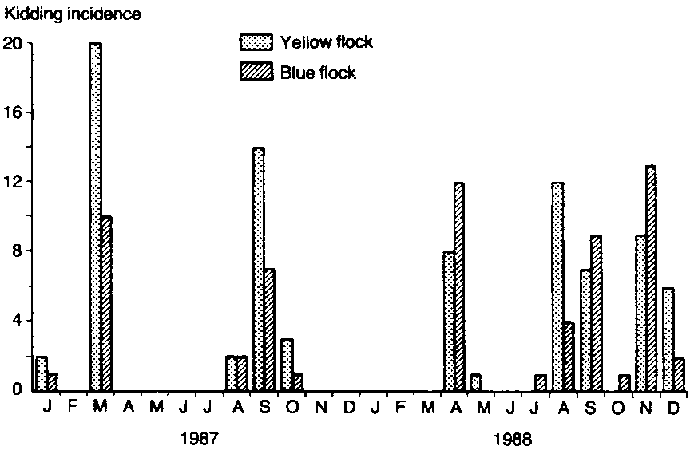
The kidding pattern showed two distinct peaks in March-April and August-December (Figure 1) which, between them, accounted for over 75% of the kiddings. The March-April peak is quite sharp and compact whilst the
August-December one is more diffuse and broad. Of the total births, about 30% were twins and 70% were singles (Table 2).
Table 1. Monitored flock size during 1987 and 1988.
|
|
1987 |
|||
|
Yellow |
Blue |
Yellow |
Blue |
|
|
Females |
69 |
42 |
57 |
37 |
|
Males |
2 |
2 |
2 |
2 |
|
Castrates |
1 |
14 |
4 |
5 |
|
Female kids |
3 |
23 |
16 |
29 |
|
Male kids |
19 |
20 |
10 |
5 |
|
|
1988 |
|||
|
Females |
42 |
35 |
58 |
40 |
|
Males |
4 |
2 |
4 |
3 |
|
Castrates |
2 |
2 |
4 |
3 |
|
Female kids |
13 |
25 |
18 |
15 |
|
Male kids |
10 |
3 |
16 |
15 |
Figure 1. Monthly kidding incidences in the monitored flocks, 1987-1988.
Table 2. Litter size in 1987 and 1988 in the monitored flocks.
|
|
Flock |
|||
|
Yellow |
Blue |
|||
|
1987 |
1988 |
1987 |
1988 |
|
|
Singles |
29 |
30 |
19 |
28 |
|
Twins |
12 |
13 |
2 |
14 |
|
Total kiddings |
41 |
43 |
21 |
42 |
|
% twinning |
29.3 |
30.2 |
9.5 |
33.3 |
Doe cyclicity in the flocks
Of the females that completed the August/September 1988 sampling period, 64% were pregnant, 20% were acyclical and 16% were cycling (Table 3). This depicts over a third of the frock as being non-pregnant. Of the 13 acyclic animals, eight had kidded in August prior to sampling. In the follow-up sampling period (March/April, 1989), of the 26 does that had kidded in October-December 1988 and were still in the flock, about 54% were acyclical and a total of 65.4% of the does were not pregnant five months after kidding (Table 4).
Table 3. Incidences of pregnancy and non-pregnancy in the monitored flocks as at August/September 1988¹.
|
Flock |
Non-pregnant |
||
|
Pregnant |
Acyclic |
Cycling |
|
|
Yellow |
24 |
4 |
5 |
|
Blue |
19 |
9 |
6 |
|
Total |
43 |
13 |
11 |
1. Total adult females (15 kg or more) were 61 and 43 for Yellow and Blue herds, respectively. Those unaccounted for above were either sold, withdrawn or slaughtered before the sampling period was completed.
Table 4. Incidences of pregnancy and non-pregnancy in does that kidded during October-December 1988 as at March- April 1989.
|
Flock |
Non-pregnant |
||
|
Pregnant |
Acyclical |
Cycling |
|
|
Yellow |
6 |
6 |
3 |
|
Blue |
3 |
8 |
0 |
|
Total |
9 |
14 |
3 |
Kidding intervals
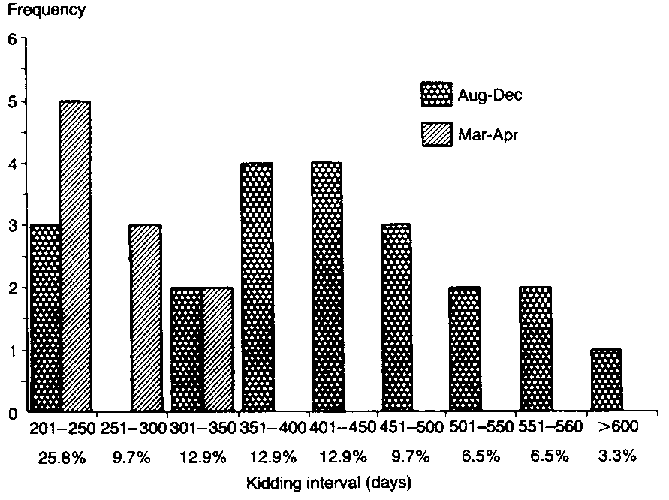
About 26% of the animals had kidding intervals of less than or equal to 250 days and about 35% had kidding intervals of less than or equal to 300 days (Figure 2). The majority (39%) had kidding intervals between 301 and 450 days. The data are based on 31 females that kidded at least twice during the study period. The mean kidding interval was 370 ± 122 days. However, if season of kidding is taken into consideration, the average kidding interval for does kidding in March-April was 265 ± 48 days whilst that for does kidding in August-December was 382 ± 90 days. Seasonal differences were significant (P<0.01).
Figure 2. Frequency of kidding intervals in monitored flocks (31 does that kidded twice).
Body-mass Changes
Does that kidded in March-April had slightly increased (mean 5% ± 3.37) in body mass from kidding to weaning (24 weeks post-kidding) while does that kidded in August-December had slight losses (mean 4% ± 1.74) in body mass over the same period. The regression of body-mass change at 24 weeks post-kidding on kidding interval was significant (P<0.01) and the resultant regression equation was:
Kidding interval = 395-7.29 percentage body-mass change at 24 weeks post-kidding.
The erratic rainfall pattern noted over the two-year study period is typical of Natural Region 5 areas in Zimbabwe. This has dire implications for cropping, especially the lack of rainfall in January 1988 which is a crucial month for maize production. It also has adverse implications for feed availability to goats and might account for the conspicuous shift of the kidding peak from August-September to November-December in 1988.
The flock composition would suggest that even though the buck: female ratio is low, shortage of bucks is unlikely to be a major cause of long kidding intervals as kidding was spread over two seasons.
The twinning rates observed here are lower than those reported by Sibanda (1988) using research station data but agree with those reported by Hale (1986) and Ndlovu and Royer (1988, unpublished) based on communal area data. It would appear that nutritional stress limits the number of foetuses that the animals in communal areas can carry to term.
The percentage of acyclical does five months after kidding reflects the long kidding intervals obtained. The kidding interval of 370 days is about 100 days more than that reported by Royer (1988, unpublished) working on the Small East African goats in Bikita District, south-east of Zimbabwe. It also differs greatly from the figure of 243 days reported by Hale (1987). It should be noted though, that a deliberate effort was made to exclude all observations that showed kidding intervals of over 300 days in the data reported by Hale (1987). The diverse kidding intervals shown in Figure 2 are typical of unselected populations but could also be due to the fact that the does were of different age groups.
Assuming that the data reported by Hale (1986, 1987) and Royer (1988, unpublished) represent the genetic potential of Zimbabwean Small East African goats, it would appear that there is some environmental factor that is suppressing the full expression of this potential in Tsengerai flocks. Animals kidding in August/September kid at a time when feed resources are at their lowest and lactate for about two months under such conditions. Thus nutritional stress appears to be a prime probable cause of acyclicity and long kidding intervals in these animals.
Body-mass changes support this hypothesis. Animals kidding in March-April on average had lower body-mass losses compared to those kidding in August-December. The large standard errors associated with the means are due to the fact that the flock was unselected and the data were not corrected for age of the doe. Doe age would affect the doe's susceptibility to stress. Nevertheless, the regression equation indicates that one percentage unit loss in bodyweight at 24 weeks post-kidding increases the kidding interval by about seven days. Body-mass changes at 24 weeks post-kidding are important as does should be mated at this stage if they are to conceive within 365 days. Body condition at mating has been shown to influence conception (Henniawati and Fletcher, 1986).
The monitored flocks showed long kidding intervals which were mostly due to extended periods of acyclicity which seemed to be due to kidding during periods of greatest nutritional stress. Follow-up studies will investigate the possible role of strategic nutritional interventions in reducing kidding intervals.
The author would like to express gratitude to the International Atomic Energy Agency (IAEA), Vienna and the International Development Research Centre(IDRC) for their financial support.
Technical assistance from Dr A.C. Llewelyn and the technical staff of the Department of Animal Science, University of Zimbabwe, is greatly appreciated.
Central Statistics Office. 1987. Statistical yearbook. Government of Zimbabwe Printers. Hale D H. 1986. Systems of production and productivity of goats in three communal areas of Zimbabwe. In: Adeniji K 0 and Kategile J A (eds), Proceedings of the Workshop on the Improvement of Small Ruminants in Eastern and Southern Africa, Nairobi, Kenya, 18-22 August 1986. OAU (Organization of African Unity), Nairobi, Kenya. pp. 181-193.
Hale D H. 1987. Sheep and goat production in Zimbabwe. A Technical Report submitted to IDRC.
Henniawati H and Fletcher I C. 1986. Reproduction in Indonesian sheep and goats at two levels of nutrition. Animal Reproduction Science 12:77-84.