Abstract
Résumé
Introduction
Epidemiology
Parasitological findings
Discussion
Control strategy in the semi-arid zone
Control strategy in the humid zone
Bibliography
S. Tembely1, T. J. Galvin2, B. Kouyate1, S.B. Ba3, K. Bengaly3 and W. Berckmoes4
1Laboratoire Central Vétérinaire, B. P. 2295, Bamako, Mali
2 United States Department of Agriculture (USDA)
3 Volet Recherche, Projet Sectoriel de l'Elevage
4 Département de la Recherche sur les Systèmes de Productions Rurales, Kikasso, Mali
An investigation of helminth parasites in sheep and goats was carried out in severe/abattoirs in various regions of Mali between 1983 and 1985.
Faecal and visceral examinations from 284 sheep and 318 goats indicated a marked variation in the level of parasitism in livestock raised in different geographic areas. Both sheep and goats were found to be infested with identical nematode species, however, with different levels of infestation. The more common nematodes in sheep were, in order of predominance: Trichostrongylus colubriformis, Haemonchus contortus, Strongyloides papillosus, Oesophagostonum columbianum, Gaigeria pectinata, C. punctata, C. curticel, and Trichuris ovis. Four trematodes (Fasciola gigantica, Dicrocoelium nospes, Paramphistomum spp and Carmyerius spp), one larval (Cysticercus tenuicollis) and three adult cestodes (Monezia, Stilesia, and Avitellina) were identified.
The following nematodes were found in goats in order of predominance: T. colubriformis, S. ovis, H. contortus, G. pachyscelis, S. papillosus, O. colombianum, T. axed, C. pectinata, and C. punctata. Trematodes and cestodes identified were the same as those in sheep.
Variation in geographic distribution and prevalence were noted in relation to the season and management practices.
Since 1987 effotts are being made in two ecological zones to assess the impact of mass anthelminthic treatment on production parameters such as weight and mortality.
De 1983 à 1985, le parasitisme à helminthes des petits ruminants a été étudié dans les abattoirs de plusieurs régions du Mali. L'examen des fécès et des viscères de 284 moutons et 318 chèvres a montré la variation du niveau d'infestation parasitaire des animaux élevés dans les différentes régions du pays. Les deux espèces sont infestées par les mêmes parasites, mais à des degrés différents. Les nématodes des ovins prédominants sont dans l'ordre d'importance: Trichostrongylus colubriformis, Haemonchus contortus, Strongyloides papillosus, Oesophagostonum columbianum , Gaigeria pectinata, C. punctata, C. curticei, and Trichuris ovis. 4 trématodes (Fasciola gigantica, Dicrocoelium nospes, Paramphistomum spp et Carmyerius spp); Un cestode larvaire (Cysticercus tenuicollis) et trois cestodes adultes (Monezia, Stilesia et Avitellina).
Les nématodes des caprins sont dans l'ordre d'importance: T. colubriformis, S. ovis, H. contortus, G. pachyscelis, S. papillosus, O. colombianum, T. axei, C. pectinata et C. punctata.
Les caprins sont parasités par les mêmes trématodes et cestodes que les ovins.
Des variations de répartition géographique et de prévalence furent notées en liaison avec la saison et les pratiques de gestion.
Depuis 1987, l'impact de traitements anthelminthiques à grande échelle sur le poids et la mortalité a été évalué dans deux zones écologiques.
Sheep and goats, although representing an important source of animal protein in semi-arid countries such as Mali, seem to have benefited little from veterinary care and production improvement. Goats are often the main supply of daily meat in rural areas. Sheep, on the other hand, are used in ceremonial festivities throughout the country, providing important trade (mainly male sheep) between rural and urban areas. Together, sheep and goats provide a large portion of the meat consumed and produce a considerable amount of manure, which is of special importance in those areas where cattle are of lesser importance. Different breeds have been adapted to different environments. Long-legged sheep and goats are found in the Sahelian regions, and the dwarf breed are found in the Sudanese region of Mali. Although adapted to local climatic and nutritional conditions, economic production of small ruminants is hampered by infectious and parasitic diseases coupled with inadequate management as mentioned by Nawathe et al (1985).
Materials and methods
Sites of collection
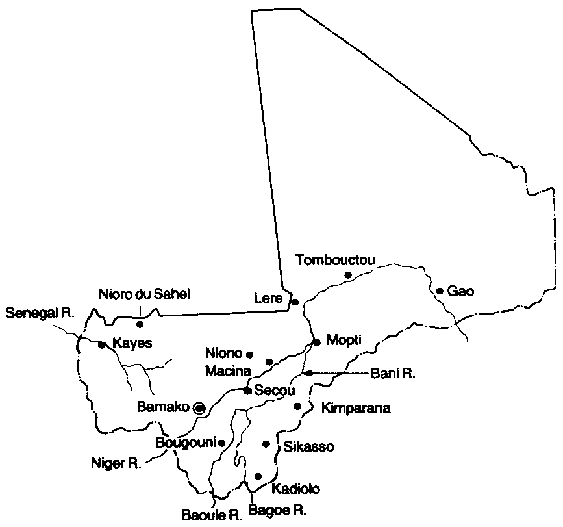
In order to obtain adequate numbers of samples from the animals, all collections were made at abattoirs. To obtain data on seasonal variations in parasite populations and biology, attempts were made to make a minimum of four collections at most sites. Points of collection are shown in Figure 1.
Selection of the abattoirs was based on the number of individual animals slaughtered daily and the probability of obtaining native animals from the various ecological regions of Mali.
Climatic data
Monthly temperature and rainfall data were obtained from the National Agroclimatological Office at Bamako.
Nematodes
Sahelian sheep
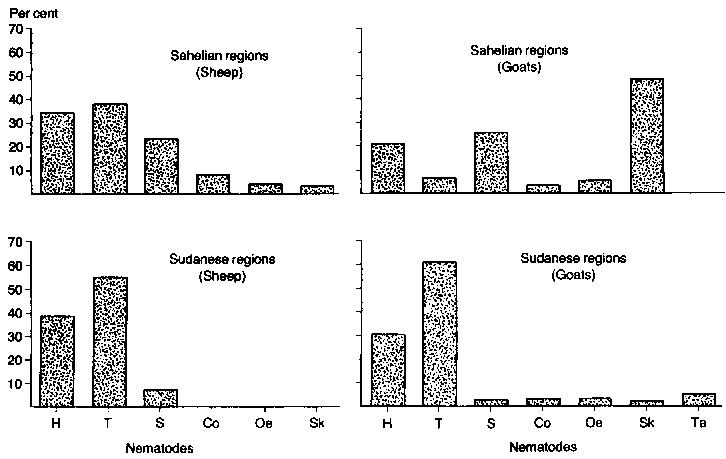
The following parasites species were recorded from Sahelian sheep in order of predominance: Trichostrongylus colubriformis, Haemonchus contortus Strongyloides papillosus, Cooperia curticei, Oesophagostomum columbianum, Skrjabinema ovis and Trichuris ovis.
Figure 1. Mao of Mali showing major rivers and collection sites.
Sudanese dwarf sheep
The results obtained from this survey may not reflect the overall field situation due to a limited sample size from the abattoirs visited.
Sahelian goats
Based on post-mortem examination, the following nematodes were identified in long-legged Sahelian goats in order of predominance: Skrjabinema ovis, S. papillosus, H. contortus, T. colubriformis, O. columbianum and Cooperia curticei.
Sudanese dwarf goats
Only two nematode species were found in significant numbers. These were T. colubriformis and H. contortus. Prevalence figures are given in Table 1. There was a relatively high prevalence of G. pachyscelis infection (27 %) observed in these goats.
Table 1. Prevalence of trematode parasites of sheep and goats in Mali (%).
|
|
Sheep |
Goats |
||
|
Sahelian |
Sudanese |
Sahelian |
Sudanese |
|
|
Fasciola gigantica |
20 |
0 |
7 |
0 |
|
Dicrolelium hospes |
0 |
18 |
0 |
44 |
|
Paramphistomes |
35 |
18 |
34 |
0 |
|
Schistosoma sp |
1 |
0 |
3 |
0 |
|
Cysticercus tenuicollis |
19 |
42 |
42 |
46 |
Trematodes
Sahelian sheep
Fasciola gigantica and paramphistomidae infections occurred with a prevalence of 20% and 35%, respectively. Only one sheep was found to be infected with Schistosoma spp. No Dicrocoelium was found during the course of the investigation.
Sudanese dwarf sheep
Not a single F. gigantica was found to infect the local dwarf sheep in the southern part of the country. However, 18% of the animals were infected with both D. hospes and paramphistomes. Due to a limited sample size, the results of this investigation concerning the dwarf sheep may not reflect the overall field situation.
Sahelian goats
Trematodes were found with the following frequency: Paramphistomum spp (34%), F. gigantica (7%) and Schistosoma spp (3%).
Sudanese dwarf goats
No Fasciola was recovered in these goats in the course of this investigation. On the other hand, 44% of the animals examined were infected with Dicrocoelium hospes.
Cestodes
The only larval cestode reported in this study is Cysticercus tenuicollis. Postmortem examination showed the following prevalence: Sahelian sheep (19%), Sahelian goats (42%) and Sudanese dwarf sheep (42%) and Sudanese dwarf goats (46%).
In the traditional management of animals in Mali, sheep and goats are grazed together. This parasitogical survey has shown that they also share the same parasite species bun with different levels of infection. Studies conducted in Australia also showed that sheep and goats were infected with the same species of worms when grazed together (Malins, 1971). However, conflicting results have been reported elsewhere in Africa (McCulloch et al, 1968) and in Europe (Le Riche et al, 1973) with different types of management. One explanation for the difference in worm burdens and composition in sheep and goats is that the latter they are browsers as well as grazers and, if feeding on scrub high enough, they could avoid most of the infective trichostrongyle larvae.
Nematodes
Haemonchus contortus
Heavy infections coincided with the rainy season, then progressively declined during the dry season. Immature stages (most of which were at an early stage of development) were recorded during the dry season and, thus, probably contributed to the increase of the adult populations during the rainy season. These findings suggest that most of the larvae had undergone inhibition of development during the drier period of the year. The phenomenon, as described in cattle, is commonly known to occur in sheep in temperate regions (Donald et al, 1964; Dinneen et al, 1965; Michael 1974) and recently recognised in tropical Africa. Studies done in Senegal (Vercruysse, 1985, have shown that larvae ingested between October and December were inhibition-prone, the adult populations resulting from the burden acquired during the previous August. Furthermore, the study showed that from January onwards, as the hypobiotic larvae started to mature, these new adults gradually replaced the older population and seeded the pasture with eggs. Therefore, the author concluded that starting in June-July-August, a new population of adult worms developed.
In Mali, the peak of immature Haemonchus was observed in March among the Sahelian sheep and represented 91% of the rainy season. This decrease coincided with a sharp increase of the adult population suggesting the maturation of the immature worms. Additional data are required from the dwarf sheep in the Sudanese region to ascertain the survival mechanisms of the parasite.
Trichostrongylus colubriformis
Although the genus Trichostrongylus is considered to occur primarily in temperate regions and not thought to thrive during the warm rainy season (Grant, 1981), results from this study indicate that this species may be of economic importance in sheep in Mali because it is one of the most prevalent species both in the Sudanese and in the Sahelian regions. In the Sahelian sheep, T. colubrifirmis was found to be the most abundant nematode species with the highest mean intensity.
Galgeria pachyscells
Since the first report on the occurrence of the hookworm Gaigeria pachyscelis in sheep and goats in South Africa (Orlepp, 1935), a wide distribution of the parasite has been reported in tropical Africa. Graber (1965) recognised this parasite among native sheep of Senegal. Assoku (1981) in Ghana found only 1 % of the sheep infected with this hookworm. The present survey indicates a higher prevalence in the southern regions with 27 % and 15 % of sheep and goats being infected, respectively. On the other hand, the Sahelian counterparts had a much lower prevalence (7% for sheep and 2% for goats). These findings suggest that the parasite thrives in a region with higher rainfall. However, research is needed to ascertain the importance of the epidemiology of this parasite in Mali.
Oesophagostomum columblanum
Results from earlier workers indicated that up to 66% in sheep of Chad were infected with O. columbianum and there was a wide distribution among the Senegalese sheep (Vassiliades, 1981). In Mali, it appears from this study that nodular form of the infection is of greater economic importance with a prevalence rate of 25 to 4096. The presence of nodules on viscera is of prime importance for the rural population because the infected intestines are subject to condemnation during meat inspection and are therefore lost for use as sausage casings.
Cooperia spp
These species occurred more commonly in cattle than in sheep and goats (less than 5% of the small ruminants were infected with the genus). The following species were identified: Cooperia pectinata, Cooperia punctata and C. cuniceci.
Trematodes
As indicated by gross liver and microscopic examinations for the presence of adult worms and eggs, 20% of the Sahelian sheep were infected with Fasciola gigantica, whereas only 7 % of the goats in the Sahelian regions were infected with the same parasites. The difference in the level of infection and prevalence is probably due to difference in resistance to infection and grazing habits of the host species.
Only 3% of the sheep examined were found to be infected with Schistosoma bovis in the Sahelian region. Further investigation is needed to assess the pathology of schistosomes in small ruminants because of increasing reports of damage that the parasite might cause in sheep (Vercruysse, 1985).
Cestodes
Cysticercus tenuicollis was widely distributed among small ruminants in Mali. However, this parasite is known to be of low pathogenicity (Dunn, 1978). Other species, such as Moniezia, Avitellina and Stilesia were also commonly associated with sheep and goats.
Materials and methods
The experiment was carried out in the Djoni village located in the Bamako country, 150 km north-east of Bamako with an average annual rainfall ranging from 500 - 600 mm.
One hundred and fifty goats and 70 sheep aged from birth to 24 months were grouped at random into different age categories prior to anthelminthic treatment. Animals comprised exclusively Djallonke sheep and dwarf goats.
Both animal breeds were owned by small individual households. They are kept around the villages during the rainy season and allowed to graze freely away from the villages without herding during the dry season.
Prior to anthelminthic treatment, animals were divided into five diferent treatment groups and all were immunised against pasteurellosis, anthrax, black leg and peste des petite ruminants (PPR). The anthelminthic treatments were as follows:
No treatment (control group)T1 - received TBZ 66 mg/kg of liveweight
T2 - fenbendazole 5 mg/kg
T3 -morantel tartrate 7.5 mg/kg
T4 - levamisole 12 mg/kgTreatment was done in July and September 1988.
Each month, faeces were obtained from the rectum and submitted to a quantitative parasitological examination using the McMaster modified method.
Liveweights were recorded every two months and the average daily weight gain was determined.
The effects of treatment on weight gain were analysed using the General Linear Model (SAS).
Results and discussion
The following strongyle eggs reduction rates were observed following the prime anthelminthic treatment.
Fenbendazole: 100% in sheep; 93 to 100% in goats;
Morantel tartrate: 98 to 99% in sheep; 90 to 99% in goats;
Levamisole: 98 to 100% in sheep and 85 to 87% in goats;
TBZ: 89% in sheep and 78% in goats.
Fifty sheep out of 70 from the starting of the experiment were analysed for live weight changes. There was no significant difference (P>0.05) between the treated and the control group. One hundred and fourteen goats out of the 150 at the beginning of the experiment were analysed for the same purpose.
When the two animal species were combined for statistical analysis a difference of 6 to 7 kg appeared. Since the standard deviations were very high the differences may not be conclusive (Table 2).
Table 2. Weight-change analysis on sheep and goats combined.
|
|
General Linear Models Procedure |
||
|
N |
Mean |
SD |
|
|
Bolumisol |
27 |
5.1109393 |
11.6966865 |
|
Exhelm |
36 |
12.1871206 |
26.81456227 |
|
Panacur |
38 |
11.8638104 |
17.9935661 |
|
Pas de traitem |
31 |
5.1871548 |
22.9355640 |
|
Thybenzol |
38 |
10.8740727 |
29.4437642 |
Material and methods
The experiment was carried out at Fonsebougou, 56 km north of Sikasso in the southern part of Mali.
Eight flocks of sheep owned by villagers were identified by ear tags and randomly divided into three groups of treatment according to their weight:
Group 1 - Fenbendazole 10 mg/kg liveweight
Group 2 - Morantel tartrate 7.5 mg/kg liveweight
Group 3- Control
Treatments were given in May, July, September and November 1989.
These groups were subdivided into three age categories: 6 12 months old; 12-18 month old and over 18 months.
Parasitological examination: A quantitative evaluation of strongyle eggs was performed using the modified McMaster method.
Liveweight changes: to determine any change that has occurred in liveweight, sheep were individually weighted every two months.
No mortality was recorded.
Results and discussion
Our findings demonstrated that lambs were more heavily infected by trichostrongyles because they were more susceptible. The maximum egg count was observed between August and October with a peak in September. However, ewes remained infected all year-round thus serving as the source of contamination for the lambs.
No significant change was noted on liveweight between the treated groups and the control in adult sheep (ewes and rams). No statistical analysis could be done of weight data lambs because of the low number of observations by the end of the experiment.
Assoku K G.1981. Studies of parasitic helminths of sheep and goats in Ghana. Bulletin of Animal Health and Production in Africa 29:1 -10.
Dinneen J K et al. 1965. The dynamics of the host-parasite relationship. III The response of sheep to primary infection with Haemonchus contortus. Parasitology 55:515-525.
Donald et al. 1964. The dynamics of the host-parasite relationship. I. Nematodirus spathiger infection in sheep. Parasitology 54:527-544.
Dunn AM. 1978. Veterinary helminthology. 2nd edition. William Heineman Medical Books Ltd. London, UK. pp. 323.
Graber M. 1965. Helminthes et helminthiases faisant obstacle a l'amélioration de la production ovine en République du Tchad, IEMVT (Institut d'élevage et de médecine vétérinaire des pays tropicaux), Fort Lamy Tchad, Laboratoire de Farcha. République du Tchad. 162 pp.
Grant J L. 1981. The epidemiology of nematode parasites of sheep in a high rainfall area of Zimbabwe. Journal of the South African Veterinary Association 52:33 37.
Le Riche P D et al. 1973. A helminth survey of sheep and goats in Cyprus, Part I. Age distribution and the severity of infection with gastro-intestinal parasites. Journal of Helminthology 47:251-262.
Malins F. 1971. Angoras in a Merino world. Journal of the Victoria Department of Agriculture 69:180-188.
McCulloch B et al. 1968. The incidence of gastrointestinal nematodes of sheep and goats in Sukumaland, Tanzania. The British Veterinary Journal 124(5):177-194.
Michel J F. 1974. Arrested development of nematodes and some related phenomena. Advances in Parasitology 12:279-366.
Nawathe D R. Sohael A S and Umo I. 1985. Health management of a dairy herd on the Jos Plateau (Nigeria). Bulletin of Animal Health and Production in Africa 33: 199-205.
Orlepp R J. 1935. Observation on the morphology and life history of Gaigeria pachyscelis, Railliet and Henry, 1910. Southern African Journal of Science 33:875-876.
Vassiliades G. 1981. Parasitisme gastro-intestinal chez le mouton du Sénégal. Revue d'Elevage et de Médecine Vétérinaire des Pays Tropicaux 34: 169-177.
Vercruysse J. 1985. The seasonal prevalence of inhibited development of Haemonchus contortus in sheep in Senegal. Veterinary Parasitology 17:159-163.